Pandora is changing how it sells, markets and makes its jewellery as the global brand enters a new phase of growth, including in Canada, where its footprint has expanded considerably over the past several years.
The Copenhagen-based company now operates 96 stores across Canada and describes the country as one of its fastest-growing markets. Canadian revenue has increased by more than 50 per cent since 2019 and surpassed DKK 1 billion in 2025, giving Pandora a substantially larger base from which to introduce changes to its merchandise, store experience and promotional strategy.
The shift comes as Pandora works through what CEO Berta de Pablos-Barbier has described as a deliberate year of change. The company reported global like-for-like sales growth of one per cent in the second quarter of 2026 and organic growth of three per cent, with newer designs and continued network expansion helping offset pressure in some established markets.
Pandora is simultaneously reducing its reliance on promotions, investing in its physical stores and broadening the materials and jewellery categories associated with the brand. One of the biggest changes involves platinum-plated jewellery, which the company is developing as an alternative to some of the sterling silver merchandise that has long been central to Pandora.
Pandora Pulls Back on Promotions
Pandora has been deliberately reducing promotional activity as part of an effort to strengthen its positioning and become less dependent on discount-driven sales. De Pablos-Barbier told analysts that the company is substantially reducing promotions and heavy discounting in its core markets, accepting some near-term pressure on sales in exchange for stronger brand positioning over time.
The effort will continue during the second half of the year, with management describing the strategy as a “promotional detox.” Pandora is particularly focused on mature markets where promotional activity increased in recent years, while also cutting back on offers outside major commercial periods such as Black Friday.
The change is having an impact online as well. Management said e-commerce historically responds more strongly to promotions than physical stores, meaning fewer discount events can weigh disproportionately on digital sales.
Pandora ultimately wants to give customers more reasons to buy based on the product itself rather than encouraging them to wait for the next promotion. That is particularly important as the company seeks to strengthen its position in accessible jewellery, where frequent discounting can influence how shoppers perceive a brand and its pricing.
Stores Remain a Growth Engine
North America recorded approximately one per cent negative like-for-like growth during the quarter, while Pandora’s U.S. business was flat. Management attributed the U.S. performance partly to weak consumer sentiment and lower store traffic, particularly among middle- and lower-income consumers, although conversion and average basket size were improving both in stores and online.
Pandora did not provide a separate Canadian comparable-sales figure during the earnings call, and its discussion of particularly weak consumer sentiment centred on the United States. The distinction is important given the growth Pandora has reported in Canada over a longer period.
Physical retail continues to play a significant role in the company’s wider growth strategy. Pandora increased its expected full-year contribution from network expansion to approximately three per cent organic growth after new stores opened somewhat earlier and generated slightly more revenue than initially assumed.
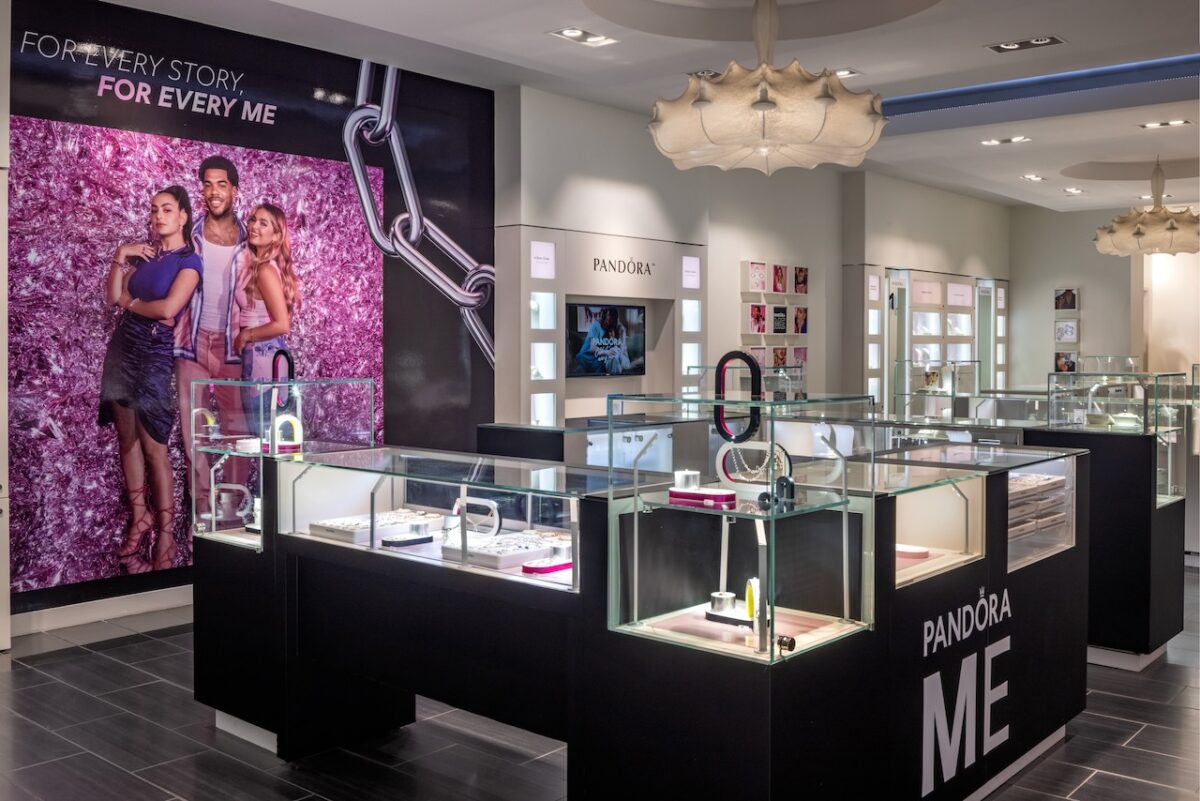
The company is also investing in existing stores through updated facades, digital screens, visual merchandising and new ways of presenting collections as coordinated looks. The changes are designed to encourage discovery and expose customers to more of Pandora’s assortment beyond the products that initially brought them into a store.
That strategy has a growing platform in Canada. Retail Insider reported in 2022 that Pandora operated 74 Canadian stores, with company executives identifying opportunities for further expansion, particularly in underpenetrated parts of the country. Its current 96-store footprint is roughly 30 per cent larger than the store count reported at the time.
Pandora had also indicated in 2022 that it wanted to build a more dedicated organization around Canada rather than simply treating the country as an extension of its larger U.S. business.
That investment has since extended beyond physical stores. In March, Pandora opened a dedicated e-commerce distribution centre in Mississauga after previously fulfilling Canadian online orders through facilities in the United States.
More than 20 per cent of Pandora’s Canadian sales are generated online. The Mississauga facility can process as many as 12,500 orders per day and was designed to reduce typical Canadian delivery times from five-to-seven days to two-to-four days while simplifying returns.
Pandora employs more than 1,400 people in Canada. Together with the 96-store network and Canadian revenue exceeding DKK 1 billion last year, the distribution investment reflects the growing scale of the company’s Canadian operations.
Pandora Prepares for a Major Material Shift
Pandora’s changing retail strategy is being accompanied by a potentially significant change to the jewellery itself. The company is introducing platinum-plated jewellery on its proprietary Evershine alloy as it works to reduce its exposure to volatile silver prices.
Sterling silver has historically been closely associated with Pandora, particularly through the charm bracelets that helped build the company into the world’s largest jewellery brand. Rising silver costs have complicated that model and increased the importance of diversifying the materials used across Pandora’s assortment.
Pandora announced the platinum-plated initiative in February after conducting a study involving 23,000 consumers in July 2025. The company said 78 per cent of participants recognized platinum as a precious metal, compared with 69 per cent for sterling silver.
An initial Northern European pilot involved a curated selection of best-selling bracelets across 30 stores and e-commerce. During the second-quarter earnings call, management said it was also testing five key products in the Netherlands — four bracelets and one necklace — as it gathered more information about consumer response and pricing.
The test is examining more than consumer acceptance of the material. In physical stores, Pandora is pricing the platinum-plated products at the same level as their silver counterparts, while online it is experimenting with different pricing approaches.
Management said the early response has been encouraging, although the tests remain at an early stage. Pandora has said the initial pilot will inform a broader global launch in the second half of 2026, including additional platinum-plated bracelets and selected charms.
The economics behind the transition are significant. Pandora said during the earnings call that its sensitivity to movements in silver prices should decline substantially as more of its assortment moves toward platinum plating, helping protect margins from sharp movements in the commodity.
Management is also making a broader argument about why consumers buy Pandora.
De Pablos-Barbier told analysts that shoppers choose the brand for its design, craftsmanship, quality and meaning across different materials, pointing to the growth of Pandora’s gold-plated jewellery as evidence that its appeal is no longer dependent on sterling silver alone.
The platinum transition will test that proposition. Pandora is asking consumers to place more of the value of a piece of jewellery in its design, brand and presentation rather than primarily in the underlying metal.
If consumers accept platinum-plated merchandise at scale alongside traditional silver pieces, Pandora would gain considerably more flexibility over its material mix while reducing exposure to silver prices. Platinum also gives the company a precious-metal proposition that can be offered within the accessible pricing structure that has supported Pandora’s global reach.
Moving Beyond the Charm Bracelet
The material shift is part of a broader effort to diversify the reasons consumers shop Pandora. The company’s core segment recorded negative one per cent like-for-like growth during the second quarter, while the business Pandora categorizes as “Fuel with More” grew three per cent. The latter includes areas where Pandora has been introducing more distinctive designs and seeking additional business in categories such as necklaces and rings.
Pandora highlighted Timeless, its Garden of Dreams collection and Pandora Essence among the stronger-performing parts of the assortment. Management said the performance shows the potential for new product design supported by more concentrated marketing.
The company is also putting greater emphasis on fashion and cultural relevance. Its Pandora Wonders creative platform launched during Paris Couture Week with stylist Harry Lambert, following other recent initiatives including its Bridgerton collaboration.
De Pablos-Barbier said recent activations have attracted proportionally more Gen Z consumers while Pandora continues to maintain a cross-generational customer base. The company is looking to broaden its relevance without abandoning the charm and personalization business that remains central to the brand.
Stores, marketing and merchandise are increasingly being developed around that broader positioning. Pandora wants customers to encounter more of its assortment in stores and to associate the brand with a wider range of jewellery rather than primarily sterling silver charms.
A Larger Platform in Canada
Pandora’s Canadian operation enters this transition from a considerably larger position than it occupied only a few years ago. Its 96-store network, rising revenue and dedicated e-commerce infrastructure give the company a sizeable platform for the next phase of its strategy. Pandora has not detailed the timing or scope of its platinum-plated expansion specifically for Canada, while its quarterly results do not separate Canadian comparable performance from the larger North American region.
The company’s Canadian expansion to date has largely been about building scale and infrastructure. The next phase will increasingly be about what Pandora sells through that network and how it presents the brand to consumers, as it relies less on promotions, broadens its jewellery assortment and reduces its dependence on the sterling silver that helped build the business.