Mississauga-based Dialist has entered the North American luxury watch resale market with an online platform combining professional dealer listings, authentication, transaction protections and watch servicing. The Canadian company is looking to establish itself in an industry where international marketplaces already connect collectors and dealers trading timepieces worth thousands or tens of thousands of dollars.
The marketplace began operating in fall 2026 and carries approximately 450 watches, according to Francisco Hernandez, Head of Marketing at Dialist. Three dealer partners have been approved, with another 11 in the onboarding pipeline, as the company works to expand its inventory and attract customers in Canada and the United States.
Dialist is targeting independent dealers and collectors seeking a more structured way to conduct high-value transactions. Its founders believe there is room for a smaller marketplace offering consistent authentication procedures, dealer oversight and services extending beyond the initial purchase.
Dialist was founded by Mike Lammens and Yousuf Waleed, who met through a classified advertisement involving a watch transaction. Lammens was a computer science student and watch collector in Saskatchewan, while Waleed worked as a watchmaker in the Greater Toronto Area.
According to Hernandez, neither knew whether the other could be trusted when they arranged the exchange. Although the transaction was completed successfully, the experience exposed weaknesses in a market where valuable merchandise frequently changes hands through informal networks.
Independent watch dealers often source inventory through WhatsApp groups, Facebook groups and longstanding personal relationships, Hernandez explained. Those channels can work for established participants, but buyers and newer dealers may struggle to evaluate reputations, verify inventory and establish accountability.
Lammens subsequently made the problem the subject of a university project. Over approximately four years, the founders rebuilt the platform three times before bringing Dialist to market, developing the technology internally without venture capital funding, according to Hernandez.
The business now combines a consumer-facing marketplace with a professional dealer environment supporting inventory sourcing and sales. Its success will depend on attracting enough buyers and sellers to make the platform commercially useful for both.
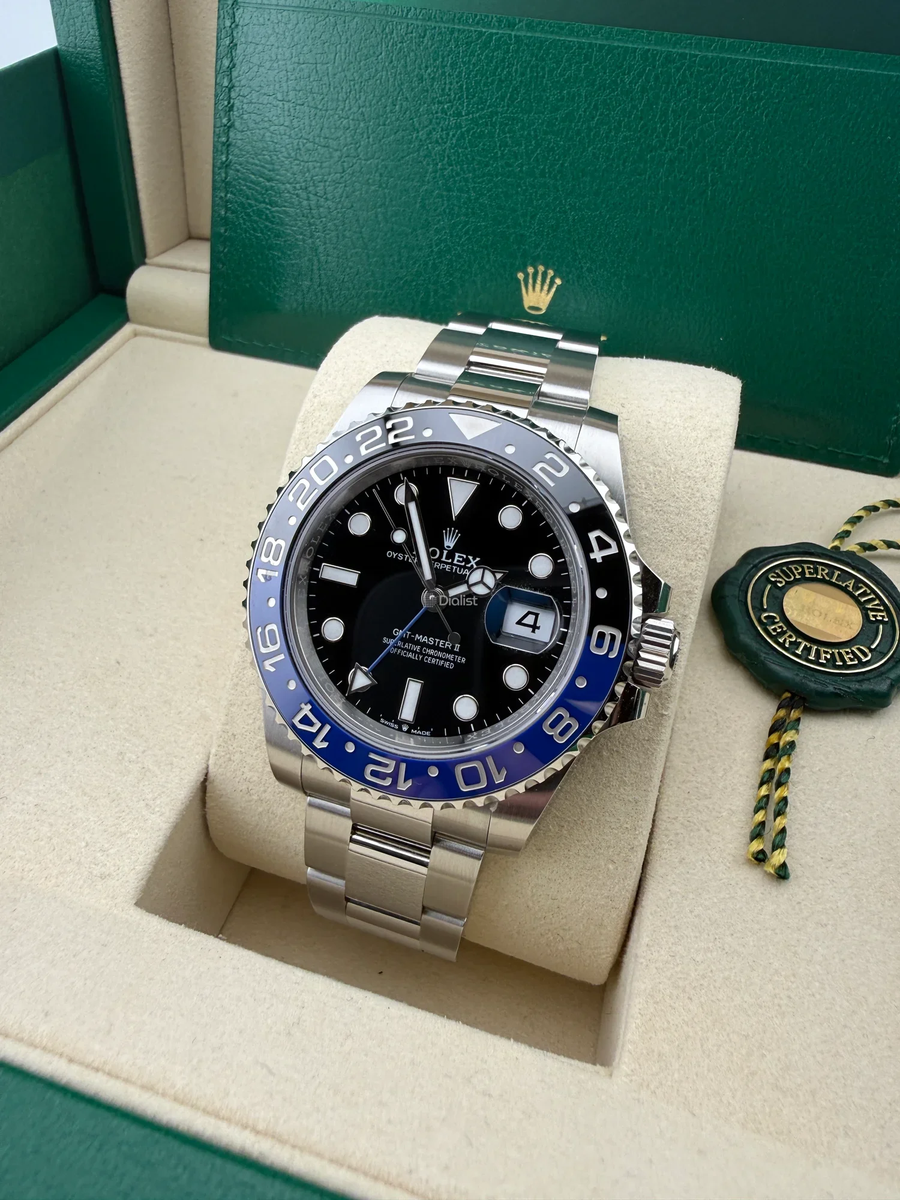
2026 Rolex GMT-Master II 126710blnr-0003 Batman Oyster Full Set New. Photo: Dialist
Authentication, Dealer Relationships and Revenue
Dialist reviews prospective dealers before granting access to its professional network, examining business experience, inventory, selling channels, references and industry standing. Payment-related identity and business verification is handled through processor Finix, according to Hernandez.
Authentication is another part of the operating model. Hernandez said approved dealer partners may authenticate watches through their own service centres once those facilities have been approved by Dialist, while other sellers must submit watches for authentication before delivery.
Sellers generally retain possession of their watches until a sale takes place, avoiding the need to transfer inventory to the marketplace in advance. According to Hernandez, buyer payments are processed through delayed settlement, with funds released after the watch has been delivered and the buyer confirms that it matches the listing.
Dialist also advertises insured shipping and a seven-day return period. Its published Secure Checkout and Return Policy specifies a 168-hour inspection window beginning at confirmed delivery, with buyers required to obtain return authorization.
Certain returns may incur a processing fee of up to 4.9% of the transaction value. Buyer-convenience returns generally make the buyer responsible for applicable costs, while responsibility may shift to the seller when a return results from seller fault.
For expensive watches, those provisions can have a significant financial impact. A maximum 4.9% charge on a US$20,000 transaction would represent US$980, although the actual fee depends on the policy’s applicable conditions and unrecovered costs.
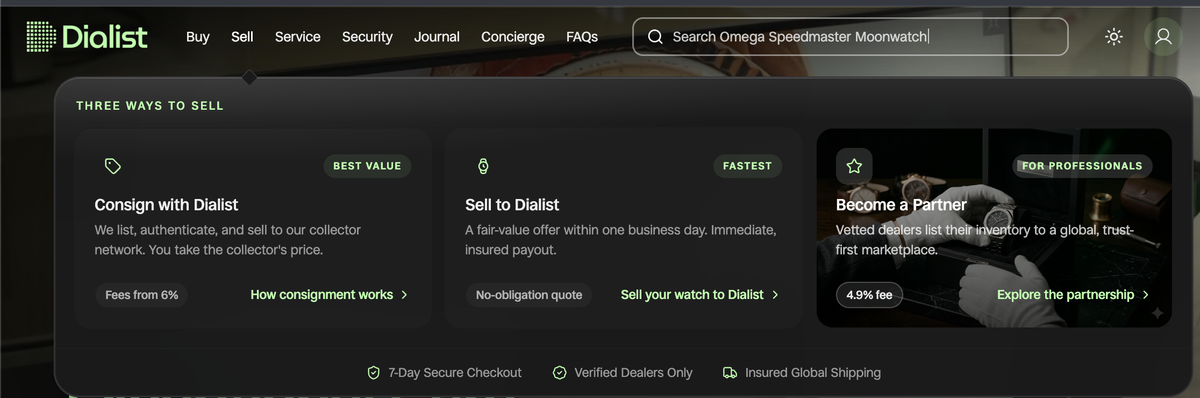
The company’s revenue model includes transaction commissions and dealer subscriptions. Hernandez said Dialist charges sellers a flat 4.9% commission on completed marketplace sales, including transactions involving company-owned inventory.
Its dealer program separately advertises monthly subscriptions ranging from US$199 for up to 25 watches to US$1,399 for up to 1,000 watches. Those charges are additional to the transaction commission, making a dealer’s overall selling costs dependent on inventory levels and completed sales.
Dialist also offers consignment, negotiating a net amount payable to the watch owner and establishing its selling price above that figure. Servicing provides another revenue stream, with Hernandez identifying watchmaking operations in Mississauga, Ottawa and Clifton, New Jersey.
Hernandez said the watchmakers work directly with Dialist rather than operating as unrelated subcontractors. The company also offers servicing to the public, potentially maintaining customer relationships between purchases and eventual resale transactions.
Canadian Operations with an American Market Focus
Although Dialist is based in Mississauga, the company has structured its operations to serve American buyers and dealers. Hernandez said the founders recognized that concentrating exclusively on Canada’s luxury watch market would limit its potential customer base.
Dialist operates through affiliated corporations incorporated in Ontario and Florida, as confirmed by its published terms. Orders shipped to Canadian addresses involve the Ontario corporation, while the Florida corporation serves as the counterparty for orders delivered outside Canada.
Cross-border transactions introduce additional considerations involving payments, shipping, customs duties and consumer protections. Dialist’s terms place responsibility for applicable duties on the buyer, making the final cost of an imported watch important for Canadian customers.
The company faces established competitors including Chrono24 and eBay, both of which have substantial international customer networks. Chrono24 offers professional-dealer listings, escrow arrangements and buyer protections, while eBay provides authentication for qualifying watch transactions.
“We are not going to beat anyone on catalogue size at this stage,” Hernandez told Retail Insider. “Chrono24 has two decades of head start and global inventory, and that is a real advantage we cannot buy.”
The platforms also differ in their seller fees. Chrono24’s published commission guidance lists a 6.95% commission for private sellers, while professional dealers operate under separate subscription and commission arrangements.
Direct comparisons are complicated by subscription costs, seller categories and transaction protections. Dialist’s competitive proposition rests on its combination of services and its ability to deliver a reliable experience, rather than on offering features unavailable elsewhere.
The luxury watch resale market has also changed since the speculative buying period of 2021 and 2022, when demand pushed prices for many desirable models sharply higher. The subsequent correction reduced resale values, although market indicators have shown renewed strength during 2025 and 2026.
WatchCharts reported a 1.9% increase in its secondary watch market index during the first quarter of 2026, the fifth consecutive quarter of gains. Its overall market index, which tracks a weighted selection of 300 watches from major luxury brands, was up 7.6% over the year ending November 1, 2026, although individual brands and models performed differently.
Hernandez said the founders never considered speculative price appreciation a sustainable foundation for the business. Their strategy is based on continued activity among collectors and dealers, alongside demand for authentication, servicing and resale assistance.
“We are not building Dialist on the assumption that every watch appreciates,” he said. “We are building on the fact that people will keep buying, selling, servicing and trading them.”
Dialist remains an early-stage marketplace, with three approved dealer partners and a pipeline of prospective participants. The company has not disclosed completed transaction volumes or gross merchandise value, making the pace of customer adoption difficult to assess.
Its immediate challenge will be turning listed inventory into transactions and attracting dealers who see sufficient value in its fees and services. The 11 prospective dealer partners could expand its selection, but repeat purchases, buyer confidence and dealer retention will provide a clearer indication of whether Dialist can establish a lasting position in North America’s luxury watch resale business.