Aritzia now operates more boutiques in the United States than in Canada. At the end of the first quarter of fiscal 2027, the Vancouver-founded retailer had 76 U.S. boutiques and 67 in Canada, excluding four Reigning Champ stores. Of the 12 to 13 new boutiques planned for fiscal 2027, 11 to 12 are expected to open in the U.S.
Revenue has moved even further south. U.S. sales increased 54.5% year over year to $638.1 million in the latest quarter and accounted for 67.1% of company revenue. Canadian revenue increased 25% to $313 million.
The Canadian business is still growing quickly, but most of that growth is coming from established boutiques and e-commerce. Aritzia is spending on Canadian real estate, though increasingly on larger or repositioned stores instead of adding large numbers of locations.
In the U.S., management has identified 180 to 200 locations that meet its site criteria, compared with 76 boutiques at the end of fiscal 2026. It is a measure of potential sites, not an opening commitment, but the difference between the two countries is becoming clear in Aritzia’s capital allocation.
Article Contents
Canada: Fewer New Doors, Larger Stores
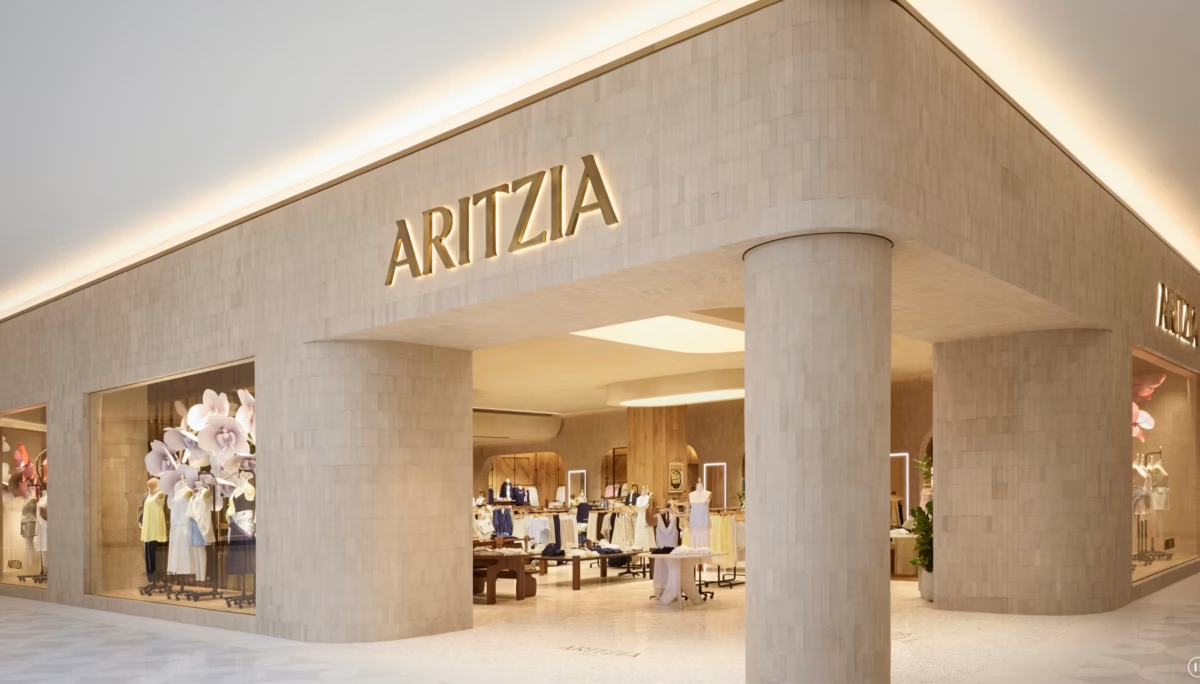
Some of Aritzia’s most important Canadian stores are getting substantially larger. At Oakridge Park in Vancouver, the company returned this year to the shopping centre where its first standalone boutique opened in 1984. That store was about 1,500 square feet. The new Oakridge location is roughly 10,000 square feet.
Aritzia has also expanded at CF Toronto Eaton Centre and is developing a four-level flagship at CF Pacific Centre in downtown Vancouver, taking part of the former Nordstrom space at Robson and Howe. At approximately 41,800 to 42,000 square feet, it will be more than four times the size of a standard Aritzia boutique.
Management said two Canadian boutique repositions completed over the past year were performing well, with another Canadian reposition planned for the second quarter. Recent reporting and earnings commentary do not indicate a broad Canadian closure program.
The economics of the Canadian business give Aritzia room to be selective. Canadian revenue rose 25% in the first quarter without a large new-store program, supported by comparable sales and digital growth. More capital can therefore go into proven locations where additional square footage has a better chance of producing additional sales.
Most new square footage is going to the U.S. At Aritzia’s July annual meeting, CEO Jennifer Wong said total company square footage was expected to grow in the low teens during fiscal 2027, with the vast majority of that increase in the United States.
The U.S. Expansion Is Moving Beyond First Stores
Part of Aritzia’s U.S. pipeline is still about entering new cities. Birmingham, New Orleans and St. Louis were among the new markets identified for fiscal 2027.
Another part involves adding stores within markets where Aritzia is already established. The company opened at Perimeter Mall in Atlanta on September 19, adding to its existing boutique at Lenox Square. Dallas is also receiving another location, while the wider pipeline has included Fort Worth, Cleveland, Las Vegas, Carlsbad and The Woodlands in Texas.
Management’s 180-to-200-store estimate is therefore less dependent on finding an equivalent number of new cities. Large metropolitan markets can support multiple boutiques where trade areas are distinct and existing demand is strong.
Atlanta is a relatively small example of that approach. Aritzia can continue entering new cities while adding second and subsequent stores in larger markets. Its ability to do both rests heavily on the economics of recent openings.
Aritzia’s standard boutique model is roughly 10,000 square feet, around $1,000 in annual sales per square foot, about $10 million in annual revenue and approximately $4 million of net investment. Management targets payback within 12 to 18 months. Recent boutiques have been paying back in less than a year on average.
U.S. stores are also reaching productive sales levels sooner. Historically, Canadian boutiques tended to open closer to mature productivity, while U.S. stores took several years to ramp. CFO Todd Ingledew told analysts in July that newer U.S. stores are now opening much closer to maturity, with the fiscal 2026 cohort particularly strong.
Faster maturation reduces the drag created by each new class of stores. Aritzia can add square footage without carrying the same volume of underproductive locations for several years after opening.
Bigger Stores Have Not Hurt Productivity So Far
Aritzia has increased the size of its stores at the same time it has accelerated U.S. expansion. The average boutique was about 6,000 square feet a decade ago, later moved toward 8,000 square feet and is now generally above 10,000 square feet. New boutiques planned for fiscal 2027 were expected to average around 11,000 square feet.
Management says stores above 10,000 square feet are producing sales per square foot comparable with Aritzia’s smaller boutiques. If that performance holds, larger stores allow the company to generate more revenue from each opening without giving up the productivity that has supported its recent payback periods.
There is a practical limit to how far that can be extrapolated. A 76-store U.S. network still gives Aritzia considerable freedom to choose strong malls, streets and trade areas. Moving substantially closer to 180 or 200 stores means working through a much larger range of locations, including more midsized metropolitan markets.
At that point, the quality of the remaining real estate becomes as important as the number of sites management has identified.
Canadian Infrastructure Is Still Part of the Expansion
Aritzia’s U.S. store count is growing faster, but Canada continues to support much of the infrastructure behind the business. A new 380,000-square-foot distribution centre in British Columbia went live in May using goods-to-person automation. Management said the facility ramped within weeks and was designed to improve picking speed and order accuracy. The company has indicated that its next major distribution expansion will be in the U.S.
The store program is also becoming more capital-intensive. Aritzia expects roughly $250 million in capital cash expenditures in fiscal 2027, including about $210 million tied to new and repositioned boutiques expected to open during fiscal 2027 and fiscal 2028.
Its first-quarter filings disclosed a 50/50 joint venture with an unnamed third party involving a property intended for a future boutique. Aritzia contributed US$1 million in equity and provided a US$27 million loan carrying a 10% annual return, due in April 2029. The company has not identified the property, partner or country, so there is no basis to connect the transaction with a known store project.
Aritzia spent decades building a dense Canadian network before its U.S. expansion reached its current scale. The Canadian business is now showing how much revenue growth can come from established stores, e-commerce and selective investment in larger locations.
The U.S. still has substantially more room for new stores. Recent openings are paying back quickly, larger boutiques are maintaining reported productivity, and U.S. stores are reaching mature sales levels sooner than they once did.
Those economics will determine how much of the 180-to-200-store site pool Aritzia ultimately pursues. The relevant number is not how many potential locations management can identify, but how many can produce returns comparable with the stores being opened today.
More From Retail Insider