Allard Developments says a new 42,500-square-foot Winners/HomeSense store will open at Parsons Creek Town Centre in Fort McMurray, marking the first and only location for the retail brands in the region.
Construction and tenant timelines will be announced at a later date.
The combined Winners/HomeSense store will become a major anchor tenant within Parsons Creek Town Centre, a planned regional retail destination that will ultimately accommodate up to 500,000 square feet of retail space in the master-planned retail development.
The announcement follows the development of a new approximately 142,000-square-foot Walmart Supercentre at Parsons Creek, which will relocate Walmart’s existing Fort McMurray store and establish the site as the city’s dominant retail destination, said the company.
“Securing Winners/HomeSense represents another significant milestone for Parsons Creek Town Centre and reinforces the strength of the Fort McMurray market,” said Paul Allard, with Allard Developments. “This development is designed to serve not only Fort McMurray residents, but the broader Northern Alberta trade area, providing access to nationally recognized retailers and creating a modern retail experience for the region.”
The company said Parsons Creek Town Centre is strategically positioned within Fort McMurray’s northern growth corridor, serving neighbourhoods that account for more than 70 per cent of the city’s residential population. The project is being developed to meet growing demand for retail services while capturing spending that has traditionally flowed to larger urban centres.
The Regional Municipality of Wood Buffalo continues to demonstrate strong economic fundamentals, including a population exceeding 107,000 residents, household incomes that rank among the highest in Canada and more than $2.3 billion in annual retail spending potential, it said.
Lisa Sweet
“We are thrilled to welcome Winners and HomeSense to Parsons Creek and to Fort McMurray Wood Buffalo,” said Lisa Sweet, CEO of Fort McMurray Wood Buffalo Economic Development & Tourism. “In both our 2021 and 2023 resident surveys, these retailers ranked among the most requested brands residents wanted to see in the region. This investment will create local jobs, expand retail choice and help keep spending within our community that has historically flowed to larger centres such as Edmonton.
“This announcement reflects growing confidence in our market and contributes to enhancing quality of life for residents while supporting the region’s long-term economic growth and resilience.”
An online store earns a large share of its yearly revenue in a handful of hours, and those hours are exactly when a weak server is most likely to fail. A Black Friday morning or a product that suddenly trends on social media: traffic arrives all at once, every shopper heads for the same cart and checkout, and the part of the store that cannot be cached has to handle every one of them live. A store that runs fine on a quiet Tuesday can stall at the precise moment it stands to make the most money. The collapse is sudden, since the server holds until the instant it does not, and that instant is the checkout under load.
It comes down to how a store checkout works. Most of a WordPress store can be cached and served fast, but the cart, the checkout, and the account pages cannot. They are different for every shopper, calculated fresh each time, and that work lands on the server during the busiest minutes of the year.
The Uncacheable Checkout
A product page is the same for everyone, so it can be saved and served from a cache without running any code. A checkout is personal. The cart contents, the shipping address, the tax, and the payment options all belong to one shopper and have to be built fresh on every request. Caching, the trick that keeps the rest of the store quick, does not apply here.
That leaves checkout speed resting on three things: how fast the server runs PHP, how fast the database answers, and how much extra code the page is carrying. On a quiet day a thin plan hides these limits. Under a rush they all show at once.
The Math of a Sale-Day Spike
Server capacity during a rush comes down to PHP workers. A worker can process a single request at any moment, so one worker handles exactly one checkout at a time. A plan with two workers can run two checkouts at once and no more. The third shopper waits, the fourth waits behind them, and a queue forms while everyone watches a spinning button.
A store expecting a flash sale needs room for several checkouts running together, which means four workers at a minimum and more for a large event. When the workers run out, the server stops accepting new requests and returns an error. The shopper who hit submit with a full cart gets a failure page, and the sale the marketing built toward turns into a wall of timeouts. The cruel part is that the store looked ready an hour earlier, when the same plan served a trickle of visitors without a hint of strain.
The Store Behind the Buy Button
Behind the buy button is a server doing real work on every order. It runs the checkout code, writes the order to the database, checks stock, and talks to the payment processor, all while the shopper waits. Choosing a WordPress hosting provider with the muscle to run many orders at once is what keeps that work quick when a hundred people check out together.
The quiet months hide the difference. A store with ten orders a day runs fine on almost anything. The same store on its biggest day needs the capacity it never uses the rest of the year. Sizing the plan to that one day is the difference between a record and an outage.
Carts Abandoned at the Worst Moment
Shoppers abandon carts at a punishing rate even when everything works. Across 50 studies, the average cart abandonment rate is 70%, and slow performance makes it worse, with 57% of shoppers leaving a store that loads too slowly. A checkout that crawls during a rush turns a ready buyer into a closed tab.
The timing is what makes it expensive. These are people who chose an item, entered a shipping address, and reached for a card, then gave up because the server could not keep pace. Each one was a completed sale a second before the page stalled.
The Database Work Inside a Checkout
A checkout leans on the database in a way a product page never does. Placing an order writes new records, updates stock counts, stores the session, and reads customer and tax data, all while the shopper waits. Under heavy concurrency those writes can collide, as two shoppers reach for the last unit of the same product and the server has to settle which one wins. Resolve that wrong and the store oversells stock it does not have, and resolving it slowly leaves every other shopper waiting behind the lock.
Two tools ease this load. Object caching holds expensive query results in memory so the database is not asked the same question repeatedly, which works even on a checkout because it caches data rather than the page. The order records can also be moved to dedicated tables built for the job, keeping order queries from dragging through the same tables that hold every post and setting. Both help, and each one needs a server with the memory and speed to run it.
The Scale of a Sale Day
The size of these days is not a guess. On a single recent Black Friday, U.S. shoppers spent a record 11.8 billion dollars online in 24 hours, and the weekend that followed pulled in billions more. At the afternoon peak, shopping carts took in around 12.5 million dollars a minute, the kind of concentration that finds the weak point in any server. The rush is predictable down to the date, which means a store can plan for it instead of being surprised by it.
Those records come with a warning. Every season, some store somewhere goes down at peak, its servers overwhelmed by the traffic the sale created. In a single recent year shoppers spent billions online in a day, and a store that cannot keep pace in those minutes loses orders it never recovers. The retailers that stay up are the ones that sized their hosting for the spike in advance. The rest discover the limit live, while shoppers sit watching a checkout that will not load.
Building for the Busiest Hour
A store cannot be sized for its quiet days, because the quiet days never test it. The real measure is the busiest hour of the busiest day, when every shopper arrives together and heads for the same uncacheable checkout. A plan that sails through a slow Tuesday tells a retailer nothing about how it will hold up then.
Sizing for that hour means confirming the workers to run many checkouts at once, the memory for object caching, and a database quick enough to record orders without a queue. Online retail keeps setting records, with shoppers raising their online spending each season, and the stores that capture that demand are the ones whose servers were ready before the rush. The rest spend the biggest day of the year repairing damage instead of taking orders.
When a new luxury fashion store opens, retail coverage usually starts with location, square footage, design, and brand mix.
Behind the scenes, it’s also a technology launch.
POS terminals, appointment systems, inventory tools, Wi-Fi, staff devices, clientele software, and e-commerce links all have to work before sales begin. That is especially true for brands using appointment-led services, where store staff rely on accurate client records before a visit begins.
Now, the harder question: What happens if systems fail during a trading moment, when the store is still expected to serve clients and protect records?
Before a luxury retailer opens, relocates, or winds down a store, cyber risk assessment services are one way to review weak points across payment systems, store networks, staff devices, and customer data workflows.
The first visible cost is store disruption
IBM’s 2025 Cost of a Data Breach Report puts the global average cost of a data breach at US$4.4 million. A breach arrives as downtime, investigation, legal review, customer communication, system rebuilds, and lost productivity.
For a luxury fashion retailer, the first visible cost can happen on the store floor. Payment terminals can go offline. Associates can lose access to clientele notes. Inventory lookup can fail during a private appointment. Ecommerce orders may stop syncing with store stock. Delivery updates and loyalty accounts can be affected.
That disruption is worse during an opening week, a relocation, or a product launch. In luxury retail, service continuity is part of the product. A client who has booked a fitting or reserved a handbag expects the store to know the details. If staff are working from partial records, the brand experience changes immediately.
Luxury stores hold more than payment data
Retail breach discussions often focus on card data, but luxury fashion stores hold far more sensitive information than payment details. Clientele systems can retain purchase history, size preferences, delivery addresses, wish list items, repairs, alterations, appointment records, and high-value transaction history.
That information is commercially valuable because luxury retail is built on long-term customer relationships. Sales associates use purchase histories to personalize recommendations, while store managers rely on appointment notes and client preferences to prepare for exclusive events and product launches.
The same information also makes luxury retailers attractive targets for cyber criminals. If access to customer records, payment systems, or business data is not properly controlled, those assets become valuable entry points for attackers.
The Canadian Centre for Cyber Security warns that threat actors target Canadian businesses for customer, supplier, financial, payment-system, and proprietary data. A successful cyber incident can result in reputational damage, operational disruption, lost productivity, and significant recovery costs.
For luxury retailers, reputation can be harder to repair than systems. A breach involving VIP client data, delivery details, or purchase histories would be seen as a failure of discretion, and discretion is part of the luxury proposition.
Openings, relocations, and closures create weak points
Retail Insider recently reported that Hermès plans to open a standalone Calgary boutique on Stephen Avenue, moving from a Holt Renfrew concession of about 1,300 square feet to a planned 5,000- to 6,000-square-foot store. A luxury relocation at that scale brings a large technology handover.
A new boutique may require network cabling, payment terminals, access controls, staff devices, guest Wi-Fi, inventory integrations, and vendor portals. Temporary access is often given to contractors, installers, and service providers during build-out, but each extra login, device, and connection can widen the risk surface.
A relocation adds another layer because old and new systems often overlap. Closures can be just as exposed if access is not removed properly. A store winding down still holds devices, customer records, payment terminals, network access, and staff credentials.
If accounts are not removed, devices wiped, and vendor access closed, risk can remain after the storefront is gone.
Where risk assessment changes the bill
The value of a cyber risk review is not only in finding technical gaps. For retailers, it’s also in finding operational failures before they become trading problems. A weak backup policy may become a delayed reopening. A missing access review may leave an ex-employee or vendor account active.
This is where cyber risk assessment services belong inside the retail expansion plan.
Experts can test whether payment workflows, staff permissions, cloud tools, backups, endpoint controls, and vendor access match the way the store operates. Experts can also reveal whether retail systems are owned clearly enough for someone to act during an incident, rather than waiting for vendors to decide who is responsible.
For a GTA retailer, an IT company in Markham may be the search phrase that starts the conversation, but the real need is broader than local support.
The partner has to understand how store networks, e-commerce, Microsoft 365, POS systems, clientele tools, and vendor access fit together.
Without this expertise and oversight, retailers stand to lose more than the cost of the recovery invoice or lost trading day. They can face interruption, investigation, customer reassurance, and reputational pressure arriving when a retailer needs the store to perform.
For Canadian luxury retailers, cybersecurity now sits inside the operating model of the boutique itself.
Smart companies treat website redesign services as a growth lever now. Not a fresh coat of paint. A redesign reshapes how people find you, how long they stick around and how often a curious visitor becomes a paying one.
Picture this. You click a link, the page crawls to life, the layout fights you and within three seconds you are gone. Sound familiar? You are far from alone. Adobe found that a business loses at least a third of its visitors when pages fail to engage through clear, useful design. That one number pushed redesign off the marketing wish list and straight onto the boardroom agenda.
Why a Redesign Actually Moves the Needle
Traffic, conversions and return sit on the same base. Search engines crawl a clean structure and rankings climb. Users find what they need fast and they convert. Both happen together and every marketing dollar suddenly pulls its weight.
Think of a website as a shop. Dusty entrance. Confusing aisles. A till that jams. Shoppers walk out. Now tidy the layout, brighten the signage, speed up the checkout. The same foot traffic buys more. Nothing about the crowd changed. The experience did.
The Traffic Engine Hiding in Good Design
Search visibility rewards technical health. Clean front-end code and quick page rendering make a site easier for search engines to read and rank. Better reading means better ranking and better ranking pulls in more visitors.
A redesign usually bundles a few traffic drivers into one project. The common ones look like this:
Faster load times that cut bounce and keep ranking algorithms happy
Mobile-first layouts, because most visitors browse on a phone anyway
Restructured navigation that helps people and crawlers reach deep pages
Fresh SEO foundations aimed at the words your buyers really type
One footwear retailer watched this happen firsthand. After a CMS-ready refresh of product pages and SEO groundwork, the store drew new visitors and lifted engagement on both mobile and desktop. Same catalogue. Different results.
Turning Visitors Into Buyers
Traffic without conversion is a leaky bucket. Water in, water straight out. A clear, intuitive interface guides people toward action and makes a sign-up or a purchase feel almost automatic. Strip the friction from a checkout and abandoned carts shrink.
The numbers stay honest here. One project cut abandoned orders at the checkout by 40 percent after rethinking a single flow. An online bank rebuilt its portal, doubled its client base and hit a high satisfaction score along the way. These are not vanity metrics. They show up on the invoice.
Measuring the Return on Investment
ROI wins over the skeptics. A redesign done properly pays back through stronger conversion rates, longer sessions and lower support costs. Want proof? Look at what real projects delivered.
Business goal
Typical redesign outcome
Organic traffic
Clear lift after navigation and media cleanup
Checkout abandonment
Drops around 40 percent
Client base growth
Twofold expansion for a digital bank
eCommerce net sales
Growth near 23 percent with 41 percent more monthly visitors
Here is the takeaway. A tweak that looks tiny on a mockup can trigger large, trackable gains once living, clicking users meet it.
Top 5 Website Redesign Companies to Watch
Your choice of partner shapes the whole outcome. So here sits a ranked shortlist of five strong providers, each with its own edge.
1. Andersen
Andersen tops the list for range and depth. With more than 19 years in software development, the company blends full-cycle UX/UI redesign with the engineering muscle to actually ship it. Its design family runs past 50 specialists and the work has earned nods from Awwwards, Dribbble and Behance next to a strong Clutch rating. A typical redesign runs 4 to 8 weeks, handled by a UX/UI designer, a product manager, a QA engineer and a researcher. That mix of speed, craft and technical follow-through makes Andersen a safe bet for teams chasing measurable results rather than a quick gloss.
2. Clay
Clay builds premium web experiences from San Francisco for global brands. Strategy, custom design, engineering, all fused together. Its client roster stretches to names like Google, Slack, Coinbase and Toyota. Startups and enterprises that want story-led, sophisticated interfaces land here, though the premium price tag suits fuller budgets.
3. WebFX
WebFX is performance obsessive. Working out of Harrisburg, the firm ties web design tightly to SEO, PPC and analytics, so every layout decision traces back to revenue. Mid-market teams that prize speed, clarity and honest reporting tend to click with its packaged programs, especially on sprawling, high-page-count sites.
4. Ramotion
Ramotion serves emerging and scaling companies that need to punch above their weight. The team fixates on brand systems and sites that grow fast without a constant rebuild, leaning on design tokens and clean editorial modules. Startups racing toward launch with flexible systems get the most value.
5. Lounge Lizard
Lounge Lizard closes the list as a full-service agency running since 1988. It marries strategic UX with brand storytelling and conversion-focused tech across several US offices. One of its redesigns drove a 133 percent jump in organic search results. Creativity and data, holding hands.
How to Pick the Right Partner
Start with the outcome, not the agency name. Do you want more qualified leads? A faster site? A clearer brand story? Write that goal down before you email anyone.
Then ask for evidence, never just promises. Request a similar project. Ask what changed after launch. Confirm what the team touched directly. A partner worth hiring welcomes those questions and answers them with numbers, not adjectives.
Common Pitfalls to Sidestep
Redesigns fall apart when teams chase trends instead of users. Skip the research, ignore mobile, launch with zero A/B testing and the gains you hoped for quietly vanish.
Budget surprises sting too. Scope creep swells timelines and costs. Lock the deliverables down early and keep everyone aligned, or the project drifts.
Conclusion
A thoughtful redesign is one of those rare bets that lifts traffic, conversions and ROI all at once. Clean code brings the crowd. Intuitive flows convert them. Hard numbers justify the spend. The evidence from real projects, a 40 percent drop in checkout abandonment here, a doubled client base there, shows how high the ceiling goes when execution stays disciplined.
Want a partner that pairs design craft with engineering reliability? Andersen offers full-cycle redesign backed by nearly two decades of delivery. The right team turns a tired website into a working sales channel and that shift tends to pay for itself sooner than anyone expects.
FAQ
Can a redesign hurt my existing SEO rankings?
It can, if handled sloppily. Broken redirects and lost URLs wreck rankings. A proper redesign maps old pages to new ones and guards your link equity from day one.
How soon will I see results after launch?
Some wins land instantly, like faster load times. Traffic and conversion gains build over a few weeks as search engines re-crawl and users settle into the new flow.
Is a full rebuild always necessary, or can I refresh in stages?
Staged refreshes work fine when the core is solid. If the platform is old and slow, a full rebuild often costs less over time than endlessly patching a fragile base.
Will a beautiful design alone boost my conversions?
No. Looks build trust, sure, but conversions come from friction-free flows, clear calls to action and fast pages pulling together.
How do I prove the redesign paid off to my boss?
Track a handful of metrics before and after launch. Bounce rate, conversion rate, session length, organic traffic. Clean before-and-after figures make the return tough to argue with.
Welcome to the Daily Synopsis by Retail Insider. We hope you enjoy the latest articles we published covering key developments in Canadian retail.
Marilyn Brooks, a pioneering figure in Canadian fashion retail, passed away at 93, leaving a lasting impact on the industry through her innovative retail and design approaches. Walmart is set to enhance Bramalea City Centre by opening a new Supercentre in 2027, expanding its footprint in Brampton. Bang & Olufsen made a statement by launching a flagship store in Toronto’s Yorkville, targeting the luxury consumer segment.
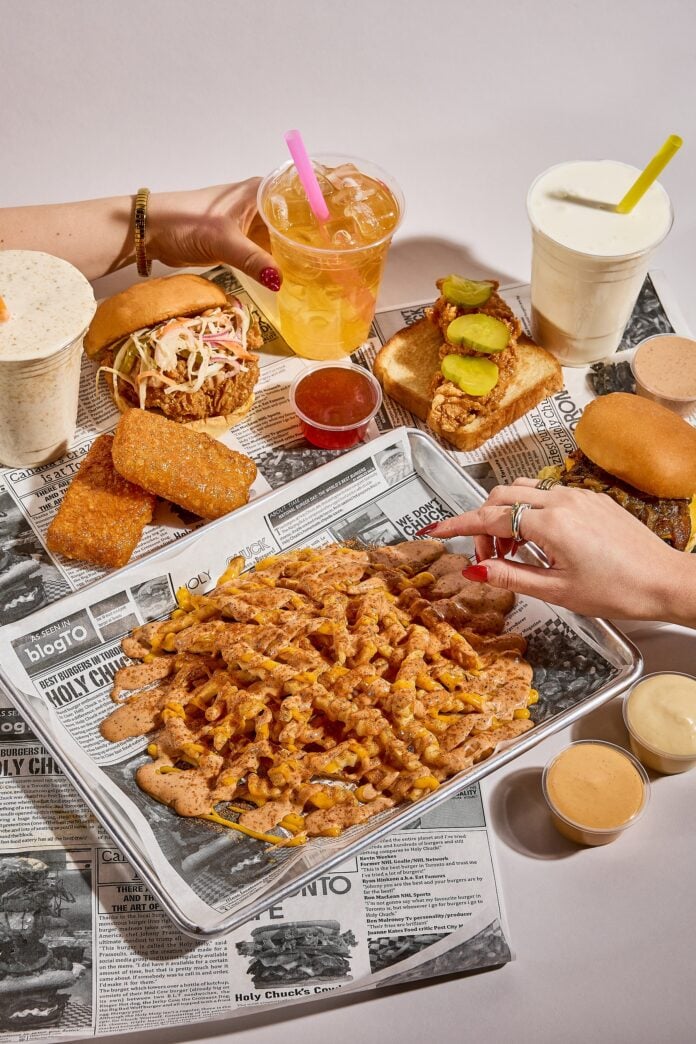
Pop Mart is expanding rapidly across Canadian cities after strong early demand for its experiential retail concept. MHRA Hospitality broadened its portfolio by acquiring Holy Chuck Burgers to strengthen its presence in premium casual dining. Meanwhile, rising food inflation is causing Canadian grocery shoppers to become more tactical with their purchases, reflecting shifts in consumer behaviour across the sector.
The company said the move brings together Canada’s fastest-growing breakfast franchise, Stacked Pancake & Breakfast House, with one of Toronto’s most recognized premium burger concepts. Under the leadership of Manish Mehra, President of MHRA Hospitality and Owner of Stacked Franchising Ltd., the partnership aims to scale Holy Chuck’s footprint while preserving the quality and personality that built its loyal following, added the company.
From left to right, Johnny Prassoulis, Founder of Holy Chuck Burgers, and Manish Mehra, President of MHRA Hospitality and Owner of Stacked Franchising Ltd.
“This isn’t about changing Holy Chuck,” said Mehra. “It’s about building around what already works. We’ve spent years refining franchise systems, operational playbooks, and growth infrastructure at Stacked. Now we’re applying that same discipline and support to help Holy Chuck reach more Canadians.”
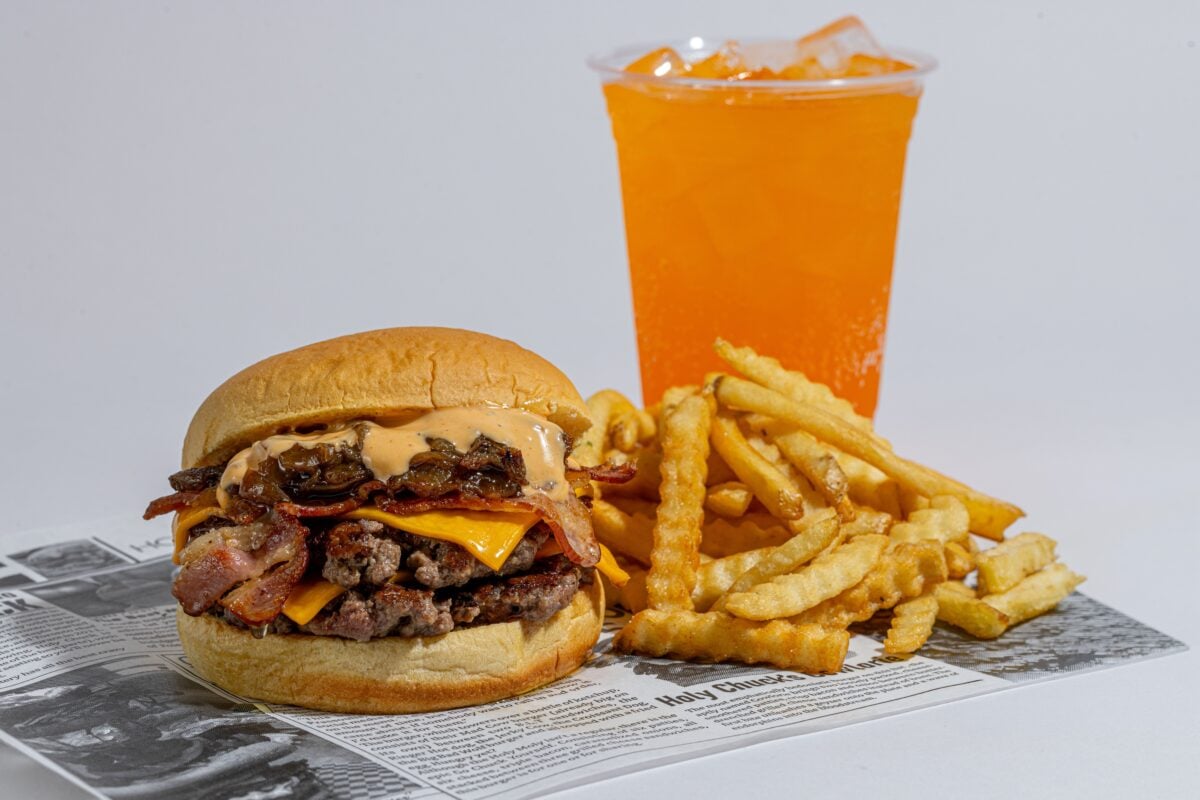
Founded by Prassoulis, Holy Chuck earned its reputation through fresh, never-frozen beef, handcrafted burgers and indulgent shakes that quickly became a staple in the Greater Toronto Area. The brand developed a strong community following by staying focused on product quality and bold, unapologetic flavour, said a news release announcing the acquisition.
“We built Holy Chuck with a simple idea: serve the kind of burger you crave and can’t forget,” said Prassoulis. “Partnering with MHRA Hospitality gives us the operational strength and growth strategy to expand without compromising what makes us different.”
Holy Chuck Burgers photo
With MHRA Hospitality’s backing, the news release said Holy Chuck will benefit from:
Proven franchise development systems refined through Stacked’s rapid national expansion
Enhanced supply chain leverage and operational support
Improved site selection and real estate strategy
Marketing and brand development resources to increase visibility
Strategic expansion into new markets across Ontario and beyond
“Stacked Pancake & Breakfast House has become one of the country’s fastest-growing restaurant franchises by combining strong franchisee support with disciplined brand standards. That same infrastructure will now power Holy Chuck’s next phase,” it said. “The goal is clear: maintain Holy Chuck’s product integrity while accelerating responsible growth.
“The addition of Holy Chuck strengthens MHRA Hospitality’s position across two high-demand dining occasions: breakfast and premium burgers. While each brand will operate independently, the shared back-end expertise will create efficiencies and new opportunities for franchise partners. MHRA Hospitality plans to support both corporate and franchise-led expansion, prioritizing sustainable growth, strong unit economics, and operational excellence.”
Holy Chuck Burgers photo
It noted that the leadership teams will work closely through the transition to ensure continuity for existing locations, staff, and customers. Expansion plans and franchise opportunities will be announced in the coming months.
“This is about building iconic Canadian restaurant brands,” Mehra added. “Holy Chuck has the product. We have the platform. Together, we’re ready to grow.”
Holy Chuck has locations on Yonge Street in Toronto and in Woodbridge, Ontario. It’s website lists a third location “coming soon” to Barrie, Ontario.
As part of Retail Insider Reports, this Q2 2026 Apparel & Fashion Retail Report covers Q2 2026 developments in the Canadian apparel retail sector. Drawing on Retail Insider’s coverage, company disclosures, and broader market research, it identifies the key market dynamics, trends, and commercial implications shaping the sector. These reports are designed to deliver executive-level insights across major retail sectors and can be accessed through the Retail Insider Report Hub.
This report examines Canadian apparel and fashion retail, including clothing, footwear, accessories, department store fashion, specialty apparel retailers, merchandising strategies, consumer demand, expansion, and competitive developments.
*****
Canadian apparel retail entered Q2 2026 facing cautious consumer spending, heightened competition, and continued structural change. Yet despite these challenges, several apparel categories demonstrated resilience, particularly premium brands, value-oriented retailers, and highly differentiated specialists.
The quarter reinforced a trend that has been building for several years: the Canadian apparel market is increasingly polarizing. Consumers are gravitating toward either premium, differentiated products or value-focused offerings, leaving many generalized mid-market chains under pressure.
The result is a sector increasingly defined by specialization, selective expansion, and clear brand positioning.
Market Context: Apparel Spending Remains Resilient but Uneven
Canadian apparel retail continues to operate in a challenging but surprisingly resilient environment.
Statistics Canada’s latest retail trade data shows that clothing, clothing accessories, shoes, jewellery, luggage and leather goods retailers generated approximately $3.96 billion in sales in April 2026, down 0.6 per cent from March but up 4.8 per cent year over year. Clothing and clothing accessories retailers specifically generated approximately $3.11 billion, down 0.5 per cent month over month but up 5.4 per cent year over year.
In volume terms, the broader category rose 6.1 per cent year over year, while clothing and clothing accessories retailers increased 4.9 per cent. The figures suggest that consumer demand for apparel remains relatively healthy despite economic uncertainty and continued pressure on household budgets.
Pricing also remains relatively contained. Statistics Canada’s latest Consumer Price Index data showed clothing and footwear prices increasing modestly year over year and remaining below the headline inflation rate. This indicates that apparel retailers continue to compete aggressively for market share and that growth is being driven more by product differentiation and consumer demand than by broad-based price increases.
The data also reinforces the increasingly K-shaped nature of Canadian consumer spending. Affluent consumers continue to support premium and luxury apparel purchases, while value-conscious shoppers increasingly seek discount retailers, resale concepts, and lower-cost alternatives.
The sector’s challenge is not a collapse in demand. Rather, spending is being redistributed across the market, with stronger operators benefiting from brand relevance, better locations, omnichannel execution, and clearer value propositions while weaker mid-market players face mounting pressure.
Broad Overall Themes
Canadian apparel retail in Q2 2026 reflects a market increasingly shaped by polarization and specialization.
Premium and differentiated brands continue to expand selectively and invest in physical retail.
Value-oriented retailers and resale concepts continue to attract consumers seeking affordability.
Specialists are increasingly outperforming generalists, with focused brands demonstrating stronger customer loyalty and clearer value propositions.
International brands continue to view Canada as an attractive expansion market, particularly in major urban centres and high-performing shopping centres.
Real estate quality is becoming increasingly important, with retailers concentrating investment in the country’s most productive retail nodes.
Premium Brands Drive Growth Through Selective Retail Investment
Premium and differentiated apparel brands continue to invest in Canadian physical retail despite broader economic uncertainty.
Aritzia’s expansion and investment in larger-format flagship stores reflects continued confidence in elevated women’s fashion and experiential retail. Canada Goose is similarly using flagship stores and experiential concepts to reinforce its luxury positioning while expanding internationally.
Canadian heritage brand Tilley also continued its evolution during the quarter, opening stores at The Well, Bayview Village, and Victoria while broadening its assortment beyond its iconic hats. The company’s measured expansion illustrates how established Canadian brands are using selective store investment and direct customer relationships to reposition themselves as broader lifestyle businesses.
International brands also continue to see Canada as an attractive expansion market. Retail Insider research showed that 20 international retailers entered Canada in 2025, with many targeting premier shopping centres and affluent urban markets. The continued expansion of Uniqlo, Mango, Alo Yoga, and others further reinforces Canada’s attractiveness as a long-term growth market and demonstrates the continued importance of high-quality retail real estate.
The common thread is selectivity. Successful brands are not pursuing growth everywhere. They are targeting premium locations, investing in differentiated experiences, and focusing on customer segments where they possess clear competitive advantages.
Value Retail and Resale Continue to Gain Share
Value remains one of the strongest themes in Canadian apparel retail.
Consumers continue to seek affordability and flexibility, benefiting off-price retailers, discount concepts, and resale operators.
Savers Value Village remains one of the clearest examples of this trend. The continued growth of resale reflects both economic considerations and changing consumer attitudes toward second-hand shopping, sustainability, and treasure-hunt retail experiences.
At the same time, ultra-low-cost platforms such as Shein and Temu continue to put pressure on traditional apparel retailers by resetting consumer expectations around price, assortment, and speed. TJX-owned Winners and Marshalls also continue to grab strong market share. Surprisingly, retailers such as Costco and Walmart are also major apparel players in Canada.
As household budgets remain under pressure, value-oriented channels are likely to remain important beneficiaries of shifting consumer behaviour.
Real Estate Quality Is Increasingly Decisive
As apparel retail becomes increasingly polarized, real estate quality is becoming a more important competitive differentiator.
The strongest brands continue to prioritize Canada’s best shopping centres, urban streets, and mixed-use developments. International entrants and domestic leaders alike are concentrating investment in locations that deliver affluent consumers, tourism, and strong productivity.
RW&CO’s reimagined flagship at CF Toronto Eaton Centre illustrates how apparel retailers continue to invest in elevated store environments as physical retail increasingly becomes a brand-building and customer acquisition tool rather than simply a place to transact.
Similarly, brands such as Aritzia, Uniqlo, Canada Goose, and Alo Yoga continue to invest in highly productive flagship environments that showcase merchandise, strengthen brand identity, and improve customer engagement.
The result is a widening gap between highly productive retail nodes and secondary locations, reinforcing the ongoing flight to quality in Canadian retail real estate.
Specialists Continue to Outperform Generalists
One of the quarter’s clearest themes is the growing strength of specialist retailers.
Consumers increasingly appear willing to support brands with clear identities and differentiated propositions.
Aritzia has established itself as a leader in elevated women’s fashion. Canada Goose continues to dominate luxury outerwear. Tilley is evolving into an outdoor lifestyle brand. Vessi has carved out a distinctive position in waterproof footwear. Uniqlo continues to resonate through functional basics and strong value.
Meanwhile, broad-based apparel chains operating across multiple categories continue to face structural challenges.
This mirrors broader changes in consumer behaviour. Shoppers increasingly gravitate toward brands that stand for something specific and deliver expertise, authenticity, or a clearly defined lifestyle proposition.
Canadian outerwear manufacturer FREED’s continued expansion through wholesale and direct channels demonstrates how heritage brands can adapt through diversification and operational flexibility.
At the same time, apparel retailers continue to navigate global sourcing challenges, changing tariff environments, and shifting consumer demand. Operators that can react quickly, maintain healthy inventory levels, and preserve margins are likely to remain better positioned in an uncertain environment.
Adjacent Categories Continue to Present Opportunities
Canada’s plus-size apparel market remains a sizeable opportunity, reflecting growing demand for greater assortment and inclusivity.
Athletic apparel and wellness-oriented categories also continue to attract investment, with brands such as Alo Yoga expanding into Canada and intensifying competition within premium activewear.
The continued growth of these niches demonstrates that opportunities remain available for retailers with focused propositions and a clear understanding of evolving consumer preferences.
Editor’s Take
Q2 2026 reinforces the idea that Canadian apparel retail is increasingly becoming a market of specialists.
Brands with clear identities and differentiated propositions continue to perform well. Aritzia dominates elevated women’s fashion. Canada Goose remains a leader in luxury outerwear. Tilley is evolving into an outdoor lifestyle brand. Vessi has built a distinctive position in waterproof footwear. Uniqlo continues to win with functional basics and strong value.
At the same time, resale concepts, discount retailers, and value-oriented operators continue to attract consumers seeking affordability and treasure-hunt experiences.
Meanwhile, broad-based mid-market apparel chains continue to face structural challenges from both premium and value competitors, as well as increasing pressure from ultra-low-cost platforms such as Shein and Temu.
Another important takeaway is that physical retail remains highly relevant, but increasingly as a tool for brand building, customer acquisition, and experiential engagement. Retailers continue to invest in flagship stores and high-quality real estate because the best locations still play a critical role in shaping consumer perception and driving productivity.
The quarter’s biggest lesson may be that differentiation matters more than ever. Retailers with clear positioning, disciplined expansion strategies, and strong customer propositions continue to find opportunities, while generalized concepts without a distinct identity face increasing competitive pressure.
Looking ahead, the key questions for the industry will be whether premium apparel demand remains resilient, how value-oriented channels continue to evolve, and whether mid-market operators can successfully reposition themselves in an increasingly polarized marketplace.
Canadian apparel retail is not moving in one direction. It is increasingly splitting between premium, value, and specialist concepts, with the winners likely to be those brands that offer clear identities, focused assortments, and compelling reasons for consumers to engage.
Soccer Zone was recently launched by Roku to help Canadians more easily discover live FIFA World Cup soccer content across streaming platforms.
It’s the world’s biggest soccer tournament with matches in Canada, the United States and Mexico.
With the tournament getting into the quarter-finals, Roku shared some early insights into how Canadians are using the platform, and what it says about changing sports viewing habits.
In the first two weeks following the launch (June 11–25):
One in five visitors went beyond browsing to stream content directly through Soccer Zone
The average streaming session exceeded one hour, highlighting strong viewer engagement
Most-streamed matches:
Canada vs. Bosnia and Herzegovina
Canada vs. Qatar
USA vs. Paraguay
As Canadians continue following the tournament, the data suggests fans are increasingly looking for a simpler way to find live sports across multiple streaming services. and once they do, they’re staying engaged.
Question: What has surprised Roku most about Canadians’ early adoption of Soccer Zone, and what do these usage patterns reveal about changing sports viewing habits?
Ivan Pehar
Answer: What stood out most was how quickly Canadians began using Soccer Zone as part of their tournament viewing. In the first two weeks alone, more than one million individuals visited the hub, which shows there is strong demand for a simpler way to follow live sports in a streaming environment.
What’s especially encouraging is the behaviour we’re seeing once viewers arrive. Fans aren’t just browsing; one in five streamed content directly through Soccer Zone. That tells us Canadians are looking for a more intuitive path from discovery to viewing, especially when live sports content is spread across different services.
Q: How does Soccer Zone address the challenge of sports content being fragmented across multiple streaming platforms, and why is that important for viewers?
A: Sports fans want to watch the match, they don’t want to spend time figuring out which app or service has it. Soccer Zone was built to make that easier by bringing together key tournament information in one destination, including where to watch, when to watch and how to get into the action.
The experience also includes features like a live scoreboard, top scorer leaderboard, and soccer-related films and documentaries, so it’s not just about finding a single match. It’s a more complete tournament hub that helps fans stay connected before, during and after the game.
Q: The average streaming session exceeded one hour. What does that level of engagement tell you about how fans are discovering and consuming live sports through connected TV?
A: An average streaming session of more than an hour tells us viewers are leaning in once they find the content they want. This is not passive browsing; it’s meaningful engagement with live sports through connected TV.
For us, that reinforces the importance of reducing friction. When fans can move more easily from discovery to streaming, they are more likely to stay engaged. It also shows how connected TV is becoming an increasingly natural home for major live sports moments in Canada.
Roku image
Q: How do you expect major live sporting events to influence streaming behaviour in Canada over the long term, beyond this tournament?
A: Major live sporting events have a way of accelerating viewer habits. As more Canadians use streaming to follow events like this, expectations around ease of access, navigation and content discovery will continue to rise.
Over the long term, we believe viewers will expect streaming platforms to do more than simply host apps. They’ll expect an experience that helps them find what’s live, understand what’s coming up and move seamlessly into the content they care about. That shift will continue well beyond this tournament.
Roku image
Q: Based on the early success of Soccer Zone, what are Roku’s plans to expand or evolve the platform for future sports events and other live programming?
A: The early response to Soccer Zone validates the importance of making live content easier to discover. While Soccer Zone was created specifically for this summer’s tournament, it also reflects Roku’s broader commitment to helping viewers discover the content they care about through engaging experiences around major cultural and sporting moments.
We’re actively working with leagues and content owners to bring additional experiences to the platform. Later this summer, Soccer Zone will transition into a permanent Sports Zone, creating an always-on destination for sports fans, with more Zones to come. We’re excited about continuing to build experiences that make it faster and easier for viewers to find the live sports and entertainment they love.
Marilyn Brooks, the influential designer, retailer and mentor who helped reshape Canadian fashion over a career spanning more than four decades, has died at the age of 93 in Toronto.
Brooks died Saturday of natural causes, according to Norma Meneguzzi Spall, a friend and spokesperson for the family.
Her death has prompted tributes to a woman remembered for bringing the energy of London’s mod era to Toronto, creating imaginative boutiques, staging theatrical fashion events and mentoring people who went on to build careers across Canadian fashion and retail.
Brooks was also an important retail entrepreneur. Decades before vertically integrated fashion brands became a major force in global retail, she built a business that combined design, manufacturing, wholesale and her own stores. She understood fashion as both a creative and commercial enterprise and believed shopping should deliver a memorable experience.
“Retail is the closest to show business,” Brooks once wrote when asked for her best retailing tip. “Make the shopper happy and give each person a moment of magic when they shop at your store.”
That philosophy ran through a career that helped change the way fashion was presented and sold in Canada.
Marilyn Brooks showcases one of her iconic designs — a clock handbag. Marilyn stands with Naomi Shapiro, who provided this image.
A New Kind of Fashion Store
Born in Albany, New York, and raised in Detroit, Brooks came to Toronto after working in the United States and built her career in a Canadian fashion market still developing its own identity.
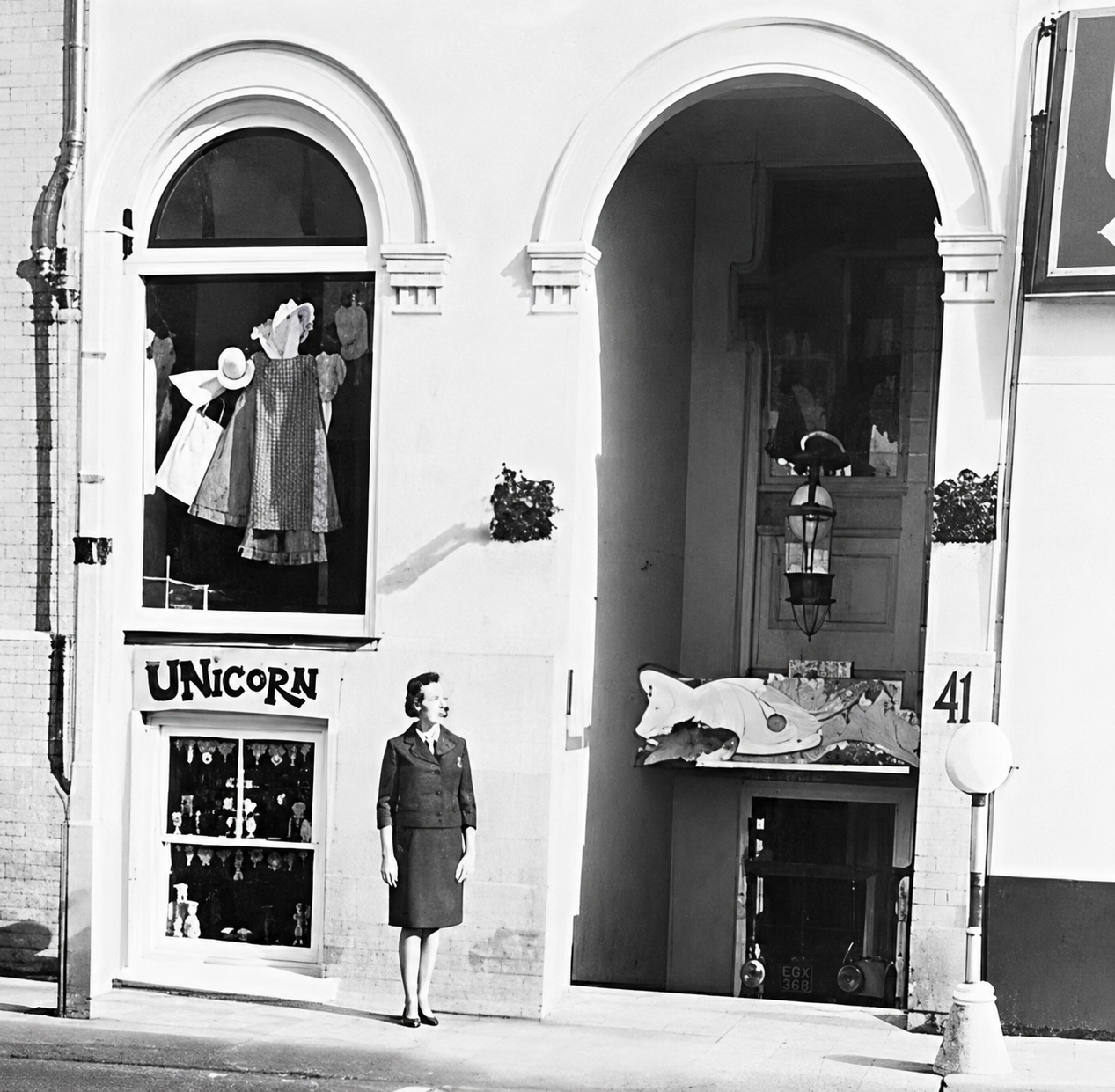
In 1963, she opened The Unicorn on Gerrard Street West with her husband. The boutique became associated with the colourful, polished and provocative mod style emerging from 1960s Britain.
For young Toronto shoppers accustomed to a more conservative retail landscape, The Unicorn offered something different.
Fashion journalist Jeanne Beker told The Canadian Press that she remembered the boutique as the city’s most exciting place to shop when she was a teenager, describing it as a destination for progressive fashion that was otherwise difficult to find in Canada.
The store channelled the energy of London’s Carnaby Street era and reflected a broader idea of fashion as identity, entertainment and cultural participation.
Brooks closed The Unicorn in 1970, but the boutique became an early chapter in a much larger business career.
She went on to develop Marilyn Brooks boutiques and a model spanning several parts of the fashion industry. The official citation accompanying her Order of Canada recognition later credited Brooks with transforming fashion retailing in Canada and described her vertical business model as a game-changer.
Brooks was appointed to the Order of Canada in 2022.
Marilyn Brooks’ Unicorn store on Gerrard St. W. (now the site of the Chelsea Hotel). Photo: Lynda Duff Davis via Facebook
Designing, Making and Selling Under One Roof
Brooks’ significance to Canadian retail came partly from the breadth of the company she built.
Her operation combined the roles of designer, manufacturer, wholesaler and retailer. Brooks created fashion, participated in its production, sold through wholesale channels and operated boutiques of her own.
That integration connected product development with merchandising, store presentation, selling and direct relationships with customers.
Toronto designer and retailer Naomi Shapiro saw the business at close range.
Shapiro, who later built Rock ’N Karma with her sister Devorah, first entered Brooks’ orbit as a young designer and street vendor. A teacher introduced the two when Brooks was looking for ways to bring new energy to parts of her collection.
Shapiro began tie-dyeing and embellishing Brooks’ clothing.
“I took her line of clothing. I tie-dyed it,” Shapiro told Retail Insider, recalling how she worked with knitwear and other pieces to make them more distinctive.
Brooks gave the young designer room to experiment, displayed the work in store windows and brought her into fashion shows.
Shapiro later worked part-time for Brooks while studying fashion, managed her Queen Street store and spent time in the studio doing everything from sewing and pattern drafting to the everyday tasks required inside a working fashion company.
It gave her exposure to the full business.
“In life, you need to know a little bit about everything,” Shapiro remembers Brooks telling her.
Marilyn Brooks wear Rock N’ Karma pants at a photo shoot in Toronto’s Graffiti Alley
Retail as Show Business
Brooks placed customer emotion at the centre of retail.
Her advice about retail being the closest thing to show business stayed with Crissi Giamos, a long-time Toronto fashion public relations professional who knew Brooks as a mentor.
Before moving into public relations, Giamos managed stores for Town Shoes. She said she repeatedly passed Brooks’ lesson along to her own teams, with one adaptation suited to the business: she changed “show business” to “shoe business.”
Brooks’ original advice urged retailers to give shoppers a memorable moment of happiness, comparing a powerful store experience to a wonderful taste that a person wants to experience again.
For Brooks, spectacle extended far beyond metaphor.
Her fashion presentations became known for theatricality and scale. Historical accounts document large productions drawing audiences in the thousands, with elaborate staging that pushed fashion beyond a conventional runway presentation.
Giamos remembers one Brooks fashion extravaganza in the park along Cumberland Street in Yorkville as a formative moment in Toronto’s fashion community.
“Marilyn also introduced me to the excitement and magic of the fashion runway,” Giamos said. “It wasn’t just a runway show. It was where so many of us who were just beginning our careers met one another, learned from the best, and became part of Toronto’s fashion community.”
The significance of those gatherings became clearer with time.
“Looking back, I realize Marilyn wasn’t just producing fashion shows,” Giamos said. “She was building a community.”
Pushing a Young Designer Out on Her Own
For Shapiro, Brooks’ mentorship was direct, demanding and transformative.
Shapiro worked for Brooks in her early twenties and eventually managed the Queen Street store for about a year and a half. When the location was closing, Brooks allowed her to rent space at the front and sell merchandise she was making herself.
Shapiro later worked in Brooks’ studio. Then Brooks told her it was time to leave.
“Naomi, there is no room for you in this establishment,” Shapiro recalls her saying.
The message came with a larger point. Brooks believed the young designer had gained experience across enough parts of the business to build something herself.
“You should go out on your own and open your own business,” Shapiro remembers Brooks telling her.
Shapiro did. She opened at Queens Quay Terminal and continued along the entrepreneurial path that would eventually lead to the long-running Rock ’N Karma brand.
“She was a great mentor,” Shapiro said. “She was never short of ideas.”
The relationship continued long after Shapiro’s relatively brief period as an employee. The two remained close, attended fashion events together and shared parts of their professional and personal lives.
During Toronto Fashion Week years ago, Shapiro said she would take time off and attend shows with Brooks.
“She was a real dude,” Shapiro said with a laugh.
Brooks could also be intimidating.
“She was a tough cookie, and if you could work for Marilyn, you could work for anybody.”
Marilyn Brooks book launch with Jeanne Beker in 2017.
A Designer With a Retailer’s Instinct
Shapiro’s memories reveal Brooks as a demanding commercial operator with a keen understanding of selling.
Brooks cared about how employees presented themselves, how merchandise performed and how teams were motivated. Shapiro remembers that staff were generally not supposed to wear jeans, though she was given more flexibility because of her ability to connect with customers and sell.
“I could sell anything,” Shapiro said. “I was one of her best salespeople she ever had. And that’s not a thought, it’s a fact.”
Brooks also ran sales incentives.
Shapiro remembers competitions in which employees collected different coloured stars for performance in categories such as jewelry sales. Decades later, she still has them.
The details offer a glimpse into a retail culture built around performance, personality and customer engagement.
Brooks could be strict, Shapiro said, while recognizing when a talented salesperson needed room to be herself.
That commercial instinct extended into a broader culture of resourcefulness. Shapiro remembers Brooks finding new purposes for fabric scraps and store fixtures and encouraging people to solve problems creatively without spending heavily.
When one of Brooks’ stores closed, Shapiro bought decorative pillars from the space and continued hauling them to her own exhibition booth at the Canadian National Exhibition for years.
“She always tried to take any scrap of fabric and reuse it,” Shapiro said.
Her conclusion is direct.
“She was well out ahead of her time.”
Building Canada’s Fashion Community
Brooks’ influence reached well beyond her own company.
Historical accounts document her role in bringing Canadian designers together at a time when the industry was still building institutions and a stronger collective identity.
In 1977, Brooks invited a group of Toronto designers to her home to discuss the creation of an organization that could support them collectively. The gathering included figures who would become prominent names in Canadian fashion, and Toronto Ontario Designers was formally launched the following year.
Brooks also contributed to fashion merchandising education, serving for years on an advisory committee connected to Seneca’s program.
That broader record aligns closely with the memories of people she mentored.
Giamos said Brooks believed in emerging talent and created opportunities for younger people to enter the industry, learn and form professional relationships.
“Many of us who met through those early events are still friends and colleagues today,” she said.
Shapiro remembers the same instinct from another perspective.
“She was a real creative person who did her own thing, who inspired other people to do theirs,” she said.
Brooks also played an early role in Linda Evangelista’s modelling career. Historical accounts linked to Brooks describe her spotting the young model while casting for a fashion show, and Brooks’ archives document Evangelista appearing in one of her Toronto runway presentations in the early 1980s.
Her contributions eventually received national recognition. Beyond her Order of Canada appointment, the City of Toronto declared Feb. 4 Marilyn Brooks Day in 1988 in recognition of her impact on fashion and retail.
1990s advertisement for Marilyn Brooks fashions
A Legacy Returns to Cumberland Street
One of the most tangible expressions of Brooks’ influence can now be found in Yorkville. Rock ’N Karma operates at 132 Cumberland Street, an address previously occupied by Marilyn Brooks.
The connection runs deeper than a shared storefront. Shapiro says she personally helped Brooks open the store there.
Throughout her own retail career, Shapiro would tell Brooks about each new location. She remembers moving Rock ’N Karma to 789 Queen Street West and driving with Brooks, who delighted in the rhythm of the address.
“Seven eight nine,” Shapiro recalls her saying. “That just rolls off my tongue.”
The two drove together singing along to Queen and David Bowie.
Years later, Shapiro found herself at 132 Cumberland Street, operating her own designer-led retail business from a space once occupied by the woman who had encouraged her to go out and build something of her own.
When Shapiro told Brooks’ husband, Kennedy Coles, and niece Darilyn Coles about the address, she said they were overjoyed.
“To me, that is like it was just meant to be,” Shapiro said.
The connection brings Brooks’ legacy back to a physical storefront.
A young designer entered her world by embellishing clothes, worked in her stores and studio, learned to sell, managed a location and was eventually pushed toward entrepreneurship. Decades later, the business Shapiro built arrived at one of Brooks’ former Yorkville addresses.
Shapiro remembers Brooks as demanding, funny, inventive and relentlessly original.
She recalls once discussing a provocative Katy Perry stage look over brunch at the Hazelton Hotel. Brooks immediately challenged the idea that such fashion was new, directing Shapiro back to what she herself had been doing decades earlier.
For Shapiro, the exchange captured something essential about her mentor.
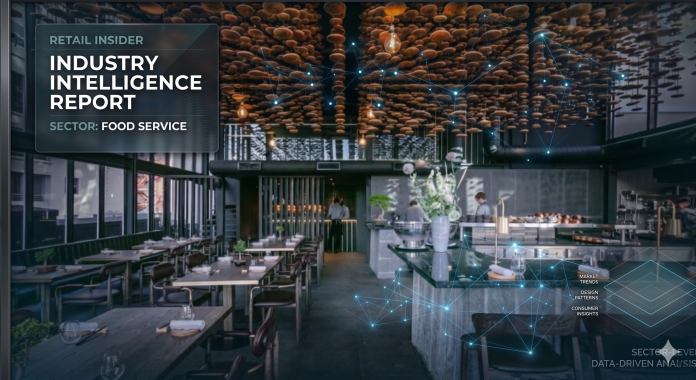
Retail Insider has released Q2 2026 Canadian Food Service: Scale, Value and New Formats, a new quarterly report authored by Craig Patterson examining the Canadian food service sector as operators compete for traffic in a market that remains active, but increasingly selective.
The report is part of Retail Insider Reports. Retail Insider Reports are designed to deliver executive-level insights across major retail sectors and can be accessed through the Retail Insider Report Hub. The report examines Canadian food service retail, including quick-service restaurants, full-service restaurants, cafés, food halls, chains, franchised operators and consumer dining trends.
General Themes
Resilient spending, harder traffic: Food service demand has not broadly weakened, but operators are competing harder for each visit as household budgets remain cautious.
Value remains central: Promotional offers, bundles, loyalty and accessible pricing are increasingly important as consumers weigh restaurant spending against other costs.
Franchise platforms are gaining influence: Foodtastic and Happy Belly Food Group show how multi-brand operators are using acquisitions, shared infrastructure and franchising to scale concepts across markets.
Coffee and breakfast are becoming more competitive: Dunkin’s planned Canadian return through Foodtastic adds pressure to a category where Tim Hortons continues to invest heavily in new restaurants and renovations.
Legacy QSR brands are improving core menus: Burger King Canada and A&W are using menu upgrades and product launches to reinforce relevance in a crowded quick-service market.
Specialty concepts are producing uneven results: Tahini’s and HEAL Wellness show the upside of culturally resonant and wellness-oriented concepts, while PLANTA’s contraction shows the limits of premium specialty positioning without durable unit economics.
Real estate formats are widening: Food halls, food courts, mixed-use dining, office catering, entertainment venues and smaller urban formats are changing how food service captures consumer occasions.
Retail Insider Coverage
Retail Insider’s coverage shows that scale is becoming one of the clearest advantages in Canadian food service. Foodtastic’s acquisition of Kinton Ramen added a Canadian-born Asian dining brand with locations across Canada and the U.S. to a growing multi-brand platform, while its master franchising agreement to bring Dunkin back to Canada positions the company as a growth partner for a major international brand returning to the market. Happy Belly Food Group also illustrates the platform model, reporting $63.1 million in system-wide QSR sales for fiscal 2025, up 108 per cent year over year, with its restaurant count rising from 43 to 77.
The report also tracks how value, menu relevance and real estate strategy are shaping the quarter. Pizza Pizza faced same-store sales pressure, while Boston Pizza reported same-restaurant sales growth of 3.1 per cent. Burger King Canada invested in core menu upgrades, including buns, fries, packaging and chicken products, while A&W launched a nationwide smash burger. In coffee, Dunkin’s planned return comes as Tim Hortons and its restaurant owners invest $400 million in Canada in 2026, including 80 new restaurants and 400 renovations.
Food service real estate is also becoming more strategic. The Kitchen at Mirvish Village, a 19,000-square-foot food hall and event venue, reflects the growing role of food and beverage in mixed-use placemaking. Kinton Ramen’s first food court concept at Vancouver’s Waterfront Centre shows how brands can use smaller formats in high-traffic urban environments, while Splitsville Bowl and Oakridge Park point to the overlap between dining, entertainment, community and destination retail.
Broader Industry Coverage
The broader industry story is not a collapse in dining demand. Statistics Canada data cited in the report shows total sales at food services and drinking places increased 0.8 per cent in April 2026 to $8.8 billion, with limited-service eating places up 0.7 per cent and full-service restaurants up 0.5 per cent. Restaurant food prices were up 3.0 per cent year over year, which helps explain why traffic remains harder to earn even as spending continues.
For operators, the market is becoming more disciplined. Expansion announcements matter less than site quality, franchisee economics, throughput, labour productivity and repeatable execution. Platform operators may have an advantage because they can share systems, real estate relationships, franchising infrastructure and capital market visibility across multiple concepts. The risk is dilution: scaling too many brands too quickly can weaken consistency if operations and franchisee economics do not keep pace.
For landlords, food service remains one of the strongest tools for traffic and dwell time, but the category is no longer limited to conventional restaurants and food courts. Mixed-use developments, food halls, drive-thru sites, compact urban formats, office catering, entertainment venues and wellness-oriented concepts are giving landlords more options, but also require sharper curation. The strongest food service tenants will be those that create repeat visits, not just opening-week attention.
Editor’s Take
The central conclusion of the report is that Canadian food service remains resilient, but more demanding. Consumers are still spending, yet they are more selective about value, convenience, quality and occasion. That favours operators with scale, strong franchise systems, menu discipline and flexible formats. Tim Hortons has national reach and franchisee investment behind it. Foodtastic is becoming a more important platform through Dunkin and Kinton. Happy Belly shows how emerging brands can scale through acquisition and franchising, though execution will matter more than portfolio growth alone. The market is likely to reward brands that can combine affordability with product relevance and operational consistency. It will be less forgiving to concepts relying mainly on novelty, premium positioning or expansion headlines.