Summer is often a popular time for homeowners to refresh their living spaces, whether updating a single room or undertaking a larger furnishing project. This year, Casavogue is marking the season with two special events designed to give customers access to significant savings while providing an elevated shopping experience.
Beginning June 18, the showroom will launch its Big Summer Sale, featuring discounts ranging from 30% to 50% off across living room, bedroom, and dining room collections. The promotion will be followed by the Big VIP Sale, a two-day event taking place on June 20 and 21.
Big Summer Sale Begins June 18
The Big Summer Sale offers customers an opportunity to explore a wide selection of furniture at reduced prices for a limited time. The promotion applies across major furniture categories, making it an ideal time to update multiple spaces throughout the home.
Whether furnishing a living room, selecting a new bedroom collection, or refreshing a dining area, customers will find savings throughout the showroom. Discounts of 30% to 50% off create opportunities to invest in furniture designed for long-term comfort, functionality, and style.
A VIP Shopping Experience
The Big VIP Sale builds on the summer promotion by transforming the showroom into a celebratory shopping event. Guests attending on June 20 and 21 will be welcomed with champagne and delicacies while exploring the collections and promotional offers available throughout the store.
Visitors will also have the opportunity to participate in prize draws and spin the wheel for a chance to win additional prizes, creating an atmosphere that combines shopping, entertainment, and celebration.
At the same time, attendees will enjoy access to the exceptional discounts available through the Big Summer Sale, with savings ranging from 30% to 50% off across selected collections. The promotion is available in all Casavogue stores.
A Destination for Furnishing the Home
Founded in 1972, Casavogue has spent more than five decades helping Montréal homeowners furnish their homes through curated collections, personalized service, and design expertise. The company’s 38,000-square-foot showroom presents furniture for the living room, dining room, and bedroom, allowing customers to explore complete room settings and coordinated interiors under one roof.
The upcoming sales events provide an opportunity for both new and returning customers to experience the showroom while taking advantage of seasonal savings.
Register for the VIP Event
Customers interested in attending the Big VIP Sale are encouraged to register in advance.
A&W’s iconic Root Beer Float is back for a limited time to kick off the hot summer season.
It marks the return of a ritual Canadians know and love: slowing down, leaning in and savouring every frosty sip, said the company in a news release.
“The A&W Root Beer Float isn’t just a drink; it is nostalgia in a frosty mug for generations of Canadians. The dreamy combination of velvety, creamy vanilla ice cream paired with fizzy, crisp, ice-cold A&W Root Beer captured many Canadians’ sweet summer memories, which earned it a cult status. Even when it disappeared from the menu, the memories lived on with Canadians who patiently waited and demanded its return. And now their wish has come true,” said the brand.
“At the heart of it all is A&W Root Beer, Canada’s favourite Root Beer. The secret recipe has long been loved for its bold, refreshing flavour, signature creamy finish, and unmistakable bite of spice that sets it apart from the rest.”
Susan Senecal
“There is something magical about the connection Canadians have with our Root Beer Floats,” said Susan Senecal, CEO and President of A&W Canada. “They are woven into the fabric of Canadian summers, from nostalgic road trip pit stops to savouring a float in the frosty mug with the whole family. We’re excited to revive this tradition today, inviting both long-time fans and a new generation to enjoy this timeless treat together.”
A&W is bringing back the iconic Root Beer Float for a limited time.
A&W is Canada’s original burger chain with over 1,100+ restaurants that are Canadian-owned and operated.
Nearly three in four (73%) of small firms say they don’t feel supported by the federal government, and this last parliamentary session did little to change that, according to the Canadian Federation of Independent Business (CFIB).
Corinne Pohlmann
“Parliament may be taking a summer break, but small business owners don’t get one. Ottawa has had every opportunity to lower the costs of doing business this past session, but it chose not to,” said Corinne Pohlmann, CFIB executive vice-president of advocacy. “Government has been all too willing to move quickly on large-scale projects for big businesses, but it has lacked the same ambition when it comes to small firms.”
While the spring economic update contained a few positive measures, such as a reduction in Canada Pension Plan (CPP) premiums and the Employee Ownership Trust tax exemption being made permanent, it didn’t do much to improve small business conditions, said Canada’s largest association of small and medium-sized businesses with 103,000 members across every industry and region.
Most (58%) small firms continue to feel pressure from rising fuel costs, with taxes squeezing margins for nearly half (48%). Four in ten (43%) also say economic/political uncertainty and other operating costs are making it difficult to do business, according to new CFIB data.
Over half (55%) say they wouldn’t recommend starting a business right now. CFIB said it is urging Ottawa to return in the fall with a real focus on Main Street, starting with: Reducing the federal small business tax rate from 9% to 6%; increasing the small business deduction threshold to $700,000; introducing a lower Employment Insurance premium rate for smaller employers; and bringing in a two-for-one rules to federal regulations to jumpstart regulatory modernization.
Jasmin Guénette
“With Canada facing an entrepreneurial drought, government needs to encourage entrepreneurship, not ignore it. Small firms need meaningful tax relief, less red tape, and a government that acts,” said Jasmin Guenette, CFIB’s vice-president of national affairs.
A new McDonald’s restaurant set to open in Alberta later this year will be unique and look a little different from other locations.
It will open at Buffalo Run within Taza on Tsuut’ina Nation land, just outside of Calgary, and be the first McDonald’s in the province whose design was guided by the Tsuut’ina-Taza Cultural Advisory Working Group, a collaborative body committed to ensuring the inclusion of Tsuut’ina language, traditions, and protocols across Taza projects.
Buffalo Run is located at the intersection of Tsuut’ina Trail and Calgary’s southwest ring road Stoney Trail.
The development has more than 50 businesses on 390 acres of retail, dining, and recreation. Officials say Buffalo Run is one of three distinct yet interconnected villages within Taza, alongside Taza Park and The Crossing, all united by Tsuut’ina Trail and the broader vision of a 1,200-acre, multi-generational development that places Tsuut’ina culture, prosperity and identity at its centre.
Working with Taza Development Corp. (TDC), McDonald’s engaged the working group in a consultation process that guided the restaurant’s architectural vision and brought Tsuut’ina design into the final plans. The collaboration produced a restaurant that honours the Nation’s identity throughout, from beautiful murals created by local artists, to signage that includes the local Tsuut’ina language, added officials.
James Robertson
“Taza is much more than a real estate project, it’s a generational commitment to building on Tsuut’ina land in a way that honours what that land represents,” said James Robertson, President of Taza Development Corp. “We ask every partner to engage with the community, and McDonald’s has stepped up in a meaningful way to understand it. That’s the kind of partnership that helps us to advance Taza’s mission.”
“From the very beginning, this project has been about more than building a restaurant – it’s about creating a space that reflects and respects the community it serves. We look forward to opening our doors and building meaningful connections with the community.”
Construction is scheduled to begin later this month, with the location set to open by the end of the year.
Canada’s last major Canadian-owned brewery is cracking a beer in celebration of the country it has called home for more than 150 years.
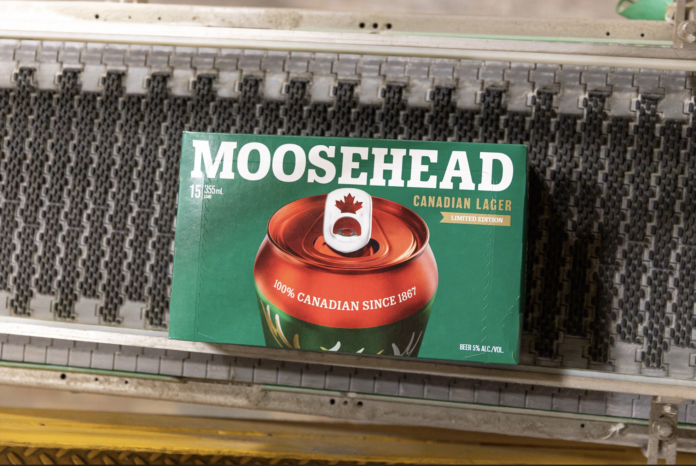
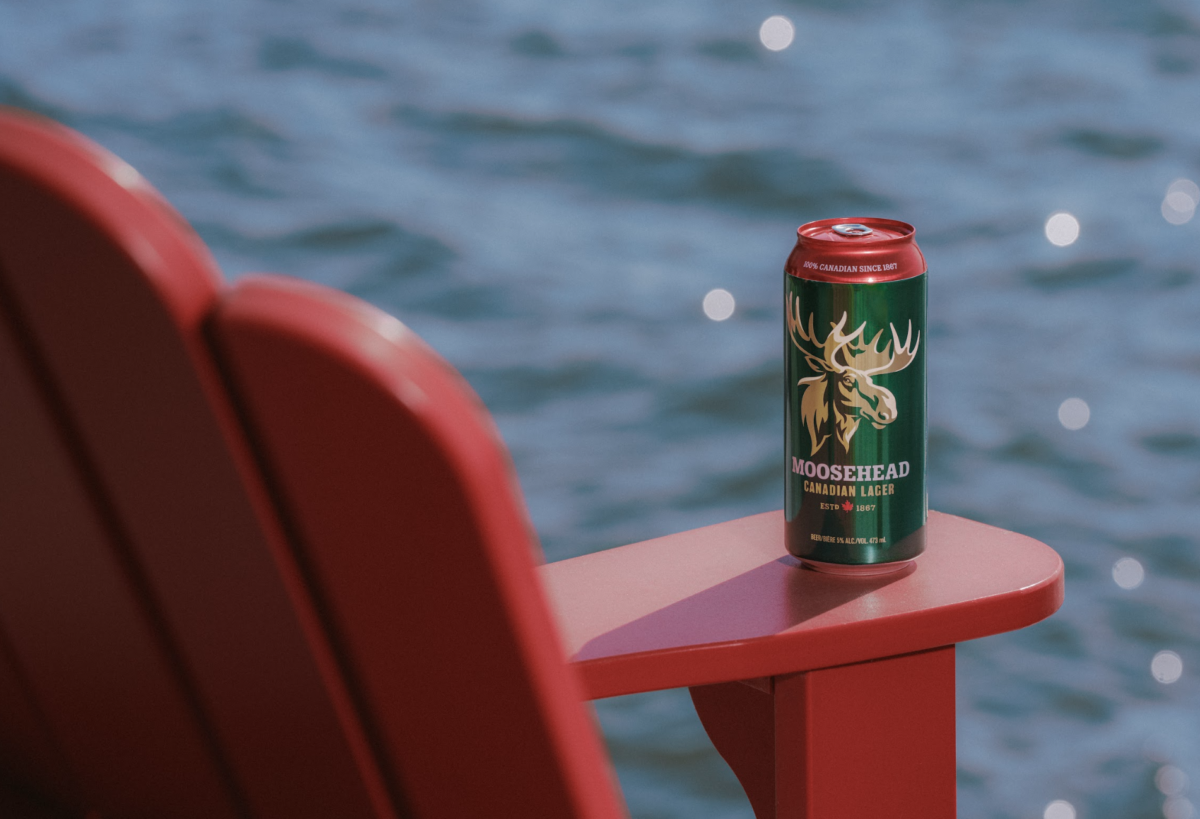
Just in time for Canada Day, Moosehead Breweries has launched “Canada in a Can”, limited-edition Moosehead Lager cans featuring red lids and maple leaf tabs.
“Moosehead was founded in 1867, which means we’ve been part of this country’s story from the very beginning. So of course celebrating Canada is especially meaningful for all of us,” said Patricia Larez, Vice President of Marketing at Moosehead Breweries. “This summer, we’re inviting Canadians to “Raise Your Tab” and celebrate the people, places and moments that make Canada such a special place to call home.”
Patricia Larez
Designed with a bold red lid and maple leaf tab, the limited-edition cans bring a distinctly Canadian visual identity to every sip, said the company, adding that Canadians are encouraged to share photos of their maple leaf tab alongside the traditions, adventures and moments that make them proud to call Canada home, tagging @Moosehead on social media.
Canadians can find select packs of the limited-edition cans at retailers nationwide. With purchase, they can also receive an exclusive Moosehead hat or t-shirt, available while supplies last, it explained.
“The launch is being supported by a large-scale, fully integrated marketing campaign, extending far beyond the packaging itself. Through a coordinated national program spanning retail, digital video, social media, out-of-home advertising, influencer partnerships and earned media activations, the campaign will engage Canadians from coast to coast throughout the summer,” said Moosehead.
It said the campaign was developed in partnership with Moosehead’s agency team, including Conflict (creative and campaign development), Media Experts (media strategy and buying), and Craft Public Relations (influencer and earned media support).
Moosehead Breweries
Moosehead has been led by the Oland family since 1867, making us the last major brewery in Canada that is still owned by Canadians.
Blue Rewards announced Tuesday a multi-year exclusive strategic partnership with Dollarama “to help Canadians make real financial progress by offering more value in their everyday spending.”
With affordability top of mind for many Canadians, Blue Rewards said it continues to expand where and how Blue Points can be earned. Through this new partnership with Dollarama, members can now earn Points on essential purchases at one of Canada’s most accessible retailers, reinforcing a shared focus on helping households make the most of their everyday budgets, it explained.
Blue Rewards said members with a linked payment card can earn Points on qualifying purchases of $20 or more at more than 1,700 Dollarama stores nationwide. In addition, BMO Blue Rewards Mastercard credit cardholders can earn 10x the Points on Dollarama purchases. With 10x the Points, members can earn up to 6% back in value on eligible spend with participating Partners, including Blue Rewards Travel.
“This collaboration builds on Dollarama’s commitment to everyday value combined with the continued evolution of Blue Rewards. With affordability top of mind for many, Canadians are focused on managing their budgets and getting the most from every dollar. By meeting our members where they already shop for essentials, we’re making it easier to turn routine purchases into meaningful value and bring this benefit to more Canadians across the country.”
Nicolas Hien
“Dollarama is focused on making everyday shopping simple, affordable and accessible for Canadians,” said Nicolas Hien, CIO of Dollarama. “Partnering with Blue Rewards allows us to enhance that experience by adding rewards to purchases customers are already making, delivering a practical benefit that fits naturally into their daily lives.”
Founded in 1992 and headquartered in Montréal, Dollarama recently reported its financial results for the first quarter ended May 3, 2026, indicating sales increased by 21.4% from a year ago, surpassing $1.8 billion. Dollarama has surpassed 1,700 stores in Canada, reaching 1,719 locations after opening 28 net new stores during the first quarter of fiscal 2027.
The milestone comes as the Montreal-based retailer continues to pursue a long-term goal of approximately 2,200 Canadian stores, highlighting management’s confidence that there remains room for significant expansion despite the company’s already extensive national footprint.
Dollarama plans to open between 60 and 70 net new stores this fiscal year, continuing a growth strategy that has made it one of Canada’s largest retail store networks. More than a decade after surpassing 1,000 stores, the retailer now operates locations in major urban centres, suburban communities, and smaller markets across the country.
SalonCentric Canada, a subsidiary of L’Oréal Canada, has signed a definitive agreement to acquire the Canadian assets of Quebec-based distributor Cantin Beauté, expanding its reach in the professional salon market.
The deal will add 25 professional-only stores and 132 employees to SalonCentric Canada’s operations, strengthening L’Oréal Canada’s distribution network in Quebec and broadening access to professional salon products across the country.
The acquisition marks a strategic move by L’Oréal Canada to deepen its presence in the professional haircare segment through SalonCentric Canada, which has operated in the Canadian market since 2023. By integrating Cantin Beauté’s established footprint and relationships, the company aims to increase its service capacity to salons and stylists.
“With more than 125,000 stylists across Canada, the professional hair salon market is highly dynamic,” said Stéphane Bérubé, President and CEO of L’Oréal Canada. “The expansion of SalonCentric demonstrates our commitment to stylists by providing them with an unparalleled selection of products, and above all, exceptional service.”
Stéphane Bérubé
Cantin Beauté, headquartered in Saint-Augustin-de-Desmaures, Que., has operated for more than 70 years and is considered a significant distributor of professional beauty products in the province. The company’s network includes 25 stores and a sales force supporting salon professionals across Quebec.
L’Oréal Canada said the acquisition will allow its Professional Products Division to build on complementary capabilities between the two businesses.
Julien Descoteaux
“The arrival of Cantin Beauté will enable the Professional Products Division (PPD) of L’Oréal Canada to leverage the complementarity of our strengths, particularly the depth of our offering,” said Julien Descoteaux, President of the Professional Products Division of L’Oréal Canada. “This partnership allows us to reach a completely new strategic level, in line with the Professional Products Division’s commitment to offer the best products, resources, and services to meet the constantly evolving needs of Canadian stylists.”
SalonCentric Canada currently operates 30 professional-only stores and employs 42 sales consultants. The addition of Cantin Beauté’s retail and distribution network is expected to significantly expand its operational scale, particularly in Quebec, where SalonCentric has been building its presence.
“We are delighted to welcome Cantin Beauté into the SalonCentric Canada family,” said Fabrice Fourteau, President of SalonCentric Canada. “Their commitment to the professional salon industry, and more specifically their exceptional customer service, aligns perfectly with SalonCentric’s mission to provide stylists and salon owners with everything they need to grow their businesses and succeed. This includes offering dynamic and innovative brands and products, as well as digital innovations that inspire and support stylists.”
Cantin Beauté has undergone several changes in recent years, including the acquisition of Montreal-based COSBEC in 2017 and a move to new facilities in 2020 aimed at improving service capabilities. The company has been led by Éric Bouchard since 2010.
Fabrice Fourteau
Bouchard said the agreement represents a significant shift for the business as it joins a larger global organization.
Éric Bouchard
“This alliance with SalonCentric Canada marks a defining turning point for Cantin Beauté,” said Éric Bouchard, President of Cantin Beauté. “I am proud to join a global leader in the professional hair industry to map out our future path together, combining our strengths with SalonCentric Canada and writing the next chapter of the hair industry together.”
L’Oréal Canada, established in 1958, operates a head office, manufacturing plant and distribution centre in Montreal, along with a sales office in Toronto. The company employs more than 2,000 people in Canada and distributes products across multiple channels, including salons, retail stores and e-commerce platforms.
The transaction is expected to reinforce SalonCentric Canada’s role as a key distribution arm for L’Oréal’s professional products, positioning the combined operations to serve a broader base of salon professionals nationwide.
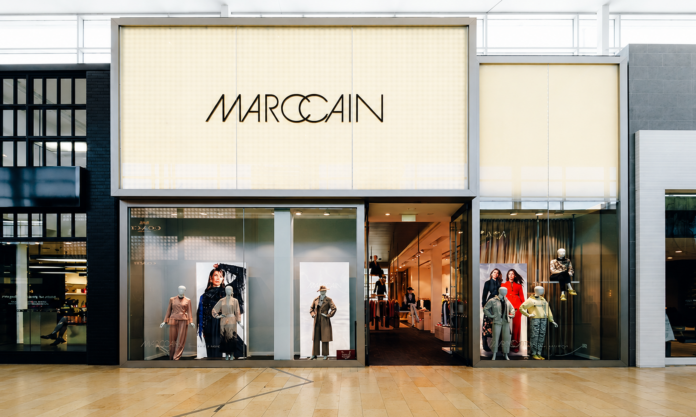
Marc Cain at Square One in Mississauga. Photo: Square One
German fashion brand Marc Cain is positioning for a broader Canadian expansion as Jessica R’Bibo, President of Marc Cain Canada and North America, leads a new North American growth strategy centred on premium shopping centres, elevated customer experiences, and the continued rise of understated luxury fashion.
R’Bibo joined Marc Cain earlier this year following a 23-year career with Michael Kors and was quickly promoted to oversee the company’s Canadian and U.S. operations across both retail and wholesale channels. Her appointment comes at a time when many premium fashion brands are reassessing how consumers shop, where physical stores matter most, and how luxury customers increasingly gravitate toward quality and longevity over trend-driven dressing.
Jessica R’Bibo, President of Marc Cain Canada and North America
“The customer today is shopping much more intentionally,” said R’Bibo. “She’s looking for quality, craftsmanship, and pieces that feel refined without being overly logo-driven.”
Founded in Germany more than 50 years ago, Marc Cain has developed an international following through collections rooted in European craftsmanship, sportive leisurewear, knitwear, outerwear, and elevated everyday dressing. The brand has built a loyal customer following through its combination of refined design, quality fabrication, and a distinctly European fashion sensibility. Marc Cain currently operates seven Canadian stores, including a recently opened location at Royalmount in Montreal, alongside one outlet store and a substantial wholesale business through independent fashion retailers.
Ontario and Western Canada Lead the Next Phase of Growth
R’Bibo said Marc Cain’s next phase of Canadian expansion will focus primarily on Ontario and Western Canada, with Vancouver representing one of the company’s most significant opportunities.
“There’s tremendous opportunity in Western Canada,” she said. “Vancouver remains a very important market for us, and Ontario continues to be a major focus as well.”
The company continues to evaluate additional locations across the country. Rather than expanding aggressively, R’Bibo said the company is taking a highly disciplined approach centred on demographics, lifestyle patterns, and long-term brand positioning.
“I like to understand a market before making decisions,” she said. “You need to study how people shop, what their lifestyle looks like, and what they expect from a premium fashion brand.”
Her long-term vision includes growing Marc Cain to approximately 15 Canadian stores while simultaneously expanding the brand’s U.S. footprint. Luc Lavigne of brokerage Oberfeld Snowcap is working with Marc Cain on the expansion.
Top Shopping Centres Remain Essential in Canada
While some luxury brands continue experimenting with high-profile street-front retail, R’Bibo believes Canada remains fundamentally driven by dominant enclosed shopping centres that concentrate affluent consumers and destination retail.
“Top shopping centres continue to matter enormously in Canada,” she said. “Properties like Yorkdale, Sherway, Pacific Centre, and Oakridge attract the customer we’re targeting.”
She said accessibility, parking convenience, climate protection, and concentrated retail density continue to make leading enclosed malls especially important for premium fashion retailers operating in Canadian markets.
The strategy also reflects broader shifts taking place across Canadian retail real estate. As traditional department stores continue to disappear, premium brands are becoming increasingly selective about physical locations while placing greater emphasis on direct customer relationships and experiential retail environments.
Marc Cain stores generally perform best within the 1,800-to-2,100-square-foot range, according to R’Bibo, allowing the company to fully present its broader lifestyle assortment spanning ready-to-wear apparel, handbags, footwear, outerwear, scarves, and accessories.
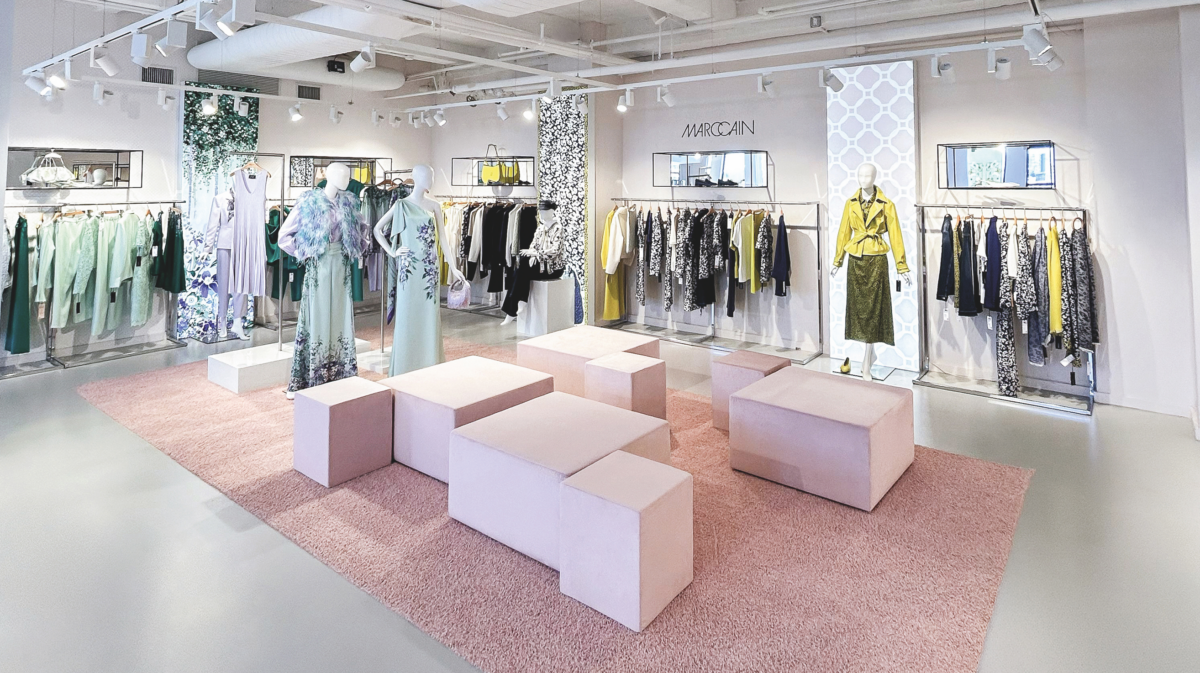
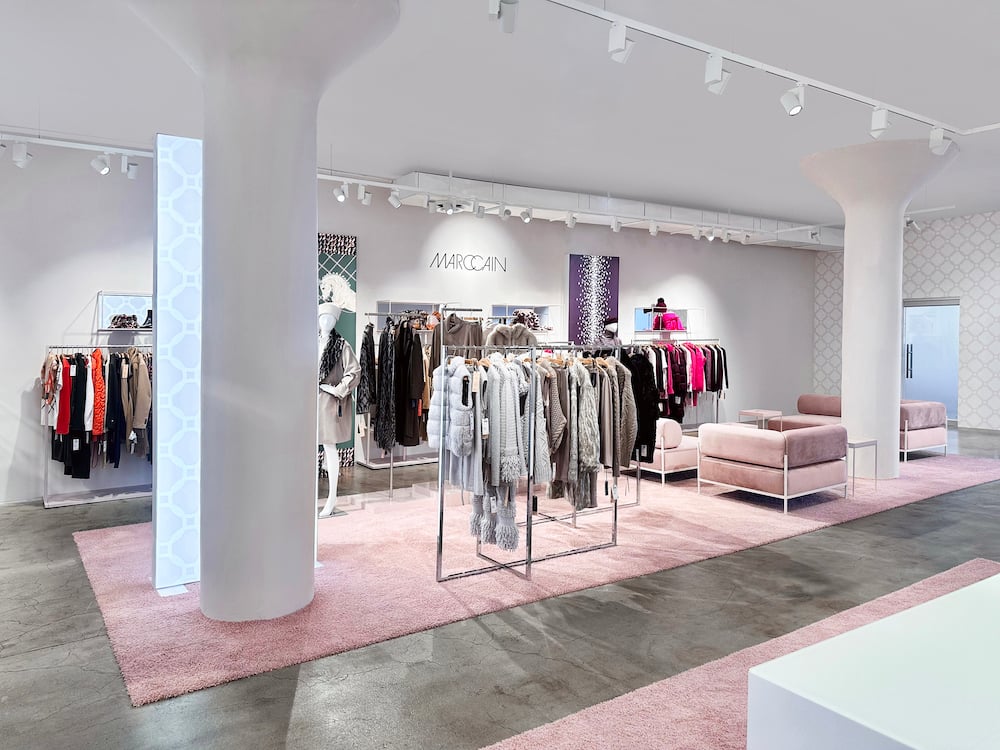
Marc Cain showroom in New York City. Photo: Marc Cain
Understated Luxury Continues to Shape Fashion Spending
R’Bibo describes Marc Cain’s core customer as a professional woman, generally aged 40 and older, who values tailoring, consistency, craftsmanship, and sophisticated wardrobe investment pieces over overt branding or fast-moving fashion cycles.
“She wants an elevated wardrobe that feels sophisticated, wearable, and timeless,” said R’Bibo. “Our customer appreciates exceptional fabrication and pieces that can remain relevant beyond one season.”
That positioning aligns closely with growing demand for understated luxury, a shift that has seen many consumers gravitate toward refined silhouettes, exceptional quality, and longer-lasting wardrobe investments over highly logo-driven fashion.
Marc Cain’s European heritage remains central to that identity. The company continues to manufacture knitwear in Germany through its own production facilities, something R’Bibo said continues to resonate strongly with North American consumers seeking authenticity and craftsmanship.
“There’s trust associated with European craftsmanship,” she said. “Customers appreciate understanding where the product is made and the quality behind it.”
Outerwear and Knitwear Anchor the Canadian Business
Although Marc Cain is widely recognized for women’s apparel, the company has evolved into a broader lifestyle brand encompassing multiple categories.
Outerwear and knitwear remain cornerstones of the Canadian business, driven both by climate and by the company’s longstanding expertise in those segments.
“Canada and Germany have very similar climates, and Marc Cain has always been exceptionally strong in outerwear and knitwear,” said R’Bibo. “Those categories continue to resonate very strongly with Canadian customers.”
The company has also expanded its Glam division, focused on elevated occasion dressing and sophisticated after-five fashion, reflecting renewed consumer interest in special-event and evening wardrobes.
“There’s renewed interest in dressing up again,” she said. “Customers are looking for refined pieces that work for dinners, events, and special occasions.”
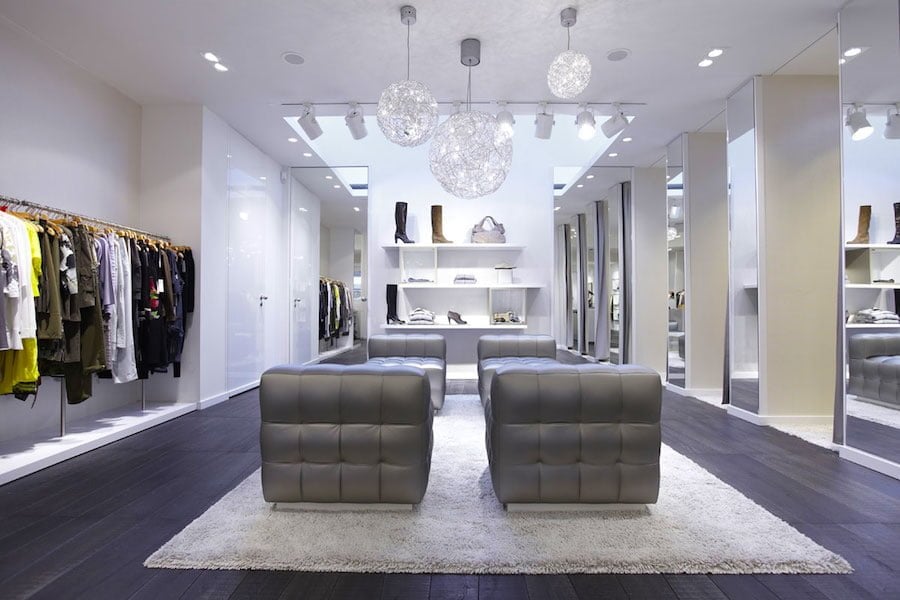
Marc Cain Store (PHOTO: WWW.BUEHLER-INNENAUSBAU.DE)
One of the operational approaches R’Bibo emphasized is Marc Cain’s localized merchandising strategy, which gives individual stores greater flexibility in tailoring assortments to local clientele.
Rather than standardizing assortments nationally, store managers actively participate in buying decisions and help shape selections based on regional market preferences.
“What works in one city may not work in another,” said R’Bibo. “Our teams know their clients very well, and assortments are built around those local needs.”
That flexibility allows stores to respond more directly to regional differences in climate, colour preferences, sizing, lifestyle, and professional dressing expectations.
R’Bibo said those distinctions are particularly important in Canada, where fashion preferences can vary considerably between Montreal, Ottawa, Toronto, and Vancouver.
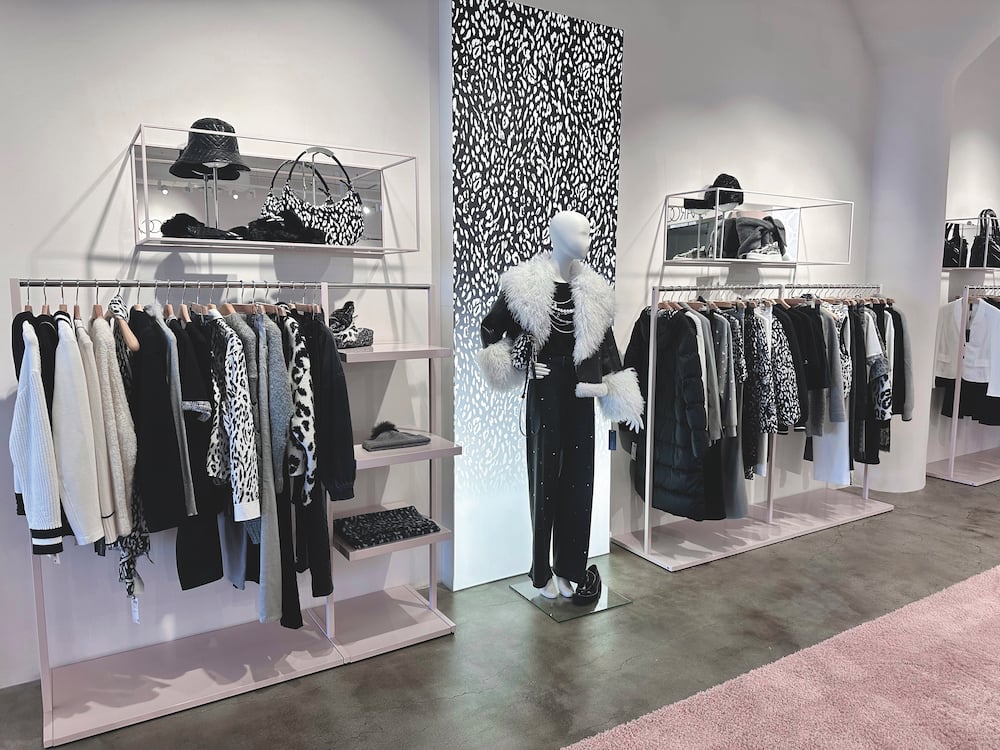
Display in the Marc Cain showroom in Los Angeles. Photo: Marc Cain
Independent Retailers Continue to Play a Key Role
Even as Marc Cain expands its direct retail footprint, independent boutiques remain central to the company’s Canadian strategy.
“There’s a very strong wholesale business in Canada, particularly in Ontario and Quebec,” said R’Bibo. “Many of those retailers have carried the brand for decades.”
Retail currently represents roughly 35 percent of the Canadian business, with wholesale accounting for the balance. R’Bibo said preserving that balance remains an important priority moving forward.
“Our wholesale partners in Canada and the U.S. are extremely important to us, and we highly value those long-standing relationships,” she said. “We want to continue growing together while listening closely to the evolving demands and expectations of today’s consumer.”
The continued importance of wholesale also reflects the structure of Canada’s premium fashion market, where independent boutiques often remain critical discovery channels for European luxury and contemporary brands.
Personalized Service and Experiential Retail Regaining Importance
R’Bibo believes premium retail is increasingly shifting back toward personalization, styling, and experiential shopping following years of digital acceleration.
She sees opportunity in expanding trunk shows, private shopping events, styling appointments, and customer-focused retail experiences designed to strengthen loyalty and long-term relationships.
“Customers want service and they want an experience,” she said. “They want to feel welcomed, understood, and taken care of.”
That relationship frequently extends across multiple product categories, with Marc Cain shoppers often purchasing complete looks rather than individual items.
“They’re building wardrobes,” said R’Bibo. “They want guidance and confidence in what they’re buying.”
While e-commerce continues to grow and now represents roughly 20 percent of sales, she said physical retail remains essential because stores allow customers to engage directly with fabrication, fit, styling, and the broader brand environment.
Marc Cain showroom in Los Angeles. Photo: Marc Cain
Building Marc Cain’s Next Chapter in North America
Since joining Marc Cain earlier this year, R’Bibo has quickly emerged as one of the executives shaping the brand’s next phase of North American growth.
The company currently operates showrooms in Montreal, New York, and Los Angeles while also evaluating additional U.S. opportunities in markets such as Dallas.
For R’Bibo, the path forward centres on disciplined expansion, strong retail partnerships, elevated service, and maintaining a clear luxury positioning within an evolving fashion landscape.
“If you have the right product and you truly understand your client, there’s tremendous opportunity,” she said.
As consumers continue gravitating toward quality, craftsmanship, personalized service, and more intentional forms of luxury spending, Marc Cain appears well positioned to expand its presence within Canada’s evolving market for understated luxury fashion.
Welcome to the Daily Synopsis by Retail Insider. We published 11 articles covering significant updates in Canadian retail across various sectors.
Reitmans recorded modest revenue growth of 0.8% in Q1 2026 driven by retail stores despite fewer locations, alongside improved adjusted EBITDA and strategic workforce reductions. Groupe Dynamite also posted a 37% revenue increase with a four-year high gross margin of 67.4% in Q1 2026, supported by new stores in premium locations and strong sales per square foot performance. Meanwhile, Marc Cain is pursuing careful Canadian expansion under new leadership focusing on premium malls and emphasizing quality craftsmanship and personalized service.
Zellers is reviving nostalgic retail by introducing a mobile diner and kiddie rides ahead of its Toronto store opening, expanding its experiential retail approach across Canada. The Competition Bureau is also investigating factors affecting food affordability to guide policy, while Foodtastic is growing its portfolio by acquiring Kinton Ramen to expand Asian dining. Additional coverage includes consumer spending patterns amid rising grocery costs and evolving AI shopping preferences influencing retail strategies.
Food prices have risen sharply in recent years, putting significant pressure on Canadian households. While many factors influence food prices, competition plays an important role in keeping prices in check and giving Canadians more choice, it explained.
The Bureau said its examination will look for potential competition issues in three key areas:
Production and processing, including how food is grown, caught, transformed and packaged;
Transportation and distribution, including how food moves to retailers across Canada; and
Retail pricing practices, including loyalty programs, pricing algorithms, shrinkflation and skimpflation.
The Bureau said it is seeking input from Canadians and organizations with experience in the food supply chain. They are invited to share their views through an online form by July 31. The Bureau said it will also meet with groups and hold roundtable discussions in the coming months to determine where competition is not working well, where there are barriers, and what could help improve competition.
The Bureau added it will publish a final report in spring 2027. The report will share findings and make recommendations to governments on how competition can be strengthened across the food supply chain.
Dr. Sylvain Charlebois
“If the Competition Bureau wants to understand why food affordability remains a challenge in Canada, it needs to look beyond grocery store shelves. The biggest barriers to competition often exist upstream—in processing, distribution, transportation, and even local property controls that prevent new food retailers from entering markets. This broader examination is long overdue,” said Dr. Sylvain Charlebois is Senior Director of the Agri-Foods Analytics Lab at Dalhousie University in Halifax.
“Competition matters, but Canadians should not expect a silver bullet. Food prices are influenced by labour costs, regulations, productivity, currency fluctuations, climate events, and global market conditions. More competition can help, but affordability ultimately depends on building a more productive and competitive food system from farm to fork.
“The Bureau’s 2023 study concluded that Canada needs more grocery competition. This new examination recognizes an important reality: the problem isn’t just retail concentration. Canada’s food affordability challenge is rooted in an entire supply chain that has become less competitive over time.”
“The cost of food matters to all Canadians, and strong competition can help keep prices in check. Our examination builds on our earlier work in the retail grocery sector and will look at all parts of the food supply chain. If you have experience in any sector along that supply chain, we want to hear from you. Your input will help us find solutions that support competition and affordability,” said Jeanne Pratt, Interim Commissioner of Competition.
“This is not a market study. It is a broader approach to understand where engagement from the Bureau is needed going forward, and where policymakers may be able to take action,” it said.
“The Bureau does not set prices. We examine whether markets are working competitively and whether barriers may be limiting competition.
“This examination is not a law enforcement investigation and is not about any specific complaint or allegation of wrongdoing. However, if the Bureau finds evidence of anti-competitive behaviour, it will investigate and take appropriate action.”
Bruce Winder, a retail analyst, said: “From what I understand, the retail part of the Canadian grocery industry was already studied from a competition perspective at length in 2023. Studying it again may waste resources and come off as performative.
“However, I do think that the upstream parts of the sector need to be reviewed. These parts include suppliers such as large global consumer packaged goods (CPG) firms. There has been significant consolidation on the vendor side over the last 20 years. Just a handful of food companies control most of the international market. These large global CPG firms generate significantly more margin than Canadian grocers. But the Bureau should also examine production, processing, transportation and distribution as well.
Bruce Winder
“If one does reflect on the retail side, Canada is one of a few markets where the big global grocery retailers (Walmart and Costco) already own about 1/3 of the market and have been growing. The retail side has razor thin margins (3-4% net ) and is already incredibly competitive. I think as a country we want to avoid a race to the bottom where innovation and employment would suffer.
“I have written much about surveillance pricing recently, especially in the grocery sector. Any regulation would be a solution looking for a problem. The big three Canadian grocers have indicated publicly that they are not using it. Consumers would quickly find out and punish any offending grocer as a result. We also want to be careful we don’t get rid of loyalty programs and other incentives as a result of any proposed government intervention.”
“In Toronto, it’s nearly 25%. While those statistics are concerning, they do not automatically point to a single cause, nor do they necessarily indicate a lack of competition among grocers or suppliers,” he said.
“It is prudent for the Competition Bureau to examine whether competitive factors are affecting food affordability and whether consumers are receiving the full benefits of a competitive marketplace.
“Food affordability is influenced by a complex ecosystem of factors, including inflation, supply chains, labour costs, transportation, energy, taxation, consumer demand, and market competition. Since COVID, many of these cost pressures have created affordability challenges for households across the country.
“One area that warrants closer examination is how technology, data analytics, and loyalty programs influence pricing strategies and consumer purchasing behaviour. There is nothing inherently wrong with targeted promotions or personalized offers; they can create significant value for consumers and retailers alike. Yet, one question is: Are sophisticated tools like AI inadvertently changing how different customer segments experience food affordability?
“Whatever the findings, food affordability is ultimately an economic issue with multiple factors beyond a grocer’s control.”