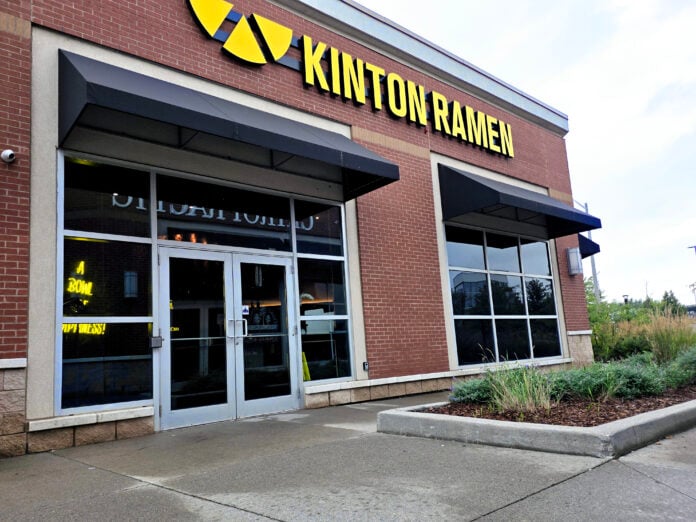
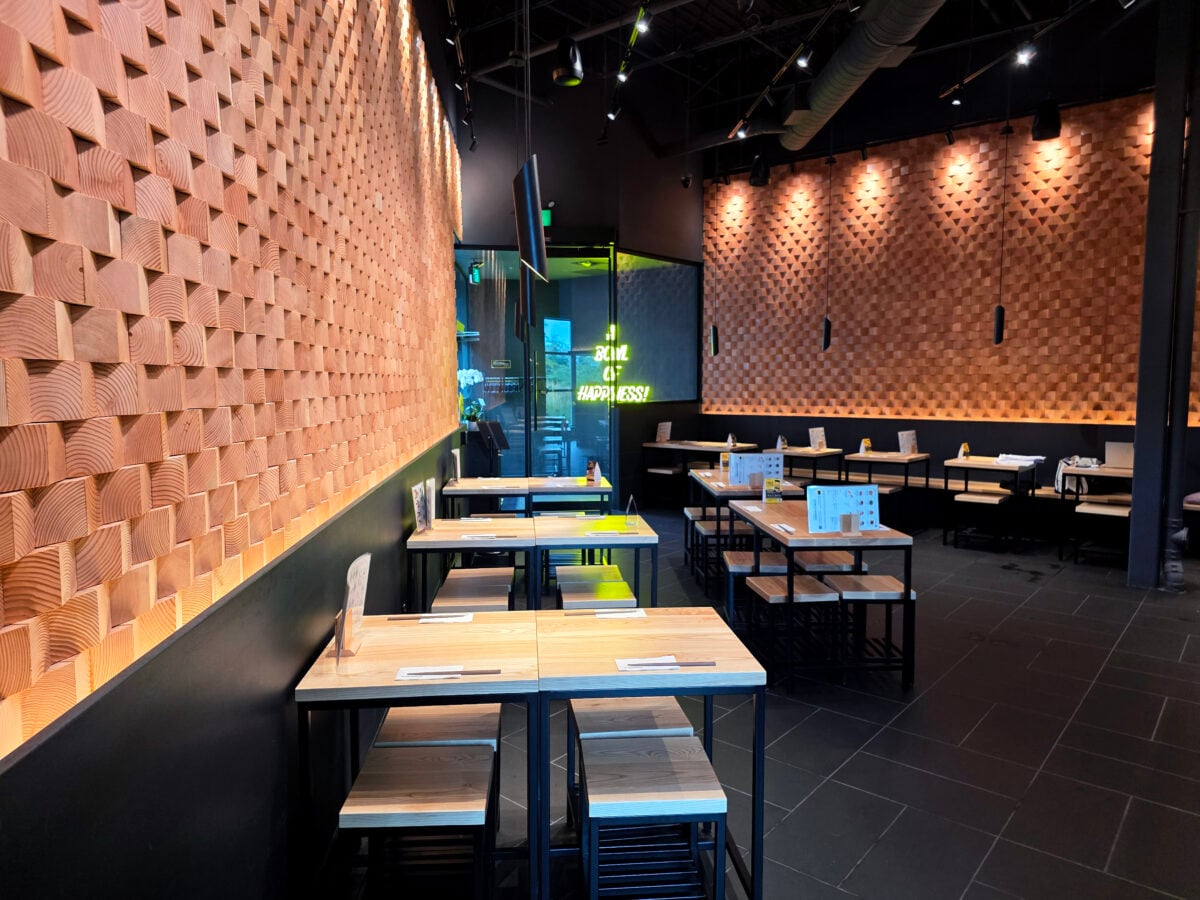
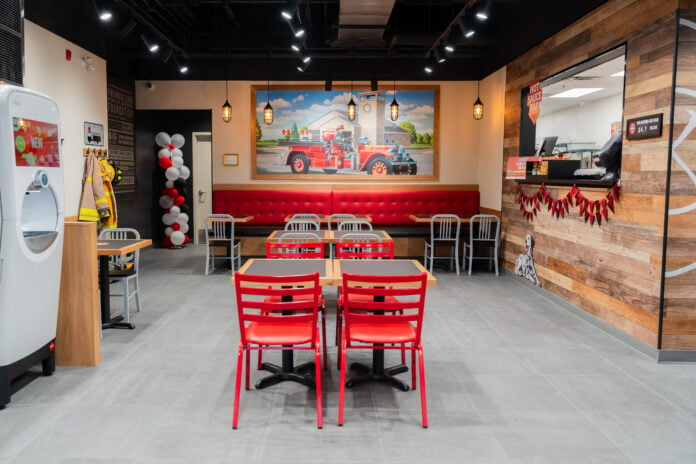
Kinton Ramen has opened its third Hamilton-area restaurant, expanding the Japanese ramen chain’s presence in the region with a new location in Ancaster Village.
Kinton Ramen Wilson Ancaster is located along the commercial and retail stretch of the village and is the company’s latest addition to a network of more than 60 restaurants across five provinces.
New Ancaster location
The restaurant is currently operating under a soft opening, with hours from noon to 8 p.m. Monday through Sunday. The company said a formal grand opening is expected once the restaurant team is fully settled into operations.
The Ancaster location is situated near the Hamilton Golf and Country Club and is intended to serve residents and visitors to the village, as well as customers shopping and dining in the surrounding commercial area.
Kinton Ramen photo
“Ancaster Village is an ideal location for KINTON RAMEN, given the strong mix of local residents, shopping, dining and nearby recreational destinations,” said Trista Jorgensen, Marketing Director, KINTON RAMEN, part of the Foodtastic family of brands. “We’re confident KINTON RAMEN Wilson Ancaster will become a popular destination for the community and visitors to the village, and we’re excited to welcome guests through our doors.”
The concept specializes in Japanese cuisine, including ramen made with slow-cooked broths. The company said its two existing Hamilton-area restaurants have established a local customer base, providing a foundation for the Ancaster expansion.
“Hamilton has been an incredible market for KINTON RAMEN, and the response we’ve received from guests over the years has reinforced just how much demand there is for authentic, high-quality ramen in the community,” said Jorgensen. “Opening in Ancaster is an exciting next step, and we look forward to becoming part of the village and welcoming both returning guests and new customers.”
Kinton Ramen photo
Kinton Ramen has also announced the grand opening of its second Mississauga location at Heartland Town Centre, a premier open-air power centre, on September 19, following a successful soft-opening period. Doors will be open from 11 a.m. to 12 a.m. that day – and dine-in guests can enjoy 50 per cent off all regular ramen items to celebrate.
KINTON RAMEN Heartland Mississauga is located at 6045 Mavis Road, Unit 11, in the southern end of the shopping centre. The new restaurant offers visitors an affordable and accessible dining option in one of the GTA’s premier retail destinations.
Continued Canadian expansion
The openings are part of Kinton Ramen’s broader Canadian expansion. The company now operates more than 60 locations in Ontario, British Columbia, Manitoba, Alberta and Quebec, with much of that growth occurring over the past five years.
Kinton Ramen was established in Toronto in May 2012 and was among the city’s first Japanese ramen restaurants. The company is led by executive chef Aki Urata and a team of ramen chefs and is part of the Foodtastic family of brands.
The company says its restaurants focus on ramen made with fresh ingredients, including noodles and broths, as well as other Japanese dishes.
At 9:05 on the first morning of a holiday campaign, a merchandising coordinator updates the banner on a retailer’s Canadian store. Seven minutes later, the US team discovers that its promotion has disappeared. Both employees had been switching between regional storefronts in the same browser, and one of them edited the wrong account.
The mistake takes only minutes to correct. Finding out why it happened takes much longer.
This is the less visible side of multi-store growth. A retailer may successfully launch new storefronts, marketplaces, advertising accounts, and social commerce channels while continuing to rely on browser workflows designed for a much smaller business.
Employees move between similar dashboards. Agencies request access to client accounts. Regional teams need different configurations and permissions. Login sessions, browser extensions, and account settings accumulate across personal computers. The company may have added more selling channels, but it has not built an operating system for managing them.
Reliable multi-store e-commerce operations begin by giving every store, employee, and automated process the correct working context before a task starts.
A single online store usually has a recognizable set of systems: an e-commerce platform, an advertising account, analytics, email marketing, customer support, and perhaps one or two marketplace integrations.
A multi-store retailer repeats that structure across brands, countries, or sales channels. The number of possible errors grows faster than the number of stores because employees must also remember which account, region, permission level, and browser configuration belong together.
The pressure becomes especially visible during product launches, seasonal promotions, regional expansion, and staff changes.
Operational layer
Common multi-store problem
What the team needs
Regional storefronts
Similar dashboards make it easy to update the wrong market
Clearly separated and labeled workspaces
Marketplace accounts
Login sessions and settings become mixed across platforms
Persistent browser environments for each authorized account
Advertising operations
Teams may confuse brands, currencies, or campaign regions
Role-specific access and a clear account context
Agency collaboration
External partners receive broader access than their work requires
Controlled access to assigned environments
Staff transitions
Important sessions and configurations remain on personal devices
Company-managed workspaces that survive personnel changes
Repetitive workflows
Manual effort increases with every new store
Gradual automation with review and recovery steps
Password managers can improve credential storage, and native platform permissions remain essential. Neither one, however, provides a complete browser workspace containing the correct session, extensions, settings, bookmarks, and operating context for a specific store.
That gap is where many multi-store workflows become unreliable.
Consider a Canadian retailer expanding into the United States and the United Kingdom.
The company operates three Shopify storefronts, two marketplace seller accounts, regional advertising campaigns, separate customer communication channels, and several analytics tools. An internal team manages pricing and merchandising, while an agency handles paid media and regional contractors prepare localized content.
At first, the company records access information in a spreadsheet. Employees create bookmarks and manually sign in to whichever system they need. Everyone knows the arrangement is imperfect, but replacing it does not feel urgent.
Then the business enters a busy promotional period.
A contractor prepares UK content inside the Canadian store. A media buyer opens the wrong advertising account and has to verify every change made during the session. An urgent update is delayed because its authentication request goes to an employee who is unavailable. Management cannot easily determine which browser setup was used for a disputed change.
None of these incidents necessarily causes a major loss on its own. Together, they consume management time and make every new store harder to support.
The root problem is not employee ability. The workflow expects people to hold too much account context in their heads.
A stronger system makes the correct context visible. Instead of telling an employee to “open the right account,” the retailer assigns a clearly named workspace associated with the store, market, and task.
A dedicated browser profile is a saved environment for a particular store, brand, market, or operational role. It can retain the relevant login state, browser data, extensions, bookmarks, and configuration without mixing them with unrelated operations.
The objective goes beyond organizing browser tabs. Each profile creates a recognizable boundary around a specific area of work.
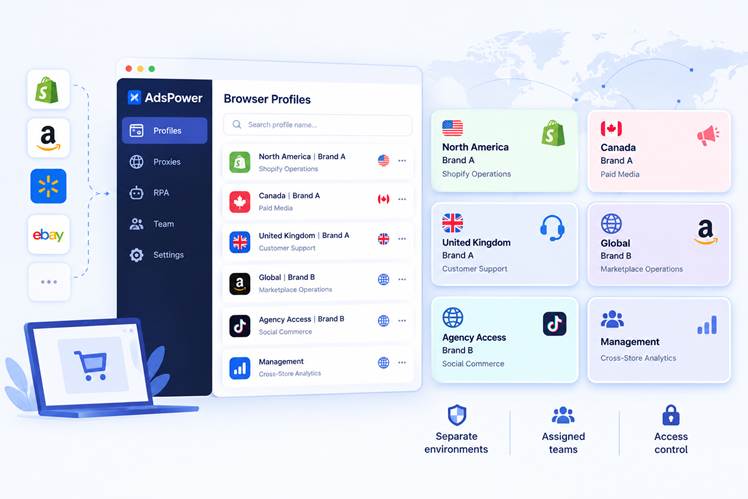
A retailer might maintain profiles such as:
North America | Brand A | Shopify Operations
Canada | Brand A | Paid Media
United Kingdom | Brand A | Customer Support
Global | Brand B | Marketplace Operations
Agency Access | Brand B | Social Commerce
Management | Cross-Store Analytics
The naming convention is not a minor detail. Labels should be clear enough that an employee can select the correct environment during a busy shift without opening it first.
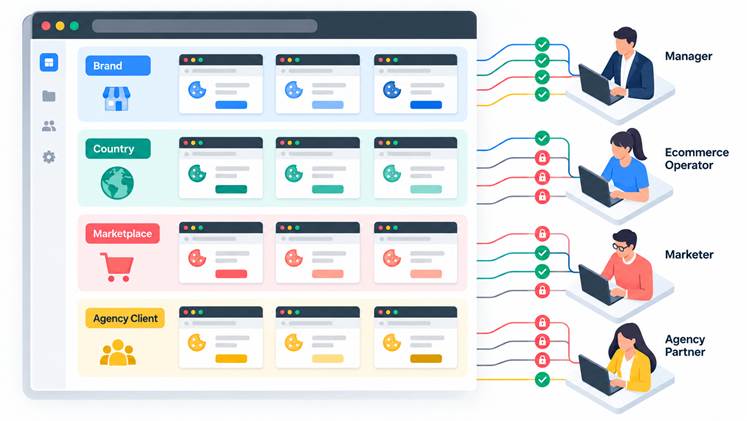
Multi-store management works best when each storefront is treated as an operational unit with an assigned environment, responsible team members, and defined access rules. Retailers can organize environments by country, brand, marketplace, or client depending on how the business is structured.
This model also improves continuity. A new employee does not have to reconstruct a working setup from scattered instructions. If someone leaves the organization, the company can remove that person’s access while retaining the environment required to operate the store.
Browser environment tools are sometimes treated as highly specialized technology. For legitimate retail teams, their practical value is more straightforward: they provide a structured way to maintain separate working environments at scale.
An anti-detect browser such as AdsPower can help authorized teams create and manage individual browser profiles for different stores, markets, and operational responsibilities.
Within AdsPower, browser profiles can be grouped and labeled according to a retailer’s own structure. One organization may group profiles by brand, while another may organize them by country, marketplace, or agency client. Each profile maintains its own browser data and working context.
Team permissions add another layer. Managers can assign environments to the people responsible for them instead of distributing every credential to every employee. This does not replace the native security controls of Shopify, Amazon, advertising platforms, or other services. It complements them by making access at the browser-workspace level easier to organize.
Browser profiles can be organized around the retailer’s structure, while access is assigned according to each team member’s responsibilities.
The purpose is operational separation and authorized team management. Retailers must still comply with the policies of every marketplace, advertising service, and commerce platform they use. A managed browser environment should make legitimate work more consistent, not provide a reason to ignore platform requirements.
Technology works best after the retailer has defined who owns each store, which systems are involved, and where approval is required. The following process provides a practical starting point.
Begin with an inventory of storefronts, marketplace accounts, advertising dashboards, customer communication channels, analytics platforms, and supplier portals.
For each system, record its brand, region, internal owner, approved users, business purpose, and data sensitivity. Include the native permission controls already available inside the platform.
This exercise often identifies problems before any new technology is introduced. Teams may discover inactive accounts, overlapping responsibilities, contractors who still have access, or important systems without a clear owner.
A useful test is simple: if an employee sees an unfamiliar login alert, does the company know exactly who should investigate it? If the answer depends on asking around, ownership is not yet clear enough.
A single environment for an entire department is often too broad.
A merchandising specialist updating product pages may not need advertising billing access. A media agency may need campaign dashboards but not customer order records. A support contractor may require access to one regional store without seeing another market’s operation.
Profiles should reflect the smallest practical area of responsibility. This makes the workspace easier to understand and limits unnecessary access.
Retailers should also adopt a consistent naming format. A simple structure such as Market | Brand | Function is easier to scan than a collection of profile names created independently by different employees.
Once profiles are established, managers can assign them to the relevant employees or external partners.
This is more reliable than asking each person to recreate browser configurations on a personal device. It reduces dependence on informal instructions such as “use the second Chrome profile” or “ask the previous account manager which extension to install.”
Access should be reviewed after role changes, agency transitions, seasonal hiring, and market closures. A quarterly review may be sufficient for a stable team, while rapidly changing organizations may need a monthly process.
The review should answer three questions:
Does this person still require access?
Is the access appropriate for the person’s current role?
Does the environment contain anything the person does not need?
Not every browser action has the same business impact.
Opening a reporting dashboard is different from changing a product price. Preparing a post is different from publishing it. Checking whether a campaign is active is different from increasing its daily budget.
Retailers should document the actions that require additional approval. These commonly include refunds, pricing changes, new permissions, banking information, advertising budgets, and public brand communications.
This step is essential before automation. If the company has not decided where human approval belongs, automation can make an unclear process run faster without making it safer.
The best first candidates for automation are frequent, rules-based, reversible, and easy to verify.
A retailer might begin with a workflow that opens an assigned browser profile, visits an approved reporting page, checks whether expected information is available, and prepares the result for an employee. The final interpretation remains with a person.
AdsPower offers RPA for predefined browser processes and a Local API for organizations that want to connect profile management with internal systems. RPA may suit repeatable visual tasks, while API access gives technical teams more flexibility for custom integrations.
A limited pilot is more useful than an ambitious rollout. Start with one store, one workflow, and a clearly defined fallback procedure. Run it long enough to encounter ordinary variations rather than judging it after one successful demonstration.
One of the most common automation mistakes happens before a workflow is ever built: the team assumes that everyone performs the task in the same way.
Ask three experienced operators to complete a routine store check, and they may take three different paths. One verifies inventory first. Another checks recent orders. A third opens a reporting tool before entering the store dashboard.
Automation does not resolve that inconsistency. It simply turns one version of the process into a repeatable sequence.
A practical discovery method is to ask an experienced operator to perform the task while describing each decision aloud. Record where the person pauses, checks another source, or makes a judgment based on context.
Those pauses reveal the boundary between a stable rule and human expertise.
Teams should also measure more than time saved. A useful pilot tracks correction rates, failed steps, wrong-store actions, manual recovery time, and the number of exceptions requiring employee judgment.
A process that runs quickly but regularly needs repair may be less valuable than a slower workflow that is transparent and easy to audit.
Rules-based automation works well when every step is known in advance. Retail operations also contain requests expressed in ordinary business language:
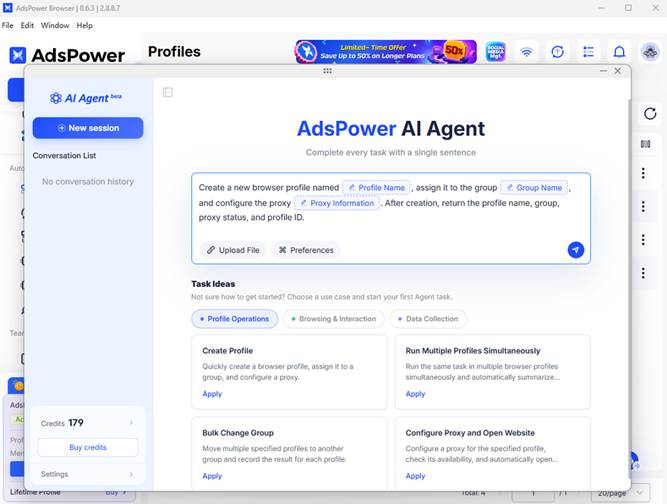
“Create a new browser profile named XXX, assign it to the group XXX, and configure the proxy Proxy Information. After creation, return the profile name, group, proxy status, and profile ID.”
“Open the browser profile with ID XXX,open platform XXX, and use the current account to publish XXXXXX. Pause the task and report the reason if verification, upload failure, or publishing restrictions occur.”
AdsPower’s recently launched AI Agent allows users to create and operate browser profiles through natural-language instructions. It can also perform selected browser tasks, including publishing approved content to accounts. Organizations can connect their own MCPs and Skills to extend the workflows available to the agent.
This gives employees another way to interact with the operational environment. Instead of navigating each configuration screen manually, an authorized user can describe the intended task conversationally.
Natural language does not eliminate the need for governance. A vague request can be just as ambiguous to an AI agent as it would be to a new employee.
Before allowing an agent to participate in production workflows, retailers should define which profiles it may access, which actions it may complete, and which steps require confirmation. The team also needs a recovery process for unexpected page changes, authentication requests, incomplete information, or actions that fall outside the approved workflow.
For many retailers, automation will operate in layers:
Manual profiles for sensitive or unfamiliar work
RPA for stable, repetitive browser sequences
APIs for connections with internal systems
AI Agent and MCP integrations for natural-language task coordination
Human approval for consequential decisions
The strongest system is not necessarily the one with the highest level of automation. It is the one that assigns the appropriate level of automation to each task.
The best automation candidates are routine, rules-based, and easy to verify. These may include opening the correct browser profile, navigating to approved pages, collecting authorized operational information, running standard checks, or preparing content for review.
Actions involving pricing, refunds, advertising budgets, customer disputes, permissions, or public brand communications should retain human oversight. The higher the potential impact on customers, payments, or platform compliance, the stronger the approval process should be.
Retailers should apply the same principle when choosing multi-store management technology. Profile capacity and feature count matter less than a few practical questions:
Can environments be organized around actual stores, brands, and team roles?
Can managers limit access and review sensitive actions?
Can the system progress from manual workflows to RPA, API, and AI-assisted operations?
Is there a clear recovery process when a workflow fails or a platform changes?
A flexible platform should allow retailers to automate gradually instead of forcing every task into the same model. Manual work, RPA, APIs, and AI agents each have a place. The right choice depends on the risk, frequency, and complexity of the task.
Automation is most useful when it reduces repetitive work while keeping responsibility visible.
New storefronts can be launched quickly. Building a team that operates them consistently takes longer.
As retailers expand across brands, marketplaces, and countries, mixed browser sessions, shared setups, unclear permissions, and undocumented routines create more opportunities for error. Dedicated browser profiles give each store a recognizable working context, while team permissions align access with responsibility.
RPA and APIs can handle stable processes, and AI agents make selected tasks easier to initiate through natural-language instructions. Together, these capabilities show how browser profile management is becoming part of the operating infrastructure for distributed e-commerce teams.
The goal is not to automate every decision. It is to ensure that employees and automated processes enter the correct store with the correct permissions and context. With that foundation in place, retailers can add new markets and channels without adding the same level of operational confusion.
Welcome to the Daily Synopsis by Retail Insider. We hope you enjoy the 13 articles we published covering key developments in Canadian retail.
Groupe Dynamite is shifting its retail growth focus toward higher-productivity stores internationally, particularly in the U.S. and U.K., while optimizing its mature Canadian network through selective closures and renovations. Empire Company Limited is rejecting supplier price hikes related to new Canada-U.S. tariffs, leveraging its diverse sourcing options and past experience to manage cost pressures without passing them to consumers. Canadian retail continues to expand amid economic challenges including tariffs, rising costs, and shifting consumer priorities.
Apple’s introduction of the high-priced iPhone Duo and elevating Pro model prices signal a shift in Canada’s premium smartphone market, emphasizing financing, trade-ins, and in-store demonstration to support affordability perceptions. Fraud imposes significant hidden costs on Canadian retailers, extending beyond direct losses to include time and resources spent managing disputes and operations.
Firehouse Subs has reached a milestone with the opening of its 200th Canadian restaurant in Calgary, doubling its national presence since 2024 and reinforcing its focus on key markets. Consumer insolvencies in Canada reached nearly 400 daily filings in the year ending January 2026, with bankruptcies rising faster than consumer proposals, indicating growing financial distress among households. Canadian retailers face urgent challenges due to new U.S. tariffs impacting nearly 900 product categories, requiring careful reassessment of pricing strategies to safeguard margins without alienating price-sensitive consumers.
Canadian retail properties showed strong performance in the first half of 2026, with tight vacancy rates and rising demand particularly in suburban and grocery-anchored centers. Ryde: has introduced a new sleep-focused functional shot containing melatonin and other ingredients to help adults fall asleep faster on occasional difficult nights. Winnipeg-based entertainment company Activate is entering the Australian market with its first venue opening at Melbourne’s Highpoint Shopping Centre in early 2027, featuring interactive game rooms powered by RFID technology.
INDOCHINO’s Fall/Winter 2026 campaign, Hold the Room, highlights made-to-measure tailoring designed for multiple occasions across a weekend, emphasizing versatility beyond single events. As retailers approach peak shipping season, heightened order volumes increase the risk of lost or damaged shipments, threatening margins and customer satisfaction.
Canadian retailers are stocking more product variants than ever: extra colors, extra sizes, bundle packs, and marketplace-exclusive listings that never touch a physical store shelf. Most inventory systems weren’t built to track that kind of catalog sprawl, and the gap between what a system says is in stock and what’s actually sitting in a warehouse keeps widening. This isn’t really a technology problem. It’s a margin problem, and it’s showing up on income statements long before anyone notices it in the warehouse.
When More SKUs Means More Chaos
Catalog growth tends to outpace the systems meant to manage it. A retailer that once carried three sizes of a product now carries eight, plus two colorways and a limited-edition bundle, and each new variant needs its own bin location, reorder point, and place in the picking workflow.
Near-duplicate SKUs- think two listings for the same shirt that differ only by a packaging update- cause pick errors and force warehouse staff to hold larger safety-stock buffers just to avoid running short. Those buffers eat directly into margin.
The problem is bigger than most operators assume. Inventory distortion, the combined cost of stockouts and overstocks, costs retailers an estimated $1.7 trillion a year worldwide, equal to 6.2% of global retail sales, according to 2026 IHL Group research. Out-of-stocks alone account for 65.6% of that figure. Meanwhile, the average U.S. retailer’s inventory accuracy sits at just 63%, while top performers hit 95% accuracy and 2.1% stockout rates.
That gap between average and top performers is exactly why more growing retailers are outsourcing the physical execution side of the problem rather than trying to solve it entirely in-house. A mid-size apparel brand adding 40 new SKUs a season, for example, doesn’t necessarily need to hire and train a bigger warehouse team; it can bring in a partner like SKU Distribution to handle SKU-level fulfillment and warehousing, freeing internal staff from manual reconciliation and letting them focus on sourcing and merchandising instead.
The Real Cost of Getting It Wrong
Stockouts don’t just cost a single sale. They cost a customer relationship, since most shoppers who hit an empty shelf or a “backordered” tag simply buy the item somewhere else. The good news is that the trend is moving in the right direction: U.S. consumers experienced a 9.5% food out-of-stock rate in 2024, down from 12.3% in 2023 and 19.3% in 2022, according to Purdue University’s Center for Food Demand Analysis and Sustainability.
Progress like that doesn’t happen by accident. It reflects real operational investment, and it lines up with what our recent report on Canadian retail logistics found: retailers that treat inventory visibility as a core operational discipline, not an afterthought, are the ones pulling ahead on both fill rates and customer retention.
Tariffs and Import Volatility Are Making It Worse
SKU-level chaos doesn’t happen in a vacuum. It’s colliding with a macro environment that’s already under strain. The National Retail Federation forecasts U.S. retail sales will grow 4.4% to $5.6 trillion in 2026, even as higher tariffs and import volatility continue to squeeze sourcing and logistics planning. Retailers responding to that volatility by diversifying vendors and geographies end up holding buffer stock across even more SKUs, which compounds the tracking problem rather than easing it.
That pressure is part of a broader pattern in how global supply chains are being reshaped, with retailers rethinking single-country sourcing and building more resilient, if more complex, vendor networks.
Technology and Process Fixes That Actually Work
The retailers closing the accuracy gap aren’t necessarily the biggest ones; they’re the ones investing in the right tools. RFID rollouts have pushed inventory accuracy above 95% for early adopters in several major chains, replacing manual cycle counts with continuous, automated tracking. AI-driven forecasting is delivering similar gains: among retailers using AI-driven inventory tools, 78% reported fewer stockouts and 75% reported less overstock, according to a 2025 Cin7 survey.
None of this works if it’s bolted onto a broken process, though. Operators who’ve watched what happens behind the scenes when retailers expand too fast know that technology amplifies whatever discipline (or lack of it) already exists on the warehouse floor.
Conclusion
SKU-level discipline, not just a top-line growth strategy, is what decides who wins on the shelf in 2026. Adding new variants and new sales channels isn’t going away, and it shouldn’t; it’s how retailers capture new customers. But the winners will be the ones who treat inventory accuracy as a core competency, whether that means building it in-house or leaning on fulfillment partners with the infrastructure in place.
Margin isn’t lost in one dramatic event. It’s lost SKU by SKU, one small reconciliation error at a time.
Retail teams that run self-hosted Magento Open Source or Magento 2 Commerce alongside NetSuite often share the same quiet failure mode. The storefront looks fine. Finance still closes the books. Warehouse staff keep picking. Then a buyer asks why a size that showed in stock on the site is actually sitting in a returns bin, or why a paid order never made it into NetSuite before the carrier cutoff.
That gap is rarely a Magento bug or a NetSuite bug. It is an ops problem: two systems of record that were never given a clear path for orders, inventory, fulfillment, and customers. This piece covers how that drift shows up on the floor, what a durable Magento to NetSuite sync should cover, and a practical checklist retail operators can use before they buy another connector or hire another custom SuiteScript project.
Why retail ops feel the Magento and NetSuite split first
Merchandising and marketing notice late. Ops notices early. When Magento and NetSuite disagree, the first hits are usually oversells on high-velocity SKUs during promotions, pick tickets that go out with the wrong warehouse or store view quantity, customer service tickets about shipped orders that finance never saw, returns that refund in Magento but never update NetSuite inventory or RMA status, and price or tax mismatches that force manual journal entries at month end.
Self-hosted Magento adds another layer. You control the stack, the MSI (Multi Source Inventory) sources, and the store views. That flexibility is why many mid-market retailers stay on Magento Open Source or Magento 2 Commerce instead of moving everything to a hosted SaaS storefront. It also means inventory truth can live across multiple sources, websites, and channels. NetSuite remains the financial and often the inventory backbone. Without a clear sync contract between them, retail teams invent spreadsheets to fill the gap.
What good Magento to NetSuite sync looks like for retail
A workable integration is not a one-way CSV dump. For day-to-day retail ops, the data paths that matter most are orders Magento to NetSuite, fulfillment NetSuite to Magento, inventory bidirectional with MSI, customers both ways, products and pricing NetSuite to Magento, returns and refunds, plus custom fields, credit limits, and tax. If your current connector only pushes orders and ignores MSI or returns, you will keep paying staff to reconcile the rest.
Self-hosted Magento specifics retailers should not ignore
Many Magento retailers run brand sites, regional sites, or B2B vs B2C store views on one instance. NetSuite often models those as subsidiaries, locations, classes, or custom segments. Mapping has to be explicit. A default website assumption breaks as soon as a second store view starts selling the same SKU with different tax or price rules.
Magento MSI lets you assign quantities to sources and stock. NetSuite has locations and bins. A retail-grade sync needs a source-to-location map you can explain to a warehouse manager in one whiteboard session. Real-time or near-real-time MSI updates matter most during flash sales and omnichannel pickup windows.
Self-hosted Magento shops already carry enough module risk. Integrations that require a heavy Magento extension or custom SuiteScript for every field change create upgrade friction. Prefer connectors that talk to Magento through the REST API and keep NetSuite configuration light, so upgrades and security patches stay on a normal cadence.
Where teams usually waste budget
Before you approve another integration invoice, watch for one-way order-only tools that leave inventory and returns for people, per-transaction fees that hurt at retail volume, long professional-services go-lives where every Magento field needs a statement of work, and pitches that treat Adobe Commerce Cloud as if it were your stack. Adobe Commerce Cloud and enterprise Adobe B2B Company-account setups are a different product conversation. Self-hosted Magento Open Source and Magento 2 Commerce need Magento-native mapping, not a cloud-only story.
A practical retail checklist before you connect
Inventory and MSI: list every Magento MSI source and the NetSuite location it maps to, decide which system wins on conflict, and confirm how safety stock, backorders, and out of stock thresholds behave on each store view.
Orders and fulfillment: define which Magento order statuses create a NetSuite sales order, confirm partial shipments and multi-package tracking flow Magento-side, and document how gift cards, store credit, and promotions land in NetSuite.
Customers and credit: choose a customer match key, map Magento customer groups to NetSuite price levels or terms, and if you sell on account, confirm credit limits sync and where holds are enforced.
Returns, tax, and custom fields: walk one full return from Magento credit memo through NetSuite RMA or credit to inventory putaway, validate tax codes for each store view, and inventory every custom Magento attribute finance needs in NetSuite.
Ops readiness: name an owner for failed sync queues, agree on same-day versus batch windows for inventory versus overnight product sync, and test a peak-day volume sample, not a three-order happy path.
What Dominate covers for self-hosted Magento retailers
For teams that want Magento and NetSuite to stay aligned without building a permanent custom project, Dominate Magento NetSuite integration is built for self-hosted Magento Open Source and Magento 2 Commerce.
In practical terms, Dominate syncs orders Magento to NetSuite, fulfillment NetSuite to Magento, inventory bidirectionally with MSI, customers both ways, products and pricing NetSuite to Magento, plus returns and refunds, custom fields, credit limits, and tax. Multi-store view mapping and real-time MSI inventory are part of the design. B2B company accounts are available on Enterprise.
Connection is through the Magento REST API: no Magento extension and no SuiteScript project to babysit. Go-live is same-day self-serve. Pricing starts from $99/mo, with Pro at $249/mo and Enterprise at $699/mo, with no setup fees and no per-transaction fees.
Dominate is the product brand. It is built by eCommerce engineers at IWD Agency, which matters mainly if you care that Magento edge cases were designed by people who ship Magento stores for a living. Adobe Commerce Cloud and Adobe-specific enterprise B2B Company account setups sit on a separate product path.
Closing: treat sync as retail infrastructure
Inventory and order truth is not a side project. For self-hosted Magento retailers on NetSuite, the goal is simple: Magento sells what NetSuite can fulfill, finance sees what ops shipped, and returns do not create a third set of books. Run the checklist with your team. If your current path still depends on CSV exports or one-way order posts, replace it with a Magento REST-based sync that covers MSI, fulfillment, and returns.
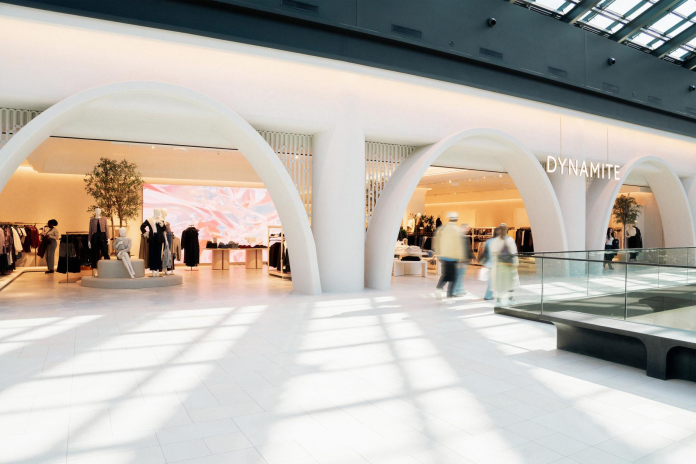
Dynamite store at Royalmount in Montreal. Photo: Charlie Marois, Berenice Golmann
Groupe Dynamite is increasingly directing store growth toward the U.S. and international markets while upgrading and selectively reducing parts of its mature Canadian network. The strategy is tied to a broader transformation of Garage, where the customer, merchandise mix and approach to real estate have changed substantially over the past several years.
The geographic split was clear in the Montreal-based retailer’s second-quarter results. Canadian revenue declined 1.9% to $145.1 million with 13 fewer stores, while U.S. revenue increased 52.2% to $271.6 million. Management expects future brick-and-mortar growth to come primarily from the U.S. and, over time, the U.K.
Garage already has nearly six times the store density per capita in Canada that it has in the U.S., according to management. Canada offers less white space for conventional store expansion, while its established network includes locations opened during earlier stages of Garage’s development.
The Garage being expanded internationally is also different from the brand on which much of the Canadian network was built.
Garage Has Changed With Its Customer
Andrew Lutfy – Photo courtesy of Carbonleo
CEO Andrew Lutfy told analysts that Garage’s target customer, or “muse,” was approximately 16 years old six years ago, while its actual customer was closer to 14. Today, the brand targets a 24-year-old customer and its actual customer averages approximately 22.5 years old.
The assortment has changed along with that customer. Lutfy estimated that “casual street” categories, including denim, sweaters and woven shirts, may have represented roughly 70% of Garage sales six years ago. He estimated that figure at approximately 15% today as the company has expanded further into activewear, athleisure and lifestyle dressing.
That evolution creates different circumstances on either side of the border. Canadian shoppers have a longer history with Garage as a denim and casual-fashion retailer, while many U.S. consumers are being introduced to the brand after much of the repositioning has already taken place.
It also gives Groupe Dynamite an opportunity to build much of its U.S. network around the current Garage concept rather than reworking a store base as extensive as the one it already operates in Canada.
Canadian Network Is Being Optimized
Groupe Dynamite continues to invest in Canadian locations through renovations and relocations, but the company has also accelerated closures within the mature network. It closed six Canadian stores during Q2, including four Garage and two Dynamite locations, after closing four Canadian Dynamite stores during Q1.
The 1.9% decline in Canadian Q2 revenue should be considered alongside that reduction in store count. Canadian revenue remained up 2.1% for the first half of the fiscal year, while management characterized Q2 comparable-store performance as approximately flat.
Stifel Managing Director Martin Landry noted that Q2 represented the company’s first year-over-year decline in Canadian sales in four years. He estimated, however, that the reduction was driven largely by store closures rather than deterioration in sales at the remaining locations.
The Canadian strategy is increasingly centred on portfolio productivity. Groupe Dynamite has a large established network in its home market and is determining which stores warrant continued investment, which should be upgraded or relocated, and which no longer fit the economics it wants from the portfolio.
Image: Garage
Investment-Grade Real Estate Takes a Larger Role
Groupe Dynamite classifies Tier 1 through Tier 3 properties as investment-grade real estate and has steadily increased its exposure to those locations. Lutfy has described the philosophy as being the “smallest house on the best street,” reflecting the company’s preference for stronger retail environments over larger stores in weaker locations.
Investment-grade stores accounted for approximately 28% of Groupe Dynamite’s sales in 2017. They now generate roughly 72%.
There is an important difference between that sales concentration and the composition of the physical network. Landry estimates that approximately 57% of Groupe Dynamite’s stores are currently investment grade, while management is targeting approximately 70% by fiscal 2028. He estimates the company will need to renovate or relocate approximately 32 stores over the next two-and-a-half years to reach that level.
The productivity difference between the stores entering and leaving the portfolio is substantial. Landry estimates that new investment-grade stores can generate four to five times the revenue of non-investment-grade locations, with an even larger difference in earnings. New openings are concentrated primarily in Tier 1 and Tier 2 properties, while closures are focused on Tier 4 and Tier 5 stores.
Net store count therefore provides an incomplete picture of Groupe Dynamite’s growth. Replacing a low-volume location with a substantially higher-productivity store can add significant selling capacity without a large increase in the overall size of the network.
Garage’s international expansion reflects that approach. The retailer has entered major U.K. shopping destinations including Bluewater Centre and Oxford Street, with management reporting encouraging early results. In the U.S., locations such as SoHo and the planned New York expansion represent the type of high-productivity real estate Groupe Dynamite is prioritizing.
Inventory Follows Store Productivity
Groupe Dynamite’s real estate strategy is closely connected to how it manages inventory. The company deliberately operates with lean inventory and uses a pull model in which relatively small initial quantities are distributed before subsequent allocations respond to demand.
Stores producing stronger sales and full-price sell-through can pull additional merchandise from the available inventory pool. Management is allocating inventory to maximize productivity and gross-margin dollars across the network rather than attempting to keep every location equally stocked.
The model favours stores where merchandise is moving fastest. A high-productivity location can sell through its initial allocation, pull additional product and create further opportunities for full-price sales, while a weaker store may receive less inventory as merchandise is directed elsewhere.
Lutfy used Sudbury, Ontario, to illustrate the trade-off. If stores in markets such as SoHo and Oxford Street are pulling aggressively against limited company-wide inventory, a tertiary Canadian location may receive less product and effectively “pay the price.”
Real estate and merchandise allocation are therefore working in the same direction. Groupe Dynamite is investing in locations with higher sales potential while its inventory system directs additional product toward stores demonstrating the strongest demand.
The model requires the retailer to replenish winning merchandise and respond quickly when customer demand changes. Stifel estimates that Groupe Dynamite averaged approximately 37 days of inventory in 2025, with about 75% of SKUs moving from fabric to store in less than 15 weeks and 31% doing so in fewer than eight weeks.
Those lead times allow the company to preserve in-season buying capacity rather than committing the full assortment well in advance. During Q2, President and Chief Operating Officer Stacie Beaver said Groupe Dynamite identified a need for greater newness and made targeted adjustments during the season, including responding to colour requests received from consumers through social media. Sales strengthened as the quarter progressed.
Lutfy also said Groupe Dynamite is using data and AI-supported forecasting as part of its inventory decisions while maintaining open-to-buy capacity for in-season adjustments. The technology supports a broader operating model built around making more merchandise decisions closer to actual demand.
Garage at Guildford Town Centre – Photo: Lee Rivett
Higher Prices Follow a Different Garage Proposition
Garage’s changing merchandise and customer profile have contributed to a significant increase in average selling prices. Groupe Dynamite’s average unit retail has roughly doubled since 2019, which management says reflects changes in product and category mix rather than simply charging substantially more for equivalent merchandise.
The shift toward activewear and more technical products provides room for higher price points, while Garage is increasingly operating in locations serving consumers with greater spending power. Lutfy said Groupe Dynamite made a strategic decision roughly six years ago to respond to a K-shaped economy by targeting a global customer in approximately the top quartile for disposable income.
Management has described its approach as a “luxury-inspired business model.” Garage remains an accessible fashion retailer rather than a luxury brand, but parts of the operating model resemble strategies used higher in the market: stronger real estate, controlled inventory, an emphasis on full-price selling and a customer with sufficient income to support a more elevated merchandise proposition.
The changes in customer age, merchandise mix and average unit retail are closely connected. Groupe Dynamite has spent several years repositioning Garage around a consumer and product assortment capable of supporting the economics of the locations it is now pursuing.
Garage Drives Growth Outside Canada
Garage has become Groupe Dynamite’s primary vehicle for expansion outside Canada, while Dynamite remains considerably more concentrated in the domestic market. Stifel estimates approximately 95% of Dynamite stores are Canadian, while Garage has a much larger U.S. presence and is leading the company’s U.K. expansion.
Landry forecasts Garage growing from 238 stores in Q2 to 262 in fiscal 2027, while Dynamite remains at approximately 69 locations. Groupe Dynamite ultimately expects its combined network to reach approximately 350 stores by fiscal 2028.
The 350-store target tells only part of the story. Groupe Dynamite is simultaneously changing the composition of the network, replacing lower-productivity real estate with stores capable of generating substantially higher volumes.
For Canadian landlords, that points to continued portfolio activity even as most incremental store growth is directed outside the country. Landry’s estimate of approximately 32 renovations or relocations over the next two-and-a-half years suggests substantial work remains within the existing network.
Groupe Dynamite’s growth strategy is increasingly centred on concentrating real estate, merchandise and capital in locations capable of generating higher productivity. Garage, meanwhile, gives the company a relatively underpenetrated platform for U.S. and international expansion.
For Canada, the next phase is likely to involve continued investment in stronger stores alongside further scrutiny of locations that no longer fit the economics of Groupe Dynamite’s evolving network.
Empire Company Limited is pushing back against supplier requests for tariff-related price increases as renewed Canada-U.S. trade tensions create another potential source of cost pressure for Canadian retailers and consumers.
Chief Customer Officer Luc L’Archevêque
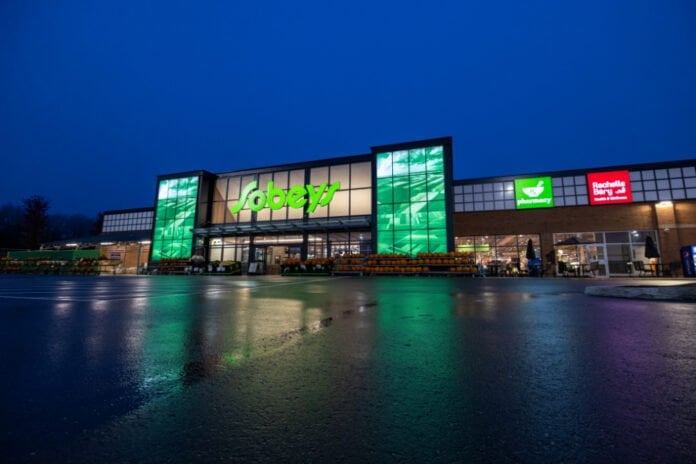
The parent company of Sobeys, Safeway, FreshCo, IGA, Foodland, Farm Boy and Longo’s says the immediate impact of the latest counter-tariffs on its grocery business has been limited. Chief Customer Officer Luc L’Archevêque told analysts Thursday that fewer than a handful of suppliers have approached Empire with cost increase submissions related to tariffs.
Empire does not intend to accept those increases at this stage.
“Our position will remain the same as the first time around,” L’Archevêque said during Empire’s first-quarter fiscal 2027 earnings call. He said the company will work with suppliers to find solutions that protect customers from tariff-related costs.
The position provides an early indication of how one of Canada’s largest grocery retailers intends to handle the latest phase of the trade dispute. Suppliers facing higher costs will not necessarily be able to pass those increases through to Empire, particularly in categories where alternative products or sources of supply are available.
Empire Sees Limited Tariff Impact So Far
The latest round of Canadian counter-tariffs took effect September 8, applying duties of 15%, 25% and 50% to a range of U.S. imports as trade tensions between Canada and the United States continue.
L’Archevêque said the current situation appears more manageable for Empire than the previous round of trade disruption because fewer product categories are affected. Empire has also had time to improve the tools and processes it uses to respond to tariff-related cost pressures.
“We have some experience now and better tools, so we are going to react faster than the first time around,” he said.
The situation could change if the dispute expands or additional categories become subject to tariffs. Based on what Empire is seeing now, management characterized the direct impact as minimal.
That assessment matters in a grocery market where affordability remains a major concern. Supplier cost increases are negotiated between retailers and manufacturers and can eventually influence shelf prices. Empire is signalling that tariffs alone will not be sufficient justification for higher costs.
Safeway store at Robson and Denman Streets in Vancouver. Photo: Graham Construction
Empire Does Not Expect Tariffs to Drive Grocery Inflation
President and CEO Pierre St-Laurent told analysts that Empire does not currently expect the latest tariffs to create inflation across its full-service and discount grocery businesses.
“We are not expecting that will create inflation,” St-Laurent said.
He pointed to Empire’s diversity of supply, particularly its access to non-U.S. products. When individual U.S. products become more expensive or consumers decide to avoid them, Empire can direct purchasing toward other products already available within its network.
The company believes its full-service banners are particularly well positioned because their larger assortments provide more alternatives within individual categories. St-Laurent said Empire’s full-service business performed well during the previous period of trade disruption, when customers were also looking for alternatives to U.S. products.
Empire says it has significant Canadian and international sourcing options and expects the smaller number of affected categories in the current round to make the situation easier to manage.
That also strengthens the retailer’s position in supplier negotiations. Where comparable products are available from other sources, Empire has more ability to challenge a tariff-related increase or shift purchasing elsewhere.
Buy Canadian Sentiment Has Yet to Show Clearly in Sales Data
Trade tensions are renewing consumer interest in Canadian products, although Empire says the shift is not yet clearly visible at the checkout.
St-Laurent said the escalation in Canada-U.S. tensions has increased customer interest in supporting Canadian businesses and products. He pointed to Empire’s Canadian roots, domestic supplier relationships and locally operated banners as advantages if that sentiment continues.
L’Archevêque was cautious about translating that sentiment into actual sales. Empire is aware of increased interest in Canadian products, he said, but it remains too early to see a clear change in point-of-sale data. Management believes Canadian products could see an increase if the current environment persists.
Price remains a major factor. Empire said value, quality and convenience will continue to influence purchasing decisions even as consumers pay greater attention to where products come from.
A sustained shift toward Canadian goods could nevertheless change market share within individual categories. Domestic brands and manufacturers could capture sales from U.S. suppliers without an increase in overall grocery spending.
Welland store. Longo’s photo
Affordability Remains the Bigger Consumer Issue
The trade dispute comes as Empire is already responding to consumers who remain highly focused on value.
Management said its internal inflation remained below Statistics Canada food CPI during the quarter, while shoppers continued to make purchasing decisions based on affordability. Empire has been increasing its emphasis on promotions, private label, Scene+ loyalty offers, personalization and larger value-sized products across its banners.
L’Archevêque said private label is performing strongly, with Empire revamping products and packaging across parts of its portfolio. Scene+ membership is growing, and Empire is using the program to deliver personalized offers. The company has also put greater emphasis on value-sized products across its banners.
These initiatives are becoming increasingly important as discount grocery expands across Canada. Empire is growing its FreshCo network while working to improve value perception at conventional banners including Sobeys, Safeway and IGA.
The tariff issue adds another layer to an existing fight for grocery spending. Consumers are already moving between products, brands and banners based on price, giving retailers an incentive to resist another source of cost inflation where alternatives are available.
Assortment Gives Empire Another Lever
The trade dispute could increase the value of assortment as a competitive tool.
Conventional supermarkets typically carry more choices within individual categories than discount stores. When customers want to avoid a particular country of origin, a broader assortment gives them more opportunities to switch products while remaining in the same store.
Empire believes that flexibility helped its full-service business during the previous trade disruption. It does not change the underlying price competition between conventional and discount grocery, but it provides Empire with another way to respond when customer preferences shift.
The effect could also reach suppliers. Manufacturers seeking tariff-related increases may encounter greater resistance in categories where comparable products are readily available, while Canadian producers could gain sales if consumers and retailers shift purchasing away from U.S. goods.
For suppliers with differentiated products and few substitutes, the equation may be different. Empire’s ability to resist cost increases will ultimately depend on the category, available alternatives and how the trade dispute develops.
Empire Says It Is Better Prepared This Time
Empire made the tariff comments as it reported its first-quarter fiscal 2027 results. Food sales increased 1.7% and same-store food sales rose 1.2%, while management described the consumer environment as challenging and highly focused on affordability.
For now, Empire believes the latest tariff exposure can be managed without materially increasing grocery prices. Few suppliers have submitted tariff-related increases, the company says it has substantial sourcing alternatives, and management believes its experience from the previous trade dispute has improved its ability to respond.
The harder test will come if tariffs spread to more categories or remain in place long enough to create costs that suppliers cannot absorb or avoid. Empire’s position at the start of this latest round is clear: before tariff-related costs reach grocery shelves, suppliers should expect the retailer to challenge them.
Customers can soon pre-order the iPhone 18 Pro lineup, the next generation of Apple Watch, and AirPods 5, along with all-new accessories. Photo: Apple.
Apple’s first folding iPhone starts at $2,999 in Canada. Configure the iPhone Duo with 2TB of storage and the price climbs to $4,799 before sales tax or AppleCare.
That puts Apple’s most expensive new iPhone within a few hundred dollars of $5,000 before the customer has paid a cent in tax, protection or accessories. It also establishes a price tier far above the conventional iPhone 18 Pro and Pro Max, whose top 2TB Pro Max configuration costs $3,699.
The iPhone Duo was the obvious headline from Apple’s September product event. The more consequential development for Canadian retail is the pricing and selling structure Apple has built around it.
The company has raised the starting prices of its conventional Pro phones, moved the mainstream iPhone refresh out of its traditional September window, made financing and trade-ins more important to the transaction, and introduced a product whose value is unusually dependent on physical demonstration. Meanwhile, Canadian Apple Watch pricing has held steady and active noise cancellation has moved into the least-expensive new AirPods.
Taken together, the launches amount to a meaningful restructuring of how Apple segments and monetizes its hardware business.
iPhone Duo features a 7.6-inch inner display that provides a large canvas for viewing content, gaming, and multitasking. Closed, it’s similar in size to a passport with a beautiful 5.4-inch outer display. Photo: Apple
Apple redraws the iPhone price ladder
The iPhone 18 Pro starts at $1,749 in Canada, while the Pro Max starts at $1,899. The iPhone 17 Pro launched a year ago at $1,599 and the Pro Max at $1,749, making the comparable entry price of each Pro model $150 higher this year.
The Duo begins another $1,100 above the Pro Max at $2,999.
More revealing is what happens as storage increases.
At 256GB, the iPhone 18 Pro Max costs $1,899 and the Duo costs $2,999. At 512GB, the prices are $2,199 and $3,299. At 1TB, they rise to $2,799 and $3,899. At 2TB, the Pro Max reaches $3,699 while the Duo hits $4,799.
The difference is exactly $1,100 at every storage level.
Apple has effectively created a parallel super-premium iPhone tier and assigned a fixed $1,100 Canadian premium to the foldable form factor.
The same pattern appears in Apple’s advertised 24-month financing. The 256GB Pro Max is listed at $79.12 per month, compared with $124.96 for the equivalent Duo. At the top of the range, the 2TB Pro Max is $154.12 per month while the 2TB Duo is $199.96.
The gap is $45.84 per month at every capacity.
That pricing structure looks considerably more deliberate than simply launching an unusually expensive new product.
Consumers also do not assess prices in isolation. A $1,899 Pro Max occupies a different position when it sits beside a folding iPhone beginning at $2,999 and reaching $4,799. Apple has created an anchor above the conventional flagship that can make an already expensive Pro Max appear comparatively restrained.
International Data Corporation (IDC) identified pricing as one of the event’s biggest surprises. The research firm had expected the Duo to start around US$2,499 rather than Apple’s US$1,999 entry price, while the new Pro models also came in below its expected increases. Its broader interpretation was that Apple is extending its product portfolio across mainstream price points while adding a new super-premium tier.
For Canadians, however, the fall entry point for newly introduced iPhones is still materially higher. The cheapest new-generation iPhone arriving this fall is the $1,749 Pro.
That is partly because Apple has changed the calendar.
iPhone 18 Pro and iPhone 18 Pro Max feature the most advanced camera Apple has ever made and deliver massive leaps in battery life and performance. Photo: Apple
The missing iPhone 18 changes the fall selling season
Apple did not introduce a base iPhone 18 in September.
IDC says the model has moved to spring, effectively separating Apple’s iPhone launch cycle into two waves: Pro, Pro Max and Duo in the fall, followed by the base iPhone, E model and Air in spring.
The firm estimates that the previous two base-model launches generated approximately 16 percent of Apple’s total iPhone shipments during their first two quarters.
That makes the change more consequential than a missing SKU.
September has long been the primary reset for the iPhone business heading into Black Friday and Christmas. Canadian carriers build acquisition campaigns around it. Electronics retailers reset displays and promotional plans. Accessory brands time product launches around the new hardware. Consumers have been conditioned to expect a largely complete new iPhone family at roughly the same point every year.
Apple is now splitting that demand across two periods.
The fall cycle becomes more heavily concentrated on premium and early-adopter customers, while the mainstream refresh moves into another part of the retail year.
That does not necessarily mean Apple will sell fewer iPhones. A staggered schedule could smooth demand across the year and give each segment more room in the market.
For retailers, timing still matters even if full-year unit sales remain healthy.
Inventory planning, promotional calendars, carrier campaigns, accessory launches and holiday merchandising can all be affected when part of the traditional September upgrade cycle moves elsewhere.
Apple may be turning one dominant annual iPhone event into two distinct selling seasons.
Siri AI can draw on personal context understanding to search across apps, answer questions related to the content on a user’s screen, and go out to the web to get up-to-date information using broad world knowledge and generate a helpful answer. Photo: Apple
A $4,799 phone makes monthly pricing considerably more important
The upper end of Apple’s new lineup also makes the mechanics of the transaction harder to ignore.
A 2TB Duo costs $4,799 outright. Apple presents the same phone at $199.96 per month over 24 months at zero percent APR, while the $2,999 entry model is advertised at $124.96 per month.
The iPhone 18 Pro starts at $1,749, but Apple also markets it at $72.87 per month over 24 months for eligible customers. The company says an eligible iPhone 16 Pro trade-in can reduce that advertised payment to as little as $40.58 per month, while maximum advertised iPhone trade-in credit reaches $1,415.
The total cost has not disappeared. The way the customer encounters it has changed.
A shopper comparing $124.96 with $79.12 per month is making a different calculation from one comparing $2,999 with $1,899 upfront. The same applies at the top end, where $199.96 versus $154.12 per month is psychologically a much smaller-looking gap than $4,799 versus $3,699.
Canadian wireless carriers have operated this way for years. Device financing, trade-in credits and return programs allow expensive hardware to be incorporated into a recurring wireless bill.
As Apple pushes its highest iPhone prices toward $5,000, those mechanisms become increasingly important.
That potentially gives carriers and multi-carrier retailers greater influence over the transaction. They can combine hardware financing, wireless service, trade-ins and promotional credits into a single monthly figure that is easier to merchandise than the full device price.
The challenge works in the opposite direction as well. A $3,000 to $4,800 handset is still a very expensive product, regardless of how neatly the cost is divided by 24.
Apple’s response appears to be making the affordability mechanisms much more visible.
Trade-ins are becoming part of the sales architecture
Apple’s maximum Canadian iPhone trade-in credit is advertised at up to $1,415.
That can materially reduce the apparent cost of upgrading, but trade-in value and resale value should not be treated as interchangeable.
That historical comparison does not establish whether Apple’s 2026 trade-in values are competitive today. A fresh secondary-market analysis would be required to answer that.
It does illustrate the underlying trade-off. Apple’s program offers convenience, but convenience and maximum resale value are not necessarily the same thing.
In 2026, the program also serves a larger merchandising purpose.
A consumer who sees a $1,749 handset reduced to $40.58 per month after an eligible trade-in encounters the price differently from someone looking at the full amount. At the upper end, any credit that lowers the monthly cost of a $2,999 or $4,799 Duo potentially becomes even more important to closing the transaction.
As Apple’s premium hardware becomes more expensive, trade-ins increasingly function as part of the conversion strategy rather than a peripheral service added after the purchase decision.
For retailers, that matters. The more expensive the hardware becomes, the more valuable it is to control the financing, trade-in and activation conversation.
Available in sand and navy blue, the iPhone Duo Case has two parts that wrap both sides of the device to protect against drops and everyday wear. Photo: Apple.
The Duo could make physical electronics retail more useful again
The iPhone Duo also gives stores something the smartphone category has increasingly lacked: a product consumers may genuinely want to handle before buying.
Most annual smartphone improvements are difficult to demonstrate at a retail table. Faster processors, computational photography gains and incremental battery improvements can matter considerably after purchase without creating much theatre during a five-minute store visit.
A folding screen is different.
The Duo has a 5.4-inch outer display and a 7.6-inch inner display, supports side-by-side applications, changes its interface between folded and unfolded configurations and can use the outer screen for several camera functions.
Consumers can immediately judge the hinge, thickness, inner display, crease visibility and usefulness of the larger format. Those are tactile questions an online specification sheet does not answer particularly well.
At a $2,999 starting price, and especially at configurations approaching $5,000, that hands-on reassurance becomes more valuable.
That gives Apple Stores, Best Buy and carrier locations a more meaningful role in the sale.
The Duo’s retail importance may therefore exceed its unit-sales importance.
A customer can enter a store specifically to see a folding iPhone and decide that $2,999 is too much, never mind $4,799. The visit can still produce an iPhone 18 Pro, Pro Max, AirPods, Apple Watch, AppleCare, accessories or a new wireless plan.
In that sense, the Duo can function as a halo product even when it is not the device ultimately sold.
That is useful in a mature smartphone market where annual upgrades have become increasingly difficult to dramatize.
In the Phone app, Call Context proactively surfaces relevant information, like a confirmation code or reservation number, when users call a business. Photo: Apple
Foldables can remain niche and still make money
The category economics support that argument.
IDC forecasts foldables will account for only about 2.2 percent of worldwide smartphone shipments in 2026, rising to 3.1 percent by 2030. Their share of smartphone revenue, however, is projected to climb from 6.9 percent to 10 percent over the same period.
The firm expects the global foldable market to increase from US$26.7 billion in 2025 to US$42 billion this year and US$68.2 billion by 2030. IDC also forecasts roughly 10 million Duo shipments during its first 12 months and expects Apple’s entry to help return the category to growth.
Apple therefore does not need the Duo to become the default iPhone.
A relatively small number of customers buying devices priced from $2,999 to $4,799 can generate disproportionate revenue while serving several other purposes: defending affluent Apple customers from Android foldables, establishing a new premium price benchmark, creating store traffic and reinforcing Apple’s position at the top of the smartphone market.
Samsung sits in an awkward position.
Apple’s entry validates a form factor Samsung has spent years developing. More consumers will now encounter foldables as a legitimate premium category rather than an Android-specific experiment.
But that validation also removes some of Samsung’s ownership of the category. The competitive question increasingly becomes which ecosystem’s foldable a customer wants, rather than whether a foldable is worth considering at all.
Apple arrived late. It also arrived with an enormous installed base.
Apple Watch Ultra 4 delivers the most accurate heart rate sensing in a wearable, higher-frequency heart rate and heart rate variability (HRV) measurements, and a new readiness score to support athletes of all kinds. Apple Watch Ultra 4 also offers extended battery life to track outdoor workouts for up to 45 hours, and the most accurate on-device GPS in a sports watch. Photo: Apple.
Apple is not pushing every category upward
The rest of the September lineup makes the pricing strategy more interesting.
The new Apple Watch Series 12 starts at $549 in Canada, while the Apple Watch Ultra 4 starts at $1,099. Those starting prices are unchanged from their Series 11 and Ultra 3 predecessors.
Both add substantially more frequent heart-rate and heart-rate-variability sensing, along with a new Readiness score combining activity, training load, vitals and sleep.
IDC interprets that as Apple moving beyond measurement toward health interpretation, bringing Apple Watch closer to specialist fitness and recovery platforms.
That does not make Whoop, Garmin or Oura obsolete. It does reduce the number of features that remain exclusive reasons for a mainstream consumer to buy a separate health-oriented device.
There is also a Canadian limitation. Hypertension Notifications will not initially be available on Series 12 or Ultra 4 in Canada while additional regulatory clearances are pending.
The new model starts at $179 in Canada and now includes active noise cancellation in Apple’s least-expensive new AirPods offering. A $209 version adds wireless charging, longer battery life and on-stem volume controls.
While Apple is stretching the iPhone upward, it is moving useful functionality downward elsewhere in the ecosystem.
That is more revealing than a blanket price increase. Apple appears willing to sharpen the value proposition of surrounding products while asking considerably more from customers buying its newest premium phones.
AirPods 5 offer the most affordable way to experience some of the most powerful AirPods features, along with greater durability compared to previous models. Photo: Apple.
Apple is testing that strategy against a cautious consumer
The timing is not especially forgiving.
The Bank of Canada’s latest Canadian Survey of Consumer Expectations says high prices and economic uncertainty continue to restrain household spending plans, with consumers remaining cautious around discretionary purchases.
Premium iPhone buyers are not necessarily representative of the average Canadian household, and Apple has repeatedly demonstrated considerable pricing power with its installed base.
Still, the environment makes the selling structure more important.
Apple is asking significantly more for its newest Canadian iPhones while simultaneously making those purchases easier to present through monthly financing, trade-in credits and retained lower-priced models.
A 2TB Duo at $4,799 makes that strategy unusually visible.
Few consumers will buy that configuration, and Apple does not need them to. Its existence expands the upper boundary of what an iPhone can cost while allowing the company to merchandise every less-expensive model beneath it.
It also creates a test for Canadian retailers and carriers.
If customers continue upgrading despite higher outright prices, retailers with trade-in programs, carrier relationships, financing options and staff capable of moving the conversation from total cost toward monthly affordability are particularly well positioned to capture the transaction.
The bigger test starts at retail
Apple’s September announcements produced five new product stories. The commercial implications extend much further.
The Duo now stretches from $2,999 to $4,799 before tax or AppleCare, with Apple maintaining an exact $1,100 premium over the equivalent iPhone 18 Pro Max at every storage capacity. Higher Pro prices make financing and trade-ins more important. Moving the mainstream iPhone launch to spring redistributes part of the traditional upgrade calendar. AirPods and Apple Watch strengthen the surrounding ecosystem without comparable Canadian price escalation.
The important question is not how many Canadians buy a nearly $5,000 folding iPhone.
It is whether Apple can use that product to reset consumers’ perception of premium smartphone pricing, pull shoppers into physical stores, strengthen the role of financing and trade-ins, and generate more value from its most committed customers while keeping the broader ecosystem attractive enough to retain everyone else.
A fraudulent retail transaction can disappear from view quickly. The merchandise is gone, the payment is disputed and the immediate loss is recorded. But Canadian merchants may be underestimating how much fraud is really costing them.
And the financial toll runs deeper than the initial loss. According to a 2026 LexisNexis study, every $1 of fraud can cost merchants in Canada and in the U.S. an estimated $5.23, up 64 per cent since 2022.
When it comes to chargebacks, the 2026 Chargeback Field Report shows merchants who fight them typically only win about 45 per cent of the time, with a net recovery rate of approximately 18 per cent.
“Fraud costs merchants more than lost sales or merchandise,” says Kris Zanuldin, Head of Konek at Interac. “It drains time, resources and momentum. Every hour spent resolving fraud is time that could be invested in serving customers and growing the business.”
These secondary consequences make the true cost of fraud difficult to measure. The direct financial loss is visible, while hours spent across customer service, payments, fraud management and operations may be less apparent.
The impact can spread quickly across a retail business. Customer-service teams spend time responding to disputes, fraud and payments specialists investigate transactions, while operations or compliance teams may be required to review procedures and documentation. For merchants relying on manual processes, each intervention consumes time that could otherwise be spent serving customers, driving sales or growing the business.
Retailers Are Balancing Convenience and Security
The challenge has intensified as digital commerce has become faster and easier. Consumers expect to create accounts, complete purchases, redeem rewards and request returns seamlessly. Retailers have worked to remove friction because a cumbersome experience can interrupt a sale or send the customer elsewhere.
However, streamlined systems can also create opportunities for bad actors to test credentials, initiate transactions and exploit vulnerabilities at scale. Retailers must assess those attempts while keeping the experience simple for legitimate customers.
Additional rules, manual reviews and authentication requirements can help manage risk, but poorly designed controls can also slow purchases and create frustration.
Kris Zanuldin
FraudAffectsCustomer Trust
Fraud is also changing consumer behaviour and how Canadians shop and interact with brands online. An Interac survey released in March 2026, found that 53 per cent of Canadians had questioned authentic messages from trusted organizations because fraudulent attempts had become difficult to distinguish from legitimate communications. The same research found that 48 per cent were becoming more cautious about deals, while 47 per cent said they were avoiding unfamiliar retailers altogether.
For merchants, that hesitation can affect customer acquisition and conversion. Shoppers may delay purchases, abandon websites or require greater reassurance before providing payment information. Building trust is especially important for younger consumers, and merchants rank strong security and fraud protection among the top expectations they believe Gen Z consumers have when shopping online, according to a new Interac study 1, based on a survey of 400 Canadian business decision-makers.
Trust has consequently become an important part of the checkout experience. Customers expect convenience along with confidence that the interaction is legitimate and their information is being handled securely.
Merchants need to identify risk without treating every customer as a potential fraudster. The traditional response has often been to detect suspicious activity after it has entered the transaction stream.
A growing opportunity lies in establishing greater confidence earlier in the payment process.
Building TrustInto Payments With Konek
“Retailers shouldn’t have to fight fraud after the fact,” says Zanuldin. “Konek helps build trust right into the payment experience from the start by leveraging the banking relationships Canadians already know and trust.”
Konek is a Canadian digital wallet powered by Interac and backed by Canada’s leading banks. It allows eligible customers to pay online using debit and credit cards, or directly from a bank account.
When a customer chooses Konek at checkout, authentication is provided through their financial institution, helping establish confidence in the transaction before payment is completed. Konek also uses randomized numbers through tokenization, so only necessary data is shared with the merchant to complete a purchase.
Konek also says its payment model can help reduce fraud losses and chargebacks compared with most traditional payment methods because it shifts responsibility for eligible fraud losses from the merchant to the issuer.
More Time for Customers and Growth
Fraud management will remain an essential responsibility for retailers as businesses still require appropriate controls and processes for responding when suspicious activity occurs.
Reducing preventable investigations and disputes, however, can preserve employee capacity for work that contributes directly to customer experience and business performance.
Retailers should examine whether their payment infrastructure establishes greater trust earlier, reducing the amount of time and resources devoted to reacting after fraud occurs.
Canadian merchants can visit Konek.ca to learn more about integrating Konek into their online checkout process.
1Interacresearch conducted online by Phase 5 among 400 Canadian businesses (1 to 499 employees) between July 17 and July 31, 2026. Respondentsare business decision-makers and wereresponsible for selecting their organization’s payment solutions. All businesses in the sample currently sell online (or plan to within the next year)and primarily serve customers in Canada.
Firehouse Subs has opened its 200th Canadian restaurant in Calgary, marking the latest step in the quick-service restaurant chain’s expansion across the country. The Alberta location also represents a doubling of the brand’s Canadian restaurant footprint since 2024.
Alberta franchisees mark milestone
The new restaurant is the sixth Firehouse Subs location operated by Alberta franchisees Cody Gosling and Mitch Turgeon, who first brought the brand to the province with a restaurant in Okotoks. Alberta was also home to the chain’s 100th Canadian restaurant.
The company said the latest opening, at the West Springs Landing plaza, #225 922 85 St SW, is part of a broader Canadian growth strategy focused on operational efficiency, restaurant design and franchisee support.
“Okotoks is where it all started for us, so being part of restaurant number 200 feels incredibly special,” said Cody Gosling, Firehouse Subs franchisee. “We’re thrilled to celebrate with a fantastic afternoon, including a free Hook & Ladder® sub for the first 200 guests, a Calgary Flames ticket giveaway, and a grant ceremony for our local fire station. Supporting this community and the first responders who keep it safe is what this brand has always been about.”
The Calgary opening is also tied to the company’s support for first responders through the Firehouse Subs Public Safety Foundation.
Foundation support tied to expansion
Firehouse Subs said its Canadian restaurants and guests have helped fund more than $6.3 million in equipment for first responders across the country. To mark the 200th Canadian restaurant, the company is donating $54,389 to the Redwood Meadows Fire Station, which was damaged by a station fire at the end of 2025.
The funds will be used to replace hydrant-related equipment lost in the blaze, according to the company.
Mike HancockPhoto: Firehouse Subs
“We’re so proud to open our 200th restaurant in Canada,” said Mike Hancock, President of Firehouse Subs. “Nobody makes a hot sub better than we do, and we love bringing our sandwiches to new communities. The part that matters most to me is what this growth does for our Public Safety Foundation. Across Canada, our restaurants and guests have helped fund more than $6.3 million in lifesaving equipment for first responders. To celebrate our 200th opening, we’re donating $54,389 to the local Redwood Meadows Fire Station, which suffered a devastating station fire at the end of 2025. The funds will help replace hydrant related equipment lost in the blaze. Every new restaurant means we can do even more for the people who keep our communities safe.”
The Firehouse Subs Public Safety Foundation has awarded more than $115 million in lifesaving equipment and resources across North America, the company said.
Firehouse Subs photo
Franchise growth plans
Firehouse Subs said it is prioritizing high-potential Canadian markets as it plans its next phase of growth. The company is seeking experienced operators, with an emphasis on multi-unit franchisees and single-unit owners it describes as disciplined.
The chain entered Canada in 2015 with its first locally owned franchise restaurant in Oshawa, Ont. It has since expanded into Ontario, British Columbia, Alberta, Manitoba, Saskatchewan, New Brunswick, Prince Edward Island and Nova Scotia.
Firehouse Subs was founded in 1994 by brothers and former firefighters and is a subsidiary of Restaurant Brands International Inc. RBI owns Burger King, Tim Hortons, Popeyes and Firehouse Subs and reported more than $45 billion in annual system-wide sales and approximately 32,000 restaurants in more than 120 countries and territories, according to the release.