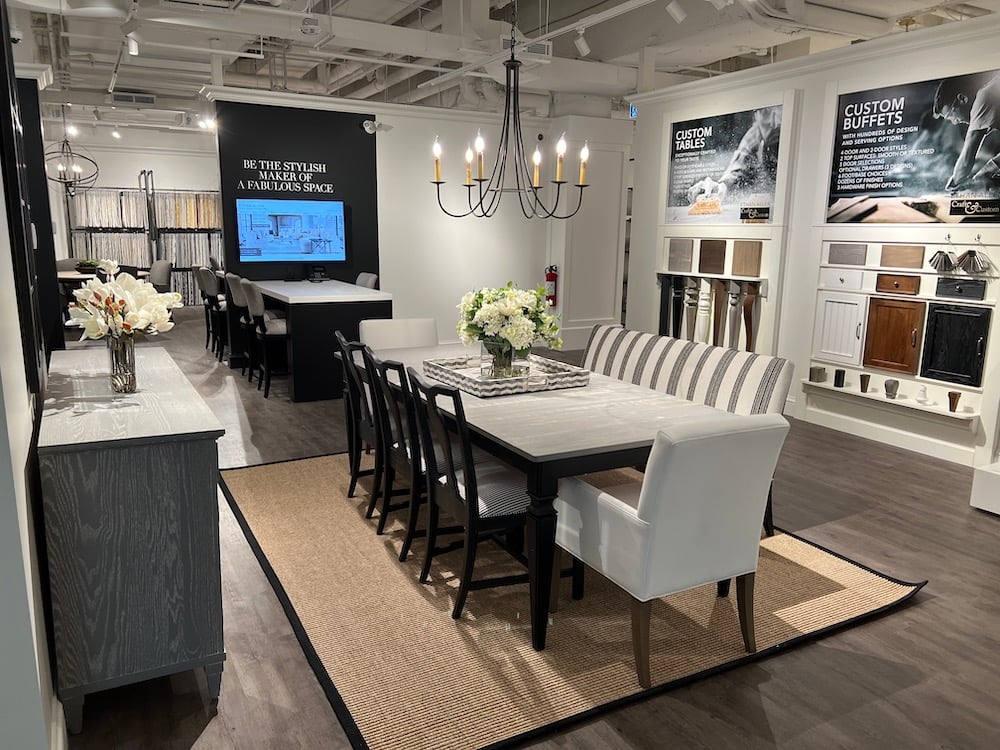
Ethan Allen at Yorkville Village in Toronto. Photo: Ethan Allen
Ethan Allen, the esteemed American furniture and interior design retailer, has opened its latest Canadian location at Yorkville Village in Toronto. The expansion places the brand in one of the city’s most prestigious shopping districts, aligning with Yorkville’s reputation for high-end retail and luxury living.
The decision to establish a presence in Yorkville Village was driven by a combination of existing customer demand and the opportunity to attract new clientele. Many of Ethan Allen’s Toronto-based customers already frequent the area for shopping, dining, and entertainment. The move enhances the brand’s accessibility while positioning it among other premium retailers catering to affluent urban dwellers.
A Distinctive Retail Experience
Ethan Allen’s Yorkville Village location has been designed as a Design Studio, placing emphasis on customization and personalized interior design solutions. The space is carefully curated to showcase a range of style projections tailored to Toronto’s diverse clientele. Through interactive technology, customers can visualize custom modifications that best suit their lifestyles and design preferences.
A key feature of the Design Studio is Ethan Allen’s complimentary interior design service. This service allows customers to work closely with in-house designers who provide expert guidance on furniture selection, room layouts, and full-home transformations. The emphasis on personalized service sets Ethan Allen apart from competitors in the luxury furniture space.
Ethan Allen at Yorkville Village in Toronto. Photo: Ethan AllenEthan Allen at Yorkville Village in Toronto. Photo: Ethan Allen
Design and Technology Integration
The store’s layout and aesthetic reflect Ethan Allen’s long-standing commitment to craftsmanship and quality. The space features a curved glass storefront, offering an inviting and open feel that immediately showcases the brand’s design capabilities. Styled room vignettes inside the studio present a curated selection of Ethan Allen’s furniture, lighting, and home accessories.
To enhance the customer experience, the store integrates advanced digital design tools. Six interactive screens placed throughout the studio allow customers to explore Ethan Allen’s extensive collections, visualize design changes, and even create 3D room plans. Virtual design consultations are also available, enabling customers to engage with design experts remotely. This combination of high-touch service and digital innovation is at the core of Ethan Allen’s modernized retail strategy.
Ethan Allen at Yorkville Village in Toronto. Photo: Ethan Allen
Catering to Toronto’s Luxury Market
Ethan Allen has long been recognized for its commitment to high-quality craftsmanship. The brand’s furniture is predominantly made in North America, with about 75% of its products produced in company-owned workshops. This dedication to craftsmanship aligns well with Yorkville’s discerning clientele, who prioritize quality and exclusivity in their home decor choices.
The new Yorkville Village location offers a selection of furniture and home décor items that reflect Toronto’s sophisticated and diverse tastes. The store’s customization options allow customers to personalize every aspect of their furniture, ensuring that each piece is tailored to individual styles and needs.
Ethan Allen at Yorkville Village in Toronto. Photo: Ethan Allen
Future Expansion Plans in Canada
While Ethan Allen has not officially announced additional Canadian locations, the brand says it remains focused on expanding its presence in strategic retail settings. The company typically seeks locations in high-traffic retail environments, such as lifestyle centres and urban shopping malls. The success of the Yorkville Village store will likely influence future expansion plans in Canada.
Ethan Allen currently operates multiple Design Centers across the country, with locations in Thornhill, Mississauga, Richmond (BC), and Calgary. Each of these centres offers a similar mix of customizable furniture and design services, reinforcing the brand’s reputation as a premier interior design destination in Canada.
Founded in 1932, Ethan Allen Interiors Inc. has built a legacy as a leader in the furniture and interior design industry. The company is known for its customization capabilities, high-quality materials, and expert craftsmanship.
Maguire Shoes, a footwear brand co-founded in 2017 by sisters Myriamand Romy Belzile-Maguire, is navigating a path to growth in the U.S. retail market, despite challenges posed by unexpected tariffs and industry barriers.
As female entrepreneurs in a traditionally male-dominated sector, the Belzile-Maguire sisters are reshaping the footwear industry with their innovative, women-led approach to design and leadership. Myrian emphasized the importance of their hands-on involvement in every step of product development, ensuring their shoes are designed with comfort and real-world wearability in mind.
The brand’s latest store, opened in Brooklyn, New York, in mid-December, has shown promising results, with customers flocking to the store despite seasonal weather challenges. While scaffolding around the store has impacted sales, the sisters remain optimistic, expecting sales to rise once the weather warms up. Maguire Shoes’ U.S. expansion plans are still in progress, with the company closely monitoring potential tariffs on European imports before committing to more U.S. locations.
Myriam Belzile-Maguire
Despite these uncertainties, the brand is already considering European ventures where margins align better with their direct-to-consumer pricing strategy.
Looking forward, Maguire Shoes is focused on both Canadian growth and expanding its U.S. footprint. The company is planning a significant collaboration across Canada and weighing the next steps for its U.S. growth. With their empathetic, women-led leadership model and commitment to long-term partnerships, the Belzile-Maguire sisters are well-positioned to continue disrupting the footwear industry while navigating the complexities of international expansion.
“We’ll see the full performance of the (Brooklyn) store once this scaffolding is down in July,” said Myriam.
“We’re waiting to see what’s going on with the tariffs, if they’re going to apply extra tariffs on European products because everything is made in Spain, Italy, and Portugal. We’re waiting to see that before opening a new store in the U.S. or if we go to Europe and do traditional wholesale.
“We’re thinking of maybe venturing into traditional wholesale in Europe only because the margin would allow our direct consumer price to make sense in a different market. We were looking originally at Boston, but we’re just waiting to see what happens before investing in a new U.S. store. Then, we’re going to concentrate more on marketing efforts in Canada for the time being.”
Besides the Brooklyn store, the retailer has locations in Toronto on Queen Street West, Montreal on St-Laurent Blvd, and in the Nolita neighbourhood in New York City.
Romy Belzile-Maguire
Myriam said Maguire is working on a big Canadian collaboration that’s going to be all over Canada.
“We’re going to be able to talk about it shortly. But I think it’s going to be good for the Canadian market, and the store we’re doing the collaboration with has stores in every major Canadian city. That’s going to help us get our foot—or get our shoes—all across Canada.”
With International Women’s Day on March 8, Myriam said while women’s clothing performs the best in retail, there’s always more money to be made in women’s clothing and footwear than in men’s footwear.
“Most of the companies are owned by men. Even all the women’s shoe brands—most of them are owned by men, and all the factories are owned by men. So, it’s really surprising for a lot of people when you go to a footwear fair. I would say it’s like 85% men, and then there’s like 15% women. Already in our industry, we’re one of the few women who own a footwear brand,” she explained.
“We pick partners who don’t have a problem working with women. When we first went to a fair to find suppliers, a lot of people thought that we were designers for a company, and then they realized that we were the owners. At the time when we started, we were also a bit younger. It’s not often that you see two younger women at the head of a company. It’s still the case when I meet new people. They think that I work for the company, and then when they realize I’m the owner, they’re surprised to see that. It’s a really masculine industry.”
INTERIOR OF MAGUIRE STORE IN TORONTO. PHOTO: MAGUIRE
Myriam said women leaders lead with a bit more empathy.
“We try to not create conflict but work together and solve it. Like they say in politics, if women were around the table, maybe it would solve issues. It’s a bit the same thing in business. I feel the fact that we’re women and we’re trying to work with the factories as partners, not as equals, creates a different dynamic,” she said.
“I know from the feedback from my factories that they all really love working with us because they feel that we’re always fair with them. They know they can rely on us, and I think in a business relationship, that’s important. That’s what we’ve managed to create with our partners. Some of them we’ve been working with for like five or six years, almost since the beginning of the company. A lot of them are telling me that it’s rare these days to find partners that are faithful. Most businesses will just go where it’s the cheapest when we’re trying to create long-term relationships.
“And I think what makes a difference in our company is that we make women’s shoes, and we’re a bunch of women trying the shoes. It makes a big difference in the comfort of our product because in a lot of businesses, let’s say if it’s run by a group of men, there’s no woman to try the product, they will just create the shoe and then put it on the market, but it won’t be tested. I’m able to test it internally with my team of different women from different ages and backgrounds. I think that makes a huge impact on the performance of the product.”
Employment was virtually unchanged in February (+1,100; +0.0%) and the employment rate held steady at 61.1%. The unemployment rate was unchanged at 6.6%, according to a report released Friday by Statistics Canada.
In February, employment rose among core-aged (25 to 54 years old) women (+27,000; +0.4%), while it fell among women aged 55 years and older (-15,000; -0.8%), said the federal agency.
Employment increased in wholesale and retail trade (+51,000; +1.7%) as well as finance, insurance, real estate, rental and leasing (+16,000; +1.1%). There were declines in professional, scientific and technical services (-33,000; -1.6%) and transportation and warehousing (-23,000; -2.1%), it said.
Statistics Canada said employment in wholesale and retail trade has trended up in recent months, rising 107,000 (+3.7%) from a recent low point in July 2024 and offsetting declines in the first half of 2024. Compared with 12 months earlier, the number of people working in the industry was little changed.
Overall employment in Canada held steady in February, following three consecutive monthly increases totalling 211,000 (+1.0%) in November, December and January. On a year-over-year basis, employment was up by 387,000 (+1.9%) in February, explained Statistics Canada.
“The employment rate—the proportion of the population aged 15 and older who are employed—was unchanged at 61.1% in February. This follows three consecutive months of increases. The employment rate had previously fallen 1.7 percentage points from April 2023 to October 2024, as employment growth was outpaced by population growth,” noted the report.
The number of employees in the private sector was little changed in February, following increases in December (+39,000; +0.3%) and January (+57,000; +0.4%). Public sector employment and self-employment were also both little changed in February.
The unemployment rate was unchanged at 6.6% in February, following decreases in December (-0.2 percentage points) and January (-0.1 percentage points). The unemployment rate had previously trended up, rising from 5.0% in March 2023 to reach a recent high of 6.9% in November 2024, added Statistics Canada.
The labour force participation rate—that is, the proportion of the population aged 15 and older who were employed or looking for work—decreased by 0.2 percentage points to 65.3% in February, the first decrease since September 2024, it said.
“The job market couldn’t keep up its feverish pace over the last few months. Winter storms were likely the culprit, but deteriorating hiring sentiment given heighten policy/trade uncertainty may have also started to bleed into the data. One month doesn’t make a trend, but Canadians should be closely watching the labour market for signs of weakness in the months ahead. Luckily, the Canadian labour market came into the current tariff crisis on solid footing, which is important given the significant headwinds the economy is facing,” said James Orlando, Director and Senior Economist at TD Economics.
James Orlando
“The Bank of Canada is set to meet next week, and markets are solidifying around a 25 bp cut. We have been arguing that it is prudent for the central bank to keep cutting as insurance against the downside risks brought on by tariffs. Our scenario analysis embeds significant risk of recession should President Trump keep holding tariffs over our heads. And even if delays keep happening, the uncertainty will weigh on business and consumer confidence, diminishing our previously rosy outlook for the economy.
The company has signed an area development agreement to bring 20 new Heal Wellness locations to the Nova Scotia, New Brunswick, Prince Edward Island, Newfoundland, and Labrador. This marks another significant step in the company’s growth strategy, with plans to further solidify Heal Wellness as a national brand in Canada.
Sean Black
“We are excited to continue the expansion of Heal Wellness across Canada,” said Sean Black, CEO of Happy Belly Food Group. “Leveraging the strong franchising interest and area development agreements established in Ontario, Alberta, Saskatchewan, and British Columbia, we look forward to expanding Heal into a leading national brand.
“By incorporating four additional provinces and securing 20 more units under development, our rollout now totals 120 contractually committed Heal Wellness units across eight provinces. Our plan is to have Heal become a recognized national brand in every province across Canada.”
Heal Wellness is known for its fresh smoothie bowls, acai bowls, and smoothies, offering healthy and energizing food options for customers with busy, active lifestyles. The addition of 20 new locations will contribute to the growing footprint of the company’s emerging brands, further strengthening its national presence, said the company.
Happy Belly’s expansion strategy is guided by a commitment to disciplined growth. The company now has a total of 521 units under development agreements across its brand portfolio, including both existing and upcoming locations.
“This is another step forward in our mission to becoming a predictable and disciplined growth company,” Black added. “Happy Belly currently has 521 contractually committed retail franchise locations from area developers across all emerging brands in the Happy Belly Food Group portfolio. We are working to actively expand this pipeline significantly in 2025 and 2026 with our disciplined approach to growth.”
The strategic expansion of Heal Wellness in Atlantic Canada is supported by an experienced area development team. David Wilson will oversee the Atlantic Canada region, joining Scott Grandin in Central Canada and Stephen Travers in Western Canada.
“Our area developer team continues to get stronger with David Wilson now overseeing Atlantic Canada,” Black said. “This strategic move sets the course for growth of the Heal Wellness brand over the coming years, as we continue to focus on delivering organic development in our backyard and expanding our national footprint.”
The expansion also marks the beginning of Happy Belly Food Group’s continued effort to secure prime real estate for its locations. Black emphasized, “We believe our multi-branded portfolio will continue to deliver strong results and help us continue to secure some of the best available real estate in the country.”
Lightspeed Commerce Inc., a leading one-stop commerce platform empowering merchants to deliver exceptional omnichannel experiences, has appointed Manon Brouillette as Executive Chair of its Board of Directors, effective April 1, aligning with the start of Lightspeed’s new fiscal year.
Brouillette, a seasoned leader with vast experience in omnichannel business transformation, is excited to take on this new role. “I’m thrilled to be named as Lightspeed’s Board Chair during this pivotal moment in the Company’s history,” said Brouillette. “Lightspeed is an incredible success story, celebrating 20 years supporting growing businesses and entrepreneurs, and I believe the Company has a powerful mission and vision to propel its next phase of growth for the years to come.”
Manon Brouillette
Lightspeed said Brouillette brings a wealth of leadership experience to the company. She is currently the Chair of the board of directors of Hydro-Québec, the largest renewable energy company in eastern Canada.
Brouillette has also served on the boards of companies like Sonder, Altice USA, and SFR (Altice France). Her extensive career includes leadership roles such as former CEO of Verizon Consumer Group, EVP of Verizon, and President and CEO of Videotron.
Brouillette rejoined Lightspeed’s Board of Directors in October 2023 and has played an instrumental role in shaping the company’s recently deployed transformation strategy.
Dax Dasilva
“We are truly grateful to have had Manon Brouillette be part of our Board, and are excited to have her bring her extensive experience in scaling growth companies to the Executive Chair role,” said Dax Dasilva, Founder and CEO at Lightspeed. “As we enter a period of focused transformation for Lightspeed, Manon’s record of success with business transformations will add immense value to our executive leadership team and our Company.”
Brouillette’s appointment marks the transition from Patrick Pichette, who has been serving as interim Chair of the Board. Pichette will continue to serve as a Director on the Board. Additionally, Lightspeed announced the appointment of Dale Murray as the Board’s Lead Independent Director.
This leadership transition comes ahead of Lightspeed’s Capital Markets Day, which is scheduled for March 26, at the New York Stock Exchange. During this event, Lightspeed’s management team will provide an update on the company’s transformation plan, along with insights into its operational and financial impact, products, go-to-market efforts, and long-term financial outlook.
Founded in Montreal, Canada, in 2005, Lightspeed is a dual-listed company on the New York Stock Exchange and the Toronto Stock Exchange. The company’s platform helps merchants across retail, hospitality, and golf businesses innovate to simplify and scale their operations, delivering exceptional omnichannel customer experiences. With teams across North America, Europe, and Asia Pacific, Lightspeed serves businesses in over 100 countries.
RONA Inc., a leader in the Canadian residential renovation sector, has launched a new initiative that will highlight over 6,500 Canadian-made products in its RONA+ and RONA stores across the country, as well as online at rona.ca.
This move is in response to the increasing demand from both consumers and contractors for locally-made items that meet Canadian building codes and standards, the retailer said.
RONA operates more than 425 corporate and affiliate stores across Canada, and the company said it is working to make it easier for customers to identify and select Canadian-made products.
J.P. Towner
“We’ve always had a strong selection of Canadian-made products. In fact, less than 10% of our supply comes directly from the United States. The challenge was primarily about making these products more visible. To help consumers choose Canadian-made products, they need to be clearly identified, well-organized, and prominently displayed. This is where our partnership with ‘Well Made Here’ truly makes a difference,” said J.P. Towner, President and CEO of RONA Inc.
“Thanks to the close collaboration with Mr. Darveau and his team over the past few weeks, thousands of additional products have now been endorsed under the ‘Well Made Here’ program, addressing the need to make it easier for consumers to find Canadian-made products.”
“Well Made Here” is a federally chartered non-profit organization founded in October 2018. Its mission is to promote the purchase of quality building materials and hardware products made in Canada for the residential market.
The company said the effort comes at a time when Canada faces a growing need for construction and renovation materials, while tariff disputes with the United States loom over trade relationships.
“This initiative from RONA comes at a crucial time when the country is facing a critical need for construction and renovation, while tariff dispute with the United States looms. Our manufacturers need this kind of support and visibility now more than ever. We hope residential homeowners and construction contractors will discover Canadian brands and remain loyal to them beyond these challenging times,” said Darveau.
RONA has been involved with the “Well Made Here” program since its inception, and with this new commitment, the company said it is reinforcing its support for Canadian manufacturers. More than 5,000 additional products will soon be added to the program, each bearing the “Well Made Here” label both in-store and online.
The “Well Made Here” program, developed by the Québec Association of Hardware and Building Materials (AQMAT), ensures that products meet the following criteria:
Compliance with Canadian construction codes, regulations, and other legal requirements;
At least 51% of the direct production or manufacturing costs must have been incurred in Canada;
The final substantial transformation of the product must have occurred in Canada.
In the coming weeks, RONA said it will also be training its in-store staff to better guide customers in selecting “Well Made Here” products.
As part of the initiative, RONA is also reminding Canadians of its strong Canadian roots. Founded 85 years ago in Canada, RONA’s headquarters are located on Montreal’s South Shore, and the company employs nearly 21,000 people across the country. Nearly half of RONA’s stores are affiliate stores owned by entrepreneurs who are deeply embedded in their local communities.
“Now more than ever, RONA’s legacy—a company founded by independent dealers here in Canada—reminds us that we can achieve great things when we work together,” said Towner. “I am incredibly proud to see our teams, vendors, and partners come together during this uncertain time to better showcase Canadian-made products.”
RONA Inc. is one of Canada’s leading home improvement retailers, operating over 425 corporate and affiliate stores under the RONA+, RONA, and Dick’s Lumber banners.
Retail Insider is streamlining its Canadian retail news from around the web to include a handful of top news stories that can be viewed quickly during the day. Here are the top stories from the past 24 hours.
US President Donald Trump with Canadian Prime Minister Justin Trudeau
The Canadian government has confirmed that its initial round of retaliatory tariffs against the United States will remain in place, despite U.S. President Donald Trump delaying the implementation of 25% tariffs on most Canadian imports for a month. The move comes amid mounting trade tensions between the two nations, with both sides engaging in economic countermeasures that could have long-term ramifications for businesses and consumers on both sides of the border.
President Trump announced Thursday that he would postpone a set of sweeping 25% tariffs on imports from Canada and Mexico for 30 days, citing concerns about the impact of a broad trade war. However, Canada will not be rolling back its own countermeasures.
Ottawa had initially implemented $30 billion CAD in retaliatory tariffs on American goods in response to the U.S. government’s trade policies. These measures targeted a wide range of American products, including orange juice, peanut butter, coffee, household appliances, footwear, cosmetics, motorcycles, and certain pulp and paper products.
Despite the temporary U.S. reprieve, Canada is maintaining its stance, arguing that the uncertainty surrounding U.S. policy makes it essential to keep the tariffs in place until a more concrete resolution is reached.
Provinces Respond with Additional Measures
Beyond federal-level tariffs, provincial governments in Canada are also taking action. Ontario Premier Doug Ford announced that, effective Monday, Ontario will increase the price of electricity exports to the U.S. by 25% in direct response to Trump’s tariff plans. Ontario currently supplies electricity to key U.S. states, including Minnesota, New York, and Michigan, impacting approximately 1.5 million American customers.
Ford emphasized that this measure will remain in place regardless of Trump’s one-month delay, stating, “So long as the threat of tariffs continues, Ontario’s position will remain unchanged.”
British Columbia Premier David Eby also revealed plans to introduce new legislation that would allow the province to impose fees on commercial trucks traveling from the U.S. through B.C. to Alaska. Eby framed this move as a necessary step to demonstrate Canada’s displeasure with ongoing U.S. trade threats, saying, “Yet again, the president is sowing uncertainty and chaos, attempting to undermine our economy with tariffs and then walking them back.”
Trudeau Expects Prolonged Trade War
Prime Minister Justin Trudeau addressed the situation on Thursday, acknowledging that tensions between Canada and the U.S. are unlikely to subside in the near future. Following a reportedly “colourful but constructive” conversation with President Trump earlier in the week, Trudeau stated that Canada is prepared for a prolonged trade standoff.
“We expect that this trade war will continue for the foreseeable future, and we will act accordingly to protect Canadian industries and workers,” Trudeau said.
Meanwhile, the U.S.-Mexico-Canada Agreement (USMCA), which was meant to ease trade relations between the three North American countries, is now being tested as the White House introduces new trade barriers. Trump’s latest executive orders include a provision that allows USMCA-compliant goods to temporarily avoid the 25% tariffs, though nearly 62% of Canadian imports to the U.S. could still be affected due to compliance issues.
Escalation on the Horizon: New Tariffs and Retaliation Expected
While the temporary tariff delay may provide some short-term relief, Ottawa is already preparing a second wave of retaliatory tariffs. In three weeks, the Canadian government is expected to impose an additional $125 billion CAD (US$87 billion) in tariffs on American goods, further escalating the trade dispute.
This next round of tariffs is expected to target electric vehicles, fresh produce, dairy, beef, pork, electronics, steel, and trucks, among other industries. Analysts suggest that these measures could have significant repercussions on U.S. exporters reliant on the Canadian market.
Energy and Critical Resources: The Reality of U.S.-Canada Trade Dependence
Despite Trump’s assertion that the U.S. does not need Canada for trade, economic data tells a different story. The U.S. remains heavily reliant on Canadian energy, with nearly a quarter of its daily oil consumption coming from Canada. Additionally, about 60% of all U.S. crude oil imports originate from Canada, while 85% of America’s electricity imports also come from north of the border.
Beyond energy, Canada is the largest foreign supplier of steel, aluminum, and uranium to the United States. Furthermore, Canada controls 34 critical minerals and metals that the U.S. Department of Defence considers essential for national security, reinforcing the strategic importance of maintaining strong trade relations.
Canada is also the top export destination for 36 U.S. states, with $3.6 billion CAD in goods and services crossing the border daily. The economic interdependence between the two nations underscores the potential risks of a prolonged trade conflict.
Automakers and Businesses Caught in the Crossfire
The trade dispute has also drawn concerns from major U.S. automakers, which are among the industries most affected by the tariffs. On Wednesday, President Trump held discussions with executives from Ford, General Motors, and Stellantis (Chrysler and Jeep), urging them to relocate production to the United States to sidestep tariffs.
Despite these talks, automakers and industry leaders warn that increasing tariffs will disrupt supply chains, raise production costs, and ultimately lead to higher prices for consumers. The uncertainty is already sending shockwaves through financial markets, as investors fear the broader implications of a North American trade standoff.
With the implementation of new U.S. tariffs on Canadian goods, retailers across the country are bracing for significant disruptions to supply chains, pricing strategies, and consumer spending habits. The economic ripple effects of these tariffs could be profound, threatening jobs, driving up costs, and reshaping the competitive landscape of Canadian retail.
To better understand the challenges ahead, Retail Insider spoke with George Minakakis, Founder and CEO of Inception Retail Group. Minakakis offered insight into how the tariffs could impact Canadian consumers, businesses, and broader economic stability, highlighting the urgent need for retailers to adapt.
George Minakakis. Photo: LinkedIn.
A New Economic Shock for Consumers
For many Canadians, the tariff-driven price increases will feel like a continuation of economic hardships stemming from the COVID-19 pandemic.
“If I told you that you’re going to do the same kind of things with your experience as during the pandemic, but this time it’s not a virus—it’s a different virus called Trump Tariffs—what would you think?” Minakakis said, referring to the economic disruption caused by the U.S. president’s policies.
The tariffs are expected to increase prices on essential goods, including groceries, automobiles, and consumer electronics. This could force Canadians to rethink their spending habits, delay major purchases, and cut back on discretionary spending.
“People aren’t going to rush out and buy new cars or shoes. They’re going to look for repairs instead. The consumer mindset is shifting toward conservation rather than consumption,” Minakakis explained.
The Complexity of Labeling and Supply Chains
Beyond price increases, another major challenge is the uncertainty surrounding what qualifies as a “Canadian” product. With many goods composed of parts from multiple countries, including the U.S., retailers are struggling to accurately label items.
“There’s a lot of confusion happening around what is made in Canada. Grocers don’t even know,” Minakakis said. “You can’t mandate something that you can’t figure out and could be incorrect.”
This complexity is further compounded by supply chain slowdowns that could be driven by slower demand, particularly in the auto sector. Minakakis, noted that higher costs will impact demand, creating shipping delays and increased costs for things like car parts will be a major concern.
“The sticker price on a new car could go up by 20 to 25%,” he warned. “People are going to feel that impact immediately, delay purchases, and switch brands.”
The Auto Sector and Broader Economic Fallout
The tariffs threaten to significantly impact Canada’s automotive sector, a major pillar of the national economy.
“The auto sector is going to slow down, across the board,” Minakakis said. “And Trump doesn’t care. This is all about Trump moving jobs to the US.”
Minakakis believes that the tariffs are being implemented with little regard for economic consequences in Canada and the US. If consumer spending contracts significantly, it could set off a domino effect leading to store closures, layoffs, and an economic slowdown.
“If you work in a sector where your job is at risk, you’re going to be focused on priorities: keeping a roof over your head and food on the table,” he said. “Retailers are about to face a serious test.”
Retailers Must Adapt or Risk Collapse
Canadian retailers now find themselves in an increasingly precarious situation. Already struggling with post-pandemic recovery and inflationary pressures, the tariffs add another layer of difficulty.
“This is opening up a Pandora’s box,” Minakakis warned. “Retailers need to be really, really smart right now. They need to change their merchandising strategies, their sourcing, and their pricing models.”
Some retailers may shift sourcing strategies to avoid U.S. tariffs altogether. Others may attempt to absorb some of the increased costs to remain competitive, but that strategy is only sustainable for so long.
“We’re going to see a slowdown before this new normal is balanced out,” Minakakis predicted. “Retailers will be fighting over fewer customers who are willing to spend. And now is not the time to spend less in marketing your brand.”
Political and Economic Uncertainty
Beyond retail, the broader implications of these tariffs are significant. Some experts warn of a prolonged trade war, while others see a political power play designed to pressure Canada into economic concessions.
“The U.S. is forcing us to operate in a corner,” Minakakis said. “We need to invest in other industries and break away from overreliance on the U.S.”
With supply chain disruptions, inflationary pressures, and consumer hesitancy at play, Canada’s retail sector is entering uncharted waters. The extent of the damage will depend on how long the tariffs last, how businesses respond, and whether the Canadian government can negotiate a resolution.
“Canadian businesses need to act now,” Minakakis urged. “There’s no wait-and-see anymore. You’ve had your wait-and-see, now you’re seeing it. If you haven’t addressed supply chains, pricing, and sourcing, you need to get on that immediately.”
Canadian Tire Corporation, Limited (TSX:CTC, TSX:CTC.A, CTC or the Company) is launching a new four-year transformative growth strategy, True North, focused on data-driven customer relationships, core retail growth, an expanded Triangle Rewards loyalty system, and focused capital allocation.
It is designed to increase value for customers and generate leading shareholder value above the Company’s historic levels. The strategy will be delivered by a newly designed senior leadership team, and CTC will reorganize from a complex holding company model into a more agile operating company, aggregated to compete and differentiated through its collective customer insights, announced the company in a news release on Thursday.
CTC also announced that, as part of True North, it is optimizing its SportChek portfolio, with new-concept stores and a revised go-to-market strategy for its Atmosphere business. The company will close 17 uncompetitive standalone Atmosphere stores, with 14 sites to be co-located within SportChek stores.
CTC is also expecting to invest more than $2 billion over the next four years in the company.
Greg Hicks
“We are an iconic Canadian retailer primed for stronger customer connections and leading shareholder returns,” said Greg Hicks, President and CEO, Canadian Tire Corporation. “In a new era of retail and hyper-scale global competition, we will operate more efficiently and go to market more strategically, harnessing our banners and loyalty system to elevate our scale. Our transformation starts from the strengths that set us apart: we have the highest customer trust, market-leading data, and the vision to know, reward and serve Canadians best.”
True North represents CTC’s next strategic horizon, marking the end of Better Connected which established a springboard for higher performance. The company concluded 2024 with strong earnings, an improved balance sheet, and increased customer loyalty, explained Canadian Tire.
True North initiatives designed to accelerate retail growth and loyalty expansion
“True North entails dozens of strategic initiatives designed to accelerate retail growth and deliver improved financial performance. This includes investments in omnichannel network expansion and new data analytics that will be a catalyst for growing market share and expanding CTC’s total addressable market,” it said.
“The Company will accelerate the Triangle Rewards loyalty system through its privileged first-party data, enabled by technology and AI. The loyalty system will expand with more personalized member value, additional brand partners that issue Canadian Tire Money beyond CTC stores, and a new retail-focused bank strategy to acquire and engage more Triangle Mastercard holders.
“An expanded loyalty system will fortify CTC’s connections to its best customers and more systematically inspire members to shop at more of its stores and more often. True North initiatives are designed to increase Triangle Rewards loyalty membership and loyalty sales across banners.”
New operating model designed for agility and scale
To execute True North, CTC said it will reorganize, converting from a holding company model of individual businesses focused on products to an operating company universally focused on customers. This new operating model aggregates CTC’s multiple banners, systems, and data, resulting in a density of customer insights and competitive scale that no single banner could achieve alone.
“The Company will continue to strengthen the customer-facing value propositions of each individual banner brand, but will work to eliminate siloed, redundant and costly back-office processes and systems. The new operating model is designed for greater agility and speed, with common enterprise-wide capabilities and platforms built and deployed once – such as the Company’s recent conversion of all major banner websites onto a single digital platform. A more-unified CTC will continue its technology and AI implementations, reinventing ways of working to improve the speed of analytics, decisions, information and workflows company-wide. This will result in both increased efficiency and more strategic customer engagement across the banners,” it noted.
PHOTO: CANADIAN TIRE
Strengthened leadership focused on customers, retail execution, and value creation
The company said True North will be delivered by a newly-designed senior leadership group of existing and added executive talent, with new roles announced today to reflect three priorities: Disciplined management of several significant multi-year transformation initiatives and related value-creating capital allocation will be governed by a new transformation office led by a new Chief Transformation Officer; Core retail business execution and growth will be led by a new Chief Operating Officer within a unified operating model for all banners, including Canadian Tire, SportChek, and Mark’s; Customer-focused retail, product, marketing and loyalty strategies will be centralized and led by a new Chief Commercial Officer. Various corporate teams within CTC will be reorganized to reflect this structure and the underlying priorities.
Susan O’Brien is appointed EVP & Chief Transformation Officer. A 17-year company veteran, she was most recently EVP & Chief Brand and Customer Officer. Her past leadership of Triangle Rewards and experience building new customer capabilities will ensure transformation initiatives stay true to customer-centricity.
TJ Flood is appointed EVP & Chief Operating Officer, leading CTC’s newly centralized banners, including Canadian Tire, Mark’s and SportChek. A 20-year company veteran, he was most recently EVP & President, Canadian Tire Retail and previously President, SportChek. This experience will enable the shift to centralized processes and cross-banner efficiencies.
Following a comprehensive search, the Company will soon appoint an EVP & Chief Commercial Officer responsible for growing Triangle Rewards, customer insights and core retail processes that enable horizontal, data-driven strategies for great customer experiences.
Darren Myers, CTC’s new EVP & Chief Financial Officer, joins April 1 as announced here. He is a three-time CFO at Canadian companies, previously responsible for large-scale transformations in retail and other sectors.
CTC’s executive leadership team is otherwise detailed here.
“This team has the experience and mandate to deliver transformational initiatives and results,” said Hicks. “As we knock down unnecessary legacy siloes and systems, we are combining the best of our business and all of our customer knowledge to rally around a unified strategy to help make life in Canada better. Together, our combined scale and our insights will set us apart from competitors big and small.”
Enhanced capital allocation and streamlined operating model
Canadian Tire said it will enhance capital allocation through prioritizing the highest-returning investments and assets.
“This is evident in the Company’s recent portfolio moves: The decision to retain full ownership of Canadian Tire Financial Services with a strategy to maximize its retail-driving capabilities; unlocking shareholder value with the February 19, 2025, announcement of the agreement to sell global performance brand Helly Hansen; and the monetization of redundant real estate assets,” it said.
Going forward, and assuming the completion of the sale of Helly Hansen, CTC said it will extend its balanced approach to capital allocation, including the following:
It will prioritize investments to transform its core Canadian retail business, while maintaining flexibility to address market uncertainty. In this context, CTC expects total operating capital expenditures in 2025 to be towards the upper end of its previously disclosed range of $525 million to $575 million. This will include capital investments in omnichannel customer experience, like the continued modernization of Canadian Tire stores. The Company also plans increased investments in Mark’s, to capitalize on its record of accretive returns and emerging market-share opportunities in the casual apparel sector.
It will return up to $400 million to shareholders through share repurchases in 2025, doubling its previously disclosed 2025 intention of up to $200 million.
It will use $200 million of proceeds to reduce debt, re-paying medium-term notes ahead of their 2026 maturity.
CTC expects to invest more than $2 billion over four years starting in 2025; expense savings begin in 2025 with $100 million run rate expected to start in 2026
“Our strategy, structure and initiatives begin in 2025, and improved value creation is expected in the years ahead,” explained Hicks. “We look forward to detailing our early progress and longer-term returns with greater precision as they begin to take shape. In the meantime, we have begun to put capital behind our conviction and expect to invest more than $2 billion over the next four years, driving the prosperity of our company and, by extension, our country.”
Canadian Tire said it expects increased transformation and advisory costs in relation to its four-year strategy, including the following:
Operating expenses will increase by $60 million in 2025, primarily for IT investments to enable transformation initiatives.
One-time charges of approximately $85 million in transformation and restructuring costs, including severance, as well as closure costs for Atmosphere stores. These costs will be recorded and normalized in the first half of 2025. They are expected to deliver annualized operating expense savings of $100 million starting in 2026.
Canadian Tire banners include Party City and PartSource; Mark’s; SportChek; Hockey Experts; Sports Experts and Atmosphere. CTC also operates a retail petroleum business and a Financial Services business and holds a majority interest in CT REIT.