Advertisement
Advertisement
Home Blog Page 64

Daily Synopsis: Mar 5, 2026

Daily Synopsis2

Today’s Retail Insider articles showcase Sungiven Foods’ expansion in Metro Vancouver with 10 to 15 new stores focusing on health-oriented urban convenience, and Happy Belly Food Group’s iQ Food Co. opening its first Western Canada location in Calgary. Meanwhile, Statistics Canada reveals a significant drop in government alcohol earnings tied to falling sales volumes. These developments highlight ongoing shifts in Canadian retail, emphasizing specialized food markets and changing consumer behaviours. Additional Canadian retail news from around the web follows below.


🗞️ The Day’s Retail Insider Article List


🌐 Canadian Retail News From Around the Web

Walmart Canada kicks off sponsorship with Canada Soccer to bring Canadians closer to the game 

Photo- Canadian Premier League

Walmart Canada, Canada Soccer, and Canadian Soccer Media & Entertainment announced on Thursday a collaboration to help bring Canadians closer to the game.

Jonathan David
Jonathan David

As the country prepares for a historic era in soccer, with growing national pride and participation across communities, Walmart Canada said its sponsorship of Canada Soccer and the Canadian Premier League (CPL), reflects a shared commitment to making the game more accessible on the pitch, in the stands, at home and in communities across the country. Jonathan David, Canada Soccer Men’s National Team forward, will support the collaboration as an official Walmart Canada ambassador.

“From aspiring athletes picking up their first cleats, to parents stocking up on game-day snacks, to fans gearing up with match-day essentials, soccer is helping to bring Canadians in communities across the country together like never before,” said Andrew Go, Vice President, eCommerce and Marketing, Walmart Canada. “Through this sponsorship of Canada Soccer and the Canadian Premier League, we’re making it easy and fun to connect through soccer and celebrate what matters most: playing, celebrating and dreaming big, together.”

Key highlights of the sponsorship include:

Jonathan David, official Walmart Canada Ambassador: One of the country’s most accomplished and recognizable players, Canada Soccer Men’s National Team forward Jonathan David will support the collaboration as an official Walmart Canada ambassador. David’s journey from grassroots soccer to both the world stage and some of the biggest clubs in the world reflects what’s possible when young athletes have access, opportunity and the support of their communities

National Team Match Ball Kids: As sponsors for Canada Soccer’s Ball Kids program for National Team home games, Walmart Canada will be front and centre on matchday to bring youth soccer players closer to action.

Grassroots Soccer Fests: Walmart Canada will be an Official Partner of Canada Soccer’s Grassroots Soccer Fests, activating at 100 local youth soccer club celebration days across Canada.

Multi-Channel Fan Engagement: Walmart Canada is connecting with fans where they are,  including in-real-life experiences at National Team and CPL matches, special offers for fans including access to tickets, merchandise and fan experiences, activations at tentpole events during peak moments of the National Team calendar and branded integrations on match broadcasts.

“Soccer has the power to bring people together in every community across Canada. Growing up, access to the game and seeing players you could relate to makes a real difference,” said David. “Collaborations like this help make the sport more visible, more accessible, and more connected to everyday Canadian families. That’s how you inspire the next generation.”

Kevin Blue
Kevin Blue

“Soccer in Canada is at an inflection point,” said Kevin Blue, CEO and General Secretary, Canada Soccer. “To seize this moment, we need partners who are prepared to invest in the long-term growth of the game from grassroots participation to our National Teams. This collaboration strengthens our ability to expand access, deepen engagement and accelerate the sport’s trajectory nationwide. It’s the kind of alignment that turns momentum into lasting progress.”

Through youth programming, player ambassador initiatives, national events, and matchday experiences – including ball kids at Canada Soccer National Team matches – Walmart said the collaboration will help ensure the sport is easy to access, easy to engage with and welcoming for Canadians from coast-to-coast.

James Johnson
James Johnson

“This collaboration reflects the momentum behind soccer in Canada and the kind of collaboration that moves the sport forward,” said James Johnson, Group CEO, Canadian Soccer Media & Entertainment. “When globally recognized brands like Walmart Canada invest in our game, it elevates visibility, accelerates growth and strengthens the entire ecosystem – from grassroots communities to the professional stage. Bringing partners of this scale into Canadian soccer is critical to expanding our reach, deepening fan engagement and ensuring the sport continues to thrive across the country.”   

More from Retail Insider:

Sungiven Foods Expanding Metro Vancouver Footprint

Sungiven Foods - 2026

When Sungiven Foods entered Canada in late 2019, the timing was challenging. Within months of opening its first Vancouver store, the COVID-19 pandemic disrupted supply chains and altered grocery shopping habits across the country.

Yet six years later, the company is accelerating growth in Metro Vancouver, refining its store format, expanding ready-to-eat offerings, and deepening its private-label program. The retailer now operates 10 stores across the Lower Mainland and plans to open between 10 and 15 more locations over the next several years.

In an interview, Paul Zhang, President of Sungiven Foods in North America, described the company’s journey as both deliberate and adaptive.

Paul Zhang, President of Sungiven Foods in North America

“Our founders were Canadians living in Vancouver for a long time,” Zhang explained. “They saw an opportunity to build something meaningful for the communities here. Vancouver has a strong appreciation for global food culture, fresh ingredients, and healthy living. We believed our strengths in global sourcing, private label development, and fresh supply chain management could fit well here.”

The result is what many shoppers describe as a curated, smaller-format alternative to traditional Asian supermarkets, often compared to Trader Joe’s in the United States, but with a distinctly Asian and health-focused lens.

A Focused Metro Vancouver Strategy

Sungiven’s Canadian operations remain concentrated in Metro Vancouver. Current locations include Vancouver, Burnaby, Richmond, Surrey, White Rock, and North Vancouver. The newest store, which soft-opened in January 2026, is located at One Park in Richmond, across from CF Richmond Centre.

“Right now, we have 10 stores,” Zhang said. “We just soft-opened our second Richmond location a couple of days ago.”

Sungiven Foods - 2026
Sungiven Foods – 2026

The company’s early stores varied significantly in size, ranging from roughly 3,000 to 24,000 square feet. That experimentation phase has now ended.

“Back in 2019, we tested different formats to see what the market wanted us to be,” Zhang explained. “Now we have a much clearer concept. We will focus on smaller sizes. There will be two models, around 4,000 square feet and about 8,000 square feet.”

The smaller footprint provides flexibility in dense, urban neighbourhoods where daily shopping is part of community life. According to Zhang, Sungiven performs best in residential areas with multicultural populations and younger families who prioritize fresh food and healthy lifestyles.

Originally, the majority of customers were Asian. That mix has shifted dramatically.

“Our non-Asian customers went up from about five percent to around forty percent,” Zhang noted. “We are still trying to find the best way to fit into communities, but it seems we perform well in younger, more health-focused neighbourhoods.”

This neighbourhood-based strategy forms the core of the Sungiven Foods Canada expansion plan in British Columbia.

Photo: Sungiven Foods

Private Label as Competitive Advantage

One of Sungiven’s defining characteristics is its heavy reliance on private-label products. More than 60 percent of stock comes from in-house brands such as Onetang, Yuho, and Sunfreesia.

“A lot of people call us an affordable Asian whole foods store,” Zhang said. “Some say we are like an Asian Trader Joe’s. We have many private label products, and we keep growing them.”

Unlike traditional grocers that rely heavily on third-party brands, Sungiven develops products directly with manufacturers and farms.

“We really focus on sourcing the best product with the best value directly from manufacturers or farms,” Zhang explained. “Everything on our shelves, we are responsible for. We are accountable for the quality. We act as the buyer for the customer, not the seller for vendors.”

This distinction is central to the company’s positioning. Rather than simply applying a store label to commodity products, Sungiven develops customized items tailored to local community preferences.

The company adheres to what it calls the “Three Lows” philosophy: low processing, low additives, and lower prices for quality through vertical integration. Products emphasize non-GMO ingredients, free-run eggs, and Canadian AAA-grade meats without added hormones.

The approach aims to blend global sourcing expertise with local supply chains. Approximately half of Sungiven’s sales now come from locally sourced products, which has helped cushion the impact of global supply chain disruptions and rising food costs.

“Yes, tariffs and cost increases have an effect,” Zhang acknowledged. “But it is not as severe for us because we have development around the world and strong local supply. The cost went up a little bit, but it’s not a shortage issue.”

Sungiven Foods - 2026
Sungiven Foods – 2026

Ready-to-Eat and Community Convenience

In recent years, Sungiven has shifted further toward ready-to-eat and ready-to-cook offerings. The newest Richmond location features expanded grab-and-go meals, hot food stations, and in-house bakery items designed for busy urban professionals.

“We can see growing demand for ready-to-eat items and ready-to-cook meal kits,” Zhang said. “People prefer to spend more time with loved ones rather than a couple of hours cooking. They want something easy and fresh.”

This evolution reflects broader grocery trends across Canada. Urban shoppers increasingly seek convenience without sacrificing quality.

Sungiven supports this strategy with centralized infrastructure. The company operates a distribution centre and a central kitchen, allowing stores to operate without large backrooms, commercial kitchens, or loading docks.

“We have our DC built already, and we have our central kitchen to supply ready-to-eat meals every day,” Zhang said. “We don’t even need a loading dock in many cases. The smaller scale helps us find locations more easily.”

That operational flexibility underpins the Sungiven Foods Canada expansion strategy, especially in land-constrained urban markets.

Digital Integration and Uber Eats Partnership

In February 2026, Sungiven launched a partnership with Uber Eats, becoming one of the first major Asian-focused grocery chains in British Columbia to offer on-demand grocery delivery through the platform.

The company had already piloted online delivery through its own app in mid-2025, promising fresh produce and meat delivered within 45 minutes.

“We see delivery as an expansion of our community service, not just a sales channel,” Zhang said. “You don’t need to spend an hour and a half driving to a big store just to buy milk. You can open the app on your way home and have fresh groceries at your door.”

Zhang acknowledged that maintaining price parity between in-store and online channels remains a challenge. However, demand continues to grow, particularly among young families and professionals.

The integration of smaller-format stores with fast local delivery creates a hybrid model that bridges physical retail and digital convenience.

Global Roots and the Boomerang Strategy

Though Sungiven is often perceived as a Chinese import, its story is more complex. The founders, Richard Lian and Kathy Su, developed the concept while living in Vancouver in the early 2000s. Inspired by the West Coast’s health-conscious retail culture, they brought the model to Xiamen, China, in 2011, where it scaled to more than 200 locations.

In 2019, they returned to Vancouver for international expansion.

“Vancouver is a good place to test our model because it is so multicultural and diverse,” Zhang said. “Once we make our model even clearer, we will move out.”

The parent company, Xiamen Sungiven Foods Holding Ltd., began as an import-export business in 2001 and now manages relationships with more than 1,000 partner factories globally. Research and development centres in Hamburg and Burnaby support product quality and regulatory compliance.

Zhang envisions broader geographic growth over time.

“For my vision, we should call ourselves Sungiven Foods Global,” he said. “Not only Canada, but the United States and Europe are targets as well.”

For now, however, the focus remains firmly on Metro Vancouver.

Looking Beyond British Columbia

When asked about expansion outside British Columbia, Zhang was cautious but optimistic.

“Moving to another province requires strict planning of supply chains and operations,” he said. “It’s on the table, but we are still focused on Greater Vancouver.”

Toronto has been identified informally as a potential future market, given its multicultural demographics and dense neighbourhoods. Zhang did not confirm timelines, but he acknowledged that Eastern Canada represents a logical next step once operational clarity is achieved.

The disciplined approach suggests that Sungiven is prioritizing long-term stability over rapid national rollout.

Building a Community Cornerstone

Zhang emphasized that Sungiven’s ambition extends beyond grocery sales.

“We try to make our shops a cornerstone of the community,” he said. “People go to grocery stores not only to buy food. It is where people connect. We want to provide value and communicate with customers about living life in the community.”

That philosophy aligns with the brand name itself, which means “Given by the Sun,” reflecting a belief in natural, sun-grown food rather than heavily processed alternatives.

As the Sungiven Foods Canada expansion continues in Metro Vancouver, the retailer appears to be refining a model that blends curated private labels, smaller-format convenience, digital integration, and community orientation.

After weathering a pandemic launch and navigating global supply chain volatility, Sungiven has quietly built a loyal following in British Columbia. Traffic counts are rising annually, customer demographics are broadening, and store formats are becoming more standardized.

If the company can replicate that balance of global sourcing and local relevance in new markets, it may evolve from a regional player into a national competitor within Canada’s increasingly dynamic grocery landscape.

More from Retail Insider:

Victoria’s Secret & Co. reports 2025 Q4 and full year results with annual sales of more than $6.5 billion

Victoria's Secret photo

Victoria’s Secret & Co. has announced its financial results for the fourth quarter and fiscal year ended January 31, 2026, reporting net sales of $6.553 billion for fiscal year 2025, an increase of 5% compared to net sales of $6.230 billion for fiscal year 2024 and above its previously communicated guidance range of $6.450 billion to $6.480 billion.

Hillary Super
Hillary Super

“We delivered an exceptional fourth quarter and a standout year, exceeding top- and bottom-line guidance with broad based outperformance across brands, channels and geographies. We drove meaningful acceleration in the second half of the year, with fourth quarter net sales of $2.270 billion and comparable sales growth of 8%,” said Hillary Super, VS&Co Chief Executive Officer.

“In the quarter, our customer responded enthusiastically to our product and marketing, as demonstrated by growing new customer acquisition and increased AURs. Our 2025 results reflect the progress we have made against our Path to Potential strategy as we build brand heat and powerful connections with our customers around the world.

“We enter fiscal 2026 from a position of strength. With a clear brand vision, a faster and more agile operating model, and a strong pipeline of product and brand moments ahead, we are confident in our ability to deliver profitable growth and create long‑term shareholder value.”

Scott Sekella
Scott Sekella

“Our results reflect disciplined execution, strong margin performance, and increased operational agility. We delivered adjusted operating income of $403 million in fiscal year 2025, despite approximately $85 million of tariff pressure. Our adjusted earnings per diluted share was $3.00, representing 22% growth versus last year, excluding last year’s cumulative gift card breakage adjustment. Our Path to Potential strategy is accelerating the Company’s growth, reinforcing our confidence in our fiscal 2026 guidance,” said Scott Sekella, VS&Co Chief Financial and Operating Officer.

Fourth Quarter 2025 Results
The company said net sales were $2.270 billion for the fourth quarter of 2025, an increase of 8% compared to net sales of $2.106 billion for the fourth quarter of 2024 and above itspreviously communicated guidance range of $2.170 billion to $2.200 billion. Total comparable sales for the fourth quarter of 2025 increased 8%.

The company reported operating income for the fourth quarter of 2025 of $229 million compared to operating income of $268 million in the fourth quarter of 2024. Net income was $184 million, or $2.14 per diluted share, for the fourth quarter of 2025 compared to net income of $193 million, or $2.33 per diluted share, for the fourth quarter of 2024.

Victoria's Secret photo
Victoria’s Secret photo

Full Year 2025 Results
The company reported net sales of $6.553 billion for fiscal year 2025, an increase of 5% compared to net sales of $6.230 billion for fiscal year 2024 and above its previously communicated guidance range of $6.450 billion to $6.480 billion. Total comparable sales for fiscal year 2025 were 5%.

The company reported operating income for fiscal year 2025 of $271 million compared to $310 million in fiscal year 2024. Net income was $161 million, or $1.93 per diluted share for fiscal year 2025 compared to net income of $165 million, or $2.05 per diluted share for fiscal year 2024.

Full Year and First Quarter 2026 Outlook
The company is forecasting net sales for the first quarter of 2026 to be in the range of $1.490 billion to $1.525 billion compared to net sales of $1.353 billion for the first quarter of 2025. At this forecasted level of net sales, operating income for the first quarter of 2026 is expected to be in the range of $32 million to $42 million compared to adjusted operating income of $32 million for the first quarter of 2025, it said.

The company is forecasting fiscal year 2026 net sales to be in the range of $6.850 billion to $6.950 billion compared to net sales of $6.553 billion in fiscal year 2025. At this forecasted level of net sales, operating income for fiscal year 2026 is expected to be in the range of $430 million to $460 million compared to fiscal year 2025 adjusted operating income of $403 million, it added.

Victoria's Secret photo
Victoria’s Secret photo

The retailer has more than 30,000 people working for it across a global footprint of 1,420 retail stores in approximately 70 countries.

More from Retail Insider:

Governments suffer big decline in alcohol earnings: Statistics Canada

ELEVATE photo
ELEVATE photo

Federal and provincial governments earned $15.5 billion (-2.0%) from the control and sale of alcohol ($13.1 billion; -4.2%) and recreational cannabis ($2.5 billion; +11.5%) in the fiscal year ending March 31, 2025. This includes net income from provincial liquor and cannabis authorities, excise taxes, retail sales taxes, other specific taxes, and licences and permits, according to a report released Thursday by Statistics Canada.

The decline in alcohol earnings in 2024/2025 was the largest annual decrease since Statistics Canada began tracking this series in 2004/2005.

“Overall, liquor authorities and other retail outlets sold $25.8 billion worth of alcoholic beverages in the fiscal year ending March 31, 2025, down 1.6% from fiscal year 2023/2024. The decrease in alcohol sales occurred despite a 1.6% increase in the price of alcoholic beverages in stores from March 2024 to March 2025,” said Statistics Canada.

“On a volume basis, sales of alcohol declined by 3.0% to 2,898 million litres in 2024/2025. This was the fourth consecutive year volume sales have declined. On average, Canadians of legal drinking age purchased the equivalent of 8.0 standard alcoholic beverages per week in 2024/2025, down from 8.7 the previous fiscal year and 9.7 a decade ago.

“In 2024/2025, domestic products represented 60.6% of total alcohol sales in Canada, up from 59.0% the previous fiscal year.

“By beverage type, 88.7% of beer sales and 90.7% of cider and cooler sales were from domestic products. In comparison, domestic products accounted for 46.7% of sales of spirits and 30.0% of wine sales.

“The share of domestic alcohol sales increased across all beverage categories in 2024/2025.”

ELEVATE photo
ELEVATE photo

The total value of beer sales by liquor stores, agencies and other retail outlets dropped 1.6% to $9.1 billion in the 2024/2025 fiscal year. Beer maintained its position as the top selling beverage category in 2024/2025; its market share was unchanged from a year earlier at just over one-third (35.1%) of total sales, said the federal agency.

Wine (-0.2 percentage points to 29.7%) and spirits (-0.4 percentage points to 25.8%) lost market share on lower sales in 2024/2025. Ciders and coolers was the lone beverage category to gain market share, up 0.6 percentage points, although they continued to represent the smallest share of total sales at 9.3%, it added.

“By volume, beer sales declined 3.8% to 1,876 million litres in 2024/2025, the ninth consecutive annual decline in beer sales by volume. Beer sales were equivalent to 3.1 standard bottles of beer per week, per person of legal drinking age. Wine sales fell 2.2% to $7.7 billion in 2024/2025, driven by a decline in imported wine sales (-3.9%). Imported wine accounted for 70.0% of total wine sales. This was the first time imported wine sales have decreased since Statistics Canada began tracking alcohol sales by origin in 1992/1993,” explained the report.

“Domestic wine sales were stable, increasing 1.9% to $2.3 billion. Wine sales by volume totalled 460 million litres, marking the fourth consecutive year of decline. The total litres of wine sold in 2024/2025 was equivalent to approximately 1.9 standard glasses per week for each person of legal drinking age.”

Statistics Canada said total sales of spirits dropped 3.2% to $6.7 billion in 2024/2025. Whisky (29.6%), vodka (22.9%) and liqueurs (15.4%) were the top-selling spirits by share of total sales. Overall, sales of spirits by volume decreased by 4.4% to 177 million litres in 2024/2025. The total amount of spirits sold was equivalent to 2.2 shots per week for each Canadian of legal drinking age. Sales of ciders and coolers rose 4.8% from the previous fiscal year to $2.4 billion in 2024/2025. For the second consecutive year, ciders and coolers was the sole alcoholic beverage category with increased sales.

Pavel Danilyuk photo

Statistics Canada said sales of recreational cannabis by provincial cannabis authorities and other retail outlets increased 6.1% or $0.3 billion from the previous fiscal year to $5.5 billion in 2024/2025. Nevertheless, this was a marked slowdown from the sales increases in 2023/2024 (+11.6%) and 2022/2023 (+15.8%). The price of recreational cannabis decreased 1.1% from March 2024 to March 2025.

“Inhaled extracts was the fastest growing recreational cannabis category in 2024/2025, up 12.8%. The market share of inhaled extracts continued to increase in 2024/2025, up to almost one-third of total sales (31.1%). Solid cannabis edibles (-2.2%) was the lone cannabis category with a sales decline in 2024/2025,” it said.

“Cannabis sales in 2024/2025 were equivalent to $167 per person of legal age to consume cannabis. Yukon ($384) had the highest sales per person, while Quebec ($105) had the lowest. Quebec’s lower sales partly reflect restrictions in effect during the fiscal year, including a ban on cannabis vaping products and topicals, as well as limited edible offerings.”

More from Retail Insider:

Vivo Avanti Expands with Restaurant in King City

Vivo Avanti in King City. Photo: Vivo Avanti

An elevated Italian dining experience has arrived in York Region with the opening of Vivo Avanti in King City, the newest restaurant from the family-owned Vivo Culinary Group.

Located at 2124 King Road, the restaurant represents the latest step in the company’s evolution from its original quick-casual roots into a more refined, chef-driven dining concept. The opening also expands the group’s footprint to nine restaurants across the Greater Toronto Area, including eight Vivo Pizza + Pasta locations and the Avanti concept.

The King City restaurant follows the launch of the brand’s first Avanti location in Toronto’s Bloor West Village and is designed to showcase a more sophisticated interpretation of the Vivo dining experience.

“We’re thrilled to expand the Vivo family and become part of the King City community,” the Vivo team said in a statement announcing the opening. “King City has long been one of our most anticipated locations, and we can’t wait to share our passion for fresh, authentic Italian dishes with the community.”

A New Chapter for the Vivo Culinary Group

The Vivo brand began nearly a decade ago with the opening of its first Vivo Pizza + Pasta location in Richmond Hill. The concept focused on authentic Italian food served in a streamlined environment designed to appeal to busy families and professionals seeking quality cuisine without the formality of traditional restaurants.

As the brand expanded throughout the GTA, the founding family began exploring ways to introduce a more elevated dining experience while preserving the culinary traditions that built the company’s reputation.

The Avanti concept reflects that shift.

“With the King City location, Vivo Avanti is providing a renewed identity for the Vivo Culinary Group,” the company said. “Our goal is to stay true to the traditions that built the Vivo name while creating a fresh, elevated space that represents where we’re headed in the years to come.”

The opening of Vivo Avanti King City therefore signals a broader strategic direction for the business, positioning Avanti locations as flagship dining destinations while the original Pizza + Pasta concept continues to serve customers through a fast-casual format.

Vivo Avanti in King City. Photo: Vivo Avanti

Chef-Driven Menu Balances Tradition and Innovation

Central to the Avanti concept is a chef-led approach to menu development under Corporate Executive Chef and Culinary Consultant Nick Ruggiero, who joined the brand after working at several prominent Toronto restaurants including Aria, Byblos Downtown, and Pastiche.

Ruggiero explained that the King City opening provided an opportunity to expand the culinary program beyond the traditional menu associated with Vivo Pizza + Pasta.

“We’re going to be launching a new menu alongside the opening,” he said in an interview. “We’re introducing more modern cuisine while still keeping the classics and comfort food that people know and love from the Pizza + Pasta brand.”

The menu will incorporate contemporary elements while maintaining a strong Italian foundation. Ruggiero noted that diners can expect a broader range of dishes that include lighter and more experimental offerings.

“We’ll be introducing things like raw dishes and some more modern plates, while still making sure the experience feels familiar and comfortable,” he said.

The menu is designed to evolve regularly, with annual updates and rotating chef specials intended to keep the culinary offering dynamic.

A Purpose-Built Dining Destination

The Vivo Avanti King City location has been designed to support a full-service dining experience that goes beyond the quick-casual model associated with the brand’s earlier restaurants.

The new space includes seating for approximately 140 guests, along with two full-service bars, private dining areas for events, and a seasonal patio designed to accommodate more than 100 additional guests.

Ruggiero described the design as a significant step forward for the brand’s hospitality experience.

“The building has been completely redesigned,” he said. “It’s a very elegant, modern space. It’s different from the Pizza + Pasta restaurants that people know across the GTA.”

The restaurant features multiple distinct areas intended to support a variety of dining occasions, including a lounge area, a main dining room, and private event spaces.

“There’s a beautiful dining room, an open-concept kitchen, a private dining space downstairs, and a very large patio on the side of the building,” Ruggiero said. “It’s going to be a really nice spot for the community.”

Vivo Avanti in King City. Photo: Vivo Avanti

King City Chosen for Its Growing Community

According to the company, King City was selected for the new restaurant because of its strong local identity and growing population.

For the founders, the location also carries a personal connection.

“Some of the family behind Vivo is originally from that area,” Ruggiero explained. “So it felt like a natural fit.”

He added that the community’s evolving dining scene made it an ideal place to introduce the Avanti concept.

“We really wanted to introduce a more elevated dining experience to the area,” he said. “We think the community will welcome it.”

York Region has experienced steady residential growth in recent years, particularly in communities such as King City, Aurora, and Vaughan. The expansion of full-service restaurants in these areas reflects a broader trend in which hospitality operators are increasingly targeting suburban markets with higher-end concepts.

Expansion Remains Measured and Community-Focused

While the opening of Vivo Avanti King City represents an important milestone for the company, Ruggiero said the group intends to maintain a deliberate pace of expansion.

“At the moment we’re focused on King City,” he said. “We take it location by location.”

The company has historically expanded at a relatively steady rate, opening approximately one new restaurant each year. That approach, Ruggiero explained, allows the team to maintain consistent quality across the brand.

“As long as we’re keeping the quality that people know and expect, we’re always open to expanding further,” he said.

Future growth could include additional locations in Canada and potentially international markets if the right opportunities arise.

For now, the company’s attention remains firmly on ensuring that its newest restaurant establishes a strong presence in its community.

“We’re excited for people to experience it,” Ruggiero said. “Everyone loves Italian food, and we hope this becomes a place where the community comes together.”

More from Retail Insider:

The Reset Team Leads Retail Merchandising in Canada

The Reset Team works with leading retailers and brands for store setups. Photo via The Reset Team

From a shopper’s perspective, new store layouts and fresh seasonal displays appear almost overnight. Fixtures are in place, signage is aligned, technology is live, and aisles are ready for customers by opening time. Behind many of those seamless transformations is Markham-based The Reset Team, a national services provider that has quietly become a key execution partner for some of Canada’s largest retailers. For chains looking to standardize experiences across hundreds of locations, The Reset Team retail merchandising and fixture installation specialists are often the people on the ground making it happen.

Founded in 2009 by President Bob Arora, the company has grown from a specialized  merchandising business into one of Canada’s leading retail execution partners handling resets, fixture installation, audits, and complex rollouts. Today, with a national footprint and a reputation for operational excellence, the firm supports some of the country’s most recognized retail banners, including Home Depot Canada, Walmart Canada, Pet Valu, and PetSmart, executing tens of thousands of projects across the country while helping retailers protect their brands at store level.

From Mountain Marketing to a Full-Service National Partner

Arora’s path to leading a national execution firm began long before The Reset Team was created. Early in his career, he worked at The Home Depot, where he saw firsthand how consistency and operational discipline separate strong retailers from the rest. That big-box experience influenced his later work with Mountain Marketing Retail Services, a business that focused on store-level merchandising.

Bob Arora

“With Mountain Marketing, we were all about merchandising, planograms, weekend demos, and training store staff,” he explained. “But I kept noticing retailers needed help with stuff that came before merchandising even kicked in. Moving fixtures, signage, and new layouts were a totally different skill set.”

That gap represented both a challenge and an opportunity. Retailers were increasingly rolling out new formats and categories across multiple locations, and they needed specialized crews who could handle the heavy lifting and intricate details before a single product hit the shelf.

“So in 2009, we launched The Reset Team with specialized crews for that work,” said Arora. “It just took off. By 2012, we rolled everything under The Reset Team name, and that let us grow from just merchandising into being a real full-service partner.”

Nearly Two Decades of Supporting Canadian Retailers

Approaching the two-decade mark, The Reset Team has become a familiar name inside many Canadian head offices, even if consumers never see it on a storefront. For Arora, the longevity is about more than the calendar.

“It is something we are really proud of,” he said. “But honestly, it is less about hitting twenty years and more about what that represents, clients trusting us year after year, our team staying consistent and resilient.”

He is quick to credit the people behind the brand.

“The best part is our people,” he added. “The Reset Team is this incredible group who show up every day to solve problems and keep stores running. This milestone reminds us we have built something that lasts, and it motivates us to keep getting better.”

That focus on reliability and continuous improvement has translated into growth. As of 2024, the privately held company reported revenue growth of 156 percent over three years and earned a place among Canada’s Top Growing Companies. The firm now operates with a core management group of about fifteen leaders and a flexible workforce that can scale to between 150 and 200 associates working at any one time across the country, with many more in the broader pool as projects ramp up.

The Reset Team works with leading retailers and brands for store setups. Photo via The Reset Team

Scale and Precision as Differentiators

In a fragmented project-services market, what sets The Reset Team apart is its ability to blend national scale with detailed execution. The company specializes in fixtures, signage, merchandising, and resets, but does so with teams that are trained for specific tasks rather than general labour.

“I would say it is combining scale with precision,” said Arora. “Lots of companies can put bodies in stores, but we bring specialized crews, extensive training, and a problem-solving mindset. Safety, communication, real-time reporting, clients always know what is happening. At the end of the day, it comes down to trust. Our clients know the job will be done correctly, on time, to the standard they expect.”

One recent project that illustrates that approach was a national rollout of new smartphone display tables tied to a major product launch. Hundreds of stores had to be upgraded within tight time frames, with every element installed in a very specific way. Any deviation would have affected both the brand experience and the launch timeline.

“It was very complex and very in depth in terms of what the client wanted to achieve,” recalled Arora. “We created a detailed playbook for our teams on how to execute step by step. We had done similar work many times, but not for such a high-profile product category. It worked out great, and it was a good example of where precision really mattered.”

For retailers, partnering with The Reset Team retail merchandising and fixture specialists means those high-stakes launches are not left to chance.

Taking Pressure Off Store Teams

The Canadian retail landscape has been through years of disruption, from international entries and exits to pandemic-era shifts and inflationary pressures. Through it all, store teams have been asked to do more with less.

Arora argues that is exactly why third-party execution partners now play a bigger role in how retailers manage change.

“We take pressure off store teams,” he said. “Associates can stay focused on customers while we handle resets. Our crews are specialized, so work gets done faster with fewer errors. Retailers also skip the hassle of hiring and managing temp staff for big projects. Bottom line, we give them peace of mind. Work gets done properly, on time, without straining their teams.”

He has watched international banners arrive in Canada and later exit, and he has seen domestic players reinvent themselves through new formats, categories, and branding. In every scenario, execution at store level makes the difference between a smooth transition and a painful one.

“There are so many parties that touch a new store,” he noted. “Trades, merchandisers, suppliers, technology teams, all the point-of-sale and back-end systems. When you are talking about a countrywide rollout, there are time zone issues and a lot to juggle. Having someone at the helm who can focus on all these things for you and take them off your plate is key.”

The Reset Team works with leading retailers and brands for store and other operational setups. Photo via The Reset Team

Process, People and Real-Time Reporting

Consistency across tens of thousands of projects is not something that happens by accident. For The Reset Team, it rests on three pillars.

“It is process, it is people, and it is reporting,” said Arora. “We have built detailed playbooks for every type of project, so work gets done the same way everywhere. Our crews are not general labour, they are trained specialists. And clients get real-time visibility into what is happening in the field.”

Because the company’s associates are spread across Canada, training has to work at a distance without losing the benefits of hands-on learning.

The Reset Team has invested heavily in comprehensive training programs, combining digital learning modules, structured handbooks, skills testing, and field mentorship. Merchandisers are not simply dispatched, they are prepared.

“Given that everyone who works for us is remote, we had to come up with some really good video and testing tools to keep people engaged,” he said. “We created a lot of training material, but the real magic happens with hands-on skill development in the field.”

The Reset Team works with leading retailers and brands for store and other operational setups. Photo via The Reset Team

The company also leverages technology to provide real-time reporting and visibility. Clients receive ongoing updates, photographic verification, and measurable progress tracking. This transparency strengthens trust and enables retailers to maintain oversight without diverting internal resources.

“For clients, technology means real-time visibility,” explained Arora. “They see progress, flag issues, and avoid surprises. For our crews, tools like digital checklists and photo verification keep things consistent and reduce errors. When something is off track, we can fix it right away. The tech does not replace people, but it makes our teams more effective and gives clients confidence that the job is being done well.”

On the workforce side, The Reset Team uses scheduling platforms that give employees control over availability while allowing managers to build crews efficiently.

“Our people can log in, set their vacation time, and tell us when they need to be off,” said Arora. “We can schedule without calling a hundred people for a project. We see who is available, book them, send a dispatch, and they accept it.”

How Merchandising and Store Design Have Evolved

When Arora first entered the industry, merchandising was heavily focused on basics. Planograms, replenishment, and simple compliance were the priorities. The store environment has since become much more dynamic.

“When I started, it was all about the basics, stocked shelves and following planograms,” he said. “Now it is part of a bigger strategy, creating consistent brand experiences, aligning with campaigns, reacting quickly to change. Speed and flexibility matter more than ever.”

Today, retailers are emphasizing flexible fixtures that can move quickly to support seasons, collaborations, and limited-time concepts. Stores are expected to feel both local and consistent, whether shoppers are in Toronto or Saskatoon.

“The retail environment is an exciting place to be for shoppers now,” said Arora. “Beautifully stocked shelves are not enough. You need point of purchase material, displays, and an engaging environment. There is a lot more changeover to keep stores exciting and engaging for customers.”

Those changes align closely with the services The Reset Team provides. The company’s work can be seen in everything from national reflows of categories to the build-out of new, visually engaging store formats that Canadian shoppers are increasingly encountering in malls and power centres across the country.

The Reset Team works with leading retailers and brands for store and other operational setups. Photo via The Reset Team

Why National Consistency Matters

For mid-sized chains looking to scale across Canada, execution risk increases with every new market. Slight differences in fixture placement, signage, or category layout may not seem significant in a single store, but across a network they quickly erode brand consistency, and disrupt the customer experience.

“Plan for scalability and consistency from the start,” advised Arora. “Growing regionally is one thing, but nationally, small inconsistencies become big problems. Build systems that replicate across markets. Train teams to the same standards. And partner early with experienced execution teams.”

He argues that a dedicated national partner can help retailers move faster and more confidently than a patchwork of regional contractors.

“Consistency is the biggest thing,” he said. “When you have multiple regional contractors, you end up with different standards, uneven work, and way more management headaches. A dedicated national team solves all that. One point of contact, one quality standard, crews trained the same way coast to coast. Retailers need the work done well, everywhere. That is what a dedicated partner delivers.”

For retailers choosing The Reset Team retail merchandising and installation support, the goal is not only to complete projects, but also to protect the brand image every time a shopper walks through the doors.

Freeing Internal Teams and Unlocking Agility

Arora sees three main opportunities for retailers that leverage execution partners more effectively. The first is freeing up internal staff. By managing complex resets, fixture installations, planogram implementations, and large-scale rollouts, The Reset Team allows internal store teams to remain focused on customer engagement and sales performance.

“You do not want your sales associates moving fixtures and setting displays,” he said. “They need to focus on taking care of the customer. That is the first thing.”

The second is scaling.

“If you want to roll out a new category, a new product, or even a new department across an entire geography, it needs to be done at scale,” he continued. “It is really difficult for retailers to do that themselves internally. That is why leveraging a partner makes sense.”

The third is agility. When retailers can trust that execution is covered, they can launch new formats, test product categories, and execute seasonal transformations with confidence, knowing the in-store execution will match strategic intent.

“When you know execution is covered, you have the confidence to test new formats and campaigns without worrying about the complexity,” said Arora. “That agility can boost revenue and brand perception.”

The Reset Team works with leading retailers and brands for store and other operational setups. Photo via The Reset Team

Leadership, Culture and The Next Five Years

As The Reset Team has grown, Arora has had to transition from hands-on operator to leader of a large and distributed workforce. Trust and communication have become central themes.

“You cannot be everywhere, so you empower leaders while keeping everyone aligned on standards,” he said. “Investing in people, training, and culture is what drives performance and retention. I have also learned to embrace change, because retail never stands still. And you lead by example. How you handle challenges and treat clients sets the tone for the whole team.”

Looking ahead, he expects The Reset Team to continue growing alongside its retail partners.

“I see us continuing to grow as a trusted partner while evolving with retail,” he said. “New formats, flexible layouts, new customer experiences, we will be there helping retailers adapt. We will keep refining processes, use technology more effectively, and develop our people. The goal is simple, be the first name retailers think of when they need execution done well, at scale.”

For Arora, the excitement is rooted in the energy of the industry itself.

“The pace of change is what excites me,” he said. “Stores are not just places to buy things anymore, they are experiences. I love seeing retailers test new layouts, displays, and seasonal concepts, and knowing our team can bring those ideas to life at scale. Being right in the middle of that evolution, helping retailers adapt, innovate, and deliver experiences that really connect with customers, that is the best part of what we do.”

More from Retail Insider:

Reset Team Founder Bob Arora on Growth and Expansion [Video Interview]

Why Retailers Can’t Afford a Bad Delivery Experience in 2026

As retail competition intensifies, the delivery experience has become a defining factor for customer loyalty. A US UPS Capital 2025 report reveals a major shift: only 39% of U.S. consumers blame carriers for delivery issues, down from 83% in 2022. Today, customers hold retailers directly accountable for smooth, reliable shipping — and any failure can cost more than a sale. It can cost trust.

Delivery Expectations Are Higher Than Ever

Nearly 31% of consumers rank fast delivery as their top priority, surpassing price and product selection. Retailers are feeling the pressure: 85% report operational impacts from rising expectations, and 42% cite major disruptions. The stakes are clear — every shipment must arrive on time and in perfect condition.

When delivery falls short, the consequences ripple across brand reputation and revenue. About 61% of consumers check reviews before purchasing, and a single bad experience can lead to lost sales and negative word-of-mouth.

Reputation and Revenue on the Line

An overwhelming 98% of merchants believe delivery impacts brand reputation, and more than half consider it one of the most critical factors. In today’s review-driven market, mishandling a shipping issue can push 25% of customers to hesitate before shopping again.

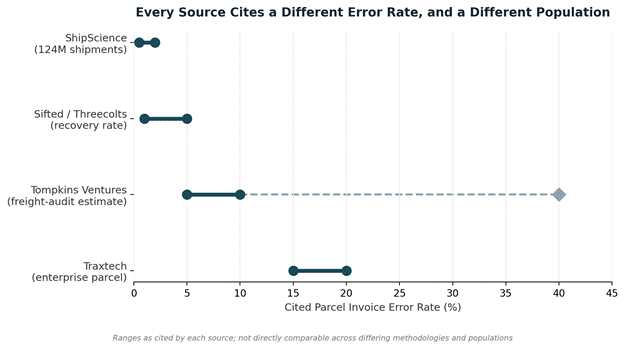
Shipping mishaps don’t just damage trust — they drain profits. 42% of merchants experience damage, loss, or theft in 2–5% of shipments each quarter, and 73% absorb these costs out-of-pocket due to disputes or lack of insurance. That’s a growing vulnerability for businesses already operating on tight margins.

Taking Back Control of the Last Mile

Retailers are investing in solutions to meet these challenges head-on. From real-time tracking to AI-driven route optimization, technology offers visibility and efficiency. But implementation isn’t easy — 36% cite high costs and complexity as major obstacles.

Innovative strategies include:

  • Partnering with trusted logistics providers.
  • Offering subscription-based shipping programs.
  • Leveraging crowdsourced delivery networks for flexibility.

While these steps help, they don’t eliminate risk entirely. That’s why shipping insurance is a smart complement — providing financial protection and peace of mind when the unexpected happens.

Why Shipping Protection Matters More Than Ever

Delivery issues now affect more than logistics. They shape brand trust, customer satisfaction, and long-term loyalty. With InsureShield® shipping insurance, retailers can:

  • Cover up to the full declared value of shipments.
  • Simplify claims through a digital portal.
  • Offer customers confidence at checkout.

A Strategic Investment for 2026

In a market where every delivery counts, protecting the last mile is no longer optional — it’s essential. InsureShield® shipping insurance helps retailers safeguard revenue, reputation, and customer relationships.

*We are licensed as an insurance broker in Ontario only and are not yet offering any services or products in other provinces, including Québec. You can find the complete insurance disclosure here: Product Disclosure. If you would like us to let you know when we are licensed in your province, then send us an email via insureshieldca@ups.com, and we will get back to you. Insurance coverage is underwritten by a Canadian licensed insurance company and issued through UPS Capital Canada Insurance Brokers, Limited (“UPS Capital Insurance Brokers”) – an indirect wholly-owned subsidiary of UPS Capital Corporation (“UPS Capital”). The insurance company and UPS Capital Insurance Brokers reserve the right to change or cancel the program at any time. Insurance coverage is governed by the terms and conditions, including the limitations and exclusions, set forth in the applicable insurance policy (the “Policy”). This information does not in any way alter or amend the terms or conditions, including the limitations or exclusions, of the Policy, and is intended only as a brief summary. Insurance coverage is not available in all jurisdictions. UPS Capital Insurance Brokers only issues policies of a single insurer in Canada, and receives commission on sales of insurance. An affiliate of UPS Capital Insurance Brokers reinsures a material portion of the risk insured by this insurance policy and the UPS Capital group therefore has a financial interest in the insurance program. You are not required to purchase insurance from UPS Capital Insurance Brokers and have the right to seek insurance elsewhere. In particular, your ability to ship using United Parcel Service Canada Ltd. or its affiliates is not conditional on your purchase of insurance from UPS Capital Insurance Brokers.

*Partner content. To work with Retail Insider, contact Craig Patterson at craig@retail-insider.com

Happy Belly Food Group’s iQ Food Co. secures 1st Western Canada location in Calgary

Happy Belly Food Group photo

Happy Belly Food Group Inc., a leader in acquiring and scaling emerging food brands across Canada, says iQ Food Co. has secured a real estate location for its first restaurant in Western Canada, located in Calgary.

With the signing of this lease, it marks the 1st location expansion outside of Ontario for the brand, a significant milestone in iQ’s national expansion strategy, it said, adding it supports the company’s continued execution against its organic growth pipeline.

iQ is a premium healthy-eating quick service restaurant concept known for its “vibrant menu of nourishing, clean-eating dishes including healthy bowls, smoothies, sandwiches, soups, and salads, crafted to satisfy a wide range of tastes and lifestyles.”

“Securing our first Western Canada location marks an important step in our national expansion plan for iQ and for Happy Belly,” said Sean Black, Chief Executive Officer of Happy Belly Food Group. “Calgary is a compelling, health-forward market with strong customer fundamentals which is an ideal fit for iQ’s positioning. This location reflects our disciplined approach to expansion by prioritizing high-quality real estate that supports consistent daily demand and attractive unit economics.

Sean Black
Sean Black

“The momentum behind iQ continues to validate both the strength of the concept and our execution. At the time of acquisition in Q3 2024, iQ operated four locations. We have since grown our footprint to 7 opened locations, with number 8 opening in Q2 2026, so Calgary will be our 9th location in Canada. With Area Development Agreements across Alberta, Ontario, and British Columbia totaling 65 committed units, we are building the foundation to scale iQ into a nationally recognized brand and drive sustained expansion in Canada’s most attractive urban markets.

“Our focus remains on accelerating growth through organic development and targeted acquisitions. With a growing pipeline of restaurants across Canada, iQ continues to strengthen Happy Belly’s broader portfolio of 666 contractually committed retail franchise locations across multiple emerging brands, spanning various stages of development, construction, and operation. Our disciplined, predictable growth engine is delivering measurable results as we expand our brands across Canada and the U.S., creating long-term value for shareholders.”


Happy Belly Food Group is a leader in acquiring and scaling emerging food brands. The company’s portfolio includes Heal Wellness, Rosie’s Burgers, Yolks Breakfast, Via Cibo Italian Street Food, iQ Food Co., and others.

More from Retail Insider:

A&W reports Q4 and 2025 financial results, with annual sales increasing to $1.92 billion

Food Court A&W Photo by Matthew at Best Edmonton Mall

A&W Food Services of Canada Inc. announced on Thursday its financial results for the 16 and 52-week periods ended December 28, 2025 and provided an outlook for fiscal 2026.

Susan Senecal
Susan Senecal

“In Fiscal 2025 we were able to deliver positive Same Store Sales Growth in all four quarters, open 26 new A&W restaurants and meet our annual guidance,” said Susan Senecal, Chief Executive Officer. “These are significant achievements given the fiercely competitive landscape and challenging macroeconomic environment that we are operating in.

“We stay committed to making sure that A&W remains affordable for all Canadians, while maintaining the high-quality and great taste that our brand is known for and are pleased with how our value-based promotions and dedicated value menu contributed to our growth in 2025.

“While the continued economic uncertainty in Canada and the severe weather events in the eastern provinces during early 2026 present headwinds for sales at A&W restaurants in 2026, we are confident in our brand’s ability to deliver value to our guests. We are optimistic about our future and believe we can successfully navigate these challenging conditions.” 

Q4 FINANCIAL HIGHLIGHTS

(as compared to Q4 2024)

  • System Sales of $591.4 million increased by $14.6 million (2.5%)
  • Revenue of $93.0 million was consistent with Q4 2024 revenue of $93.2 million
  • Income before income taxes increased by $2.5 million (12%) to $23.4 million
  • Adjusted EBITDA increased by $1.4 million (5%) to $29.3 million and Adjusted EBITDA Margin increased 150 bps to 31.5% from 30.0%
  • General and administrative expenses increased by $1.9 million (12%) to $16.9 million, primarily due to differences in the timing of when expenses were incurred
  • Cash Dividend of $0.480 per share was declared on December 1, 2025
  • Opened 12 new A&W restaurants

FISCAL 2025 FINANCIAL HIGHLIGHTS
(as compared to Fiscal 2024)

  • System Sales increased by $51.8 million (2.8%) to $1.92 billion
  • Revenue increased by $1.8 million (1%) to $294.1 million
  • Income before income taxes increased by $26.7 million (53%) to $76.7 million
  • Adjusted EBITDA  increased by $6.6 million (7%) to $100.0 million and Adjusted EBITDA Margin increased 200 bps to 34.0% from 32.0%
  • General and administrative expenses increased by $1.1 million (2%) to $49.7 million, in line with the increase in Canada’s Consumer Price Index in 2025 of 2.1%
  • Cash Dividends totalling $1.92 per share were declared
  • Opened 26 new A&W restaurants and achieved net annual restaurant unit growth of 2.0%, compared to 1.8% in Fiscal 2024

More from Retail Insider: