Exterior of Good Earth Cafe. Photo: Good Earth Cafe
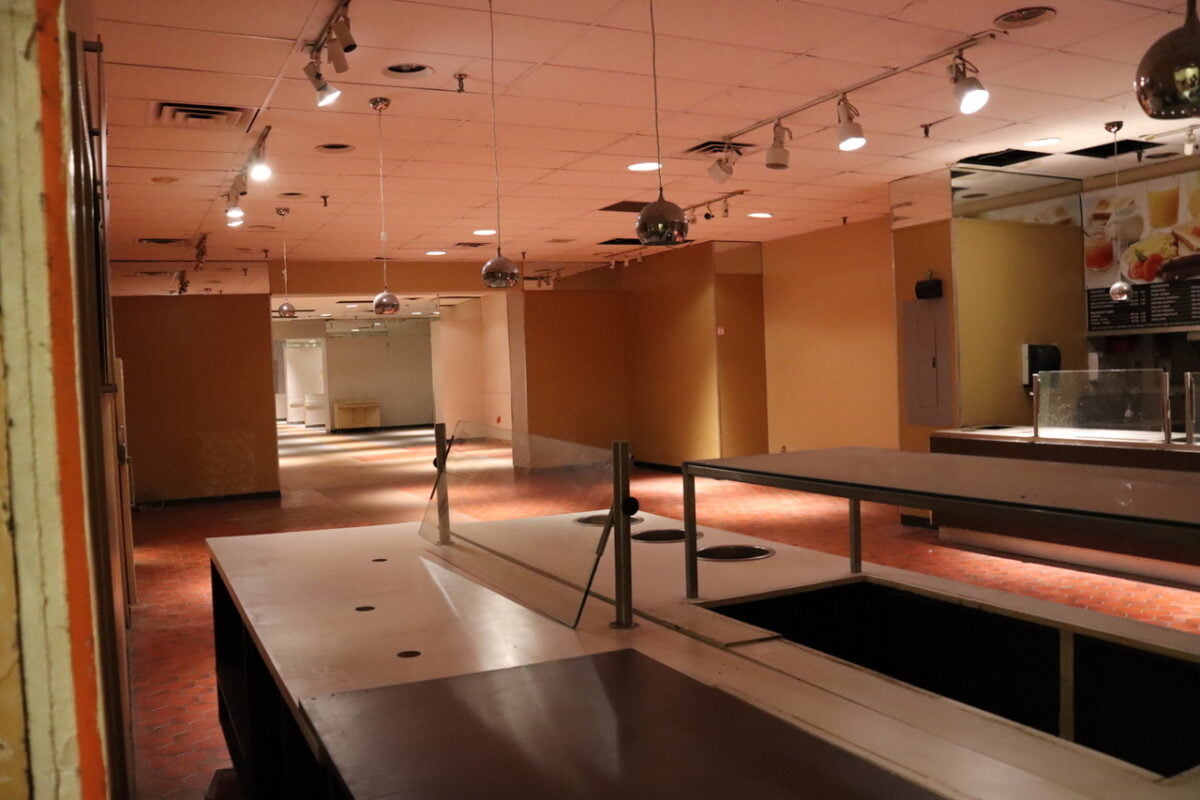
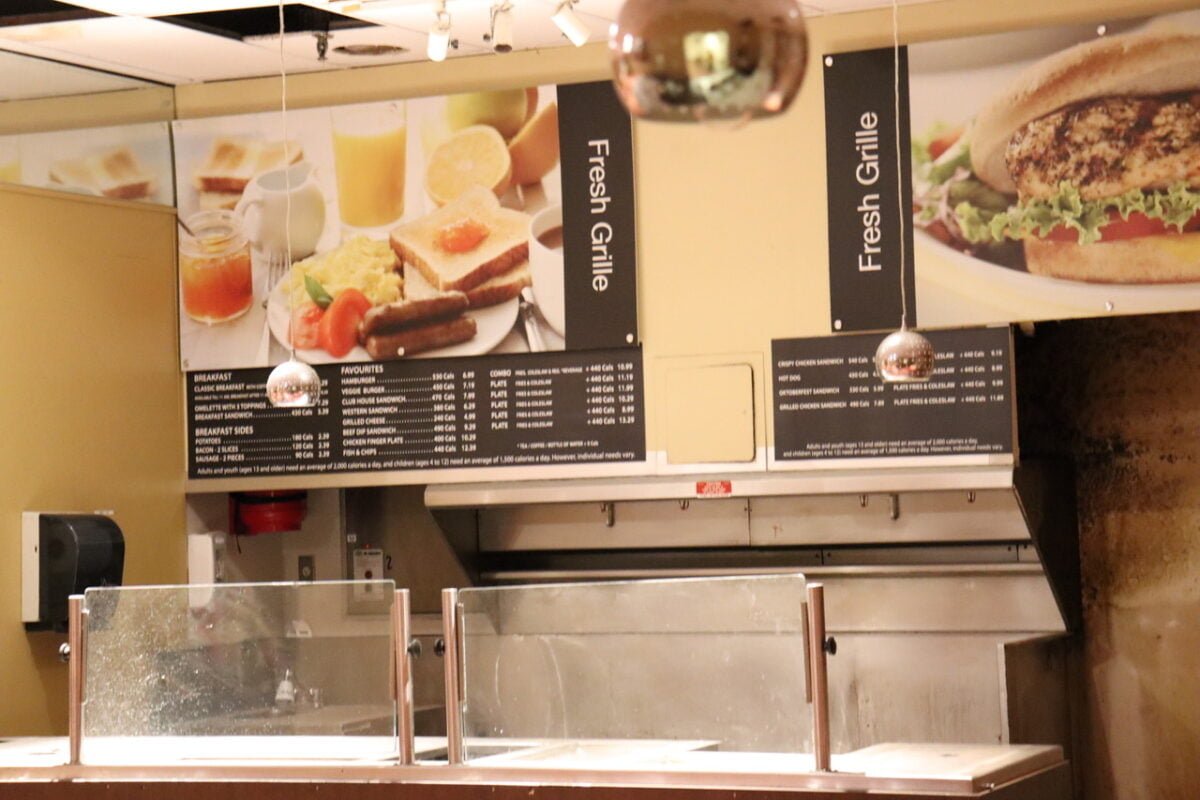
Calgary-based Good Earth Cafes Ltd. is setting its sights on acquiring a number of spaces recently abandoned in Canada by Starbucks which has announced the closure of about 300 coffee shops in the country.
Michael Going, Founder and CEO of Good Earth, said the company has retained Stan Boniferro, Managing Director of Stabon Enterprises, to work with landlords and developers in identifying sites suitable for conversion to Good Earth Coffeehouses.
Michael Going
He said the focus will be on sites with proven performance, in-place infrastructure, and opportunity for future growth.
“With their (Starbucks) announcement to close so many stores, obviously we look at that as an opportunity for us to step in and infill in some of the locations that they’re leaving behind. Certainly we’re not looking for 300 locations – and I think Starbucks will end up closing probably more than 300 and we’re hearing that now — we know that out of those there are a number of locations that we would be very interested in and we’re already starting to move on a few of those,” added Going.
“We don’t have an exact number. It will really be driven by the quality of the real estate as we see it and then very importantly by the interest that we have from franchise prospects, franchise partners. We’re very interested in partnering up with groups that want to open multi locations especially in bigger markets in proven real estate. We feel there’s an opportunity rather than going in one cafe at a time to work instead with groups that want to open a number of cafes.”
Good Earth, founded by Going and Nan Eskenazi in 1991, today has 45 locations from Victoria to Montreal throughout six provinces. The heaviest concentration of locations is in Alberta and the home base of Calgary. All of the stores are franchise operated as the company converted to that model about 15 years ago.
1 of 4
Good Earth Cafe coffee beverages. Photo: Good Earth Cafe Facebook
Good Earth Cafe lunch options. Photo: Good Earth Cafe Facebook
Good Earth Cafe coffee beverages. Photo: Good Earth Cafe Facebook
“Our intention is to be a 100 percent franchisor,” said Going.
Going said changes in the Canadian coffee landscape induced by the pandemic will leave coffee lovers high and dry in many communities due to the Starbucks’ closures and he feels this presents an opportunity for Good Earth to bring its community-minded coffeehouses to more Canadians.
“(The Starbucks locations) were known as coffee locations with some success and success being traffic and sales produced by the former operators. Certainly we do look at all different types of real estate and we just feel this is a big push for the reasons I just stated. They’re known. They’re typically in a lot of communities that are now going to be left without a favourite local coffee shop.
1 of 3
“While other brands are shrinking, we are stepping up to serve communities. We believe the human interaction that takes place in our coffeehouses is valuable — as valuable as the ethically sourced coffee and fresh food we serve. A coffeehouse is so much more than a drive-thru convenience. Social interaction is part of being human. At Good Earth Coffeehouse we get that.”
Gerry Docherty
Gerry Docherty, President and COO of Good Earth, said this unique opportunity in a competitive landscape offers excellent partnership possibilities for investors looking for multi-unit franchises and for single-unit owner operators alike.
“The pandemic has awakened people’s desire to be in greater control of their lives, something that franchising with Good Earth has to offer,” he said.
Going said it’s no surprise that the hospitality and food and beverage industries have taken a real blow during COVID.
“But people will continue to eat and they will all dine out in force when we can. Coffee is very much a community centred endeavour. We like to get together. There’s the experience that we have in cafes and restaurants. There’s the exposure to other people. We’re so missing that right now. Those of us in the industry recognize that there’s a need to get back to that – to human interaction,” he said.
Emiel Bril, an entrepreneur since age 14, has a solution for property owners and managers that will help them better work with vendors.
Bril is Founder and CEO of VendorPM, which began in January 2020 — a software-enabled marketplace that streamlines the vendor sourcing & procurement process while giving head-office centralized control & visibility.
Emiel Bril
“I used to be a service vendor. I worked for a high rise window cleaning company many years ago. So I worked with thousands of property managers, serviced many, many properties, including retail of course, and was very shocked – blown away – at how much money these management companies and owners are spending on these service vendors. But how inefficient, old school and decentralized the vendor sourcing and procurement process is,” said Bril.
“So working with vendors is inevitably an old school process and of course it comes directly at property management’s expense or the property owner’s expense.”
That’s how VendorPM started. Bril wanted to start a software-enabled marketplace that empowers property managers, ultimately addressing the existing market imbalance.
“The way we’ve done that is we’ve automated the vendor sourcing and procurement process, focusing on key areas like planning services, getting quotes, finding new vendors and even vendor compliance,” said Bril.
“And in turn, because we’re automating historically manual processes, we’re now giving head office or senior leadership in these owner and management companies far greater control and visibility than what they had before.”
Bril said the company’s reach is across Canada right now and has ambitions to grow globally.
“We’re a venture-funded start-up. In January (2020) we raised venture funding and hired world-class talent from our industry which helped us quickly grow with some of the most recognized brands in real estate. The government of Canada has also been a great support in supporting our R&D, innovation and job growth in Canada,” said Bril.
“Our intent is to become the operating system for property management. We plan to scale into the US this year and eventually IPO within 4-6 years”
For businesses, Bril said there are several benefits for using VendorPM.
“Property managers today are using Excel spreadsheets, word of mouth and email to complete these tasks which becomes very, very time-consuming and inefficient. Simply put, we’ve built a better way for them to work with vendors to ultimately save them a lot of time and a lot of headaches. Because these things were done manually before, there was no way to track data, improve and optimize. So by automating them, at the site level, it then gives head office control and visibility to make better decisions” he said.
“Vendors today still rely on old-school means of sales & marketing. So think of this like the HomeStars or the Yelp but specific to our industry. So in other words, it’s the most cost-effective way for vendors to grow their business.”
Bril started his first business at the age of 14 when he was knocking on doors selling window cleaning.
“I needed to make some money to help out my family at the time but very quickly fell in love with the business. I ended building a pretty big business. By the age of 20 we were doing about a million dollars a year in revenue with 50 employees and grew a pretty big window cleaning company,” said Bril.
“Eventually I exited that business and started working at a high-rise window cleaning company. That was the transition from selling to homeowners to selling to property managers to service these buildings or these retail properties. It was my experience then working in the commercial space, working with property managers, that ultimately led to VendorPM.”
In about a year, VendorPM has successfully scaled its platform across Canada accumulating thousands of vendors and is utilized daily by real estate owners and managers of all asset classes both large and small as well as major institutional Canadian real estate corporations.
We’ve heard it all before: small businesses are the lifeblood of the Canadian economy. They are the backbone of the communities in which they operate; the very heart and soul of the neighbourhoods they serve. These are statements that have often been employed to describe the contribution of Canadian entrepreneurs and independent business owners toward the continued overall strength of Canadian society. As true and accurate as those statements are, however, they have for one reason or another, perhaps through their wide use and the passing of time, somehow been turned into hackneyed cliches that don’t seem to resonate as strongly as they should with the average Canadian and government official alike. But, according to former small business owner, Kristina Egyed, as consequences of the pandemic continue to mount and its long-term impacts begin to rear, the critical role filled and performed by independent businesses toward the health of Canadian communities and the financial viability of the country could soon start to become regrettably obvious.
“Small businesses are an integral part of their communities,” she says. “On a micro level, it’s hard to think about any community without small businesses, not simply because of the services offered, but because of their contribution toward the lifestyle and vibrancy of their neighbourhoods. They ensure diversity and a unique environment, and consistently support local arts, culture, sporting and recreational events and activities. Small business owners in communities across the country have always assumed this responsibility, with great pride, to ensure the health and wellbeing of their local neighbourhoods. On a macro level, small businesses contribute considerably toward the strength of Canada’s GDP. If we lose the small businesses that we very much depend on, the health of Canadian communities, and of the country’s economy as a whole, could suffer significantly.”
Economic Decline
Per recently released data from Statistics Canada, it seems that the narrative woven by Egyed concerning the correlation between small businesses and the stability of the country’s economy is already bearing supporting evidence. According to the agency, the Canadian economy posted its worst ever performance, registering a 5.4 percent decline in Gross Domestic Product (GDP) for 2020, marking the largest recorded decrease since data was first calculated in 1961. Although its difficult at the moment to accurately ascertain exactly how many small businesses across the country have permanently closed their doors since the start of the pandemic – surely, it’s in the tens of thousands – the impact of these closures seems undeniable. And, it could get much worse before it gets better.
Kristina Egyed standing in her gift boutique, Lala’s, that had been in operation for 25 years before its forced closure due to COVID-19. Photo: CBC
In July of last year, during a period when a preliminary understanding and recognition of the potential harm posed by the virus’ spread began to develop, the Canadian Federation of Independent Businesses (CFIB) released a report as part of its #SmallBusinessEveryDay campaign. The report offered an early mid-range estimate concerning the impacts of the pandemic, stating that 158,000 (14 percent) small businesses across the country are likely to close their doors as a consequence of the resulting implications. Given the range of results that are expected from the survival and recovery efforts being put forth by entrepreneurs from coast to coast, that number could rise as high as 218,000, or 19 percent of all small businesses in the country. These projections are certainly grim and start to tell a story on their own. However, when considering the fact that small businesses, which account for 97.9 percent of all businesses operating in the country and contribute toward just under 40 percent of the Canadian GDP, that story begins to take on a much darker tone.
Local Prosperity
In addition to propping the country’s economy on an annual basis, employing 8.3 million people or 69.7 percent of the country’s private labour force, small businesses are also central to the economic wellbeing of their local neighbourhoods. Their oft unique verve, style and offering draws interest from visitors, generating traffic to, and awareness of, the wares and cultural offering of their communities. And, as Egyed rightly points out, the injection of sponsorship dollars and philanthropic investments into the surrounding areas that they operate in helps to ensure their proper function and maintenance. However, she adds that the support that small businesses provide for local economies is far more significant than many realize and goes well beyond that of charitable giving and donations.
“There has never been a thorough understanding of the role of small business and what it takes to run a successful operation,” she laments. “The aspect of small business that isn’t often taken into account by many people is the fact that it’s income-based, not profit-based. It has to make enough to earn the owner a living wage and to pay for staff, all of the fixed and rolling costs. But it doesn’t have to make money in order to pay people who are invested in the company. As a result, the money that’s being generated by any small business stays within the community. It stays with the owner that lives in the community. It stays with the staff that live in the community. It stays with the providers of local services in the community, and on and on. The contributions of entrepreneurs are immense and that much more meaningful through this multiplier effect that’s inherent in running a small business.”
Video by Jessica Fraser. Please note that the video was filmed prior to some provincial mask mandates.
Recirculating Revenue
The multiplier effect that Egyed refers to is an equation that’s been calculated by LOCO BC – a not-for-profit organization committed to applied research, education and networking to promote the benefits, and improve the enabling environment of independent business in British Columbia. Its research indicates that the local economic impact of small businesses is twice that of multinational competitors, with $63 of every $100 spent at local merchants recirculating back into the community, contrasting the paltry $14 that remains from every $100 spent within large multinational retail locations. As a result, it says that local businesses recirculate 4.6 times more revenue into local economies, multiplying their positive impact on the communities they serve. And, as though these numbers weren’t enough to provide empirical proof of the critical value of small businesses in Canada, Egyed suggests that when the taxes they pay are layered on, their value only increases.
“From a municipal, provincial and federal point-of-view, small businesses pay a sizeable portion of the taxes that feed the revenue that’s generated in the country,” she asserts. “When you compare the taxes paid by residents versus the taxes that businesses pay, small business owners pay their portion at a much higher range, without receiving the equitable benefits or service from those tax dollars. It’s unfair, and in many cases, prevents the growth of small business in the country, limiting the prospering of neighbourhoods and communities everywhere.”
From Coast to Coast
Extremely passionate about small business and community, Egyed was once the proud owner of LaLa’s, a gift boutique that offered an eclectic assortment of unique product with two locations in Vancouver. Founded in 1996, Egyed and her stores served the communities in which they operated in, helping to infuse flavour and inspiration into the surrounding environment. Shortly after social distancing protocols started to take effect across the country early last year, she made the decision to close her stores. She likens the decision to that of a “breakup” because of the interdependent relationship that she had develop with LaLa’s and the deep connections she enjoyed with customers. However, after having lost $140,000 in sales, incurring a personal debt of $75,000 and realizing that her 25-year career as a small business owner had come to an end, rather than simply walk away, she decided to go for a drive.
“From a personal point-of-view, it was an incredibly difficult decision for me to close my stores,” she says. “And after both locations closed, and a big part of me suddenly went missing, I realized that I needed an outlet to share my story and to hear other people’s stories. So, I got in my car and I drove from Vancouver to the Eastern Townships of Quebec and back. Along the way, I made very conscientious choices to leverage the services of locally-owned and operated hotels, restaurants and gas stations and began anecdotally speaking with business owners to get a sense of how they were doing and feeling and to find out how their businesses had been impacted by our situation. I then started to record these conversations and gain a real understanding of the small business landscape across the country, the communities and settings where people are doing well, and where people are struggling.”
Government Support?
For instance, Egyed says that one of her observations is that in smaller communities, where people are being forced to stay at or close to home, small businesses are doing well and in some cases are experiencing increased patronage because of limited choice. Whereas, in more urban settings, where traffic has come to a complete halt, results have shown up in massive challenges for small business owners and juxtaposing outcomes. She says that her cross-country experience was cathartic and one on which she met some amazing Canadian entrepreneurs. She describes their attitude, generally speaking, as positive, but adds that there was also a collective theme of disappointment that accompanied most of her conversations.
“Unfortunately, small business owners feel as though they’ve been left by the wayside by their government,” she admits. “They’re ashamed of the way they’ve been treated, yet again, and believe that the current lexicon of the “Ma’ and Pa’” store is so degrading that they’re sick of it. Many of these people are innovative entrepreneurs who employ staff and run large numbers of inventory to their storefronts. The dismission by government of the economic value of small business in communities across Canada has been difficult to swallow. It sends a message that they don’t view the return on investment in small business to be significant enough to support them. And yet, they’re willing to bail out larger corporations who are paying dividends out to their shareholders. It’s all been received by most of the small business owners that I’ve spoken to as a real slap in the face.”
Shopping Local
Despite the negativity of that particular point of conversation, however, Egyed recognizes that there is also a heartening thread among the developing narrative, one that’s showing up in the form of the encouraging loyalty and backing that many small business owners are receiving from their customers in areas where physical traffic still exists. She says that in most of these instances, customers are doing everything possible, leaving as much of their spend as they can within their local small business establishments. It’s a positive sign, she acknowledges, and one that emphasizes the importance of shopping local with respect to the survival of Canadian communities.
“I don’t think I’m even able to express how significant shopping at your local small business will be over the course of the next couple of years and beyond,” she says. “But it’s not easy at the moment. People have to go out and, in some cases, stand in line or visit stores at times that may not be the most convenient for them, to experience an environment that has changed considerably, where service levels have been altered as a result of the pandemic to that of something prescribed and void of the usual character that we’ve come to expect from our local small businesses. But, if we don’t collectively make the effort to support our local shops, we’ll end up with the lowest denominator of product available. We won’t have access to the same variety and won’t enjoy the positive influence on our neighbourhoods. We’ll lose everything that makes our communities and the varied cultures within them unique.”
Eyes on the Street
In addition to these losses, points out Egyed, communities hardest hit by the loss of small businesses could also potentially experience an uptick in violence and crime, suggesting that the presence of merchants and their familiarity with the neighbourhoods in which they’re located provides a natural prevention to the unseemliness and degradation that some areas are blighted by.
“When communities lose small businesses, they’re also losing their eyes on the street,” she explains. “I don’t think that many people realize the true value of small businesses in this way, taking it for granted. When retailers were mandated close in certain parts of the country, many areas experienced significant increases in vandalism, theft and other crimes within the first week of lockdowns. There are many case studies from across North America involving communities that have, for a multitude of different reasons, lost their small businesses, and the result is almost always a dilapidated area which then negatively impacts the surrounding residential neighbourhoods. Small businesses keep communities safe. And without them, municipalities are not going to have the tax revenue to increase community policing.”
The True Value of Small Businesses
Indeed, the impact of small businesses on the communities that they operate in is tremendous. And, given the details of their contributions, combined with the potential ramifications that entrepreneurs could be facing over the next 12 to 18 months, those hackneyed cliches used to describe their value could once again be restored to their rightful meaning. In the meantime, Egyed believes that the abilities and character that are intrinsically part of every small business owner, combined with their desire to help their communities and neighbourhoods to continue growing, will serve many of them well through these challenging times and beyond.
“Small business owners are the most resilient people I know. Their ability to shift and pivot inside environments as difficult and challenging as a global pandemic is incredible and has been shown time and again throughout the country for decades. It’s something that I think is only matched by their hard work and the care that they put into it. Many that I’ve spoken to are so dedicated toward making this situation work for their businesses, customers and communities. And I really think that Canadians are going to start to realize that they have to put in some of the work as well and rally around their local establishments in order for their neighbourhoods to survive through the long-term. And hopefully the government will shift their perspective with respect to small business, review the data that’s produced by Statistics Canada, and finally recognize the true value of the Canadian small business community.”
The arrival of vaccines is bringing light to the end of the COVID-19 tunnel, but retailers on Main Streets and within malls rightly are wondering, what’s next? Are permanent changes coming in how and where people shop? How can I recover lost market share? Where am I likely to reach my market’s demographics?
Relief won’t come from creating flashy temporary attractions or by reverting to old practices and pretending last year never happened. Part of what will make a difference for enterprises is meaningful agile data, the kind provided by Citiscope, a software startup that combines urban science with computer science to provide a thorough understanding of the behaviours of Canadian shoppers.
Citiscope is a software platform that selectively mines publicly available, dynamic geo-social data. It pulls together a wide range of relevant intelligence such as trip reviews, mobility data, even analyzing the location and timing of emoticons. The deliverable is nearly real-time visualization tools that allow retailers to gain insights about customers, malls and neighbourhoods where businesses and institutions operate. Citiscope’s product thus goes well beyond the kind of statistics from censuses or one-dimensional counts of foot traffic that retailers have become accustomed to.
The company’s material is mapped to help merchants and city-builders probe what residents and visitors value in particular communities. In so doing, the program sheds light on evolving preferences and behaviors of shoppers, social activities that act as magnets for locals and visitors, and understandings that can help stores, groups, organizations, and neighborhoods thrive. By observing how, where and when different demographics go you can understand what they want.
The software – which can be accessed from a desktop, iPad, or smart phone – can help retailers understand the following points:
Understand visitation patterns
Understand the activities drawing people to a mall, shop or BIA
Understand where shoppers are coming from, and how they are arriving
Understand the influence of placemaking events
Understand aspects of the local character that are causing customers to keep returning
What is missing from a mall, BIA or retail area that is driving retention in other areas
How can you turn your mall, BIA or retail area into more of a destination?
How can your BIA, mall or retail area change to reflect the unseen but permanent COVID-induced changes to your neighbourhood?
By examining data from during the Pandemic some findings include:
Cities lately have been turned inside-out with more people working remotely, a trend likely to stay. Retail high streets and Business Improvement Areas that focus on creating opportunities to see and be seen are faring better.
There’s a palpable hunger for more public spaces. After being locked down for so long, Canadians are on record as wanting more settings where they can safely see and be seen.
Whereas before “experience destinations” were regarded as big glitzy downtowns, we can see how local placemaking efforts like outdoor restaurants, wide, safe bike lanes, and outdoor exhibits for art and for cinema can turn even overlooked BIAs into the kinds of sites where residents and visitors come to spend time and rejuvenate.
Dorn Townsend
Citiscope was founded by Dorn Townsend, a Toronto native whose interest in learning how people engage with cities began after university when he spent a year as a bike messenger in Toronto and Vancouver. He spent years working on urban issues around the world with the UN while he was also contributing to media like The Economist, Foreign Affairs, and The New York Times. The software’s back-end was built by a team of PhDs in math and telecommunications engineering. The platform is uniquely built to take and seamlessly integrate information from different sources including in-house data, Internet of Things, smart-city sensors, and social media.
Woman grocery shops with face mask on during COVID-19 pandemic.
It was certainly a year to be forgotten for the food service industry. StatsCan numbers told us this week that sales in the food service industry dropped by a whopping 32 percent, from Q4 2019 to Q4 2020. The food retail/service ratio, an important metric to assess how important food service is in our lives, also saw a significant shift in Q4 2020. Before the pandemic, about 35 percent of all the money spent on food was in food service and restaurants. In Q2 2020, it went below 20 percent, the lowest in decades, and now it is back up to 24.3 percent. Still, it’s a very low percentage compared to before the pandemic.
Even if, across the country, the sector registered fewer than 20 bankruptcies since August, many restaurants have closed or given up on their business. COVID-19 has ripped away the dreams of many entrepreneurs and chefs. Heartbreaking, really. Even worse, a large number of new Canadians, who have brought more innovation and wealth into the sector over the last several years, have had to close shop. A lot of them were family businesses. It is happening around the world, including here in Canada.
Looking ahead though, COVID-19 may become the food service industry’s opportunity to experience a great reset. Like many other sectors, the food service has had to turn on its head to adapt, pivot, convert, and change over the last 12 months, in order to survive. It has been incredible. While the industry will come out of the pandemic with scars, the future presents a great opportunity to redefine its purpose in our overall economy.
Even with the pandemic’s end in sight, it is unclear if people will be comfortable going out and about and patronizing their favorite restaurants again. It will take a while before most Canadians befriend the virus and not fear it. The fear must be managed carefully by restaurant operators.
While many establishments have disappeared, the gap created by the massive exodus will provide room for more innovation. New recipes, new cuisines, new ingredients, new tastes, new ways of serving, new restaurant designs and more. Canadians, coming out of their kitchen-intensive days more food literate, will have different expectations. The need for more creativity will impact innovative vibes for years to come. Perhaps not at the very beginning when pent-up demand will get people out no matter what. But soon after, Canadians will expect more.
The way the competitive landscape is defined by operators will also change. With the pandemic, the supply chain is now much more open and democratized. Many companies can sell online, and not just food. Prepared meals and meal kits are being delivered at a record pace. With e-commerce becoming a legitimate strategic option for a growing number of operations, farmers, farmers’ markets, and processors can and are selling directly to consumers. Kraft-Heinz, of all companies, is now operating three ghost kitchens in Canada. Imagine, a multinational consumer goods company delivering meals to consumers. Profits are not the aim but rather it is about understanding the ever-changing customer. Loblaws, through its PC Chef app, is now in the meal kits business prepared by well-established restaurants in some parts of the country.
The pandemic has altered rules for everyone, including restauranteurs. Market access and consumers’ expectations will make things interesting. A combination of both always leads to more innovation.
On the human side of the equation, the sector will need to find a way not only to attract more talent, but also to offer people a chance to build a career. Salaries and how workers are compensated need urgent attention. During COVID-19, the no-tipping agenda was brought back into focus. Tipping is known to be discriminatory and can only benefit the few, when the experience, and the meal itself is the product of many people’s work, not just the server. To make the sector more attractive, and for equality’s sake, the practice of including the tip in prices, like we see in many parts of the world, will need serious consideration. It’s time for a great reset so the sector becomes a place of choice for a growing number of people who have lost their professional positions due to COVID’s wrath.
It is unclear when Canadians will back out in full force and once again spending at least 35 percent of their budget on food consumed outside the home. It could take a few years, perhaps more. But as with everything, humans will bounce back, and a different food service industry will surely be ready.
Exterior of Second Cup location on King Street East in Toronto. Photo: Second Cup
Montreal-based Foodtastic, a franchisor of multiple restaurant concepts, is buying the specialty coffee brand Second Cup Coffee, with aggressive plans for expansion in the coming years across the country.
“Second Cup has been a Canadian staple for almost 45 years and we’re excited to welcome them into the Foodtastic family,” said Peter Mammas, President and CEO of Foodtastic.
Peter Mammas
“We look forward to working with all our new franchisees and emerging through this pandemic with a revitalized Canadian leader in the premium coffee segment. This acquisition is consistent with our strategy of acquiring quality Canadian brands with growth potential.”
Foodtastic is buying the brand from Aegis Brands Inc. The official closing of that deal is in early April.
Foodtastic started in 2012 with the first Beauty and the Beef burger bar concept. It is the franchisor of multiple restaurant concepts — 16 of them — including Au Coq, La Belle et La Boeuf, Monza, Carlos & Pepe’s, Souvlaki Bar, Nickels, Rotisseries Benny, Chocolato, Big Rig, and Bacaro. Foodtastic is a leader in the restaurant franchising business with over 130 restaurants and $240 million in annualized sales.
Lawrence Mammas, Chief Development Officer and a founding partner in Foodtastic, said there are currently 211 Second Cup locations across Canada.
Lawrence and Peter Mammas have been in the restaurant business since their youth. In 1990, Lawrence came up with a concept called Nickels Deli with a local Quebec singer, who is now an international diva, Celine Dion. Together with Dion and her husband, René Angélil, and his cousin Paul Sara, the Mammas brothers started Nickels “and that’s how we got into the franchise game,” added Lawrence.
Beauty and the Beef started in 2012 with another partner, Jack Gaspo. Then they started Souvlaki Bar and then it purchased Carlos & Pepe’s and continued its expansion. In late 2018, they signed a partnership with Oaktree Capital, an investment firm out of the U.S., to help it continue its expansion and they acquired several brands. In January 2020, Gaspo was bought out and the company is currently owned by the Mammas brothers and Oaktree Capital.
Lawrence said in 2018 Oaktree Capital initially invested $47 million and it was recently announced it was investing another $50 million.
“Second Cup fell in our strategy of being a diversified restaurant company and having brands to appeal in different segments. So we did not have anything to do with any kind of coffee chain. We knew that Second Cup was possibly available and we looked at it and said this is a brand that’s been around since 1975. They have coffee. It’s a Canadian brand. We would be very proud to own it being Canadian ourselves and we wanted to keep it Canadian and not allow some American company to come and grab it,” he said.
“Our expertise is we’re very, very strong in our food component. So we hope to bring a new offering on the food side to draw more clients into Second Cup. They already have a great, great coffee.
“Our game plan is to basically tweak operations, bring a new twist to the food offering and our goal is to surpass 300 units in the next 36 months. We want to grow out West. We want to grow in the Maritimes, Quebec, and wherever we can in Ontario.”
Tony Flanz of Think Retail represents Foodtastic and is negotiating leases for Second Cup.
CF Toronto Eaton Centre - Photo by Dustin Fuhs (March 8, 2021)
Monday, March 8th, 2021 was the first day that Toronto re-entered the lockdown “grey zone” after more than 100 days in a stay-at-home order. Retail Insider toured certain parts of the city today in an attempt to showcase what we saw while walking through downtown Toronto on the first day of reopening.
Retailers deemed ‘non-essential’ during lockdowns were permitted to reopen Monday morning at 25% capacity. In-person dining, visiting gyms, and personal services are still not permitted.
As part of the tour we visited Bloor Street West, Yorkville, CF Toronto Eaton Centre, The PATH, and Front Street.
Bloor Street
We had the opportunity to explore the Bloor-Yorkville neighbourhood and will be discussing what we saw. Overall the area was quiet. It is becoming apparent that food and beverage businesses help drive foot traffic to neighbourhoods and given that in-person dining is still prohibited, the normally busy Yorkville area has far fewer visitors than one might see if the neighbourhood’s dining establishments and services were open.
One Bloor / Nordstrom Rack – Photo by Craig Patterson (March 8, 2021)
Starting at the corner of Yonge and Bloor, the Nordstrom Rack store had a lineup of people looking to shop or return purchases. Nordstrom Rack was one of few retailers that appeared busy on Monday afternoon. The retailer opened at the base of the 1 Bloor Street East mixed-use tower in the spring of 2018.
H&M at 13 Bloor Street West – Photo by Craig Patterson (March 8, 2021)
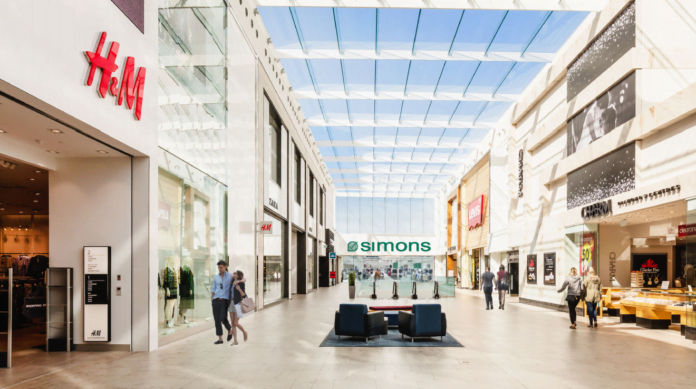
We had expected to see a lineup in front of the H&M store at 13-15 Bloor Street West as was common in the summer when stores were open, but Monday afternoon was still relatively quiet on the ‘Mink Mile’. Construction noise could be heard for ‘The ONE’ project, which is set to include a residential tower spanning more than 1000 feet at the southwest corner of Yonge and Bloor, which will feature a boutique hotel and an Apple store when completed in 2023.
Zara and Aritzia – Photo by Craig Patterson (March 8, 2021)
We also expected to see lineups in front of Zara and Aritzia — both stores were relatively quiet. A Fossil store between the two closed permanently several months ago.
Holt Renfrew Bloor Street – Photo by Craig Patterson (March 8, 2021)
The Holt Renfrew store at 50 Bloor Street West is open again and we saw several customers coming in and out of the store. We reported last month on the completion of Holts’ new facade and ground-floor renovation, both of which were completed in November during lockdowns.
Bay & Bloor – Photo by Craig Patterson (March 8, 2021)
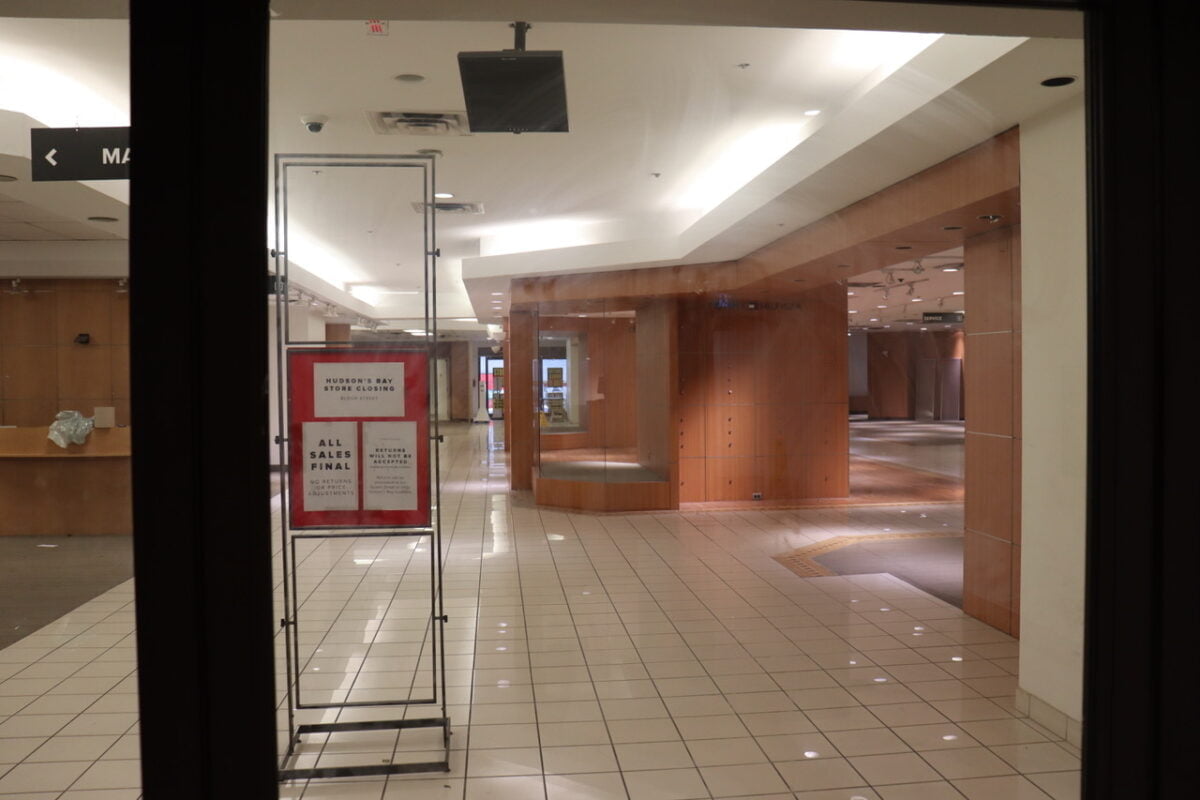
The corner of Bloor and Bay was seeing a fairly typical amount of foot traffic. The Gap store at 60 Bloor Street West closed forever earlier this year. Hakim Optical, considered to be an ‘essential’ retailer during lockdowns, remained open while its neighbours were all shut. Hakim opened over the summer.
Bay & Bloor – Photo by Craig Patterson (March 8, 2021)
The photo above includes the Maison Birks jewellery store to the right, which saw an overhaul in 2019, as well as grocerant, Eataly, which opened in late 2019. The shuttered Gap store is at the left of the photo, which was taken in front of the TD Bank at 77 Bloor Street West.
Banana Republic, Goodlife Fitness and Roots – Photo by Craig Patterson (March 8, 2021)
We reported last year that Banana Republic had shut its store at 80 Bloor Street West. A Roots store remains open, while the Goodlife Fitness gym upstairs remains closed due to pandemic restrictions.
MCM, Fire & Flower – Photo by Craig Patterson (March 8, 2021)
The row of retailers between 83 and 95A Bloor Street West have struggled as of late. The Victorinox space at the corner is now vacant after the retailer shuttered permanently last year. MAC Cosmetics also shut its Bloor Street location last year. Fire & Flower cannabis never ended up opening on Bloor Street and the space is listed for lease. Upscale retailers MCM, APM Monaco, and COS remain open, as well as a clearance retailer currently occupying the former Hugo Boss storefront at 83 Bloor Street West.
Harry Rosen at 82 Bloor Street W – Photo by Craig Patterson (March 8, 2021)
The Harry Rosen flagship store at 82 Bloor Street West opened Monday morning, and CEO, Larry Rosen, himself made the announcement on social media from within the store (Monday was also his birthday). The Harry Rosen store appeared to be quiet, and the Bellair Street entrance was covered in plywood on Monday morning after being used as a click-and-collect access point for shoppers not able to enter the store during lockdowns.
Hermes and Holt Renfrew Men – Photo by Craig Patterson (March 8, 2021)
Hermes and Holt Renfrew Men at 100 Bloor Street West reopened Monday morning. Both stores were relatively quiet. Hermes had been offering curbside pick-up during lockdowns and was using a service door facing Bellair Street to deliver goods to vehicles during that period.
The Colonnade at 131 Bloor street west – Photo by Craig Patterson (March 8, 2021)
It was business as usual for many of the retailers at The Colonnade at 131 Bloor Street West. Over the summer, the massive Dior flagship saw lineups and we may see that again this upcoming weekend as shoppers are expected to converge on the area. German retailer Bogner signed a short-term lease to test a space next to Moncler at The Colonnade — the store opened in mid-November and the idea was to gage sales until March of 2021 before extending the lease. Due to the 105 day lockdowns, the Bogner store has only been open to the public for a few days despite having occupyied the leased space for nearly four months.
The Colonnade at 131 Bloor street west – Photo by Craig Patterson (March 8, 2021)
The above photo is also of The Colonnade, showing Prada, Cartier, Black Goat Cashmere, and Escada. The Escada stores in Toronto and Montreal remain open for the time being, but the Vancouver store unfortunately recently closed permanently. German luxury fashion brand Escada has been experiencing financial troubles and the future of the company is uncertain.
Winners / Homesense on Bloor Street West – Photo by Craig Patterson (March 8, 2021)
The Winners/HomeSense store at 110 Bloor Street West was one of few stores in Bloor-Yorkville with a lineup on Monday. Due to capacity limits, a door person monitored who came and left the store.
Gucci at 130 Bloor St W – Photo by Craig Patterson (March 8, 2021)
The impressive Gucci flagship store at 130 Bloor Street West recently saw a full renovation inside and out. We saw several customers in the store, which is expected to see lineups over the weekend.
Gucci’s popularity as a brand is said to have plateaued, and it remains to be seen how its Canadian stores do as consumers gravitate to other brands. Globally, Gucci’s growth has been explosive over the past several years.
The Burberry, Tiffany & Co, and Louis Vuitton stores were all open on Monday — Burberry is at 144 Bloor Street West and Tiffany & Co. and Louis Vuitton occupy the retail podium at 150 Bloor Street West. We expect to see lineups over the weekend — during the summer all three stores saw tremendous interest from shoppers, particularly on weekends.
Village of Yorkville
The Deciem beauty store on Bellair Street, behind Harry Rosen, is again open for business. The store is expected to see consistent foot traffic moving forward due to the brand’s popularity.
Further north on Bellair Street at 77 Yorkville Avenue is the new Isaia storefront, currently under construction, which will open next month.
The Free People store on Yorkville Avenue was open with a couple of customers inside when we walked past. The Free People store at CF Toronto Eaton Centre was being cleared out Monday morning as it appears to have closed permanently.
Russell Oliver, aka ‘The Cashman’, will open a luxury consignment store this spring on Yorkville Avenue. The signage on the space can be identified in the above photos with the words ‘OHHH YEAH’. An adjacent space at 90 Yorkville Avenue is for lease, and on the other side at 86 Yorkville Avenue an upscale medi spa will open this spring according to the owner.
The Christian Louboutin store at 99 Yorkville Avenue reopened to shoppers on Monday morning. The store opened to fanfare in 2016 and is the only standalone Louboutin location in Canada.
The photo above was taken in front of the Brunello Cucinelli flagship store at 108 Yorkville Avenue. Across the street at 101 Yorkville Avenue is a building that was set to be redeveloped. First Capital Realty is now marketing the property for sale so the redevelopment plans as set out are uncertain.
The photo above is of the Chanel flagship store that opened at 98 Yorkville Avenue in the fall of 2017, as well as Stone Island, Versace, and Brunello Cucinelli. The doors of the Chanel store were wide open and we saw several people enter the store.
The photo above is of Cumberland Street, facing the Nespresso cafe, as well as Lululemon, Aveda, and Nicolas storefronts. SEE Eyewear recently shut permanently next to luxury retailer Nicolas and a new retailer has already leased the space to replace it.
Lovely Hazelton Avenue was quiet on a Monday afternoon. The street isn’t busy at the best of times, and is lined with a mix of retailers and art galleries. Canadian outerwear brand Nobis, which opened its flagship store at 20 Hazelton Avenue in late 2017, is in the process of shutting permanently with its stock being moved to the retailer’s Queen Street West location.
CF Toronto Eaton Centre
CF Toronto Eaton Centre has been preparing for this moment and outside of a few hiccups and retailers making the decision to open later this week, we had a pleasant experience.
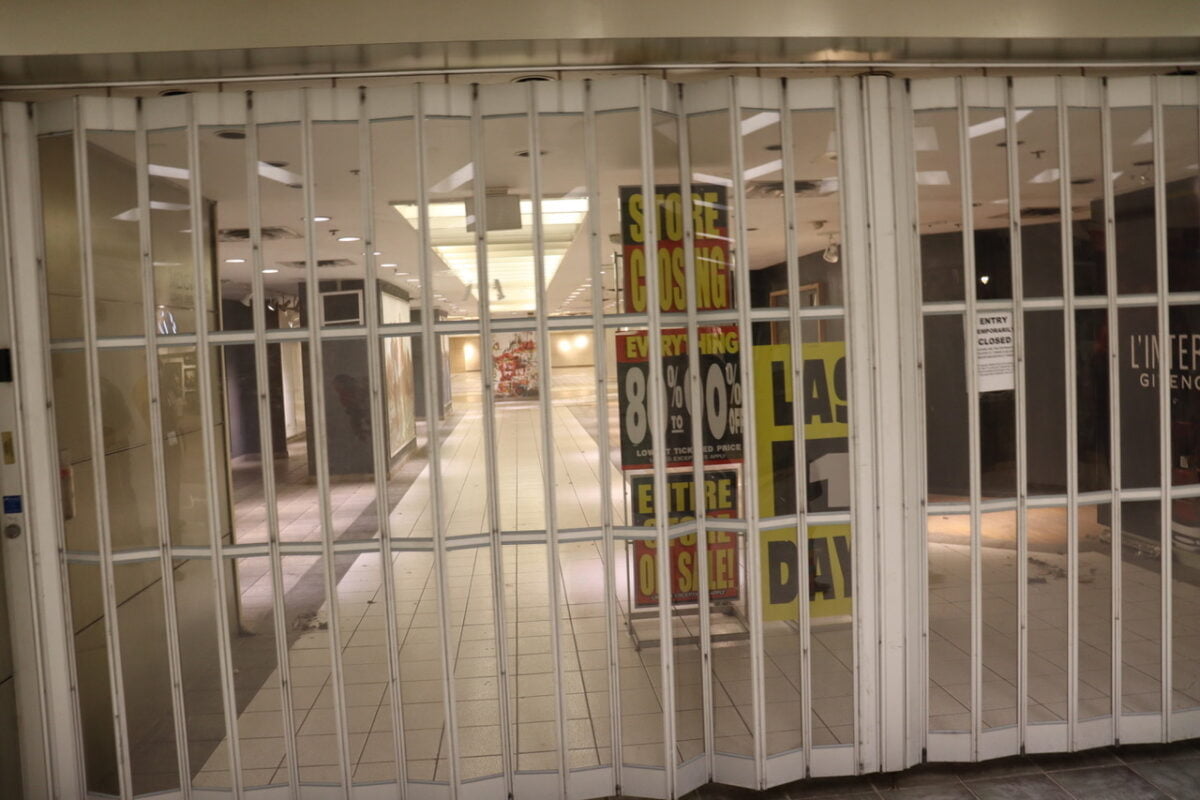
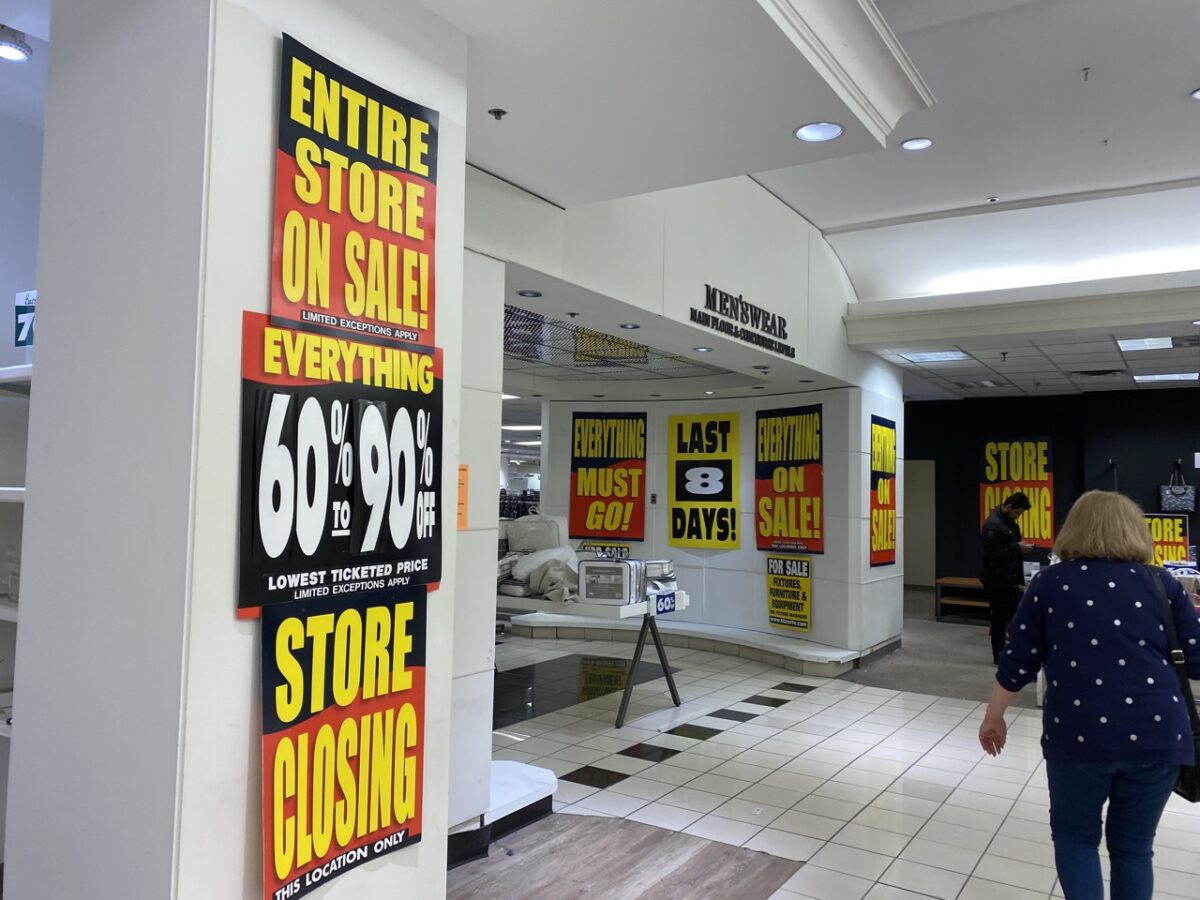
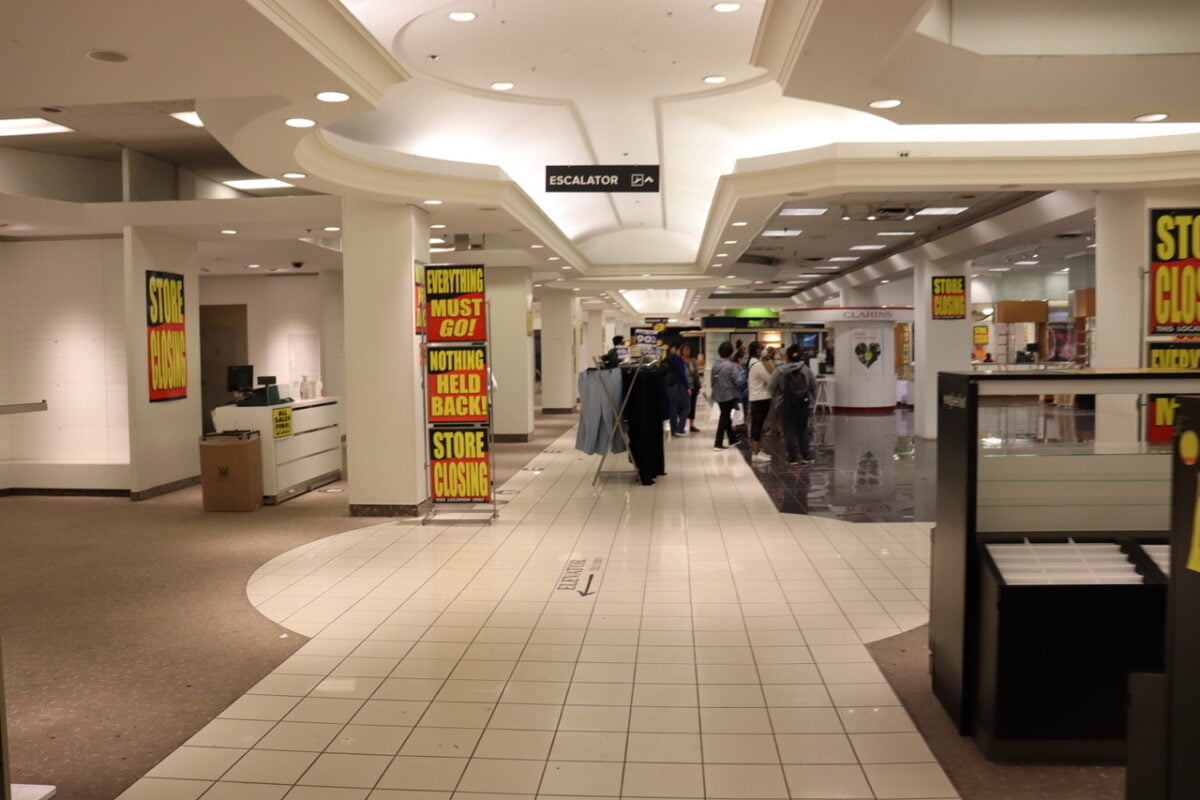
Le Chateau is still in the process of closing its locations including the one at CF Toronto Eaton Centre, which is selling at up to 70% off via a receiver.
Our first stop, not pictured, was at the Disney Store. This image was taken from the line, which took some time to get through because folks needed to get their hands on limited-edition merchandise and a really nice 50% off sale on clearance. Because the stores in the Eaton Centre never had a Boxing Day or an opportunity to sell-off holiday/winter stock, this was a great time to secure deals as a consumer.
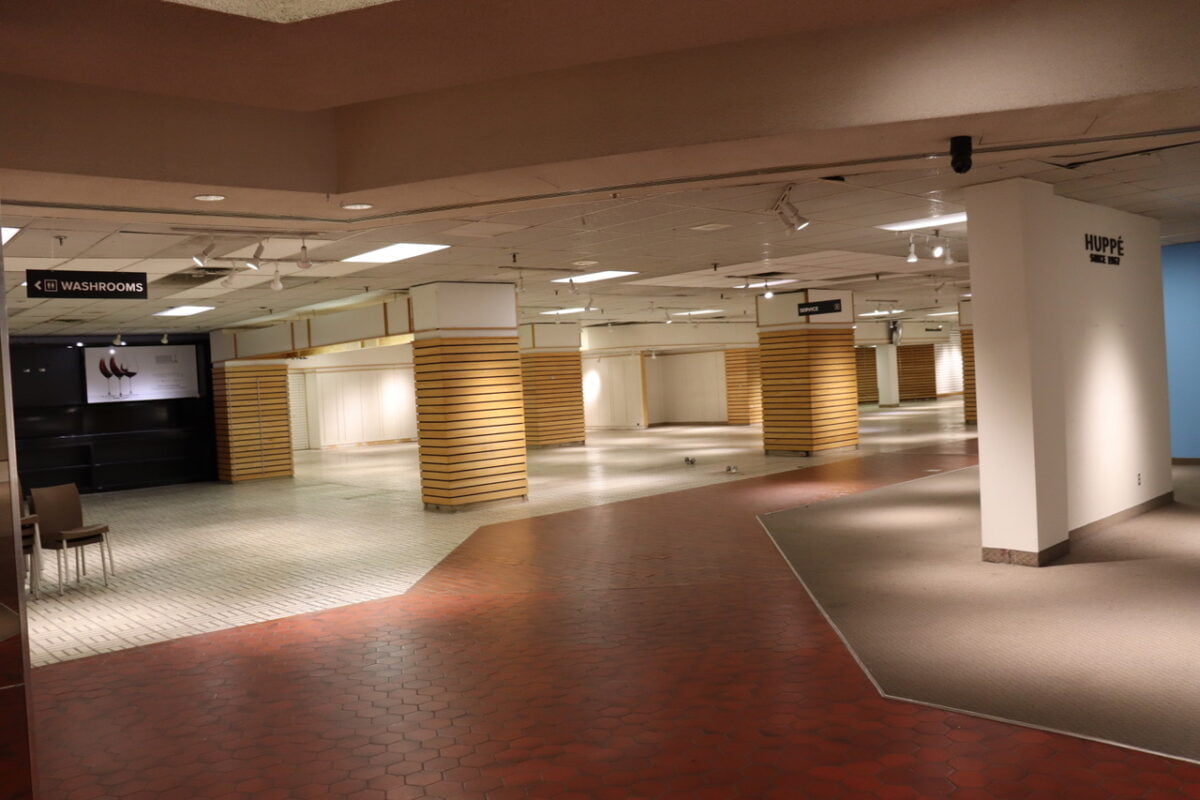
Surprisingly, women’s fashion retailer, Free People, has closed its store permanently in the mall.
All the merchandise and fixtures have been removed from the Free People space, leaving an empty storefront that was in the process of being covered with window decals.
There were stores, like Ever New Melbourne, which had lights on but left us wondering whether or not they would be re-opening.
A super quick trip across the street to confirm that yes, the Foot Locker at 306 Yonge Street has indeed opened. This would technically be its first day open to the public despite having finished renovations last year. The new Foot Locker is Toronto’s “Community Power Store” concept which we reported on back in December 2020. The space was formerly occupied by a Michael-Jordan-branded storefront that was renovated and rebranded last year.
There was a lineup around the corner to get into Foot Locker, and we’ll be doing a longer trip up Yonge Street in the days to come.
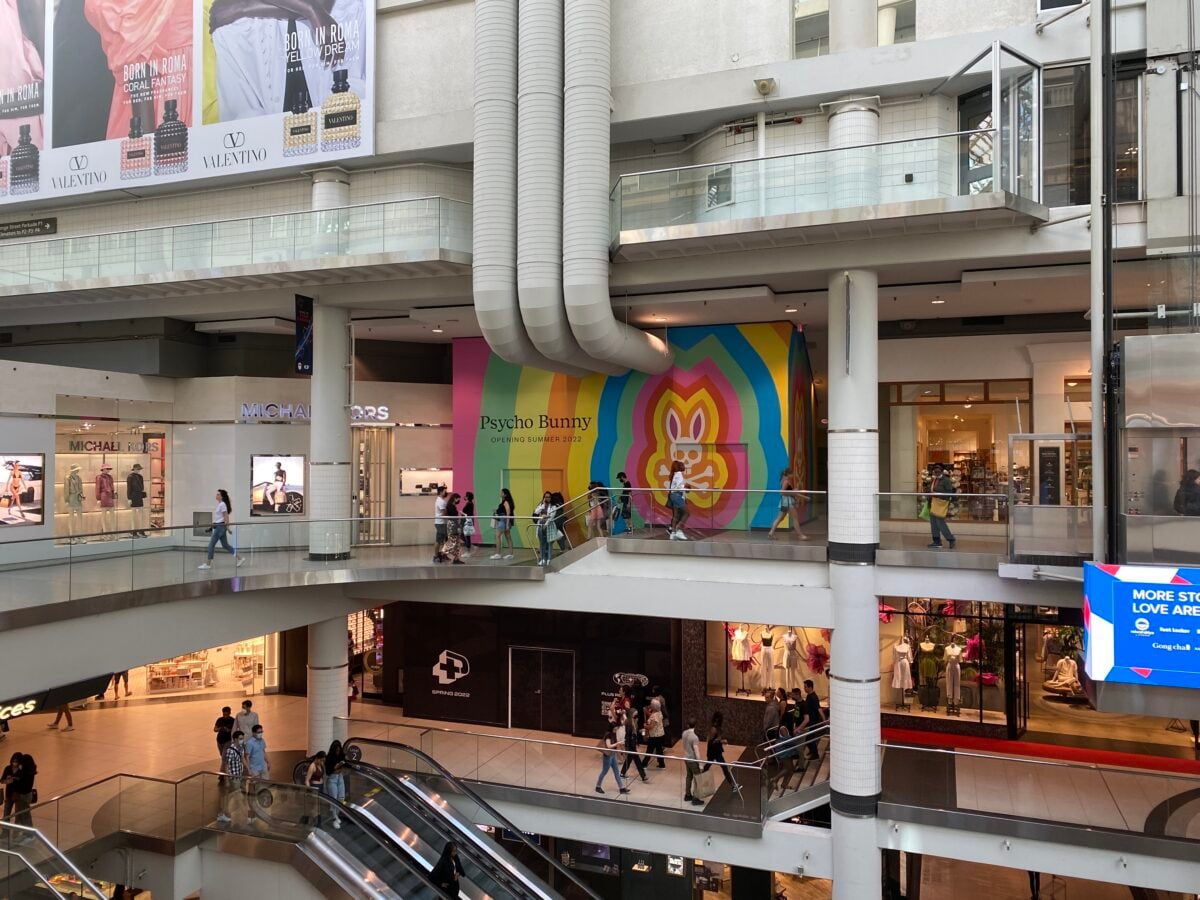
Heading back into the CF Toronto Eaton Centre, we walked through Nordstrom and came across this opportunity to share the four levels of the mall in a single photo.
The Danish Pastry House had not re-opened as of Monday. On the bottom floor, Eddie Bauer didn’t have lights on and the Calendar Club location across the hall was shuttered long before our latest stay-at-home order.
On level three, this image was taken outside of the Indigo book store and provides a number of storylines. Links of London beside Michael Kors will be replaced with a Jo Malone storefront this spring, while we haven’t heard what will be taking the vacated Stuart Weitzman location that closed in 2020. Upscale footwear brand Stuart Weitzman also operates a store at 151 Bloor Street West which sources say will eventually be closing permanently.
The sign is a little hidden, but we’re glad that Canada’s first standalone Ray-Ban store re-opened on Monday. More locations are expected to be announced soon.
This is the other view from the same vantage point, with the physical distancing and security being showcased. You can see the line for Sephora going back to True Religion Jeans, which we didn’t see open on Monday. Victoria’s Secret and Pink were not open either, but they had signage to let guests know that they will reopen on Wednesday.
On Monday, March 8th when the CF Toronto Eaton Centre opened, we found that the OVO store was closed and had the merchandise fully cleared out. A couple days later on March 10th, the store was re-opened with full stock.
We weren’t sure if the store had shut permanently, as the brand had closed its location on Dundas Street West. We’ll be circling back on this brand, as Drake is growing his footprint in The6ix and around the world.
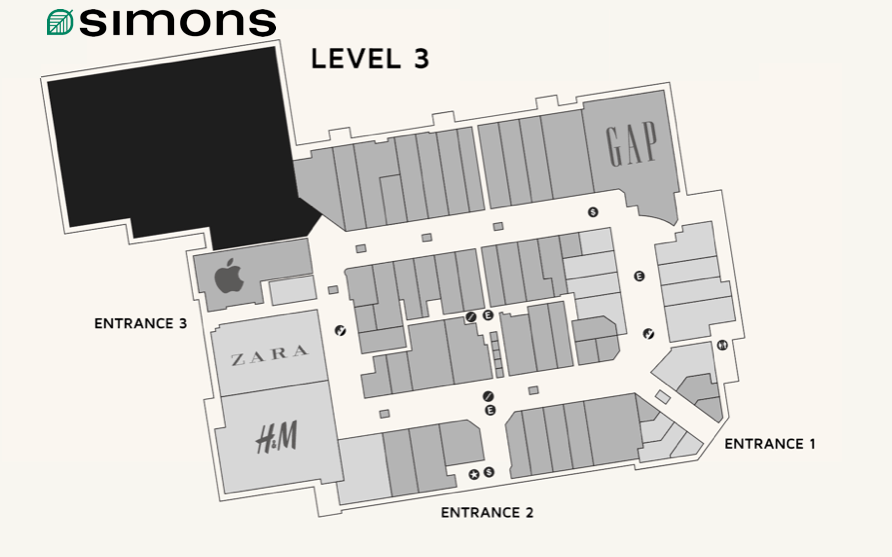
A lineup in front of the Apple store is never a surprise, though this lineup is much shorter than what we’ve seen in the past. Apple moved downstairs to its current 14,000 square foot space in late 2019 and Canada Goose subsequently opened in the former 5,000 square foot Apple space.
Bently, Bell, and Bluenotes/Aeropostale were all in operation on Monday. This was a photo to show that stores with large entrances have actually adapted to have a single walkway in and out.
NYX Cosmetics announced that it was closing all of its Canadian stores back in November 2020, so this wasn’t a surprise to see the storefront papered up. Right beside the store is the Sunglass Hut, which is also freshly closed.
The line that you see is for the NIKE store, which is in between the newly-renovated Under Armour and the large Levi’s location. The Microsoft Store is still sitting empty across the hall, after the company announced in June 2020 that it would be permanently closing all 83 locations in the chain.
Purdy’s Chocolatier and the Cheese Garden didn’t open on Monday, and we also found that Rocky Mountain Chocolate Factory and Freshii have both fully closed their operations on the first floor.
The Path
On our walk south from the CF Toronto Eaton Centre, we decided to visit the PATH which is the largest underground shopping centre in the world and is directly below the Financial District. Here are a few of the notable changes, with more photos and stories to be shared in future articles.
The PATH is full of hundreds of stores, and we’re going to do a full breakdown of all the news as things come out from the cloud of dust that was 2020. However, it was disheartening today to realize the volume of smaller retailers and services that did not make it through the COVID-19 pandemic.
This was the dry-cleaning location outside of the Sheraton Centre and next to the food court (below) that clearly couldn’t survive having no walk-through office traffic.
This is the view on a Monday at 1:30pm in First Canadian Place. The beautiful marble-clad shopping complex has been quiet for almost a year as many are still working from home.
Danier Leather, in the Toronto-Dominion Centre, didn’t reopen on Monday, and we are hopeful that the brand and all the other office-focused retailers in the PATH are able to make a strong return in the future.
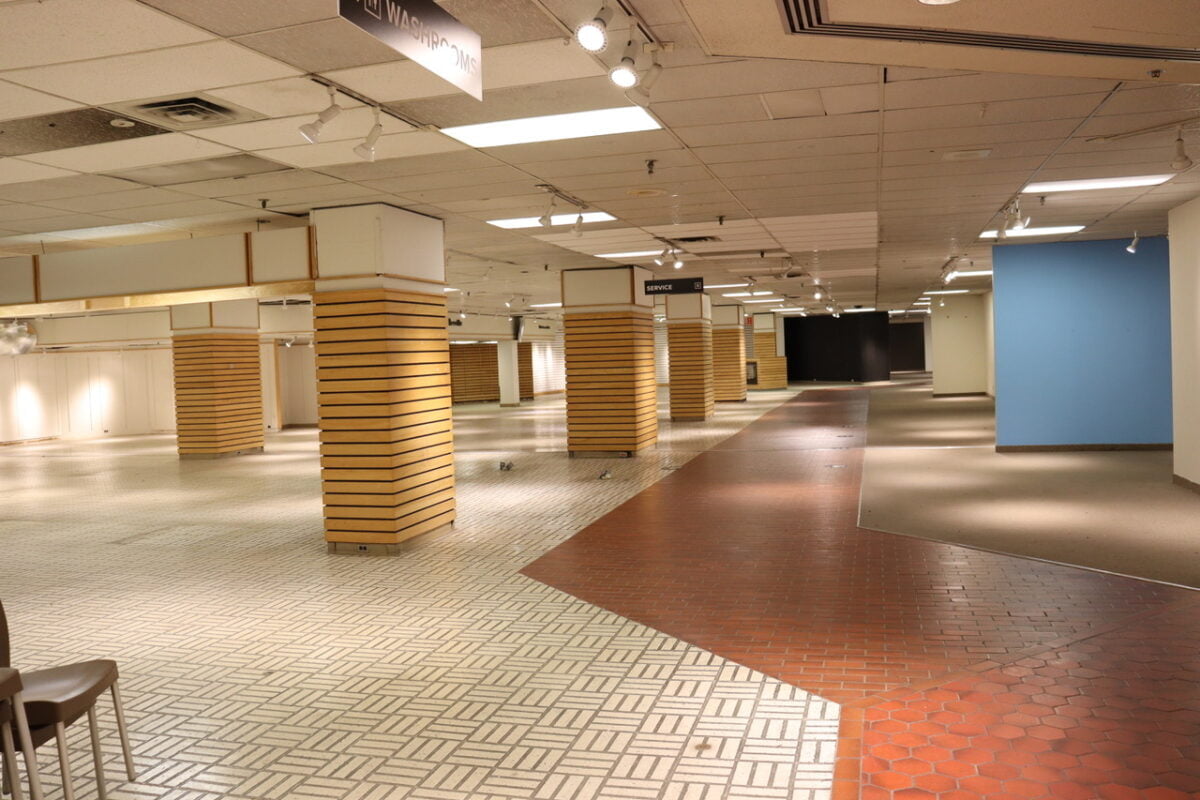
St Lawrence Market Area/Front Street East
The Winners store on Front Street East in Toronto had a lineup on Monday. Winners/Homesense/Marshalls were all uniquely positioned during the pandemic, as the TJX brands don’t have an e-commerce platform. This meant that the lines were significant at two of the three Winners stores that we walked past on Monday, with the only one without a line being the Winners in the PATH at Scotia Plaza.
Below is an image of Urbinz, a smaller retailer on Front Street that was welcoming customers back with an incentive: 50% off regular merchandise. If you can, please visit these smaller stores, as these are the heart and soul of our communities.
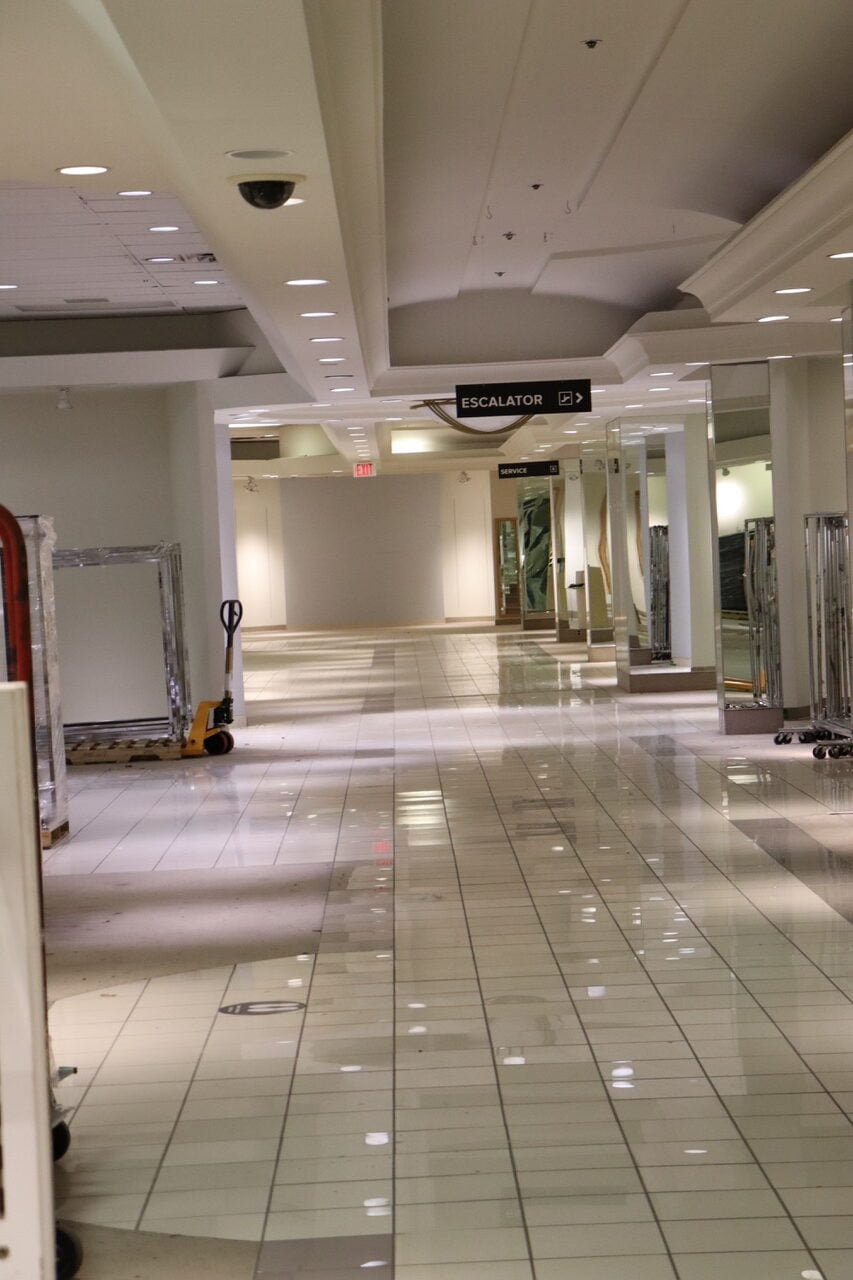

We’ll be revisiting this ever-changing retail environment in Downtown Toronto throughout the next week so please stay tuned for more interesting news and observations.
Exterior of new Giant Tiger store on Walkley Road in Ottawa. Photo: Giant Tiger
Ottawa-based Giant Tiger Stores Limited, a leading Canadian discount retailer, has launched a new store concept in its home base with plans to roll out the idea to more stores as the company continues its expansion plans across the country.
“Despite the vast challenges currently being felt across the Canadian retail landscape due to COVID-19, Giant Tiger continues to execute our growth strategy that includes expanding online and in-store capabilities,” said Paul Wood, President and CEO of Giant Tiger. “We are focused on ensuring Giant Tiger’s customers will be able to shop in the manner that best suits their busy lifestyle.”
Paul Wood
The new concept recently launched at a redesigned store on Walkley Road in Ottawa — right beside the company’s head office. Wood said the idea of the new concept is to enhance the customer experience, improving the overall journey through the store and the integration of online and in-store capabilities, ensuring an easier and more efficient shopping experience that continues to save customers time and money.
The company currently has 258 stores in Canada.
“As of yet, we are still not in British Columbia nor are we in Newfoundland. But both of those I would caveat with a yet,” added Wood.
The company has been at that Walkley Road location since 1996 where it had a store, its main office and a distribution centre which has since moved to another location. Over the last year and a half to two years, it has been working on building a new home office structure behind the existing one and a new store has been attached to that structure. The old structure for the store will be demolished.
“It allows us to refresh the experience again. The last kind of standard we adjusted to we established about 10 years ago. A lot has continued to change in retail and in our operations over that time and we needed to refresh the store experience to help integrate the online experience with the in-store and to amplify some of the areas that have grown for us strategically around fresh and some of those different product categories that we needed an expanded and more capable set of fixtures and experience for the customers,” said Wood.
Exterior of new Giant Tiger store on Walkley Road in Ottawa. Photo: Giant Tiger
The new store, of about 25,000 square feet of selling space, aims to deliver an enhanced customer experience and includes:
Enticing exterior window treatments to display Giant Tiger’s varied assortment, allowing the customer to see what they can expect to save on inside;
Elevated in-store wayfinding signage provides shoppers an easier shopping experience and reinforces product assortment;
Fitting rooms with empowering messages on the doors encouraging customers to feel good trying on their purchases;
Interior specialty lighting in Fashion and Home departments highlight key products allowing the customer to better understand the product’s value and design;
Branded online order pick-up area saves customers time by making the pickup process easier;
Improved customer messaging about offerings both in store and online emphasize the ways customers can shop and save; and
This new store will also serve as a test environment for additional customer-focused initiatives that add to the shopping experience before nationwide rollouts.
Wood said the new store has been carefully planned and designed to help communicate Giant Tiger’s commitment to product quality, freshness and safety, as well as everyday low prices.
1 of 8
Interior of new Giant Tiger store on Walkley Road in Ottawa. Photo: Giant Tiger
Interior of the Giant Tiger store on Walkley Road in Ottawa. Photo: Giant Tiger
Interior of new Giant Tiger store on Walkley Road in Ottawa. Photo: Giant Tiger
Interior of Giant Tiger store on Walkley Road in Ottawa. Photo: Giant Tiger
Interior of new Giant Tiger store on Walkley Road in Ottawa. Photo: Giant Tiger
The first Giant Tiger store opened in 1961 in Ottawa’s ByWard Market.
“This will be really a live test for us of some of these new elements and we will undoubtedly tweak them. We’ve got a few other test elements that are scheduled to go into the store over the next few months as well and being attached to our office it kind of serves as a good test facility for us in that sense,” said Wood.
“We absolutely anticipate leveraging the learnings from this launch and representing that into our new store standard as we go forward and open a few more stores that we have online coming in the spring but also as we test and confirm the design making it available to our existing stores so we can refresh across the country. Different stores, different sizes may be able to avail themselves of some or all of the components that we’ve updated and refreshed in the existing stores. So we approach it as a bit of an opportunity to allow them to refresh as much as possible or as much as they’re bounded by their existing retail space for example.”
Wood said the retailer continues to be positive on the opportunities for expansion in Canada. But being a frugal, low-cost operator the company is selective in its expansion strategy to make sure it is making opening decisions for profitable locations.
The company is opening a new store in Cobourg, Ontario in May, a store in Ancaster, Ontario in July. A few of the Western stores are being refreshed. A store in Sorel, Quebec will open later in the Fall as well as in Niagara Falls.
“We’re still on track in the five to eight store a year pace provided we find the right one, the right location. For us, growth exists in two capacities – one in enhancing our online presence and our execution on gianttiger.com and secondly continuing to tap into available space across the country for new bricks and mortar stores that will complement our offering, reach more Canadians and provide the opportunity for that store to be in their community,” said Wood.