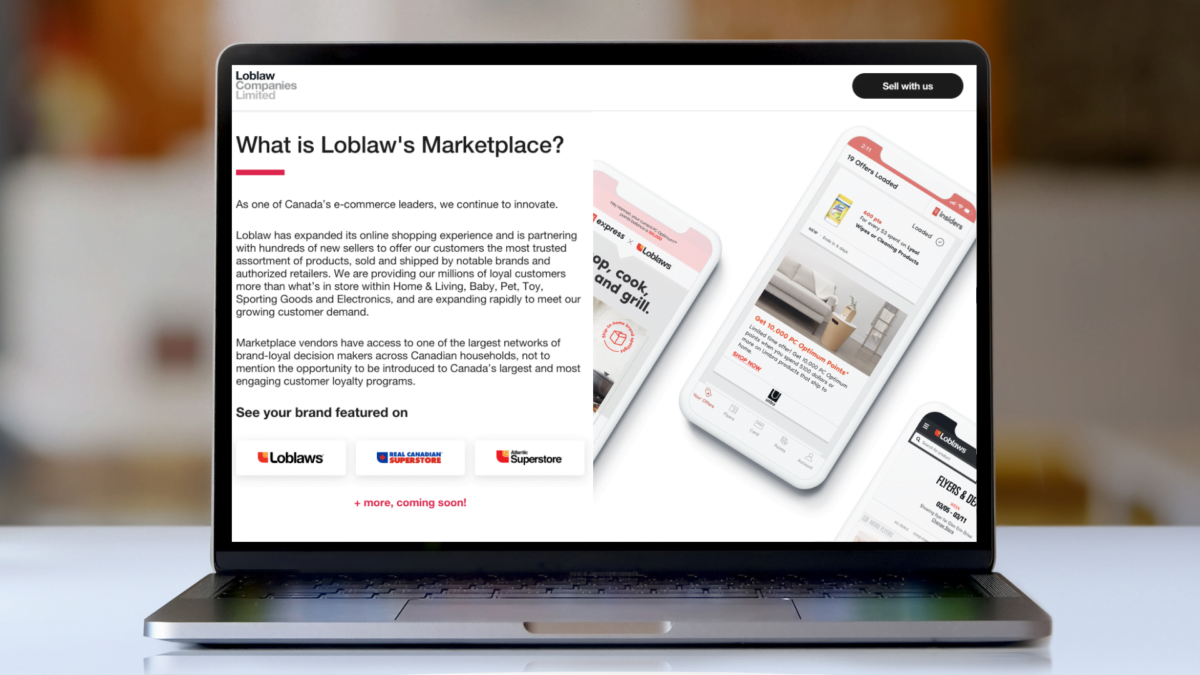
Grocery store giant Loblaw is expanding its online shopping experience, Loblaw Marketplace, and is looking to add hundreds of new sellers before the end of the year.
Since launching the curated assortment from third party sellers in November 2019, the online shopping platform has seen significant growth, welcoming 150 reputable lifestyle brands, such as Henckels, Staub, Evenflo, and Umbra to its roster. Currently there are about 65,000 products.
Niki Starkman, Head of Merchandising and Business Development at Loblaw Digital, said the retailer is now ready to increase its offerings even further to meet the growing demand from its customers – and is calling on Canadian vendors to apply.
“We’re trying to grow that really quickly because the demand is coming in now that customers are starting to understand that we have this marketplace,” said Starkman. “We’re targeting to get to about 300,000 products by the end of the year.”
Image: Loblaw Marketplace
That could be upwards of about 400 sellers.
Starkman said marketplace vendors have access to one of the largest networks of brand-loyal decision makers across Canadian households and the opportunity to be introduced to Canada’s largest and most engaging customer loyalty programs. Products are also listed online under all Loblaw grocery banners: Real Canadian Superstore, Real Atlantic Superstore, Loblaw, Zehrs, Maxi, Provigo, Fortinos, Your Independent Grocer and Independent City Market.
“We are embedded into the PC Express platform and also each grocery banner. So if you’re a shopper of loblaw.ca or realcanadiansuperstore.ca or Provigo.ca all the Marketplace products, third-party seller products, show up on all of the platforms,” added Starkman.
Loblaw Digital has more than 10 million digital users and more than 18 million PC Optimum members.
“The reason we launched this business is really twofold. The first is we really believe our customers want their shopping experience to be easy and convenient and come from a retailer they can trust. We know that we have millions of loyal customers who trust Loblaw so we wanted to offer them more than what we have in store, all in one place, one easy shopping experience and have it delivered to their door,” said Starkman. “There’s no reason why we can’t offer them grocery plus everything they need really to live their life well ,which is the mandate we work on every day at Loblaw.
Image: Loblaw Marketplace
“The other side of it is we believe the power of our brand has the ability to provide sellers a platform to grow their businesses. When we launched we didn’t know how relevant that would become. Now obviously with the pandemic it’s really important to give Canadian businesses the opportunity to get their product in front of Canadians and we can do that for sellers as well.
“We have two customers. We always talk about our customer on the front who is shopping and our sellers on the back end, who are hoping to sell their products to Canadians.”
In response to customer demographics and demand, Loblaw is aiming to expand its offering of items in the following categories: home and living, baby, pet toys, sporting goods and consumer electronics, and is encouraging vendors selling these products to apply.
“We’re looking to expand into all non-food categories . . . And really our investment in these categories is to make sure that we can offer our customers everything they need for their every day. So those are our focus categories for now. They will grow and expand as we go and looking for sellers to fill out those places for us, those spots for us,” added Starkman.
“It is good for sellers to know that listing with us is really, really easy. We’ve built our own in-house platform that sellers enroll in and we have a live sellers’ success team who offers any type of help that sellers need to get on board and be a success when they are on our platform. It’s a big difference maker for us from some of our competitors because we offer live support and we have a team dedicated just for this which I know not all our competitors do – just so it’s really easy to sell with us. So that’s our hope is we attract sellers to our platform and get them on board.”
Salesforce is hosting a free online event on Tuesday, June 22 featuring a fireside chat with Brian Solis, Global Innovation Evangelist at Salesforce. It will take place at 12pm Eastern/9am Pacific Time where he will discuss the business shift to digital over the course of the pandemic with an eye to customer-centred engagement. [Register Here]
Retail is changing at an unprecedented time. To meet post-pandemic expectations, retailers are looking to transform their operations via accelerating digital transformation while at the same time modernizing their workforce management strategies to better empower their service agents and store associates.
About 80% of customers say that experience is as important as product or service, which means it’s imperative that retailers take a customer-first approach to enhance the end-to-end shopping experience and achieve new levels of loyalty. Becoming a digital-first business involves leveraging data to understand shopper habits during times of change which allows businesses to pivot their processes, products, and services seamlessly to meet and exceed customers’ expectations.
Join Brian Solis, a world-renowned digital anthropologist, 8x best-selling author, and futurist who serves as Global Innovation Evangelist at Salesforce, to learn how to accelerate service innovation for Generation-Novel (a cross-generational market majority of digital-first customers), and how retailers can transform their post-pandemic operations into a seamless customer engagement engine to drive business growth and loyalty.
This week, Craig and Lee talk about Artizia buying a stake in Reigning Champ as well as Montreal’s Robert brothers acquiring WANT Les Essentiels.
The Weekly podcast by Retail Insider Canada is available on Apple Podcasts, Stitcher, TuneIn, Google Play, or through our dedicated RSS feed for Overcast and other podcast players.
**Sponsor: Salesforce virtual “The Future of Retail is Now” event on June 22, 2021 featuring an exclusive fireside chat with Brian Solis. [Register Here]
Drop us a line at Craig@Retail-Insider.com. You can also rate us in Apple Podcasts or recommend us in Overcast to help more people discover the show!
Background Music Credit: Hard Boiled Kevin MacLeod (incompetech.com). Licensed under Creative Commons: By Attribution 3.0 License. http://creativecommons.org/licenses/by/3.0/
Cybersecurity is a more prevalent concern for Canadian retailers than ever. As the retail industry embraces digital transformation to meet the needs of a changing market, it faces new challenges from cybercriminals. One particular area of concern is the supply chain.
A 2018 survey revealed that 66% of global organizations had experienced a supply chain attack. More than half of this group reported experiencing these attacks on multiple occasions. Supply chain security is no longer something retailers can afford to overlook.
Why Are Supply Chains at Risk?
Today’s supply chains handle far more data than they used to. You may collect clients’ personal information like names and addresses, credit card information, or valuable intellectual property. If cybercriminals can steal this data, they could hold it for ransom or sell it to other criminals, making a considerable amount of money.
Supply chain attacks also have the potential to be remarkably destructive. Take the recent SolarWinds hack in the U.S., for example. Hackers managed to infect 18,000 customers with malware by putting malicious code into a supply chain software update. That level of disruption makes supply chains a high-value target for cyber-terrorists or enemy state-sponsored hackers.
Cybercriminals may also target retail supply chains simply because they’re easy targets. Many retailers don’t understand the need for supply chain security, so they remain vulnerable. Here’s how you can reverse that trend.
1. Examine Supply Chain Partners Carefully
Experts say that you can’t fully trust something unless you continuously monitor it. Since you can’t monitor all of your suppliers and logistics partners, you should limit how much you trust them. Never assume another company shares your cybersecurity standards, because they might not, and any oversight can be risky.
Before partnering with another company, you should also thoroughly vet their cybersecurity. Ask how they protect their data and that of their clients, and request verification, like a security audit. If they can’t answer these questions or don’t demonstrate high standards, avoid partnering with them.
2. Tighten Access Controls
In that same vein, you should limit what data your partners can access. If a supplier has access to your mission-critical systems or sensitive customer data, a data breach on their end will impact you. Minimizing what third parties can see and do mitigates any potential damage if their security fails.
Everyone should only have access to the data and systems they need to do their job. This same philosophy applies to your employees, too. Restrict access as much as possible and require tight controls like multi-factor authentication to prevent data breaches.
3. Secure IoT Devices
Many retailers have started embracing the Internet of Things (IoT) to improve supply chain visibility. These devices help make supply chains more flexible and resilient, but they also present a security risk. Hackers can use them as gateways into the rest of your network, accessing sensitive data from unexpected locations.
You can mitigate these threats by limiting the types of data you transmit over these systems. Similarly, IoT devices shouldn’t operate on the same network as unrelated, more sensitive information. Be sure you also encrypt all of these devices’ signals and update them regularly.
4. Develop a Continuity Plan
Finally, you should develop a business continuity plan should you fall victim to an attack. Ransomware attacks in Canada demand an average of $148,700 and surpass the million-dollar mark in some cases. That’s too significant a financial impact to ignore, so you should have a contingency plan in place.
First, analyze your setup to determine what data and systems you need to continue operations. Make backups of all of these mission-critical systems, ideally both on the cloud and offline. You should also have a way to communicate with involved employees and partners efficiently.
What your continuity plan looks like will vary depending on your specific situation. In general, though, you should ensure you can keep your most critical operations working through an emergency.
Canadian Retailers Must Improve Supply Chain Security
Retailers can’t operate without a safe, functioning supply chain. As these become increasingly popular targets for cybercriminals, you must secure them. Follow these tips and always look out for ways to improve to protect yourself and your customers from cybercrime.
Devin Partida is a writer and blogger, as well as the Editor-in-Chief of ReHack.com
Humankind is really quite remarkable. Our ability as a species to display the agility and nimbleness required to triumph in the throes of misfortune is impressive. Our resilience and adaptability, supporting our capacity to pivot and evolve amid change, are equally admirable qualities that often serve us well, allowing us to turn adversity and impediments into opportunity and innovation. A better example of these characteristics could not be found outside of the Canadian grocery sector, which has been forced to adjust to an altered food shopping environment and changed consumer purchasing habits, transforming the entire experience to continue meeting the grocery needs of Canadians across the country. It’s a feat that’s applauded by grocery industry expert and Senior Director, Agri-Food Analytics Lab at Dalhousie University, Sylvain Charlebois. However, despite their efforts to collectively keep up with recent changes, there remain many unanswered questions concerning the future of grocery in Canada.
Sylvain Charlebois
“Generally speaking, I think that the Canadian grocery sector performed very well over the last 18 months,” he says. “Frankly, I think it surprised many Canadians while reassuring others. But there are headwinds approaching on the horizon and some questions that grocers operating in the country have to figure out. They’ve got to quickly gain a real understanding of the new marketplace within the new normal. Whether people will be working from home or at the office remains to be seen. But what I’ve noticed on Bay Street are a number of companies that have done very well despite the fact that a lot of their staff have been working from home. This idea that work-from-home breeds inefficiency is not necessarily founded. And so, we may see extended periods of work-from-home situations. It’s all part of our new reality, which will likely be a blend of physical and virtual. Likewise, consumer shopping habits are also set to continue blurring the lines between the in-store and online environments. From a food retail perspective, it’s really about serving a market, whether in a physical or virtual manner, and making sense of that blend to better serve today’s omnichannel customer. That’s one big question mark currently hanging over the sector, and I’m not sure anyone has quite figured out the answer to it yet.”
The virtual/brick-and-mortar dilemma
It’s one of the questions, or matters of interest within today’s grocery space, that’s put forward as part of a new report released by The Agri-Food Analytics Lab at Dalhousie University, in partnership with Caddle, which aims to help the industry better understand the impact of the COVID-19 global pandemic and the ways the Canadian grocery experience might be shaped as a result going forward. According to the report, which was developed based on the responses of more than 10,000 Canadians surveyed during the month of May 2021, online grocery purchases are expected to continue generating considerable sales for the sector, creating what Charlebois refers to as a “virtual/brick-and-mortar dilemma for food purveyors” as nearly a quarter of Canadian shoppers state their intentions to purchase their groceries online with regularity, with the curbside pickup option maintaining popular momentum. Considering the recent digital shift in consumer purchasing behaviour and the work that needs to be done in order to align the grocery experience with rising expectations, Dalhousie’s grocery expert believes that there is still much to be done by those operating within the sector, but that some are a little further ahead than others in their calibration of the new food shopping experience.
“Grocers in the country are still a little behind when it comes to the development and execution of their omnichannel strategies,” he says. “There’s still a lot to be done. But, having said that, they’re catching up slowly, adapting their services and offering to meet consumer preferences and demands. Collectively, the industry wasn’t sure at the onset of the pandemic whether to commit to investing in and enhancing the virtual shopping experience or not. But they are now. The dynamic has pushed them to think differently about the market and to consider compromising in-store sales for the digital channels. It’s resulted in a bit of a paradigm shift by grocers, which is already resulting in good things for the consumer. Take Sobeys’ deployment of Voila! as an example. The rollout and execution of the service has been very impressive. It’s added a much-needed layer of service and convenience for their customers that’s only going to increase over time. This, in addition to their acquisition of Longo’s, which increases their number of consumers in a very important GTA market, places them at the head of the pack in my estimation.”
Erosion of big three dominance
Charlebois goes on to explain that outside of Sobeys, at the moment anyway, there doesn’t seem to be too much distinction in service and offering among the other grocery players. However, he suggests that if anyone is searching for the benchmark when it comes to digital grocery fulfillment, they don’t have to look further than perennial online giant Amazon. According to The Agri-Food Analytics Lab report, Amazon’s service and offering, along with those of other non-traditional players, are beginning to erode the influence of Canada’s three major food retailers – Loblaw, Metro and Sobeys. It suggests that as consumers have been forced to shop online during the past 16 months, they’ve come to realize the choice that they have access to and the ease and convenience of online purchasing. Charlebois recognizes these forcing functions, but believes that the more predominant factor behind this challenging of the Canadian grocery status quo is Amazon’s acute understanding of the new digital world.
“Amazon understands the power of data better than anyone else,” he asserts. “They leverage analytics more effectively than anyone else. They understand the virtual game extremely well and have been operating within it for quite a long time. The food retail industry in Canada has never been truly data-driven. Head offices were, but not single store locations. Operationally, it wasn’t data-driven, but it’s becoming increasingly more so every day. The pandemic has created that shift and I’m expecting to see much more innovation and creativity within the sector as it becomes more data-driven.”
Decreased loyalty
In addition to the shadow of influence that Amazon is currently casting on the sector, the report also indicates that the popularity of independent grocers is also biting into the dominance once held by Canada’s big three. Respondents to the survey seem to sympathize with the smaller players in the space, with 60.9 percent stating that they’d like to spend up to 19 percent of their food budget at independently owned and operated grocery stores. And further disrupting the norm, the report also cites a significant decrease in loyalty by shoppers with respect to store locations. A quarter of Canadians (25%) have switched locations or banners altogether when it comes to where they’ve been buying their groceries during the pandemic. Charlebois suggests that the reasons for this decrease are varied and likely include perceived COVID-related health risks, adding that the net result will be greater emphasis being placed on enhancing the loyalty programs currently offered by grocers in the country.
“Our report shows that an overwhelming number of Canadians, 73.1 percent, are likely to be influenced by loyalty programs and rewards when shopping for their groceries,” he points out. “And, given the fact that one of the consequences of the pandemic has been a reduction in store loyalty, grocers’ development of these programs is going to be critical in incentivizing customers to shop with them. Sobeys has its Air Miles program. But this is an area where Loblaw is way ahead of the game. Its PC Optimum program is far superior to the programs of any other grocer. What we’re anticipating seeing over the course of the next 6 to 12 months, as we exit the pandemic, is greater focus paid toward using loyalty programs more efficiently. If people show up to your grocery store, you want to reward them for it. And, based on results of our survey, the Canadian consumer expects to be rewarded for their loyalty.”
Food affordability and discounting
Another factor that will go a long way toward influencing the sector, at least in the near term, says Charlebois, is discounting in the grocery aisles. He points to the recent wave of grocery store conversions into discount stores. And, combined with findings of his lab’s report, which reveals that 70.2 percent of Canadians will be actively seeking promotions and discounts on food products, he expects this trend to intensify over the course of the year ahead with a powerful and perhaps overlooked factor playing the most significant role in driving it.
The CORE from Stephen Avenue Mall (8th Ave SW) in Calgary. Photo: Ivanhoe Cambridge.
Calgary’s downtown retail sector has been hit with a double whammy over the past year or so due to the COVID-19 pandemic and the continued challenges brought on by a low oil price environment.
With downtown office vacancy rates still hovering in the historic 30 per cent level, the economic recovery for the downtown retail industry will take some time.
Michael Kehoe
Recently, Calgary’s City Council recognized the ongoing challenges of the downtown and committed millions of dollars in an initiative to revitalize the core.
Michael Kehoe, broker/owner with Fairfield Commercial Real Estate in Calgary, said recovery is achievable but it’s going to take a significant commitment from the City of Calgary to make it a business-friendly environment and market it like a shopping centre is marketed.
“Downtown Calgary is an employment centre but as well it’s a shopping centre. There’s a tremendous amount of leasable area in the downtown core that’s dedicated to retail. Not only in the main shopping centre The CORE and Stephen Avenue Place but on the Plus 15 levels and at street level throughout the core,” said Kehoe.
Image: Calgary Downtown Association Facebook
“It needs to be reconceived and many retail spaces will be repurposed maybe into alternate uses. The City needs to encourage citizens and shoppers to come downtown with incentives like relaxed parking fees, special events, other attractions. That’s what the post-pandemic downtown core is going to require. A full-scale commitment from the City of Calgary.”
With minimal foot traffic and occupancy in several office buildings, retail in those towers have suffered a devastating blow in the past year or so. Commercial tenants on main and second levels are obligated to stay open through their lease agreements with little or no sales. It’s a very difficult situation for these entrepreneurs.
“The downtown is the economic engine of the city. Buildings like the Bow, their recovery will be an important part of how the downtown reinvents itself. It’s going to be dependent on workers returning to a reinvented work environment and the commercial viability of stores and restaurants is driven by foot traffic and these building populations,” said Kehoe.
Calgary city skyline. Photo: Google
“Until that recovers, it’s going to be very difficult downtown.” Ron Odagaki, Senior Sales Associate, Retail, with JLL in Calgary, said the downtown core’s retail scene has been hit the hardest with the work-from-home orders experienced over the past 12 months or so.
“That’s really had a very negative impact on the retail in the core,” he said.
Image: Ron Odagaki
“With what we’re seeing with some of the office buildings perhaps transitioning to other types of uses, maybe there’s a different lens to which people are viewing what can be done to revitalize the downtown core.”
While business closures, particularly in retail and restaurants, have taken place, it has not been at the level many anticipated would happen due to the persistent economic challenges.
Odagaki speculated that government support programs have helped keep businesses open. Also retailers in the city have been able to find other means of getting products into the hands of consumers through revamping a website, delivery to homes, telephone orders, curbside pickup, pick up in store.
“A variety of multi-channel methods of product delivery and service delivery,” he said. “There’s still a number of construction projects that are ongoing in spite of the pandemic. A lot of these relate to the fact they’ve been years in planning, years in the making. Certainly notwithstanding the timing these projects are moving forward and they are creating some leasing activity.
“There’s a relative tightness of retail in this market in general. So for the long term I do still expect that as the city grows the retail will grow with that.”
Main Entrance at CF Chinook Centre in Calgary. Photo: Jessica Finch.
A market report by JLL said the Calgary retail outlook remains solid in the long haul despite a surge of new supply in 2020.
“More than one million square feet of retail entered the market last year, the highest since 2017. The market should stabilize over time as lower construction levels provide a breathing room for the absorption of excess supply,” said the report.
“Leasing activity in 2020 was down about 40 per cent compared with 2019. However, the market enjoyed a refreshing boost in activity in Q1 2021, one of the best Q1 marks for Calgary over the past few years.
“In 2020 asking rents for available space fluctuated, but the 2021 trend has been downward. In turn, effective rents for occupied space plummeted by 17 per cent ‒ the worst mark across markets.”
It said retailers have taken advantage of vacating class-A spaces. Several high-profile suburban locations have been subject to multiple offer scenarios.
“Calgary’s retail sales decreased by four per cent in 2020 ‒ the worst performance in a major market after Toronto and Montreal,” said JLL. “Pedestrian traffic along downtown retail corridors was down significantly compared with 2019, as the commercial district lacked office workers.”
Calgary Farmer’s Market West – Image by Melcor Developments
Total availability in the market has risen from 3.1 per cent in 2018 to 4.7 per cent in 2020.
Scheduled to open this fall, Royop’s Township continues to lease up and recently surpassed 85 per cent pre-lease. The total project encompasses 1,500,000 square feet and includes retail, office, residential and hotel space. Sobeys, PetSmart, buybuy Baby, and Winners are some of the notable tenants, said JLL.
The next construction phase for The Shops at Buffalo Run is scheduled to begin this spring/summer with tenant openings commencing in the fall of 2022. Anchor Costco opened its doors last summer. The Calgary Farmers’ Market started to build a second location in the northwest community of Greenwich. The new store will encompass 50,000 square feet and is due to open in 2022.
New Salesforce data indicates that more than three-quarters (76 per cent) of Canadians expect customer service online to be as good as or better than the in-store experience.
Rob Garf, VP and GM of Retail at Salesforce, a global leader in Customer Relationship Management, said over the course of the pandemic consumers by and large were forced to go online to engage and ultimately purchase with retailers. They didn’t have a choice. And neither did retailers.
Rob Garf
“Two really interesting things occurred because of that. First of all, we saw over the course of 2020, 40 per cent net new digital shoppers. So these were individuals who might have gone online for other things like entertainment and interacting with friends, family and colleagues, but they didn’t purchase online. So we saw a large spike in new digital shoppers and that drove worldwide a 57 per cent year-over-year increase in digital sales,” said Garf.
“Given this, a whole new definition of loyalty emerged during the pandemic and that comprised health, safety, convenience and trust. If I think about a common theme across those four values that is frictionless. Consumers got really used to having a frictionless and convenient shopping experience. That behaviour and those expectations are now the new baseline for shopping both in the digital world and the physical world as we emerge from the pandemic.”
Garf said that one-third of Canadians say they are willing to compromise on product quality for a positive customer experience. What’s interesting to note is that consistently over the years, traditionally, product quality has been the number one priority for the online experience.
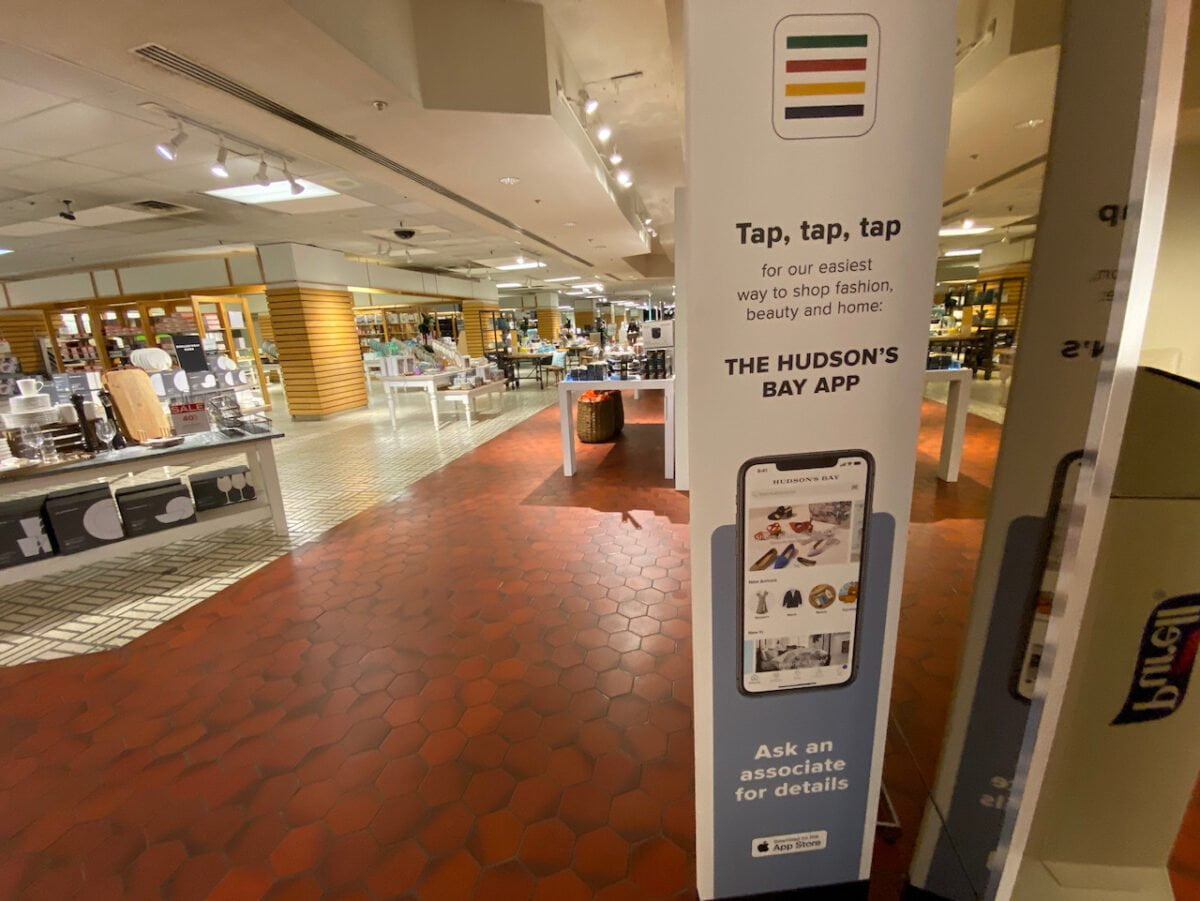
Hudson’s Bay App signage on Bloor – Photo by Dustin Fuhs
“But in this case what we’re finding is that Canadians are willing to compromise just a little bit on product quality for a better online experience. These expectations of service, of personalization, really removing the friction that has become table stakes over the last 12 months has elevated in importance,” said Garf.
He said that over the next few months as we get to the back to school and holiday seasons these new expectations for online experience are now going to translate and transcend into the physical store.
“We anticipate as we come out of the lockdown, we come out of the pandemic, obviously varying degrees of where you are. Consumers are going to want to experience life again and part of that experience will be going into a physical store. We anticipate a shopping spree that will occur in the fall through the holiday and it will be a combination of digital and physical,” said Garf.
“So really where the winners and losers will be defined is how retailers take those digital experiences and bring them into the physical store.”
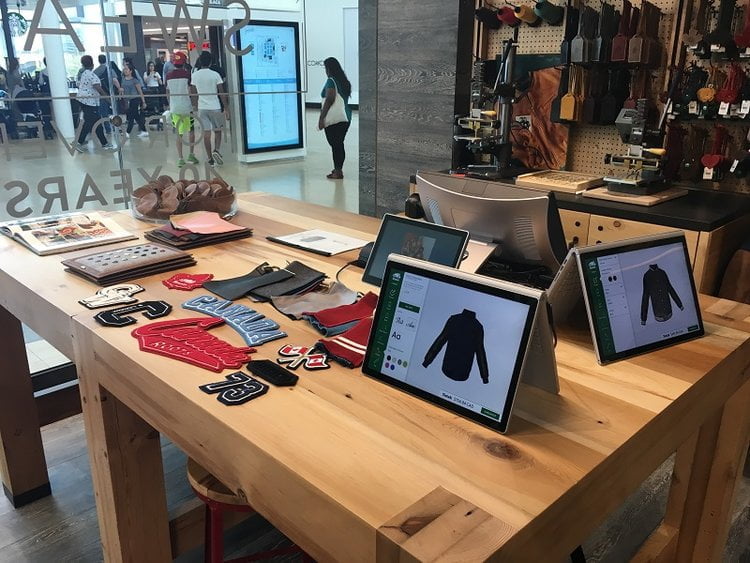
Image: Roots
One example is the personalized service. Most retailers have been focused on check out which is all about speed and efficiency and getting people through the till as fast as possible. There’s going to be a change to focus as much on the ‘check in’ event which is about engaging the consumer with personalized service and curating that experience ‘at the moment of truth’ when they’re doing discovery and inspiration, added Garf.
Amber Mac, a technology expert, entrepreneur and President of AmberMac Media, who has been hosting Salesforce’s #PathToGrowth series, said there is an acceleration of digital adoption in retail but that acceleration is not necessarily equal among all retailers.
“If I think about the future of retail, one of the things I think is concerning is we know that those retailers who have successfully adopted digital technologies over the course of the pandemic will continue to be able to build that better but for those businesses who are a little bit slower I think they’re going to have a harder time in terms of their post-pandemic recovery,” said Mac.
Amber Mac
“As a retailer it is so critical that you provide a really seamless experience for them when it comes to your digital offerings because if we think about the conversation around building trust you really have only one shot to be able to do that with the customer and we know from all the data that they will leave if they don’t have a good experience.
“It’s hard to take things away that you’ve already offered. What I mean by that for retailers is let’s say that a retailer has decided that they’re going to offer contactless experiences in terms of rallying customers to order online and pick up at the store. It’s going to be more difficult for retailers to take away some of these digital offerings that they offered during the COVID-19 pandemic. So I do think there is a challenge ahead for those retailers in terms of how do you continue to offer those things that you offered during the pandemic that were easy for customers but also continuing with these other digital channels that are so critical for your business.”
Garf said it is absolutely critical for retailers to get the shopping experience right the first time amidst the pandemic. Because of this new definition of loyalty, consumers were really quick to move on to a new and different brand if they were able to get that health, safety, convenience and trust.
“That’s why it doesn’t necessarily surprise me that more than three quarters of consumers that we surveyed in the April time frame of this year said customer service online should be as good or better than the in-store experience,” said Garf. “There were a whole new set and a whole new baseline of customer experiences that was set. Consumers were anticipating and expecting a personalized experience – 46 per cent of Canadians expect brands to know them and know their profile. So personalization became really important.
“The ability to buy online with the confidence the products will be available in the store and then pick it up with the convenience and safety in and around the store became a new service in many cases offered by retailers. Customer service really emerged as a critical, or I would say even re-emerged as a critical, experience and partly because inventory was in many cases scarce for certain categories, shipping capacity issues emerged . . . There was a whole new set of expectations as it relates to the customer experience that now sets a whole new baseline that doesn’t just snap back as we emerge from the pandemic.”
When it comes to digital innovation in retail, it’s about the transition to e-commerce. Many businesses have successfully been able to transition to e-commerce over the course of the past year or so. Some have also been successful in digital marketing and building community.
“What’s really interesting is that when we talk about the digitization of retail businesses I think we have to include a conversation about how do you build relationships and how do you build communities during a crisis like we’ve seen over the past year or so. For me, one of the things I really learned throughout hosting #PathToGrowth for Salesforce is that the key conversation a lot of retailers need to be having about the future of retail is how do we build trust in an environment like this where so much of the business being done is through digital channels,” explained Mac.
“Joe is a great example of an entrepreneur in the retail space who not only understands how to be able to continue to build a brand during difficult times but if you watch #PathToGrowth, the most recent event, Joe is building a business right now that is targeting new parents. I think what’s really fascinating about Joe’s perspective on the future of retail, he isn’t just thinking about how to run a business during COVID-19, he in fact is launching a business and that of course has additional challenges in order to be able to succeed in such a tumultuous time,” said Mac.
When asked how their expectations of online shopping changed since the beginning of the pandemic, the Salesforce survey found:
67 per cent of Canadians expect online stores to better understand their needs;
46 per cent of Canadians expect online brands to know their customer profile;
About one-third (31 per cent) now expect to be able to buy big-ticket items, such as vehicles and houses, online. This increases to nearly half (44 per cent) of 18- to 24-year-olds; and
More than eight in 10 (82 per cent) Canadians expect to buy a greater variety of products online.
Other survey findings include:
71 per cent of Canadians say the in-store safety experience will be the most important shopping feature to them even after the pandemic is over;
Other Canadian shopper priorities in a post-pandemic world include: 36 per cent of Canadians want a variety of shipping and return options; 36 per cent of Canadians want personalization; 31 per cent want social media shopping; 33 per cent want customer service live chat; 20 per cent want virtual access to in-store associates;
One-third (33 per cent) of Canadians say they are willing to compromise on product quality for a positive customer experience; and
When shopping online, the majority of Canadians (85 per cent) prioritize product quality. When shopping in-store, a quarter of Canadians (25 per cent) say customer experience is top priority.
A lot has changed within and around the retail industry since March 2020 and the first wave of lockdowns that were to set a tone for the 16 months that followed. Social distancing protocols and other public health restrictions quickly led to the cocooning of families and individuals across the country and a subsequent shift in consumer purchasing behaviour toward digital channels. The increased online activity displayed by Canadian consumers has no doubt benefitted perennial ecommerce giant Amazon. However, as much as the company has prospered as a result of the pandemic-induced transformation of shopping preferences, it’s also served a critical role in ensuring that the product needs of Canadians everywhere have been met while providing small businesses throughout the country with a platform and the reach necessary to succeed during these challenging times.
Small and medium-sized business boom
According to the 2020 Amazon Canada SMB Impact Report, which focuses attention on the performance of small and medium-sized Canadian businesses (SMB) selling on the Amazon marketplace, 30,000 Canadian-based third-party sellers from all 13 provinces and territories were active selling on Amazon.ca in 2019, grossing more than $1 billion. It’s a staggering number that represented a growth of 40 percent year-over-year, adding to the more than $2 billion that Canadian sellers sold on Amazon stores around the world. And, the numbers are only getting better. For the 12-month period ending October 3, 2020, Canadian SMBs enjoyed an average of $110,000 in sales, up from $65,000 the previous year, while the number of Canadian SMBs that surpassed $1 million in sales grew by more than 80 percent. Kristin Gable, Senior Manager, Corporate Communications at Amazon Canada, recognizes the influence that the pandemic has had on shopping behaviour, but believes that the success of its sellers is simply a continuation of the recent positive trajectory of sales on its stores, supported by the company’s commitment to help its partners grow.
Kristin Gable
“There’s no doubt that as Canadians have been forced to stay home during the pandemic, Amazon has played an increased role in supporting a lot of their shopping habits,” she says. “We’re very proud to have been able to get Canadians the products they’ve needed quickly and safely, while also protecting the health and safety of our employees. And we’re just as proud to have been able to create even more opportunities for our many selling partners during this time, whether they’re partners that have been with us prior to the pandemic or new sellers that have been looking for a new retail channel in the changing climate that’s been created by COVID-19. Our commitment is always toward helping them and supporting their continued growth. It’s a fundamental part of our approach and an extension of our dedication to maintain our focus on the customer.”
Flexibility and variety of selling plans
A sizeable amount of Amazon’s customer focus shows up in the selling plans that it makes available for its merchant partners, which are developed through the selection of a number of flexible service options. An Individual plan, for those who are perhaps just testing the ecommerce waters, costs sellers CDN $1.49 per unit sale, while the Professional plan, meant for businesses that sell a minimum of 30 products in a four-week period, costs CDN $29.99 per month. In addition to the cost of a merchant’s selling plan, Amazon charges a referral fee for each item sold which, for most of the product categories on the marketplace, ranges between 8 and 15 percent. Merchants also have the option to ship their own orders or, for a fee, leverage Fulfilment by Amazon (FBA) and allow it to handle shipping, customer service, and returns. Some sellers may incur additional fees, such as long-term storage fees, or choose to pay for optional programs like advertising or premium account services depending on the volume of product that they sell and their desire to grow.
It’s an impressive suite of services that the company has steadily built and refined since it first made its virtual shelf space on Amazon.ca available to sellers back in 2003. It’s allowed many Canadian businesses, despite their size and presence, to complement their existing offering and channels or to grow exclusively on the Amazon platform. The virtual marketplace, as Gable points out, has also served a significant and pivotal role in helping SMBs in the country not only endure a turbulent and uncertain time, but to thrive as well. But, most importantly, she says, the platform is providing an opportunity for innovative entrepreneurs to showcase their wares, increase their exposure and convey the personalities of their brands.
“The fact that there is such a significant number of Canadian small businesses selling on Amazon.ca speaks to how broad and robust the Canadian small business community is,” she asserts. “It highlights a very entrepreneurial spirit within the country. Many have conceived their idea and launched their business in the past year and have built their selling strategy exclusively around Amazon’s services. And there are also a lot of sellers who have a much more diverse retail strategy with a brick-and-mortar store and their own ecommerce storefront, but selling on Amazon helps them reach customers outside of their community, province or even country. Despite the business, however, Amazon’s Storefront marketplace provides them with the platform and opportunity to really express the uniqueness of their brand.”
Focus on Canadian entrepreneurs
Image: Drizzle Honey Products
To help increase exposure to entrepreneurs in the country, just last year Amazon launched its first ever Storefront aimed at spotlighting Canadian small businesses. The SMB Shop Small Storefront, found within Amazon.ca, is a dedicated space where products and specific offers are themed. Its objective is simple: to provide Canadian SMBs with a tailored portion of the marketplace to help support them in their efforts to meet the needs of their customers and to promote the importance of ‘shopping small’.
Aja Horsley
One such entrepreneur who’s benefitted from the Amazon.ca Shop Small Storefront is Calgary’s Aja Horsley, CEO and Queen Bee at Drizzle Honey Products – a purveyor of all-natural, raw, bee-friendly honey. The 100 percent Canadian-made product, produced with the support of local farmers, recently received an investment from Dragon’s Den investor Arlene Dickinson, allowing Horsley and her small team to execute on its vision to promote the responsible manufacturing of honey and the positive changes that are required within the food production industry. However, she’s quick to point out the fact that much of that execution would not be possible if it were not for the Amazon.ca marketplace, which she launched her product on in April of last year.
“When you’re selling on Amazon, there are a lot of eyes on your product,” she says. “Everybody shops on Amazon today, even some people who may not have shopped online prior to the pandemic. We were fortunate in that we had already been building our storefront before COVID hit and were able to launch at a good time, exposing our brand to a huge population of customers that would not have otherwise been aware of Drizzle Honey. We leverage Amazon’s fulfillment expertise, which removes a lot of the shipping and delivery challenges for us. But, from a business and revenue perspective, the biggest benefit for us has been the marketing capabilities that the platform provides. Our sales have been great and continue to ramp up on both Amazon.ca and .com. And I also believe that our presence on Amazon is also helping to drive traffic to the Drizzle Honey website. People often start their shopping journey on Amazon but end up purchasing on our site. It’s a really big benefit and result of the exposure that we receive.”
Global expansion
Image: The Cocktail Box Co
Another Canadian small business owner finding a significant amount of success by virtue of its partnership with Amazon is Chris Yee, Co-Founder of Brew Your Bucha and The Cocktail Box Co. The company’s, similar in vision, are dedicated to providing everything someone needs in order to brew kombucha and to make premium cocktails like a pro in the comfort of their home. The companies, each founded in 2016, are available on Amazon’s marketplaces in Canada, the United States, the United Kingdom and Singapore, and have performed extremely well. Yee echoes Horsley’s sentiments concerning the exposure that the brands have received as a result of selling on Amazon’s marketplace, adding that it serves as the perfect platform on which to launch prospective products.
Image: Christopher Yee
“For our businesses, Amazon has always been an amazing testing ground to introduce new products to the marketplace and get them in front of as many people as possible,” he says. “It really helps us generate the real-time feedback that we need to continue developing our products and offering our customers what they’re looking for. In addition, to help support what we’re doing as a business, the overall logistics benefits offered by Amazon are immense. When my business partner and I first started, we were preparing and shipping packages and performing customer service all from our apartment. It’s all very time-consuming, almost like running a separate business. Amazon has been able to take that portion of the work off of our plate. We use them not only from a fulfillment and warehousing perspective, but they provide all of the customer service elements related to shopping as well. The services they make available takes pressure and legwork off of the backend, allowing us to deliver product on a timely basis and focus on the other aspects of our business.”
Partnering for success
Considering the variety of services and offering that Amazon provides for its merchant partners, it’s no wonder that many of them are enjoying the success that they’re experiencing with the ecommerce leader. The combination of flexibility within its plans and the full scope of support that it offers business owners across the country is not only helping SMBs withstand the adversity of these challenging times, but to continue growing in spite of them as well. And, according to Gable, Amazon doesn’t have any intentions to divert its focus from cultivating and nurturing partnerships with the country’s entrepreneurs any time soon.
“Amazon is a company that is truly customer-obsessed and focused on innovation. We are incredibly proud of the partnerships that we’ve built with sellers and look forward to continuing to help small and medium-sized businesses in the country grow and extend their reach even further. It’ll be really interesting, as we approach a post-pandemic world when stores start to reopen, to see how the Canadian consumer continues to adapt their behaviour. And, as we enter that new normal, whatever it might be, Amazon will be maintaining its commitment to small and medium-sized businesses and continuing to develop ways by which we can help support Canadian entrepreneurs and ensure that their businesses have the opportunity to thrive going forward.”