By Anne-Marie Broudehoux and Bernardo Emmanuel
Every summer, Canada’s major cities come alive, with the addition of pedestrianized streets, al-fresco dining, parklets and other temporary installations. The ever-growing conversion of roadways into car-free public spaces allows citizens and tourists alike to enjoy a greater portion of the streets, turning cities into a convivial, festive, and dynamic destination.
Summer also coincides with the release of Time Out’s list of the world’s coolest streets. Canadian cities are regularly featured on this list in recent years, with, for example:
- No. 1 in 2022: Montréal’s Wellington Street
- No. 5 in 2024: Vancouver’s Commercial Drive
- No. 14 in 2022: Toronto’s Ossington Avenue
- No. 27 in 2024: Montréal’s St-Hubert Plaza
What makes a street “cool?” Who is this type of ranking for and what impact can it have locally? As design professor at UQAM’s School of Design and a doctoral student at INRS-UQAM’s joint urban studies program, we looked into these issues.
Prize lists that make you dream
Headquartered in London, Time Out is a global media and hospitality company specialized in urban tourism, which operates on multiple digital and physical platforms. After over fifty years of operation, it prides itself on being “the only international brand dedicated to urban living” and vows to “inspire travel and allow people to discover the best that the city has to offer.”
Apart from cool streets, the company publishes all kinds of other lists. These include an annual compilation of the world’s top cities and of the trendiest neighborhoods, the best TV shows of all time, the best summer songs, best pasta shapes, best hangover cures, and more. A variety of travel, leisure or business magazines feature these lists in their own publications.
“Coolness” according to Time Out
Time Out relies upon a global network of journalists, specialized in the arts, gastronomy, travel and entertainment, located in 333 cities and 59 countries, to identify the 30 streets that make the list, after consulting tens of thousands of city dwellers.
Several criteria determine their degree of “coolness”, including, among other things, the local offer in terms of gastronomy, entertainment and nightlife, as well as the street’s authentic character. The cool street is a friendly place, where everyone feels welcome and wants to hang out. A mix of local residents and discerning city dwellers patronize its various bars, cafes and independent businesses. In recent years, new criteria such as outdoor terraces, pedestrianization and initiatives linked to sustainable development have also been taken into account. Although scattered across the world, these streets share the same DNA. They are generally located in cities that appear on the Time Out ‘top cities’ list.
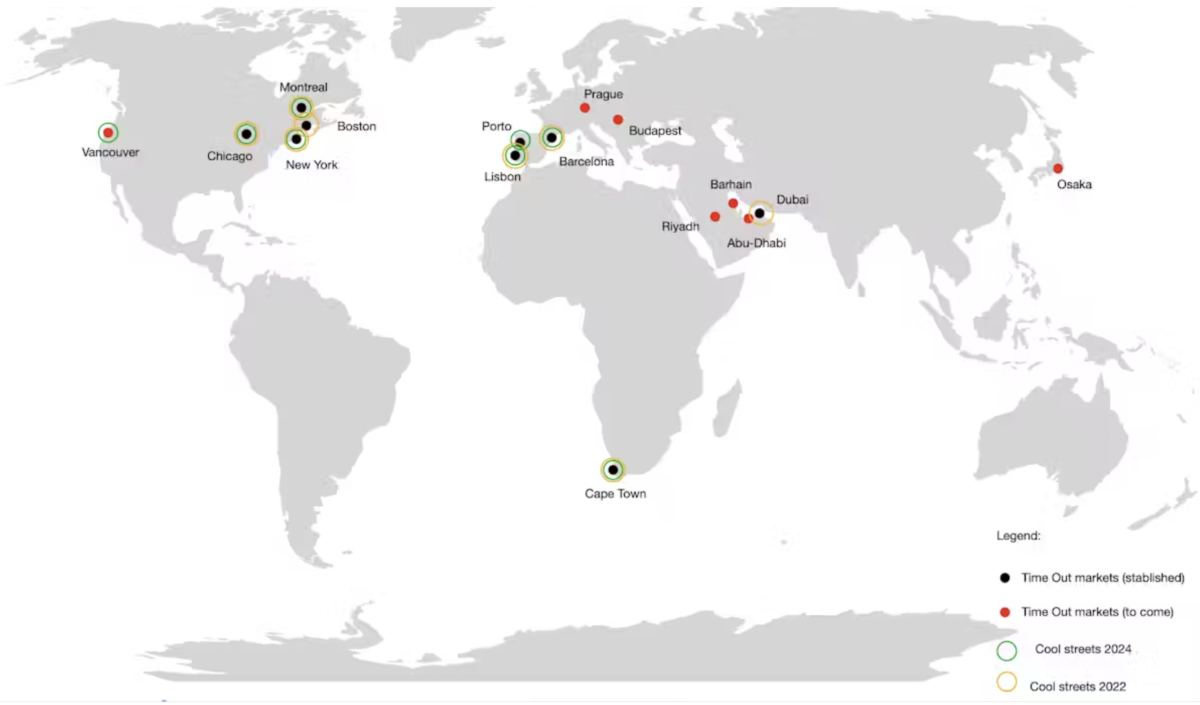
These are also often cities where the company built one of its famous gourmet markets. There are eight Time Out Markets around the world, in Lisbon, New York, Boston, Montréal, Chicago, Dubai, Cape Town and Porto, with several more to come. This may explain the company’s interest in promoting tourism to these destinations.
The streets that appear on the list generally feature establishments that themselves appear on coveted lists: starred restaurants, clandestine bars, exclusive boutiques, renowned micro-breweries, artisan bakers, etc. They are located on the fringes of the usual tourist circuits, in areas which have yet to be conquered by gentrification and large commercial chains.
Typically, these destinations are first discovered by a local elite of artists, connoisseurs and members of the bohemian bourgeoisie, in search of “authentic” experiences, sheltered from crowds and mass consumerism, where they rub shoulders with neighborhood regulars. They are followed by influencers, on the lookout for unexplored territories, off the beaten track, who will attest to their cosmopolitanism, their audacity, discernment, and their own trendiness.
Local streets and international consumerism
They are, to a large extent, the main targets of these rankings. At a time when the greatest vectors of influence are social networks, where success, achievement and recognition are measured in the number of “likes” or subscribers, this type of compilation is intended for destination influencers.
Thus, cool streets are vehicles for the personal branding of influencers who leave in their wake the desire to consume novelty and exclusivity. In our society of spectacle and appearance, where one’s image is paramount, influencers are in constant search of distinction, seeking to position themselves as avant-garde, pioneers and trend-setters. Motivated by FOMO (fear of missing out), their subscribers emulate them in order to feed their insatiable need for celebrity capital.
Tourism agencies favor such granular content marketing strategies to secure a positive return on investment, rather than expensive targeted campaigns. Media companies like Time Out capitalize on the vast sphere of influence of these opinion makers and benefit from their wide distribution network to amplify their impact and confirm their status as city specialists.
An accelerator of inequalities
However, the enthusiasm generated for these destinations is as fragile as it is ephemeral. “Coolness” is a perishable commodity. Once a street appears on the list, this well-kept secret runs the risk of losing its exclusive character to become predictable or outdated. The resulting increase in popularity and massive arrival of hordes of tourists will undoutedly push local elites, in their neverending quest for novelty, to use their keen flair to find other territories to colonize.
These growing incursions into neighborhoods formerly sheltered from mass consumerism risk disturbing their fragile ecosystem. Ultimately, it is the local population who may suffer the most from being featured on such lists. The rising popularity of these destinations can cause prices and rents to soar, thus accelerating the sector’s gentrification and commercialization. Small independent businesses may not survive such rent hikes, having to move out and be replaced by large chains. The phenomenon is already clearly visible on Wellington Street, two years after boasting first place on the cool-street list.
With our summers becoming increasingly sweltering, another type of “cool” street should be of interest. Born out of the initiative of Libby Gallagher, an Australian doctor of landscape architecture, the Cool Streets Pilot Project aims to adapt city streets around the world to face climate change through a participatory citizen approach focused on reducing heat islands. Many other initiatives seek to transform streets into innovative convivial spaces, which do not rely on consumption. It is this kind of “cool” street, whose positive impact is not only more lasting but also beneficial for local residents, which should be celebrated.
Authors:
Anne-Marie Broudehoux, Professeure agrégée en design de l’environnement, Université du Québec à Montréal (UQAM) and,
Bernardo Emmanuel, PhD candidate, Institut national de la recherche scientifique (INRS)
*****
This article is republished from The Conversation under a Creative Commons license. Read the original article.
What makes a street ‘cool?’ These Canadian cities have the world’s coolest streets
Every summer, Canada’s major cities come alive, with the addition of pedestrianized streets, al-fresco dining, parklets and other temporary installations. The ever-growing conversion of roadways into car-free public spaces allows citizens and tourists alike to enjoy a greater portion of the streets, turning cities into a convivial, festive, and dynamic destination.
Summer also coincides with the release of Time Out’s list of the world’s coolest streets. Canadian cities are regularly featured on this list in recent years, with, for example:
No. 1 in 2022: Montréal’s Wellington Street
No. 5 in 2024: Vancouver’s Commercial Drive
No. 14 in 2022: Toronto’s Ossington Avenue
No. 27 in 2024: Montréal’s St-Hubert Plaza
What makes a street “cool?” Who is this type of ranking for and what impact can it have locally? As design professor at UQAM’s School of Design and a doctoral student at INRS-UQAM’s joint urban studies program, we looked into these issues.
Prize lists that make you dream
Headquartered in London, Time Out is a global media and hospitality company specialized in urban tourism, which operates on multiple digital and physical platforms. After over fifty years of operation, it prides itself on being “the only international brand dedicated to urban living” and vows to “inspire travel and allow people to discover the best that the city has to offer.”
Apart from cool streets, the company publishes all kinds of other lists. These include an annual compilation of the world’s top cities and of the trendiest neighborhoods, the best TV shows of all time, the best summer songs, best pasta shapes, best hangover cures, and more. A variety of travel, leisure or business magazines feature these lists in their own publications.
“Coolness” according to Time Out
Time Out relies upon a global network of journalists, specialized in the arts, gastronomy, travel and entertainment, located in 333 cities and 59 countries, to identify the 30 streets that make the list, after consulting tens of thousands of city dwellers.
Several criteria determine their degree of “coolness”, including, among other things, the local offer in terms of gastronomy, entertainment and nightlife, as well as the street’s authentic character. The cool street is a friendly place, where everyone feels welcome and wants to hang out. A mix of local residents and discerning city dwellers patronize its various bars, cafes and independent businesses. In recent years, new criteria such as outdoor terraces, pedestrianization and initiatives linked to sustainable development have also been taken into account. Although scattered across the world, these streets share the same DNA. They are generally located in cities that appear on the Time Out ‘top cities’ list.
These are also often cities where the company built one of its famous gourmet markets. There are eight Time Out Markets around the world, in Lisbon, New York, Boston, Montréal, Chicago, Dubai, Cape Town and Porto, with several more to come. This may explain the company’s interest in promoting tourism to these destinations.
The streets that appear on the list generally feature establishments that themselves appear on coveted lists: starred restaurants, clandestine bars, exclusive boutiques, renowned micro-breweries, artisan bakers, etc. They are located on the fringes of the usual tourist circuits, in areas which have yet to be conquered by gentrification and large commercial chains.
Typically, these destinations are first discovered by a local elite of artists, connoisseurs and members of the bohemian bourgeoisie, in search of “authentic” experiences, sheltered from crowds and mass consumerism, where they rub shoulders with neighborhood regulars. They are followed by influencers, on the lookout for unexplored territories, off the beaten track, who will attest to their cosmopolitanism, their audacity, discernment, and their own trendiness.
Local streets and international consumerism
They are, to a large extent, the main targets of these rankings. At a time when the greatest vectors of influence are social networks, where success, achievement and recognition are measured in the number of “likes” or subscribers, this type of compilation is intended for destination influencers.
Thus, cool streets are vehicles for the personal branding of influencers who leave in their wake the desire to consume novelty and exclusivity. In our society of spectacle and appearance, where one’s image is paramount, influencers are in constant search of distinction, seeking to position themselves as avant-garde, pioneers and trend-setters. Motivated by FOMO (fear of missing out), their subscribers emulate them in order to feed their insatiable need for celebrity capital.
Tourism agencies favor such granular content marketing strategies to secure a positive return on investment, rather than expensive targeted campaigns. Media companies like Time Out capitalize on the vast sphere of influence of these opinion makers and benefit from their wide distribution network to amplify their impact and confirm their status as city specialists.
An accelerator of inequalities
However, the enthusiasm generated for these destinations is as fragile as it is ephemeral. “Coolness” is a perishable commodity. Once a street appears on the list, this well-kept secret runs the risk of losing its exclusive character to become predictable or outdated. The resulting increase in popularity and massive arrival of hordes of tourists will undoutedly push local elites, in their neverending quest for novelty, to use their keen flair to find other territories to colonize.
These growing incursions into neighborhoods formerly sheltered from mass consumerism risk disturbing their fragile ecosystem. Ultimately, it is the local population who may suffer the most from being featured on such lists. The rising popularity of these destinations can cause prices and rents to soar, thus accelerating the sector’s gentrification and commercialization. Small independent businesses may not survive such rent hikes, having to move out and be replaced by large chains. The phenomenon is already clearly visible on Wellington Street, two years after boasting first place on the cool-street list.
With our summers becoming increasingly sweltering, another type of “cool” street should be of interest. Born out of the initiative of Libby Gallagher, an Australian doctor of landscape architecture, the Cool Streets Pilot Project aims to adapt city streets around the world to face climate change through a participatory citizen approach focused on reducing heat islands. Many other initiatives seek to transform streets into innovative convivial spaces, which do not rely on consumption. It is this kind of “cool” street, whose positive impact is not only more lasting but also beneficial for local residents, which should be celebrated.
Anne-Marie Broudehoux, Professeure agrégée en design de l’environnement, Université du Québec à Montréal (UQAM) and Bernardo Emmanuel, PhD candidate, Institut national de la recherche scientifique (INRS)
This article is republished from The Conversation under a Creative Commons license. Read the original article.