

Editor’s Note: This article is part of a special Retail Insider thought leadership series exploring how luxury retail actually works, based on insights from luxury retail executive Douglas Mandel.
If product is the foundation of luxury retail, and store execution is the proof, then staff are the heartbeat.
Luxury retail does not work because of marble floors, curated lighting, or carefully edited assortments. It works because of human connection. The associate standing in front of the client determines whether the brand feels aspirational or transactional.
To understand how luxury retail actually works, we have to examine Luxury Retail Staff Strategy.
Douglas Mandel, former VP of Dior who led Canada and a veteran global luxury executive, makes a direct point. “You can’t build a client-centric brand without first building an employee-centric culture”.
For Canadian retailers navigating rising labor costs, digital disruption, and evolving client expectations, that statement is more than philosophical. It is operational.
The Client Experience Mirrors the Employee Experience
In luxury, the sales associate is not simply an employee. They are the frontline brand storyteller.
“They’re the ones translating product into emotion, and interaction into loyalty,” Mandel says.
Luxury brands often invest heavily in store design, visual merchandising, and marketing campaigns. Yet underinvestment in team development remains common. Training becomes rushed. Coaching becomes reactive. Feedback becomes transactional.
The result is predictable. Service quality plateaus.
“The client experience will never exceed the employee experience,” Mandel argues.
Luxury Retail Staff Strategy begins with culture. Respect shown internally transfers externally. When associates feel empowered, supported, and educated, that confidence translates into poise on the floor.
For Canadian luxury retailers competing in increasingly sophisticated urban markets, empowerment is not a soft concept. It is a competitive advantage.
Leadership on the Floor
Luxury retail leadership cannot be confined to an office.
Mandel emphasizes the importance of leaders who coach in real time, who are visible on the floor, and who guide service standards by example.
He compares strong retail leaders to orchestra conductors, bringing individual talent together toward a shared crescendo of service.
This metaphor captures something essential. Luxury service is collaborative. It requires rhythm. It depends on clarity of cues.
In Canada’s expanding luxury corridors, where global brands and domestic players operate side by side, visible leadership builds consistency. It ensures rituals are respected. It allows service standards to be refined daily rather than reviewed quarterly.
Luxury Retail Staff Strategy is not simply about hiring charismatic personalities. It is about building managers who understand culture as much as conversion.
Empowerment Over Pressure
The traditional sales model in retail often leans heavily on pressure. Individual quotas. Commission races. Internal competition.
In luxury, that model can undermine the very atmosphere the brand seeks to create.
“Luxury retail isn’t just about what you sell. It’s how you make people feel,” Mandel says.
When commission structures reward only the individual transaction, collaboration weakens. Associates compete for clients rather than collaborate around them. Clients sense tension. The emotional journey fractures.
Luxury Retail Staff Strategy requires a smarter approach to incentives.
The solution is not eliminating incentives. It is realigning them.
Team-based goals, retention metrics, service excellence recognition, and structured handoffs reinforce collective ownership of the client journey.
In luxury, the client does not care who closed the sale. They care how they felt.
For Canadian retailers, particularly in multi-brand stores and high-traffic luxury streets, compensation design shapes culture. When staff are rewarded for protecting relationships rather than capturing transactions, loyalty strengthens.
From Salespeople to Brand Stewards
Luxury associates must understand more than product features. They must understand the “why” behind the service standard.
Ownership transforms behaviour. When employees see themselves as stewards of the brand rather than executors of tasks, they deliver with pride.
Mandel emphasizes shifting from instruction-based management to empowerment-based leadership.
That includes collaborative feedback, structured training, and clarity around the client journey.
In a market increasingly influenced by AI tools and automated service systems, human connection becomes the differentiator.
“In an era of AI chatbots and shrinking margins, human connection is the luxury,” Mandel says.
For Canadian luxury retailers investing in digital innovation, this perspective is critical. Technology can support service. It cannot replace the emotional nuance of a skilled associate reading a client’s cues.
Luxury Retail Staff Strategy must therefore prioritize emotional intelligence as much as product knowledge.
The Baton Pass
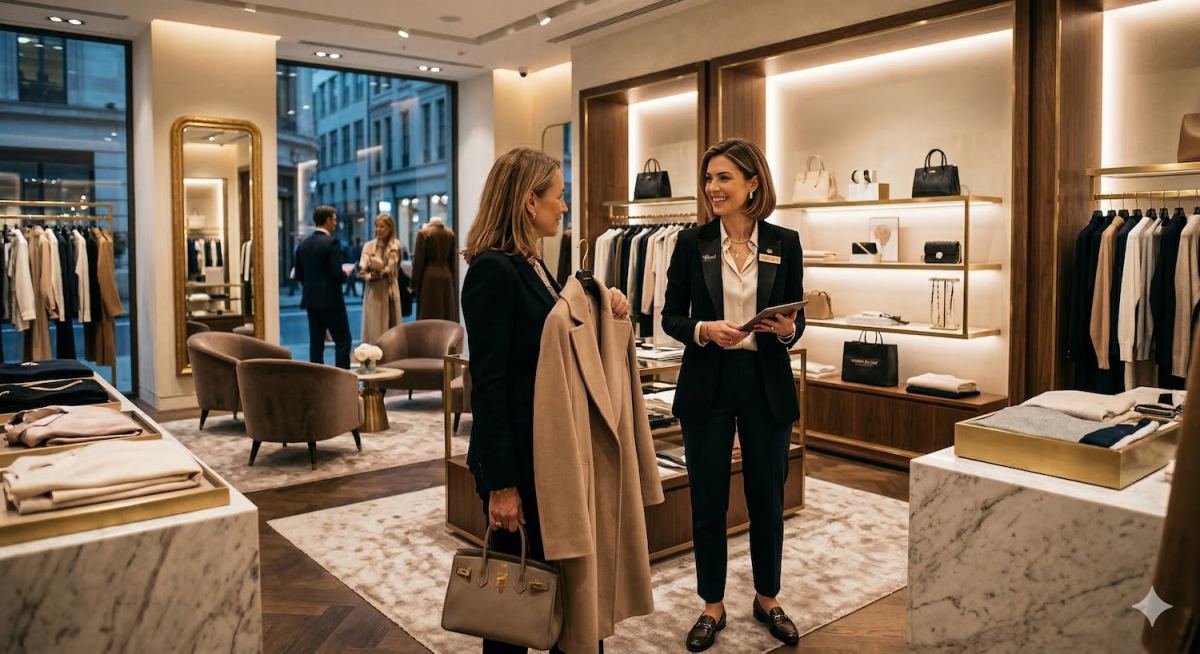
Luxury service often involves multiple associates interacting with the same client. A greeter welcomes. A specialist presents product. A manager confirms availability. A cashier finalizes packaging.
Without clear protocols, these transitions become awkward.
Mandel highlights the importance of service rituals and zone clarity so associates know how to pass the baton gracefully.
When handoffs are seamless, the client feels cared for. When they are clumsy, the magic dissolves.
In Canadian luxury environments, where bilingual service, tourism, and high expectations converge, choreography matters. Retail floor movement should feel effortless, even if carefully designed behind the scenes.
Luxury retail works because the experience feels personal, even when structured.
What This Means for Canada
Canada’s luxury market is growing more competitive. International brands are expanding.
Domestic brands are professionalizing. Clients are increasingly global in perspective.
In this environment, Luxury Retail Staff Strategy will define the next era of performance.
The brands that thrive will invest in empowerment rather than pressure. They will design compensation models that protect collaboration. They will train leaders to coach on the floor. They will recognize that employee experience shapes client experience.
Product matters. Store design matters. Execution matters.
However, in the final moment, when a client decides whether to return, it is the human interaction that lingers.
Luxury retail does not work because of price. It works because of people.
Behind every iconic storefront stands a team. And when that team is empowered, aligned, and respected, the brand becomes real.












Very true. Sales is mostly the transfer of emotion in an empowering manner. You don’t sell a bag, you sell confidence, not a pair of shoes but swagger, not a diamond ring but status, not a watch but ambition, celebration, milestone, respect, etc. The client should stand tall and proud leaving the store. Even if a sale isn’t made, a good sales rep will make the prospective customer feel welcome and plant a seed that one day may be harvested with a massive sale. This happens at car dealerships where young boys get to sit in the front seat of a Ferrari only to return 30 years later to buy the latest model.