

For generations of Torontonians, Fran’s Restaurant was always there.
It was where shift workers stopped for breakfast before sunrise. It was where concertgoers gathered after a night downtown. It was where students lingered over coffee, families met for weekend meals, and late-night conversations stretched into the early morning hours.
For more than eight decades, Fran’s occupied a special place in Toronto’s cultural and culinary landscape. On June 22, the city lost one of the people most responsible for preserving that legacy.
Francis “Fran” Deck, longtime steward of Fran’s Restaurant and son of founder G. Francis “Fran” Deck, passed away peacefully in Toronto at the age of 89.
While his name may not have been widely recognized outside restaurant and hospitality circles, the institution he helped guide remains one of Toronto’s most enduring brands. His passing marks the end of an important chapter in the history of a restaurant that helped shape the city itself.
From a 10-Seat Diner to a Toronto Landmark
The story of Fran’s began in 1940 with a modest 10-seat diner near Yonge and St. Clair.
What started as a small neighbourhood restaurant grew into one of Toronto’s most recognizable dining chains, with locations serving generations of residents across the city. Along the way, Fran’s built a reputation for hospitality, consistency, and accessibility.
Long before Toronto became the vibrant, around-the-clock city it is today, Fran’s welcomed customers at all hours. The restaurant became famous for operating 24 hours a day, 365 days a year. Family stories recount that some of the original locations never even had locks on their front doors, a small detail that reflected the open-door philosophy that defined the business.
Fran’s became a place where everyone felt welcome. Office workers, artists, musicians, students, families, tourists, and night-shift employees all found a seat at the same tables.
That broad appeal helped make Fran’s part of the daily rhythm of Toronto life.
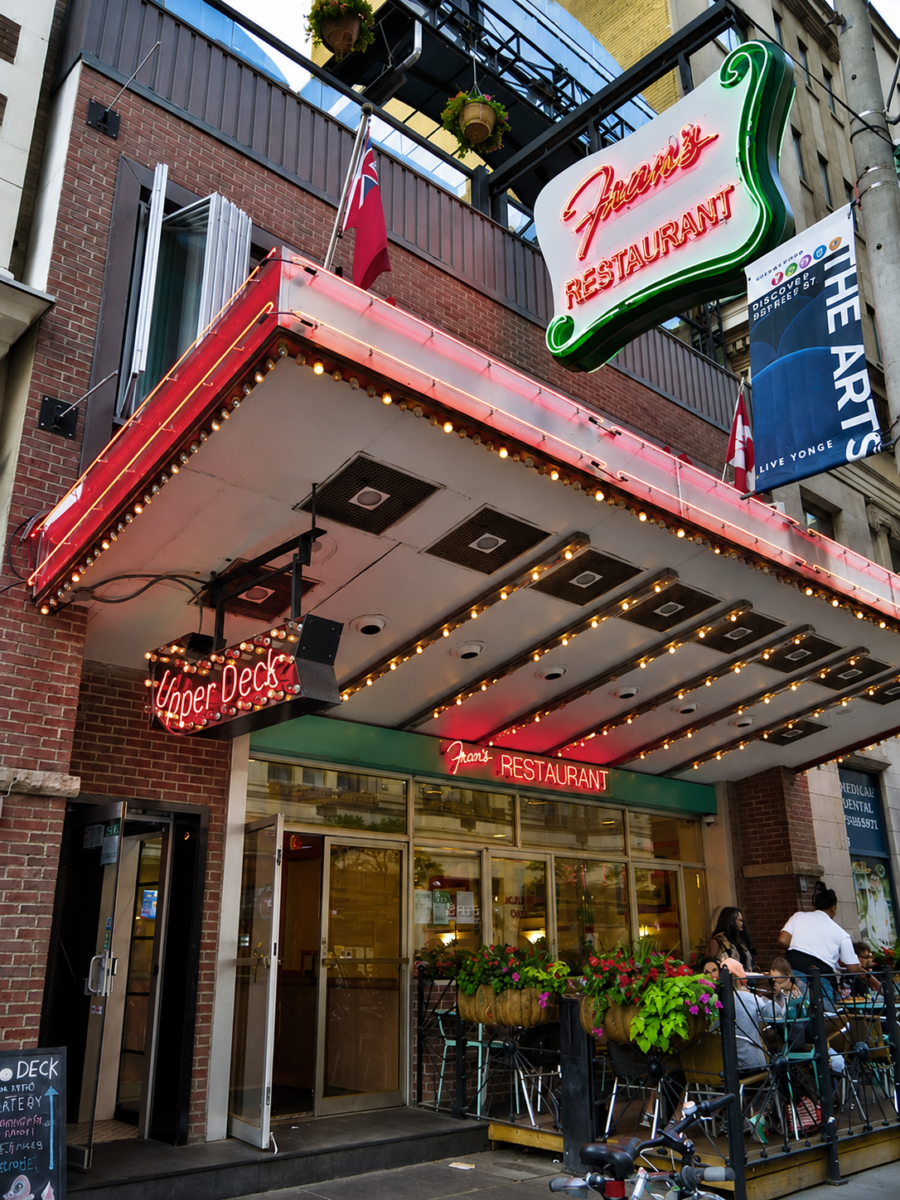
A Restaurant That Helped Shape Toronto’s Dining Culture
Fran’s influence extended well beyond serving meals.
The restaurant is widely credited with popularizing the banquet burger, a dish that became a staple across Toronto’s restaurant scene and remains closely associated with classic diner culture. The company has also long maintained that founder Fran Deck created one of the city’s earliest bacon-and-cheese burgers, originally known as the Forest Hill Burger.
Coffee became equally synonymous with the brand. For countless customers, a visit to Fran’s meant a bottomless cup, familiar faces, and a comfortable place to sit for a while.
Some of the restaurant’s most enduring menu items emerged from simple conversations with customers. One family story recalls how waffles topped with ice cream became a menu favourite after a regular mentioned his fondness for both. Founder Fran Deck saw no reason they couldn’t be served together. The combination proved popular and became part of the restaurant’s history.
Stories like that illustrate why Fran’s endured. The restaurant evolved alongside its customers and reflected the character of the city around it.
A Gathering Place for Toronto
Few restaurants become part of a city’s collective memory. Fran’s did.
Legendary pianist Glenn Gould was among its most famous regulars, known for visiting during the early hours of the morning. Folk music icon Gordon Lightfoot also had connections to the restaurant early in his career.
Yet the restaurant’s importance was never defined by celebrity patrons.
Its real significance came from the ordinary moments that unfolded there every day. First dates. Family celebrations. Business meetings. Post-concert meals. Quiet breakfasts before work. Conversations that lasted longer than expected.
For decades, Fran’s served as a gathering place where people from every part of the city crossed paths.
Carrying Forward a Family Legacy
When founder G. Francis “Fran” Deck passed away in 1976, the responsibility of preserving the family business fell to the next generation.
Fran Deck embraced that role with the support of his wife Anne and their family. Those who knew him describe a gifted storyteller, a dedicated mentor, and a man who believed deeply in the value of community.
He often spoke about the small details that helped define the restaurant, from recipes developed by his mother Ellen to the traditions that made customers feel at home. He understood that Fran’s was built on more than food. It was built on relationships.
That perspective guided his stewardship of the business for decades.
Preserving an Important Toronto Brand
The restaurant entered a new era in the late 1990s when restaurateur Joon Kim acquired the business and began guiding the brand forward.
In announcing Fran Deck’s passing, the family specifically acknowledged Kim’s dedication to preserving the traditions and character that have defined Fran’s for generations.
That continuity is significant. Toronto’s retail and restaurant landscape has changed dramatically over the past several decades. Historic businesses have disappeared, independent operators have faced increasing pressures, and many long-standing brands have faded into memory.
Fran’s remains one of the few surviving names that still connects today’s city to an earlier Toronto.
Remembering Fran Deck
Beyond the restaurant business, Fran Deck was devoted to his family and community.
He supported Covenant House, participated in a men’s therapy group during retirement, and took genuine satisfaction in helping others. He loved movies, coffee, chocolate, the Toronto Blue Jays, and the Green Bay Packers. He was known for his humour, his stories, and his insistence that fries should always be served hot.
His grandson, Kyle Ecclestone, perhaps summarized his legacy best.
“My Papa’s love for family and food was something that extended beyond the walls of the restaurant,” he said in a family statement. “His stories, his jokes, and the time we shared together will not be forgotten.”
For Toronto, Fran Deck’s passing represents the loss of a businessman, family man, and caretaker of an institution that helped define the city’s dining culture.
His legacy lives on in the restaurant that bears his family’s name, in the generations of customers who shared meals at its tables, and in the enduring belief that hospitality begins with making people feel welcome.












I have fond memories with my mother having dessert at Fran’s at Yonge and Eglinton in the 1960’s when I was a little girl. The Lemon Meringue Pie was a favourite served on green Jadeite plates. To this day, I have green Jadeite dinnerware that when I make Lemon Meringue Pie, it is served on it…just like at Fran’s ♥!!
Hello Cathy, I’m writing a feature obituary on Francis Deck. I’d like to speak with you about your history with Fran’s. My email is bwheeler@globeandmail.com
Thanks, Brad Wheeler