Maxi will open a grocery store of more than 13,000 square feet inside Montreal’s former Forum, extending Loblaw Companies Limited’s push to bring smaller discount stores into dense urban neighbourhoods.
Construction and fit-out work are underway at the Sainte-Catherine Street West and Atwater Avenue property. The multi-million-dollar store is scheduled to open by the end of 2027, according to Loblaw.

The location will carry fresh food, grocery products, prepared meals, multicultural foods and natural and organic items. Loblaw said the assortment will include more than 6,000 products from Quebec. Customers will also have access to Maxi’s price-matching program and PC Optimum.
Patrick Blanchette, senior vice-president of Maxi, said the store is intended to serve residents, families, students and people working in the surrounding district.
The opening will place a practical, recurring-use retailer inside one of Montreal’s best-known buildings. It also offers another example of Loblaw adapting the Maxi format to urban real estate that cannot accommodate a conventional suburban supermarket.
Maxi builds a smaller urban format
At slightly more than 13,000 square feet, the Forum store will be considerably smaller than many full-size supermarkets. Its size is consistent with several recent Maxi openings in central Montreal.
A Maxi that opened on Plaza Saint-Hubert in June occupies 8,000 square feet and created approximately 40 jobs. Another location in Montreal’s Village occupies just over 18,000 square feet. Loblaw also identifies its René-Lévesque Boulevard store as part of the same urban expansion strategy.
The stores show that Maxi can operate across a wide range of urban footprints. Smaller formats give Loblaw access to neighbourhoods where available grocery space is fragmented, rents can be higher and loading or parking conditions differ from suburban sites.
The approach has become a material part of Loblaw’s expansion program. The company opened 48 Maxi and No Frills stores in 2025, including 39 small-format locations. Loblaw has described those stores as a way to bring hard discount into urban pockets as well as suburban communities.
That expansion continues in 2026. Loblaw plans to invest $2.4 billion in its stores, supply chain and related infrastructure during the year. Its plan includes 31 new Maxi and No Frills stores among 70 new food, pharmacy and health-care locations.
The company reported in May that its discount banners continued to outperform during the first quarter. Loblaw opened five hard-discount stores in the period, while increased customer traffic and new locations contributed to revenue growth.
The Forum announcement therefore fits into a wider allocation of capital toward value-oriented food retail. The location gives Loblaw another point of access to consumers in central Montreal without requiring a large standalone building or suburban shopping-centre site.
CBRE in Montreal, under the direction of Bryan Greenberg and his team, negotiated the Maxi lease deal, and represented several other lease deals for stores in the city.
Grocery adds recurring traffic to the Forum
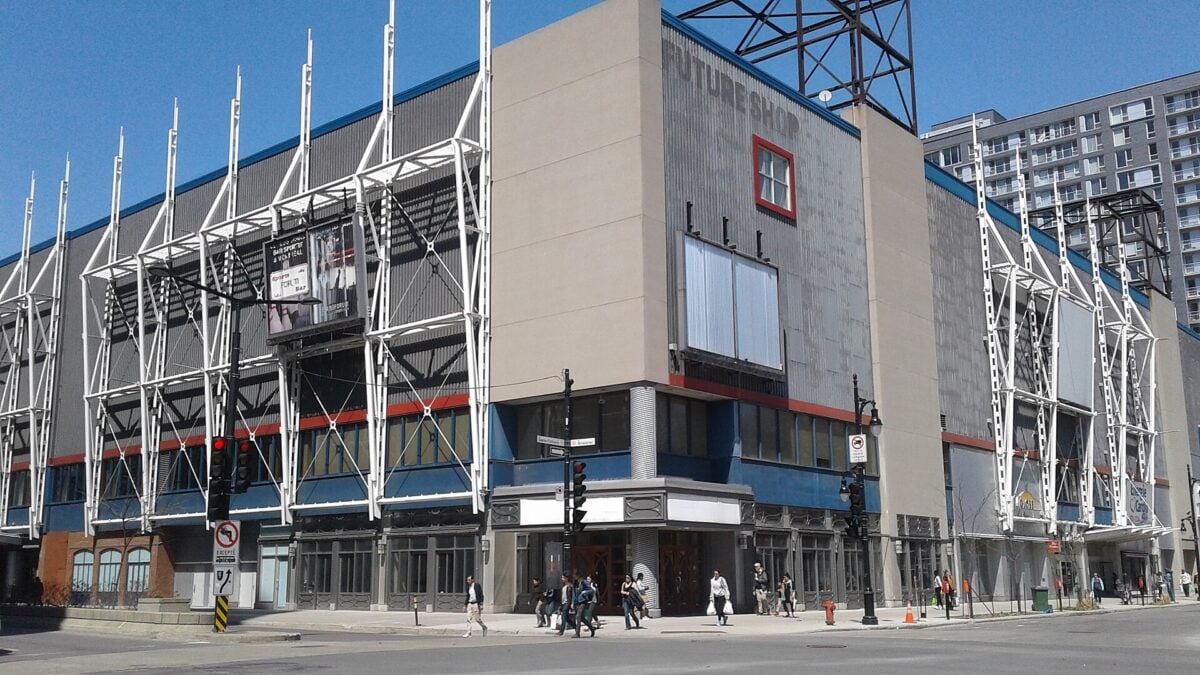
Ashkenazy Acquisition Corporation lists the former Forum in its portfolio as Forum Towers, a six-level mixed-use property covering an entire city block. The company puts the complex at 1.2 million square feet and identifies tenants including Cineplex, Econofitness, the Comedy Nest and Dawson College.
For the property, Maxi can generate a different traffic pattern from its entertainment and institutional uses. Grocery shopping creates frequent neighbourhood visits and can support activity across mornings, evenings and weekends.
That regular traffic could benefit food-service and service tenants while making the Forum more useful to people living and working nearby. It also gives the complex a tenant whose performance is tied to the surrounding residential trade area, not solely to destination entertainment.
The store’s precise position inside the building has not been disclosed. Loblaw has also not provided details about its entrance, loading arrangements, parking, online-order services, employment numbers or lease terms.
Those details will determine how effectively the location operates as an urban grocery store. Visibility from Sainte-Catherine or Atwater, convenient pedestrian access and efficient deliveries will be particularly important in a compact format.
Established competition near Atwater
Maxi will enter a well-served grocery district.
Marché Adonis operates at 2173 Sainte-Catherine Street West, along the same corridor. The downtown Adonis opened in 2013 with 15,000 square feet of selling space, making it comparable in size to the future Maxi. The store represented a $6.5-million investment when it opened.
IGA also operates at street level inside the neighbouring Alexis Nihon shopping centre at 1500 Atwater Avenue. The store offers online grocery ordering and is positioned within the Atwater transit and retail complex. Metro’s Super C discount banner has another store at 147 Atwater Avenue, south of the Forum.
The competitive challenge will go beyond price. Adonis has an established position in multicultural foods and prepared meals, two categories Loblaw specifically identified for the Forum store. IGA benefits from its location within Alexis Nihon, while Super C already competes for discount-oriented customers in the Atwater trade area.
Maxi will bring Loblaw’s private-label assortment, PC Optimum membership base and price-matching proposition into that mix. Its compact footprint suggests a curated assortment designed for frequent urban shopping, with less room for the breadth found in a conventional suburban location.
A new chapter for a historic property
Built in 1924, the Montreal Forum served as the home of the Montreal Canadiens until 1996. It was designated a National Historic Site of Canada in 1997 because of its place in Canadian hockey and its history as a venue for major sporting, cultural, political and religious events. The building was converted to other uses after the Canadiens left.
The heritage connection gives the opening a recognizable address, but the commercial importance lies in Maxi’s role within the property today.
For Loblaw, the store advances a model that allows discount grocery to enter constrained urban sites. For the Forum, it introduces an anchor based on daily needs and repeat visits.
The long construction schedule leaves several questions unanswered, including why the store will not open until late 2027 and whether building conditions, approvals or the complexity of the fit-out are factors. More information about the unit and its access will offer a clearer picture of how grocery will be integrated into the former arena.
What is already evident is that Maxi is becoming less dependent on a standard store box. The Forum location will test how far Loblaw can compress its hard-discount model while competing in one of central Montreal’s more established grocery clusters.