Coach is increasing investment in stores, marketing and brand-building after another year of strong growth, with younger consumers, higher handbag prices and reduced promotional activity reshaping the Tapestry-owned brand.
The strategy has direct relevance in Canada, where Coach operates 29 locations across Ontario, British Columbia, Alberta, Quebec and Manitoba, spanning major shopping centres and outlet malls. Its network includes Yorkdale Shopping Centre and CF Toronto Eaton Centre in Toronto, CF Pacific Centre and Oakridge Park in Vancouver, CF Chinook Centre in Calgary and West Edmonton Mall.
Coach reported fourth-quarter revenue growth of 14% on a constant-currency basis, including a 10% increase for the brand in North America, which includes Canada. It attracted more than two million new customers during the quarter and nearly nine million during fiscal 2026, with Gen Z leading customer acquisition.
The growth comes as Coach deliberately reduces its reliance on promotions. Handbag average unit retail increased at a mid-teens rate during the fourth quarter while unit volumes were roughly in line with the previous year, reflecting a decision to reduce promotional days rather than pursue additional sales through discounting.
For the full year, Coach generated both mid-teens growth in handbag average unit retail and low-double-digit unit growth. Management expects both average prices and units to increase again in fiscal 2027.
Younger Consumers Drive Coach Growth
Tapestry has made reaching consumers as they begin buying within the category central to Coach’s strategy. Younger customers joining the brand are spending more per purchase than its broader customer base, according to the company, while also demonstrating strong retention.
Tapestry CEO Joanne Crevoiserat said Gen Z’s influence extends beyond purchases made by younger consumers themselves, with the generation increasingly influencing buying behaviour across age groups. Sales from existing Coach customers have also continued to grow as the brand adds new shoppers.
Product development has been an important part of that strategy. Coach has concentrated investment around recognizable handbag families that can be expanded over time, including Tabby and its New York collection, which encompasses styles such as Brooklyn, Empire and Chelsea.
Footwear is another area the company sees as underdeveloped. Coach reported high-teens footwear growth in the fourth quarter, supported by demand for sneakers including the Soho family, and management believes the category provides room for further expansion.
Coach CEO and Brand President Todd Kahn said the brand remains particularly focused on the roughly US$200-to-US$500 portion of the market. That positioning gives Coach access to consumers seeking a premium or luxury purchase without moving into the substantially higher price points associated with many European luxury houses.
Marketing spending is increasing alongside that effort. Coach raised marketing investment by approximately 20% in the fourth quarter, while Tapestry said spending on marketing and related demand creation represented about 12% of sales during fiscal 2026.
Recent initiatives include the &Coach campaign, developed with input from Gen Z consumers, as well as the brand’s ongoing WNBA partnership. The company has also been directing more marketing toward broad brand awareness as it looks to sustain customer growth over time.
More Investment Goes Into Physical Stores
Stores are becoming an increasingly important part of Coach’s strategy. Tapestry expects to spend approximately US$300 million on capital expenditures and cloud computing in fiscal 2027, with about 70% directed toward growing and improving its store fleet. Coach expects to add approximately 40 to 50 net stores globally during the year, with roughly three-quarters of those additions outside the United States.
The expansion will take Coach beyond 1,000 stores worldwide, while significant investment is also going into existing locations.
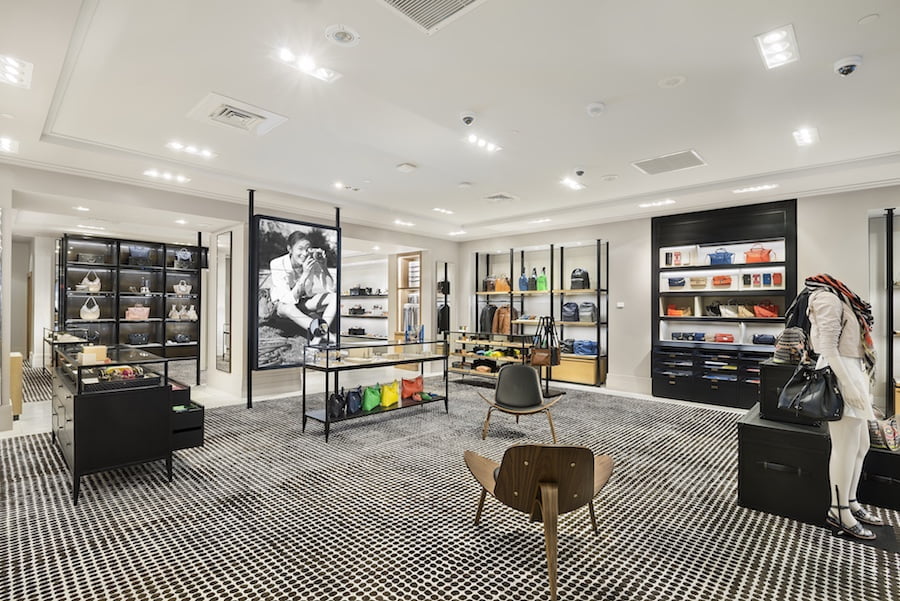
Central to that effort is what Coach calls its “expressive luxury” store concept. The company plans to expand the format so that upgraded stores ultimately account for approximately 80% of global Coach store traffic by fiscal 2030.
Management said stores incorporating the concept have generated stronger traffic and longer visits, particularly among Gen Z consumers. Physical locations are increasingly being treated as places where customers experience the brand and its products rather than simply points of sale.
Coach is also selectively opening more experiential Coach Play locations, with recent examples in Chicago, Atlanta and the Le Marais district of Paris. Ideas tested in those stores can subsequently influence the design of the broader fleet.
Tapestry did not identify Canadian locations slated to receive its expressive luxury format during the earnings call. With 29 Coach and Coach Outlet locations already operating across Canada, however, the global fleet investment could eventually have implications for a substantial domestic network.

‘One Coach’ Blurs the Line Between Full-Price and Outlet Retail
Another significant change involves the traditional division between Coach’s full-price and outlet businesses. Under its “One Coach” strategy, the company is deliberately reducing some of those distinctions. Coach has introduced collection merchandise at full price into outlet stores while working toward a more consistent presentation of the brand across physical and digital channels.
Kahn said the strategy reflects the company’s view that customers see Coach as a brand rather than viewing its full-price, outlet and digital businesses as separate channels.
The approach is particularly relevant in Canada because Coach has an extensive presence in both types of retail environments. Alongside stores at major shopping centres such as Yorkdale, CF Toronto Eaton Centre, CF Pacific Centre, Oakridge Park and CF Chinook Centre, the brand operates outlets at centres including Toronto Premium Outlets, Vaughan Mills, CrossIron Mills, McArthurGlen Designer Outlet Vancouver Airport and Tsawwassen Mills.
Coach can use the channel to introduce customers to higher-priced collection merchandise while maintaining a more consistent brand position across its network.
Management has linked the One Coach approach to customer growth and higher average unit retail, although the company has not disclosed specific results for Canadian outlet stores or identified which collection products are being carried at individual Canadian locations.
For a brand with a substantial outlet presence, the shift is notable. Coach is betting that it can preserve the reach provided by outlet distribution without allowing discounting to define the broader brand.
Coach Returns to a Transformed Oakridge Park
Coach’s return to Oakridge Park in Vancouver provides a timely Canadian example of its evolving positioning.
The retailer operated at the former Oakridge Centre before departing ahead of the property’s extensive redevelopment. Coach returned when the first phase of Oakridge Park opened on May 28, placing the brand back at the property after years of construction.
The retail environment surrounding Coach is considerably different from the former shopping centre. Oakridge Park has assembled one of Canada’s largest concentrations of luxury retailers, including Louis Vuitton, Chanel, Prada, Miu Miu, Moncler, Tiffany & Co., Bvlgari and Loro Piana.
Coach’s presence within that mix illustrates the position the brand is attempting to occupy. The company is raising average selling prices, reducing promotions and elevating its physical presentation while retaining price points and a distribution network capable of reaching a broader customer base than traditional luxury houses.
The Oakridge opening also continues a longer history of investment in Coach’s Canadian fleet. Retail Insider has previously reported on renovations and relocations at major Canadian locations as the retailer has updated its store design and merchandising.
In downtown Vancouver, Coach relocated its CF Pacific Centre store in 2022 as part of changes to the shopping centre’s retail mix. Earlier investments included renovations and upgraded merchandising concepts at other prominent Canadian stores.
International Markets Take a Larger Role
Coach’s recent growth has extended well beyond North America.
Fourth-quarter revenue increased 30% for Coach in Greater China and 25% in Europe, compared with the 10% increase in North America. Those international markets are expected to contribute a growing portion of Coach’s expansion as the brand remains less penetrated in many countries than it is in North America.
The geographic split of planned store openings reflects that opportunity, with approximately 75% of Coach’s 40 to 50 expected net additions in fiscal 2027 planned outside the United States.
For the full fiscal year, Tapestry expects Coach revenue to increase at a high-single-digit rate. North American growth is expected to moderate as the company moves against strong previous-year comparisons, but management has emphasized that it does not intend to pursue additional sales through heavier promotions.
Kate Spade Remains in Rebuilding Mode
Coach’s performance stands in contrast to Tapestry’s Kate Spade brand, which remains in a multi-year effort to strengthen its positioning and return to sustainable growth.
Kate Spade attracted approximately two million new customers during fiscal 2026, including more than 450,000 in the fourth quarter, with younger consumers an important source of growth. Tapestry continues to invest in product, marketing, store improvements and creative leadership as part of the turnaround.
Progress has nevertheless been slower than anticipated. Tapestry expects Kate Spade revenue to decline at a high-single-digit rate in fiscal 2027 and projects a modest operating loss as investment in the brand continues.
The divergence underscores how central Coach has become to Tapestry’s performance. While both brands have access to the company’s consumer data, marketing capabilities and retail infrastructure, Coach is currently generating considerably stronger results. Kate Spade also recently closed a handful of stores in Canada, which is concerning.
Coach Targets Further Growth
Tapestry generated US$8 billion in revenue during fiscal 2026, and management believes Coach has a path to eventually become a US$10-billion brand on its own.
Getting there will require Coach to sustain a combination that worked particularly well during the past year: attracting millions of new consumers while increasing average selling prices, reducing promotional activity and continuing to grow unit volumes.
Physical retail will be a significant part of that effort. Dozens of new stores are planned globally, spending on the fleet is increasing and Coach intends to bring its newer store experience to locations representing the majority of its customer traffic over the next several years.
Canada is already a meaningful part of that physical network, encompassing major regional malls, luxury-oriented properties and outlet centres across five provinces. Coach’s return to Oakridge Park also puts the brand inside one of Canada’s most significant new concentrations of luxury retail as it pursues a broader strategy of higher prices, fewer promotions and more elevated stores.