EXTERIOR OF A DOWNTOWN TORONTO STARBUCKS COFFEE SHOP. PHOTO: STARBUCKS
Starbucks Canada is joining forces with the Breakfast Club of Canada this holiday season to fight hunger nationwide. Starbucks has pledged to donate two school meals for every Grilled Cheese on Sourdough sold in company operated coffeehouses between December 2 and January 5.
Over 23,000 coffeehouses in more than 30 Starbucks markets around the world are participating in the hunger relief campaign with a goal of donating up to 12 million meals to children facing hunger globally, said the company.
Lori Digulla
“No child in Canada should ever have to start their day hungry,” said Lori Digulla, general manager, Starbucks Canada. “Our role as a community coffeehouse is about more than what we serve – it’s about showing up for the neighbourhoods we’re part of.
“By working with organizations like Breakfast Club of Canada, we can help strengthen school nutrition programs that support children every single day. When Canadians choose a grilled cheese this season, they’re also choosing to make a meaningful difference for kids in their own communities.”
Starbucks said its partnership with Breakfast Club of Canada builds on its long-term commitment to reducing hunger and improving food security in Canadian communities. Through initiatives including Starbucks FoodShare and the Starbucks Capacity Grants, the company said it donates unsold food to local food rescue organizations nationwide and supports investments in food recovery infrastructure and community-led solutions to address long-term food insecurity.
As the community coffeehouse, Starbucks is committed to bringing partners, customers, and local organizations together across Canada to help ensure that more children start their school day nourished and ready to learn, it said.
Starbucks said it has pledged to donate the value of two school meals to support programs that feed kids around the world through the World Food Programme (WFP) – the global organization part of the United Nations that will distribute meals to international markets through their global school meals program – and in Canada through Breakfast Club of Canada.
“WFP is the world’s largest provider of school meals, reaching more than 20 million children in countries every year. In the classroom, school meals provide children with essential nutrition to stay healthy and focus on their lessons. Outside of the classroom, school meal programs lift children, families and entire communities out of extreme poverty by providing a market for farmers’ produce and creating jobs,” said the company.
Retail Insider is streamlining its Canadian retail news from around the web to include a handful of top news stories that can be viewed quickly during the day. Here are the top stories from the past 24 hours.
Canadian shoppers continued to show strength through Cyber Monday and into Cyber Week 2025, according to new Salesforce data shared with Retail Insider. Online spending increased throughout the final week of November, reflecting a value-driven consumer who remains active, responsive to promotions, and increasingly supported by AI-enabled discovery. Canada Cyber Week sales rose seven percent year over year, paired with a four percent increase in online order volumes.
Cyber Monday alone generated an estimated $668 million in Canadian online sales, which was a three percent increase over last year. Order volumes rose one percent, reinforcing that shopper demand is holding steady even as households remain cautious with discretionary spending. Canada Cyber Week sales also reflected shifting price dynamics, as the average selling price fell two percent, indicating that shoppers were deliberately targeting deeper discounts and leveraging retailers’ promotional strategies.
Consumers Focus on Value as Payment Trends Shift
Caila Schwartz, Director of Consumer Insights at Salesforce, said the numbers show a highly intentional consumer who is stretching budgets while still participating fully in the holiday season. She noted that the decrease in average selling price demonstrates the extent to which Canadians sought out promotions, using price-sensitive behaviour to maximize purchasing power. Schwartz said Canadian shoppers were “masters of the deal,” navigating the season with a high degree of discipline.
Caila Schwartz
Payment methods continued to shift toward flexibility. Buy Now, Pay Later usage doubled to five percent during Cyber Week, up from two point five percent last year. On Cyber Monday specifically, BNPL reached four point two percent of transactions, doubling from last year’s level. Mobile wallet payments also edged upward, reaching eighteen percent during Cyber Week and seventeen percent on Cyber Monday. Traditional credit and debit card transactions continued to lose share, reflecting a broader trend across the early holiday season.
Mobile remained the dominant device for browsing and purchasing, although patterns shifted slightly. Mobile traffic share dipped to seventy three percent for the week and seventy two percent on Cyber Monday. At the same time, mobile order share rose to sixty three percent for Cyber Week and fifty nine percent on Cyber Monday, indicating that shoppers remain highly comfortable completing purchases on their phones even if browsing behavior continues to fragment across channels. Social traffic held steady at twelve percent for the week.
AI and Agentic Search Become a Major Revenue Driver
The most significant shift during Cyber Week was the scale of AI’s influence on Canadian purchasing. Salesforce reported that AI and agentic search influenced twenty one percent of all online orders placed in Canada during the week of November twenty fifth to December first. On Cyber Monday alone, AI- and agent-driven discovery played a central role in shaping browsing and buying behaviour.
Schwartz described this as a turning point for retail in Canada. She said that agentic search traffic quadrupled over the weekend compared to last year, indicating a rapid acceleration in how Canadians use AI to narrow choices, compare prices, and find value. She noted that AI’s influence translated directly into commercial impact, contributing to more than one fifth of online sales during the entire Cyber Week period. The performance aligns with the Black Friday trend where AI-referred traffic surged and outperformed social channels in conversion rate.
Giving Tuesday Highlights Pressure on the Nonprofit Sector
Cyber Week concluded as Giving Tuesday campaigns launched across the country. Salesforce said nonprofits are facing increasing operational strain due to funding pressures, burnout among staff, and rising demand for services. In response to those challenges, the company introduced four new AI agents for nonprofits to support administrative efficiency, donor engagement, and service delivery. The initiative adapts AI technology that has already shown measurable impact in retail and e-commerce throughout the early holiday season.
Looking Ahead to December Spending
Canada Cyber Week sales show that shoppers remain active and discount-driven heading into December. The week’s results reinforce a holiday season shaped by heightened value sensitivity, rapid adoption of flexible payments, and increasing reliance on AI-powered search tools. Retail Insider will continue to track Canadian retail performance as early December data becomes available and as the sector shifts toward its final peak period before the holidays.
Future Lululemon store at 1035 Ste-Catherine St. W. in Montreal. Photo: Retail Insider
Lululemon is preparing to make a significant new investment in downtown Montreal with the lease of a large multi-level retail space at the northeast corner of Ste-Catherine Street West and Peel Street. Construction signage has now appeared on the building, confirming industry speculation that the Vancouver-based brand had secured the address. The forthcoming Lululemon Montreal flagship is poised to become one of the largest locations for the retailer and will add fresh momentum to a prime downtown corner that has been awaiting a new anchor tenant since American Eagle exited the site during the pandemic.
The arrival of Lululemon at this intersection reinforces the brand’s commitment to expanding its presence in Canada’s largest urban centres after opening a major flagship at Toronto’s Yonge and Bloor intersection in spring 2024. Montreal will be next to receive a statement location that reflects the company’s focus on experiential retail, design-forward environments, and high-visibility sites within the most trafficked retail districts in the country.
A Major Corner Reintroduced to Downtown Montreal
The retail space at 1035 Ste-Catherine St. W. has long been considered one of the most valuable in Montreal’s commercial landscape. Located at a high-traffic corner surrounded by dense office towers, hotels, restaurants, and other flagship retailers, the site benefits from some of the highest pedestrian volumes in the city. Its expansive street-facing windows wrap around the intersection, ensuring near-constant visibility for any retailer operating within the space.
With approximately 12,000 square feet across two levels, the property is ideally suited to a flagship of the scale Lululemon is known for in global cities. Lululemon’s decision to move forward suggests both confidence in the condition of the property and optimism about the long-term strength of downtown Montreal’s retail performance.
The corner’s appeal has only grown in recent years as Ste-Catherine Street continues to undergo a major transformation. Public realm upgrades, wider sidewalks, refreshed landscaping, and improved lighting have reshaped the corridor, encouraging longer street visits and higher engagement from downtown workers, residents, and returning tourists. The new flagship will capitalize on this momentum as Montreal’s downtown revival continues to take shape.
Future Lululemon store at 1035 Ste-Catherine St. W. in Montreal. Photo: Retail Insider
Inside the Marine Building and Its Prominent Retail Base
The Lululemon Montreal flagship will occupy the retail podium of the Marine Building, a mixed-use property that has anchored this corner of the city since its completion in 1989. Developed by Montreal entrepreneur Sheldon Mintzberg, who continues to own and operate the building through the Marine Group, the property rises eight storeys with a blend of high-quality office floors above retail space.
The building’s design reflects its late 1980s origins, when many of Montreal’s commercial projects were built with substantial materials intended to last decades. Marble finishes, escalators, curated artwork in the lobby, and modern upgrades introduced over the years reinforce the building’s premium positioning in the downtown market. The Marine Building also connects directly to Montreal’s vast Underground City, offering seamless indoor access to Peel Metro Station and a link to the growing REM system. This connectivity creates a steady flow of visitors from both the street and the city’s subterranean retail and transit network.
For retailers, the combination of street exposure and interior connectivity is rare. On-site parking and immediate access to nearby garages further widen the property’s reach, helping create a destination environment suited to a company seeking to maximize footfall across multiple dayparts.
Office lobby of the Marine Building at 1411 Peel Street in Montreal. Photo: The Marine Group/Marketing materials
A Key Addition to Montreal’s Strengthening Retail Landscape
Lululemon’s arrival comes at a time when downtown Montreal is reestablishing its position as a major Canadian retail market. While the pandemic created temporary setbacks for the district, the past two years have seen a notable bounce back. Office occupancy has improved, tourism has returned at scale, and several global and national brands have invested in either opening new stores or expanding existing ones along the Ste-Catherine corridor.
A flagship of this size and visibility contributes significantly to this upward trajectory. The corner of Ste-Catherine and Peel had been without a long-term tenant since American Eagle vacated the site, leaving one of the city’s most recognizable storefronts inactive for an extended period. The activation of the site by a brand with Lululemon’s appeal will restore energy to the intersection, create a new draw for the surrounding retail cluster, and strengthen the corridor’s appeal for both locals and visitors.
Ste-Catherine Street has always been defined by its blend of international brands, department store anchors, and long-standing local operators. The renewed interest among major retailers, paired with the city’s extensive investment in urban improvements, has set the stage for a new era in the street’s evolution. Lululemon’s commitment to this corner is a clear signal of confidence in Montreal’s retail future.
Lululemon’s Global Strategy and Canadian Expansion
Lululemon’s continued investment in large-format stores aligns with the brand’s broader international strategy. The company, founded by Chip Wilson in Vancouver in 1998, has grown from a yoga-focused apparel label into one of the world’s leading athletic and lifestyle brands. Under the leadership of CEO Calvin McDonald and Chairman Glenn Murphy, the company has expanded rapidly in markets across Asia, Europe, and newly entered territories such as Italy, Denmark, and Mexico.
As of early 2025 the company operates more than 670 stores worldwide, with approximately 767 locations when including new openings and recent franchise expansions. While North American markets have matured and shown slower growth in recent quarters, international markets have strengthened considerably, especially in China. Lululemon’s approach has included increasing the proportion of new styles, improving speed to market, and elevating the in-store experience through design innovation and expanded product assortments.
Canada remains central to Lululemon’s identity. The country had 71 stores as of February 2025, including prominent locations in Vancouver, Toronto, Calgary, Ottawa, and Montreal. The company’s decision to open a major Montreal flagship reflects both a commitment to its home market and a response to shifting consumer habits in urban centres where brand experience and store design play increasingly important roles in purchasing decisions.
Lululemon flagship store at the corner of Yonge and Bloor in Toronto. Photo: Craig Patterson
Comparisons to the Toronto Flagship at Yonge and Bloor
The Montreal flagship follows Lululemon’s significant investment in Toronto, where the brand opened a major multi-level store at Yonge and Bloor in spring 2024. That store spans more than 12,000 square feet across three levels and features expansive glass façades, custom millwork, terrazzo flooring, digital screens, and a sculptural staircase inspired by 1970s architectural forms. Men’s apparel occupies the upper floor, women’s apparel is located on the main level, and a concourse level connects directly into the TTC network.
Looking down the grand staircase at the front entrance to the new Lululemon store at Yonge and Bloor in Toronto. Photo: Craig Patterson
The Toronto flagship replaced a smaller 3,067-square-foot location in Yorkville, freeing that site for redevelopment, and signaling Lululemon’s intent to anchor important retail nodes within Canada’s major cities with larger, more immersive formats.
Montreal’s Lululemon Montreal flagship may surpass Toronto in size based on available square footage at the Marine Building. If confirmed, Montreal could house the largest Lululemon store in the country. Given the brand’s attention to architectural detail and experiential features in its most recent flagships, the Montreal location has the potential to introduce new design elements that reflect both the brand’s evolving identity and the character of the city.
You’ve spent years learning every aisle, every supplier quirk, and every customer’s favorite brand.
But have you mapped out what happens to the register, the leases, and the late-night inventory jokes when you step away?
Before worry kicks in, skim these seven practical ways to dodge probate, smooth succession, and keep the doors swinging.
Bounce every idea off a licensed professional who understands both retail margins and estate statutes to be sure it fits your family and your state.
Family Trust Structuring
A trust operates like an invisible manager, keeping the doors open and shelves stocked even while your family copes with grief and estate taxes. A quick call with an estate planning lawyer in Houston can confirm that the clauses you choose work nationwide.
Revocable Living Trust Mechanics
Serving as trustee while alive means retaining day-to-day control; after death, a successor trustee steps in, transferring assets without the glare of probate judges.
Irrevocable Trust Advantages
Locking assets away shields them from creditors and potential estate taxes; the trade-off is surrendering amendment power, so weigh flexibility against rock-solid protection carefully.
Special-Purpose Trusts
Supplemental-needs, spendthrift, and charitable trusts let you direct profits toward a disabled child’s care, curb reckless spending, or fund local causes dear to the store.
Trust Funding Checklist
Title the building deed, vendor receivables, and even key-man insurance to the trust; otherwise, forgotten assets can slip back into probate and unravel your careful strategy.
Ongoing Administration
Annual accountings, tax ID numbers, and successor training sessions keep the trust compliant and transparent, preventing sibling squabbles that could stall holiday shopping seasons.
Michigan Business Formation
Running a family shop in Michigan means marrying hometown charm with tight legal logistics, especially when sidestepping probate before it snowballs into court delays and public headaches.
Create a Living Trust: A revocable trust shifts store real estate, inventory, and cash accounts into one bucket, letting successors inherit privately and bypass lengthy probate court sessions.
Use Joint Tenancy: Title storefront property jointly with right of survivorship so your co-owner instantly owns it when one passes, needing only a simple affidavit update.
Designate POD/TOD Accounts: Bank, brokerage, and even vehicle titles can name beneficiaries who walk into the clerk’s office, show ID, and claim assets outside probate.
Lean on Lady Bird Deeds: Michigan’s enhanced life-estate deed transfers real estate automatically at death, yet lets you refinance or sell while still alive and thriving.
Simplified Small-Estate Procedure: If the shop’s remaining probate estate is under about $27,000 (2024 figure, adjusted annually), Michigan’s affidavit shortcut lets heirs collect assets within days, not months.
For deeper state-specific details, bookmark this Michigan probate guide so your playbook stays aligned with inflation tweaks and emerging court rules.
LLC Conversion Benefits
Transforming the sole-prop storefront into a family-managed LLC can slash liability, smooth generational hand-offs, and freeze estate values before future appreciation balloons taxes.
Shield Personal Assets: Lawsuits from slip-and-falls target the LLC, not your home, college funds, or retirement nest egg, safeguarding generational wealth from unexpected judgments.
Centralize Voting Rights: Operating agreements spell out which relatives vote on inventory shifts, lease renewals, and big renovations, avoiding emotional shareholder showdowns.
Streamline Gift Valuations: Fractional LLC membership interests qualify for valuation discounts, letting you gift larger economic stakes without triggering gift-tax landmines.
Maintain Operational Continuity: Death of a member doesn’t dissolve the entity; remaining managers keep issuing purchase orders and payroll so Saturday sales never skip.
Easily Amend Ownership: Buying out disengaged cousins or welcoming in-laws becomes a simple ledger change, not a courthouse expedition with public filings.
Early Equity Gifting
Handing heirs a slice of the shop while you’re still behind the counter funds their dreams now and trims the taxable estate later, a win-win for every generation.
Annual Exclusion Strategy
Gift up to the yearly IRS exclusion amount in non-voting shares, letting children build equity slowly while you retain decisive command over inventory and vendor relations.
Tuition and Medical Payments
Pay a grandchild’s college directly or cover a parent’s surgery bill; direct payments skirt gift taxes entirely and free loved ones from crushing debt.
529 Plan Front-Loading
Super-fund five years of contributions in one check, accelerating education compounding while using up zero estate exemption if you survive the five-year window.
Documenting Intent
Gift letters, updated cap tables, and independent appraisals preempt IRS scrutiny and family folklore disputes about who owns what percentage of holiday cash registers.
Clear Buy-Sell Blueprint
A buy-sell agreement is your family’s fire-drill script, ensuring sudden deaths, divorces, or retirements don’t plunge the shop into valuation chaos or liquidity crises.
Triggering Events
Define retirement age, disability thresholds, creditor seizures, or bad-boy acts that force a sale so everyone knows exactly when the agreement springs into action.
Valuation Formula
Choose fixed multiples, outside appraisers, or insurance-funded payouts; locking methodology now prevents marathon haggling sessions precisely when emotions already run high.
Funding Mechanisms
Life-insurance cross-purchase or redemption structures provide instant liquidity, letting surviving owners pay heirs promptly without dipping into operating capital or inventory lines.
Right of First Refusal
Give existing members the option to purchase shares before outsiders do, preserving family culture and blocking competitors from sniffing around your prime downtown location.
Beneficiary Designations Update
Beneficiary forms on IRAs, 401(k)s, and life insurance trump wills every single time, so an outdated form can funnel six figures away from the intended cousin.
Post-SECURE Act Compliance
The 10-year distribution rule means most beneficiaries must drain inherited retirement accounts within a decade; plan cash-flow and tax brackets accordingly to avoid surprise spikes.
Alignment With Trusts
If retirement assets flow into a conduit or accumulation trust, verify wording meets the IRS “see-through” requirements to keep stretch provisions alive where still possible.
Contingent Layers
Name secondary and tertiary beneficiaries to cover simultaneous deaths or disclaimers, ensuring assets never revert to probate under state intestacy statutes.
Regular Review Schedule
Births, divorces, and tax law changes raise exemption levels; calendar semi-annual reviews so beneficiary lists match your current reality.
Durable Power Of Attorney
Even the healthiest shopkeeper can face sudden incapacity; a durable power of attorney keeps the lights on and vendors paid without a court-appointed conservator.
Select a Trustworthy Agent: Pick someone who understands retail cycles, landlord quirks, and payroll timing rather than the sibling who never balanced a checkbook.
Grant Broad Banking Access: Enable your agent to sign checks, negotiate credit-line renewals, and deposit weekend sales, preventing bounced supplier payments.
Include Real-Estate Powers: Authority to refinance, sign leases, or sell the building allows adaptive pivots if interest rates dip or a bigger storefront opens.
Durability Language Matters: Explicit “shall not be affected by subsequent incapacity” phrasing keeps the document effective when it’s needed most, avoiding emergency court filings.
Opt for Springing Clauses: Requiring two doctor letters before activation balances autonomy with protection, activating powers only when cognitive decline truly interferes.
Store the signed original in a fireproof cabinet and give copies to bankers, ensuring transactions flow smoothly if an accident sidelines you during peak season.
Finish Strong
Succession doesn’t secure itself; you must document who leads, who owns, and who can sign when crisis strikes. Regularly test each safeguard, refining paperwork as laws or family dynamics shift. For perspective beyond Michigan, study how a seasoned probate lawyer in Houston navigates similar retail complications to safeguard your legacy.
If you manage a retail team, you know communication is everything, but trying to coordinate with employees on the shop floor, in the warehouse, and on their break using a mix of personal texts, emails, and phone calls just leads to chaos.
A dedicated work chat app is the solution, bringing your team communication into one organized space. To help you find the right tool, here is a comprehensive review of the top work chat apps for retail teams.
What to Look For in a Team Chat App
Choose a work chat app that has:
Mobile-first design, as easy and intuitive as texting.
Fast onboarding & offboarding, so you can easily add new hires to, and a way to instantly remove ex-employees’ access.
Professional tools that help with daily tasks and let you control your data.
A mobile-first design that’s made for a team that’s on their feet all day.
Built-in tasks let you turn any message into an actionable to-do item with a deadline.
Powerful admin controls include one-click offboarding to instantly remove an ex-employee’s access, which is crucial for security.
Files and conversations are stored securely in the cloud, not on personal phones, preventing data from being lost or stolen.
Seamless integrations with business tools like Shopify, Square, Hubspot, Google Calendar, and more, so you can get notifications directly into your team chat instead of scattered across multiple apps.
Intuitive, easy-to-use app that your whole team will be able to start using on day one, with no training required.
2. Slack
Slack is built for large tech companies that need many settings and complex workflows.
Overly complex and designed for desktops, not convenient on mobile.
A per-user pricing model that’s expensive for most businesses.
3. Microsoft Teams
MS Teams is good forlarge retail chains that are already using the Microsoft 365 ecosystem.
Pros:
A cost-effective choice for businesses already paying for Microsoft 365.
Useful for office staff who work on other Microsoft tools on a daily basis.
Cons:
The app feels clunky and confusing, especially on mobile, which is inconvenient for on-the-go employees.
A complex and corporate feel discourages the quick daily chats that many teams rely on.
4. Connecteam
Connecteam is used by businesses looking for an all-in-one app that also includes HR tools like scheduling and time clocks.
Pros:
An all-in-one solution, combining chat with employee scheduling, time tracking, and training.
Good mobile experience.
Cons:
The chat feature is just one piece of a larger system and doesn’t feel as polished as a dedicated team chat app.
The number of features can be overwhelming if your main goal is just to improve team communication.
5. Flock
Flock is a productivity-focused chat app with many built-in widgets and tools.
Pros:
Includes many productivity tools like polls, lists, and notes directly within the chat.
Saves you from having to switch to a separate app for basic notes or reminders.
Cons:
Too many extra built-in tools can make the app feel cluttered and confusing.
Instead of focusing on just communication, Flock bundles many tools into one place.
6. Google Chat
Google Chat is convenient for small teams that use Google Workspace and only need the most basic messaging.
Pros:
Convenient for teams already using Google Workspace.
A simple interface that’s easy for quick one-on-one messages.
Cons:
Too basic for a dynamic retail team, as it lacks any real organizational features.
7. Pumble
Best for: Teams on a strict budget who want a Slack-like experience.
Pros:
A generous free plan with unlimited message history is appealing for new businesses.
The interface is a direct copy of Slack, so there is no learning curve for teams switching from there.
Cons:
Too complicated for most retail teams.
Not enough innovation and relevant features.
8. Personal Chat Apps (like iMessage or WhatsApp)
Best for: Personal conversations only – no professional business should use it for work communication.
Pros:
Familiar and easy to use.
Cons:
A massive security risk. You have no admin controls, so ex-employees still have access to group chat history, personal phone numbers are shared with everyone, and files are saved on personal devices.
Mixing work and personal life leads to employee burnout.
No organizational features or task management.
The Smartest Choice for Your Retail Team
For any retail business, the best work chat app must be easy to use.
New shopping data from Salesforce for Cyber Monday and Cyber Week (Nov 25-Dec 1) indicated a marked major shift this year: AI and agentic search influenced more than 20% of all Canadian online orders during Cyber Week.
Cyber Monday Canada Findings (Dec 1 only)
Canada online sales grew 3% YoY to $668M USD, while online order volumes rose 1%.
Buy Now, Pay Later (BNPL) usage doubled, rising to 4.2% from 2.1% last year
Mobile wallet payments increased to 17%, up from 16% last year
Mobile traffic share dipped slightly to 72% (down from 73% last year)
Mobile order share increased to 59%, up from 57% last year
Social traffic share decreased slightly to 12%, down from 13% last year.
Cyber Week Canada Findings (Nov 25-Dec 1)
Canada online sales grew 7% YoY, with orders increasing 4%.
AI and agents influenced 21% of all Canadian online orders.
Average Selling Price fell 2%.
Buy Now, Pay Later (BNPL) usage doubled to 5%, up from 2.5% last year
Mobile wallet payments increased to 18%, up from 16% last year.
Mobile traffic share decreased to 73%, down from 76% last year
Mobile order share climbed to 63%, up from 60% last year
Social traffic share held steady at 12%, down slightly from 13% last year
Caila Schwartz
Caila Schwartz, Director of Consumer Insights and Strategy, Retail & Consumer Goods at Salesforce, said: “With online sales jumping 7% and order volumes growing 4%, Canadian consumers displayed exceptional strength this Cyber Week. More significantly, the 2% decrease in Average Selling Price confirms that these consumers were masters of the deal, successfully stretching their dollar farther than nearly any other market.”
“The 2025 Cyber Week was the inflection point where AI agents became crucial revenue drivers in Canada. Agentic search traffic quadrupled over the weekend compared to last year, proving consumers are actively using AI for smarter purchasing. Ultimately, this AI and agent influence translated into immense commercial power, accounting for over 20% of all sales for the entire Cyber Week.”
This Giving Tuesday (December 2), Albertans are being asked to give the gift of time to loved ones facing a cancer journey. The Alberta Cancer Foundation has launched ‘The Time Store’, an exclusive pop-up store experience available for one-day only at Calgary’s CF Chinook Centre.
The Time Store is about the greatest gift there is: time. It invites Albertans to reflect on what time is worth and consider how they can help give more of it to those facing cancer. Donations to the Foundation directly fuel lifesaving research, innovation, and patient support programs that give Albertans more hope, explained the Foundation.
Wendy Beauchesne
“We know Albertans want to make a difference this giving season. The Time Store is our way of sparking meaningful conversations and inspiring Albertan to make a real impact,” said Wendy Beauchesne, CEO of the Alberta Cancer Foundation. “We all have the power to help. Donations translate directly into more time for meaningful moments and what better gift is there this season than the gift of time?”
The store is part of a wider campaign from the Foundation – including ads airing across the province this holiday season – asking Albertans to give the gift of time this holiday season. One in two Albertans will be diagnosed with cancer in their lifetime, it said.
It’s a message that resonates with Colin Dalziel, a young husband and father of two living with a stage 4 cancer diagnosis. In July 2024, Colin was on a mountain hike when he experienced what seemed to be a minor stomach-ache. It progressively worsened each day, eventually leading to the emergency room. He was soon diagnosed with stage 4 cancer of unknown primary. His prognosis was three months.
Colin’s ongoing treatment journey has taken place at the Arthur J.E. Child Comprehensive Cancer Centre in Calgary and has involved a grueling schedule of chemotherapy and multiple rounds of radiation. The treatment plan has been remarkably effective. The radiation quickly shrunk the largest mass in his pelvis, and the combination of chemo and radiation continues to work, giving him precious time.
“Every month I have where I feel well enough to parent is another month where my kids are developing and growing with their dad around. This gift of time makes me value the small things in life — being present with them, dropping my son off at hockey, and watching my daughter and her friends run around the neighbourhood. There’s a huge sense of purpose in that,” said Dalziel.
He calls the time he’s been given a “miracle”, a testament to the decades of research and development funded by organizations like the Alberta Cancer Foundation.
The Time Store pop-up is one-day only, in generous partnership with Cadillac Fairview and CF Chinook Centre. Albertans across the province can join the movement on Giving Tuesday and throughout the holiday season by visiting AlbertaCancer.ca/MoreTime to give the gift of time.
The final $623 million in the Canada Carbon Rebate payments for 2024-25 will start to hit small business bank accounts today, says the Canadian Federation of Independent Business (CFIB). Six hundred thousand (600,000) small firms in eight provinces will receive a rebate between today and December 16.
Dan Kelly
“This is good news for small businesses who have been waiting for the money they’re owed. After another challenging year, small firms could really use this chunk of cash,” said Dan Kelly, CFIB president. “But there’s still work to be done. We’re calling on Ottawa to act quickly and pass legislation to ensure the rebates are tax-free and to deliver on government’s promise to extend the original filing deadline so that more small firms can qualify.”
Legislation to proceed with these changes was introduced as part of the budget implementation bill but it hasn’t passed yet, said the CFIB.
“This will end the long battle against the consumer/small business carbon tax,” Kelly said. After stalling on paying promised rebates for small business for five years, government finally dispersed $2.5 billion in December 2024. This represented only a fraction of the total carbon tax revenue paid by small firms.
“It is a relief that the government has cancelled the consumer carbon tax and is delivering the final rebate to small firms.”
Rebates will be based on the number of T4s issued by an employer, and the Canada Revenue Agency will automatically issue the rebates to eligible businesses in Alberta, Saskatchewan, Manitoba, Ontario, New Brunswick, Nova Scotia, Prince Edward Island, and Newfoundland and Labrador, said the CFIB.
Total rebate by province
Example rebate for an employer with 10 FT/PT employees
Alberta
$159.5 M
$1,200
Saskatchewan
$42 M
$1,530
Manitoba
$34.3 M
$1,110
Ontario
$338.6 M
$980
New Brunswick
$13.4 M
$690
Nova Scotia
$18.3 M
$780
Prince Edward Island
$2.9 M
$560
Newfoundland and Labrador
$14.1 M
$1,270
Corinne Pohlmann
“While the federal carbon tax has been unfair to small businesses from the start, small firms will finally receive the last of the money they’re owed. This wouldn’t have happened without CFIB’s relentless advocacy. We held the government accountable through over 200 meetings with officials, getting provincial premiers on board and collecting over 27,000 signed petitions,” said Corinne Pohlmann, executive vice-president of advocacy. “This is a final win and good news for small businesses at the end of what has been a challenging year.”
For more information on CFIB’s work on carbon tax, visit cfib.ca/carbontax.
The CFIB is Canada’s largest association of small and medium-sized businesses with 100,000 members across every industry and region.
Staples Canada, The Working and Learning Company, is redefining its retail experience with the opening of a new, brand-defining store in Burlington, Ontario that brings the company’s EASY promise to life through innovative merchandising, expanded product categories, and new shopping experiences. (CNW Group/Staples Canada ULC)
Staples Canada is marking a new chapter in its long-running reinvention with the opening of a prototype concept store in Burlington, Ontario, that brings together refreshed design, expanded categories and a reimagined services hub under one roof. The newly redesigned location at 1035 Plains Road East, which celebrated its grand opening on November 29, is intended to act as a brand-defining model for how the retailer plans to serve Canadians who are working and learning in new ways.
“This new store was designed with our customers at the heart of every decision,” said Brian McDougall, Interim CEO and Chief Retail Officer, Staples Canada. “We have created a shopping experience that is more intuitive, more engaging and more aligned with how Canadians actually work and learn today. After more than thirty years serving this community, we are proud to deliver a store that meets the needs of our customer base in Burlington and sets the standard for what is next in retail.”
The Burlington opening is the latest expression of a strategy that began in 2018, when Staples Canada repositioned itself as The Working and Learning Company and began rolling out concept stores, coworking spaces and an expanded suite of services. The new format is the clearest signal yet that the company has no intention of standing still in a competitive and cost-conscious retail landscape.
Brian McDougall
An Immediate Visual Statement At The Front Door
One of the most striking aspects of the Burlington location is the way it unfolds visually as customers walk in. Instead of high gondolas and obstructed sightlines, the store uses lower profile fixtures and open lines of sight that reveal the full breadth of the offering from the entrance.
“As soon as you walk in, the entire ecosystem of Staples Canada manifests itself before your eyes,” said McDougall. “You can stand at the front door and see the store, understand where to go and start to connect with the brand very quickly. That was intentional.”
Office supplies, which have historically anchored the centre of many Staples locations, have been shifted to the right side of the store. The change has freed up space for a more dynamic front-of-house experience that includes a new seasonal department and expanded discovery zones. The Staples Canada new concept store is designed to encourage exploration without sacrificing clarity, something that becomes more important as more customers arrive with specific missions such as shipping or returns.
“We have put a lot of attention on navigation,” McDougall said. “Customers want to find what they came for quickly, but they are also open to discovering new ideas if the space makes that easy.”
Staples Canada, The Working and Learning Company, is redefining its retail experience with the opening of a new, brand-defining store in Burlington, Ontario that brings the company’s EASY promise to life through innovative merchandising, expanded product categories, and new shopping experiences. (CNW Group/Staples Canada ULC)
Seasonal, Travel And Learning Zones Reflect How Canadians Live Today
Perhaps the most notable merchandising change is the introduction of a dedicated seasonal department, a first for Staples Canada. The section will evolve through the year with curated assortments tied to key moments such as the holidays, back to school and other seasonal occasions. The opening set includes décor, candles, gifts, throws and ornaments, supported by small inspirational displays that are designed to draw customers into the space.
“We know our trip frequency has gone up significantly, particularly with Amazon returns and shipping,” McDougall said. “Having a seasonal area at the front of the store gives customers another reason to purchase while they are in the building. They want rotation and variety, and we are leaning into that.”
Nearby, an expanded travel department acknowledges the strength of domestic travel and the need for practical solutions as Canadians move around the country more often. Staples has seen increasing demand for travel-related products, and the Burlington store brings those items together in a focused way at the front of the store.
Further into the space, Staples Kids Learn and Play delivers a curated take on children’s products that is rooted in education rather than traditional toy merchandising. The assortment is organized around developmental pillars such as fine motor skills and sensory learning, with a view to supporting teachers, parents and caregivers.
“We are not in the toy store business,” McDougall said. “We are in the learning and playing business. We are The Working and Learning Company, so everything in that area is selected to support educators, children and families in a purposeful way.”
The greeting card department has also been reshaped, supported by a refreshed Carlton program. With fewer specialty greeting card retailers in the market, Staples sees an opportunity to capture gifting-related purchases by positioning the card offering adjacent to seasonal and gifting categories.
Staples Canada, The Working and Learning Company, is redefining its retail experience with the opening of a new, brand-defining store in Burlington, Ontario that brings the company’s EASY promise to life through innovative merchandising, expanded product categories, and new shopping experiences. (CNW Group/Staples Canada ULC)
Workspaces And Endless Aisle Support Hybrid Work And Study
The workspace section of the Burlington store reflects how home offices, flexible work and hybrid study patterns have changed the way Canadians shop for furniture and accessories. Rather than rows of desks and chairs, the store showcases carefully composed vignettes that show complete workspaces, with supporting products placed nearby to encourage solution-based shopping.
“We have taken a less-is-more approach in the workspace area,” McDougall said. “We want to inspire customers with real examples of how a home office or work area can look, then make it easy to build that solution with everything around it.”
At the centre of the space, an endless aisle kiosk connects directly to staples.ca. If a particular item or configuration is not available in the store, associates can order from the full online assortment with next-day delivery available to the vast majority of Canadian households.
“The experience with our associates has been enhanced because they can focus on understanding what customers need and then use the endless aisle to complete the solution,” McDougall said. “It means the customer does not have to compromise.”
A Reimagined Services Hub At The Back Of The Store
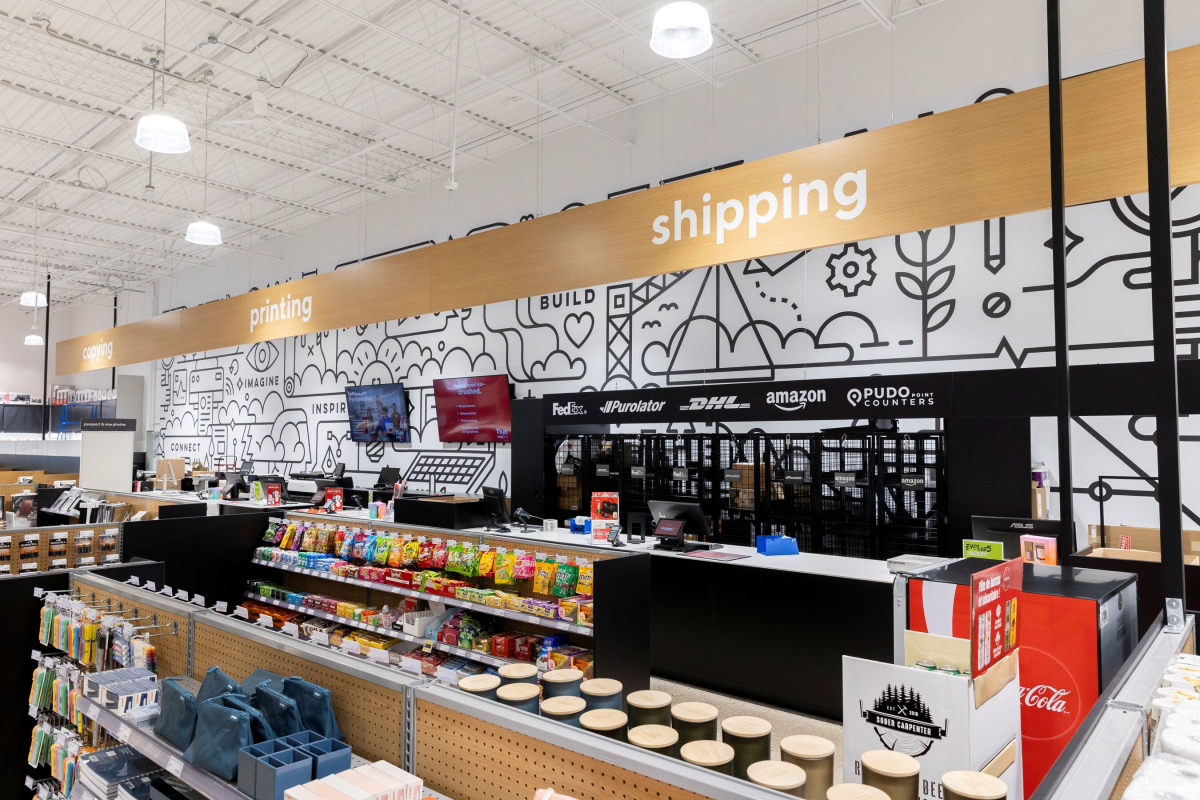
One of the most important shifts in the Staples Canada new concept store is the redesign of the services hub at the back of the building. Staples has long offered extensive print, copy and shipping services, and demand has grown as shoppers rely more heavily on retailers for package drop-off and returns. In the Burlington store, the company has used those learnings to produce a cleaner, more intuitive customer journey.
“In a typical store, ninety-five percent of the questions at the entrance are about shipping,” McDougall said. “Customers want to know where to go, and often they would end up at the wrong counter because print and shipping shared that space. We knew we had to make it easier.”
In Burlington, clearly defined queue lines and strong visual cues separate print services from shipping, with curated adjacencies around both areas. The print production zone has been moved away from the customer-facing counters, allowing associates focused on production to work without frequent interruptions, while customer-facing associates manage transactions, consultations and selling opportunities in the front.
“This is a better customer experience and a better associate experience,” McDougall said. “Associates are not pulled in many directions, so they can give each customer the time and attention they deserve.”
Staples continues to deepen its position as Canada’s shipping destination, with shipping partners that include FedEx, Purolator, DHL and UPS alongside returns programs with Amazon and Pudo. McDougall noted that the company is in discussions with one more carrier that would complete the national offer.
The rise of Amazon returns and increased parcel traffic has had a visible impact on store visits. While labour disruptions at Canada Post can temporarily double those trips, McDougall said everyday footfall from shipping alone now runs about fifteen percent higher than in the early days of the service.
“Retailers live and die by trips,” he said. “We will take those trips all day, but the real unlock is how you use them. The design, the navigation and the merchandising all work together to convert that mission-based customer into a shopper who discovers more.”
Staples Canada, The Working and Learning Company, is redefining its retail experience with the opening of a new, brand-defining store in Burlington, Ontario that brings the company’s EASY promise to life through innovative merchandising, expanded product categories, and new shopping experiences. (CNW Group/Staples Canada ULC)
Built From Pilots Rather Than Consultants
The Burlington format is the culmination of several years of experimentation across the Staples Canada network. Pilots in Scarborough and other markets tested shipping concepts, Kids assortments, merchandising vignettes and different layout approaches. Rather than rely on external consulting firms to draw up a new concept in isolation, Staples built its next-generation format from the ground up based on field experience and data.
“We have worked with consultants over the years and they can be very helpful, especially when you need a fresh perspective or a catalyst for change,” McDougall said. “In this case, we had already done a lot of work shaking the box internally. Our pilots gave us confidence that we could deliver a format that would hurdle our capital cases and deliver the returns we needed.”
Weekly project meetings, frequent store visits and rigorous analytics work have shaped the Burlington store. Associates and customers were part of the process, with feedback loops feeding into the final solution.
“In any solution design, if you are not working end to end, you are not serving yourself well,” McDougall said. “We have a lot of confidence because this format is built on what we have already seen working in the real world.”
Own Brands, Value And The Next Phase Of Change
While Burlington introduces significant changes, it is also a stepping stone toward further evolution. McDougall said 2026 will mark a major expansion of Staples Canada’s own brand platform, with a new curated zone planned for future iterations of the concept store.
“There is a whole new look and feel coming for own brands,” he said. “We see that as a key way to offer comparable quality at a better price. You cannot race to the bottom on pricing forever, so own brands, when done right, help us tell a value story that still feels authentic.”
The value message is critical as Canadians navigate a challenging macroeconomic environment. McDougall said that while customers remain cautious, they are still willing to spend when they see clear value, particularly on products that support their work, education and home lives.
“I have been in retail a long time,” he said. “There are years when money feels like it is falling from the sky and years when you really have to work to earn each dollar. The art is in how you present your value proposition, how you merchandise and how you communicate with customers. That is where we are putting our energy.”
Staples Canada, The Working and Learning Company, is redefining its retail experience with the opening of a new, brand-defining store in Burlington, Ontario that brings the company’s EASY promise to life through innovative merchandising, expanded product categories, and new shopping experiences. (CNW Group/Staples Canada ULC)
Burlington As A Blueprint For The Network
The Burlington store will not remain a one-off. McDougall said the company expects the format to inform remodels and new locations across the network, with adjustments as needed for market size and store footprint.
“We see a path forward with this design,” he said. “The softer look and feel, the different zones, the focus on services at the back and the way everything connects to The Working and Learning Company, this is the footprint for what we roll out next.”
The concept builds on earlier flagship investments such as the University Avenue store in downtown Toronto, which introduced Staples Studio coworking, café partnerships and a more experiential layout. While coworking will remain concentrated in major urban markets where density can support it, elements of that thinking, such as community spaces and solution-based merchandising, can be seen in the Burlington format.
For the Burlington community, which first welcomed Staples in 1993, the new store represents both continuity and renewal. To mark the opening, Staples Canada donated twenty-five thousand dollars to MAP through its Even The Odds partnership, which supports research aimed at closing health equity gaps across Canada.
The Staples Canada new concept store in Burlington brings together the company’s retail learnings of the past several years into a single place where design, services and product mix are working toward the same purpose. It is a physical expression of a brand that is moving beyond its roots as an office supply big box and into a broader role as a partner in how Canadians work and learn.
As McDougall put it, the opening weekend underscored why the in-store experience still matters. “This is a fun day for us at Staples,” he said. “The energy, the excitement from our teams, the buzz from customers in the store, you cannot get that online. It reminds us why investing in stores still makes so much sense.”