Home Blog Page 7

52% of tariff-impacted small businesses are performing worse: Merchant Growth report

Sam Lion photo
Sam Lion photo

Many Canadian small businesses are feeling the financial pressure from the current Canada/US trade war and they’re not seeing much relief from government support or the Buy Canadian movement, says the 2026 Canadian Small Business Report by Merchant Growth.

“You don’t have to export anything to feel this trade war. It lands on a supplier’s invoice, or with a customer who decides to hold off, and a lot of owners can’t pass that cost along,” said David Gens, Founder and CEO of Merchant Growth. “Canadians have shown up for local businesses, and that matters, but it hasn’t been enough to cover what owners are paying for goods and fuel. With tariffs, fuel prices, and slower spending all hitting at the same time, small businesses need financing that’s fast and flexible enough to keep up, so one hard quarter doesn’t decide whether they stay open.”

Vitaly Gariev photo
Vitaly Gariev photo

Looking ahead, 41% of Canadian small businesses plan to hold steady with their business plans. Meanwhile, some are planning to make further adjustments by cutting costs and finding ways to improve margins. Over the next six months, Merchant Growth said:

  • 22% plan to raise prices for customers
  • 14% plan to wind down their business
  • 11% plan to delay or cancel a planned investment
  • 9% plan to reduce staff or hours
  • 8% plan to invest in equipment or technology

Nearly two in three (65%) small business owners say U.S.-Canada trade tensions have affected their business in 2026. Among those owners, more than half (52%) say their business is performing worse than it was at this point last year. Many owners also feel shut out of the national response, with over one in three (37%) saying they’re not part of the conversation at all. Meanwhile, another 39% say large exporters, manufacturers, and political considerations come first, said the report.

Despite the series of tariff relief programs that federal and provincial governments have introduced, 68% of small business owners say they have seen no noticeable impact from these initiatives. Canadian consumers say they have been choosing Canadian, but small business owners haven’t felt the boost. Over half (56%) of Canadian consumers have shopped more from Canadian small businesses in the past 12 months than in previous years. However, two in three (67%) small business owners say the Buy Canadian movement hasn’t had a noticeable impact on their business. As economic pressures stack up, some owners are putting their own finances on the line to keep their businesses afloat. More than one in five (22%) small business owners have used personal credit, such as credit cards, home equity lines of credit or personal loans, to fund their business, added the report.


The 2026 Canadian Small Business report also found that:

How have U.S.-Canada trade tensions impacted small businesses?

The U.S.-Canada trade tensions are directly impacting Canadian small businesses’ bottom lines. As a result of the trade disruptions:

  • 38% saw an increased cost of goods or supplies
  • 27% faced lower revenue
  • 26% experienced lower customer demand
  • 23% absorbed higher costs because they couldn’t raise prices
  • 13% delayed or cancelled a planned purchase or investment
  • 12% faced a higher cost of equipment or machinery purchased from the U.S.
  • 12% saw cancellation or pause of contracts or orders
  • 6% lost a U.S. customer or contract outright

In response to the U.S.-Canada trade tensions, small businesses are adjusting how they operate with U.S. partners and customers:

  • 13% stopped working with U.S. suppliers or partners
  • 9% found new suppliers outside the U.S.
  • 8% stopped selling to U.S. customers
  • Looking ahead, 11% of small business owners plan to seek new customers or suppliers outside the U.S. over the next six months.

Is the Buy Canadian movement helping small businesses?

  • The share of Canadian consumers who have shopped much more from Canadian small businesses has gone up from 20% in 2025 to 24% in 2026.
  • Canadian consumers’ top motivators for buying from Canadian small businesses are supporting the local economy (75%), supporting Canadian jobs (69%), and U.S. tariffs (55%).
  • Canadian consumers’ top barriers to buying from Canadian small businesses are prices (52%), product availability (31%), clarity that a product is Canadian (23%), and store locations (23%).
  • That support has yet to translate into a meaningful change for most owners. Only about one in four (24%) small business owners say the Buy Canadian movement has had a positive impact on their business so far in 2026, while 67% have seen no noticeable impact.

Canadian small business owners are raising prices and pulling back on growth plans

This year, the three biggest pressures on Canadian owners’ businesses are inflation or rising input costs (44%), weak customer spending (38%), rising fuel and energy costs (36%), and trade uncertainty (12%).

In response to these pressures, Canadian small business owners are shifting their approach to pricing and operations. However, some are trading off their growth plans.

  • 22% increased prices for customers
  • 15% delayed or cancelled a planned investment to expand the business
  • 13% diversified their products or services
  • 11% reduced staff or hours
  • 10% paused hiring
  • 9% adopted new technology (AI, automation systems, etc.)

Merchant Growth is a Canadian financial technology company that specializes in small business financing. Founded in 2009, Merchant Growth has since supported over 15,000 Canadian businesses with over $1.5 billion in growth financing. 


https://kaboompics.com/ photo

In an interview with Retail Insider, Hash Aboulhosn, Chief Growth Officer at Merchant Growth, takes a closer look at the report.

How have Canada-U.S. trade tensions affected small businesses over the past year in terms of costs, revenue, customer demand and relationships with U.S. suppliers and customers?

It’s hit a lot of small businesses, and it’s landing as a direct hit to the bottom lines. Nearly two in three Canadian owners (65%) tell us they’ve felt some impact from trade tensions with the U.S. 

Rising costs are the biggest concern, with 38% saying their cost of goods or supplies has increased, followed by lower revenue at 27%, and lower customer demand at 26%. And it’s not spread evenly. Owners who’ve been affected by trade tensions are twice as likely as those who haven’t to say business is worse than it was in 2025 (52% vs. 27% of Canadian small businesses overall). 

We’re seeing signs of that pressure in the broader economy, too. Statistics Canada’s July retail trade data came in down 0.7% month over month, led by a drop at general merchandise stores, as trade uncertainty is weighing on discretionary spending.

On the supplier and customer side, some owners are already taking action: 13% have already stopped working with U.S. suppliers or partners, 9% have found new suppliers outside the U.S., and 8% have stopped selling to U.S. customers altogether. And it’s not slowing down, another 11% say they plan to look for new customers or suppliers outside the U.S. in the next six months. 

That search for options outside the U.S. is happening at the same time as the biggest change to internal trade in this country in a decade. The Free Trade and Labour Mobility in Canada Act came into force on January 1, 2026 and the Canadian Federation Of Independent Business (CFIB) has flagged some of the barriers it’s chipping away at, in sectors like health care and education, as equivalent to a 40% tariff. For owners looking beyond the U.S. for suppliers or customers, there’s more room to move inside Canada than there was a year ago. 

What does the report show about the ability of Canadian small businesses to access government support, and why do many owners feel they have been left out of trade negotiations?

Honestly, the data isn’t encouraging: more than two in three owners (68%) say government support, federal or provincial, for those hit by tariffs hasn’t made a noticeable impact on their business, and a lot of them don’t feel like anyone’s speaking for them at the table in the first place either. 

Some of that comes down to how the support itself is built. The last federal budget put $1 billion into a Regional Tariff Response Initiative, and the eligibility rules disqualify many small businesses. That’s the kind of program design owners are dealing with when they tell us the support isn’t registering.

One year after your previous benchmark, what has changed in consumer support for buying Canadian products, and to what extent do small businesses say that sentiment is translating into measurable business results?

The overall number of Canadians shopping Canadian hasn’t changed year over year, but those who are doing it are doing it more. Over half (56%) of Canadians say they’ve shopped more from Canadian small businesses this past year, the same as in 2025. What has shifted is intensity. About 1 in 4 (24%) now say they’ve shopped “much more” Canadian, up from 20% last year. The main reasons people give are supporting the local economy (75%), supporting Canadian jobs (69%), and U.S. tariffs (55%). 

While Canadians have been choosing to support local, one of the surprising findings from the study is that the Buy Canadian movement isn’t giving many businesses a boost. Two in three (67%) Canadian small businesses say the Buy Canadian movement hasn’t made a noticeable impact on their business so far in 2026, and only 24% say it’s had a positive effect. 

Part of that, in my view, comes down to costs. A lot of owners are dealing with higher costs across the board right now, and there’s only so much of that an owner can pass on before they start losing customers. So even with more people saying they want to buy local, that doesn’t automatically show up as healthier margins if the cost side is moving just as fast.


Andrea Piacquadio photo

How are current economic pressures affecting small-business owners’ decisions around financing, investment, expansion and their own personal finances?

About 1 in 5 (22%) have raised prices and 15% have delayed or cancelled an investment they’d planned to grow the business. Right now, a lot of owners are just trying to get through the year. Between trade uncertainty and inflation, the priority for most owners is paying their employees and vendors, keeping customers served, and keeping the doors open.

Much of that pressure is landing on owners personally, not through the business at all. About 1 in 5 (22%) have used personal credit, credit cards, HELOCs, and personal loans to keep the business funded this past year. Meanwhile, 28% have cut their own salary, and 15% have stopped paying themselves altogether.

A lot of that comes down to access. The Big Six banks hold 93% of Canadian financial assets, but their loan sizes typically start at $250,000, well above what most small businesses need. And even when they can secure financing, it comes at a cost. When an owner needs cash for payroll or a supplier invoice, a credit card or a line against their house is often the fastest option, even if it’s not the cheapest. This is why we need faster and more flexible financing options for small businesses, giving them a better option to fund what they need to grow, not just keep their doors open.

What does the data reveal about the steps small businesses are considering to cope with the current environment, including raising prices, reducing staff or hours, delaying growth, investing in technology or equipment, or potentially winding down their businesses?

Owners are getting smarter about where they spend and how they price, trying to protect margins wherever they can, but that also means trade-offs on growth. Looking ahead six months, price increases are the most common plan, 22% of owners say they’ll raise prices, 11% plan to delay or cancel an investment, and only 4% plan to hire.

That low hiring number lines up with a bigger staffing squeeze. More than 1.3 million temporary work permits expire by the end of 2026, and many employers relying on the program say they’d likely close without those workers. On top of that, CFIB puts the cost of pure compliance work at $17.9 billion a year nationally, with the smallest firms paying about seven times more per employee than the largest, the baseline cost of staying open before any of these other pressures. 

Small businesses have created millions of jobs in the private sector. So when owners pull back, it shows up as fewer job postings and fewer independent businesses in the communities they serve.

Many businesses are looking to close their doors, with 14% planning to wind down in the next six months. Small businesses impacted by trade tensions are more than twice as likely to be considering it (19% versus 6% for those who haven’t been touched by it.)

More from Retail Insider:

Canadian Retail Construction Hits Decade Low as Scarcity Reshapes Expansion

Yonge Street in Toronto, Photo: Craig Patterson

Canadian retail construction has fallen to its lowest level in a decade, creating an increasingly constrained supply of new space even as vacancy remains low and retailers continue opening stores across the country.

Construction starts dropped by more than 40% in the first half of 2026, according to JLL’s Fall 2026 Retail Market Dynamics report. Approximately 4.9 million square feet of retail space was under construction nationally at mid-year, compared with an existing inventory of roughly 805 million square feet. The national vacancy rate stood at 2.5%.

Leasing activity was also down approximately 11%, but the decline does not necessarily indicate a corresponding reduction in retailer demand. JLL identifies a shortage of suitable available space as an increasingly important constraint, particularly in Canada’s largest and most supply-constrained markets.

The national figures also conceal substantial differences across the country. Toronto and Vancouver have thin development pipelines, while Calgary is experiencing its largest retail construction cycle in a decade.

Canada’s Retail Supply Pipeline Shrinks

Canada’s retail construction pipeline has contracted after reaching approximately 6.2 million square feet in early 2025. JLL said developers have remained disciplined, concentrating construction in neighbourhood centres and general retail, particularly projects serving daily needs.

The slowdown is occurring alongside weakness in parts of Canada’s broader development industry. New condominium construction has fallen sharply in markets including Toronto, reducing one of the channels through which new urban retail inventory has traditionally been delivered as part of mixed-use projects.

CMHC reported that population-adjusted housing starts in Toronto during the first half of 2026 were among their lowest levels since 1996. Condominium launches have largely stalled, with only 156 condominium units starting construction in the City of Toronto during the first six months of the year, compared with an annual average of about 7,000 over the previous decade.

Not every residential development includes a significant retail component, but fewer large mixed-use projects moving into construction also reduce a potential source of future storefront inventory in dense urban markets.

Toronto’s Low Leasing Reflects Limited Supply

Toronto illustrates how declining leasing activity can coexist with an exceptionally tight retail market. Retail vacancy was 2.3% at mid-year, according to JLL, while average asking rents reached $37.19 per square foot.

Leasing activity nevertheless fell 15% year over year to approximately 1.3 million square feet during the first half of 2026, one of the lowest levels recorded over the past decade. Space under construction fell by more than half from a year earlier, with construction starts near historic lows.

JLL identifies supply as the more consequential issue, with no large development on the horizon capable of adding meaningful inventory. Retailers continue to commit to the market: Toronto accounted for 38% of notable store-opening announcements across the major Canadian markets tracked by JLL during the first half of the year.

Activity includes leases in Bloor-Yorkville, continued leasing along Yonge Street between Gerrard and Bloor streets, and retail incorporated into mixed-use projects including ROQ City, Bloor Crossing and the redevelopment of Galleria Mall.

The suburban picture is different. Halton Region is attracting grocery and large-format development as growing communities create new trade areas, with Costco and Fortinos among the retailers identified by JLL. Toronto ranks alongside Calgary as one of Canada’s two leading markets for new daily-needs development.

Lower leasing volumes in a supply-constrained market can therefore partly reflect a shortage of appropriately located and configured space, rather than simply weaker retailer interest.

Calgary Defies the National Construction Slowdown

Calgary is the most significant exception to Canada’s shrinking retail development pipeline. Approximately 2.1 million square feet of retail space was under construction at mid-year, up from 1.1 million square feet in late 2024.

Based on JLL’s national and local-market figures, Calgary alone accounts for roughly 43% of all retail space currently under construction in Canada.

The city is adding more retail inventory than it has in a decade, with much of the development concentrated in fast-growing suburban areas and weighted toward value-oriented daily-needs uses. Despite the new supply, Calgary’s retail vacancy rate was only 2.4%.

Vacancy was 0.8% in the Southeast and 0.9% in Airdrie, while approximately 80% of the development pipeline was pre-leased, according to JLL.

Projects including Taza and Bingham Crossing illustrate the pattern, with Walmart and Costco anchoring new retail serving expanding residential trade areas. Calgary’s Southwest and West are attracting a disproportionate share of larger developments as residential growth expands the customer base available to retailers.

Housing construction helps explain the contrast with Canada’s more constrained markets. CMHC reported 61 housing starts for every 10,000 Calgary residents during the first half of 2026, compared with 19 in Toronto and 51 in Edmonton. While Calgary housing starts have moderated from exceptionally high 2025 levels, construction remains above recent historical averages.

Consumer spending is also considerably stronger in Alberta. Retail sales in the province were 9.7% higher in July than a year earlier, compared with growth of 5.1% nationally, 4.9% in Ontario and 1.5% in British Columbia, according to Statistics Canada.

Edmonton shows a similar, though less pronounced, suburban development pattern, with approximately one million square feet of retail under construction at mid-year, heavily concentrated in South Edmonton.

Grocery Dominates New Daily-Needs Development

The composition of new development is changing along with its geography. Grocery stores anchored 96% of new daily-needs centres developed since 2022, according to JLL, up from 74% between 2016 and 2021. The shift reflects developer preference for formats supported by frequent visits and essential consumer spending.

Neighbourhood-centre vacancy has fallen from approximately 4.4% in 2017 to about 2% today, while strip-centre vacancy is even lower at 1.7%. Space under construction in neighbourhood centres has increased almost 60% year over year, and neighbourhood centres were the only major retail property format to record an increase in leasing activity while other categories contracted.

Grocery anchors can also support pharmacies, restaurants, personal services, financial services and other businesses dependent on recurring visits, making the format particularly attractive in newly developing suburban communities.

Value Retail Takes Share From the Middle

JLL’s research also points to a significant change within grocery-anchored development. Value-oriented grocery anchors represented 38% of new development between 2016 and 2021. For projects developed or expected to be completed between 2022 and 2027, the share rises to 52%.

Mid-range grocery falls from 45% to 30%, while premium grocery remains comparatively stable, moving from 17% to 18%.

The shift suggests that polarization in consumer spending is increasingly visible in the physical development pipeline. Value-oriented formats are gaining substantial ground while the traditional middle receives a smaller share of new investment.

At the opposite end of the market, major premium developments continue to attract retailers and capital where demographics and expected store productivity support the investment.

Vancouver Shows Demand at the Premium End

Vancouver provides the clearest example at the upper end of the market. The opening of Oakridge Park contributed to approximately 557,000 square feet of net retail absorption during the first half of 2026, Vancouver’s strongest first-half performance since 2020. Average asking rents reached $39.44 per square foot, the highest among the major Canadian markets tracked by JLL.

Oakridge’s completion also substantially reduced Vancouver’s remaining development pipeline. Approximately 526,000 square feet was under construction at mid-year, with construction starts close to decade lows.

Vancouver’s overall vacancy rate was 2.6%, although conditions varied sharply within the region. Downtown Vancouver vacancy remained at 9.9%, while Surrey and Langley were among Canada’s tightest retail submarkets at approximately 1.5%.

Luxury retail is a striking exception to the broader construction slowdown. JLL counted 30 luxury store openings in Vancouver between July 2025 and July 2026, compared with 18 in New York City, 11 in Miami and seven in Los Angeles, with Oakridge Park accounting for most of Vancouver’s activity.

Together, the value-oriented suburban development occurring in Alberta and premium investment in Vancouver illustrate how selective the current development environment has become. Conventional retail supply is growing slowly, while capital continues to flow toward projects where location, demographics, recurring demand or expected productivity provide a stronger investment case.

Low Vacancy Does Not Mean Every Storefront Is in Demand

Montréal provides an important qualification to the national scarcity story. Overall retail vacancy was just 2.1% at mid-year, but conditions varied substantially by property type. Power-centre vacancy tightened to approximately 1%, while strip-centre vacancy increased to 4.6%.

Regional malls continue to absorb the impact of former Hudson’s Bay space, while JLL found necessity-anchored properties continuing to tighten as some discretionary storefront formats face greater pressure.

Retail space is highly specific to location, size, configuration, parking, loading, neighbouring tenants and surrounding demographics. A large former department-store box does not necessarily meet the requirements of a restaurant, supermarket or small-format apparel retailer, just as vacant downtown storefronts do little for chains seeking suburban sites with parking and highway access.

Canada’s low headline vacancy rate can therefore coexist with visible empty storefronts. The constraint is less about an absence of vacant retail space than a limited supply of the right space in the right markets.

Consumer Spending Remains Resilient

The construction slowdown is occurring without a corresponding collapse in Canadian retail spending. Canadian retail sales reached $73.7 billion in July, down 0.7% from June but 5.1% higher than a year earlier, according to Statistics Canada.

Regional performance varied considerably, with Alberta leading the major provinces at 9.7% year-over-year growth. Toronto retail sales increased 2.4%, while Vancouver sales declined 0.8%.

JLL’s first-half analysis similarly found stronger growth in essential categories and food services than in core discretionary retail. Foodservice spending increased 5.6%, while dining represented approximately one-third of announced store openings.

The pattern aligns with where development capital is increasingly concentrated: categories and locations where landlords and developers have greater confidence in recurring consumer demand.

A More Selective Expansion Market

Canada’s constrained construction pipeline is likely to influence retailer expansion strategies over the next several years. In established markets such as Toronto and Vancouver, retailers seeking high-quality locations may face limited choices and greater competition for suitable space.

Some will need to adjust store sizes, commit to developments earlier or consider repositioned existing properties instead of relying on significant amounts of new supply.

Suburban growth markets present a different set of opportunities. Calgary and parts of Edmonton continue to add retail alongside residential development, while grocery-anchored projects provide a relatively predictable framework for new centres.

Mixed-use and transit-oriented development will remain another source of inventory in Canada’s largest cities, although weakness in condominium construction creates uncertainty around how quickly some projects will proceed. CMHC says new project launches have weakened across several major Canadian markets even as previously started projects continue toward completion.

JLL expects supply constraints to become more apparent as population and consumer demand strengthen again. With relatively little conventional retail entering the pipeline in several major markets, stronger demand could tighten conditions quickly.

For retailers planning Canadian expansion, the increasingly important question is whether the right space, in the right trade area and in the right format, will be available when they are ready to grow.

More from Retail Insider:

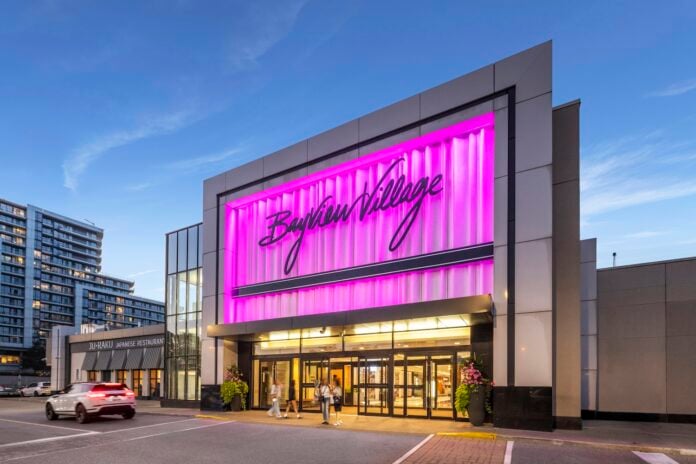
Bayview Village Unveils Major Interior Transformation as QuadReal Advances Mixed-Use Redevelopment

Bayview Village in Toronto, fall 2026. Image supplied

Bayview Village Shopping Centre has completed an extensive interior transformation, introducing natural materials, custom furnishings and a more intimate atmosphere as owner QuadReal advances a broader redevelopment of the 22-acre Toronto property.

Designed by Antonio Tadrissi, the renovation incorporates natural marble, brass and copper, Venetian plaster, custom furniture, mature trees, art and new lighting. The individual elements support a larger objective: changing how people move through and spend time at Bayview Village.

“I wanted people to slow down,” Tadrissi told Retail Insider. “Shopping centres are usually designed around movement, getting you from one store to another as efficiently as possible. I wanted to challenge that idea and create a place where you actually want to stay, look around and discover things.”

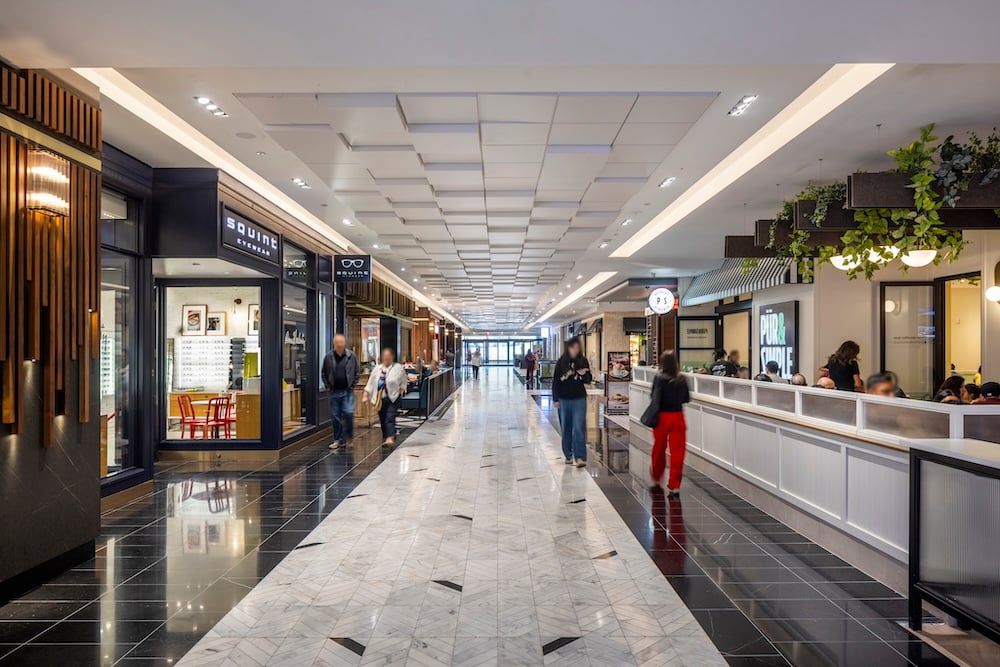
Tadrissi approached the centre as a sequence of spaces instead of a continuous interior. Perspectives and materials change as visitors move through the property, with trees, furniture, artwork and architectural elements creating distinct gathering points.

The approach builds on Bayview Village’s relatively compact scale, a characteristic QuadReal deliberately embraced when establishing the direction for the renovation.

“The intimate scale and nature of Bayview Village is one of its greatest strengths,” said Chrystal Burns, Executive Vice President, Canadian Retail Experience at QuadReal. “We wanted to create an environment that feels considered at every touchpoint, where gracious architecture, sumptuous materials, refined lighting and landscaping and an elevated retail offering all work harmoniously.”

Bayview Village in Toronto, fall 2026. Image supplied

European Influences Shape the Design

When Retail Insider spoke with Tadrissi about the project in 2024, he pointed to European gathering places and retail environments, including Piazza Duomo in Milan and shopping streets in Paris and Rome, as influences.

The completed design does not attempt to replicate those places. Tadrissi was interested in how European cities use architecture, storefronts, paving, cafés, lighting and landscaping as parts of a larger composition, leading pedestrians through spaces that vary in scale and character.

“For me, the European influence is not about copying a particular building or making Bayview Village look like Milan, Paris or Rome,” he said. “It is much more about how those cities are built and how they make you experience space.”

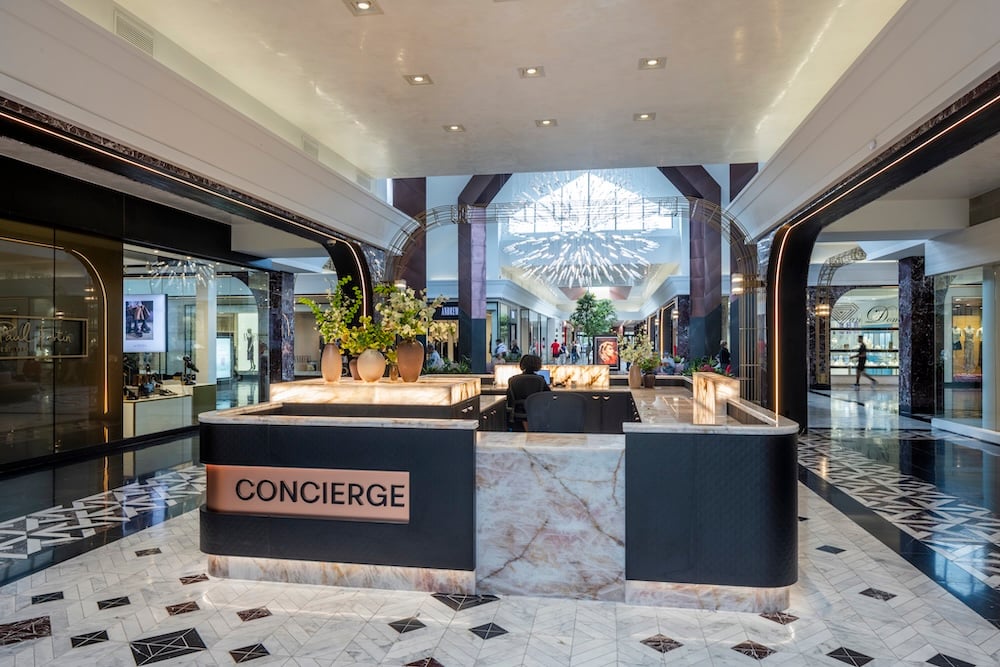
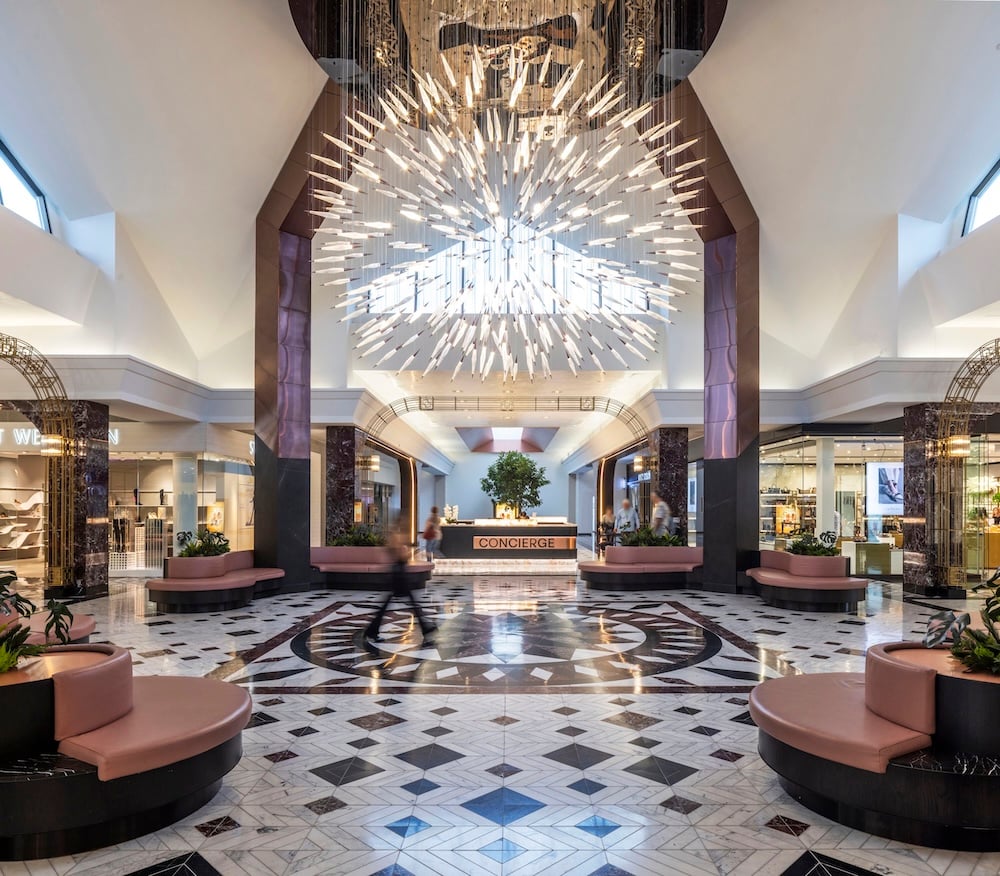
That thinking informed areas of Bayview Village that might otherwise function primarily as circulation. Patterned marble defines pathways, architectural portals frame views, trees establish piazza-like gathering points and custom furniture provides places to stop.

Tadrissi said the European influence is expressed through proportion, rhythm, materials and craftsmanship. He was also interested in how historic cities absorb successive renovations while retaining their underlying identity, an idea that influenced his treatment of the existing shopping centre.

Bayview Village in Toronto, fall 2026. Image supplied

Natural Marble Becomes Part of the Architecture

The flooring is among the renovation’s most visible changes and plays a functional role in the design. Instead of engineered stone commonly used in commercial interiors, the project incorporates classical marble arranged in patterned configurations. Colour density changes throughout the centre, with darker blacks and reds becoming more prominent around gathering areas while lighter stone opens up circulation routes.

The transitions help direct movement through the property without relying solely on conventional wayfinding. Tadrissi also selected natural stone for the way it will change as people walk across it over time.

“The marble does not just establish the visual language of the floor. It is meant to age with the centre,” he said. “As people move through it over the years, it becomes part of the story.”

Other materials were chosen with similar considerations. Venetian plaster adds texture and depth, while brass and copper respond to changing light and will develop character as they age. Solid wood, upholstered furniture and trees add warmth against the harder surfaces.

Lighting is treated as another architectural component, particularly during Toronto’s darker months. It illuminates the stone and metal while bringing out variations in the plaster as natural light changes throughout the day and across seasons.

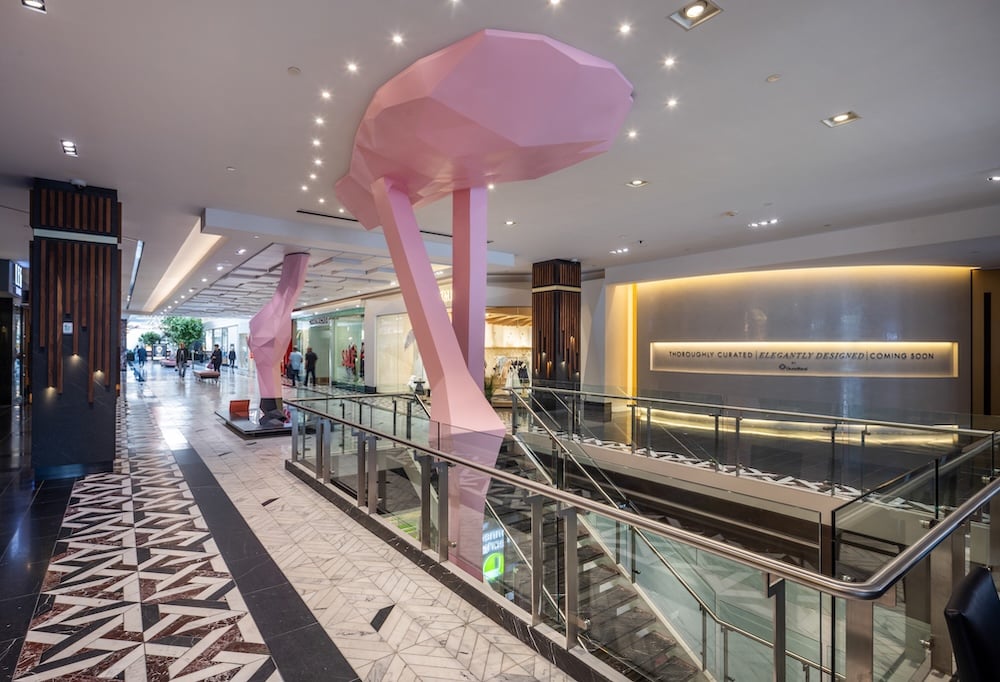
Prominent features include the hand-blown Big Bang chandelier in Centre Court, custom Infinity benches and a two-storey Lady Flamingo sculpture.

For Tadrissi, luxury comes primarily from craftsmanship, materials, proportion and details designed specifically for the property.

“I wanted Bayview Village to have that feeling, the sense that things were designed specifically for this place rather than selected from a catalogue,” he said.

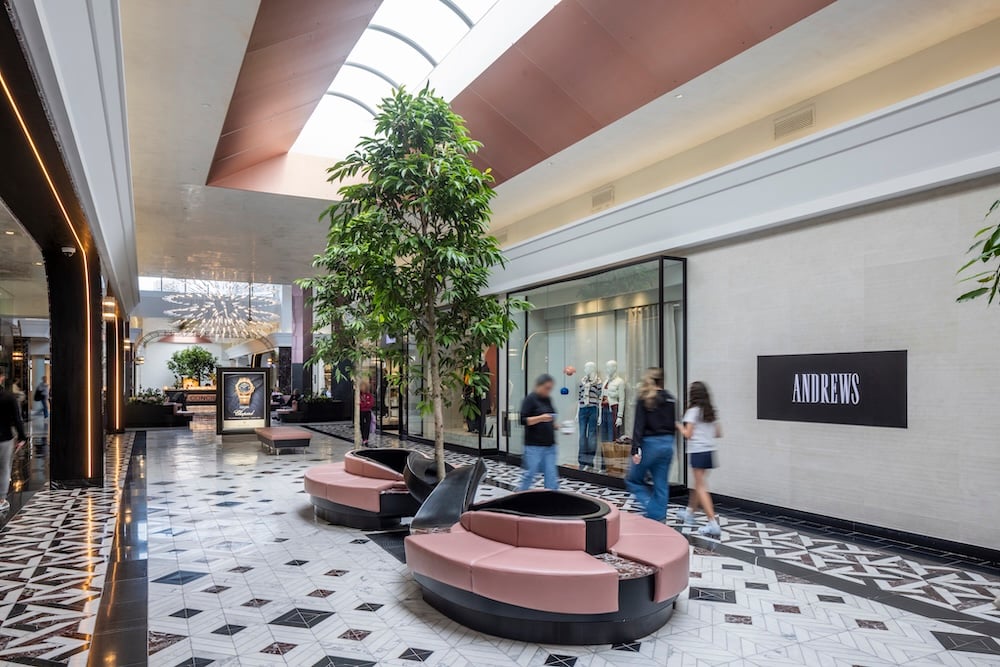
Bayview Village in Toronto, fall 2026. Image supplied

Existing Trees Carry Bayview Village’s History Forward

The renovation retains elements that predate Tadrissi’s work. Bayview Village opened in 1963 as an open-air shopping centre and was enclosed in 1977, with existing Ficus trees inside the property providing a physical connection to that history.

Tadrissi designed the Infinity benches to wrap around the trees beneath elevated skylights. Seating, planting, daylight and architecture work together, turning areas along the centre’s circulation routes into places where visitors can stop.

“I never wanted to completely gut Bayview Village or erase what had come before,” he said.

The trees illustrate his broader approach: identifying parts of the existing centre that continued to have value, preserving them and rethinking elements that no longer served the intended design.

“That was really the vision from the beginning: not to decorate a shopping centre, but to create an environment with its own identity without disregarding the past,” Tadrissi said.

Bayview Village in Toronto, fall 2026. Image supplied

QuadReal Looked to Hospitality for the Retail Environment

The hospitality quality of the finished interior was intentional. Burns said QuadReal’s brief focused on how people should feel while moving through Bayview Village. The company sought the level of detail associated with a high-end hotel, restaurant or European retail destination while maintaining the warmth and accessibility of a neighbourhood shopping destination.

Rich materials, layered lighting, landscaping and tactile elements became part of that strategy.

“Ultimately, the goal was not to make Bayview Village feel like somewhere else,” Burns said. “It was to elevate what is already distinctive about it and create a more memorable expression of the Bayview Village experience.”

QuadReal says Bayview Village’s smaller scale and curated character were strengths it wanted to preserve and reinforce through the renovation. The completed design consequently places considerable emphasis on spaces for lingering, gathering and discovery.

Bayview Village in Toronto, fall 2026. Image supplied

Interior Establishes the ‘DNA’ for Larger Redevelopment

The completed interior will also serve as a design foundation for the larger transformation underway around Bayview Village.

QuadReal’s master plan encompasses more than 22 acres and includes approximately one million square feet of residential space, more than 1,500 new residential suites, additional retail and new public spaces.

“This is really the beginning of a much larger transformation, so we thought about the interior as the first chapter of a bigger story rather than as a standalone renovation,” Burns said.

North Village, now under construction, is the first major phase. Plans include a 23-storey residential tower, two boutique mid-rise buildings, an open-air retail promenade connecting the new development with the shopping centre, and an approximately 40,000-square-foot public park.

Construction began in 2024, with current project materials anticipating completion in 2028.

QuadReal intends the transition between the existing shopping centre, new retail, outdoor spaces and residential buildings to feel cohesive as the development is completed. Burns said the individual components will have their own character while remaining identifiable as parts of the same neighbourhood.

She described the renovated interior as establishing the “DNA for what comes next.”

Bayview Village in Toronto, fall 2026. Image supplied

Retail Mix Continues to Evolve

The physical transformation coincides with changes to Bayview Village’s retail and food-and-beverage mix.

The centre is home to more than 90 retailers, restaurants, service and wellness businesses, with recent and incoming additions including HANK., Tilley, Pür & Simple, Kit and Ace and Level Up Hot Yoga. McEwan Fine Foods is expected to open in 2027.

Additional commercial space is planned through the wider redevelopment, including the open-air retail promenade in North Village.

For Tadrissi, the completed interior comes back to the way people move through Bayview Village and encounter it gradually.

“You do not necessarily understand the whole space the moment you enter it,” he said. “It reveals itself as you move through it.”

More from Retail Insider:

EY Canada honours entrepreneurs with 2026 Lifetime Achievement and Family Business Awards of Excellence

Tina Lee, CEO of T&T Supermarkets (Image: Cadillac Fairview)

EY Canada has selected its 2026 regional recipients of the EY Entrepreneur Of The Year Lifetime Achievement and Family Business Awards of Excellence, which recognize accomplished entrepreneurs and family business leaders whose companies have become part of Canada’s economic and cultural fabric.

This year’s honourees have built nationally recognized brands, created opportunities for entrepreneurs and employees across the country, and demonstrated how Canadian businesses can achieve lasting impact both here in Canada and beyond, said the company.

Spanning fashion, real estate, food and beverages, and grocery retail, this year’s recipients have challenged convention and built enduring organizations, representing the breadth and strength of Canadian entrepreneurship. They will be celebrated alongside regional winners at the EY Entrepreneur Of The Year award shows this October, it explained.

“This year’s recipients have built businesses that Canadians admire and trust, while creating lasting economic and social impact in communities across the country,” said Daniel Baer, EY Entrepreneur Of The Year Canada Program Director. “Their achievements remind us that some of the world’s most influential companies and brands are built right here in Canada. Canadians should be proud of their legacies.”

EY Canada presents its regional recipients:

2026 Prairies Lifetime Achievement Award of Excellence

Dale Wishewan, Booster Juice 

When Dale Wishewan opened the first Booster Juice location in Sherwood Park, Alberta in the winter of 1999, the idea of a smoothie and juice quick-service concept succeeding in Canada was far from certain. Dale Wishewan recognized early that Canadians were looking for convenient, great-tasting options that supported more active and health-conscious lifestyles. Over more than two decades, he built Booster Juice into one of Canada’s most recognizable homegrown brands, proving that a quick-service concept born in the Prairies could scale nationally. Through the franchise model, Wishewan has created opportunities for entrepreneurs across Canada, supported local job creation and contributed to communities from coast to coast.

Today, Booster Juice stands as one of the Prairies region’s most successful business growth stories and a testament to what can happen when entrepreneurs challenge conventional thinking.

“This is a huge honour to be recognized alongside such an esteemed list of past recipients,” says Wishewan. “It has been such an enjoyable journey building such a well-recognized Canadian brand and having such amazing franchise partners, team members and loyal customers across Canada.”

Learn more about Dale Wishewan’s entrepreneurial journey

2026 Eastern Lifetime Achievement Award of Excellence

Andrew Lutfy, Groupe Dynamite 

Few Canadian retail leaders have demonstrated the longevity and adaptability of Andrew Lutfy. Andrew started his career at 18 working at the first GARAGE store in Montréal and went on to shape Groupe Dynamite into one of Canada’s leading fashion retailers, competing successfully in some of the world’s most demanding retail markets. After becoming sole owner in 2002, he guided the business through decades of change in an intensely competitive industry, transforming the company’s operating model and building GARAGE into an increasingly global brand.

Today, Groupe Dynamite’s brands are recognized by shoppers across Canada, the UK, the US and beyond, while Lutfy’s entrepreneurial influence extends beyond retail through Carbonleo, a Montréal-based real estate development company behind iconic destination projects including the Four Seasons Montréal, Quartier DIX30 and ROYALMOUNT.

Lutfy’s journey reflects the power of ambition, reinvention and long-term brand building.

“I have never viewed entrepreneurship as protecting what you have built. It is about having the courage to keep reinventing it,” says Lutfy. “The greatest privilege of my career has been building alongside extraordinary people — giving them the trust, ownership and freedom to turn ambitious ideas into reality. I am deeply proud that so much of what we have built began in Québec and is now competing, growing and succeeding on an international stage.”

Learn more about Andrew Lutfy’s entrepreneurial journey

2026 Pacific Lifetime Achievement Award of Excellence

Anthony von Mandl, The Mark Anthony Group of Companies 

For more than five decades, Anthony von Mandl has demonstrated entrepreneurial leadership and global brand-building. Since founding The Mark Anthony Group in 1972, he has transformed a small British Columbia venture into one of the world’s most successful beverage companies. His career has been defined by disciplined vision and calculated risk-taking, from helping advance premium wine production in Canada to reshaping the ready-to-drink category through brands including White Claw Hard Seltzer and Mike’s Hard Lemonade.

From helping elevate Canadian wine production to pioneering successful consumer beverage innovations, von Mandl’s story shows how long-term stewardship can unlock the global potential of entrepreneurship rooted in Canada.

“This award isn’t just in recognition of one’s career accomplishments, it’s a testament to the fact that each one of us has the potential to achieve far more in our lives than we could ever imagine,” says von Mandl. “Wholeheartedly, it’s the people we bring together who enable us to create our world-class brands and introduce them to the world.

Learn more about Anthony von Mandl’s entrepreneurial journey

2026 Ontario Family Business Award of Excellence

Cindy Lee and Tina Lee, T&T Supermarket Inc.

The story of T&T is a reflection and celebration of multiculturalism in Canada. Cindy Lee founded T&T Supermarket to bring culture, family and community into the grocery experience. Since its first stores opened in 1993, T&T has grown from a family-led idea into the country’s largest Asian supermarket chain, bringing once hard-to-find foods and traditions to a broader audience while inspiring greater awareness, appreciation and pride in Asian culture.

Today, Cindy’s daughter Tina Lee is carrying forward that legacy while leading the company into its next phase of growth and innovation. Under her leadership, T&T continues to expand the reach and visibility of culturally rooted retail, building on the company’s role in paving the way for categories such as dumplings, steamed buns, mangoes, k-beauty skincare, which elevate the communities behind them. The transition from one generation to the next exemplifies the strength of family entrepreneurship and the enduring values that underpin many of Canada’s most successful businesses.

“This recognition is a reminder that Canadian innovation isn’t just alive, it’s thriving, and there’s real opportunity for the next generation of entrepreneurs to build on that,” says Tina Lee. “I’m proud of the role we’ve played in the evolution of Asian food culture in Canada, helping elevate Asian cooking and making it more accessible, exciting and celebrated.”

Learn more about Cindy and Tina Lee’s entrepreneurial journey

More from Retail Insider:

Walmart Enters Squamish Grocery Market After 20 Years of Retail Restrictions

Walmart Canada has converted its longtime Squamish, B.C. store into a Supercentre, bringing a full fresh grocery assortment to a location that spent nearly two decades operating under municipal rules designed, in part, to protect existing grocery stores from competition.

The approximately 86,000-square-foot store at 39210 Discovery Way now sells fresh produce, meat, seafood, bakery and dairy products alongside Walmart’s general merchandise assortment. It also includes a full-service pharmacy and offers pickup and delivery, with approximately 170 associates employed at the location.

Walmart formally celebrated the transformation in September after opening the Supercentre in August. What appears at first to be another store renovation has an unusual history: when Walmart entered Squamish in 2006, local planning rules prevented it from becoming the full grocery competitor it is today.

Walmart Grocery Sales Were Restricted in Squamish

The restrictions date to a period when Squamish officials were concerned about what a large-format Walmart could mean for existing retailers.

Planning rules associated with the site prohibited the sale of several fresh-food categories, including fresh meat, poultry, fish and produce, while limiting the amount of space Walmart could devote to food.

During discussions about removing those restrictions in 2024, District of Squamish planner Philip Gibbins told council that they had originally been intended “to reduce competition for grocery stores downtown.”

That rationale looked considerably different two decades later. Squamish recorded a population of 24,232 in the 2021 Census, up from 19,893 in 2016, representing growth of 21.8 per cent in five years. Mayor Armand Hurford noted during the Walmart rezoning discussion that the community had roughly 14,000 residents when Walmart’s arrival was being debated about two decades earlier.

A policy developed for a much smaller Squamish had effectively prevented one of Canada’s largest retailers from competing fully in a grocery market serving a substantially larger population.

More Grocery Competition Becomes the Goal

By the time Walmart sought permission to convert the store into a Supercentre, the argument around competition had largely reversed.

During council discussions in November 2024, Hurford pointed to grocery affordability and price differences he had observed between Squamish and other communities. Coun. John French also supported the proposal, saying residents had told him they wanted more grocery competition.

There were still concerns about what Walmart’s entry into fresh grocery could mean for incumbent retailers. Coun. Lauren Greenlaw raised the potential impact on established grocery businesses, including a nearby family-operated retailer, while acknowledging the financial pressure facing residents and the potential benefits of additional competition.

The shift is notable. Walmart’s grocery business had originally been restricted because of concerns about competition. Nearly 20 years later, competition itself had become part of the case for allowing it.

That does not mean a Walmart Supercentre will necessarily reduce grocery prices across Squamish. Whether it does will depend partly on how competing retailers respond. But it introduces another major operator into fresh-food categories where Walmart had previously been prevented from competing.

Council gave the required zoning amendments their first three readings in November 2024, with six of seven councillors supporting the proposal. Final adoption followed in April 2025.

Coun. Chris Pettingill, who opposed the initial readings, raised concerns related to land-use intensity and the nearby FortisBC pipeline rather than Walmart’s expansion into fresh grocery.

Walmart Adds Grocery Without Adding Another Big Box

Walmart subsequently renovated the existing store instead of constructing a larger replacement. The new Supercentre carries produce, meat, seafood, bakery and dairy products alongside categories including fashion, home, electronics, health and wellness and seasonal merchandise. The location also operates a full-service Walmart Pharmacy and supports pickup and delivery.

“For years, our customers have been asking for a Supercentre, and we’re thrilled to officially welcome them into a store that offers even more of what they need, all under one roof,” said Donna Ricci, store manager of the Squamish Walmart.

At approximately 86,000 square feet, the Squamish store is considerably smaller than several new Supercentres Walmart Canada is developing. New locations announced for Lindsay and southwest London in Ontario and southwest Edmonton are around 140,000 square feet or larger.

In Squamish, Walmart has gained a full fresh-grocery business without acquiring another site or building another large-format store. The retailer is getting more out of an existing piece of real estate while adding categories that typically bring customers into stores more frequently than many general merchandise purchases.

Walmart Investing $6.5 Billion in Canadian Network

The conversion comes amid Walmart Canada’s broader push to expand and modernize its physical store network. Walmart announced in January 2025 that it would invest approximately $6.5 billion over five years in new stores, renovations and its Canadian supply chain. The program followed an earlier $3.5-billion investment under which the company said it modernized more than 180 Canadian stores.

New Supercentres have since been announced in several markets, including Fort McMurray, Hamilton, Ottawa, Bramalea, Lindsay, London and Edmonton, as well as on Tsuut’ina Nation near Calgary. Some of that growth is also taking Walmart into established shopping centres and large spaces previously occupied by department stores.

As of July 31, 2026, Walmart reported 401 Canadian stores, including 345 Supercentres and 56 conventional discount stores. Supercentres therefore account for more than 85 per cent of Walmart’s Canadian network.

Squamish illustrates another way Walmart can expand the format. The company did not need another 140,000-square-foot store to add a meaningful grocery operation; it needed permission to make fuller use of the store it already had.

Squamish Grocery Market Gets a New Competitor

For existing grocery operators in Squamish, the practical consequence is straightforward. Walmart can now compete for spending on produce, meat, seafood, dairy and bakery products that had been restricted at the location since it opened.

The Supercentre arrives in a community considerably larger than the one Walmart entered in 2006, and in a grocery market where affordability and competition were explicitly part of the municipal discussion that cleared the way for the conversion.

There is an irony in how the store finally got there. Squamish once limited Walmart’s grocery assortment because officials worried about the consequences of additional competition. Twenty years later, local concerns about grocery prices helped make additional competition part of the solution.

More from Retail Insider:

Tipping Decline Across Canada: Actual report

Vitaly Gariev photo
Vitaly Gariev photo

A new report by Actual, a tip management and hospitality financial operations company, suggests Canadians are tipping restaurant servers less these days.

The State of Tipping in Canada 2026 Report, based on a survey of tipped and non-tipped hospitality workers across Canada conducted with Angus Reid, found that the majority (67%) of tipped workers say tips have declined in the last two years, but it also reveals that tipping is more important than ever, and transparency in tip division is top of mind.

“This data confirms what we’ve heard from the industry for years: tipping is declining at the exact moment hospitality workers need it most,” said Afshin Mousavian, CEO and co-founder of Actual. “Most Canadians don’t realize that restaurants run on razor-thin margins, so for many workers, a tip is how they cover rent and groceries.  Workers aren’t asking for more tipping; they’re asking for tips that reflect the service they provide, and clear answers about how those tips are divided.” 

Key Findings: 

  • 67% of tipped workers report decreased tip amounts over the past two years, up sharply from 39% in 2024
  • 43% of tipped workers rely on tips to cover essential expenses like rent and groceries
  • 76% of workers say tipping incentivizes better service, and similarly, 62% believe tips should be tied to quality of service, not the total bill
  • 85% of hospitality workers agree tip division policies should be clear and transparent for both employees and customers
  • 61% of tipped workers say tip income has influenced their decision to stay in hospitality
  • 90% of workers are aware of how tips are divided at their own workplace
Vitaly Gariev photo
Vitaly Gariev photo

As the country grapples with tipping standards, Actual said its survey finds tipped workers are in fact feeling the pinch of this uncertainty, and with rising inflation and cost of living, tipping is more important to hospitality workers than ever. 

“Tips are critical to the livelihoods of many hospitality workers, and the majority believe they should be earned, not automatic, with tipping directly tied to the quality of service provided,” it said.

“While the industry has made real strides in tipping transparency internally, that clarity has yet to reach the customers footing the bill, again reinforcing the disconnect between the customer and the people offering the service, creating further mistrust.”

The full State of Tipping in Canada 2026 Report can be found at onactual.com/blog/tipping-trends-in-canada-2026-what-hospitality-workers-actually-told-us

More from Retail Insider:

Fitness World launches HYROX Training Club in British Columbia

Fitness World photo
Fitness World photo

Fitness World, a leading fitness and wellness brand in British Columbia, has launched HYROX Training Club classes at two of its locations: South Surrey Signature and its newest location TRAIN by FW University Village ahead of HYROX Vancouver in December – which sold out in minutes.

HYROX Vancouver is a large indoor fitness-racing event that combines running with functional fitness exercises. It is part of the global HYROX race series, where competitors in different cities complete the same basic race format.

As an official HYROX Affiliate Partner, HYROX Training Club classes pair the fitness studio’s signature small-group training model, THE WORX, with HYROX365 group programming, giving members unparalleled support to prepare for the world’s fastest-growing fitness race, without breaking the bank. Fitness World’s new Brentwood Signature location, opening in late 2026, will be the third HYROX Affiliate location, expanding access to affordable HYROX training, said the company

Beyond the Affiliate locations, Fitness World said its facilities are equipped to support HYROX training, with rowing ergs, ski ergs, kettlebells, wall balls, and more available to all members. It’s high-quality training infrastructure at a price point built for accessibility, not exclusivity.

“HYROX has become one of the biggest stages in fitness, empowering athletes at every level to chase new goals,” said Chris Smith, President and CEO of Fitness World. “This partnership is about giving people access to dedicated, high-level training without an elite-level price tag. Whether you’re in THE WORX or training solo, Fitness World will get you HYROX ready.”

HYROX Training Club classes offered as part of THE WORX will be included in current GOAL memberships at South Surrey and University Village at no additional cost.

Fitness World photo
Fitness World photo

To learn more about HYROX Training Club, view class schedules, and explore Fitness World memberships to fuel all types of training, visit https://fitnessworld.ca/hyrox-training-club/.

Fitness World has 18 locations across British Columbia.

More from Retail Insider:

Donations Needed to Help Meet Demand for Affordable Second-Hand Goods

The Salvation Army Thrift Store photo

The Salvation Army Thrift Store says the demand for affordable second-hand goods remains strong as Canadians continue to look for ways to stretch their dollars.

The Salvation Army Thrift Store said it is seeing continued interest from people seeking affordable clothing, household goods and everyday essentials. To help meet this demand, community donations are needed to keep store shelves stocked throughout the fall and winter months.

“As a Canadian non-profit thrift store, we want Ontarians to know that their donation does more than they think,” said Ted Troughton, Managing Director of The Salvation Army Thrift Store. ” Every donation helps give items a second life, reduces waste, and helps fund vital programs and services that provide hope, practical support and opportunities for people facing life’s challenges.

“As we prepare for the colder months ahead, winter jackets, sweaters, boots, and other seasonal items are especially needed. We also welcome donations of household essentials such as cookware, small appliances, and home décor. What may no longer serve a purpose in your home could become an affordable and valuable resource for someone else in your community.”

As The Salvation Army Thrift Store prepares for fall and winter, it said donations of new and gently used winter clothing, household essentials, and everyday items help keep shelves stocked with affordable goods while supporting Salvation Army programs and services in local communities.

Proceeds help fund Salvation Army programs and services that support individuals and families in communities throughout Canada, including food banks and meal programs, shelters, housing supports, addiction rehabilitation, children’s programs, and life-skills development initiatives.

Donations can be dropped off at any Donor Welcome Centre. 

There are 98 stores across Canada.

More from Retail Insider:

Daily Synopsis: October 2, 2026

Welcome to the Daily Synopsis by Retail Insider. We hope you enjoy the 9 articles we published covering key developments in Canadian retail. Here are a couple highlights with a full list of the day’s articles thereafter.

Joseph Tassoni’s shift to presenting mood-driven shows focuses on confidence and presence, with his latest Toronto runway offering immersive art and curated casting that reflect his brand’s identity. This approach supports sustainable growth by strengthening direct customer relationships and blending physical retail with digital and community engagements. Meanwhile, Toronto’s waterfront retail market develops unevenly, with established central zones showing low vacancy and the eastern district facing higher vacancy amid ongoing construction and infrastructure efforts. Both narratives reveal evolving strategies within distinct but connected retail environments.

Lunaro Hospitality opened its first Toronto restaurant, Shay Ristorante, featuring Italian cuisine by chef Justin Friedlich and reflecting a blend of familial tradition and local integration. Simultaneously, OK Tire launched a national video series highlighting the independent owners of its Canadian locations, emphasizing local entrepreneurship and community connection. These initiatives illustrate sector growth through a focus on tailored, authentic experiences, connecting food and automotive retail via locally engaged approaches that contribute to broader commercial real estate and retail expansion.

🗞️ The Day’s Retail Insider Article List

🌐 Canadian Retail News From Around the Web

From The Desk: Polarized retail growth, evolving formats and AI-driven customer engagement

It’s becoming increasingly clear that Canadian retail is moving in different directions depending on the customer. Value remains important as households watch their spending, while premium and luxury retail continues to see investment and expansion. The middle is a tougher place to be, particularly for retailers that haven’t given customers a compelling reason to choose them.

We’re also seeing retailers become more creative about how they grow. New store formats, expanded services and franchising are helping some brands enter markets or expand without simply repeating the same model everywhere. That has implications for landlords as well, particularly as large spaces are subdivided and demand varies considerably from one market to another.

Technology is becoming another important part of the equation. AI-powered tools are starting to change how retailers communicate with customers and operate internally, while tariffs, supply-chain uncertainty and changing consumer behaviour continue to add complexity to the business.

There’s a lot happening across the industry right now. Here are some of the stories and developments that caught our attention this week.

Retailer News

Toronto’s waterfront retail market is developing unevenly as established central and western areas experience low vacancy, while the eastern district faces higher vacancy amid ongoing construction and an expanding inventory. This eastward expansion is driven by major residential projects, upcoming transit infrastructure, and growing demand for businesses that operate year-round, creating distinct opportunities for retailers and commercial landlords across the district.

Tsawwassen Mills marks a shift from its original outlet mall model by adding entertainment and recreation through concepts like TM Wander and The Nest indoor sports facility, raising weekend traffic by 10% since TM Wander’s opening and targeting a new 30,000-square-foot H Mart anchor to boost visit frequency by Christmas 2027. In Calgary, CF Chinook Centre is securing major new tenants including Old Navy, SportChek and Winners as part of a redevelopment to strengthen its standing among Canada’s top-performing malls, reflecting robust leasing demand and an effort to refresh shopping options by mid-2027. Meanwhile, Montreal-based Quartz Co. is expanding its Canadian retail footprint with an upcoming boutique on Notre-Dame Street and plans to enter Toronto, while maintaining local manufacturing despite challenges from U.S. tariffs and growing its women’s product lines.

Retail trade activity in Canada fell 1.0% in July, reflecting a contraction mainly in gasoline stations and fuel vendors where sales dropped 3.5%, reversing gains seen in June. This decline signals cautious consumer behaviour amid economic uncertainty and rising energy costs, impacting sectors reliant on discretionary spending and challenging landlords dependent on steady retail sales.

Aritzia’s financial results show the company absorbed significant U.S. tariff costs without compromising profitability thanks to strong sales growth and improved margins in its expanding American market. This ability to offset tariff pressures demonstrates how Canadian retailers with growing U.S. operations can manage trade-related risks through strategic pricing, sourcing and operational efficiencies.

Retailer Op-Eds

Canada’s retail market continues to show clear signs of polarization between value-oriented and premium offerings, leaving retailers positioned in the middle to rethink their competitive approach. This shift demands that mid-tier retailers sharpen their differentiation and clarify their customer proposition to avoid losing ground to either end of the spectrum.

In response to labour shortages and cost challenges, many Canadian retailers are adjusting their expansion strategies by exploring franchising models and experimenting with store formats to better control operational expenses and meet changing consumer behaviour. These adjustments affect retail real estate, as landlords increasingly convert larger vacancies into multi-tenant spaces to accommodate the evolving needs of retailers. Retailers and landlords must tune their strategies to localized market conditions and operational requirements to sustain growth in this uneven but active environment.

Editor’s Take

Canadian retail is becoming increasingly polarized. Value-focused retailers continue to benefit from consumers watching their spending, while premium brands are investing heavily in stores and experiences. The middle is becoming more difficult, particularly for retailers without a clearly defined customer or reason to visit.

Some of this week’s stories show what appears to be working. Aritzia is putting more emphasis on larger, highly productive stores as it expands in the U.S., while Tsawwassen Mills is adding food, entertainment and other uses that broaden the property beyond its outlet roots. Sports Experts’ $8 million renovation at CF Carrefour Laval is another example: the investment is designed to make an existing location more productive while better supporting e-commerce and changing how customers shop.

Growth itself is also changing. Franchising is helping brands including Tommy Gun’s and Craig’s Cookies expand without relying entirely on corporate stores, an increasingly attractive model as labour and operating costs rise. For landlords, changing store formats and the subdivision of larger spaces are creating opportunities, although demand varies significantly by market and location.

Technology will increasingly sit alongside these physical changes. AI is moving into customer communication, inventory, checkout and other parts of retail operations, while tariffs, labour disruptions and supply-chain uncertainty are forcing companies to pay closer attention to costs and risk.

The common thread is selectivity. Opening more stores is not necessarily the objective; opening the right stores, in the right markets, with a format that works for the customer increasingly is. The retailers and landlords getting that equation right appear best positioned for what comes next.

This Week’s Articles

Retailer News

Retailer People News

Retailer Op-Eds

News From Around the Web