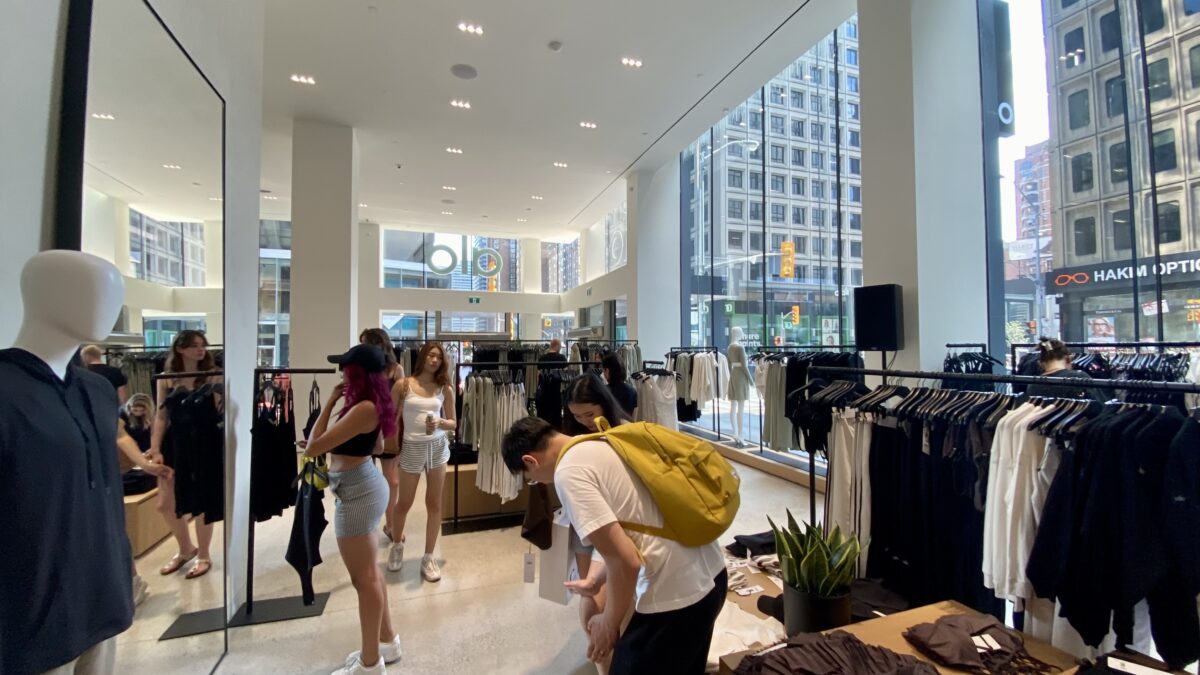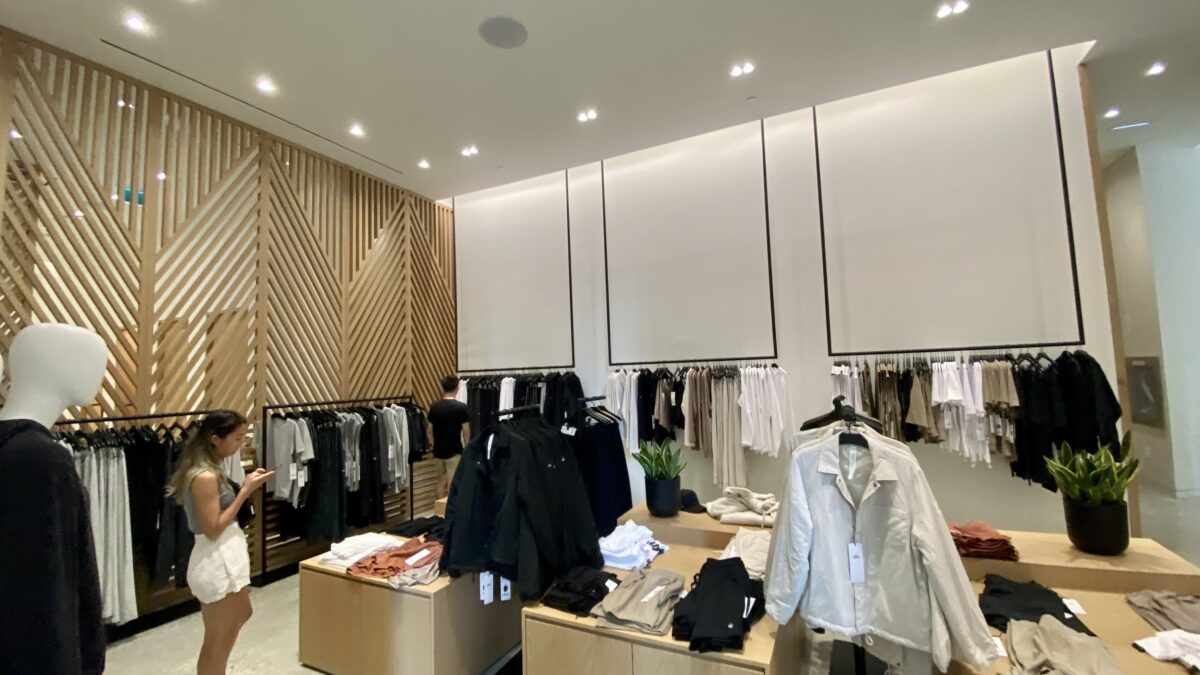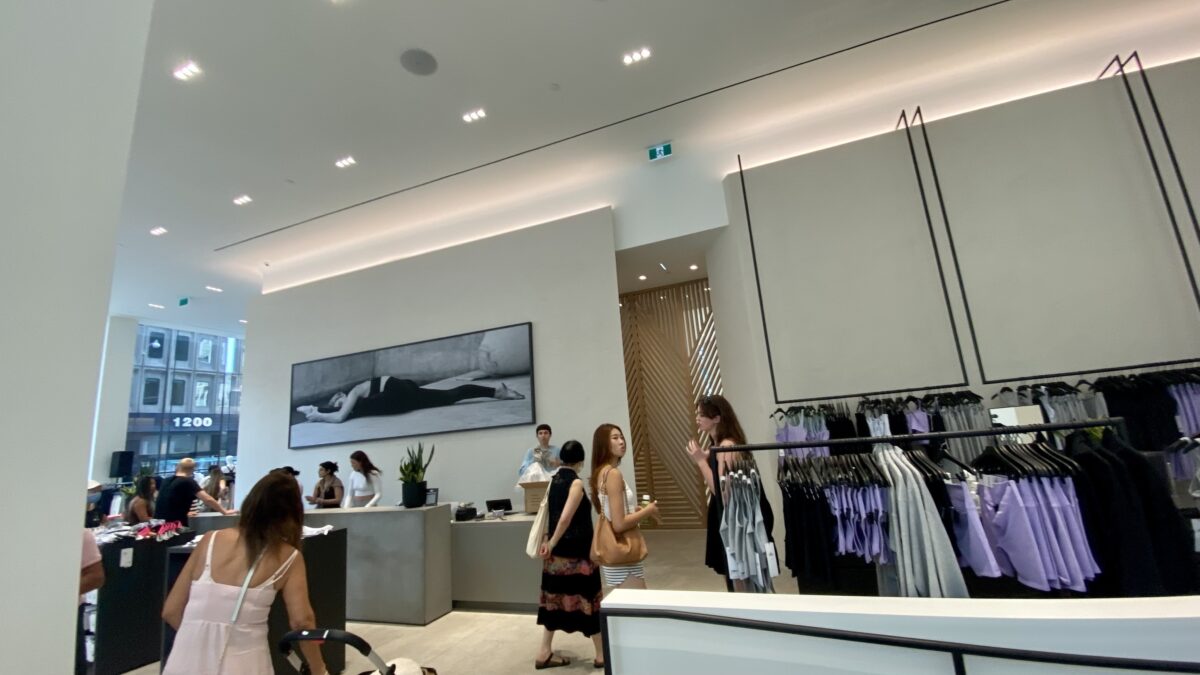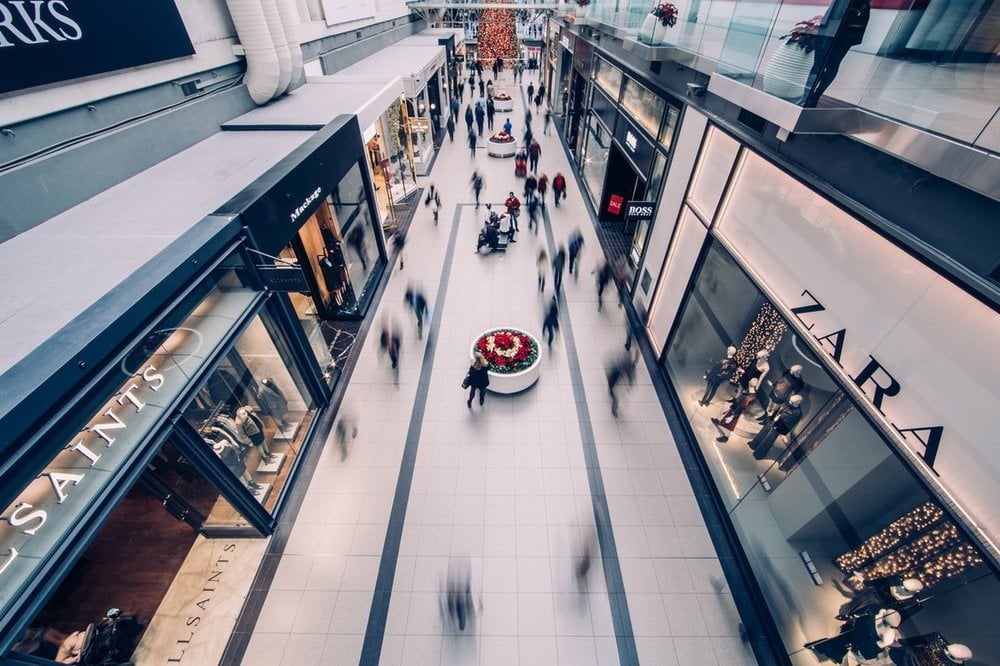
Black Friday at Kate Spade (CF Toronto Eaton Centre) Photo by Dustin Fuhs
Black Friday has become the busiest shopping day of the holiday season for Canadian retailers.
According to Moneris, Canada’s largest provider of mobile, online and in-store payments, Black Friday last year overtook the Friday before Christmas with the most retail sales. And yes, it’s become even more popular than Boxing Day.
Peter Goldsztajn, Director of Corporate Data Analytics for Moneris, said Black Friday has definitely taken the lead over the last few years.
Old Navy at CF Toronto Eaton Centre (Photo by Dustin Fuhs)
“Last year, given all the restrictions and capacity limits (due to the COVID-19 pandemic) and in certain regions complete lockdowns, it wasn’t I would say as popular but it was still the busiest day,” he said.
Peter Goldsztajn
“Moneris processed I think at one point 550 transactions per second. Although it was lower than prior years by about 100 transactions, which was probably related to the lockdowns and restrictions, it’s expected that this year that trend will continue. It’s hard to say how much more but I do anticipate it’s going to be a rebound for sure.
“We can actually observe the busiest shopping time between 2 and 4 p.m. Eastern. It’s essentially when we record pretty much consecutively as the busiest shopping time.”
Goldsztajn said Moneris is expecting a spike in activity this year over last year and the company expects apparel, household goods, mass merchandise and specialty categories to top the lists of items purchased this Black Friday. Moneris is also forecasting consumers throughout the holiday season will seek experiences and experience-related gifts to enjoy with loved ones.
Indigo at Bay & Bloor (Photo by Dustin Fuhs)
He said that Black Friday has overtaken Boxing Day and much of that has to do with the timing of the event.
“I think a lot of people like to take advantage of the schedule essentially of the day and how it lands before the holidays to capture some of those sales for gifting,” said Goldsztajn.
Moneris is also expecting transaction levels during the peak of the Black Friday rush to be closer to pre-pandemic levels, now that capacity limits at stores are lifted in most provinces across Canada and consumer confidence is higher.
“Another interesting thing here is that retail experts caution on the availability of toys and apparel. Because of limitations due to the impact of COVID ongoing globally in regards to the availability of products, we definitely recommend shopping earlier,” he said.
“It’s much more important. If you’re looking for that hot new toy, then you should probably get out there earlier and if you can’t get out there earlier, a good alternative to shopping is gift cards.”
He said that over the past year average transaction sizes for shopping have increased.
“People are spending more with a lower amount of visits,” added Goldsztajn. “We do expect a little bit of that as well. That trend has been continuing throughout the latter half of 2020 into 2021. I don’t see that trend slowing down yet.
“People are still focusing on experience-based activities. That trend has been pretty vivid throughout the pandemic . . . We’ve seen a large lift this year in areas like movie theatres, going out, triple digit growth. That trend seems to be very much aligned with the rebound and the recovery from COVID. That’s going to be an interesting trend to watch, especially over the holidays.”
The ongoing COVID-19 pandemic has presented a challenging time for the retail sector in Canada but for the Hillside Centre in Victoria it’s also been an exciting time as the popular shopping centre has welcomed several new retailers and will be introducing two retail giants in the near future.
Kerry Shular, the Centre’s General Manager, said the high profile additions will include a 150,000-square-foot Walmart as well as a 15,000-square-foot Dollarama.
“We have quite a few new retailers actually. The last year and a bit has been pretty exciting for Hillside shopping centre. Like everyone we lost the Sears when they went bankrupt, and since then we have procured a new Walmart for Hillside Centre which is currently under construction. It will open in May of 2022. So that’s very exciting for us,” she said.
Hillside Centre in Victoria, BC
“We’ll also be welcoming a new 15,000-square-foot Dollarama within Hillside and that will open in the Spring of 2022. In the last year, we’ve welcomed a number of smaller retailers including an amazing independent BC store called BC Shaver + Hobbies.”
Shular said having Walmart and Dollarama as part of the mall’s offering is going to be a huge draw for the property.
“We know that the Walmart at the Uptown shopping centre in Victoria is in the top 10 in Canada in terms of performance for them. We also know that it’s wholly hated for its parking. When they come to Hillside, you can pretty much drive right up to the front door. I think it’s going to be huge for Hillside and for the neighbourhood and for our customers.”
The Centre, which opened in 1969, is close to 590,000 square feet at the corner of Shelbourne Street and Hillside Avenue. It has about 110 shops and services including Marshalls, SportChek/Atmosphere, Canadian Tire, Shoppers Drug Mart, Thrifty Foods and Bolen Books. The property is owned by the BentallGreenOak Prime Canadian Property Fund.
Hillside Centre in Victoria, BC
It also has a 600-seat food court.
The shopping centre is primarily on one level but a newer section was added in 2013 that is two levels on the south end of the property encompassing a two-level Marshalls and a two-level Sport/Chek on that end.
The first OceanWall in Canada, a 12’ x 7’ screen, is located in the upper food court. It offers amazing footage of the Salish Sea with all its incredible inhabitants including orcas, humpbacks, and harbour seals.
Other new retailers recently added to the mall include Local Pizza, Noodle Fans, CinnZeo, Out of Bounds, Ronsons. TELUS has also done a major expansion by doubling the size of its location.
Telus at Hillside Centre in Victoria, BC
“Like any other shopping centre, we were closed for a period of time. Not completely closed. The mall never closed but most of the retailers closed between March and May of 2020 and we’ve seen a slow recovery since then,” said Shular. “I would say that now our traffic is equal to or very close to what it was pre-COVID and depending on the retailer what you do and how you do it some have fully recovered and some are still in recovery mode. But Hillside has actually fared better than most retail centres I would say.
“We have one of the largest Canadian Tires in Western Canada and again he’s generally in the top 10 in terms of performance across Canada. We’ve got a really good Shoppers Drug Mart. We don’t see their numbers but my understanding is that he’s very happy. Thrifty Foods has just completed a major renovation of their store. It’s like walking into a brand new store.
“With the addition of Walmart and Dollarama and the smaller retailers, we hope that it’s very well positioned for continued growth into the future and we’re pretty happy with where we are.”
Merchant preparations for the upcoming holiday shopping season – the busiest period on the retail calendar – are now well and truly underway. Retailers and brands everywhere are tweaking and enhancing every part of their operations, focussing efforts on ensuring the right merchandise, an engaging and welcoming store and superior customer service. These preparations spark an excitement in most consumers as they witness storefronts and shop windows, signage and décor transform to reflect the special time of year. However, according to Ray Abramson, COO at operations SaaS provider MeazureUp, as exciting as it might be, the holiday shopping season can be equally daunting for store operators and managers charged with coordinating all of the tasks that require execution and optimizing their staff to the best possible effect.
“The upcoming holiday shopping season is going to push a lot of retailers a lot harder than in the past,” Abramson says. “Now that the COVID-related restrictions and protocols are being lifted, there’s an anticipated upsurge in physical store traffic as consumers everywhere release a pent-up demand for experiences. A current labour shortage is placing additional pressure on retailers and brands with respect to the number of customer-facing store employees that they might have on staff. During a normal shopping season, retailers are usually adding seasonal workers to help them get through the busiest period of the year. And this season, they’ll likely be leaning even heavier on seasonal employees who often don’t possess a full education or awareness of the operational requirements of the brand or the key pillars that they need to conduct themselves by to meet the standards of that store. In order to equip store employees with the information they need to perform their jobs to the greatest effect, and to make their jobs easier, retailers need to leverage the right technologies.”
Increased in-store efficiency
Image: MeazureUp
One of those technologies is MeazureUp’sDailyChex digital checklist solution for store managers and their staff. Available as an API solution, the digital checklist is easily integrated into retail technology stacks, benefitting retailers of any size. The solution allows store managers to automate routine tasks, capturing and recording their completion and quality, empowering them with a complete view into the operations of the store. And, because the digital tool also provides store staff with the information critical to understanding their roles and responsibilities, it enables them to execute faster with a lessened learning curve. In addition, the data that’s generated through the checklist solution is in real-time, arming store operators with vital insights to inform strategy and improve performance. It’s a digital solution that provides retailers with the ability to ensure much-needed consistency and efficiency. And, it’s one that Abramson says helps remove any uncertainty for store managers, allowing them to reallocate their focus and efforts.
“Our daily checklist tool allows store managers and staff to conduct assessments on a daily basis,” he asserts. “They all know exactly what they need to be doing, taking a lot of the guesswork out of the equation. Nobody likes ambiguity or vagueness when working in a frenetic store environment. With this tool, every member of the store staff can log in to find out exactly what they’re responsible for at the store each day. This type of accountability among employees not only ensures that their jobs are done properly and to the best quality possible, it also increases engagement among staff, raising their collective pride concerning the work they’re doing and the experience that they’re creating for the brand and customer.”
Supporting consistency across networks
In addition to supporting the efforts of store managers and their teams, MeazureUp’s digital checklist solution also equips regional and district managers with the means by which to ensure consistency across multiple store locations. MeazureUp’s AuditApp allows brands to track their insights and performance checks, streamlining their efforts and reducing the amount of manual recording required when doing their jobs. It’s a layer of the technology provider’s offering that Abramson says is proving invaluable to district and regional managers, and one that he believes can help transform the way retailers and brands execute store and performance audits going forward.
“When district managers visit their stores, they’re able to track everything digitally with our tool.,” he explains. “This means that they save a lot of time. Without AuditApp, they’d be required to sit down at the end of a day of auditing to manually develop all of these reports for each individual store and then try to consolidate the data in order to recognize inconsistencies across their networks. We make it incredibly easy for district managers to record, track and organize all of the data efficiently and in real-time. As soon as an audit is complete, everyone, including the stores, sees the data. Because of the short feedback loop involved and how quickly the information is shared, all stakeholders can better understand where the strengths and weaknesses of those stores are, how they’ve been trending on a category-by-category basis, supporting consistency across stores.”
Enabling data-driven decisions
Image: MeazureUp
Abramson goes on to explain that, in his estimation, the collection, tracking and correct dissemination of data is becoming crucial to the enhancement of retail store and network operations. However, he also recognizes that the use of the data that MeazureUp’s DailyChex generates has the potential to go far beyond supporting the performance of stores, providing insights that can be leveraged to inform decisions and achieve further growth for retailers and brands.
“It’s very difficult for any retailer or brand to grow without developing a plan to scale,” he says. “For any business that wants to grow and add locations, they want to be able to put data and information at everyone’s fingertips as quickly as possible. It tends to eliminate timelapses, gaps and blind-spots, which is sometimes the difference between success and failure. For the retailers not currently leveraging data, they really need to jump on that curve. And they need to do it earlier rather than later. The use of data often helps organizations transform their cultures. When there isn’t accountability and there’s no push for consistency, an inordinate amount of work is required to achieve the same results that technology- and data-enabled solutions can help retailers arrive at in a fraction of the time.”
Streamlining operations
As the 2021 holiday shopping season quickly approaches and retailers and brands everywhere look to enhance the service and experience that they offer, many are exploring digital tools as a way to achieve these improvements and upgrades. It’s a shift in thinking among the industry, one that’s being driven by consumer behaviour and the accelerated digitization of retail and the world around us, that’s yielding impressive results for some. And, according to Abramson, it’s a shift that MeazureUp will continue to support as the company maintains its commitment to helping retailers flourish and grow.
“Because the technology and solutions that we develop are not represented by one out-of-the-box example, our digital checklist tools are completely customizable, providing retailers with amazing flexibility to build their own solution. We’re extremely focused on ensuring that our clients are equipped with the digital tools that will help them instill greater organization, consistency and efficiency into the operations of their stores, whether they operate a single store or an enterprise of 1,000 locations. And, of course, as the holiday shopping season approaches, as we move away from the pandemic environment and closer to a post-pandemic world, we’re looking forward to continuing to help retailers achieve their goals and targets through optimized and streamlined operations.”
Kingsway Mall in Edmonton has launched the unique new concept UNITE as a collaborative marketplace and business incubator.
The first-of-its-kind retail concept in the Alberta city is a space for makers, creators and designers to follow their dreams and bring their business to a larger audience – the one-million-square foot mall owned by Oxford Properties.
UNITE by TMK at Kingsway Mall
“The pandemic has created unique challenges for local business owners, but it has also created opportunities for us to look at things differently and collaborate on innovative solutions to overcoming those challenges,” said Katrina Petryshyn, owner and founder of The Makers Keep and UNITE.
Katrina Petryshyn
“I have seen first-hand the countless benefits a collective, supportive environment can have for entrepreneurs, and I am excited to continue to expand this concept of collective retail with the launch of UNITE.”
The new concept has 85 vendors in place in about 6,700 square feet of space in a high visibility spot in the mall – the former location of Victoria’s Secret.
Petryshyn said UNITE is a collaborative effort in one showroom.
“Essentially it’s a shop-in shop and we wanted to mimic the greats like Hudson’s Bay and how they would put in stores inside their store,” she said. “So it is an incubator for small businesses looking to scale up and potentially have their own retail storefront.”
UNITE by TMK at Kingsway Mall
UNITE will carry a wide array of products, ranging from jewelry to clothing, giftware to food. With the capacity to house numerous vendors at any given time, brands will be able to set up their own “shop within a shop”, making their designated retail areas their own with custom signage and displays.
The new indoor hotspot will operate as a multipurpose event space, tasting bar, and marketplace, showcasing brands from the community. UNITE will be fully licensed, carrying a selection of local food and beverage, some of which will rotate monthly. As more than just a shopping destination, UNITE also plans to host a variety of different events, workshops, educational programming, and social engagements.

Kingsway opened in 1976. UNITE is located on the second level.
“The way we structured the setup is when we went on the hunt for vendors, we put together a presentation that gave them different options to get involved,” said Petryshyn. “We wanted it to be accessible to anybody. So we had three different terms. One was the one-month pop-over. We did six months and we did the full term. And for now our full term was for one year.
UNITE by TMK at Kingsway Mall
“We offered that to vendors along with different financial fee structures as well. Most of the vendors we currently have in there are with the six month or the full term lease. We have not that many on the one-month turnover but we are hoping to rotate vendors in and out. So the idea is that once a vendor’s completed their term we’ll bring in a new person.”
If vendors move on and want to open their own space, UNITE will give them some guidance.
The unique feature with UNITE is it has eliminated the overhead for vendors and the staffing issues. There is a central staff that works the space. They’re trained in all of the brands. A customer can shop at all of the different vendors and pay at one central cashier.
“We have a system where our vendors can log in on the back end and view their sales and their inventory so they can still be participating in real time on what they need to stock up with or what their sales are at,” said Petryshyn.
UNITE by TMK at Kingsway Mall
Lindsay Botha
“We just do it all under one system so that there’s a lot of headache removed there for the vendors and it just makes it easier for them to participate. They don’t have to worry about having to be there all the time or worrying about a staff member calling in sick. We take on that worry for them.”
Lindsay Botha, Kingsway’s Specialty Leasing Manager, said Kingsway is dedicated to championing local entrepreneurs by providing the resources and opportunities needed for them to succeed.
“We definitely noticed over the last I think 15 to 18 months there’s been a lot more self-starter businesses in the Edmonton area – people starting their own little side hustles whether they’re full time and starting small businesses on the side. So we’ve definitely seen a change and an opportunity,” said Botha.
“We wanted a seven-day market really and a seamless experience for both retailers and shoppers alike.
“On top of the 85 vendors that it’s holding it can also accommodate a rotating brewery or distillery and an eventing space as well.”
UNITE by TMK at Kingsway Mall
Botha said Petryshyn has an established reputation in the local business community from her existing retail location with The Makers Keep.
“She even has a waiting list of people to get in right now,” said Botha.
“I think it’s appealing for retailers that are either online or home based or those that are just not ready to scale their business yet. They don’t need to staff their space. They have all the support they need with opening up their first bricks and mortar business. So it’s really, really easily accessible for them to transition into the bricks and mortar landscape for the first time.
“There’s always opportunity for local business. It’s always been at the forefront of our minds. Kingsway is very much about the entrepreneurial spirit. That’s always been a thing for us. It’s always going to be a thing for us.”
UNITE by TMK at Kingsway Mall UNITE by TMK at Kingsway Mall UNITE by TMK at Kingsway Mall UNITE by TMK at Kingsway Mall UNITE by TMK at Kingsway Mall UNITE by TMK at Kingsway Mall UNITE by TMK at Kingsway Mall UNITE by TMK at Kingsway Mall
It also found that BFCM shoppers plan to spend $542 over the long weekend, up from an average of $481 planned in 2020.
Hudson’s Bay Queen Street (Photo: Dustin Fuhs)Solmaz Shahalizadeh
Solmaz Shahalizadeh, VP Data Science and Engineering at Shopify, said people have no hesitation to go shopping this year compared to their feelings a year ago. Part of the reason is the widespread vaccinations for COVID-19.
“People have gone out of that survival mode,” she said, as people are more mobile and thinking about gifts for their loved ones as well as buying things for themselves.
“We’re also seeing some uptick in economic recovery which means people have more disposable income to spend on gifts and things for themselves as well this year.”
And that’s good news for all the merchants out there who have had to navigate the challenges of the pandemic for more than a year and a half.
Some of the key findings from the survey include:
Half of Canadian consumers planning to participate in BFCM will be shopping on Black Friday and Cyber Monday (50 per cent), with 32 per cent planning to shop more on Black Friday and 18 per cent planning to shop more on Cyber Monday;
Overall, 82 per cent plan to participate in Black Friday and 68 per cent in Cyber Monday;
Men plan to spend significantly more than women ($669 vs. $421), as are those with children at home ($683 vs. $461 no children at home);
A large majority of Canadian consumers planning to participate in BFCM say that COVID-19 will impact their shopping (84 per cent): Nearly two-thirds (60 per cent) plan to increase their online shopping;
34 per cent of online BFCM shoppers mentioned wanting to avoid shopping in-store because of COVID-19, significantly less compared to last year (51 per cent);
Canadian BFCM shoppers are still more likely to shop online than in-store. Overall, 89 per cent of Canadian BFCM shoppers plan to shop online and 60 per cent plan to shop in-store;
39 per cent of BFCM shoppers plan to shop online only (down from 52 per cent in 2020);
50 per cent plan to shop online and in-store (up from 45 per cent in 2020);
10 per cent plan to shop in-store only (up from 3 per cent in 2020);
Canadian BFCM shoppers main reasons for shopping online during BFCM are: want to take advantage of online sales (51 per cent), save time (46 per cent), get better prices online (45 per cent) and take advantage of free shipping (44 per cent); and
The top categories Canadian BFCM shoppers plan to purchase are: Electronics (47 per cent); Clothing/footwear/accessories (46 per cent); Toys/games/hobby supplies (31 per cent); and overall, the top category in terms of total spend is electronics (31 per cent).
Shahalizadeh said the spend in the electronics category is something that has been seen consistently over the years.
“It is one of those items and categories that has a lot of discounts happening during Black Friday/Cyber Monday. So it’s always one of those categories that consumers are planning to spend quite a bit during this weekend,” she said.
She said the trend toward more consumers shopping online has been around for the past few years.
“Part of it is the convenience of shopping online and even in the pandemic days it’s pushed all the generations, older generations, also to come online so it’s not limited to a particular demographic anymore,” said Shahalizadeh.
“The other thing is that with online shopping their options for personalization and better product discovery, things for example we are doing to help our merchants really get in front of the right customers, and this again has resulted in the shift towards online shopping.”
The development of sustainable practices that can help reduce a retailer’s negative impacts on the environment and curb their contribution toward climate change has long been a focus for many operating within the industry. The consumer, too, has increasingly grown environmentally-conscious through the years, expecting more from their favourite brands when it comes to their commitment to the health of the planet. In fact, it’s a sentiment that’s been accelerated by effects of the COVID-19 global pandemic, intensifying and rising in importance amid a reassessment by Canadians concerning their values and beliefs. As a result, the practices of retailers everywhere are coming under sharper focus. And, as Joe Solly, Partner, Sustainability & Climate Change, Deloitte Canada, points out, it’s a heightened awareness and concern that’s driving positive change throughout the retail value chain.
“There isn’t a retailer anywhere that intends on posing a negative impact on the environment,” he says. “By default, however, as a result of the expansive supply chains that most retailers rely on, their contribution to the environment and climate change is adverse. In fact, 90 percent or more of most retailers’ overall emissions accountable to their business activities or enterprise come from their supply chain. Virtually every product within a grocery store, for example, has a carbon footprint. As a result, each supply chain partner within a retailer’s value chain has a significant contribution to those overall emissions. A retailer that operates its own trucks, fleet, buildings and stores can directly control those aspects of their business through renewable energy, energy reduction initiatives, fuel switching, electric vehicles and a number of other things. But, it’s the many different components and partners within the supply chain that retailers are challenged to improve.”
Reducing negative impacts
Exacerbating the issue of emissions within the supply chain, explains Solly, is the fact that the market operates within a global sourcing model in which many products travel a significant distance to arrive at their destinations. This model, combined with the fact that much of the planet is still transporting goods via combustible engines, trains and road logistics, renders the emissions created as almost unavoidable. In addition, the sheer nature of the North American economy, one which tends to place greater emphasis and focus on buying and selling rather than creating products that can be kept, maintained, repaired and reused, only worsens the issues around emissions and their detrimental effect concerning climate change. And, although the challenges that arise as a result of these factors and influences seem almost innumerable, Solly believes that there are some meaningful improvements that retailers can achieve by simply assessing their value chain, identifying where their negative impacts can be reduced.
“Because much of the emissions and impact that retailers are accountable for are found within their supply chains, they need to focus on developing strong partnerships with their suppliers,” he asserts. “They’ve got to work closely with them, because the emissions of their supply chain partners are their emissions as well. And, when they examine their supply chain, many are beginning to recognize the value in adopting a local sourcing and manufacturing model where appropriate in order to dramatically reduce the length of the supply chain and the distance a product needs to travel. These things can help retailers address some of the challenges they face while also promoting and supporting their local businesses and economies.”
The circular economy
Solly goes on to explain that there are a multitude of tweaks and changes, large and small, that retailers can make to their operations and supply chains that can help improve their impact on the environment. However, he points to the development of the circular economy as one of the more significant movements within the industry posing perhaps the greatest benefits to the planet. In fact, it’s a movement that’s being driven by consumer sentiment, as evidenced by findings within a recent Deloitte report titled Consumer Business: Merging climate change and business strategy to benefit the bottom line. According to the report, consumer attitudes toward environmental, social and governance issues have risen, with concern around reducing the use of single-use plastics (59%) and climate change (56%) topping the list. In addition, 42 percent of consumers surveyed for the report cited to have changed their consumption habits over the past year as a result of their environmental concerns. They are consumer concerns that Solly recognizes as critical for retailers to address, and an area of opportunity for them to focus more holistically on the construction and use of their products.
“Creating a more circular economy is a vital need,” he stresses. “We collectively put a lot of valuable materials into landfills every year such as plastics and unseparated materials. Some discarded products are separated and dismantled as much as possible, but there are often so many layers of various substrates, plastics, foams, leathers and everything else that some other product can’t be reused or recycled at all. Municipalities everywhere are struggling to understand how they deal with all of the materials that are being discarded. It’s leading many to explore the ways in which we can keep more materials in circulation, where waste materials from one business or home perhaps becomes input to another, and the profound benefits that can be achieved as a result. And the goal for many now is to become a business of zero waste in the hopes of one day negating the need for landfills. To execute on this properly, however, businesses need to tweak their design thinking. They need to focus on their products and the ways in which they can make them more modular and reusable, extending the length of their life.”
Barriers and constraints
In addition to enabling retailers and other businesses to do the right thing, the report also indicates that environmental initiatives aimed at reducing their negative impact will also win over the hearts and minds of their consumers as well. With respect to consumer expectations of companies when it comes to their environmental initiatives, 77 percent of survey respondents said that they think CEOs of consumer companies should be more engaged in recycling and reusing materials to help support a circular economy, while 75 percent expect executives to champion reductions in carbon emissions and the production of single-use plastics. And, it seems that some CEOs are listening and developing initiatives that are lending to increased momentum around the development of a circular economy. Ikea, for instance, recently introduced its ‘Sell-Back’ program in which the retailer offers in-store credit for the return of its used furniture and other items. And Walmart, which has long been a leader in the area of sustainability, launched a goal to become a regenerative company, decarbonizing its global operations and targeting zero emissions by 2040. Despite the impressiveness of these initiatives, however, Solly recognizes barriers that remain in the development and rollout of similar actions throughout the industry at large.
“There are still some inherent impediments and constraints when it comes to the development of these types of initiatives,” he says. “We are ultimately a make, use and dispose society in which product is short-lived. And this is a problem within the current manufacturing system in which there’s almost a design obsolescence. What’s required is stronger regulation in order to enforce longer warranty periods on consumer products in order to keep them in circulation longer. And, when product breaks or malfunctions, retailers need to be offering really good repair options that are affordable. There’s also a massive need for the introduction and availability of more ‘take-back’ programs in order to increase accountability on retailers and their manufacturing partners with respect to the life of their products. These improvements, however, are currently counterintuitive to, and conflict with, the nature and design of commerce in our society which is linked heavily to shareholder return. This mindset and approach need to be replaced by a focus on stakeholder return and value, instead, which is going to require retailers to think differently about their operations and the impact of their supply chains with downstream thinking in mind.”
Starting at the top
Although Solly admits that the required shift in thinking has not yet occurred at a substantial enough rate to proclaim real progress throughout the industry as a collective, he says that it’s underway. Driven by a thorough examination and assessment of an organization’s operations, the risks that they pose to the environment and society, many are developing and enhancing their strategic direction with respect to reducing their negative impacts on the world around us. And, he says, it’s a direction and vision that needs to start at the top in order to cultivate the proper awareness throughout a business and improve the future condition of the planet and the health and wellbeing of everyone on it.
“In order for environmental initiatives to gain traction, the board and executive team members need to be educated concerning the impacts of their operations and supply chains, including all of the risks and opportunities that are involved. And, in turn, retailers have got to educate their consumers and measure the success of their initiatives, understanding their baseline to most effectively set targets and goals for their businesses. All of this requires innovation, which doesn’t mean simply coming up with a smart solution or two. It’s a program, accompanied by governance, that consistently drives new ideas and ways of thinking. But, in the end, issues around climate change and carbon emissions have got to be tackled by retailers with a holistic supply chain approach, bringing it to the centre of the business, making sure that the potential environmental impact of every aspect of their operation is considered every step of the way, from sourcing to shelf. The retailers that act the fastest on these issues, building a high level of trust with their customers, lowering their costs and finding new operating ways that are profitable, are going to be the ones that will win going forward.”
Shoppers Drug Mart PC Optimum (Photo: Dustin Fuhs)
A new consumer survey finds that loyalty program usage has not yet returned to normal in Canada.
The fifth edition of the LoyalT study, by Leger and R3 Marketing in collaboration with Dialog Insight, said that in 2018, 87 per cent of members regularly presented their loyalty cards. Since the pandemic, 69 per cent have done so.
Although Canadians are members of more programs (13.5 programs in 2021, compared to 10 in 2020), only 53 per cent of them are actually used, explained the study.
LoyalT 2021 Ranking
“Loyalty programs are being challenged by new consumer behaviours as well as the impact of COVID-19. Loyalty programs are maturing, and only the best will remain relevant and profitable,” said Hans Laroche, Partner at R3 Marketing.
Hans Laroche
“In terms of frequency of shopping we still don’t see a return to the normal. What the retailers are seeing in terms of frequency, we’re not back to the level that we had before the pandemic and it shows in loyalty programs because the frequency dropped.”
He said the reason for the increase in more programs is because consumers have changed brands and retailers over the last two years.
“It’s also easier to join a program than it was like five or six years ago or 10 years ago when you had to fill out a form. Now it’s mainly with the mobile app, it’s online, and they just ask for your email. So it’s quick,” added Laroche.
Image: Proxi Extr
Anne-Marie Delisle, Senior Research Director at Leger, said while consumers are going shopping less frequently than prior to the pandemic their baskets are bigger.
Anne-Marie Delisle
“They spend a lot. They’re doing like shopping lists. That is still possible to see this kind of behaviour since the pandemic. They are using their cards. Last year we saw some people that were saying that they were not showing the cards, they just wanted to pay and get out of the store quickly. Now, they’re using a little bit more their cards. Using their hands. They’re not afraid like last year to show their card to get points or maybe they have the cards on their phone,” said Delisle.
The LoyalT study said there is a direct correlation between content personalization and the program’s ability to modify the purchasing behaviour of its members (more frequent visits and annual purchases). The same is true for the correlation between the perceived generosity of the program and the impact on changes in purchasing behaviour.
The report said the generosity of a program is based on two dimensions: the accumulation of points on total purchases (base points) and the possibility to obtain additional points related to engagement (using the mobile app, participating in a contest, writing a review or giving a rating). Therefore, it is becoming essential for a brand or retailer to understand its customers and their purchasing behaviour, and to use this data to personalize the content offered, which, when relevant, adds value for members, added the study.
Image: Chipotle Loyalty Rewards
“We’ve known this for many years. In fact, what we’ve known is the two main factors that will drive behaviour change the first one is the generosity of the program. So the capacity to accumulate points rapidly and to exchange points rapidly,” said Laroche.
“But also the personalization and the relevance of the content. Those two factors are directly correlated to the change in behaviour. But what is interesting is they have the same weight. So now content and relevance of content and personalization is as important as generosity in terms of the ability of a program to increase your frequency or concentration of purchases.”
Laroche said high frequency retailers tend to have better results in the LoyalT study – gasoline stations, pharmacies, supermarkets.
“But we’re seeing now more and more for example restaurants and specialized restaurants like McDonald’s, Starbucks and also we’re more and more traditional dining restaurants like Chipotle. Those programs are getting to be more and more popular,” he said.
Laroche said three factors drive the loyalty score – the ability of a program to modify the behaviours; the engagement into the program; and the ‘affection’ index measuring how much consumers like the program.
The 10 Best Loyalty Programs in Canada according to the study are:
Chipotle Rewards
Proxi Extra (Harnois Energies)
PC Optimum (Loblaws)
Milliplein (EKO)
Starbucks Rewards
Irving Rewards
Piece of the Pie Rewards (Domino’s Pizza)
Inspire (SAQ)
PC Optimum (Esso)
Metro & moi (Metro)
Some highlights of the study include:
47 per cent of members primarily use a mobile device to view program communications. This is a five per cent increase from 2020;
22 per cent of 35-54-year-olds say they often participate in a program’s gamification activities. This is similar to 18-34-year-olds, 26 per cent of whom participate;
44 per cent of respondents are members of Amazon Prime. In two years, the program has seen a growth of almost 20 per cent in membership.
Canadian-founded restaurant chain Tim Hortons is releasing a limited edition fashion drop as part of the collaboration with Canadian singer and multi-platinum international recording artist Justin Bieber. Retail Insider was provided images to be one of the first to showcase the new line.
The November 29th launch will coincide with a limited-edition selection of “Timbiebs” Timbits, which will debut with Chocolate White Fudge, Sour Cream Chocolate Chip, and Birthday Cake Waffle flavours.
Timbiebs is the first product launch in the partnership, which was announced last week, between the two Canadian icons. This will include new menu innovations and co-branded merchandise inspired by Justin’s fanatical love of the Tims brand.
Image: Tim Hortons x Justin Bieber
Hope Bagozzi
“Doing a Tim Hortons collab has always been a dream of mine,” said Justin Bieber in a statement. “I grew up on Tim Hortons and it’s always been something close to my heart.”
The merchandise will include a black touque, a brown corduroy-style fanny pack and a classic tote bag, all adorning the “Timbiebs” distinctive logo.
The brand has been able to work with Justin for the launch and has “been all-in on this partnership,” said Hope Bagozzi, Chief Marketing Officer for Tim Hortons, including filming a TV commercial for the Timbiebs launch.
“We had a lot of fun developing the line of Timbiebs merch that we know fans of Tims and Justin are going to want to have,” said Bagozzi.
Image: Tim Hortons x Justin BieberImage: Tim Hortons x Justin Bieber
“Justin knows exactly what our guests already love about the Tims brand and he’s helping us deliver new ideas that we know they’re going to love. We’re really looking forward to what’s next.”