

The financial decline of the Hudson’s Bay Company in the year leading up to its March 2025 bankruptcy filing has been laid bare in a confidential document obtained by The Globe and Mail. The internal memorandum reveals a steep year-over-year decline in sales, painting a dire picture of a company in freefall amid operational neglect, dwindling customer trust, and a collapse in leadership and investment.
The information memo, prepared in February 2025, shows that Hudson’s Bay’s total sales fell by nearly a third in fiscal 2024, dropping to $1.11 billion from approximately $1.65 billion the previous year. Even more staggering is the nearly 50% collapse in e-commerce sales, which dropped to $142 million from nearly $300 million in 2023.
“The compounding effect of store neglect, inventory challenges, and leadership turnover ultimately accelerated Hudson’s Bay’s downward spiral,” said retail expert Carl Boutet in an interview with Retail Insider. “It just kept getting worse.”

E-commerce Collapse Reflects Deeper Issues
The plunge in digital sales is emblematic of larger structural failures. Sources told Retail Insider that some online orders never arrived, communication with customer service was often inconsistent or nonexistent, and delivery timelines were missed. These issues drove even loyal customers away.
“We received numerous complaints from customers who had previously trusted The Bay’s online service,” said one source familiar with the retailer’s e-commerce operations. “They stopped shopping altogether after experiencing repeated delivery failures and silence from customer service.”
According to Boutet, there were likely severe disruptions in Hudson’s Bay’s logistics and third-party fulfilment networks.
“I suspect there were payment delays with 3PLs and other logistics partners,” he said. “If you’re not paying your shipping partners, they’re not going to prioritize your customers — or ship anything at all.”
Declining In-Store Experience Drove Away Shoppers
Issues were not limited to e-commerce. Many Hudson’s Bay stores had not seen renovations in years. Customers reported outdated interiors, broken escalators and elevators, inadequate air circulation, water damage, and — in some instances — stores closing due to overheated HVAC systems.
“Stores that had no music playing, had large sections closed off, and elevators out of service for months,” said one long-time customer who contacted Retail Insider. “It felt like they had just given up.”
These problems were compounded by a notable exodus of both senior managers and sales associates. The resulting lack of staff meant customer service suffered in stores just as it had online.
“It’s hard to sell when there’s no one on the floor,” said a former department manager who requested anonymity. “Customers would walk out because there was no one to help them.”
Marketing Cuts and Zellers Reboot Fizzle Out
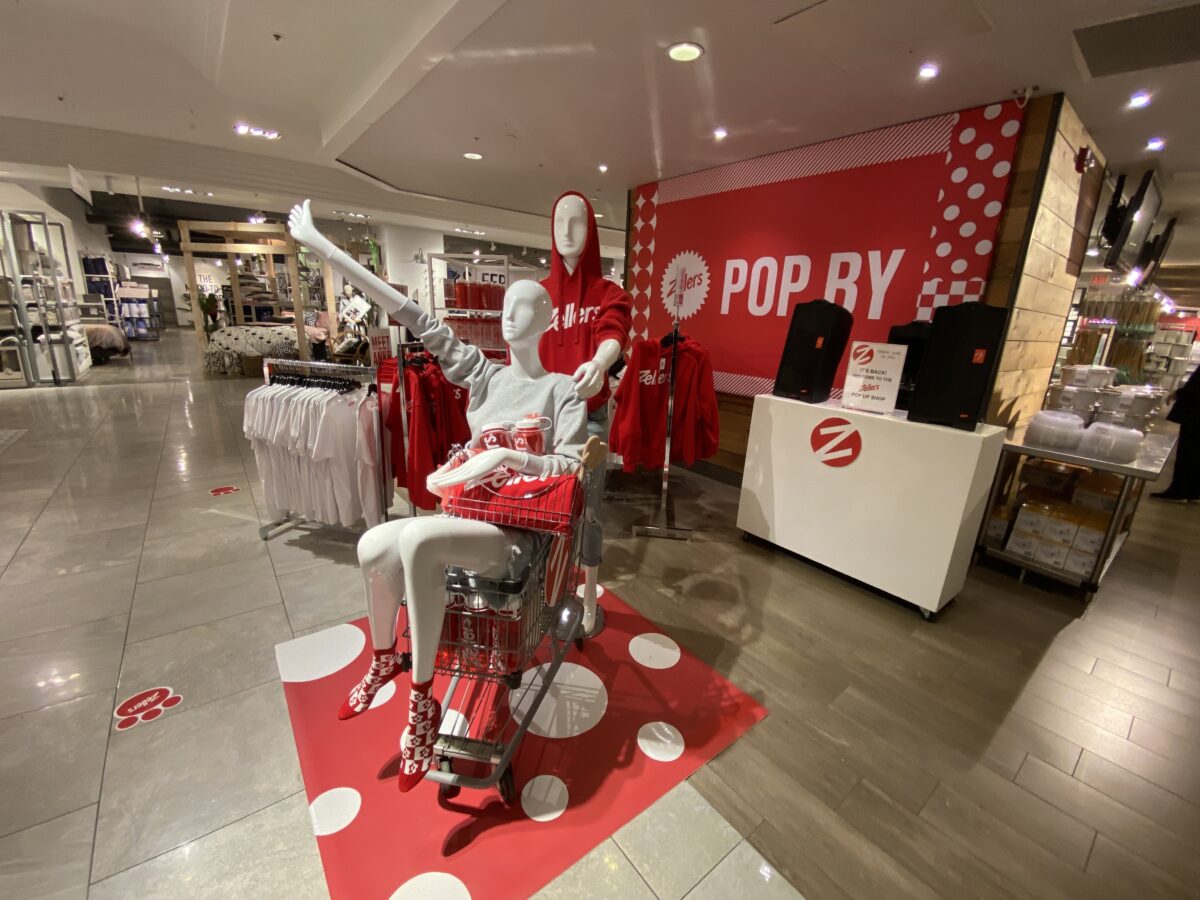
Adding to Hudson’s Bay’s troubles was a dramatic reduction in marketing efforts. Advertising budgets were slashed, including campaigns for Zellers, which had been relaunched as a pop-up concept within Bay stores starting in early 2023. While Zellers initially drew attention, its visibility faded throughout 2024.
“The Zellers concept had some initial traction,” noted Boutet. “But without marketing support or a compelling value proposition, it quickly became forgettable.”
Even signage and visual merchandising were inconsistent across stores. In some Zellers pop-ups, fixtures looked temporary and merchandise was sparse.
“It didn’t look like a serious retail initiative,” said one visual merchandising expert who toured multiple Zellers shop-in-shops. “It looked like a clearance section.”
Private Brands Offer Little Cushion
About 12% of Hudson’s Bay’s sales in 2024 came from its stable of private brands, which include Gluckstein Home, Distinctly Home, 1670, Black Brown 1826, and Zellers-branded goods. That’s a modest figure compared to rivals like La Maison Simons, whose private label offering makes up approximately 70% of its merchandise and contributes to better margins.
Boutet believes this underperformance signals a missed opportunity.
“Private label can be a huge strategic advantage, but it requires investment and merchandising depth,” he explained. “Hudson’s Bay didn’t have the resources or the focus to build strong in-house brands.”
A bright spot was the performance of the iconic Hudson’s Bay striped blanket, with sales reportedly surpassing $5.6 million this year so far. However, Boutet warned against overestimating its significance.
“It’s impressive, sure, but it’s not going to save a $1.1 billion business,” he said. “You’d have to sell a mountain of blankets to make a dent in that number.”
Sales Lag Behind Smaller Retailers
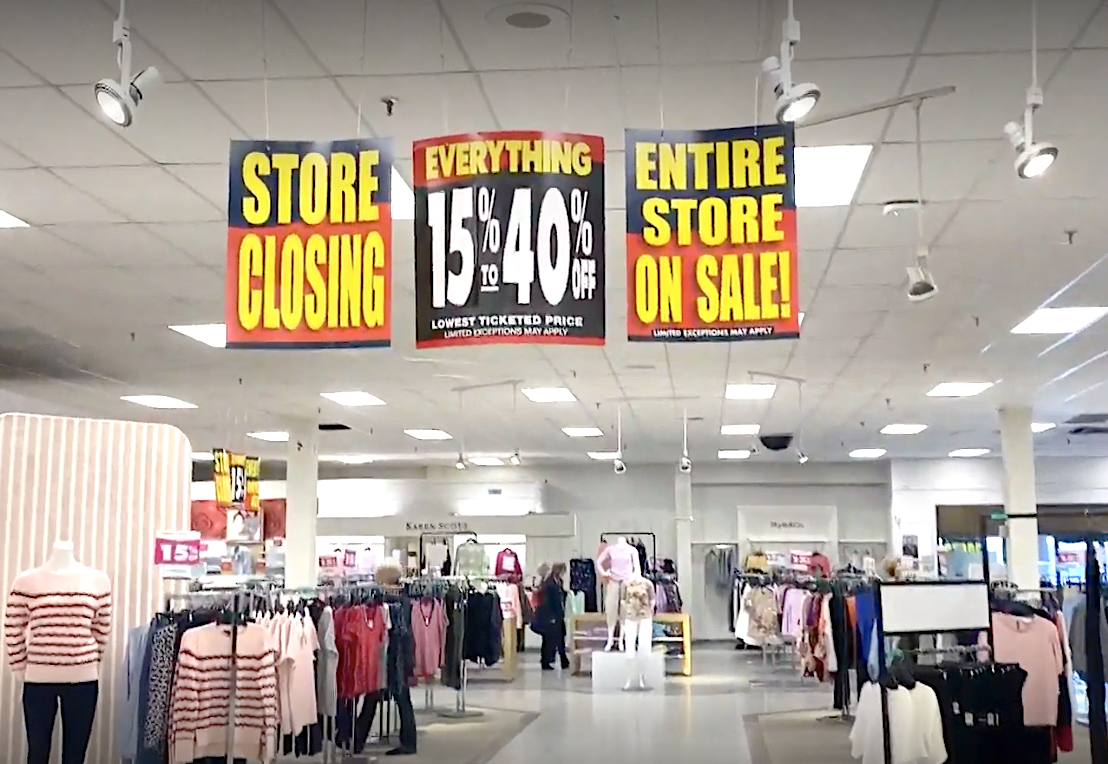
Despite operating more than 80 stores in Canada, Hudson’s Bay’s total annual sales are now roughly on par with Holt Renfrew, which runs just six stores nationally. In fact, some individual Bay stores are said to underperform significantly when compared to smaller retail tenants in the same malls.
“We’ve seen Sephora stores and others outselling the entire Bay store in the same centre,” said one retail landlord source. “That’s telling.”
Other competitors have outpaced Hudson’s Bay with more focused strategies. La Maison Simons, for instance, has grown to 17 stores with annual brick-and-mortar sales of approximately $430 million — nearly 40% of Hudson’s Bay’s 2024 revenue — despite being a smaller player and only expanding outside Quebec in 2012.
Simons’ e-commerce operation now surpasses Hudson’s Bay’s as well, with annual digital sales estimated at $220 million — nearly 55% higher than Hudson’s Bay’s online business in 2024.
Flagships See Sharp Declines
The leaked memo underscores just how far Hudson’s Bay’s store sales have fallen since their peak. In 2016, the Queen Street flagship in Toronto is said to have brought in approximately $220 million annually. Yorkdale’s Bay store was said to generate roughly $120 million per year.
Today, those numbers are likely dramatically lower, given the overall sales slump across the chain.
“It’s safe to assume that Queen Street and Yorkdale saw tens of millions shaved off their sales,” said retail analyst Carl Boutet. “The loss in traffic, combined with empty shelves, broken elevators, and no marketing, made even flagship stores feel neglected.”
Internal Challenges and Vendor Distrust
Another major barrier to a potential revival is vendor confidence. Multiple sources told Retail Insider that Hudson’s Bay had made promises to pay outstanding invoices mere weeks before its bankruptcy filing — promises that went unfulfilled.
“Retailers don’t forget that kind of thing,” said one apparel vendor. “They left a lot of people hanging.”
Boutet agreed that rebuilding trust would be an uphill battle.
“If you’re 90 days past due and still asking for inventory, that’s not a partnership — that’s desperation,” he said.
Proposed Turnaround Plan Falls Short
According to the memo, Hudson’s Bay proposed keeping six stores operational, alongside a renewed e-commerce effort. The company estimated it would require an $82 million investment in the first year to sustain these operations.
The breakdown included:
- $68 million in inventory
- $12 million in capital improvements
- $2 million in IT infrastructure
But Boutet questioned whether that amount would be sufficient, particularly given the condition of the three Quebec stores, none of which had been renovated in years.
“There’s no money in that plan for escalators, HVAC repairs, fixturing — let alone meaningful renovations,” he said. “And if they’re not investing in the store experience, why would anyone come back?”
The six stores reportedly lost $58 million in 2024. Even under the proposed turnaround, Hudson’s Bay projected a loss of $40 million in the first year.
“So really, the investment required is closer to $126 million,” Boutet pointed out. “That’s if you believe they can break even by year two — which is a big assumption.”
Real Estate May Be the Last Asset
As financial prospects fade, real estate remains the most valuable piece of the puzzle. Hudson’s Bay holds long-term leases — some as long as 118 years — at high-profile malls like Yorkdale in Toronto.
The memorandum floated the idea of monetizing these leaseholds, subject to landlord consent. But even that may prove challenging in a softening real estate market.
“Landlords are looking to densify,” said Boutet. “They may not be interested in propping up failing department stores — especially when they could build condos or bring in higher-performing tenants.”
Legacy and Unanswered Questions
As Hudson’s Bay seeks potential investors or buyers for all or parts of its assets, there remains lingering skepticism about its leadership. Some insiders have suggested that a different management team would be required for any viable future.
“You need a true leader to restore credibility,” one former VP said. “Someone like Bonnie Brooks, who had a vision and could execute it.”
With liquidation underway at most locations, questions still remain about the fate of the remaining stores and the brand itself. Some speculate that Hudson’s Bay could re-emerge as a smaller, more focused retailer or as a brand licensor leveraging its heritage.
Boutet is less optimistic.
“There’s nothing new in this latest reporting that gives me much hope,” he said. “Apart from the $5.6 million in blankets — and even that won’t come close to saving them.”










Do we know the proportion of stores that were profitable and which ones ?
I was told 20-25 stores were profitable — I don’t have a list, though many I’m sure many locations could be guessed.
Hi Craig – long time reader – Thanks for keeping us updated on the latest HBC news!
Do you see any potential buyers for Hudson’s Bay? Could any one buy it for the tax losses like how Sears bought Eaton’s?
As for the drop in the ecommerce site, do you think it is linked to the poor rollout of the rewards app and the removal of thebay.com from referral sites such as aeroplan estore, airmiles, ratuken? It would be great to get insight to how these referral sites work as it seems like a large cost for the merchant to drive sales.
Thanks!
I’m a Canadian who really wants Zellers back as a full store with the Restaurant as well.Let me know what I need to do to get our beloved store back all across Canada.Zellers will return one way ir another
they pulled any cash for them to split hudsons and used money to create saks global to buy neimans