

Canada’s women’s plus-size apparel market is entering a period of structural change, driven by new brand entry, evolving distribution models, and intensifying competition across price tiers.
According to Trendex research’s Q1 2026 Canadian Apparel Insights report, the Canadian plus-size market reached approximately $4.4 billion in 2025, positioning it as one of the most significant and resilient segments within the broader apparel landscape. At a time when overall apparel growth is forecast to slow in 2026, the plus-size category is becoming more competitive rather than retreating.
The most visible catalyst in this shift is Lane Bryant’s entry into Canada through an exclusive partnership with Walmart Canada, marking a new phase in how international apparel brands are choosing to access the Canadian market.
A Market Long Dominated by a Few Players
Historically, Canada’s plus-size apparel market has been shaped by a relatively small group of established retailers, with Penningtons, now operating under the PENN. banner, and Walmart Canada emerging as the dominant national players. Together, these companies have defined much of the accessible and mid-market plus-size offering across the country over the past decade.
PENN., which operates approximately 86 stores nationally, continues to stand as the most prominent dedicated plus-size retail banner in Canada. The company has evolved its positioning through a “house of brands” approach that integrates Addition Elle as a leading sub-brand across both physical stores and e-commerce. While the core Penningtons assortment remains focused on everyday wear and comfort, Addition Elle contributes a more fashion-forward dimension, particularly in occasionwear and lingerie, where it retains strong recognition among consumers.
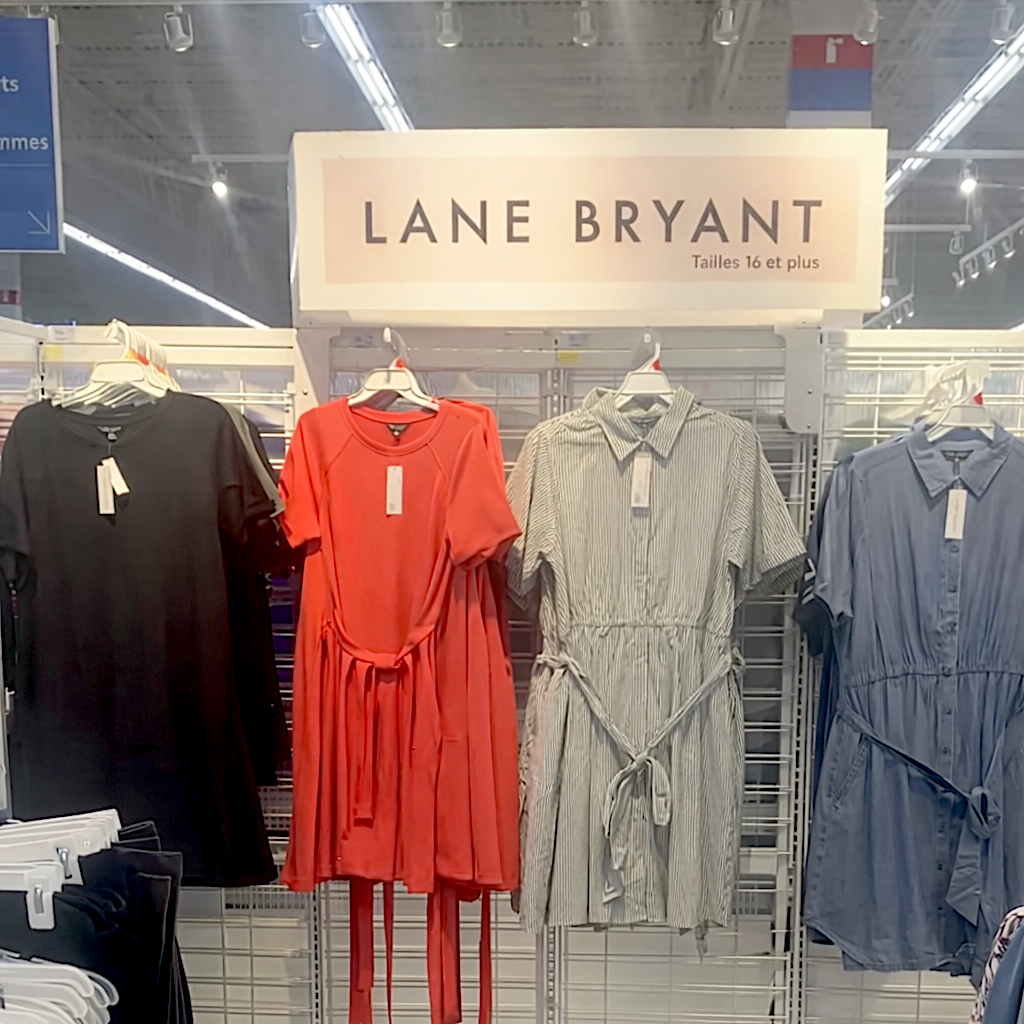
At the mass-market level, Walmart Canada offers unmatched reach, with more than 400 stores nationwide. This scale positions the retailer as the most accessible entry point for plus-size apparel in the country. In early 2026, Walmart introduced a notable shift in its apparel strategy through an exclusive partnership with KnitWell Group and Centric Brands to launch Lane Bryant in Canada. The rollout spans approximately 320 stores as well as Walmart.ca, consolidating previous fragmented assortments into a more cohesive, single-brand presentation.
Although both PENN. and Walmart serve the same customer segment, their approaches continue to diverge. PENN. draws on decades of experience in fit and specialization, supported by a more curated in-store environment. Walmart, by contrast, is leveraging scale and brand partnerships to elevate its fashion credibility while maintaining competitive price points. As both retailers continue to invest in digital capabilities and product development, the Canadian plus-size sector is entering a more competitive phase, shaped by rising consumer expectations around both style and accessibility.
A Monobrand Destination Strategy
One of the most notable aspects of the Walmart Canada rollout is the consolidation of the retailer’s plus-size assortment around a single branded destination.
Instead of offering a fragmented mix of private labels and smaller brands, Walmart has repositioned the category as a Lane Bryant-led monobrand presentation in participating stores. The move represents a meaningful shift in merchandising philosophy. It prioritizes brand equity, fit consistency, and customer clarity over assortment breadth.
From a competitive standpoint, this strategy creates immediate pressure for other mid-market plus-size retailers. Lane Bryant enters with more than a century of brand history, strong awareness among cross-border shoppers, and a reputation for fit and specialization. By pairing that credibility with Walmart’s value positioning, the partnership reshapes expectations around accessibility and price.
Positioning Across Price and Age
Trendex’s analysis of the Canadian plus-size market suggests a clear segmentation by both price and age. At the lower price end, Walmart and Torrid capture value-oriented shoppers. At higher price points, Laura Plus and Toni+ appeal to more mature and premium customers. Penningtons occupies a broad mid-market position.
Lane Bryant, according to the Trendex positioning framework, enters near the centre of the market. It targets women aged 25 to 55 with a mix of trend-forward styles and wardrobe staples, while maintaining accessible price points. That middle positioning allows the brand to compete across multiple fronts simultaneously.
By launching through Walmart, Lane Bryant gains national distribution while avoiding the capital intensity of standalone store expansion. The strategy also acknowledges the narrowing range of viable large-format retail entry points in Canada.
Competitive Pressure in a Slower Growth Environment
Trendex forecasts a deceleration in overall apparel sales beginning in the second quarter of 2026, following strong growth in 2025. In a slower growth environment, share shifts become more consequential. Gains by one retailer typically come at the expense of another.
Plus-size apparel has historically been underserved in Canada, with consumers often citing limited assortment, inconsistent fit, and fewer recognizable brands compared with the U.S. The arrival of Lane Bryant addresses some of those longstanding gaps.
However, it also intensifies competition in a category that is unlikely to expand rapidly in line with overall population growth.
In practical terms, this means incumbents may need to sharpen differentiation strategies, whether through fit expertise, loyalty programs, digital engagement, or elevated in-store experience.








It’s nice to finally see some light shed on plus-size women’s fashion in Canada. There is a big opportunity for more major brands to diversify their size offering. Not always, but there are more than not. I will say, however, that Torrid pricing is exuberant compared to Walmart, and their pricing is often in USD, so when converted, it hurts. Their online shopping experience, as a Canadian shopper, is even worse. Also, what many of these brands miss is style – clothing style tends to be bland and/or something cut from your grandmother’s curtains. Let’s also highlight the unnecessary need to constantly sell a “cold-shoulder” top or the proliferation of all things Disney and/or “cute”. To be plus-size is more than that. Plus-size can be “sexy”, it can be “trendy”.
I wholeheartedly agree with you, particularly about the number of “cold shoulder” tops; they had their heyday 20 years ago, thank you. Where I find retailers really need to focus is on office-wear for both suits and casual; I work in retail property management and am at that cusp of fitting in the higher end of regular sizing and the lower end of plus sizing, and a lot of retailers offering plus sizes seem to think we don’t have corporate jobs and work in professional settings. Look at those photos of Lane Bryant dresses at WalMart in Quebec; a button-up dress in wrinkled cotton-poly with a flimsy “belt” with a drop-waist and drop-shoulders? I’ve seen Lane Bryant stores in the US, they do NOT look like this. Should I just wear my Nana’s housecoat to the office to meet with my retail tenants? We have Reitmans here at my shopping centre–parent company for Penningtons/PENN, RW&CO, and Addition-Elle–who get it that women of all sizes need office-appropriate clothing, but it’s hard to find other retailers who share that same understanding. This is why I sew many of my own clothes and have taken professional tailoring & finishing courses so that I can have the professional wardrobe I want and need, but not everyone has this option.
Office attire is SO hard to find. And when you do, it’s all frumpy-magoo. Kudos to you for learning how to tailor – I’ve simply resorted to wearing all-black in office LOL!