Alain Ménard (left), Senior Vice-President, RONA Affiliated Dealers, is today appointed President and Chief Executive Officer, succeeding to J.P. Towner (right), who has accepted the role of Senior Advisor with Sycamore Partners, RONA’s owner, and will also serve on RONA’s Board of Directors.
RONA inc. says Alain Ménard will become its president and chief executive officer next month, succeeding J.P. Towner, who is moving into a senior advisory role with the home-improvement retailer’s owner, Sycamore Partners.
The leadership change takes effect Oct. 1, with Towner also joining the retailer’s board of directors. The company says Towner and Ménard will continue to work closely together during the transition as the company moves into its next phase of growth.
Leadership transition
Ménard has been with RONA since January 2024, when he joined as senior vice-president of RONA Affiliated Dealers. In that role, the company says he has developed relationships across the organization while drawing on his retail experience and knowledge of the affiliated dealer model and RONA’s operations and culture.
As CEO, Ménard will focus on maintaining the momentum of recent years while advancing RONA’s strategy, according to the company.
“I am honoured to lead RONA and build on our teams’ achievements,” said Menard. “Together with the leadership team, I will focus on advancing our strategy, supporting our teams, serving our customers and strengthening our corporate stores and affiliated dealer network.”
Towner’s move to Sycamore Partners will see him work with the private-equity firm on the retailer’s strategy and provide expertise on key priorities and decisions. He will remain connected to the retailer through his position on its board.
The company said the transition follows several changes made during Towner’s three years as CEO. During that period, RONA says it united three banners under a single brand and recorded growth in its professional, or PRO, and digital businesses.
It also increased the share of its sales generated by private-label brands, introduced shop-in-shop concepts with major national brands and added new affiliated dealers, the company said.
It also cited efforts to develop what it describes as a more agile and entrepreneurial culture, improve productivity and strengthen its workplace practices.
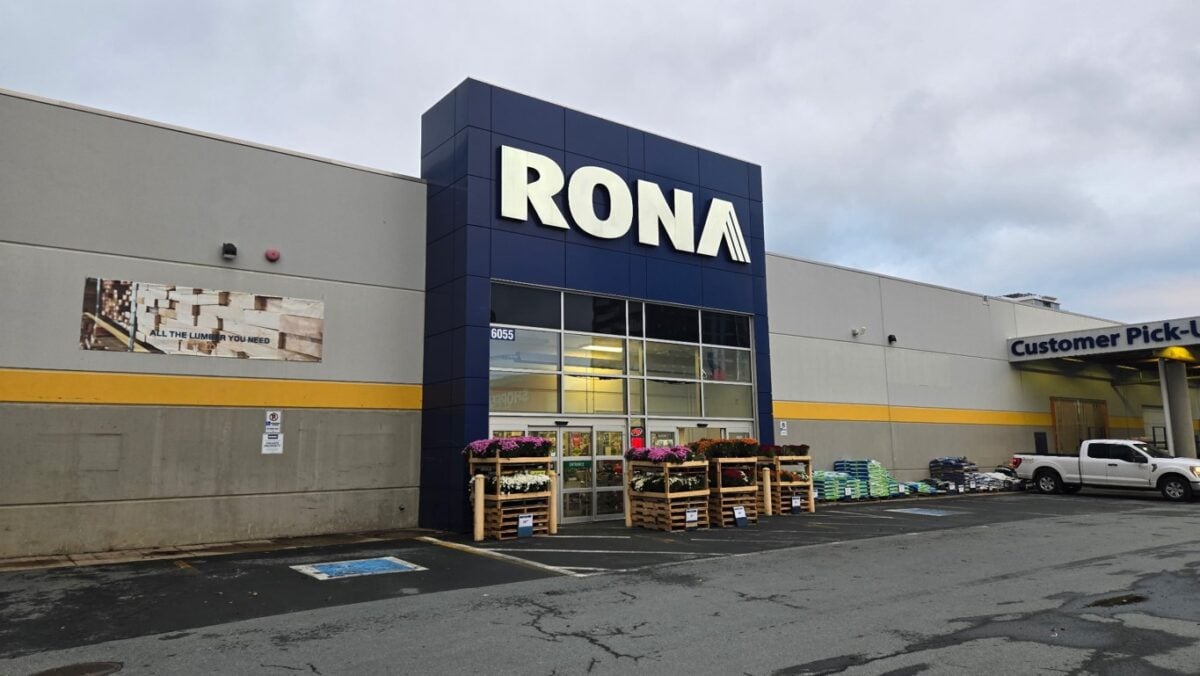
RONA store in Halifax. Photo: RONA
Focus on growth
RONA said the leadership transition is intended to build on those initiatives as the company continues its growth strategy.
RONA operates a network of more than 425 corporate and affiliated dealer stores under the RONA+ and RONA banners. The company is headquartered in Boucherville, Que., and says it employs about 21,000 people.
The retailer has operated in Canada’s home-improvement and construction market since 1939, according to the company.
RONA said Ménard’s experience with its affiliated dealer network will be part of his focus as he assumes the CEO role, with the company emphasizing both its corporate stores and affiliated dealers as areas of continued attention.
Amazon announced Wednesday it is investing more than 78 million in pay increases for Canada operations employees, raising its average hourly base wage to $26.27 per hour — up from $25.27 in 2025, a 4% year-over-year increase.
The retail and logistics giant said the pay increase means full-time Canada operations employees working 40 hours per week would earn more than $54,000 per year on average.
Beyond the hourly rate, Amazon said its step plan compensation model provides eligible hourly full- and part-time employees with planned pay increases every six months until their 24-month anniversary, with another increase at month 36.
“Every day, our associates across Canada go the extra mile to prepare packages for customer deliveries, and we’re grateful for their dedication,” said Jasmin Begagic, Director, AMZL Canada. “We remain committed to ensuring they have the wages, benefits, and career development opportunities they need to succeed and grow — and this is how we deliver on that.”
Jasmin BegagicBruce Winder
Starting October 1, 2026, Amazon said it is introducing the Employee Grocery and Daily Essentials Discount for eligible employees in Canada — including full-time, part-time, and seasonal Canada operations employees as well as corporate employees. Eligible employees across the country will receive 10% off online grocery and daily essentials purchases on Amazon.ca — with no cap on savings. The discount is available from Day 1 of employment with no minimum hours requirement, and covers eligible categories including pantry items, snacks and beverages, health and personal care, household essentials, beauty, baby items, and pet products.
Retail analyst Bruce Winder Bruce said Amazon’s announcement is a good sign for the Canadian economy.
“As inflation has been around 3% this raise will help with the affordability crisis for workers. The new 10% grocery benefit will be a big help too,” said Winder.
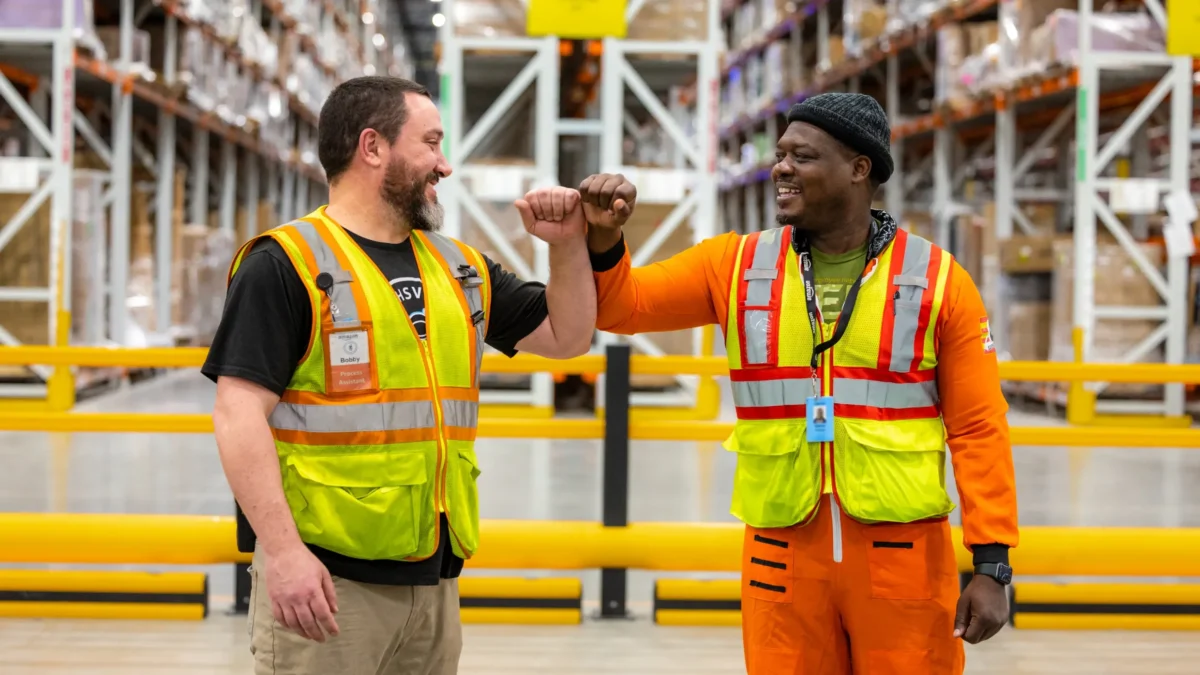
Amazon photo
“If I was a person in my 20’s or 30’s who was interested in the retail or technology industry I would check Amazon out as you can make a good wage and get full benefits including medical, dental and eyecare and rise up in a company that is expanding.
“You can also go back to school and get reimbursed which is also attractive as you avoid student debt. It would be nice for other companies to do the same so we can improve our standard of living as a country.”
Feeling the heat of the first union contract soon to be awarded to workers at its YVR2 facility in Delta, B.C., Unifor said Amazon has announced a sudden wage increase across its Canadian operations, much like Walmart did in 2024.
“It’s about time Amazon recognizes that if they want to operate in Canada, they will do it while respecting the rights of the very workers they employ. We’re going to keep the pressure on to see workers across Canada benefit from the gains made through collective bargaining,” said Unifor National President Lana Payne.
Lana PayneGavin McGarrigle
The wage bump announced coincides closely with the pending conclusion of mediation ordered by the B.C. Labour Relations Board. Following months of stalling and challenges by Amazon, Unifor was forced to seek a first contract through binding arbitration, said the national union.
“Pay raises are just one part of the equation. A union means a voice for workers, not only on their pay and benefits, but in fixing health and safety and the notoriously dangerous speed ups that Amazon is known for the world over,” said Unifor Western Regional Director Gavin McGarrigle. “Only by working together with the power of a union can we fix the systemic abuses at Amazon.”
Unifor is Canada’s largest union in the private sector, representing 320,000 workers in every major area of the economy. The union said it advocates for all working people and their rights, fights for equality and social justice in Canada and abroad, and strives to create progressive change for a better future.
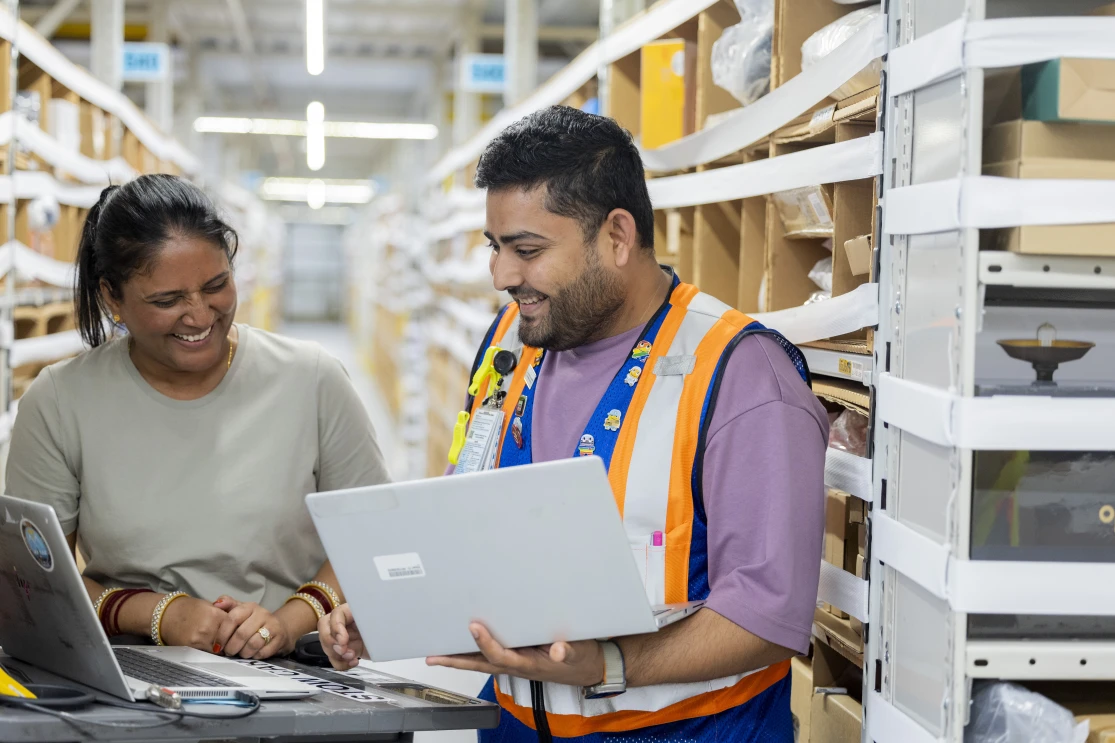
Amazon photo
Amazon said the pay increase and new grocery discount build on Amazon’s existing workplace benefits package for Canadian employees. For regular full-time Canada operations employees, benefits start on day one of employment and include:
Extended health, dental, and vision benefits providing additional coverage beyond provincial health plans, including treatments like massage therapy, chiropractic treatment, acupuncture, physiotherapy, vision care, and coverage for prescription drugs
An RRSP savings plan with a Deferred Profit Sharing Program (employer match)
Financial, mental, and physical health resources
The Employee Prime Benefit, giving eligible employees Prime memberships at no additional cost after 90 days of employment
The Career Choice program, which pre-pays 100% of tuition, up to a yearly maximum, toward a certificate or diploma in high-demand careers after 90 days of tenure (language courses are available from Day 1). Fourteen educational institutions across Canada are partnered with Career Choice, and since the program launched in 2014, more than 13,500 employees in Canada have participated. Among the most popular programs are commercial vehicle operation, data analytics, IT support, cybersecurity, clean energy, and construction trades.
All Canada operations employees — including seasonal — have access to mental health and wellbeing support through Amazon’s Employee Assistance Program from Day 1, it added.
Model wearing clothing from Mine & Yours at The Well in downtown Toronto. Image supplied
Mine & Yours Luxury Resale will mark its 13th anniversary in Toronto this fall with a runway show that offers a useful snapshot of what the business has become.
The October 21 event at the El Mocambo will be co-hosted by Mine & Yours owner Courtney Watkins and Canadian fashion personality Jeanne Beker. A Fall 2026 runway will feature designer pieces available for guests to purchase in real time, while a portion of proceeds will support The Princess Margaret Cancer Foundation.
The shoppable runway is the more interesting retail detail. Mine & Yours is taking previously owned merchandise and presenting it using familiar fashion-retail tools: curation, presentation, customer experience and an immediate path to purchase.
That was a less obvious proposition when Watkins opened a 300-square-foot resale shop in Vancouver in 2013. She has said Mine & Yours has since grown to five locations, more than 80 employees and nearly 10,000 square feet of retail space across Canada. Those figures come from Watkins, but they illustrate the scale the business has reached.
The larger change is not simply that consumers are more willing to buy second-hand luxury. Mine & Yours now has to solve many of the same problems as any other luxury retailer: securing desirable inventory, choosing productive locations, merchandising well, building trust and giving customers reasons to return.
There is one important difference. Its customers can also be its suppliers.
Jeanne Beker
Competing for Closets as Well as Customers
Mine & Yours operates permanent stores in Vancouver’s Yaletown and Kitsilano neighbourhoods and in Toronto’s Yorkville neighbourhood. The company has also used pop-ups in Toronto and Calgary as part of its growth strategy. Its location at The Well, for example, was designed to reach downtown Toronto consumers outside its Yorkville customer base.
The physical expansion has been matched by a more structured merchandise-acquisition system. Sellers can book appointments, drop off items, obtain online quotes or arrange larger in-home closet buys. Accepted merchandise can be exchanged for cash or store credit, while certain higher-value pieces can be consigned.
That changes the economics of the customer relationship.
A conventional fashion retailer generally acquires merchandise from a brand, distributor or wholesaler and sells it to the end customer. Mine & Yours must persuade consumers to participate on both sides of the transaction. Someone who sells a handbag to the company may later buy another one from it. If that seller chooses store credit, the connection becomes even more direct: inventory comes into the business and purchasing power goes back to the person who supplied it.
Mine & Yours is therefore competing for closets as well as customers.
That is one of the defining commercial challenges at the upper end of resale. Demand matters, but so does access to the right merchandise. A polished store cannot sell a Chanel bag it never managed to acquire.
Mine & Yours currently offers sellers different payout structures, including cash, store credit and consignment for qualifying merchandise. Those options function as inventory-acquisition tools while giving sellers different reasons to transact with the company.
Courtney Watkins in front of the Toronto Mine & Yours at 79 Yorkville Avenue. Photo supplied
Holt Renfrew Connects Resale With New Luxury
The company’s Calgary relationship with Holt Renfrew makes the interaction between new and previously owned luxury particularly clear.
Mine & Yours returned to Holt Renfrew’s Calgary store in April 2026 for a second six-month pop-up after operating there the previous year. Customers selling merchandise through Mine & Yours can choose cash, Mine & Yours store credit or Holt Renfrew credit.
The Holt Renfrew credit option is commercially revealing. A customer can dispose of an existing luxury product through the resale operator and redirect its value toward something new at the department store.
Watkins told Retail Insider there was considerable crossover between the two customer bases and that many Mine & Yours sellers were already Holt Renfrew shoppers. The companies were also exploring further promotions and possible additional locations.
The arrangement does not make resale and primary luxury interchangeable. It does show that they need not operate in opposition.
For Holt Renfrew, resale gives customers a mechanism to extract value from goods already sitting in their wardrobes and potentially redirect that value toward new merchandise. For Mine & Yours, the department-store relationship provides access to luxury consumers who already own exactly the sort of inventory it needs.
That is a more useful way of looking at the relationship than the familiar question of whether resale simply cannibalizes new luxury sales.
Toronto Becomes Part of the Growth Story
The location of the anniversary event also reflects how far Mine & Yours has moved beyond its Vancouver origins.
Mine & Yours entered Toronto with its Yorkville store in 2023, occupying roughly 3,000 square feet over three levels at 79 Yorkville Avenue. It subsequently added the approximately 1,100-square-foot pop-up at The Well as it sought to reach a different downtown customer.
Holding the 13th-anniversary event at the El Mocambo places the milestone in a market where Mine & Yours has been building its physical presence rather than simply staging a Toronto publicity event.
Watkins and Beker will hold an on-stage discussion covering fashion, entrepreneurship, women in leadership and the future of luxury. Watkins described the collaboration as a full-circle moment after growing up watching Beker on television.
The Easy Part Is No Longer Convincing People to Buy Used
Mine & Yours’ development points to a higher competitive bar within luxury resale.
Retail Insider’s previous reporting has already documented the normalization of resale among affluent consumers. In May 2026, Watkins said traditional luxury shoppers were increasingly participating in resale alongside customers who had grown into the category as their disposable income increased.
A business at Mine & Yours’ scale is therefore no longer simply proving that resale has a market.
The harder work is operational: finding enough desirable merchandise, winning sellers before competitors do, authenticating and pricing product, operating productive stores, merchandising one-off inventory coherently and retaining customers who have plenty of other places to transact.
That is what makes the October runway more interesting than the anniversary itself. The merchandise has previous owners, but the business selling it increasingly depends on the disciplines of luxury retail.
Mine & Yours began when convincing consumers to reconsider second-hand luxury was itself a meaningful hurdle. Thirteen years later, the more consequential question is how sophisticated a resale retailer has to become to keep growing.
BRP Inc. says the powersports industry is emerging from its post-pandemic inventory hangover, with off-road vehicles leading growth as the Quebec-based manufacturer prepares to accelerate the pace of new product launches.
Sandy Scullion, president of Powersports at BRP, said demand for side-by-sides and all-terrain vehicles remains healthy, while the broader industry has stabilized after a surge in sales during the COVID-19 pandemic left dealers with excess inventory.
Sandy ScullionBRP photo
BRP is planning to introduce a major off-road vehicle innovation every six months over the next four years, a strategy Scullion said is aimed at strengthening the company’s position with dealers and maintaining its competitive edge through new products, technologies, platforms and engines.
In early September, BRP raised its full-year earnings guidance after reporting an 18.5 per cent increase in second-quarter revenue, although tariffs and a supplier financial restructuring contributed to a sharp decline in profit margins.
The Quebec-based powersports company reported revenue of $2.24 billion for the three months ended July 31, up from $1.89 billion a year earlier. The increase was primarily driven by higher off-road vehicle shipments and a favourable side-by-side vehicle product mix.
BRP reported a net loss of $136.8 million, compared with net income of $57.1 million in the same quarter last year. Normalized EBITDA fell 34.9 per cent to $138.8 million from $213.2 million.
Headquartered in Valcourt (Québec) BRP is a global leader in the world of powersports. Through its portfolio of industry-leading brands featuring Ski-Doo and Lynx snowmobiles, Sea-Doo watercraft and pontoons, Can-Am on- and off-road vehicles and Rotax powertrains, BRP unlocks exhilarating adventures and provides access to experiences across different playgrounds. With more than 2,000 dealers worldwide, BRP has annual sales of CA$8.4 billion from over 110 countries and has approximately 17,000 employees as of January 31, 2026.
BRP is the #1 OEM in the North American powersports industry.
Approximately 5% of BRP’s revenue is invested in R&D.
2,000+ Patents and Applications
1,500+ Engineers and Technicians
BRP is launching one of the most ambitious growth and innovation initiatives in the industry: a commitment to unveil a major off-road vehicle innovation every six months over the next four years. This accelerated pace is designed to strengthen BRP’s position as an industry leader and expand its product portfolio, already recognized as one of the most comprehensive in the market, within one of the industry’s most competitive segments.
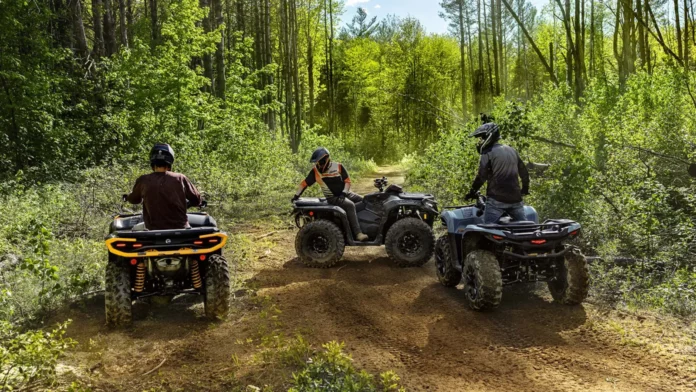
BRP photo
As part of this recent announcement, BRP unveiled two spectacular concept vehicles, the Defender Prerunner and the Maverick R XRay, showcasing its vision for the future of off-road riding.
Scullion said the industry went through the crazy times of COVID and during the lockdown ATV’s and snowmobiles became popular. Then after the surge there was a big of a “hangover. That led to an inventory issue with too much available. Now in 2026, Scullion said the situation is stabilizing and off-road vehicles is the company’s biggest growth area.
“That’s still growing consistently year over year. ATV a little bit less, side-by-side a little bit more, so quite healthy,” he said.
The snowmobile sector is dependent each year on the amount of accumulation in certain geographic areas and “everything marine post-COVID has been a little bit slow.”
As BRP launched one of the most ambitious growth and innovation initiatives in the industry with its commitment to unveil a major off-road vehicle innovation every six months over the next four years, Scullion said “this speaks to the pace of innovation, the investments we’re making towards bringing new products, new technologies, new platforms, new engines, name it.”
A new Canadian website is making it easier for consumers to find domestic alternatives to familiar U.S. brands as trade tensions continue to influence purchasing decisions across the country.
Founder Tomas Svec
TryCanadian.ca officially launched September 8, the same day Canada’s latest round of counter-tariffs on selected U.S. goods took effect. The platform allows consumers to search for an American brand, product or service and find Canadian companies offering potential alternatives.
Founder Tomas Svec spent roughly three to four weeks developing the platform ahead of its launch, with much of that time devoted to researching and building a database that now includes more than 900 companies and is approaching 1,000. The challenge, he said, was not simply finding Canadian businesses, but determining what being Canadian actually means.
“The database was the hardest part because I wanted to be very rigorous about the sources I was using,” Svec told Retail Insider.
The premise is straightforward. A shopper can enter a familiar U.S. company and receive suggestions for Canadian businesses serving a similar need. During the Retail Insider interview, for example, a search for Ralph Lauren produced alternatives including Penningtons, RW&CO., Province of Canada and Quartz Co.
Svec said the idea grew out of conversations with consumers who wanted to shift some of their spending but did not necessarily know where to go.
“People started reaching out to me and to friends asking, ‘Do you know any alternatives to this U.S. company?’” he said.
Svec does not position TryCanadian as an anti-American boycott platform. He describes it as a discovery tool that gives consumers more options while making smaller Canadian businesses easier to find.
“I’m trying not to promote it as a boycott of the U.S. It’s about offering people more alternatives,” he said. “There are many options and many small companies. I’m also trying to help smaller businesses become more visible because I think this is a great time to support local economies.”
There is not always a direct Canadian substitute for a large multinational company. A platform such as Amazon spans an enormous number of categories, meaning replacing it with Canadian alternatives could involve several specialized businesses instead of a single competing retailer.
Defining What Is Actually Canadian
One of the more complicated parts of the project is determining what qualifies as Canadian. A business can be founded and headquartered in Canada while ultimately being controlled by a foreign owner. A Canadian-owned company, meanwhile, may manufacture some or all of its products outside the country.
TryCanadian therefore separates characteristics such as ownership, headquarters and manufacturing rather than applying a single Canadian designation to every business.
“When I say Canadian-owned, I’m looking at who ultimately controls the company,” Svec explained. “A company can be founded and headquartered in Canada, but that doesn’t necessarily mean it isn’t foreign-owned.”
The distinction becomes more complicated when products are marketed as Canadian. Competition Bureau guidelines generally require at least 51 per cent of total direct production or manufacturing costs to have been incurred in Canada for a non-food product to carry a qualified “Made in Canada” claim. The last substantial transformation must also have occurred in Canada, and the claim requires an appropriate qualifier indicating imported content.
The threshold for a “Product of Canada” claim is considerably higher, generally requiring at least 98 per cent of total direct production or manufacturing costs to have been incurred in Canada, with the last substantial transformation also occurring here. The definitions illustrate why Canadian ownership, headquarters and domestic manufacturing are separate considerations.
Svec said transparency around those distinctions became a priority while developing TryCanadian. He wants consumers to understand why a company has been categorized in a particular way instead of simply accepting a broad Canadian designation.
“I’m trying not to be vague,” he said. “I want to be transparent so people understand what these terms actually mean.”
That work remains labour-intensive. Svec researches companies himself and plans to contact businesses when information about ownership, headquarters or manufacturing cannot be confidently established. TryCanadian’s methodology says it prioritizes corporate disclosures, government and regulatory databases, manufacturer information, reputable news sources and other credible business information, while using “Unknown” when a claim cannot be sufficiently verified.
On launch day, Svec had already assembled a list of approximately 50 companies he intended to contact for additional information.
“The verified badge means I’ve been able to verify the information about the business — where it is headquartered, where its products are made and whether it is Canadian-owned,” he said.
The designation is TryCanadian’s own verification system and should not be confused with government certification. The Competition Bureau provides guidelines for Canadian-origin claims but does not approve or certify individual “Made in Canada” or “Product of Canada” claims.
Buy Canadian Moves Into Consumer Spending
TryCanadian’s launch comes as the Canada-U.S. trade dispute continues to affect consumer sentiment and spending behaviour. Effective September 8, Canada imposed counter-tariffs of 15, 25 and 50 per cent on selected U.S. products covering $27.6 billion in imports, including products in sectors such as steel, dairy, appliances, agricultural equipment, pulp and paper and electronics.
There is growing evidence that the Buy Canadian movement has extended beyond consumer sentiment. Bank of Canada research published in February found a modest but measurable shift in grocery spending away from U.S. products and toward Canadian ones following the escalation of trade tensions in 2025, although researchers cautioned that tariffs and resulting price changes may account for some of the substitution.
Bank of Canada consumer surveys have also continued to show a preference for domestic goods. In its first-quarter 2026 survey, consumers reported continuing to substitute toward goods made in Canada while spending less on goods made in the United States, with most respondents expecting that behaviour to persist over the long term regardless of what happens in the Canada-U.S. trade relationship.
Svec said people he knows had long expressed an interest in supporting Canadian companies, but convenience frequently determined what they actually purchased. He believes the current environment has pushed more consumers to put additional effort into finding alternatives.
“People would say they wanted to support Canadian businesses, but convenience was often more important,” he said. “Now, because of what is happening and the tensions we’re seeing, people are opening up to alternatives. Sometimes they’re even willing to pay a little more for a Canadian product.”
Price remains an important limitation. Bank of Canada consumer research found three-quarters of respondents were unwilling to pay more than an additional 10 per cent for Canadian-made products, highlighting the continued importance of affordability alongside origin, convenience, selection and quality.
For Canadian retailers and brands, that creates a more nuanced opportunity. Consumers may increasingly want to support domestic businesses, but they still need products that compete effectively on the fundamentals. What appears to be changing is the willingness of some shoppers to look for a Canadian option before making their decision.
Svec encountered the same trade-off while developing TryCanadian. He deliberately selected Canadian companies for services supporting the website, including its technology infrastructure, even where doing so cost considerably more than using international providers.
“For me, some Canadian services cost 50 to 60 per cent more than the other options,” he said. “But I wanted to support Canadian companies.”
A Discovery Opportunity for Smaller Businesses
Smaller Canadian businesses could be among the beneficiaries if the change in consumer behaviour persists. Svec said his research repeatedly uncovered companies offering domestic alternatives that consumers may simply not know exist.
“There are many small businesses offering these products, but people often aren’t aware of them,” he said. “Sometimes there is a business in your own community doing this, but you’ve always gone to the large retailer instead.”
That visibility gap has historically favoured larger national and international companies with greater marketing resources. Svec believes the current environment could alter part of that equation as consumers take a more active role in discovering domestic businesses.
“In the past, these businesses had to spend thousands of dollars on campaigns to compete,” he said. “Now people are actually seeking out and trying to find those businesses.”
The extent of that shift will take time to measure, particularly for TryCanadian itself. Svec acknowledged that the platform is too new to provide meaningful proprietary data about which companies or categories its users are searching most frequently.
Before launch, he examined discussions on Reddit, Facebook groups and other online communities to identify the kinds of alternatives Canadians were looking for. Technology services emerged as one area of interest, along with Canadian options for broad platforms such as Amazon.
The database is also designed to expand through submissions from consumers and businesses. Visitors can suggest a Canadian alternative that is missing, while companies can submit themselves for consideration. Those submissions are researched before being incorporated into the database.
“If somebody suggests a business that isn’t there, it goes into my database and I research it,” Svec said. “Once everything has been researched, I can add it.”
Originally from Slovakia, Svec moved to Canada approximately five years ago and has worked in journalism for about two decades, primarily covering technology and science. He continues to contribute journalism in Slovakia while working in communications with the Greater Vancouver Food Bank.
His work at the food bank has given him a close view of the financial pressures facing households, while building TryCanadian has become part of his own relationship with the country.
“Since moving here, I’ve started to understand what it really means to be proud to be Canadian,” Svec said. “I’m trying to support that with this small initiative.”
Whether the current shift toward Canadian products survives the immediate trade dispute remains an open question. Svec believes at least part of the behavioural change could endure because consumers are becoming more conscious of ownership, manufacturing and where their spending ultimately goes.
“When people buy something, I think they’re going to be more conscious of who is actually behind the business,” he said. “They’re thinking more about whether they are supporting a local company.”
For TryCanadian, the immediate task is to continue expanding the database, verify the information behind its listings and make domestic alternatives easier to discover. For Canadian retailers and brands, the broader opportunity is that some consumers who once needed to be persuaded to notice domestic alternatives are now actively looking for them.
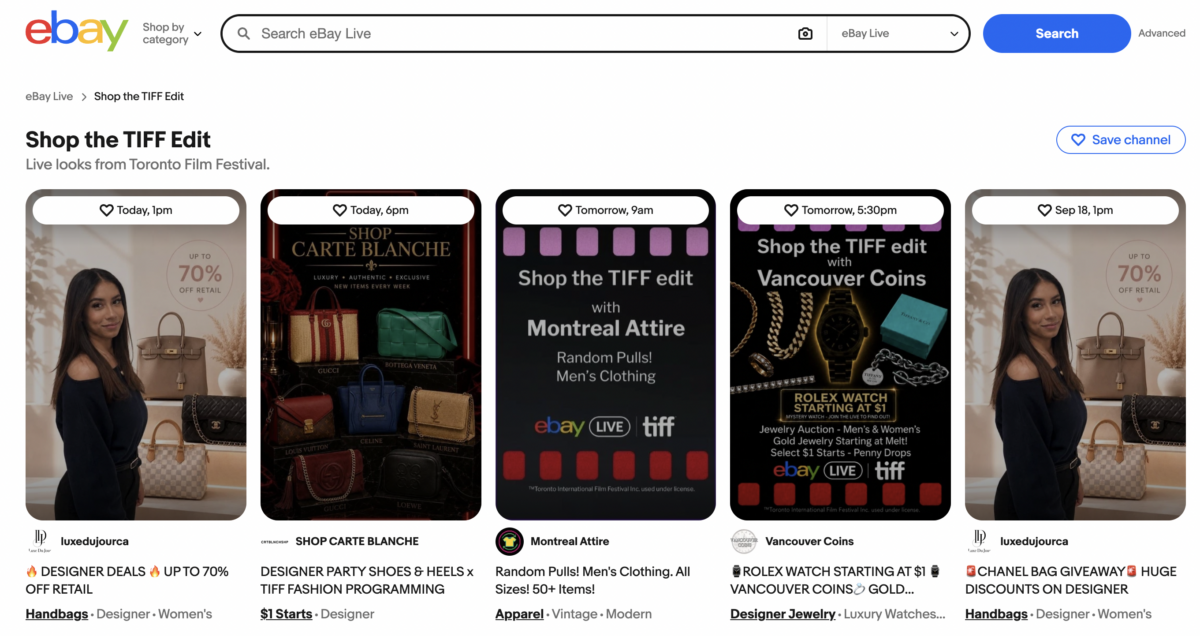
eBay Live has officially joined TIFF (Toronto International Film Festival) as an Official Festival Partner, bringing together film, fashion and the thrill of finding something you didn’t know you were looking for.
Launched in Canada earlier this year, eBay Live is eBay’s interactive live shopping experience, where shoppers can tune into livestreams hosted by top sellers (sometimes featuring celebrity guests), discover unique finds, and bid and buy in real time. This new way to shop eBay launched in Canada earlier this year, but in the US the experience has drawn a range of stars, including Elton John, the Backstreet Boys, Maura Higgins – and more.
Until September 20 Shop the TIFF Edit will be a dedicated eBay Live destination featuring TIFF-inspired live shopping experiences hosted by sellers, with vintage finds, luxury pieces, statement looks, premiere-worthy fashion and movie-inspired style all up for discovery.
Question: What does eBay hope to achieve through its partnership with TIFF, and why was the festival a natural fit for eBay Live’s expansion in Canada?
Answer: TIFF is one of Canada’s biggest cultural and fashion moments, making it a natural platform to introduce more Canadians to eBay Live through style discovery. Through the partnership, eBay is showing how shoppers can move from inspiration to purchase in real time through Shop the TIFF Edit, featuring livestreams focused on vintage finds, luxury pieces and festival-inspired fashion.
The partnership also showcases eBay Live’s expansion beyond collectibles and into fashion. We launched eBay Live in Canada earlier this year in the high-passion collectibles category, and we’re excited to now offer fashion enthusiasts a new way to shop. TIFF provides a highly relevant moment to demonstrate what eBay offers enthusiasts: they can see it, find it, shop it live.
Q: How has eBay Live performed in Canada since launching earlier this year, and what have you learned about Canadian consumers’ appetite for interactive livestream shopping?
A: Since launching earlier this year, eBay Live has introduced Canadian shoppers to live commerce through community-driven activations at events such as Fan Expo and the Sports Card & Memorabilia Expo. These experiences have helped build awareness of eBay Live’s blend of livestream entertainment, real-time interaction and trusted sellers.
We’ve seen that Canadians respond to experiences rooted in their passions, whether that’s collectibles, sports, pop culture or fashion. Our eBay Live shopping experience is compelling because it combines discovery, entertainment and direct interaction with sellers.
Q: What role do vintage, luxury, resale and collectible products play in eBay Live’s strategy, particularly in attracting shoppers interested in TIFF-related fashion and culture?
A: Fashion and collectibles are central to the eBay Live strategy – these are deeply passionate communities that want to engage and showcase their style and fandom. For TIFF, this includes vintage fashion, luxury pieces, pre-loved designer items and statement looks inspired by the festival.
How do you expect the TIFF partnership and the “Shop the TIFF Edit” programming to influence eBay Live’s growth and customer engagement beyond the festival?
A: TIFF is an opportunity to introduce new audiences to eBay Live during a cultural moment that already drives conversations around fashion and style. We’re here to connect with Canadian shoppers who value style and trends, and showcase how livestream shopping can be part of the discovery experience for unique pieces and looks.
More broadly, the partnership is intended to be the start of an ongoing relationship, helping build engagement beyond the festival itself.
Q: How does eBay see live shopping evolving in Canada, and what does the company need to do to make the format a regular part of how Canadians discover and purchase products?
A: eBay sees strong potential for live commerce in Canada, driven by passionate enthusiast communities, a growing resale culture and demand for more interactive shopping experiences. The combination of entertainment, community, trusted sellers and unique inventory is what makes the format compelling.
We’re focused on connecting live shopping with the cultural moments, communities and categories Canadians already care about, creating holistic experiences. By expanding into areas like fashion while continuing to leverage the trust and scale of the eBay marketplace, we see an opportunity to make live shopping another way people can do more of what they love.
Business groups in Canada are welcoming the federal government’s introduction of the Productivity Mega Deduction described by the government as a game-changing initiative to boost business investment, enhance certainty and simplicity for businesses, and strengthen Canada’s tax competitiveness.
Restaurants Canada said it welcomes the Productivity Mega Deduction announced by Prime Minister Carney. This is an important measure that will have a significant impact on the restaurant sector’s ability to invest in productivity and growth and directly addresses one of our key recommendations to the federal government.
Restaurants Canada said it has consistently called on the federal government to make it easier for restaurants to invest in their businesses.
“In our pre-budget submissions to Finance Canada and the House of Commons Finance Committee, we specifically recommended enhanced accelerated capital cost deductions for investments in equipment, technology and restaurant modernization,” said Kelly Higginson, President and CEO, Restaurants Canada.
“This proposed measure will allow businesses to immediately deduct the full cost of most qualifying capital investments in the year they become available for use, making it easier for restaurants to invest in expansion, equipment, technology and modernization.
“With the rising cost of doing business and ongoing economic uncertainty, many restaurants have had to put equipment and building investment plans on hold. That constrains productivity and growth within restaurants and reduces investment in the Canadian businesses that supply them with equipment, technology, construction and other services.”
Kelly HigginsonKim Furlong
The national organization said restaurants are a $125 billion industry representing 4% of Canada’s GDP. They employ 1.2 million people, contribute $26 billion in taxes and purchase $43 billion in food and beverage products, most of which come from local suppliers.
“Measures that support success and growth in our industry ultimately help grow the Canadian economy, produce local jobs and support other industries and hundreds of thousands of related jobs. We look forward to working with the federal government on this measure and others that can unlock the full economic potential of the restaurant sector,” added Higginson.
To boost business investment, enhance certainty and simplicity for businesses, and strengthen Canada’s tax competitiveness, the Government of Canada announced that it proposes to implement the Productivity Mega Deduction, which will provide immediate expensing for a broad-based range of depreciable property on a permanent basis. Immediate expensing allows taxpayers to fully write off the cost of an investment in the year that it becomes available for use. This powerful investment incentive will create the conditions for an extended period of higher investment—a Canadian investment supercycle.
“This measure builds on the Productivity Super-Deduction announced in Budget 2025, which provides immediate expensing to about 15 per cent of investment in capital assets, including machinery, equipment, and buildings used for manufacturing and processing, clean energy generation and energy conservation equipment, zero-emission vehicles, patents, data network infrastructure, and computers,” it said.
“The Productivity Mega Deduction would permanently provide immediate expensing to a much wider range of assets and expenses (i.e., about two-thirds of investment in capital assets would be eligible). The estimated incremental fiscal cost of the measure is $36 billion over five years, beginning in 2026-27.
“Assets not eligible for immediate expensing will continue to receive an enhanced first-year deduction under the Accelerated Investment Incentive.”
“As the country’s largest private-sector employer and among the largest investors in supply chains and operational efficiency, retail relies heavily on continuous capital investment to keep goods moving and maintaining affordability for Canadians.
“Making immediate expensing permanent will accelerate those investments in modern logistics, distribution automation, and digital infrastructure—giving Canadian retailers the tools they need to continue to drive productivity and build a more competitive economy from the ground up.”
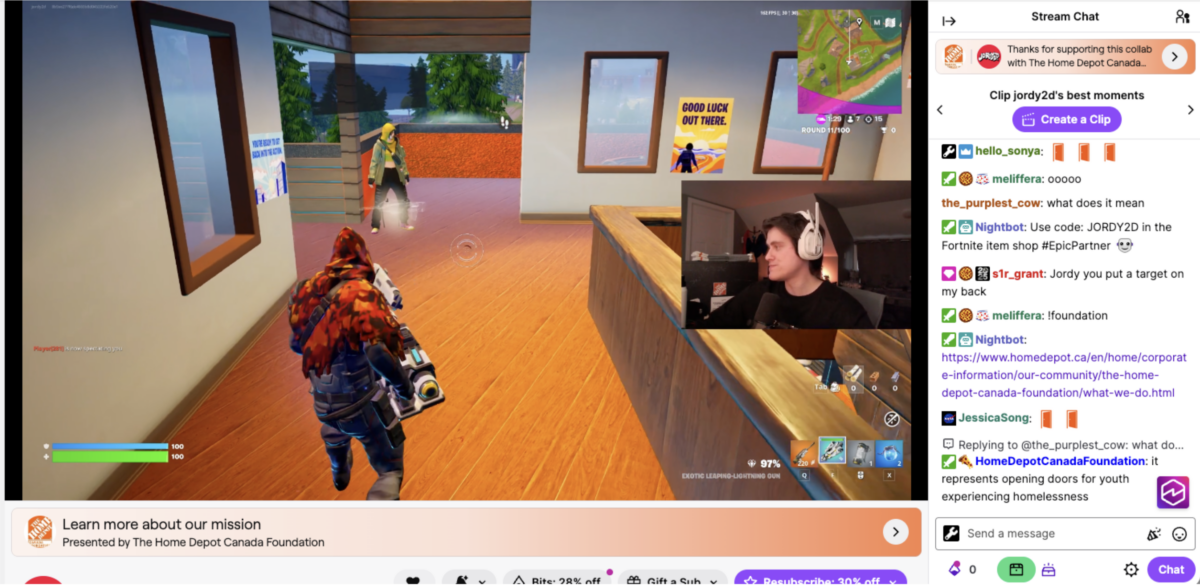
To bring the issue of youth homelessness to audiences in an engaging and accessible way, The Home Depot Canada Foundation (THDCF) recently created The Safe House, a custom Fortnite map that immersed players in challenges inspired by the realities youth can face when trying to find stability and support.
Throughout the gameplay, players navigated a world filled with locked buildings, limited supplies and persistent danger before discovering THDCF’s Safe House, a beacon of hope, support and opportunity.
THDCF, The Home Depot Canada’s charitable organization, is dedicated to helping prevent and end youth homelessness through investments in housing, life-skills development, employment support and other critical services for youth.
By 2030, The Home Depot Canada Foundation will invest $125 million in creating new paths for youth at risk of or experiencing homelessness. THDCF designed this gaming experience to help young audiences understand the barriers and challenges that more than 35,000 youth experiencing homelessness in Canada face every day.
Last month, Canadian Fortnite creator jordy2d hosted a two-hour live Twitch stream, which began with the unboxing of a custom Foundation mailer featuring branded items, campaign materials and two mystery envelopes that revealed key elements of the experience. The unboxing helped introduce viewers to The Safe House before Jordy and his community entered the map together and explored its challenges. He blended gameplay with his signature hosting style to guide viewers through the custom-built map while naturally weaving in messaging about youth homelessness and THDCF’s mission to help prevent and end it.
Amy BilodeauThe Home Depot Canada Foundation image
In addition to the livestream, the campaign was promoted across both The Home Depot Canada’s and Jordy’s social channels.
“Youth homelessness isn’t always visible, and that can make it difficult for young people to understand or even know that it exists. With The Safe House, we wanted to create an experience that builds awareness through participation. By partnering with Jordy2d and bringing this conversation into Fortnite, we’re finding ways to engage new audiences in our mission to help prevent and end youth homelessness in Canada.” said Amy Bilodeau, Senior Manager, Community Affairs, The Home Depot Canada Foundation.
The custom gaming experience included:
The inability to enter any other building other than The Safe House, representing homeless youth who have nowhere to go
Orange “supply drops” that represented the resourcing from THDCF’s charity partners
Multiple levels in the Safe House that unlocked more abilities like health upgrades and energy restoration
THDCF campaign posters around placed on walls of the house
A terrace with a launchpad where players could jump to gain a vantage point or travel to a new location, representing the new perspective youth develop after being equipped with resources and support systems
A mysterious orange beam of light that helped guide the player to safe house
The Foundation said the stream received prominent placement on Twitch.tv through a custom homepage takeover, channel skins and additional platform integrations. The live stream generated the following:
98K+ views
85K+ unique viewers
258K+ minutes watched
The Home Depot Canada Foundation image
“The Home Depot Canada Foundation is dedicated to preventing and ending youth homelessness. We have committed to invest $125 million by 2030 and work alongside youth-serving organizations across Canada to help young people access stable housing, develop life skills, and access employment opportunities and other supports they need to change their path in life. By partnering with organizations on the front lines serving youth experiencing homelessness, the Foundation is helping create new pathways to independence and long-term success for vulnerable youth across the country,” said Bilodeau.
“The Safe House presented a unique opportunity to raise awareness of youth experiencing homelessness in a way that was interactive, engaging and accessible to new audiences. Through a custom Fortnite experience and Twitch livestream, the project translated the real-world barriers faced by youth experiencing homelessness into an immersive experience that helped Canadians better understand the issue.
“For The Home Depot Canada Foundation, it was a powerful example of how innovative platforms can help spark meaningful conversations about an issue that affects thousands of young people across Canada.”
The Safe House project helped introduce conversations about youth homelessness to audiences that traditional awareness campaigns may not always reach, said Bilodeau.
“Through gameplay, livestream content and social engagement, the initiative encouraged people to learn more about the issue and consider how they can support efforts to address it,” she said.
“Beyond audience reach, the project demonstrated how innovative digital platforms can be used to drive awareness around important social issues. By meeting people where they spend their time online, Safe House created an accessible and engaging way to build empathy and understanding around youth homelessness.”
Since 2013, The Home Depot Canada Foundation has invested more than $94 million to support youth experiencing or at risk of homelessness across Canada, said Bilodeau.
“Annually this equates to $12 million across 179 partners supporting 30,000+ youth. Frontline youth serving organizations providing 90,000+ hours of wrap around supports, 48,000 hours of employment training and permanently housing 66% of the youth we serve through our housing supports,” she said.
“With a commitment to invest $125 million by 2030, we’re continuing to work alongside community partners to help young people access stable housing, employment opportunities and the support they need to build a more secure future.”
“At a time when households are making careful spending decisions, customers continued to count on Dollarama for dependable value. Together with the execution of our teams, this contributed to our strong second-quarter performance and supports the increase in our annual Canadian Comparable store sales and net new store opening guidance,” said Neil Rossy, President and CEO.
“We continue to drive profitable growth in Canada, and Central and South America, while building our presence in Mexico and advancing the transformation of our Australian business. Across all markets, our teams remain focused on earning every customer visit through strong value, convenient locations, a compelling assortment and a consistent shopping experience.”
Neil RossyDollarama photo
Fiscal 2027 Second Quarter Results Highlights Compared to Fiscal 2026 Second Quarter
Sales increased by 17.6% to $2,026.6 million, compared to $1,723.8 million
Comparable store sales in Canada increased by 5.4%, compared to 4.9% in the second quarter of the previous year
EBITDAincreased by 11.0% to $653.0 million, representing an EBITDA margin of 32.2%, compared to 34.1%
Operating income increased by 7.0% to $517.3 million, representing an Operating margin of 25.5%, compared to 28.0%
Net earnings increased by 8.7% to $349.3 million, resulting in an 11.2% increase in diluted net earnings per common share to $1.29, compared to $1.16
15 net new stores opened in Canada, compared to 27 in the corresponding period of the previous year
4 net new stores opened and 25 stores renovated in Australia, all operating under the legacy banner
1,596,016 common shares repurchased for cancellation at a cost of $300.4 million
The comparative information for the second quarter of fiscal 2026 includes the financial results of The Reject Shop Limited (now Dollarama Australia Pty Limited) for the 13-day period from July 22, 2025 to August 3, 2025, whereas the results for the second quarter of fiscal 2027 include a full quarter of operations, it noted.
Dollarama photo
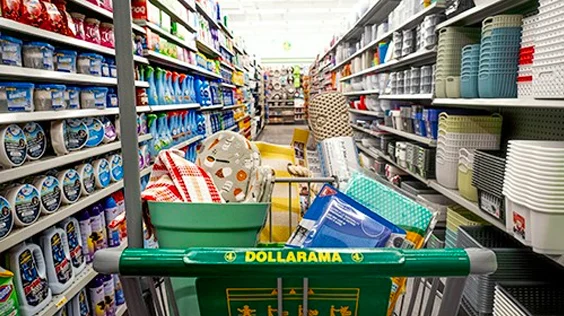
Dollarama said the sales increase was driven by the inclusion of a full quarter of sales in Australia.
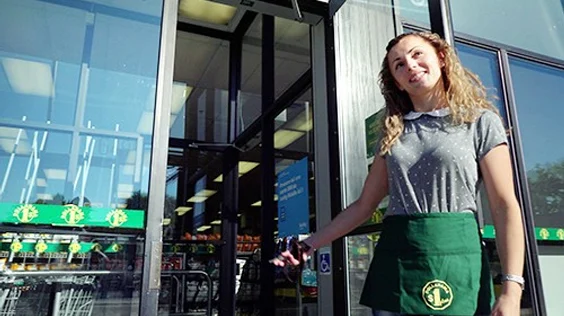
Founded in 1992 and headquartered in Montréal, Quebec, Canada, Dollarama is a leading Canadian value retailer with international reach with more than 2,900 conveniently located stores and over 43,000 people serving customers in seven countries on three continents. In every market where it operates, Dollarama said it aims to provide compelling value at select low fixed price points and convenient access to a wide assortment of affordable everyday and seasonal merchandise that appeals to a broad customer base.
Dollarama operates more than 1,700 stores in Canada with a presence in all 10 provinces and two territories. In Australia, Dollarama operates the country’s largest discount retail chain, The Reject Shop, with a national network of over 400 stores. Dollarama is also the majority shareholder, through its equity-accounted investments, in Latin American value retailer Dollarcity which has more than 750 stores located in Colombia, El Salvador, Guatemala, Mexico and Peru.
The company said comparable store sales consisted of a 3.7% increase in the number of transactions and a 1.7% increase in average transaction size, over and above 4.9% growth in the second quarter of fiscal 2026. Comparable store sales growth in Canada was primarily driven by strong demand for consumables and general merchandise.
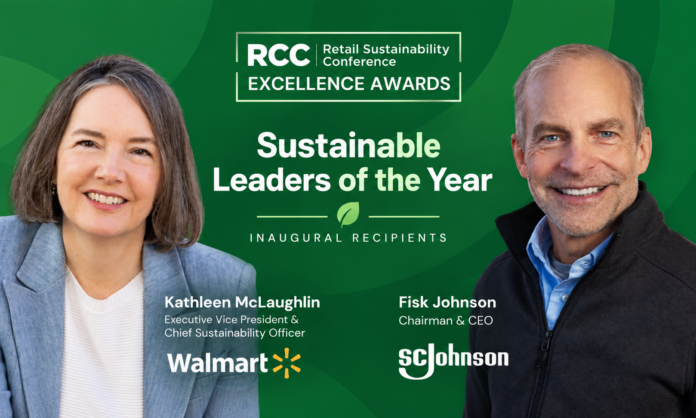
Retail Council of Canada has named Walmart Inc. Executive Vice President and Chief Sustainability Officer Kathleen McLaughlin and SC Johnson Chairman and CEO Fisk Johnson as the inaugural recipients of its Sustainable Leaders of the Year Award.
The new recognition will be presented as part of RCC’s Retail Sustainability Excellence Awards on October 28. It recognizes executives who have advanced measurable environmental progress across the retail value chain, including supply-chain transformation, product innovation and environmental impact.
“This is the first time we have presented this award, and we set the bar high,” said Kim Furlong, President and CEO of Retail Council of Canada.
Furlong said McLaughlin was selected in part for translating Walmart’s climate commitments into measurable action across thousands of suppliers, while Johnson has pushed issues including plastic waste and chemical transparency into the policy arena. Both, she said, demonstrate how sustainability commitments can translate into action across the retail industry.
McLaughlin’s Work Across Walmart’s Supply Chain
McLaughlin leads Walmart Inc.’s sustainability strategy across sourcing, supply chains and community resilience. She chairs the Walmart Foundation board after spending more than a decade as its president and previously spent more than 20 years at McKinsey & Company, where she led its Retail Practice.
Central to her work at Walmart has been Project Gigaton, the retailer’s supplier-focused initiative launched in 2017. Walmart set a goal of working with suppliers to reduce, avoid or sequester one billion metric tonnes of greenhouse-gas emissions from product value chains by 2030.
In 2024, Walmart announced that participating suppliers had reported projects expected to exceed the one-billion-metric-tonne threshold, reaching the target more than six years ahead of schedule. More than 5,900 suppliers participated in Project Gigaton.
Walmart’s methodology allows qualifying projects to include anticipated emissions impacts through 2030. As a result, the milestone incorporates some reductions, avoided emissions or sequestration expected to occur after the company announced the result, rather than representing only emissions already eliminated.
Project Gigaton also has a Canadian connection. Walmart Canada joined the initiative in 2019, when more than 200 of its Canadian suppliers had already made commitments under the program. Participants included Maple Leaf Foods, Unilever Canada and Agropur Cooperative.
The program covers energy, waste, packaging, agriculture, forestry and product use. Some of those measures have implications beyond emissions targets, particularly where changes to transportation, energy consumption and packaging can affect operating costs and supply-chain efficiency.
Fisk Johnson’s Focus on Plastics and Regulation
Johnson has served as Chairman and CEO of family-owned SC Johnson since 2004 and joined the company in 1987. His environmental work has included plastic waste reduction, renewable energy, carbon reduction, green chemistry and greater transparency around product ingredients.
One of Johnson’s more prominent policy priorities has been Extended Producer Responsibility, commonly known as EPR, which places greater responsibility for managing packaging at the end of its useful life on the companies that produce it.
His advocacy has a direct Canadian connection. When Johnson appeared before the U.S. Senate Committee on Environment and Public Works in March 2024 to advocate for EPR legislation for consumer packaging, he pointed to British Columbia’s system as an example of how such a framework can operate.
Under the B.C. model highlighted by Johnson, producers and brand owners assume financial and operational responsibility for collecting, sorting and recycling packaging. Johnson has argued that EPR can also give businesses an incentive to redesign packaging, increase recycled content and develop reuse and refill systems.
RCC cited Johnson’s work on plastics and chemical transparency, along with his support for an international treaty addressing plastic pollution, in recognizing him with the inaugural award.
Canadian Retailers Among 60 Sustainability Finalists
The two executive awards are part of a broader sustainability recognition program being introduced by RCC. Sixty finalists have been selected across 10 Retail Sustainability Excellence Award categories, covering operational waste diversion, community impact, data and traceability, facilities decarbonization, sustainable products and packaging, low-carbon logistics, recycled content, reuse and take-back programs, and supply-chain impact.
The list includes some of Canada’s largest retailers and consumer-facing businesses. Sobeys, IKEA Canada, Canada Goose, Tim Hortons, Canadian Tire Corporation, Holt Renfrew, Roots Corporation, Longo’s Brothers Fruit Market, Sleep Country Canada and Staples Canada are among the finalists.
Several companies are represented in multiple categories. Sobeys is a finalist for back-of-store circularity and operational waste reduction, data, transparency and traceability innovation, and energy and facilities decarbonization. IKEA Canada appears in categories covering operational waste, community impact, low-carbon logistics, and reuse, refill and take-back programs.
The categories point to where sustainability spending and regulation are increasingly intersecting with retail operations. Energy use in stores and distribution centres, fleet investments, packaging, waste handling and supplier requirements all carry cost and operational implications alongside their environmental objectives.
That is particularly evident in programs such as Project Gigaton, where initiatives involving transportation efficiency, packaging, energy consumption and waste can change how products are manufactured, shipped and ultimately sold. For large retailers, sustainability strategy is increasingly tied to decisions already being made across procurement, logistics, real estate and supplier management.
The Sustainable Leaders of the Year Award and the individual Retail Sustainability Excellence Awards will be presented October 28 following RCC’s Retail Sustainability Conference.
Retail Council of Canada represents businesses ranging from independent retailers to major national chains, with its membership encompassing more than 65,000 storefronts across the country.