Planet Fitness is expanding its presence in the Halifax area with a new 18,000-square-foot fitness club in Lower Sackville that is expected to open this fall.
The company said the new location will be at 70 First Lake Dr., Unit 201, and will be its third club in the Halifax area, joining existing locations in Halifax and Dartmouth.
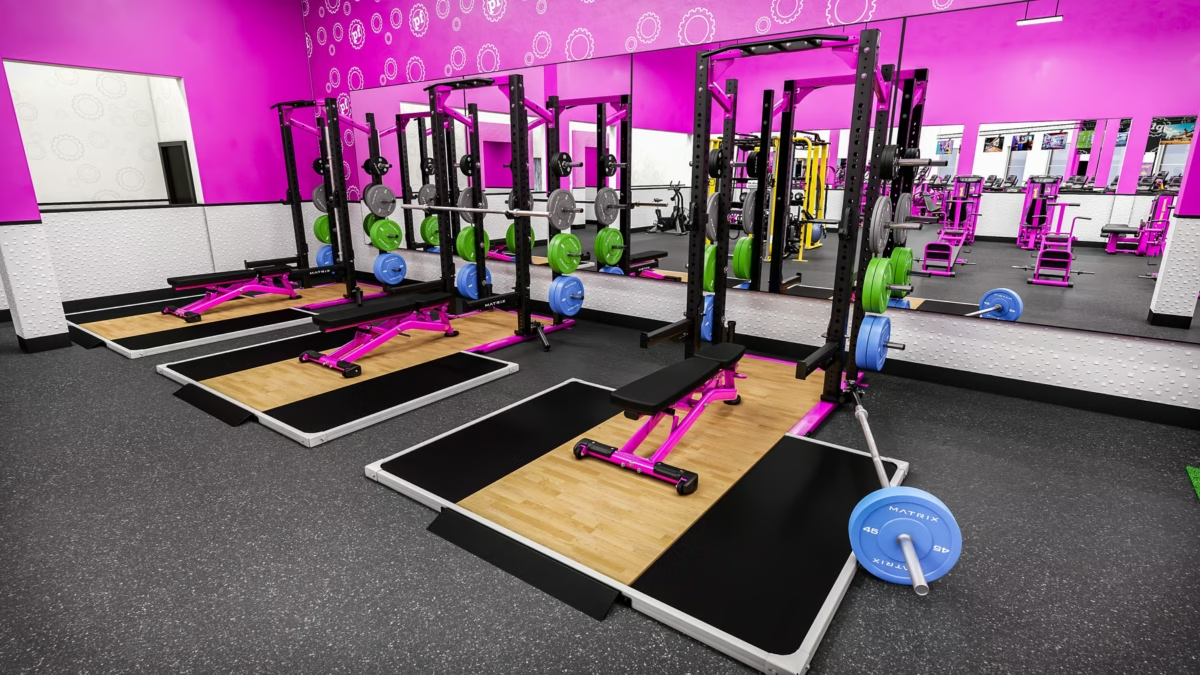
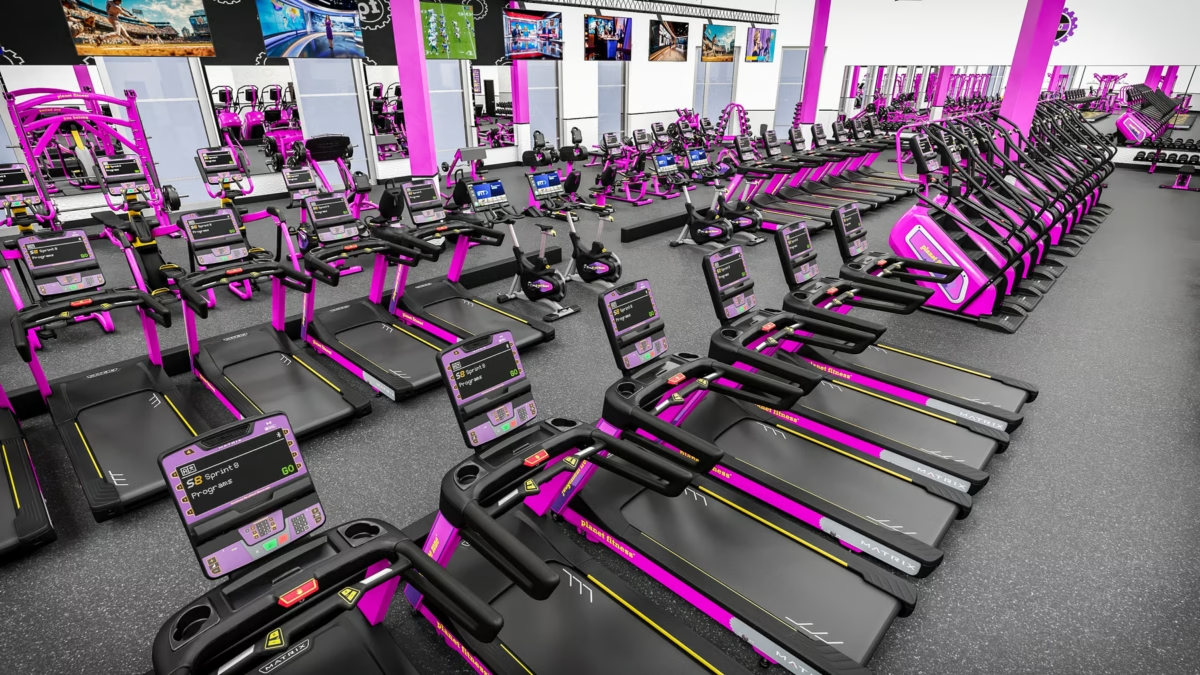
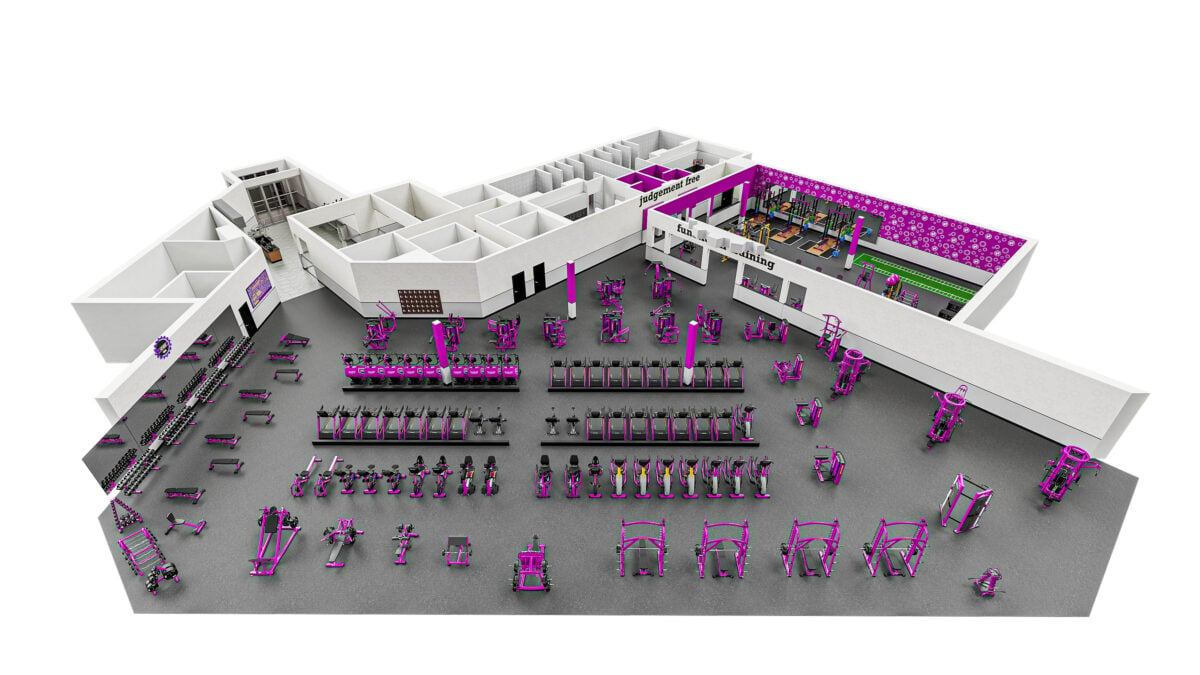
The Lower Sackville facility will include cardio, strength and functional training equipment, as well as free fitness training and PF Black Card Spa amenities. Equipment will include treadmills, ellipticals, rowers, free weights, Smith machines and cable towers, with a dedicated area for functional training.
The club will also offer a PF Black Card Spa, where members with the PF Black Card membership can access amenities including HydroMassage, massage chairs, tanning and Total Body Enhancement.
The company said prospective members can join ahead of the opening under a limited-time pre-opening offer. New members can enrol for $1 and choose a Classic membership for $15 a month or a PF Black Card membership for $24.99 a month, compared with the regular $29.99 monthly price for the latter. The offer is available without a commitment until Sept. 16.
The Lower Sackville location will be the third Planet Fitness club in the Halifax area. The company also has locations in Moncton, Saint John and St. John’s elsewhere in Atlantic Canada.
Planet Fitness said its Classic membership starts at $15 a month, while the PF Black Card membership costs $29.99 a month and includes additional benefits such as the ability to bring a guest at no additional charge, access to more than 2,900 Planet Fitness locations worldwide and use of PF Black Card Spa amenities.
Planet Fitness photo
The company said further details about the grand opening of the Lower Sackville location will be announced closer to its opening this fall.
Planet Fitness was founded in 1992 in Dover, N.H. As of March 31, 2026, the company had approximately 21.5 million members and 2,909 clubs across the United States and several other markets, including Canada, Panama, Mexico, Australia and Spain.
Approximately 90 per cent of Planet Fitness clubs are owned and operated by independent business owners, the company said.
Retailers increasingly use WhatsApp groups to coordinate store events, support local communities, communicate with partners, and manage customer interest groups. However, the contact information generated through these conversations often remains separate from spreadsheets, customer relationship management systems, and other retail tools. A WhatsApp Group Number Export tool can help retailers organize contacts from relevant groups into structured files for review.
Exporting numbers is only the first step. Retailers must still determine why each contact was collected, remove duplicate records, confirm permission for future communication, and protect the resulting files. A reliable workflow treats WhatsApp group data as information that requires verification rather than as an automatic marketing list.
Why Retail Contact Data Becomes Fragmented
Retail contact information can originate from physical stores, ecommerce platforms, loyalty programs, events, social media, and messaging applications. Without a consistent process, different teams may maintain separate and incomplete records.
Customer Conversations Often Sit Outside the CRM
Store employees may create WhatsApp groups for product launches, workshops, appointment reminders, community events, or customer support. These groups can be useful for immediate communication, but their participants may not appear in the retailer’s central customer database.
Manual copying is possible for a small group, but it becomes inefficient when a business manages several locations or recurring events. Employees may also record names and numbers in different formats, making later comparison difficult.
Store, Event, and Partner Groups Can Overlap
The same person may participate in multiple groups. A supplier could belong to both a vendor group and a store-opening group, while a customer might join separate groups for local events and product updates.
Combining these records without preserving their original group information can remove valuable context. Retailers may no longer know where the contact came from or why the individual joined a particular conversation.
Group Membership Does Not Equal Marketing Consent
Participation in a WhatsApp group does not automatically demonstrate permission to receive promotional messages through another channel.
A customer may have joined a group to attend one event or obtain support for a purchase. Retailers should therefore keep the technical process of exporting contact information separate from the legal and operational process of verifying consent.
Define the Retail Use Case Before Exporting
Before processing any contacts, the retailer should identify the business purpose and decide which groups are relevant.
Identify Retailer-Managed Groups
The workflow should focus on groups that the organization owns or is authorized to manage. These may include:
store event and workshop groups;
retailer-operated customer communities;
franchise or branch coordination groups;
approved supplier and wholesale partner groups;
internal retail operations groups.
Personal groups and unrelated communities should not be included simply because an employee can access them.
Separate Different Types of Participants
Customers, employees, suppliers, administrators, and business partners should not be combined into one undifferentiated file.
Separating these audiences reduces the risk of sending inappropriate communications. It also helps teams apply the correct retention, access, and consent rules to each category.
Choose Only Necessary Data Fields
Retailers should collect only the information needed for the defined purpose. Depending on the workflow, useful fields may include the phone number, country code, display or saved name, group name, and whether the number is already saved.
Additional classifications can be added during review, but assumptions about customer status, preferences, or consent should not be inferred from group membership alone.
How to Export WhatsApp Group Contact Data
WAExport operates as a Chrome extension alongside WhatsApp Web. It can process one, multiple, or all accessible groups and export the resulting information into structured formats.
Select the Relevant Groups
After installing the extension and opening WhatsApp Web, the user can select the groups required for the approved retail task.
Limiting the export to relevant groups makes the file easier to review and reduces unnecessary collection. For recurring workflows, retailers can document which groups belong to each store, event, or operating function.
Apply Filters Before Downloading
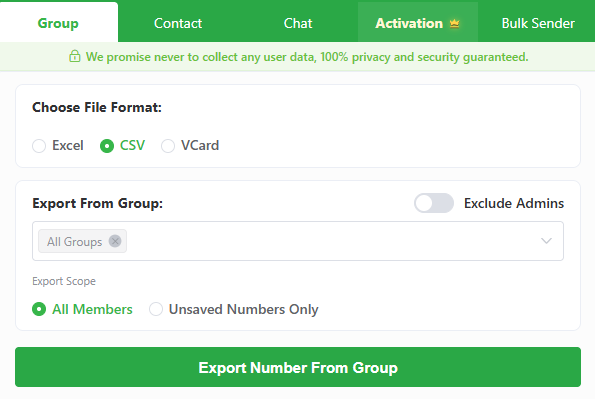
A WhatsApp group contacts extractor can filter unsaved phone numbers and exclude group administrators when they are not part of the intended dataset.
These options can reduce manual cleanup, but the file should still be inspected after downloading. An administrator may also be a customer or employee, while an unsaved number may not contain enough information to identify its owner.
Choose the Appropriate File Format
WAExport supports XLSX, CSV, and VCF exports. Each format serves a different retail workflow:
XLSX is useful for manual review, tagging, and reconciliation;
CSV can prepare verified records for import into compatible CRM or loyalty systems;
VCF is suitable for creating approved device contact lists.
The tool generates the specific export file locally in the browser rather than uploading that file to its servers. Retailers should still protect the downloaded copy and store it only in approved locations.
Clean and Organize the Exported Records
Raw contact data should be reviewed before it enters any operational system.
Remove Duplicate Numbers
Phone numbers provide a practical starting point for identifying duplicate records across groups. Retailers should standardize the number format before comparing files because the same contact may appear with different spacing, punctuation, or country-code conventions.
Duplicate removal should not erase useful source information. If one customer belongs to several approved groups, the record can retain those group names as separate source fields.
Standardize Names and Country Codes
Display names may include abbreviations, emojis, store references, or informal labels. Teams can normalize these fields where reliable information is available, while leaving uncertain records unchanged for later verification.
Country codes should also be checked, especially when the retailer serves tourists or operates across international markets.
Preserve the Original Context
A well-structured retail file should show where each record originated. Relevant source fields may include:
store or branch;
WhatsApp group;
event or campaign;
date of export;
contact category;
permission status;
last verification date.
This context helps employees understand how a record may be used and prevents unrelated audiences from being combined.
Prepare the Data for Retail Systems
Once the file has been cleaned, it can be matched against existing retail records.
Review Records in a Spreadsheet
A spreadsheet allows teams to inspect missing names, duplicate numbers, inconsistent country codes, and unclear group sources before importing anything.
It can also be used to flag records that require consent confirmation or review by a store manager.
Import Only Verified Contacts
A CSV export can be prepared for a compatible CRM, customer service platform, or loyalty system. WAExport does not automatically connect exported records to these platforms, so retailers must follow the destination system’s import requirements.
Only approved and verified fields should be imported. A retailer should not label every group participant as a customer, lead, or subscriber without supporting information.
Protect Customer Trust and Privacy
Contact data should be handled with the same care as information collected through ecommerce checkouts, loyalty programs, and customer service systems.
Verify Consent Before Outreach
Before sending promotional messages, retailers should confirm that the planned communication matches the permission provided by the recipient. The consent record should specify the relevant channel and purpose where required.
Customers should also have a clear method for withdrawing permission.
Restrict Access to Exported Files
Downloaded files should be available only to employees who need them for the approved task. Retailers can use controlled folders, access permissions, and defined ownership to prevent informal copies from spreading across personal devices.
Establish Retention and Deletion Rules
Exported files should not be stored indefinitely. Each retailer should determine how long the working file is needed, when verified records may move into an approved system, and when temporary copies must be deleted.
Build a Repeatable Retail Contact Workflow
WhatsApp group contact export is most useful when it forms part of a documented process. Retailers should define who may perform exports, which groups may be included, how records are cleaned, who verifies consent, and where the final information is stored.
This turns scattered group information into structured retail data without treating every available number as a marketing opportunity. The result is a more practical contact-management workflow that supports store operations while maintaining customer trust.
If you run a small business in London, you’ve been here before. You write a proper email to a prospect, hit send, and hear absolutely nothing back. No reply, no open, nothing. And it’s been getting worse year on year.
Cold B2B email outreach now converts at miserable rates. Some studies put reply rates for unsolicited messages at under 1%. Inboxes are so packed with newsletters, promos and automated sequences that even a genuinely good email gets buried before anyone scrolls down far enough to spot it. The businesses actually winning new clients in London right now are the ones picking up the channels everyone else walked away from
The Inbox Arms Race Nobody Wins
Every business with an email list is scrapping over the same tiny window of attention. Open rates across B2B have gone up on paper, but a lot of that comes down to Apple’s Mail Privacy Protection pre-loading tracking pixels and inflating the numbers. Real engagement tells a different story. People spend less than nine seconds reading a brand email on average, down from over 13 seconds just a couple of years ago.
So what do businesses do? They send more emails, more often, with pushier subject lines. Which just makes the whole thing worse. Your prospect’s inbox isn’t a quiet room where your message gets a fair hearing. It’s a packed Tube carriage at rush hour, and you’re trying to tap someone on the shoulder from the other end of the car.
For London SMEs selling to other businesses, that bottleneck is a real problem. You can’t grow if nobody reads what you send.
Why the Phone Became a Contrarian Move
Here’s where it gets interesting. Because email took over everything, the phone became underused, and that actually made it more effective again. Ofcom data shows roughly 42% of UK adults now screen calls or let them go to voicemail before deciding whether to pick up. Nearly half of people surveyed say they don’t like unexpected calls. That sounds like a good reason to avoid the phone altogether, but it works the other way round.
When everyone defaults to email and LinkedIn messages, a well-timed call cuts through. The businesses doing this well aren’t reading off a cold-call script. They’re running targeted outreach to researched lists, often through appointment setting solutions in the UK that handle the whole process externally. The result isn’t a wishy-washy “let’s connect” reply. It’s a confirmed meeting in the diary with a decision-maker who’s already been qualified.
That distinction matters. A lot of London firms have stopped asking their own sales teams to make these calls, partly because it’s tough to hire people who are good at it, and partly because a specialist team doing it full-time will deliver more consistent results.
Trade Events and Face-to-Face Still Work
London has a trade show or industry event on most weeks, and they haven’t lost their pull. If anything, attendance has picked back up since the post-pandemic dip faded. For small businesses, the maths is dead simple: you’ll have a proper conversation with 20 or 30 people in a single day. Good luck doing that over email.
The trick is being selective. Not every event will be a fit, and plenty of exhibitors waste money on the wrong ones. The businesses getting real value tend to follow up fast, usually within 48 hours, because that’s the window where the conversation is still fresh in someone’s head.
The Channel Everyone Else Forgot
There’s an awkward truth buried in all of this. The most effective outreach channel at any given moment is usually the one your competitors have abandoned. Direct mail has made a quiet comeback among London B2B firms for exactly this reason.
When someone gets a physical letter, they notice it because it’s rare. Attention is the scarce resource, and the businesses winning new clients are the ones going where attention still exists.
Where Attention Goes Next
Email isn’t dead, but treating it as your only outreach channel will leave you talking to yourself. London businesses that are growing right now tend to mix two or three methods: phone-based outreach for high-value prospects, events for relationship-building, and email for nurturing leads who’ve already engaged.
The pattern is the same across almost every sector. Go where your competitors aren’t and stop leaning on the channel that stopped working two years ago.
A couple of years ago, you could spot a phishing email from a mile off. Bad grammar, a vague “Dear Customer” greeting, a weird logo, a sender address with a few too many random numbers in it. Most people binned them without thinking twice, and spam filters mopped up whatever slipped through. That’s not how it works anymore. Attackers are now feeding large language models the right prompts and getting back emails that sound like they were written by someone in your own office.
They’ll match the tone, reference actual projects, and read like any other internal message you’d get on a Monday morning. The UK government’s Cyber Security Breaches Survey 2025/2026 found that 85% of breached businesses pointed to phishing as the root cause. The old playbook of relying on filters and common sense isn’t cutting it, and the gap between what attackers can do and what most companies are prepared for is only getting wider.
How AI Makes Phishing Emails Harder to Catch
Traditional spam filters scan for known red flags. They’ll catch suspicious domains, blacklisted IP addresses, dodgy attachments, and clumsy wording. For a long time, that was good enough to stop most of the rubbish.
AI-generated phishing doesn’t trip any of those wires. Give a large language model the right prompt and it’ll spit out an email that’s grammatically clean, sounds natural, and dodges every pattern a filter’s been trained to look for. No spelling mistakes and no robotic phrasing that a filter would latch onto.
But grammar’s only part of the story. Attackers are pulling publicly available data from LinkedIn profiles, company websites, even press releases, and they’re folding all of that into the email. So if someone just got promoted, or their company announced a new partnership last week, that detail ends up in the message. The recipient gets an email that looks like it came from a colleague or a supplier, and it mentions something they actually know about. That’s a hard thing to second-guess when you’re halfway through your inbox before lunch.
The Verizon 2025 Data Breach Investigations Report puts the median time for someone to click a phishing link at just 21 seconds. That’s before most people have even finished reading the thing. When the message already looks believable, that instinct to click becomes almost automatic.
Why Spam Filters Fall Short
Most email security tools are reactive by design. They compare incoming messages against databases of known threats, scan for malicious URLs, and check sender reputations. If something matches a threat they’ve already catalogued, it gets blocked.
AI-generated phishing doesn’t match anything on file. Every email can be completely unique, with no reused templates and no recycled payloads. This is what’s known as polymorphic phishing, where every message is slightly different, and it makes signature-based detection close to useless.
On top of that, generative AI lets attackers churn out thousands of these personalised emails in minutes. Instead of blasting one generic template to 10,000 inboxes, they’re sending 10,000 individually tailored messages, each one built to convince a specific person.
What Actually Works Against AI Phishing
If filters alone won’t stop these emails from landing in people’s inboxes, the focus has to move towards what happens after they arrive. That means getting staff to a point where they can spot the subtle signs that something’s off, even when the email looks polished and professional.
Security awareness training is the most direct way to tackle this. And not the once-a-year compliance tick-box that everyone clicks through in ten minutes. It needs to be ongoing, with realistic examples and regular testing. Phishing simulations are a big part of that. They’ll give organisations actual data on who’s clicking, who’s ignoring, who’s reporting suspicious messages, and where the weak spots are. Reputable cyber security firms like Equilibrium Security now run structured simulation programmes that track how employees respond across repeated exercises, so the training adapts based on real employee behaviour.
Behavioural analytics add a different kind of protection. These tools monitor how people interact with their email and flag anything unusual. If someone on the finance team suddenly starts downloading attachments from an unfamiliar sender at 2am, that gets picked up. It’s less about blocking individual messages and more about catching what happens after someone takes the bait.
Multi-factor authentication won’t stop anyone from clicking a dodgy link, but it will limit what an attacker can do with stolen credentials. Even if a username and password get harvested, MFA puts another barrier in the way before they can actually get into the account.
Don’t Wait for the Filter to Catch Up
None of these measures will do much on their own. Simulations without MFA leave a gap. Analytics without proper training means you’re always reacting after the fact instead of preventing the problem in the first place. The companies that get this right treat phishing defence as a layered stack, where each piece covers what the one before it misses.
AI-powered phishing isn’t something that’s coming down the line. It’s already the main method attackers use to break into UK businesses. Spam filters will keep getting better, but they’ll always be playing catch-up with attackers who can generate fresh, convincing content whenever they want. The organisations that stay ahead will be the ones putting money into their people and their processes, not just tweaking their inbox rules and hoping for the best.
Welcome to the Daily Synopsis by Retail Insider. We hope you enjoy the 13 articles we published covering key developments in Canadian retail.
Michael Hill is accelerating its Canadian expansion after a record fiscal 2026 marked by 7.3% revenue growth and a 22% surge in online sales, identifying Canada as its fastest-growing and most promising market. Loblaw is accelerating its $1.2 billion capital investment in 2026 to expand its No Frills and Maxi discount grocery stores across Canada, responding to strong performance and shifting consumer preference toward value. Canadian retailers are entering the 2026 holiday season with increased consumer spending and order volumes, despite ongoing economic uncertainty and heightened price sensitivity among shoppers.
Temu is shifting from a primarily international discount marketplace to a more localized Canadian model by incorporating domestic sellers and fulfillment, facilitated through a Shopify integration. Williams-Sonoma identifies Canada as a key driver of its international growth, with increasing market share in a stagnant home furnishings sector supported by digital expansion and trade business development.
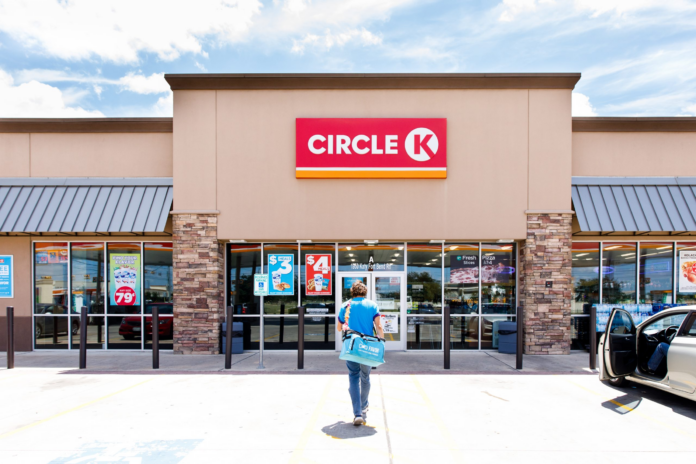
Circle K store/ Couche Tard. Photo: Yonge + St. Clair
Alimentation Couche-Tard Inc. reported higher earnings and sharply higher revenue in the first quarter of fiscal 2027, while merchandise sales at its Canadian convenience stores were flat amid continued pressure in tobacco-related categories.
The Laval, Quebec-based owner of Circle K and Couche-Tard reported revenue of US$21.7 billion for the 12-week period ended July 19, up 25.1% from a year earlier. Net earnings attributable to shareholders reached US$828.5 million, compared with US$782.5 million, while adjusted net earnings rose 12.2% to approximately US$827 million. Adjusted diluted earnings per share increased 15.4% to US$0.90.
Higher fuel prices accounted for much of the revenue increase. Couche-Tard said higher average road transportation fuel selling prices, acquisitions and organic growth in its convenience operations contributed to the gain, partly offset by softer fuel demand. Foreign exchange added approximately US$64 million to reported revenue.
Canadian Convenience Sales Remain Soft
Same-store merchandise revenue was flat in Canada during the quarter, compared with growth of 1.7% in the United States and 1.2% in Europe and other regions. Consolidated same-store merchandise revenue increased 1.6%.
The Canadian result follows a marked slowdown over the past year. Same-store merchandise revenue increased 5.4% in the second quarter of fiscal 2026 before growth slowed to 0.3% in the third quarter and turned negative at 0.9% in the fourth quarter. In the first quarter of fiscal 2026, Canadian same-store merchandise revenue had increased 4.1%.
The category performance indicates that the slowdown is not uniform across the store. Couche-Tard said packaged beverages and alcohol grew in Canada during the latest quarter, but those gains were offset by the impact of regulations and competition on tobacco.
Tobacco-related pressures had also weighed on Canadian results in preceding quarters. In the fourth quarter, Couche-Tard attributed the 0.9% same-store merchandise decline partly to tobacco industry challenges, while alcohol remained a stronger-performing category.
Total Canadian merchandise and service revenue declined 2.6% to US$599.9 million during the quarter. Merchandise and service gross margin fell 0.6 percentage points to 33.3%.
Couche-Tard said the margin decline in Canada and the U.S. reflected category mix and deliberate pricing decisions aimed at supporting customer value. Chief Financial Officer Filipe Da Silva said the company continues to invest in value and traffic-driving initiatives while advancing its broader strategic priorities.
Canadian Fuel Volumes Move Higher
Fuel produced a stronger Canadian result during the quarter. Same-store road transportation fuel volumes increased 1.1% in Canada, while volumes declined 1.6% in the United States and 4.3% in Europe and other regions.
Couche-Tard said Canadian volumes benefited from promotional activity and market growth, while high retail prices contributed to weaker demand in the U.S. and Europe.
Canadian road transportation fuel gross margin reached 16.79 Canadian cents per litre, up 2.58 cents from the comparable quarter last year. Higher fuel margins were among the main contributors to Couche-Tard’s adjusted earnings growth, alongside acquisitions, organic convenience growth and share repurchases.
The Canadian fuel business has been comparatively resilient in recent quarters. Same-store fuel volumes increased 4.2% in Canada in the third quarter of fiscal 2026 and 2.0% in the fourth quarter, while both the U.S. and Europe recorded declines during those periods.
Fuel Prices Drive Much of Revenue Increase
Road transportation fuel revenue reached US$16.7 billion during the first quarter, an increase of approximately US$4.1 billion from a year earlier. Couche-Tard said approximately US$3.9 billion of that increase resulted from higher average fuel selling prices.
Acquisitions contributed about US$436 million to fuel revenue growth, with those gains partly offset by softer demand.
Merchandise and service revenue grew at a much slower rate, increasing 4.1% to US$4.9 billion. Acquisitions contributed approximately US$112 million to the increase, along with organic growth in the convenience business.
The fuel-price impact puts Couche-Tard’s 25.1% increase in total revenue into perspective. Higher retail fuel prices added billions of dollars to reported sales, while consolidated same-store merchandise revenue increased 1.6%.
President and CEO Alex Miller said Couche-Tard was encouraged by the start of fiscal 2027 and pointed to the company’s fifth consecutive quarter of positive same-store merchandise growth in the U.S. He also highlighted continued momentum in food, energy drinks and other nicotine products, along with the profitability of the fuel business.
Couche-Tard Continues Store Investment
Couche-Tard continued to invest in its physical network during the quarter, acquiring two company-operated stores, constructing 12 locations and completing eight relocations or reconstructions. Another 42 stores were under construction as of July 19.
Those figures cover the company’s global network. Couche-Tard operates in 27 countries and territories with more than 17,200 stores, approximately 13,100 of which sell road transportation fuel. Its principal retail banners include Circle K and Couche-Tard.
Canada remains one of Couche-Tard’s largest markets, with more than 2,000 locations across the country.
Żabka Acquisition Would Expand European Footprint
Couche-Tard is also pursuing a major expansion in Central and Eastern Europe through its proposed acquisition of Żabka Group.
The company announced after the quarter that it plans to acquire the Polish convenience retailer, which operates more than 13,000 stores across Poland and Romania. Shareholders representing approximately 57% of Żabka’s outstanding shares have entered into agreements to tender their holdings into the offer.
The proposed transaction values Żabka at approximately US$8.6 billion and is expected to close before the end of Couche-Tard’s fiscal 2027, subject to regulatory approvals and other conditions. Miller said the acquisition would strengthen Couche-Tard’s capabilities in food, digital engagement and supply chain while expanding its scale in Central and Eastern Europe.
Canadian Merchandise Growth Remains a Watch Point
Couche-Tard enters fiscal 2027 with higher earnings and strong fuel profitability, while its Canadian convenience business continues to show slower merchandise growth than it did a year ago.
The latest quarter provides some indication of where that pressure is concentrated. Packaged beverages and alcohol continued to grow, while tobacco-related regulatory and competitive pressures held back the overall Canadian same-store result. Fuel volumes remained positive in Canada despite declines in Couche-Tard’s U.S. and European operations.
Management is scheduled to discuss the results with analysts during Couche-Tard’s earnings webcast on September 2 at 8 a.m. EDT, and Retail Insider will report on the discussion.
These essential neighbourhood services will create more than 130 jobs locally, adding to the economic and social vitality of a town whose population has surged by more than 20 per cent over the past decade, said the company.
It said the project will feature the very first Super C in Mascouche, “a long-awaited announcement that will expand access to a wider variety of food products for local residents and create about 100 jobs in the area. This opening further strengthens Super C’s presence in Québec, where the chain now has 122 stores.”
“The future discount store, with approximately 36,000 square feet of floor area, will offer local residents a range of products that deliver quality, freshness and value. Customers will find everything that Super C is best known for: competitive prices, a wide selection of fresh produce, an in-store meat counter, and convenient services such as online ordering, in-store pickup and delivery,” it added.
“This project marks a new collaboration between MONTONI and the Super C and Jean Coutu banners, three well-established brands in Québec that share the same commitment: to create lasting value and make a positive contribution to local communities,” said Dario Montoni, President of the real estate company.
“The opening of our first store in Mascouche marks another important step in strengthening Super C’s position as Québec’s premier discount retailer. We are proud to contribute to the region’s food offering and make quality products at very competitive prices accessible to even more consumers, all within a simple and efficient shopping experience guided by our three guarantees: Always fresh, always in stock, always great prices,” added Anna Kolakowski, Senior Vice-President of Super C.
MONTONI said the development will also incorporate a Jean Coutu affiliated pharmacy covering nearly 15,700 square feet, run by pharmacists owners Catherine Roy and Jean-Christophe Guay, who are already well known in the region as owners of the one on Chemin Gascon in Terrebonne.
MONTONI photo
The store, designed to reflect the banner’s latest concept, will deliver a modern and user-friendly shopping experience featuring an optimized layout and a spacious, welcoming cosmetics section. Customers will also have access to a range of convenient services, including online ordering and in-store pickup, home delivery, self-service checkouts and self-service prescription pick-up lockers, it explained.
The opening of this new store will create around 30 jobs in the region.
“We are extremely pleased to be establishing roots in Mascouche and to be providing the citizens with greater access to high-quality healthcare and community services. This new location will enable us to support the community by offering personalized advice, accessible pharmacy services and a wide range of health and wellness products, all in a friendly atmosphere,” said Roy and Guay.
Dario MontoniAnna Kolakowski
MONTONI develops, builds and manages real estate projects and it has completed more than 700 projects representing over 30 million square feet of industrial, commercial, institutional and residential construction and 30 corporate campuses, with another 25 million square feet under development–an impressive portfolio of properties across Québec.
It has completed more than 7 million square feet of LEED-certified buildings and over 2.3 million square feet of Zero Carbon Building (ZCB) spaces. Construction is also nearing completion on properties totalling nearly 7 million square feet.
With annual sales of more than $22 billion, METRO Inc. is a food and pharmacy leader in Québec and Ontario, providing employment to more than 97,000 people. As a retailer, franchisor, distributor, manufacturer, and provider of eCommerce services, the company operates or services a network of some 1,000 food stores under several banners including Metro, Metro Plus, Super C, Food Basics, Adonis and Première Moisson, and some 640 pharmacies primarily under the Jean Coutu, Brunet, Metro Pharmacy and Food Basics Pharmacy banners.
The project, developed in collaboration with the City of Mascouche, incorporates a number of measures designed to encourage a seamless integration into the neighbourhood. These include, among others, the installation of a green noise barrier, the preservation of a protected wooded area, the planting of hundreds of trees and shrubs, and the installation of infrastructure to encourage active transportation. These initiatives are in line with MONTONI’s responsible development approach and the principles of its PURE by MONTONI program, said the real estate developer.
“This groundbreaking ceremony marks a significant milestone for residents of the Chemin des Anglais area. With the arrival of two major retail chains, they will soon be able to enjoy convenient access to local businesses that meet their day-to-day needs. I would like to thank Groupe Montoni for its partnership in a project that will improve the choice of shopping options in an area that was in real need of them, while minimizing the impact on the neighbourhood,” added Guillaume Tremblay, Mayor of Mascouche.
Micheal Hill Pacific Center Boutique. Source: Michael Hill
Michael Hill is increasing its investment in Canada after the country emerged as the jewellery retailer’s fastest-growing market, with stronger sales, rising profitability and a significant store modernization program planned for the year ahead.
Canadian revenue increased 7.3% to CAD $174.2 million in fiscal 2026, while same-store sales rose 7.0%. Comparable EBIT increased 16.3% to CAD $21.9 million, and gross margin improved by 20 basis points to 60.3%. Michael Hill described Canada as its fastest-growing market by sales and its clearest growth opportunity.
Momentum has continued into fiscal 2027. During the first eight weeks of the new financial year, Canadian same-store sales increased 9.8%, compared with gains of 1.7% in Australia and 3.3% in New Zealand. Michael Hill is responding with additional investment in Canadian marketing and inventory, plans to modernize five of its six highest-volume stores and a continued search for new locations.
Canadian Sales and Profitability Reach New Highs
Michael Hill attributed its record Canadian year in part to a market-specific approach to products, promotions and marketing. Canadian online sales increased 22% during fiscal 2026, significantly ahead of the 10% increase across Michael Hill’s global online business.
Bridal was another major contributor. The Canadian segment recorded particularly strong bridal growth, while improved performance in diamond fashion and coloured stones helped support gross margin. Stronger bridal sales also lifted average transaction values and brought higher-value customers into the business.
Chief Executive Officer Jonathan Waecker told analysts that Michael Hill continues to see considerable room for growth in Canada, citing the resilience of the market and the retailer’s relatively modest market share.
“In Canada, we are just facing into a market with an incredible amount of opportunity,” Waecker said during the results presentation. He also pointed to the 22% increase in Canadian online sales as evidence of the opportunity across stores and e-commerce.
The Canadian business posted the stronger results despite higher security expenses following a series of robberies and other security incidents. Michael Hill said those incidents have since slowed.
Micheal Hill CF Pacific Center Boutique. Source: michael-hill.prezly.com
Michael Hill Targets an 85-to-90-Store Canadian Network
Michael Hill ended fiscal 2026 with 81 stores in Canada and continues to target what it describes as an optimal footprint of between 85 and 90 locations. The retailer says it currently operates Canada’s second-largest fine-jewellery store network.
The expansion target follows several years of network consolidation. Michael Hill operated 86 Canadian stores at the end of fiscal 2023, 85 in fiscal 2024 and 82 in fiscal 2025 before finishing fiscal 2026 with 81. In the latest year, one Canadian store opened and two closed.
Sales have moved in the opposite direction. Canadian revenue reached successive records even as the store count declined, including CAD $157.1 million in fiscal 2024, CAD $162.4 million in fiscal 2025 and CAD $174.2 million in fiscal 2026.
The history helps explain Michael Hill’s current approach. New stores remain part of the plan, while capital is increasingly being directed toward productive existing locations, higher-value products and improvements to the customer experience.
Peoples Jewellers describes itself as Canada’s largest fine-jewellery retailer, with more than 90 locations from the Maritimes to British Columbia. Michael Hill’s stated target of 85 to 90 stores would keep its physical network close in scale to the country’s largest national fine-jewellery chain.
Five Major Canadian Stores to Be Modernized
Michael Hill plans to modernize five of its six highest-performing Canadian stores in fiscal 2027, extending its refreshed network across Toronto, Vancouver, Calgary and Edmonton. The company has not publicly identified the five locations.
The program follows major investments in Toronto and Vancouver. Michael Hill relaunched its Yorkdale Shopping Centre store as a Canadian flagship on November 1, 2025, incorporating the retailer’s updated brand design, consultation areas, personalized jewellery offerings and expanded customer experiences.
In April 2026, Michael Hill opened a new flagship at CF Pacific Centre in downtown Vancouver. The location became the retailer’s second new-concept flagship in Canada, following Yorkdale, and forms part of its broader move toward a more premium and experience-focused retail environment.
Michael Hill says the economics of its refitted stores are encouraging. Across the broader network, refreshed locations are recording improvements in average transaction values, margins and conversion rates above the network average.
Bridal and Bespoke Jewellery Drive Higher-Value Sales
Bridal is taking on a larger role in Michael Hill’s Canadian business. Strong bridal sales contributed to gross profit growth during fiscal 2026, increasing average transaction values while attracting customers the retailer believes can generate greater lifetime value.
The company has also expanded its bespoke jewellery service to more than 40 stores across Australia and Canada. Average bridal transaction values through the bespoke program are running well above Michael Hill’s overall bridal average.
Personalization is gaining ground elsewhere in the business. Made For You personalized and custom products now account for more than 15% of Michael Hill sales, while the company has identified men’s jewellery, core categories, bridal and watches among its areas for further development. Its diamond strategy includes premium lab-grown diamonds alongside natural diamonds. The newer Canadian flagships provide a physical setting for that strategy, with greater emphasis on consultations, personalization, bridal appointments and service.
Michael Hill @ Market Mall
Online Sales Surge 22% in Canada
Michael Hill’s Canadian growth is increasingly coming through digital channels as well as stores. Online sales increased 22% during fiscal 2026, and the retailer plans further investment in its online customer experience, including expanded buy-online-pickup-in-store capabilities and clienteling tools for frontline employees.
The online increase substantially exceeded Michael Hill’s overall e-commerce growth of 10% for the year. As the company considers additional Canadian stores, it is also generating greater sales through a digital channel that management describes as the largest store in the business.
A More Disciplined Approach to Canadian Expansion
Michael Hill first expanded into Canada in 2002 and has spent more than two decades building its presence across the country. Its first Canadian store was opened and operated by Emma Hill, daughter of founders Sir Michael Hill and Christine Hill.
The latest strategy places greater weight on the economics of that network. Across the group, gross profit per store increased 4% in fiscal 2026 while inventory productivity improved 13%, giving Michael Hill greater confidence to reinvest selectively in productive inventory and stronger locations.
Capital spending has also shifted toward physical retail after several years of heavier technology investment. Michael Hill built or refreshed 14 stores globally during fiscal 2026, including four flagships, and expects capital expenditure and SaaS-related spending to increase to about AUD $25 million in fiscal 2027 as further store upgrades and an AI-enabled inventory planning project proceed.
In Canada, the strategy combines a modest increase in potential store count with heavier investment in important locations, inventory, bridal and bespoke services, digital capabilities and marketing.
Canada Takes a Larger Role in Michael Hill’s Turnaround
The Canadian investment comes as Michael Hill simplifies its global business and directs resources toward its strongest opportunities. The company has reduced its portfolio to two core brands: Michael Hill as its international business and Bevilles as its Australian value jewellery banner.
Michael Hill has set a medium-term goal of reaching an EBIT margin of at least 10%, with stronger store productivity, sustainable sales growth, gross margin improvement and operating leverage identified as the four principal drivers.
Fiscal 2026 marked considerable progress. Group revenue reached a record AUD $655.7 million, same-store sales increased 5.2% in constant currency and comparable EBIT rose 57% to AUD $24 million. Net debt fell to AUD $5.5 million from AUD $41.9 million a year earlier, strengthening the balance sheet ahead of further investment.
Canada now has a prominent role in that strategy. Sales growth is running ahead of Michael Hill’s other markets, e-commerce increased 22% in fiscal 2026, five major stores are scheduled for modernization and additional locations remain under consideration.
The shift is particularly notable given the recent contraction in the Canadian network. Michael Hill is generating record sales from fewer stores and is now preparing to grow the footprint again selectively, with an eventual target of 85 to 90 locations. The next stage of its Canadian expansion will be measured as much by what those stores produce as by how many stores the retailer operates.
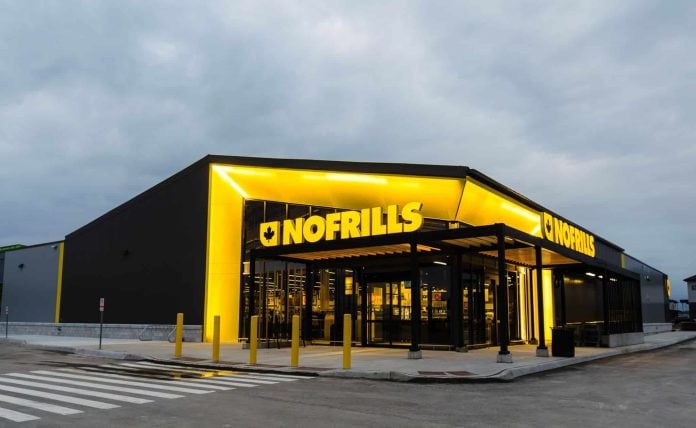
New concept No Frills store in Komoka. Image: Loblaw Companies
Loblaw Companies Limited is directing more of its capital toward discount grocery, with the country’s largest retailer planning approximately $1.2 billion in capital expenditures through the remainder of 2026.
The Brampton-based company expects to open approximately 75 grocery, pharmacy and other locations this year, compared with about 70 anticipated at the beginning of 2026. Loblaw says the increase reflects the performance of recently opened stores and confidence in the formats receiving investment.
About half of Loblaw’s previously announced $2.4-billion capital program for 2026 has already been deployed. The remaining investment will support additional openings, renovations and continued testing of new store concepts across Canada.
Grocery expansion will be concentrated predominantly in the No Frills and Maxi hard-discount banners, where Loblaw has been seeing strong results from newer locations.
“We’re very happy with how our new stores are performing,” Loblaw President and CEO Per Bank said. “As they mature, we’re seeing strong double-digit same-store sales growth. That gives us confidence in our expansion strategy and in continuing to invest behind the formats customers are choosing.”
Loblaw has opened 38 new grocery and pharmacy locations so far in 2026, including 21 grocery stores and 17 Shoppers Drug Mart locations, with dozens more scheduled before year-end.
Hard Discount Takes a Larger Role
Loblaw began the year expecting to spend approximately $2.4 billion in 2026 and open about 70 locations, including 31 No Frills and Maxi stores and 34 Shoppers Drug Mart, Pharmaprix pharmacies and care clinics.
By its second-quarter earnings call on July 30, management was already indicating that Loblaw was on track to open approximately 75 locations during the year. Executives also pointed to strong results from recent openings, with newer stores entering the comparable-store base producing double-digit comparable sales growth.
Those results help explain Loblaw’s increasing emphasis on discount. Bank told analysts in July that the company considers consumers’ preference for discount to be a long-term shift, making No Frills and Maxi increasingly important to its development plans.
Loblaw opened four No Frills stores and three Maxi locations during the second quarter. Management has also highlighted its conversion of a former No Frills in Bathurst, New Brunswick, to Maxi. According to Bank, sales at the location more than doubled following the conversion.
Per Bank
Canadian households remain highly attentive to price and promotions. Loblaw says the share of its grocery sales purchased on promotion has increased four percentage points since 2022, while promotional sales of its No Name private-label products have risen 18%.
“Canadians are being thoughtful about every dollar they spend,” Bank said. “We see that in how they shop our stores, the brands they choose, and how they use our loyalty and ecommerce solutions.”
Those spending patterns are influencing Loblaw’s development strategy. Its growing commitment to No Frills and Maxi indicates that management expects hard discount to remain an important part of the Canadian grocery market even as inflationary pressures change.
New No Frills Formats Target Different Markets
Loblaw is also using its expansion program to experiment with the size and design of No Frills stores.
A location that opened July 30 in Dutton, Ontario, provides one example. At approximately 8,000 square feet, the store is considerably smaller than a conventional supermarket and carries a curated assortment of about 4,000 products intended to provide a full grocery shop for Dutton and surrounding rural communities.
The smaller footprint could broaden the range of communities available to No Frills, particularly in markets that may not require or support a conventional supermarket. If the model performs well, it could give Loblaw another option for growing the banner outside larger urban and suburban markets.
Loblaw is testing a different approach in nearby Komoka, Ontario. The No Frills that opened there in March introduced a redesigned environment incorporating a hybrid timber-and-steel structure and a warmer interior, departing from some elements traditionally associated with the banner’s warehouse-style stores. The location also includes an expanded fresh and prepared-food offering.
The two Ontario locations test different approaches to future No Frills growth. Dutton pairs a smaller footprint with a tightly edited assortment for a rural market, while Komoka explores a more contemporary store environment with a broader food offering. Both retain the banner’s discount positioning.
Maxi supermarket chain, Montreal, Quebec. Image: Hkeely at https://commons.wikimedia.org/wiki/File%3AA_Maxi_supermarket_chain_grocery_store_in_Montreal%2C_Quebec%2C_Canada_01.jpg
More Than 190 Existing Locations to Be Renovated
New construction represents only part of Loblaw’s 2026 capital program. More than 190 existing locations are scheduled for renovations this year, with projects ranging from improvements to fresh-food departments to updates elsewhere in stores.
The spending will modernize portions of a grocery network that includes more than 1,100 stores across multiple banners and price segments. Loblaw is also investing in its pharmacy network, adding Shoppers Drug Mart and Pharmaprix locations while updating existing stores.
Food is becoming part of that work at Shoppers Drug Mart. Seventeen locations have completed what Loblaw describes as a food realignment, with 43 expected to be completed by year-end. The changes include a greater emphasis on convenience, value and multicultural products, alongside updates to beauty and other front-store categories.
Canada’s Discount Grocery Competition Intensifies
Loblaw’s expansion comes as other major Canadian grocers continue adding capacity at the discount end of the market.
Metro has been expanding Food Basics in Ontario and Super C in Quebec through new stores and conversions. Food Basics opened its 156th Ontario store in Mississauga in July, the fifth of eight locations the banner expected to open during 2026.
Empire Company Limited is pursuing further expansion of FreshCo. The Sobeys parent had 161 FreshCo locations as of June 17, including 53 in Western Canada and 108 in Ontario, and expects to open approximately 15 additional stores across Western Canada, Ontario and Atlantic Canada during fiscal 2027. The expansion will bring FreshCo to Atlantic Canada for the first time.
The investments underway at the country’s major grocers are changing the composition of Canada’s supermarket network. Loblaw is adding No Frills and Maxi stores, Metro continues to build its Food Basics and Super C networks, and Empire is taking FreshCo into additional markets.
For Loblaw, No Frills provides an established discount platform across several provinces, while Maxi gives the company a substantial network in Quebec and a growing presence in Atlantic Canada.
Shoppers Drug Mart (Image: Dustin Fuhs)
Shoppers and Digital Channels Also Grow
Loblaw’s capital program extends beyond grocery, with pharmacy openings and renovations remaining a significant part of its 2026 plans.
The company has opened 17 Shoppers Drug Mart locations so far this year and continues to expand pharmacy and healthcare services across its network. Changes to food, beauty and front-store categories are also being tested as Loblaw updates existing locations.
Digital sales are growing alongside the physical network. Loblaw reported ecommerce sales growth of 19.3% year over year during the second quarter, while PC Express delivery sales increased by more than 40%. Click-and-collect sales were relatively stable.
The growth in delivery is notable alongside Loblaw’s investment in discount stores. The company is expanding lower-price physical formats while continuing to build digital channels around convenience, loyalty and ecommerce.
T&T Provides Another Avenue for Expansion
T&T Supermarket represents another area of expansion for Loblaw, although its growth strategy differs considerably from No Frills and Maxi.
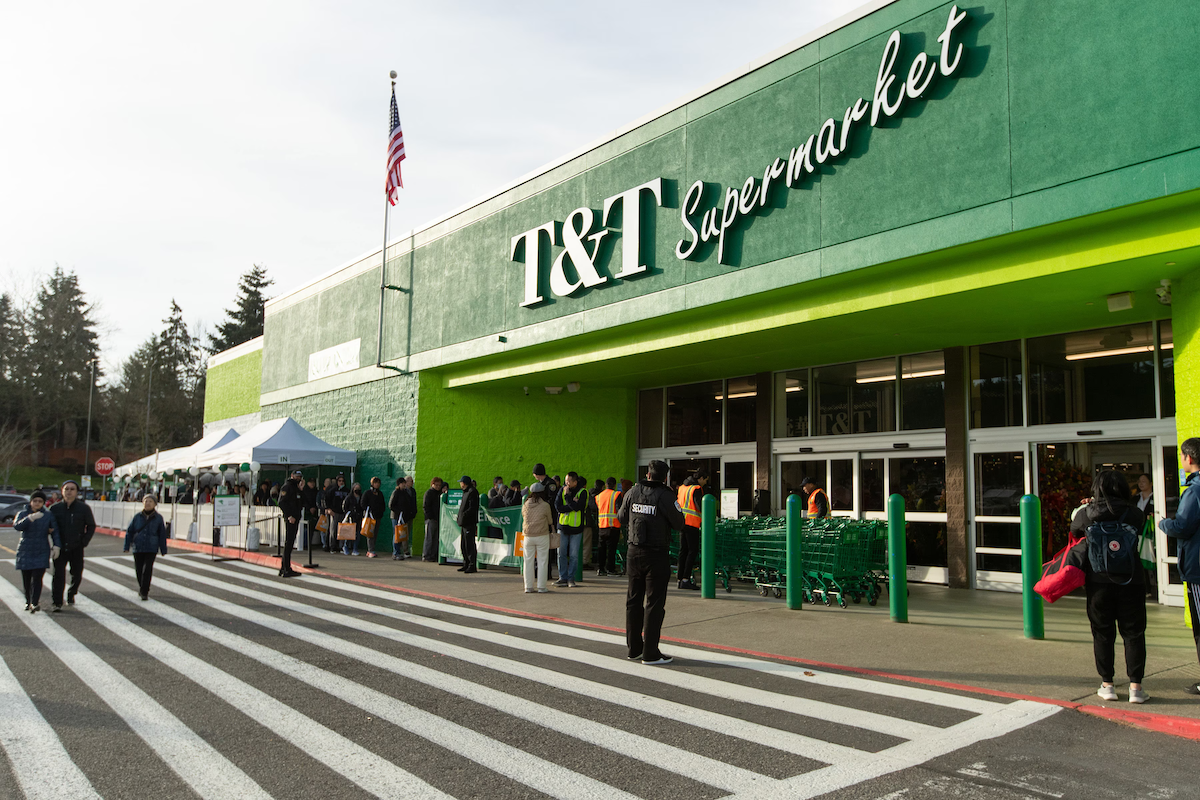
The Asian supermarket chain opened its first California store in San Jose in June, building on its expansion into Washington state. Bank told analysts that San Jose recorded the highest first-week sales of any store opening in Loblaw’s history. Two additional California locations are planned for 2026.
T&T continues to expand in Canada as well, giving Loblaw another grocery banner with growth potential as the company builds its network at home and in the United States.
T&T Supermarket in Bellevue, Washington. Photo: T&T Supermarket
A $10-Billion Investment Program Through 2030
Loblaw’s $2.4-billion capital program for 2026 represents the second year of its five-year plan to invest approximately $10 billion in Canada by 2030. The company expects this year’s program to support approximately 9,700 retail and construction jobs.
The spending is gradually changing Loblaw’s physical network. Hard discount is taking a larger role in grocery development, No Frills is being tested in different footprints and configurations, existing supermarkets and pharmacies are being renovated, and the company continues to add locations and services through Shoppers Drug Mart.
The expansion of No Frills and Maxi is one of the clearest indications of where Loblaw sees opportunity in Canadian grocery. Newer stores are producing strong results, competing grocers are adding discount capacity of their own, and Loblaw is continuing to put capital behind formats aimed at shoppers who remain highly focused on price.
Smart home brand Tapo is launching a direct-to-consumer online store in Canada, giving consumers another way to purchase the company’s connected home and security products.
The new e-commerce operation allows Canadians to buy Tapo products directly from the brand while the company continues to sell through online and physical retailers across the country.
Tapo, a smart home brand owned by TP-Link, said the online store is intended to expand the ways Canadian consumers can access its product portfolio as the company grows its presence in the market.
“The launch of Tapo’s online store marks an exciting next chapter in our Canadian growth,” said Benjamin Liu, general manager of TP-Link Canada. “We’re giving Canadians more choice in how they shop Tapo, while making it easier to discover our growing ecosystem of smart home solutions in one place. Whether they’re looking to strengthen home security, add greater convenience or build a more connected home, we want smart technology to be simple, accessible and easy to bring into everyday life.”
Benjamin LiuTapo photo
The Tapo product lineup includes indoor and outdoor security cameras, 2K and 4K security products, solar-powered and wire-free cameras, smart locks and video doorbells.
The portfolio also includes smart home hubs, motion and contact sensors, water-leak and temperature sensors, smart lighting and Wi-Fi products.
The launch gives Tapo a direct sales channel in Canada in addition to its existing retail distribution, allowing consumers to shop the company’s products through its own online storefront.
The Canadian online store launched Aug. 25.
Tapo is the smart home brand of TP-Link and offers connected products including cameras, sensors, lighting and automation devices.
TP-Link was founded in 1996 and provides networking devices and smart home products for consumers and businesses. The company distributes its products in more than 170 countries and says it serves billions of users worldwide.