

Canada’s largest grocery companies are reshaping their footprints around low-cost formats as food inflation and consumer caution persist. Loblaw, Metro, and Empire are investing billions of dollars into hard discount banners, converting conventional stores, and refining supply chains to protect price points. The acceleration in Canada discount grocery expansion reflects both opportunity and pressure in a market where total store density is quietly declining.
In a recent interview with Retail Insider, Dr. Sylvain Charlebois said expansion headlines do not tell the full story. “I actually went into numbers and tried to figure out what is the per capita ratio in Canada versus the US,” he said. Since 2020, the number of grocery stores per 100,000 Canadians has fallen from over 22 to roughly 18 or 19. “As soon as you have fewer stores based on population, you can argue that there is less competition out there or less access,” he added.

Against that backdrop of consolidation and selective closures, discount banners have become the primary growth engine.
Loblaw Scales No Frills and Maxi
Loblaw remains the most aggressive player in the value segment. In late February, the company announced a $2.4 billion investment for the year, including 70 new stores. Of those, 31 will be No Frills or Maxi locations. The broader plan sits within Loblaw’s $10 billion, five-year capital program.
The expansion is nationwide, with a heavy concentration in Ontario and Western Canada. At the same time, Loblaw continues to convert underperforming full-service stores into No Frills to capture price-sensitive urban customers. “It’s totally normal for grocers to adapt to a more frugal market,” Dr. Charlebois said, noting the shift toward discount formats.
Automation supports the strategy. Large-scale investments in distribution, including high-capacity facilities designed to lower supply chain costs, are intended to keep discount shelf prices competitive. Private labels such as President’s Choice and No Name are also central to the model, as shoppers increasingly trade down from national brands.
Metro Leans on Food Basics and Super C
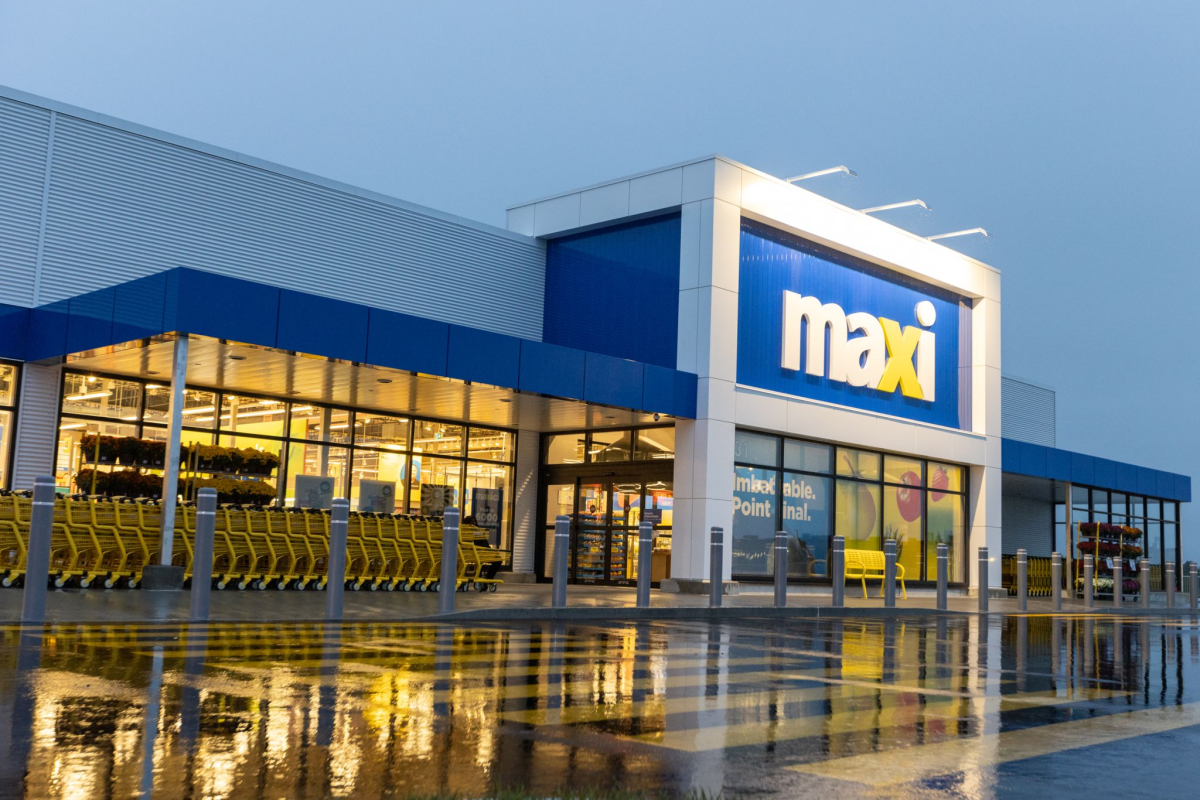
Metro has identified discount banners as its main source of market share gains. In January 2026, the company confirmed plans to open 12 new discount stores in fiscal 2026. Three have already opened. Metro ended 2025 with 267 discount locations, including 150 Food Basics stores in Ontario and 117 Super C stores in Quebec.
The performance gap between discount and conventional formats has widened. Value-conscious shoppers are looking for lower prices without sacrificing convenience. Metro recently extended grocery delivery to its discount banners, helping drive a 25.8 percent increase in e-commerce sales.
The emphasis on discount reflects a broader change in behaviour. “They’re going to be promoting their private labels a little bit more,” Dr. Charlebois said. He also pointed to the emergence of liquidation centres that sell near-expiry or rejected products at steep discounts. “We are seeing very aggressive discounting out there, much more so than before,” he noted.
Empire Advances FreshCo in the West
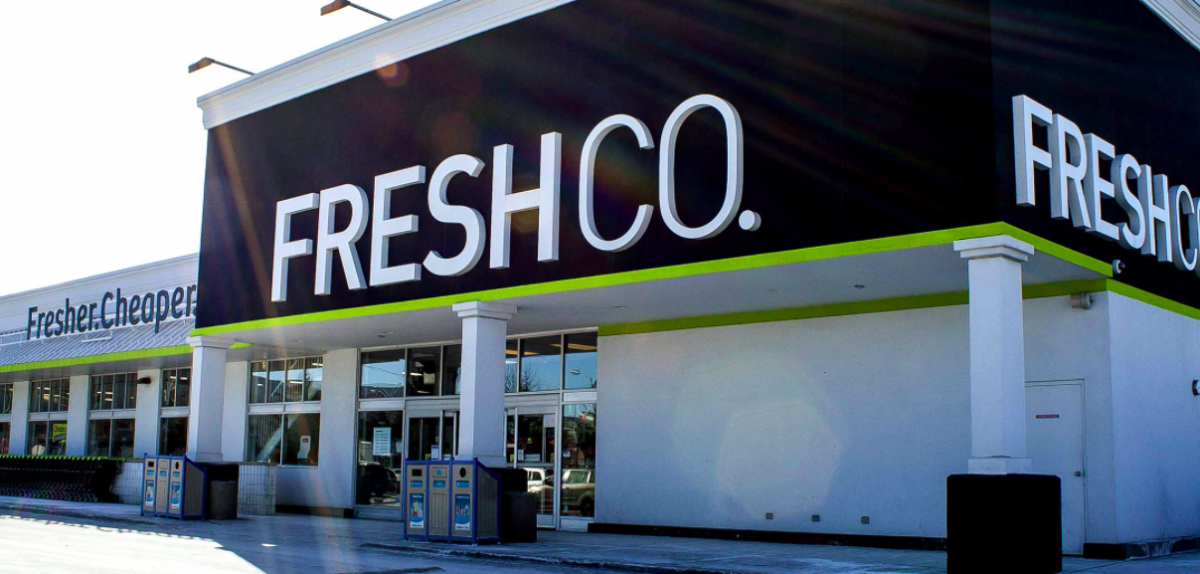
Empire, parent of Sobeys and Safeway, is nearing completion of its “Project Horizon” plan to convert roughly 25 percent of its Western Canadian full-service stores to the FreshCo banner. The company has now confirmed 37 of its planned 65 FreshCo locations in Western Canada, with significant activity in Alberta.
Recent Safeway-to-FreshCo conversions in Calgary and Edmonton illustrate Empire’s focus on improving price perception in competitive markets. In January 2026, Empire also announced it would close Alberta e-commerce facilities and pivot toward third-party partnerships while prioritizing physical discount store profitability.
The strategy aligns with a broader pattern. While total store density per capita is edging lower, the share of discount stores within that footprint is rising sharply.
Urban Discounting and Market Share Shifts
One of the more notable developments is the move of discount banners into higher-rent urban cores. In Toronto, for example, No Frills locations are appearing in neighbourhoods where discount grocers historically had limited presence. The aim is to capture younger, price-sensitive consumers who live in dense areas.
Dr. Charlebois cautions that urban expansion carries risk. “Opening up stores downtown is incredibly difficult right now,” he said, citing shrink and theft as major concerns. “Shrink is a huge problem for sure.” Retailers are balancing the need for access with heightened security costs.
In Quebec, the hard discount model has delivered measurable gains. According to 2025 to 2026 data from dunnhumby, Maxi has overtaken Costco as the top grocery retailer in the province, underscoring how effective the format has become in today’s economic climate.
Retraction Beneath the Headlines
Despite high-profile investments, net expansion remains nuanced. Dr. Charlebois emphasized that closures often accompany openings. “They never talk about stores that they’re closing,” he said, referring to annual expansion announcements.
As demographics shift and profitability varies by neighbourhood, retailers are rationalizing portfolios. Some markets may lose options even as others gain new discount formats. “You can argue that there is less competition out there or less access,” he reiterated.
The result is a reshaped landscape rather than pure growth. Conventional banners are being trimmed or converted, while discount stores proliferate.
The current wave of Canada discount grocery expansion reflects a structural pivot rather than a temporary tactic. Consumers are trading down. Private label penetration is at record highs. Supply chains are being optimized for efficiency. E-commerce is being integrated into value banners to remove the stigma of trading down.
At the same time, consolidation and selective closures are redefining access. The grocery market is not simply adding stores. It is reallocating capital toward formats that resonate in a cautious economy.











I wonder if Winnipeg will see more Safeway to Freshco conversions. My nearest Safeway at River East Plaza was one of the newest replacement Safeway stores rebuilt by Safeway Inc after the closure of Zellers. I have a feeling that it is a prime target for converting to the hard discount format.
LOL Discount brands.. they are the same rip off prices as they are at the big brands. Pathetic!