McDonald’s says its new specialty beverage platform is performing at or above expectations in Canada, giving the restaurant giant early evidence that an expanded cold-drink menu can generate customer visits beyond its traditional meal periods.
Canada is one of the first major markets participating in the rollout, alongside the United States and Germany. Australia introduced the platform in July, with additional countries expected to follow as McDonald’s develops beverages into what it believes can become a long-term global growth platform.
The strategy reaches well beyond adding new drinks to the menu.
Executives said during McDonald’s second-quarter earnings call this week that the strongest early results have come during the afternoon, when restaurants typically have excess capacity. More than half of the beverage traffic across the initial launch markets has been occurring after lunch, creating new customer occasions rather than simply shifting existing demand. Customers are also adding food to many beverage purchases, producing average cheques approximately 50 per cent higher than McDonald’s full-day average.
McDonald’s did not disclose Canada-specific sales, traffic or average-cheque figures. The company said results from Canada and the other initial markets were consistently meeting or exceeding expectations.
Canada Becomes an Early Launch Market
McDonald’s Canada introduced its permanent beverage lineup nationally in May, adding Crafted Sodas, Refreshers and Cloud Iced Coffees at participating restaurants across the country.
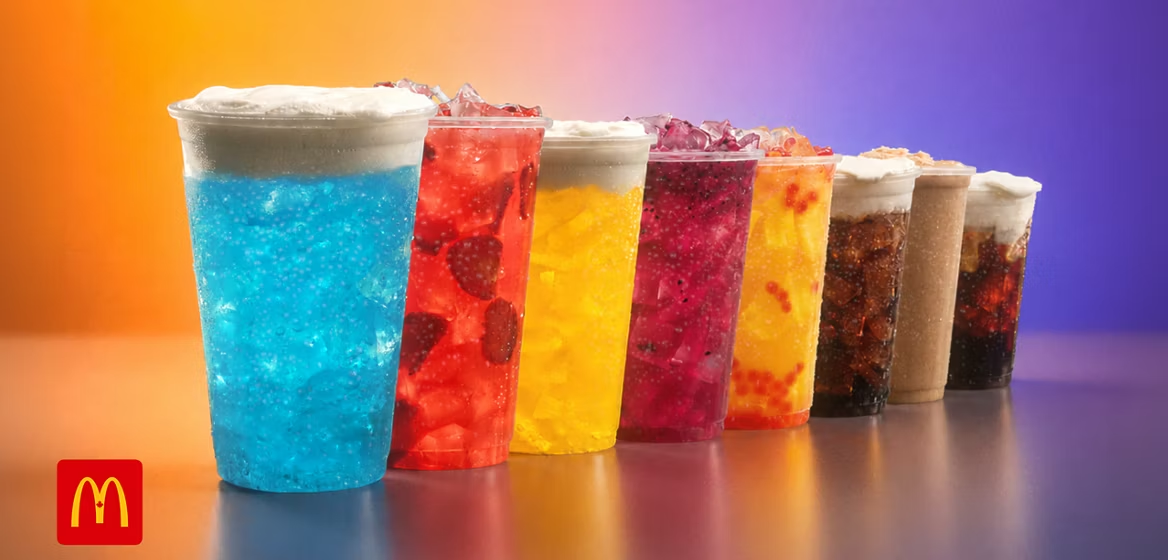
The menu includes Crafted Sodas such as Sprite Berry Bliss, Orange Dream and Creamy Strawberry Coke, alongside fruit-based Refreshers and a range of Cloud Iced Coffees topped with cold foam.
The drinks are considerably more elaborate than the fountain beverages and traditional iced coffees long associated with McDonald’s. Cold foam, fruit garnishes, popping pearls and layered flavours move the chain into territory more commonly occupied by coffee shops, bubble tea operators and specialty beverage concepts.
Importantly, McDonald’s is pursuing that opportunity through its existing restaurants, drive-thrus and digital ecosystem rather than introducing a separate store format.
Canada’s menu also demonstrates how the company intends to scale the platform globally. While the overall beverage architecture is shared across markets, flavours and product combinations can be adapted to local tastes, allowing McDonald’s to balance global consistency with regional preferences.
Creating a New Afternoon Occasion
The most significant insight from the earnings call was not which drinks customers are ordering, but when they are buying them.
Afternoon traffic has long represented an opportunity for quick-service restaurant operators because restaurants typically have available capacity between the lunch and dinner rushes. Every additional beverage visit during those hours improves utilization without requiring another restaurant or additional dining space.
McDonald’s believes beverages can become a destination in their own right.
Management said customers frequently add food to their beverage purchases, increasing average order values while creating incremental visits that may not otherwise have occurred.
The company developed the broader strategy through testing in parts of the United States, where it evaluated customer demand, restaurant equipment, employee training and operational execution before expanding into Canada and other international markets.
Executives now view beverages as a platform capable of supporting multiple years of growth through new flavours, seasonal offerings, loyalty promotions and future product innovation.
That represents a different approach from the limited-time entertainment collaborations that have become common across the restaurant industry.
Chief Executive Officer Chris Kempczinski told analysts that McDonald’s must be careful not to rely too heavily on what he described as “borrowed equity” such as movies, sporting events or celebrity partnerships. While those campaigns can generate significant short-term attention, permanent menu platforms provide a stronger foundation for recurring customer visits and sustainable growth.
Competition Extends Beyond Traditional Quick Service
McDonald’s is expanding into one of the most competitive segments of Canada’s restaurant industry.
Tim Hortons has recently broadened its own cold beverage lineup with Sparkling Quenchers, Protein Quenchers and flavoured iced beverages, while Starbucks, bubble tea chains, convenience stores and specialty beverage operators continue investing heavily in the category.
McDonald’s has chosen to compete through visually distinctive drinks featuring cold foam, fruit garnishes and colourful flavour combinations designed to appeal to younger consumers and social media sharing.
The company also benefits from advantages many competitors cannot match, including one of Canada’s largest restaurant networks, an extensive drive-thru system and direct access to millions of customers through its mobile app and loyalty platform.
The objective is straightforward: encourage consumers to think about McDonald’s when they want an afternoon drink, even if they are not initially planning to purchase a meal.
Balancing Value and Premiumization
The beverage strategy also illustrates how McDonald’s is attempting to balance affordability with higher-value purchases.
The company brought back Summer Drink Days alongside the beverage launch while continuing its broader value initiatives, including $1 small McCafé coffee and $5 McValue Meals.
Those promotions reinforce McDonald’s value credentials while allowing Crafted Sodas, Refreshers and Cloud Iced Coffees to occupy a more premium position within the menu.
The approach reflects current consumer behaviour. Many customers remain highly price-conscious on everyday purchases while continuing to spend selectively on products they perceive as distinctive, convenient or indulgent.
McDonald’s is attempting to capture both ends of that spectrum within a single restaurant visit.
Execution Will Determine Long-Term Success
The earnings call also highlighted the principal risk facing the strategy.
McDonald’s acknowledged that U.S. restaurant teams became overwhelmed during the second quarter after several major initiatives, including value menu changes, digital promotions, the beverage rollout and FIFA marketing, were introduced within a relatively short period. The result was slower service and lower customer satisfaction.
Management has already begun simplifying restaurant operations and reducing non-customer-facing activities to allow employees to focus more closely on speed, hospitality and food quality.
“If it looks great on paper, but you can’t execute it, it doesn’t matter,” Kempczinski told analysts.
The company did not identify comparable issues in Canada. Even so, the U.S. experience illustrates the operational challenge associated with introducing products requiring additional preparation steps into a system built around speed and consistency.
Canadian restaurant teams now prepare beverages using syrups, cold foam, fruit toppings and multiple product builds while continuing to deliver McDonald’s core menu efficiently.
Execution is particularly important in Canada because approximately 92 per cent of the country’s 1,520 McDonald’s restaurants are operated by franchisees. Consistency across hundreds of independently operated restaurants will ultimately determine whether the platform can achieve the scale the company envisions.
Part of McDonald’s Next
The beverage rollout is one of the earliest public examples of McDonald’s Next, the company’s new global growth strategy that will be presented in greater detail during its September Investor Day.
The strategy focuses on improving food quality, strengthening customer engagement, simplifying restaurant operations and enhancing hospitality while identifying productivity improvements that can help fund future investment.
McDonald’s also plans to launch what it describes as the largest training initiative in its history on October 5, providing instruction centred on taste, quality and hospitality to more than two million restaurant crew members, company employees and supplier partners.
Taken together, those initiatives reflect a broader shift in strategy. Rather than relying primarily on periodic promotional campaigns, McDonald’s is investing in permanent platforms that it believes can generate recurring customer visits over many years.
Financial Results
McDonald’s reported global comparable sales growth of 1.3 per cent during the second quarter.
Comparable sales increased by 0.8 per cent in the United States, while International Operated Markets, which include Canada, recorded growth of 1.5 per cent. International Developmental Licensed Markets increased 1.9 per cent.
Systemwide sales grew four per cent in constant currencies, and McDonald’s generated more than US$4 billion in restaurant margins during the quarter.
The company continues to plan approximately 2,600 gross restaurant openings globally this year but now expects to reach 50,000 restaurants in 2028, one year later than previously anticipated, reflecting higher development costs and a more challenging consumer environment.
McDonald’s did not disclose a Canadian restaurant-opening target.
Canada’s early beverage results are likely to play an important role in determining how quickly the company expands the platform across additional international markets. If the early performance continues, beverages could become one of McDonald’s most significant growth opportunities outside its traditional breakfast, lunch and dinner business.