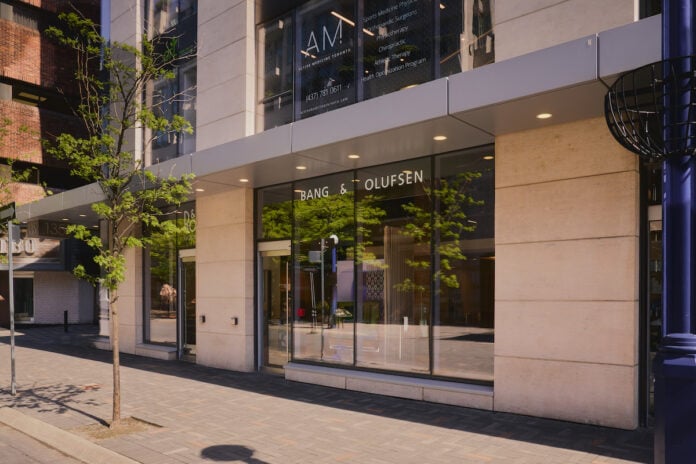
Bang & Olufsen at 135 Yorkville Avenue in Toronto. Image supplied
Bang & Olufsen has returned to Toronto’s luxury retail landscape with the opening of a new flagship in Yorkville, marking the Danish audio brand’s first dedicated store in the city since 2019 and underscoring its growing confidence in the Canadian market.
The 2,100-square-foot store, located at 135 Yorkville Avenue, introduces a destination retail environment where clients can experience Bang & Olufsen’s speakers, headphones, bespoke audio solutions, and Atelier customization program through private demonstrations and personalized consultations.
For Bang & Olufsen, the new flagship reflects a broader bet on Canada’s luxury consumer market, the continued relevance of physical retail, and the growing connection between premium technology, interior design, and high-end residential living.
Retail Insider first reported in February that Bang & Olufsen was preparing to return to Yorkville with a new Toronto store. The opening now brings that plan to life in one of Canada’s most important luxury shopping districts.
Yorkville as a Luxury Platform
Kevin Cheung, CEO of Landa Global Properties and owner of the Bang & Olufsen Toronto and Vancouver flagships, said Yorkville was a natural fit for the brand.
“Yorkville has long been recognized as Canada’s premier luxury retail and lifestyle district,” said Cheung. “It brings together high-end fashion, fine dining, luxury hospitality, art, and design in a way that naturally aligns with Bang & Olufsen’s brand values.”
He said Bang & Olufsen customers are not simply buying products. They are investing in craftsmanship, design, and experiences.
That positioning is important in Yorkville, where global luxury brands, affluent residents, international visitors, designers, architects, and business leaders converge. The neighbourhood has become Canada’s premier showcase for luxury retail, with brands increasingly using physical stores to create deeper relationships with clients.
Cheung said the opportunity at 135 Yorkville Avenue was particularly compelling because it allowed the brand to create a destination that reflects Bang & Olufsen’s elevated and immersive positioning.
Bang & Olufsen at 135 Yorkville Avenue in Toronto. Image supplied
A New Kind of Electronics Store
The Toronto flagship has been designed less like a traditional electronics showroom and more like a luxury residential environment.
The store features curated living settings, natural oak, wool fabrics, soft acoustic panels, aluminum details, rich textiles, and a palette inspired by understated Nordic tones. Heritage displays throughout the space reference Bang & Olufsen’s 100-year history in audio and design.
A dedicated VIP Room offers a more intimate setting for demonstrations of the brand’s flagship products and Atelier service, allowing customers to explore custom colours, materials, finishes, and configurations.
Cheung said luxury consumers now expect more than a transaction when they visit a store.
“The traditional retail model of displaying products on shelves is becoming less relevant for luxury categories,” he said. “Customers increasingly conduct research online before visiting a store, which means that the role of physical retail has shifted from information delivery to experience creation.”
That shift is especially important for premium audio, where the product cannot be fully understood through specifications or images.
“Sound is inherently experiential,” Cheung said. “A customer can read about acoustic performance online, but they need to physically experience the emotional impact of exceptional sound reproduction.”
Bang & Olufsen at 135 Yorkville Avenue in Toronto. Image supplied
Canada’s Growing Role
Cheung said Canada represents an increasingly important market for Bang & Olufsen in North America.
Canadian consumers, he said, have a strong appreciation for premium design, craftsmanship, and high-performance products. Toronto and Vancouver, in particular, are global luxury markets with sophisticated consumers who value authenticity, personalization, and long-term quality.
The Toronto flagship also fits within Bang & Olufsen’s broader North American retail expansion. The brand has recently opened locations in San Francisco and Los Angeles, with more stores planned in California and New York later in 2026.
For Cheung, the Canadian opportunity extends well beyond traditional retail.
Bang & Olufsen at 135 Yorkville Avenue in Toronto. Image supplied
Luxury Homes Become a Growth Channel
One of the fastest-growing parts of the business is custom home integration, according to Cheung.
Luxury homeowners increasingly expect technology to integrate seamlessly into their homes without compromising aesthetics. That has created growing demand from custom home builders, architects, interior designers, luxury developers, and commercial clients.
In Vancouver, Cheung said Bang & Olufsen has worked with leading developers including Landa Global Properties, Bosa Properties, and Aspac Developments to incorporate Bang & Olufsen and Beohome smart home solutions into premium residential projects.
His perspective is notable because he is both a luxury real estate developer and the owner of the brand’s Toronto and Vancouver flagships. That gives Bang & Olufsen’s Canadian retail strategy a direct connection to the country’s high-end residential market.
“We believe that beautiful sound should be part of the luxury living experience from the very beginning,” Cheung said.
The same approach will now be brought to Toronto, where luxury condominiums, custom homes, hospitality projects, and design-driven residential developments continue to shape the market.
Bang & Olufsen at 135 Yorkville Avenue in Toronto. Image supplied
Personalization Takes Centre Stage
Customization is also becoming a larger part of the luxury audio experience.
Through Bang & Olufsen Atelier, clients can select materials, finishes, colours, and design details to create products that reflect their personal taste and interiors.
Cheung said Canadian customers are gravitating toward natural and timeless materials such as oak, walnut, aluminum, and premium textiles. Popular colours include bronze, gold tones, charcoal, black anthracite, and soft neutrals, while some clients are choosing bolder bespoke finishes as statement pieces.
For luxury consumers, personalization turns the purchase into a collaborative design process.
“Our clients are no longer simply purchasing a product,” Cheung said. “They are commissioning a piece that reflects their personal taste and complements their environment.”
Physical Retail Still Matters
The opening comes as consumers increasingly arrive in stores having already researched products extensively online. For Bang & Olufsen, that has made physical retail more important, not less.
Cheung said the future of luxury retail will be experiential, educational, and relationship-driven. Stores will increasingly function as brand destinations where customers can experience products, receive expert guidance, attend events, and build long-term relationships.
For premium audio, that in-person experience is especially important. The emotional quality of sound, the feel of materials, and the integration of technology into a living environment are difficult to communicate online.
As luxury retail continues to blur the lines between shopping, design, hospitality, and residential living, Bang & Olufsen’s Yorkville flagship offers a glimpse into the future of premium consumer electronics retail — one built around experiences, personalization, and long-term relationships rather than traditional showrooms.
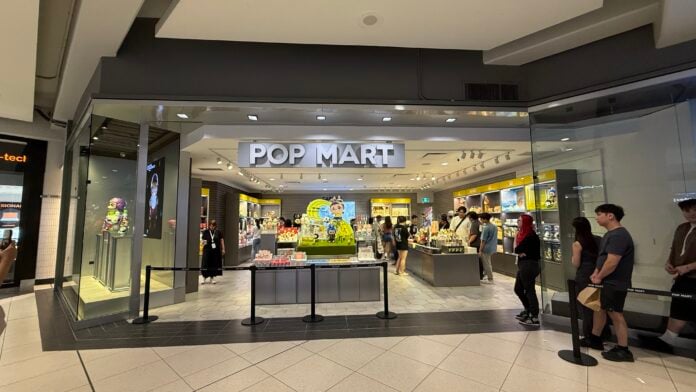
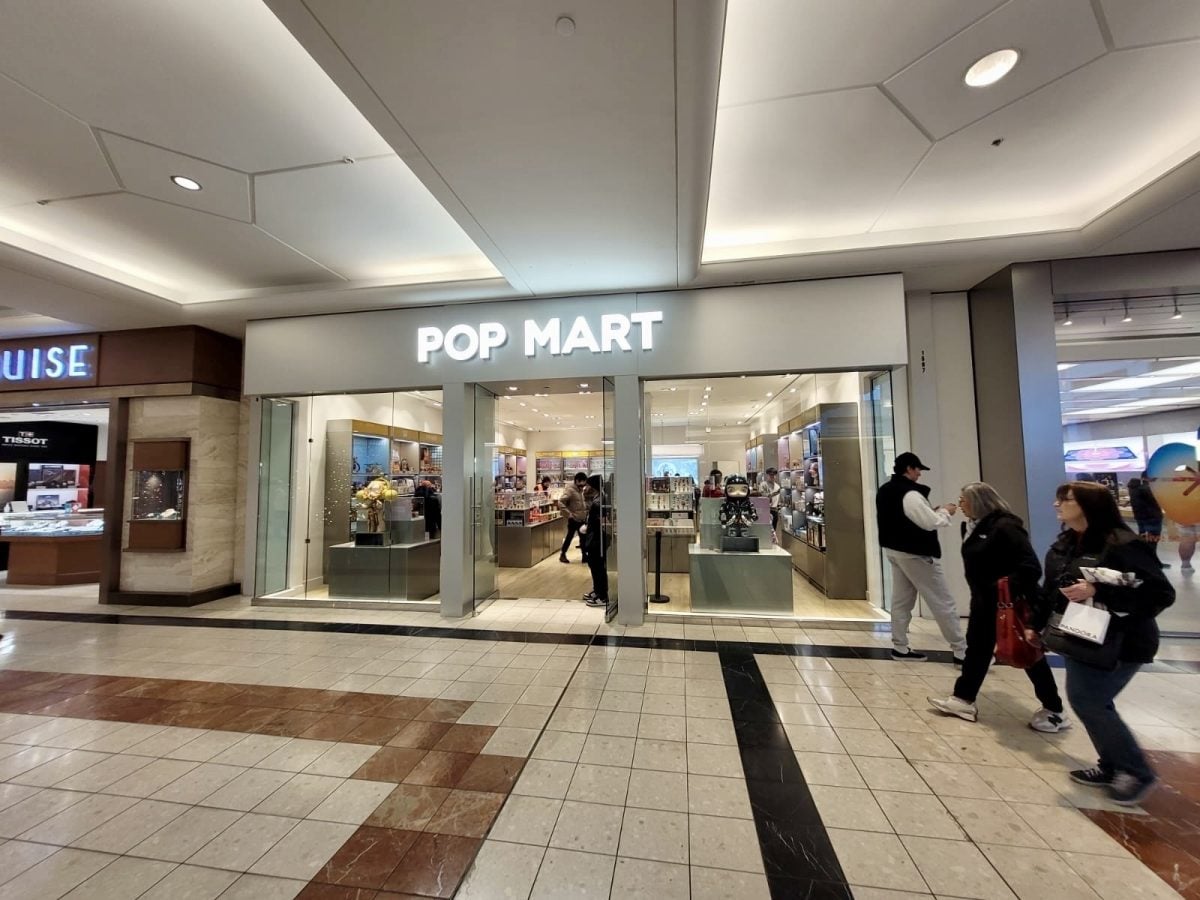
Pop Mart, CF Toronto Eaton Centre. Photo: Craig Patterson
Pop Mart is moving quickly to expand in Canada after stronger-than-expected demand at its early stores, with the global character-based entertainment company confirming that it now has 10 Canadian leases signed or committed.
The momentum was visible in downtown Toronto over the Canada Day weekend. Pop Mart opened its new CF Toronto Eaton Centre store on Friday, July 3, and when Retail Insider visited the following day, customers were lined up along the mall corridor waiting to enter.
The retailer, known for collectible designer toys and character IP including Labubu and The Monsters, entered Canada with its first permanent store at CF Richmond Centre in Metro Vancouver. Consumer response has since exceeded initial expectations, creating early product allocation pressure and reinforcing Canada as a priority market.
“Canadian consumers have really shown out for Pop Mart, and we are truly humbled by their support,” said Valen Tam, Head of Real Estate for Pop Mart in Canada. “It is not easy to enter a new national market, but we have seen performance exceeding initial expectations at our physical stores, to the point of causing early allocation issues.”
Tam said the company is working to bring more of its characters and products within reach of Canadians as it builds out a larger national network.
Pop Mart, CF Toronto Eaton Centre. Photo: Craig Patterson
The Canadian growth comes as Pop Mart continues to expand globally. The company reported revenue of RMB 37.12 billion in 2025, up 184.7 per cent year-over-year, with international markets becoming an increasingly important part of the business. The Americas have emerged as a major growth region for Pop Mart as the company expands its physical store network and builds the global reach of its character portfolio.
For Canada, Tam said the opportunity is rooted in both consumer response and the country’s cultural makeup.
“By its very essence, Canada is a perfect home for Pop Mart,” he said. “It is a melting pot of cultures and its societal composition mirrors the many different characters in the Pop Mart collection who have come together under one umbrella, despite each having very distinct appearances, backgrounds, aspirations and stories.”
Premium Shopping Centres Anchor the Canadian Strategy
Pop Mart’s Canadian expansion is being shaped around premium shopping centres, where the company says its design standards and experiential approach can be fully expressed.
Valen Tam
Cadillac Fairview has played a notable role in the brand’s early growth in Canada. Pop Mart opened its first Canadian store at CF Richmond Centre, while the new CF Toronto Eaton Centre location places the company in one of the country’s highest-profile urban shopping destinations.
“The people there are what has made them a pleasure to partner with,” said Tam of Cadillac Fairview. “They have excellent leadership top-down who have been nothing but communicative, supportive and understanding.”
Tam said Cadillac Fairview was one of the first Canadian landlords to proactively partner with Pop Mart, a relationship that remains important as the company adds locations.
“We opened our very first Canadian store at CF Richmond Centre,” he said. “As our landlord partner there, Cadillac Fairview was one of the first Canadian landlords to proactively partner with us, which is something we will always appreciate and hold dear. We are looking forward to further developing the relationship.”
Pop Mart’s Canadian real estate rollout is being supported by Aurora Retail Group, whose Co-CEO Jeff Berkowitz has been involved in representing the brand as it expands into major Canadian shopping centres.
For Pop Mart, real estate is closely tied to brand execution. At CF Toronto Eaton Centre, the store uses illuminated perimeter displays, central character installations, digital screens and changing product presentations to create a highly visual environment around the company’s different IP.
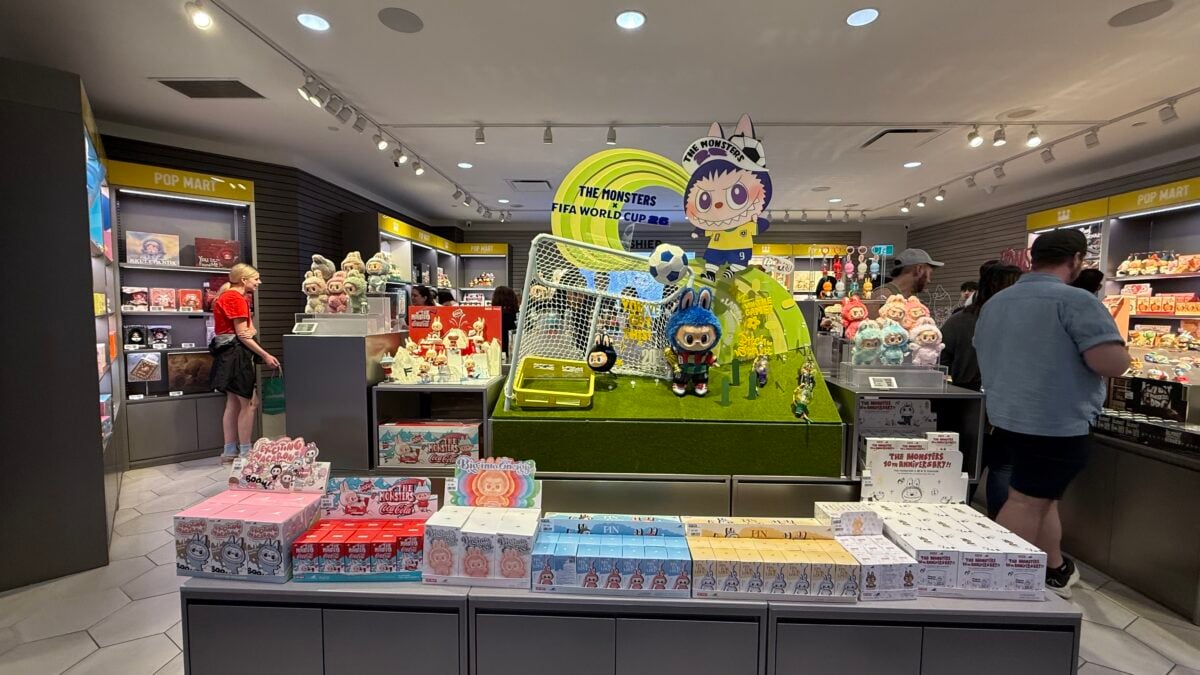
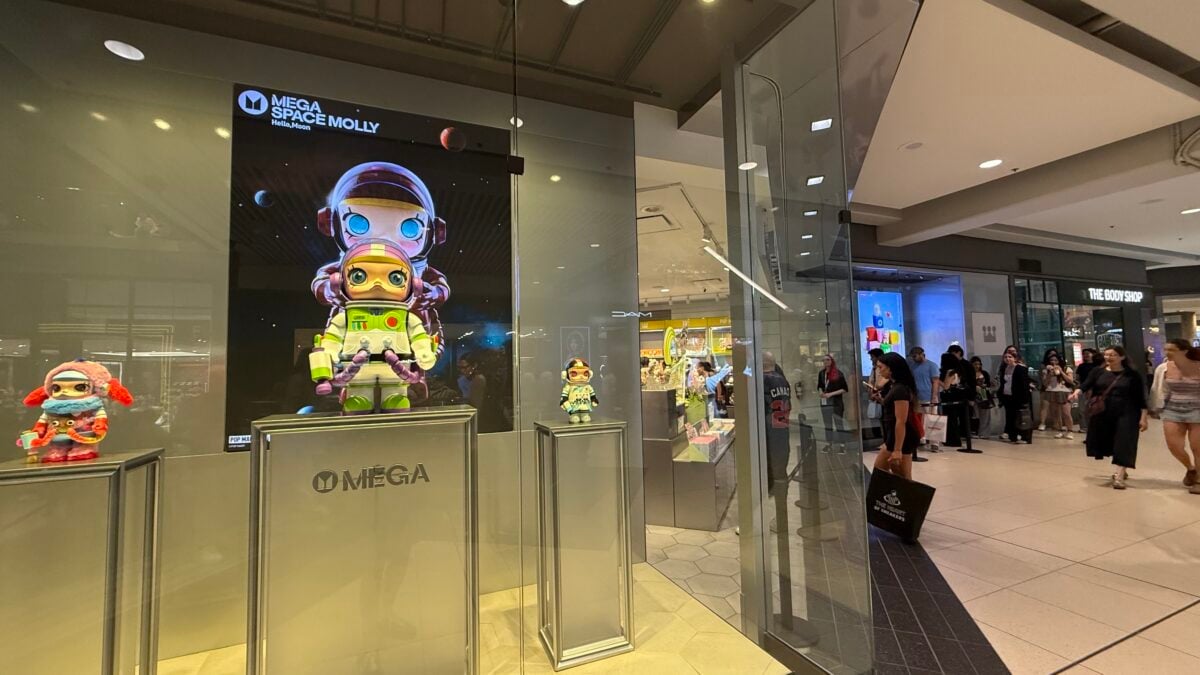
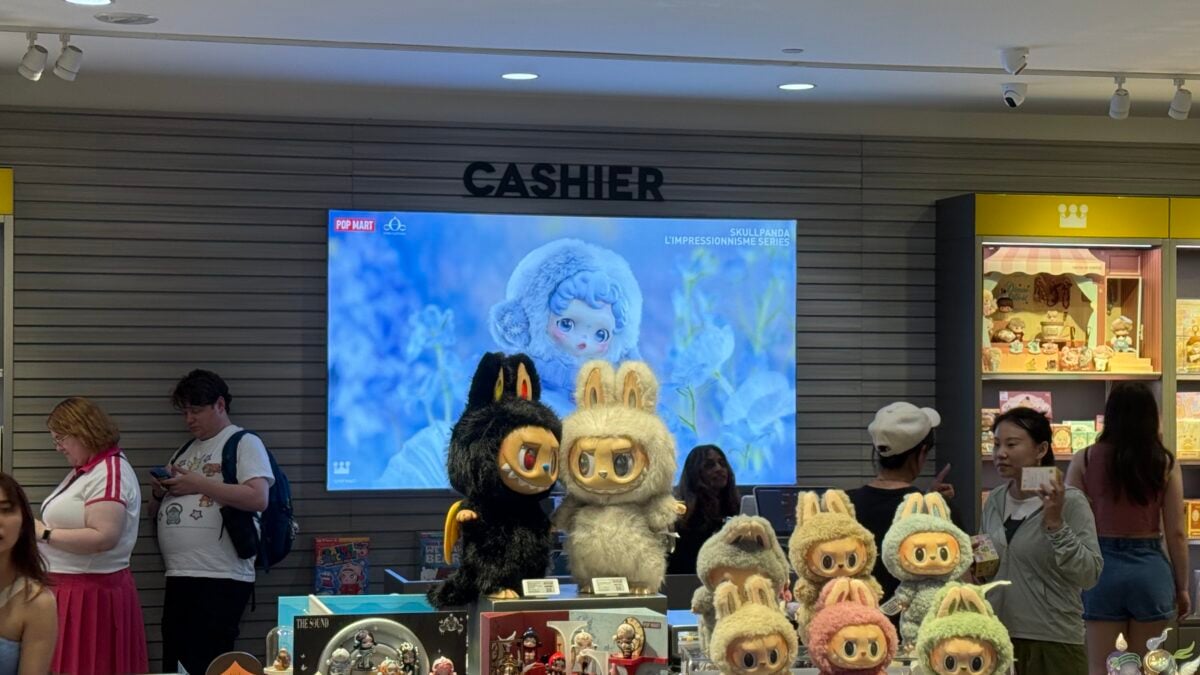
During Retail Insider’s visit, a prominent window installation featured MEGA SPACE MOLLY, while a central in-store display highlighted The Monsters’ FIFA World Cup 26 collaboration. Labubu plush characters were also prominently merchandised near the cashier and throughout the store.
Tam said Pop Mart follows strict global standards around store design, lighting, millwork and visual merchandising.
“We uphold a very strict global design standard at Pop Mart,” he said. “We are meticulous with our store design, lighting, millwork and visual merchandising. Therefore, premium shopping centres, where this is expected of retailers, are natural homes for us.”
Design Standards Shape Site Selection
Pop Mart’s site selection process is driven by more than market demand. Tam said each location must support the company’s design requirements and allow for the type of customer journey the brand wants to create.
“When selecting store locations, we evaluate by ensuring the space conforms to our design standards and has a layout that lends itself toward a design which can deliver the kind of unobstructive customer journey we strive to deliver,” said Tam.
The same thinking informs how Pop Mart approaches flagships. While standard locations must meet the company’s global design system, flagship stores give the brand room to create more localized and ambitious retail environments.
“Flagship stores give us an opportunity to go above and beyond,” said Tam. “We step outside our conventional boundaries to amalgamate the cultures of the block, the city and Pop Mart into a re-imagined, one-of-a-kind unique design expression.”
Pop Mart, CF Toronto Eaton Centre. Photo: Craig Patterson
10 Canadian Leases Signed or Committed
Tam confirmed that Pop Mart has 10 Canadian leases signed or committed as part of its expansion strategy.
The company is not yet providing a long-term store count target for Canada, although Tam said early support suggests significant runway.
“I can’t provide an estimate right this minute, but seeing the support from the market so far, it looks like we might just have to be everywhere,” he said. “Jokes aside, our vision is not fixated on the quantity of stores but the quality of each. We want to build only stores that we can be proud of, and then maintain consistent and joyous consumer experiences.”
Tam said a primary goal is to “drastically increase Canadians’ accessibility” to Pop Mart.
That could eventually take the company into multiple regions across the country. Tam said Pop Mart wants to be in every province, while acknowledging that growth will depend on the availability of suitable real estate.
Quebec, the GTA and Vancouver Eyed for Growth
Quebec is expected to play a meaningful role in Pop Mart’s Canadian strategy.
“Absolutely,” said Tam when asked whether Quebec will be part of the company’s growth plans. “Quebec is beautiful and the home of incredible culture. We are already educating ourselves and prepping to enter the market with the help of our global team and partners. It is a critical market for us, and not an endeavour we are taking lightly.”
The Greater Toronto Area is also being evaluated for additional opportunities. Pop Mart already has a presence at Toronto Premium Outlets and now at CF Toronto Eaton Centre, while Tam said the wider region could support more stores.
“The GTA is a sprawling metropolis and we would be remiss not to look hard at each of the many municipalities that comprise it,” he said. “We are actively working with our landlord partners to explore opportunities.”
Greater Vancouver remains another priority. Pop Mart opened two of its earliest Canadian stores in the region, where the brand saw strong consumer response from the outset.
“Two of our earliest stores opened in Greater Vancouver, and to astounding support,” said Tam. “We are still far from serving Vancouver well at the moment and are actively measuring opportunities.”
Tam said the company is willing to look broadly across the country as opportunities emerge.
“We will go wherever our incredible Canadian landlords take us,” he said. “We want to be in every province, but everything is subject to availability.”
Pop Mart, CF Toronto Eaton Centre. Photo: Craig Patterson
Labubu Opens the Door to a Larger Character Universe
Pop Mart’s Canadian growth is taking place as Labubu has become one of the most recognizable collectible characters globally.
Labubu, part of The Monsters character universe created by artist Kasing Lung, has helped bring Pop Mart to a wider audience through plush toys, collectible figures, social media visibility and collaborations. Pop Mart and Sony Pictures are also developing a Labubu feature film, extending the character’s reach further into entertainment.
Tam said Labubu has become a globally recognized icon, while emphasizing that Canadian interest extends well beyond a single character.
“The rest of our characters have all seen incredible support in Canada as well, certainly an ode to how diverse the Canadian populace is,” he said. “We invite customers to come see our stores or surf our many digital platforms to learn more about each.”
That breadth was visible at CF Toronto Eaton Centre. The store’s mix of MEGA SPACE MOLLY, Labubu and other character worlds, along with the prominent FIFA World Cup 26-themed The Monsters installation, illustrated how Pop Mart uses rotating visual presentations and partnerships to encourage discovery across its broader portfolio.
Tam described Pop Mart as a pop culture entertainment company, with stores acting as physical gateways into its character worlds.
“Behind every character and product line is a heartfelt story and the passionate brush strokes of their artists,” he said. “There is genuine emotion that is hemmed into every design, and as time grows, the characters’ stories develop alongside the customer.”
Stores Built for Discovery and Repeat Visits
Experiential retail is integral to Pop Mart’s store strategy.
Tam said the company’s visual merchandising and operations teams work to create a thematic journey in stores, guiding customers from one character to the next. The approach is designed to encourage discovery and give consumers reasons to return as assortments and presentations evolve.
“At our stores, my colleagues in VM and operations work hard to lay out a thematic journey that takes our consumers from one character to the next,” he said.
The CF Toronto Eaton Centre store offered a clear example during Retail Insider’s visit. Product was presented through a mix of wall displays, central fixtures, character installations and digital content, while controlled entry helped manage the flow of customers into the space during the opening weekend.
Digital engagement also plays a central role. Social media has helped build awareness around characters such as Labubu, while Pop Mart’s online platforms keep consumers connected to product updates and brand activity between store visits.
“Online engagement works hand-in-hand with our physical stores,” said Tam. “While our stores deliver an irreplaceable in-person experience, our digital platforms provide customers with timely updates and round-the-clock access to Pop Mart.”
Pop Mart at CF Richmond Centre in Vancouver. Photo: Ritchie Po
Robo Shops, Activations and Larger Concepts Could Follow
Pop Mart’s Canadian growth could eventually extend beyond traditional stores.
The company operates Robo Shops and other formats internationally, and Tam said Canada could see additional concepts as the market develops.
“We are in the infancy stage of Pop Mart in Canada, but most people do not know that our founder and CEO, as well as many of our colleagues, have worked for over 15 years to bring Pop Mart to its current form,” said Tam. “We have so many ideas and so many learnings that we cannot wait to bring to the Canadian market.”
The company is also looking at opportunities for Canadian-exclusive merchandise, artist partnerships, collaborations, activations and events.
“Our president Larry, the IP team and marketing team are looking into exclusive artist partnerships, collaborations and activations,” said Tam. “They are meticulous in their work and these processes do take some time to set up, but we cannot wait to tell you more down the road.”
Larger-format concepts or flagship destinations could eventually arrive in Canada as well. Tam did not provide specifics, but when asked whether Canadian consumers could see concepts similar to larger destinations found in other markets, he indicated the possibility may be closer than expected.
“I cannot reveal anything yet but they may be coming much sooner than not,” he said.
Future store sizes will vary depending on the market and real estate availability.
Building a Long-Term Canadian Presence
Looking ahead five years, Tam said success in Canada will be measured by more than store count.
The goal, he said, is to create stores that generate excitement for consumers while building a sustainable operating culture for Pop Mart’s teams.
“If we are able to keep lighting up the faces of Canadians when they see our stores or characters, if we are able to keep bringing smiles and laughter into their lives, and if we are able to enrich the lives of not just our customers but also our unsung heroes, our staff on the frontlines and in the backrooms, then it would all be a worthwhile success to us,” said Tam.
He added that Pop Mart will continue reinvesting in its characters and brand while pursuing further innovation.
For Canadian shopping centres, the expansion brings another fast-growing international concept into the premium mall landscape. For Pop Mart, the early response suggests there is room to build a considerably larger network.
And at CF Toronto Eaton Centre, where customers were still lined up to enter on the store’s second day of operation, the next phase of that growth was already visible.
Summer travel isn’t disappearing, but many Canadians are scaling back their itineraries this year. A new survey of 1,068 Canadian consumers by Omnisend found that while 67% have travel plans this summer, only 17% are taking a major trip involving flights or paid lodging. Instead, many are choosing more affordable alternatives:
21% say they’re taking a shorter or cheaper trip than originally planned
29% are sticking to day trips or local outings
12% plan to stay home altogether
Overall, 45% say they’ve postponed, shortened, downgraded, or entirely canceled a summer trip because of cost. Among those affected, gas prices were cited most often (47%), along with groceries and everyday bills (32%), as well as hotel and vacation rental costs (25%), according to the survey.
Marty Bauer
“Canadians aren’t giving up on summer. They’re giving up on the idea that a memorable vacation has to involve flights, hotels, or a hefty price tag. A vacation budget no longer exists in isolation – it’s competing with higher fuel costs, grocery bills and other everyday expenses that have become harder to ignore. So, people are becoming much more creative about finding breaks that fit their budget instead of abandoning the idea of a getaway altogether,” said Marty Bauer, Ecommerce Expert at Omnisend.
For many Canadians, the money saved by cutting back on travel is being redirected toward more immediate priorities. Twenty-six percent of those who are spending less on travel this year admit they need the money for essentials. Nearly half (46%) say they’re spending it on groceries, while 24% are putting it toward rent or mortgage payments. Another 26% are using it to pay down debt, added Omnisend.
“There was a time when skipping or downgrading a vacation might have meant spending that money on a home renovation or new furniture. Today, that’s increasingly not the case. Before families decide where they want to go, they’re deciding whether that money would be better spent putting food on the table, staying on top of bills or paying down debt. That’s a very different kind of spending than we typically associate with summer,” said Bauer.
Bath & Body Workshas launched a new body care franchise called Fruit Fusion across Canada and the United States, pairing the product introduction with a long-term partnership that names actor and singer Hilary Duff as the brand’s campaign ambassador and creative partner.
The collection, available online and in stores, is part of the company’s Consumer First Formula strategy, which Bath & Body Works says is aimed at placing consumers at the centre of product development, design and marketing.
The launch represents a new product franchise for the retailer while also serving as a key initiative in its broader brand transformation efforts. Bath & Body Works said Fruit Fusion combines four new fragrances with a range of body care products designed to allow customers to build personalized routines through layering.
The initial lineup includes the fragrances Watermelon Whirl, Tangerine Twirl, Berry Bliss and Banana Blend. Products are available in formats including All Day Moisture Body Wash, Smooth & Soothe Body Cream, Perfume Mist for Body & Hair, 48H Moisturizing Body Lotion, Hand Cream, Mini Perfume Mist, Lip Oil, PocketSpray Hand Sanitizer and accessories. The collection is available in Canada and the United States, with prices ranging from $5.95 to $20.95.
Duff, a longtime Bath & Body Works customer, also worked with the company as a creative partner in developing the collection and campaign.
“For me, it’s always about feeling good in your own skin and choosing what works for you,” Duff said. “I look for products that work with my routine and provide real benefits. Fruit Fusion by Bath & Body Works fits into that perfectly. The scents are joyful, the products actually deliver, and it’s something I genuinely look forward to using.”
Bath & Body Works said Duff’s role extends beyond appearing in advertising. The company said she collaborated on the campaign’s creative direction and will feature the collection as part of her everyday routine across her Instagram and TikTok channels, where she reaches more than 30 million followers.
Bath & Body Works introduces its new “Fruit Fusion” collection featuring Hilary Duff as the campaign ambassador and creative partner. (CNW Group/Bath & Body Works Canada)
The company said the timing of the partnership coincides with Duff’s return to touring for the first time in 18 years and the release of a new album, while Bath & Body Works continues what it describes as its own brand evolution under new leadership.
Veronique Gabai
“Fruit Fusion is a clear example of our Consumer First Formula in action,” said Veronique Gabai, chief brand & product officer of Bath & Body Works. “We’re focused on creating high-quality, innovative products that deliver real performance and make people feel good, while showing up in ways that feel authentic and relevant. This launch brings that together, from innovation and design to the partnership with Hilary, in a way that genuinely connects with our customers.”
According to the company, the Fruit Fusion formulas are dermatologist-approved, vegan and made without sulfates, parabens and phthalates. The products combine perfumer-crafted fragrances with ingredients including shea butter, coconut oil and hyaluronic acid, which the company said help hydrate skin while maintaining its natural moisture barrier.
Bath & Body Works new Fruit Fusion collection. (CNW Group/Bath & Body Works Canada)
The launch also introduces new packaging for the brand, including redesigned bottles and soft-touch finishes, as part of the broader rollout.
Bath & Body Works said the campaign supporting Fruit Fusion is one of the most extensive marketing efforts in the company’s history, spanning multiple platforms and featuring Duff throughout.
The company said Fruit Fusion is intended to become a long-term product franchise, with additional fragrances and product formats planned over time as it continues to expand the line.
Bath & Body Works operates more than 1,900 stores across the United States and Canada, as well as more than 500 international locations, and sells its products online through BathandBodyWorks.ca.
Welcome to the Daily Synopsis by Retail Insider. We hope you enjoy the 11 articles we published covering key developments in Canadian retail.
The Retail Insider “Grocery Report” examines how value is reshaping Canadian food retail, highlighting the rise of discount formats, enhanced fresh offerings, loyalty programs, and private label strategies. Lotus Capital expanded its retail platform with the purchase of a grocery-anchored shopping centre in Kelowna, emphasizing stable income from necessity-based retail and growth potential in Western Canada.
Retail Insider has released its latest Q2 2026 Canadian Grocery Retail Report, authored by Craig Patterson, examining how value is reshaping one of Canada’s most important retail sectors.
The report is part of Retail Insider Reports, a growing series designed to deliver executive-level insights across major retail sectors. Reports are available through the Retail Insider Report Hub.
This report examines the Canadian grocery retail sector, including supermarkets, discount grocers, specialty food retailers, convenience-oriented food retail, merchandising strategies, store expansion, competition, consumer purchasing trends and developments affecting food retail in Canada.
The Q2 report finds that Canadian grocery retail is increasingly being reorganized around value. Food inflation remains a defining pressure for consumers, discount formats continue to expand, digital tools are becoming more practical, and grocery-anchored real estate is attracting renewed investment from landlords and institutional owners.
General Themes
Discount grocery growth is structural: Empire, Loblaw and Metro continue investing in value-oriented formats as shoppers prioritize price and value perception.
Full-service grocers are under pressure: Traditional banners need to defend relevance through fresh, service, convenience, loyalty, prepared foods and sharper price perception.
Digital grocery is becoming more practical: AI, delivery partnerships and grocery technology are being used to support meal planning, fulfilment, savings and budget control.
Grocery real estate is gaining importance: Grocery is increasingly being used to anchor mixed-use projects, experiential food destinations and necessity-based retail environments.
Prepared foods are becoming more important: Grocers are using prepared meals and foodservice-style offerings to capture more meal occasions and higher-margin sales.
Product innovation remains targeted: Health, convenience, protein, dairy-free options and greenhouse-grown products continue to find opportunity, even as shoppers remain price-sensitive.
Inflation remains a major operating challenge: Food prices, produce volatility, freight costs and regional differences continue to affect pricing, assortment and promotional strategy.
GLP-1 drugs are an emerging demand risk: The report flags potential long-term impacts on snacks, confectionery, alcohol and impulse categories, while noting the trend should not be overstated.
Retail Insider Coverage
Retail Insider’s Q2 coverage points to discount grocery expansion as the clearest growth theme in the sector. Empire continues to prioritize FreshCo as a national growth vehicle, with 161 stores as of June 17, 2026, including 53 in Western Canada and 108 in Ontario. The company expects to open approximately 15 new FreshCo stores in fiscal 2027 across Western Canada, Ontario and Atlantic Canada. Loblaw’s No Frills banner also reached its 200th Ontario store during the quarter, reinforcing the strength of hard discount in the country’s largest grocery market.
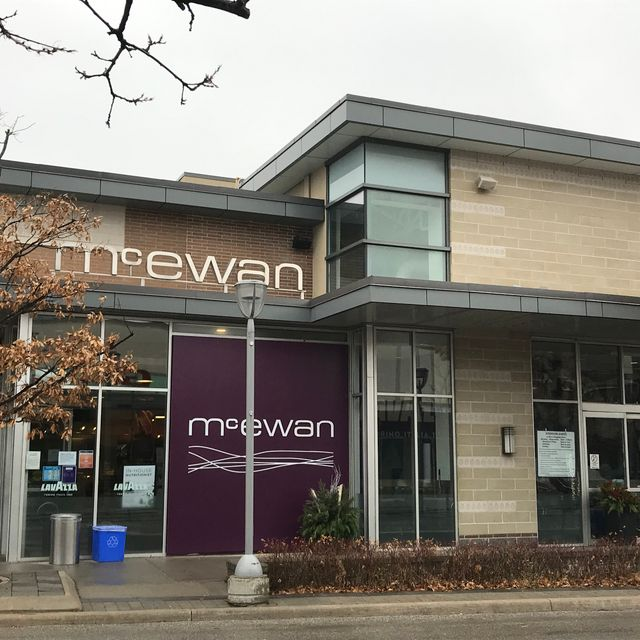
The report also highlights the growing strategic role of grocery real estate. Nations Experience at Oakville Place, Loblaws Humbertown, Food World Plus in Mississauga and McEwan’s planned Bayview Village location show how grocery is being used to reposition major spaces, support mixed-use redevelopment, create food destinations and strengthen culturally specific retail offerings.
Industry Coverage
The broader industry read is that grocery value is no longer limited to shelf price. It is now shaping capital allocation, loyalty strategy, private label, digital tools, fulfilment models and real estate decisions. The report notes that Canadian grocery operators are moving into a more disciplined phase of omnichannel execution, with store-based picking, third-party delivery, click-and-collect and targeted digital tools taking priority over expensive automation-heavy models.
Grocery anchors also remain central to Canadian retail real estate. As department stores weaken and some discretionary categories face pressure, grocery continues to bring frequency and daily-needs traffic. The next phase is broader than traditional supermarket anchoring, with grocery appearing in mixed-use communities, food halls, cultural retail destinations, department store redevelopments, premium lifestyle centres and urban necessity-based portfolios.
Editor’s Take
The report’s central takeaway is that value has become the organizing principle of Canadian grocery retail. Discount growth is the most visible expression of that shift, but the bigger story is how value is influencing store formats, private label, loyalty, digital investment, real estate strategy and category management. At the same time, the sector is not becoming purely discount-driven. Premium, experiential and culturally specific grocery concepts continue to work where they match the trade area. That polarization may define the next phase of Canadian grocery competition.
Readers can access the full Q2 2026 Canadian Grocery: Value Reshapes the Market report, along with Retail Insider’s complete library of Industry Intelligence Reports, through the Retail Insider Report Hub. The collection provides executive-level analysis across Canada’s major retail sectors, helping retailers, landlords, developers, brands and investors stay informed on emerging trends and market developments.
A sign encouraging shoppers to buy Canadian products at a liquor store in Vancouver on Feb. 2, 2025. Shoppers have been caught up in the buy Canadian fervour since U.S. President Donald Trump began threatening to apply tariffs on imports from Canada. THE CANADIAN PRESS/Ethan Cairns
The decision by several Canadian provinces to remove American wines, beers, and spirits from government liquor stores was intended to send a clear political message in response to U.S. tariffs. Symbolically, it resonated. Commercially, however, the consequences are now beginning to emerge.
The introduction of the CANADA Act in the U.S. Congress this week marks a significant development. The proposed legislation would require the U.S. Trade Representative to investigate provinces that continue to exclude American alcoholic beverages from their distribution systems. Should the investigation conclude that these measures constitute discriminatory trade practices, Washington could consider retaliatory action.
This initiative should not be dismissed lightly. Canada’s provincial liquor authorities are not ordinary retailers; they are government-controlled monopolies that regulate access to the marketplace. When these entities deliberately remove products from a particular country, it becomes increasingly difficult to argue that the decision is purely commercial. From the perspective of many American stakeholders, this is a government intervention that may conflict with the spirit—if not the letter—of existing trade agreements.
Quebec provides a telling example. The removal of American products imposed significant costs on the SAQ. More than one million bottles were pulled from store shelves and placed into storage, tying up inventory valued at over $27 million. Warehousing costs quickly climbed into the hundreds of thousands of dollars. Facing the risk that some products would deteriorate over time, the Quebec government ultimately authorized the liquidation of part of the inventory, recovering up to $8.6 million, with the proceeds directed to Quebec food banks. While the decision was pragmatic, it also underscored that the boycott carried real economic costs.
American producers, meanwhile, argue they have suffered substantial losses. U.S. spirits exports to Canada are estimated to have declined by more than 80 percent since the provincial measures were introduced. In several U.S. states, these losses are now translating into growing political pressure on elected officials, who are demanding a response from Washington.
The timing could hardly be more sensitive. Canada-U.S. trade relations are already strained by disputes over tariffs, steel and aluminum, and the upcoming review of the Canada-United States-Mexico Agreement (CUSMA). Opening another front involving provincial liquor monopolies will only add to existing tensions.
There is also a broader precedent worth considering. If governments use public monopolies to exclude foreign products for political reasons, other countries may feel justified in applying similar measures against Canadian exports. For a country whose prosperity depends heavily on international trade, that is a risky proposition.
The boycott of American alcohol may have served a legitimate political purpose. But symbolic actions often have a limited lifespan, while their economic consequences can endure. What began as a commercial dispute is increasingly becoming a diplomatic one.
The introduction of the CANADA Act does not mean U.S. sanctions are imminent. It does, however, send a clear signal that Washington no longer views the removal of American products as merely a provincial political gesture, but as a trade practice that could warrant a federal response.
Given the current CUSMA review, Canada would be well served by reducing sources of friction rather than creating new ones. Markets value predictability. So do trading partners.
Ultimately, the most effective way to express disagreement in a market economy may also be the simplest: let consumers decide. If Canadians wish to boycott American products, they are entirely free to do so. But when governments remove those products from store shelves, an individual consumer choice becomes an official state action—with all the commercial, diplomatic, and financial consequences that inevitably follow.
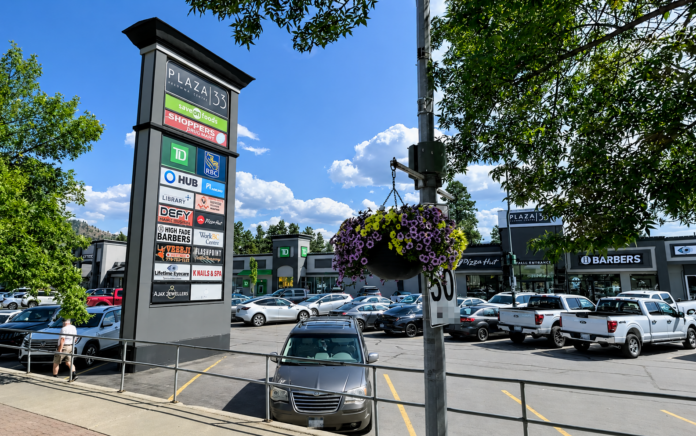
Vancouver-based Lotus Capital Corp. is expanding its Canadian retail portfolio with the acquisition of Plaza 33 in Kelowna, adding an established grocery-anchored shopping centre to a growing collection of necessity-based properties across the country.
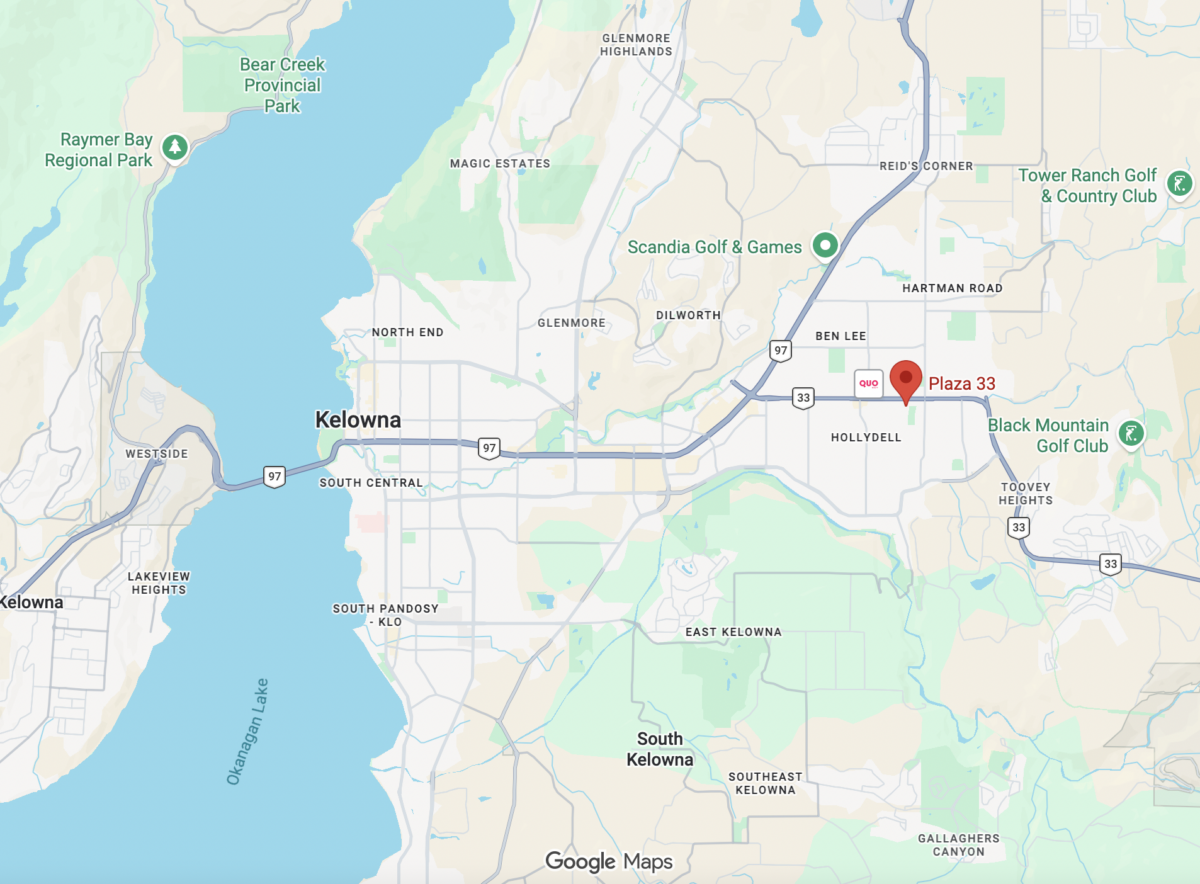
The 86,000-square-foot centre is located at 301 Highway 33 in Kelowna’s Rutland area and sits on 4.61 acres. Built in 1970, Plaza 33 is anchored by Save-On-Foods and includes a mix of pharmacy, banking, health services and community uses. Tenants include Shoppers Drug Mart, RBC, TD Canada Trust, a medical laboratory and an Okanagan Regional Library branch, along with other businesses serving the surrounding community.
The acquisition marks Lotus Capital’s first purchase in Kelowna and extends a recent expansion into grocery-anchored and necessity-based retail. The company has identified the city as one of Western Canada’s stronger secondary markets, pointing to population growth, a diversifying economy and increasing business investment as part of the acquisition rationale.
The purchase price was not disclosed. Plaza 33 had previously been marketed for sale with a reported asking price of $37.5 million, while the property’s most recent reported B.C. Assessment value was $29.1 million.
A Tenant Mix Built Around Daily Needs
Plaza 33 fits closely with the type of retail property becoming more visible within Lotus Capital’s portfolio. Its mix of grocery, pharmacy, banking, medical and community-oriented uses brings several forms of repeat traffic to one neighbourhood centre, with much of that activity tied to routine household needs.
The presence of both Save-On-Foods and Shoppers Drug Mart is particularly important. Two major bank branches, health-related uses and a public library add further reasons for customers to visit the property throughout the week.
For an owner, that mix reduces reliance on any one discretionary retail category and gives the centre a broader role within the surrounding community. Properties of this type often function as local service hubs, particularly in established residential areas where shoppers combine multiple errands in a single trip.
Lotus has indicated that its current plan is to continue operating Plaza 33 as an income-producing retail property, drawing on the centre’s existing traffic and tenant base.
Why Kelowna Matters
The acquisition also places Lotus in one of British Columbia’s most closely watched regional growth markets. Kelowna has experienced significant population expansion over the past decade and continues planning for further growth, while its economy has broadened beyond tourism and leisure to include education, health care, technology, professional services and other industries.
Retail conditions have remained comparatively healthy, though performance differs by format and submarket. Colliers reported approximately 6.2 million square feet of retail inventory across Greater Kelowna at mid-year 2025, with a vacancy rate of 2.94 per cent and average asking net rents of $30.10 per square foot.
By year-end, average net rents remained close to that level at $29.89 per square foot, even as several larger vacancies affected overall market conditions. The figures support the broader case for Kelowna as a growth market while showing that retail demand is not equally strong across every segment.
National retailers have continued entering and expanding within the region. At the same time, high construction costs have made both tenants and landlords more selective about new development and major improvements to existing space. That can strengthen the position of established centres with functional premises, known traffic patterns and long-standing ties to surrounding neighbourhoods.
An Established Retail Node in Rutland
Plaza 33’s location in Rutland adds another dimension to the acquisition. Rutland is one of Kelowna’s major residential areas and has an established network of neighbourhood retail serving local residents.
Mid-2025 market data from Colliers placed retail vacancy in the submarket at approximately 2.4 per cent. Average asking net rents were lower than in several other Kelowna submarkets, at roughly $23.67 per square foot.
The figures point to a market where space was comparatively affordable while vacancy remained limited. For tenants, lower occupancy costs can make locations more accessible. For owners of well-positioned properties, a constrained supply of available space can support leasing stability.
Plaza 33 also has a long operating history in the neighbourhood. Although the property dates to 1970, older shopping centres can retain significant value when their locations remain relevant and their tenant mix continues to serve local demand.
Cash Flow Today and Longer-Term Optionality
The amount of land involved adds another layer to the Plaza 33 acquisition. At 4.61 acres, the property represents a sizeable urban site within a growing city.
Previous marketing of the property highlighted longer-term development potential, and local planning context has been associated with the possibility of greater density on the site, including development of up to 12 storeys. Lotus has not announced redevelopment plans and has indicated that its current intention is to continue operating Plaza 33 as a retail centre.
For now, the investment case centres on an established income-producing property with a durable tenant base. Ownership of a large site in a growing urban market also leaves room for future flexibility if market conditions and planning priorities change over time.
That combination can be especially valuable where older low-rise retail centres occupy substantial parcels of urban land.
A 292,000-Square-Foot Push into Grocery-Anchored Retail
Plaza 33 follows a much larger retail acquisition by Lotus Capital in Eastern Ontario. In 2025, the company acquired a four-property portfolio of grocery-anchored shopping centres from Choice Properties REIT, totalling approximately 292,000 square feet across Kingston, Cornwall, Rockland and Hawkesbury.
Each centre is anchored by a grocery store. The Kingston property at 1030 Coverdale Drive includes a No Frills, while the Rockland centre at 2737 Laurier Street and the Hawkesbury property at 1560 Cameron Street are anchored by Your Independent Grocer locations.
The largest asset in the portfolio is Brookdale Centre in Cornwall, a roughly 140,000-square-foot shopping centre anchored by Food Basics. Other major tenants include Dollarama, Scotiabank and Planet Fitness.
Brookdale Centre also carries a broader mix of restaurants, apparel retailers and service businesses. Reported tenants have included GameStop, Guac Mexi Grill, Kelseys, Penningtons, Play It Again Sports, Reitmans, Stacked Pancake House, The Beer Store, Tim Hortons and Tootsies Shoe Market. The centre was approximately 90 per cent leased when the portfolio was sold.
The transaction gave Lotus immediate scale in Eastern Ontario and placed the company in several regional markets where grocery-anchored centres hold prominent positions in their communities. With Plaza 33 added to the portfolio, the two recent acquisitions account for approximately 378,000 square feet of retail property.
The Current Strategy Has Deeper Roots
The Ontario and Kelowna purchases have made Lotus Capital’s retail activity more visible, though the company has previous experience owning and managing neighbourhood shopping centres.
One example is Forest Glen Shopping Centre in Kitchener, an approximately 127,000-square-foot grocery-anchored property acquired by Lotus in 2013. During its ownership, the company renewed the grocery anchor’s lease and carried out targeted improvements before realizing the investment in 2016.
The property is relevant to the current strategy because it carried many of the same characteristics now visible in the company’s recent acquisitions, including neighbourhood positioning, grocery anchoring, repeat consumer traffic and active asset management.
Lotus has also previously owned Kameyosek Shopping Centre in Edmonton, a neighbourhood-oriented property serving an established residential area. Its mix included banking, medical and convenience-oriented uses, making it similar in some respects to the service-based profile now seen at Plaza 33. Lotus later realized the Kameyosek investment.
Those earlier holdings show that the current expansion is not Lotus Capital’s first experience with shopping centres. The more recent acquisitions appear to be increasing the scale and visibility of a property type the company already knows.
Retail Within a Broader Real Estate Platform
Lotus Capital is a diversified real estate investor with interests spanning industrial, residential, retail and development assets across Canada, along with investment activity in the United States.
That wider platform helps put the recent retail expansion into context. In Brampton, Lotus acquired two Class A business-centre properties in the Airport Intermodal Business Park in 2025. Together, the assets comprise approximately 140,000 square feet and are fully leased.
The company has also owned or invested in manufacturing, warehouse and industrial properties in markets including Burlington, Windsor and Greater Victoria. In Metro Vancouver, Lotus has assembled a Legacy Apartment Portfolio comprising 10 multi-residential properties and 338 units.
Its other activity includes residential development projects such as LINX in Vancouver and the Wildcat Industrial project in Colwood, which is planned to include approximately 150,000 square feet of industrial strata space.
Across more than three decades, Lotus has invested in and realized assets across several property categories and says its activity has represented billions of dollars in investment across North America. Retail remains one part of that broader platform, though the recent shopping-centre acquisitions have given the sector greater prominence within the company’s Canadian activity.
What the Portfolio Suggests About Lotus Capital’s Approach
Viewed across its disclosed holdings, Lotus appears to favour properties that already produce income and also leave room for active management or future value creation.
That pattern takes different forms across the portfolio. Industrial assets can provide contracted income from business tenants. Multifamily properties allow for long-term ownership and incremental improvements. Development sites create value through planning and construction.
The retail acquisitions bring several of those elements together. A grocery-anchored neighbourhood centre can generate current cash flow, serve regular consumer needs and offer opportunities through leasing, operations or property improvements. In some cases, a large land holding may also carry future development potential.
Plaza 33 illustrates that mix. It is an operating shopping centre with a broad daily-needs tenant base, a long-standing community presence and a sizeable site in a growing city. The Eastern Ontario portfolio offers a similar income-oriented profile across four regional markets.
Why Necessity-Based Retail Remains Attractive
Lotus Capital’s expansion comes as grocery- and drug-anchored shopping centres continue to draw investor attention.
The appeal is easy to understand. Consumers may delay furniture, apparel or other discretionary purchases when household budgets tighten, but they continue buying groceries, filling prescriptions and using everyday services.
Necessity-based retail still faces pressure. Grocery operators deal with tight margins, pharmacies adjust store networks and neighbourhood centres require ongoing leasing and capital investment. Even so, properties anchored by regular consumer needs can carry a degree of stability that is harder to achieve in heavily discretionary formats.
Established centres may also benefit from the high cost of creating new commercial space. Construction expenses, financing conditions and tenant improvement costs can make new projects difficult to justify in many markets.
An existing centre with usable space, established access, familiar traffic patterns and a strong local tenant mix can remain valuable even when the buildings themselves are older. Western Canadian market commentary has continued to identify grocery- and drug-anchored plazas as attractive investment targets in selected markets.
Looking Beyond Canada’s Largest Cities
The geography of Lotus Capital’s recent retail acquisitions is notable. Kelowna, Kingston, Cornwall, Rockland and Hawkesbury are very different communities, with distinct economies and growth patterns.
What they share is a location outside Canada’s largest downtown investment markets and a reliance on established regional and neighbourhood retail.
In communities like these, grocery-anchored centres can hold important positions within local shopping patterns. They often serve broad residential catchments and benefit from customer routines built over many years.
Acquisition conditions can also differ from Toronto or Vancouver, where competition for land and income-producing real estate can be intense. That does not make every secondary market equally attractive, but it can create opportunities for investors prepared to assess communities individually.
Kelowna adds a Western Canadian growth market to the portfolio. For Lotus, Plaza 33 provides exposure to that growth through an operating property already embedded in the Rutland community.
A Retail Platform Taking Shape
The Plaza 33 acquisition makes Lotus Capital’s retail strategy easier to see.
The company now has a major grocery-anchored portfolio in Eastern Ontario, a newly acquired neighbourhood centre in Kelowna and earlier experience with shopping centres in Ontario and Alberta. Those holdings sit within a larger real estate platform spanning industrial, residential and development assets.
The pattern points to a growing focus on established locations, everyday consumer demand and properties with durable income characteristics. In selected cases, longer-term land value may add another layer to the investment.
Plaza 33 may be Lotus Capital’s first acquisition in Kelowna, but it sits within a much longer record of real estate investment and shopping-centre ownership.
With its recent Eastern Ontario and British Columbia acquisitions accounting for approximately 378,000 square feet of retail property, grocery-anchored and necessity-based centres are becoming a more visible part of the company’s Canadian portfolio.
As part of Retail Insider Reports, this Q2 2026 Retail Food Service Report provides structured analysis of the Canadian food service sector, drawing on Retail Insider coverage, company disclosures, and Statistics Canada data to identify the market dynamics, trends, and commercial implications shaping the period. The full report series is available through the Report Hub.
This report examines Canadian foodservice retail, including quick-service restaurants, full-service restaurants, cafés, food halls, chains, franchised operators, and consumer dining trends.
*****
Canadian food service entered Q2 2026 with resilient sales but tougher competition for traffic. Operators are not facing a broad collapse in dining demand. Instead, the market is being shaped by value sensitivity, franchise-led growth, menu innovation, convenience-focused real estate strategies, wellness-oriented concepts, and renewed competition in coffee and breakfast.
The quarter highlighted several overlapping themes. Multi-brand platforms such as Foodtastic and Happy Belly Food Group are using acquisitions, franchising, and shared infrastructure to scale. Legacy quick service brands including Burger King Canada and A&W are investing in menu improvements to reinforce relevance. Pizza operators are seeing uneven performance, with Boston Pizza reporting sales gains while Pizza Pizza faced same-store sales pressure. Specialty and fusion concepts are producing mixed outcomes, with Tahini’s expanding around a viral product platform while PLANTA reduced its Canadian presence. Coffee competition is also entering a new phase as Dunkin prepares to return to Canada through Foodtastic while Tim Hortons invests heavily in new restaurants and renovations.
At the same time, food service is becoming more important to real estate strategy. Food halls, mixed-use developments, entertainment venues, food court concepts, office catering platforms, and wellness fast-casual brands are giving operators and landlords new ways to capture traffic beyond traditional restaurant formats.
Statistics Canada’s latest food services and drinking places data shows continued spending momentum heading into the second quarter. Total sales in the subsector increased 0.8 per cent in April 2026 to $8.8 billion. Limited-service eating places rose 0.7 per cent, while full-service restaurants increased 0.5 per cent. Restaurant food prices were up 3.0 per cent year over year.
The data suggests consumers are still spending in food service, but operators are competing in a more demanding environment. Higher prices, cautious household budgets, and strong promotional activity are pushing brands to sharpen value propositions, improve convenience, and differentiate through menu quality, loyalty, experience, and format innovation.
Broad Overall Themes
Canadian food service in Q2 2026 reflects a market where demand remains present, but growth is harder to capture. Operators with scale, strong franchise systems, clear value propositions, and flexible formats are better positioned, while those lacking differentiation face greater pressure.
Value and affordability remain central to traffic generation. Promotional platforms, bundles, cautious pricing, and everyday value offers are increasingly important as consumers weigh restaurant spending against household cost pressures.
Multi-brand franchising platforms are gaining influence. Foodtastic’s acquisition of Kinton Ramen, its Dunkin master franchise agreement, and Happy Belly Food Group’s expanding brand portfolio all point to the growing importance of platform operators with franchise infrastructure, real estate relationships, and brand management capabilities.
Coffee and breakfast competition is intensifying. Dunkin’s planned Canadian re-entry gives the market a new potential challenger, while Tim Hortons is reinforcing its dominant position through significant investment in new builds and renovations.
Legacy quick service brands are using menu innovation to defend relevance. Burger King Canada’s core menu upgrades and A&W’s smash burger launch show how established chains are trying to improve perceived quality while remaining accessible.
Specialty, wellness, and fusion concepts are producing mixed outcomes. Tahini’s demonstrates the potential of culturally resonant, social-media-driven menu innovation, while HEAL Wellness shows continued momentum for health-oriented fast casual. PLANTA’s contraction points to the challenges facing premium plant-based concepts in Canada.
Real estate and format innovation are becoming more important. Food courts, food halls, mixed-use projects, non-traditional locations, office catering platforms, and entertainment-based food service environments are giving operators new ways to reach consumers beyond traditional restaurant formats.
Community engagement continues to support brand affinity. Campaigns such as McHappy Day and culturally resonant activations can deepen consumer connection, though they work best when paired with strong operations, value, and product relevance.
Retail Insider Coverage
Scale and Multi-Brand Platforms Drive Growth
Multi-brand franchising platforms are becoming more influential in Canadian food service. Foodtastic is one of the clearest examples. The company’s acquisition of Kinton Ramen adds a Canadian-born Asian dining brand with dozens of locations across Canada and the U.S. to a portfolio that now spans multiple restaurant categories. The deal strengthens Foodtastic’s position as a national platform operator and reinforces the growing appeal of scalable, culturally relevant concepts with proven operating models.
Foodtastic’s master franchising agreement to bring Dunkin back to Canada further demonstrates how established platform operators can act as growth partners for global brands entering or re-entering the Canadian market.
Happy Belly Food Group represents another version of the platform model. The company reported $63.1 million in system-wide QSR sales for fiscal 2025, up 108 per cent year over year, while its operating restaurant count increased from 43 to 77. Its acquisitions and investments across emerging food brands point to a growth model built around shared infrastructure, franchising, and brand portfolio management.
This model can accelerate growth by giving smaller concepts access to franchising expertise, site selection support, operating systems, and capital markets visibility. The next phase for platform operators will depend on franchisee economics, site quality, operational consistency, and the ability to scale without diluting individual brand identities.
Value and Affordability Remain Critical Traffic Drivers
Food service demand remains resilient, but consumers are still price sensitive. This makes value one of the most important themes in the sector. Pizza Pizza’s Q1 2026 results showed the pressure clearly, with same-store sales down 4.1 per cent amid softer demand, constrained discretionary spending, and a competitive promotional environment. Its response, including value-focused offers such as meal deals, reflects the importance of affordability in driving walk-in traffic and repeat visits.
Boston Pizza showed a more positive trajectory, reporting Q1 franchise sales growth and same-restaurant sales growth of 3.1 per cent. The company attributed performance to increased guest traffic, takeout and delivery momentum, and promotional initiatives.
For operators, the key challenge is balancing value with margin protection. Aggressive discounting may support short-term traffic but can pressure profitability if not supported by operational discipline, menu engineering, and franchisee alignment.
Legacy QSR Brands Invest in Core Menu Quality
Legacy quick service brands are using menu improvements to defend market share and strengthen consumer perception. Burger King Canada’s upgrades, including changes to buns, fries, packaging, and chicken products, reflect an effort to improve the core guest experience rather than relying solely on limited-time offers.
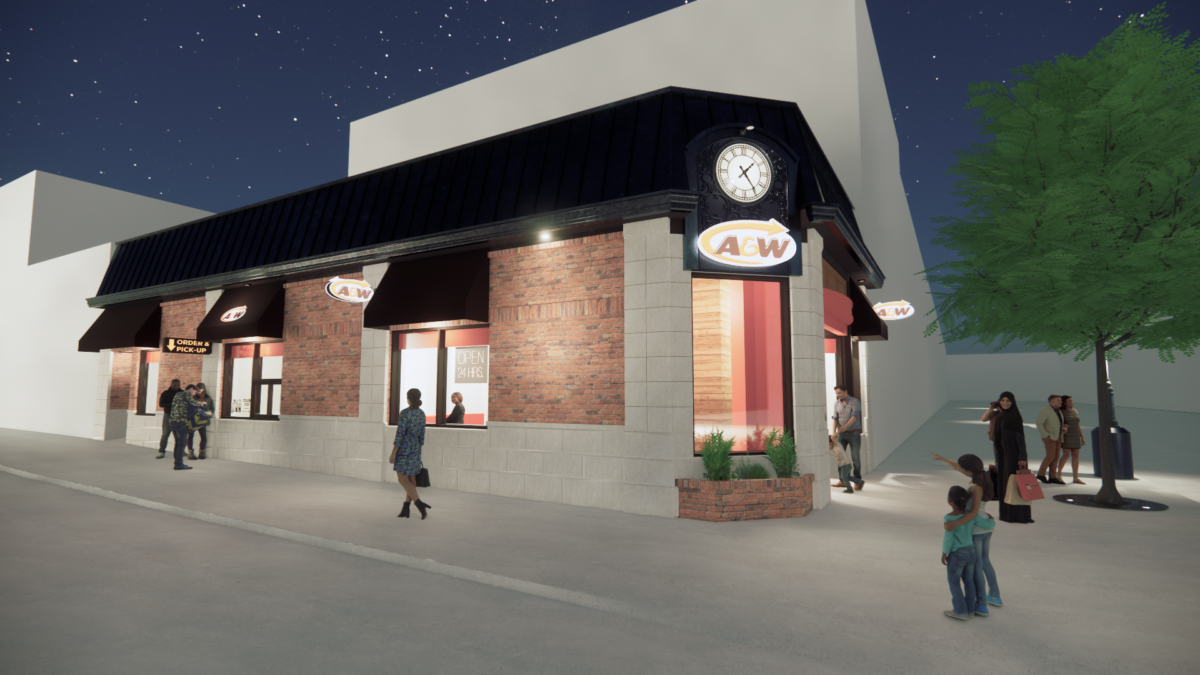
A&W’s nationwide smash burger launch points to a similar strategy. The brand is leaning into product news and quality cues to remain relevant in a crowded burger market.
This matters because legacy QSR operators face pressure from multiple directions: value-focused competitors, premium fast-casual brands, delivery platforms, and younger consumers with more dining options.
Rendering of the new location. Final signage package subject to approvals
Coffee and Breakfast Competition Intensifies
The coffee and breakfast segment is entering a more competitive phase. Dunkin is preparing to return to Canada through a master franchising agreement with Foodtastic, with the first Canadian location expected in late 2026 or early 2027 and a longer-term plan for hundreds of locations nationally.
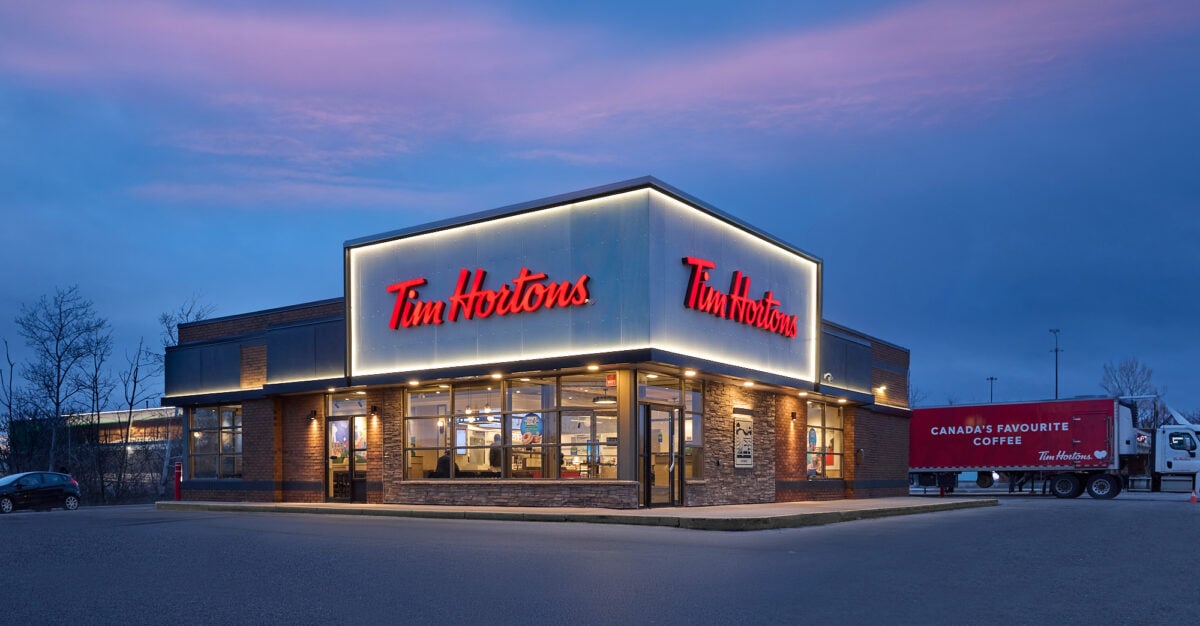
Tim Hortons is not standing still. The company and its restaurant owners are investing $400 million in Canada in 2026, including 80 new restaurants and 400 renovations. That investment reinforces the scale advantage Tim Hortons continues to hold as it updates restaurants, expands in growth markets, and supports franchisee confidence.
Canada’s coffee market remains intensely competitive, and consumer routines are difficult to displace. Dunkin’s return will likely play out over several years, but it adds another layer of competition to one of the country’s most important food service categories.
Wellness, Specialty and Fusion Concepts Show Divergent Outcomes
Specialty food service concepts continue to produce mixed results. Tahini’s Shawarma Ramen illustrates the upside of product innovation tied to cultural relevance and social media momentum.
HEAL Wellness reflects another important growth direction. The brand’s expansion across Canada and into the U.S. shows continued demand for health-oriented fast casual concepts built around smoothies, bowls, functional ingredients, and wellness positioning.
At the same time, PLANTA’s contraction in Canada points to the challenges facing premium plant-based dining. The broader takeaway is that specialty concepts require more than novelty. They need strong unit economics, clear audience definition, operational consistency, and formats that can scale.
International and Culturally Specific Concepts Continue to Resonate
Canadian food service continues to benefit from consumer interest in international and culturally specific concepts. Kinton Ramen’s growth and Foodtastic’s acquisition of the brand show that Asian dining concepts can scale meaningfully when they combine brand recognition, operational discipline, and adaptable formats. Kinton’s first food court concept at Vancouver’s Waterfront Centre also demonstrates how international food brands can use smaller formats to reach high-traffic urban environments.
Tahini’s provides another example of culturally resonant menu development and cross-cultural flavour profiles that generate attention and differentiation.
Canada’s population growth and increasing cultural diversity continue to create opportunities for internationally inspired and culturally specific food concepts.
Food Service Becomes a Placemaking Tool
Food service real estate is adapting to consumer demand for convenience, experience, and flexibility. Mirvish Village’s The Kitchen is a strong example. The 19,000-square-foot food hall and event venue combines restaurant vendors, bars, live entertainment, and programming, positioning food service as a central part of mixed-use placemaking.
Food halls continue to blur the lines between restaurants, entertainment, and experiential retail, making them increasingly attractive components of mixed-use developments.
Kinton Ramen’s food court concept at Vancouver’s Waterfront Centre reflects a different approach, using a streamlined format suited to high-volume, convenience-oriented urban environments.
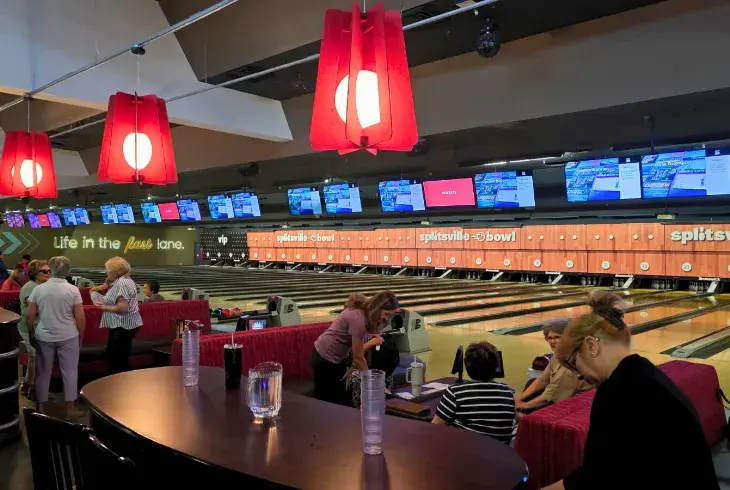
Splitsville Bowl’s expansion into mixed-use retail environments points to another trend: dining, entertainment, and social activity increasingly overlap.
Splitsville, Source: splitsvillebowl.ca
Major mixed-use projects such as Oakridge Park in Vancouver also illustrate the growing importance of food and beverage offerings in creating destination environments. In these projects, restaurants and food experiences are not secondary amenities. They are part of the broader strategy to create all-day traffic, hospitality, and community energy.
For landlords, food service remains an important leasing category, but the formats are changing. Food courts, quick service kiosks, food halls, drive-thru sites, entertainment venues, and mixed-use dining environments are all becoming part of a broader real estate toolkit.
Non-Traditional Channels Create New Food Service Opportunities
Food service growth is also extending beyond conventional restaurants. Nüu Catering’s office-focused model shows how food service can support return-to-office culture by connecting workplaces with local restaurant brands.
These channels matter because the definition of food service is widening. Operators are not only competing for dine-in, takeout, and delivery occasions. They are also competing for workplace meals, event catering, food hall visits, entertainment occasions, and mixed-use traffic.
Community Engagement Supports Brand Affinity
Community-linked campaigns continue to play a role in strengthening brand connection. McDonald’s McHappy Day raised more than $10.8 million in 2026 for Ronald McDonald House and children’s charities, showing the enduring power of large-scale cause marketing.
Other culturally resonant campaigns, including KFC’s Montreal Forum seats activation, demonstrate how brands can use nostalgia, local identity, and cultural memory to deepen consumer engagement.
TimeOut Oakridge in Vancouver. Photo: Lee Rivett.
Broader Industry Coverage
Demand Is Uneven Across Segments
The Canadian food service market is not moving uniformly. Company results show meaningful variation by segment and brand.
Boston Pizza’s sales growth suggests resilience in casual dining when operators combine traffic-driving promotions, takeout and delivery strength, and franchisee execution. Pizza Pizza’s same-store sales decline shows the pressure facing value-oriented operators when consumer confidence softens and promotional competition intensifies.
Franchisee Economics and Execution Will Determine Growth Quality
Franchise-led growth remains central to Canadian food service, but unit-level economics will be decisive. Tim Hortons’ investment in new builds and renovations reflects confidence in its Canadian franchise system and long-term market opportunity.
Jersey Mike’s continued Canadian expansion through Redberry also points to the importance of experienced franchise operators in scaling U.S. QSR brands across Canada.
Expansion quality matters more than expansion announcements. New restaurants must be supported by viable trade areas, strong franchisee recruitment, operating discipline, supply chain strength, and marketing support.
Promotional Intensity Is Here to Stay
Restaurant operators are likely to remain promotional through the balance of 2026.
Higher menu prices, cautious consumers, and intensified competition are pushing brands to use bundles, limited-time offers, loyalty programs, and value platforms to sustain frequency.
Real Estate Strategy Is Becoming More Flexible
Food service operators are increasingly using different formats for different occasions.
Traditional restaurants remain important, but growth is also coming through smaller footprints, food courts, food halls, drive-thru sites, mixed-use developments, entertainment venues, office catering, and urban convenience formats.
For shopping centre landlords, food service continues to be a traffic driver and a tool for repositioning properties.
Labour and Productivity Remain Underlying Pressures
Food service operators continue to face pressure from labour availability, wage costs, training, and operational complexity.
This helps explain why some brands are pursuing simplified menus, smaller formats, digital ordering, franchising discipline, and operational systems that improve throughput and consistency.
Tim Hortons photo
Editor’s Take
Q2 2026 confirms that Canadian food service remains resilient, but the market is becoming more competitive and more selective.
The strongest food service operators are those combining scale, value, convenience, and menu relevance. Tim Hortons has the advantage of national reach and franchisee investment. Foodtastic is positioning itself as a major platform for global and domestic brand growth through Dunkin and Kinton. Happy Belly is demonstrating how emerging brands can scale through acquisition and franchising, though its next phase will require careful attention to unit economics and execution.
Legacy QSR brands are responding with product upgrades and menu innovation. Consumers are looking for value, speed, consistency, and relevance. Brands that improve food quality while maintaining affordability will be better positioned than those that simply add limited-time offers without a clearer value proposition.
The coffee and breakfast category deserves close attention. Dunkin’s return to Canada is significant, but it should be viewed as a long-term competitive development rather than an immediate disruption.
Specialty, wellness, and fusion concepts will remain an important part of the market, but performance will be uneven. Tahini’s shows the upside of cultural relevance and social media-driven product innovation. HEAL Wellness shows the strength of health-oriented fast casual when supported by brand clarity and expansion discipline. PLANTA’s contraction shows that premium specialty concepts must still prove sustainable economics in Canada.
For landlords, food service remains one of the most important categories for traffic, dwell time, and mixed-use activation. The Kitchen at Mirvish Village, Kinton’s food court format, Splitsville Bowl, and the broader role of restaurants at mixed-use projects such as Oakridge Park all show how food service is becoming more central to placemaking.
Food service is increasingly about creating occasions and ecosystems around convenience, entertainment, and community.
Looking ahead, the key indicators will be the pace and quality of Dunkin’s rollout, Tim Hortons’ renovation and new-build execution, Happy Belly’s ability to sustain growth, Foodtastic’s integration of Kinton, promotional pressure across QSR and pizza, and the performance of food service tenants in mixed-use and non-traditional formats.
The Canadian food service market is not weakening broadly. Instead, it is becoming more demanding, more competitive, and increasingly shaped by scale, experience, convenience, and disciplined execution.
As part of Retail Insider Reports, this Q2 2026 Grocery Retail Report provides structured analysis of the Canadian grocery sector, drawing on Retail Insider’s ongoing coverage to identify key market dynamics, emerging trends, and strategic shifts. These reports are designed to deliver executive-level insights across major retail sectors and can be accessed through the Retail Insider Report Hub.
This report examines the Canadian grocery retail sector, including supermarkets, discount grocers, specialty food retailers, convenience-oriented food retail, merchandising strategies, store expansion, competition, consumer purchasing trends, and developments affecting food retail in Canada.
*****
Canadian grocery retail in Q2 2026 is being reorganized around value. Inflation remains a defining pressure for consumers, discount formats continue to expand, digital tools are increasingly focused on helping shoppers manage budgets, and grocery-anchored real estate is attracting renewed investment from major landlords and institutional owners.
The quarter also showed that the market is becoming more polarized. Discount formats are capturing capital, traffic, and consumer attention, while premium and experiential grocery concepts continue to find opportunities in affluent, dense, and culturally diverse trade areas.
The result is not a simple move toward discount grocery. Value is becoming the organizing principle behind store strategy, assortment, technology, real estate, loyalty, and consumer engagement. At the same time, grocers and landlords continue to invest in formats that use prepared foods, food halls, specialty products, and cultural relevance to create destination appeal.
Market Context: Grocery Spending Faces Pressure as Food Inflation Persists
Statistics Canada’s latest retail trade data shows a more pressured grocery environment heading into Q2. Food and beverage retailers recorded $13.46 billion in April 2026 sales, down 2.0 per cent month over month, even as total retail sales rose 0.5 per cent to $73.0 billion. Core retail sales fell 0.7 per cent, with food and beverage retailers among the categories contributing to the decline.
At the same time, food inflation remained elevated. Statistics Canada’s May 2026 Consumer Price Index showed food purchased from stores up 4.3 per cent year over year, outpacing headline inflation for the 16th consecutive month. Fresh vegetables rose 9.0 per cent year over year, while tomato prices rose 45.2 per cent due to supply constraints.
These figures reinforce the central tension in Canadian grocery. Consumers still need to buy food, but they are doing so with greater price sensitivity. That is pushing grocery retailers to defend traffic through discount banners, loyalty programs, private label, promotions, larger pack sizes, and digital tools that help shoppers manage budgets.
Broad Overall Themes
Canadian grocery retail in Q2 2026 reflects a sector where affordability, convenience, and operational discipline are increasingly decisive.
Discount grocery growth is structural. Empire, Loblaw, and Metro are expanding value-oriented formats as shoppers continue to prioritize price. FreshCo’s planned expansion across Western Canada, Ontario, and Atlantic Canada highlights the national importance of discount growth, while No Frills’ continued expansion reinforces Loblaw’s strength in hard discount.
Full-service grocers are under pressure to defend relevance. Traditional banners must balance fresh, service, convenience, loyalty, prepared foods, and price perception while proving they can still deliver value. The risk is not that full-service grocery disappears, but that weaker operators lose share if shoppers perceive the price gap as too wide.
Digital innovation is becoming more practical. Loblaw’s ChatGPT-powered grocery integration, Skip’s expanded grocery delivery partnership, and Tre’dish’s SproutAI all point to technology being used less as a novelty and more as a tool for meal planning, fulfillment, savings, and budget control.
Grocery real estate is gaining strategic importance. Projects such as Nations Experience at Oakville Place, Loblaws Humbertown, Food World Plus in Mississauga, and McEwan’s planned arrival at Bayview Village show how grocery can anchor mixed-use, experiential, premium, culturally specific, and necessity-based retail environments.
Prepared foods are becoming increasingly important as grocers seek to capture meal occasions, compete more directly with restaurants, and generate higher-margin revenue streams.
Product innovation remains targeted. High-protein ice cream, dairy-free frozen novelties, ready-to-eat salad kits, and greenhouse-grown produce reflect continued interest in health, convenience, and select premium niches, even as broader consumer behaviour remains value-driven.
Inflation and category pressure remain major operating challenges. Food inflation, produce volatility, meat prices, freight costs, and regional disparities continue to shape pricing, assortment, and promotional strategy.
GLP-1 weight-loss drugs represent an emerging demand risk. The impact should be treated carefully, but early research suggests appetite-suppressing medications could affect food consumption patterns over time, particularly in snacks, confectionery, alcohol, and impulse categories.
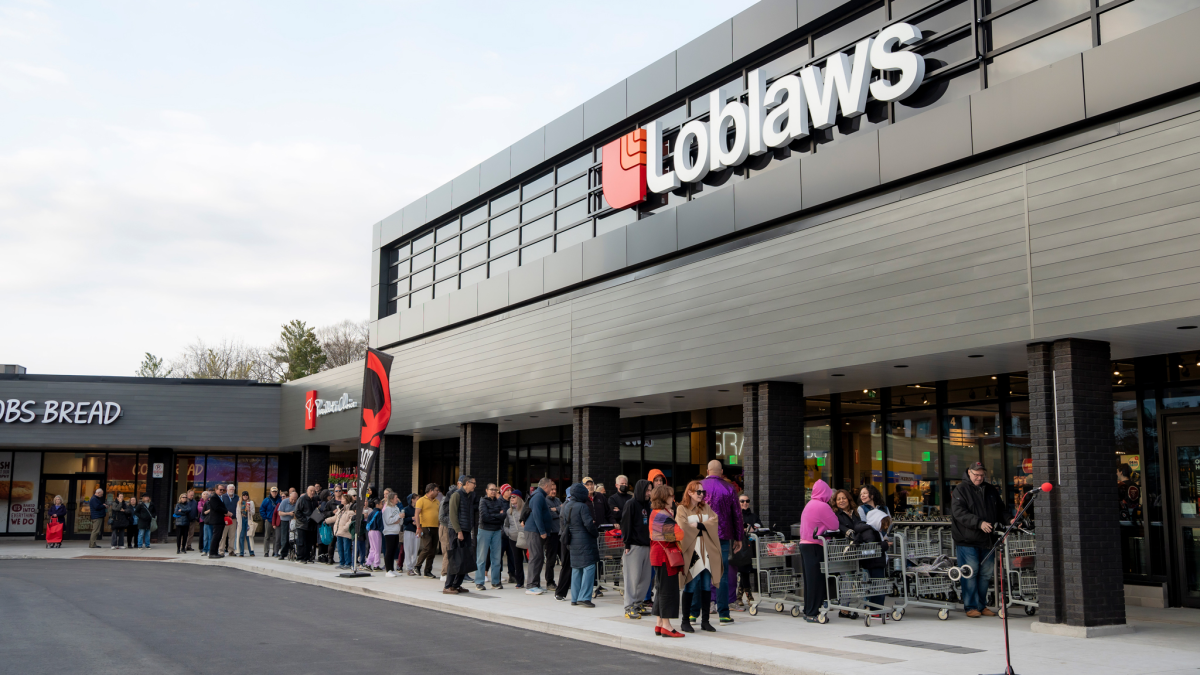
Loblaws at Humbertown Plaza in Toronto. Photo: Loblaw Companies
Retail Insider Coverage
Discount Grocery Expansion Anchors Growth
Discount grocery expansion remains the clearest growth theme in Canadian grocery.
Empire’s latest fiscal results show the company continuing to prioritize FreshCo as a national growth vehicle. As of June 17, 2026, FreshCo had 161 stores, including 53 in Western Canada and 108 in Ontario. Empire expects to open approximately 15 new FreshCo stores in fiscal 2027 across Western Canada, Ontario, and Atlantic Canada.
FreshCo’s move into Atlantic Canada is especially significant. The region has historically had fewer discount grocery options than Ontario and parts of Western Canada, creating room for new value-oriented competition. The Halifax-area openings show Empire using discount expansion not only as a defensive move, but also as a way to enter or strengthen underpenetrated markets.
Loblaw’s No Frills network also continues to grow, with the banner marking its 200th store in Ontario during the quarter. This reinforces the strength of hard discount in the country’s largest grocery market and shows how Loblaw continues to use its scale, private label, loyalty, and store network to defend value shoppers.
The broader implication is clear: discount is no longer a temporary response to inflation. It has become a long-term strategic priority. Grocers are investing capital, real estate, supply chain resources, and marketing behind formats designed for a more value-conscious consumer.
Value Is Reshaping Assortment and Shopping Behaviour
Consumer behaviour continues to shift around affordability. Persistent food inflation is pushing shoppers toward promotions, private label, larger pack sizes, and more deliberate trip planning. Retailers are responding by sharpening value messaging and using loyalty data to personalize offers.
This does not mean consumers are only buying the cheapest products. The market is more nuanced. Shoppers may trade down in staples while still selectively purchasing premium, health-oriented, local, or convenient products.
That makes assortment management more complex. Grocers must maintain value credibility without abandoning categories that support margin and differentiation.
Private label will likely remain one of the most important battlegrounds. For large grocery operators, private label supports value perception, margin management, and customer loyalty. For smaller and specialty retailers, the challenge will be competing against major chains with more control over branded and owned-label pricing architecture.
Premium and Experiential Grocery Continue to Find Opportunity
While value is the dominant theme, Q2 also showed that premium and experiential grocery concepts remain viable in the right trade areas.
McEwan’s planned arrival at Bayview Village illustrates this side of the market. The shopping centre serves an affluent customer base and is undergoing a broader transformation into a mixed-use, premium lifestyle destination. A curated food concept such as McEwan can operate as both a grocery anchor and a lifestyle amenity, supporting the property’s repositioning while giving shoppers a premium alternative to conventional grocery.
Nations Experience at Oakville Place offers another model. The 120,000-square-foot concept combines grocery, prepared foods, foodservice, and entertainment elements, turning a former department store environment into a large-scale food destination.
Food World Plus in Mississauga adds a culturally specific dimension, transforming a former Highland Farms location into an international grocery and food hall concept.
Together, these examples show that grocery is becoming more polarized. Discount formats are expanding rapidly, but premium, experiential, and international grocery concepts can still succeed when they align with local demographics, food culture, convenience, and destination appeal.
McEwan Fine Foods at CF Shops at Don Mills in Toronto. Photo: OpenTable
Digital and AI Tools Focus on Budget Control and Convenience
Digital grocery innovation in Q2 became increasingly practical.
The strongest examples are not about replacing grocery stores. They are about helping consumers plan, save, shop, and fulfill orders more efficiently.
Loblaw’s ChatGPT-powered grocery integration allows customers to turn recipes and meal ideas into shopping lists and orders. This is meaningful because it links inspiration, planning, and transaction. In a value-conscious environment, the next opportunity will be connecting AI-driven meal planning with budget controls, loyalty offers, private label substitutions, and household replenishment.
Skip’s expanded grocery delivery partnership with Loblaw across multiple banners also reinforces the role of third-party delivery in convenience and top-up trips. Delivery economics remain challenging, but consumers increasingly expect flexible grocery access.
Tre’dish’s SproutAI offers another example of the sector’s direction. By positioning AI around grocery budget optimization, the platform reflects a broader shift from digital convenience alone to digital savings.
The Canadian market also appears to be favouring pragmatic fulfillment models. Grocers are leaning on store-based picking, marketplace partnerships, and scalable digital tools rather than only pursuing capital-intensive automation.
Product Innovation Targets Health, Convenience and Select Premium Niches
Product innovation remains active, but it is more targeted than transformational.
Foothills Creamery’s high-protein ice cream, Righteous Gelato’s dairy-free Sorbetto Bars, and Haven Greens’ ready-to-eat salad kits all reflect consumer interest in health, convenience, and better-for-you indulgence.
These launches show that premium and specialty demand still exists, even in an inflationary grocery environment. Consumers may be selective, buying premium items when they solve a specific need or deliver a clear benefit while trading down elsewhere.
For grocery retailers, this creates a balancing act. Product innovation can drive differentiation and margin, but it must sit within an assortment that still feels affordable.
Grocery Real Estate Becomes a Strategic Growth Platform
Grocery real estate was one of the most important themes in Q2. Several Retail Insider stories showed grocery being used to reposition major spaces, anchor mixed-use redevelopment, and create more experiential retail environments.
Nations Experience at Oakville Place demonstrates how grocery can help repurpose large-format department store space. The concept combines grocery, prepared foods, foodservice, and entertainment elements, giving the mall a new traffic driver after the decline of traditional department store retail.
Loblaws Humbertown reflects another model. The reopened store is part of a broader mixed-use redevelopment, showing how grocery can anchor pedestrian-oriented urban villages and provide daily-needs traffic within larger residential and retail environments.
Food World Plus in Mississauga shows the importance of culturally specific grocery formats in major Canadian urban markets, where population growth and diversity continue to create demand for international food concepts.
McEwan at Bayview Village adds a premium grocery dimension, reinforcing how food retail can support the repositioning of affluent shopping centres and mixed-use communities.
At the institutional level, the Choice Properties and KingSett transaction involving First Capital further reinforces grocery-anchored retail as a strategic real estate category. Choice is set to acquire approximately $5.0 billion of high-quality retail assets from First Capital, strengthening its position in necessity-based urban retail.
The transaction also underscores the continued appeal of necessity-based retail at a time when certain discretionary retail categories remain under pressure. Grocery-anchored retail remains one of the most attractive and defensible forms of retail real estate in Canada.
Inflation, Freight and Regional Disparities Shape Operations
Food inflation continues to be one of the most important operating issues in grocery. Higher prices for fresh food, produce volatility, supplier cost requests, and freight pressures are affecting pricing and margins.
Canada’s grocery market cannot be viewed as a single national market. Consumer needs, competition, logistics, and operating costs vary dramatically between urban, suburban, and northern communities.
The North West Company’s performance signals the importance of understanding grocery through a regional lens rather than treating Canada as one homogeneous market.
For operators, inflation management is no longer simply about passing through supplier costs. It requires disciplined sourcing, promotional planning, private label strategy, loyalty targeting, and careful communication with shoppers.
GLP-1 Drugs Create an Emerging Demand Question
GLP-1 medications are becoming an important long-term issue for grocery, though the impact should be framed carefully.
Early research suggests appetite-suppressing drugs may reduce food consumption and shift category demand, particularly in snacks, confectionery, alcohol, sugary beverages, and impulse-oriented categories.
The scale of the impact remains uncertain, and it would be premature to describe GLP-1 drugs as a fully realized category disruption. However, grocers, food manufacturers, and landlords should monitor the trend closely.
GLP-1 medications. Photo: health.com
Broader Industry Coverage
Discount Growth Is Becoming a Capital Allocation Strategy
The most important shift in Canadian grocery is that discount growth is now tied directly to capital allocation.
Empire is opening new FreshCo stores, Loblaw continues to invest in No Frills and hard discount, and Metro remains focused on discount growth in key markets.
This is different from simply adding a few value stores during a period of inflation. Grocers are rebalancing networks around the expectation that value-conscious behaviour will persist.
Omnichannel Grocery Is Becoming More Cost Conscious
The Canadian grocery sector appears to be entering a more disciplined phase of omnichannel execution.
Earlier enthusiasm for heavy automation is giving way to more flexible models built around store-based picking, third-party delivery, click-and-collect, and targeted digital tools.
Digital investments need to improve convenience, loyalty, basket size, or efficiency without creating unsustainable fulfillment costs.
Grocery Anchors Are Central to Mixed-Use Retail
Grocery remains one of the most important anchors in Canadian retail real estate.
In a market where department stores have weakened and some discretionary categories are under pressure, grocery brings frequency and daily-needs relevance.
The next phase is more dynamic than traditional supermarket anchoring. Grocery can now be part of mixed-use communities, food halls, cultural retail destinations, department store redevelopments, premium lifestyle centres, and urban necessity-based portfolios.
Inflation Is Changing the Meaning of Loyalty
Loyalty in grocery is increasingly tied to perceived savings.
Programs such as PC Optimum and other loyalty platforms are not only engagement tools; they are value-delivery systems. As food inflation persists, shoppers are more likely to compare promotions, accumulate points, use personalized offers, and shift trips based on perceived savings.
Retailers with stronger loyalty ecosystems can better understand household behaviour, target offers, and defend market share.
Grocery store meat butcher department. Image: RI/Google
Editor’s Take
Q2 2026 confirms that value has become the organizing principle of Canadian grocery retail.
Discount expansion is the most visible expression of that shift, but the story is broader. Value is now shaping store formats, real estate strategy, private label, digital tools, loyalty, product innovation, and category management.
Statistics Canada data reinforces the pressure consumers are facing. Food and beverage retail sales declined month over month in April, while food purchased from stores rose 4.3 per cent year over year in May. Consumers are still buying groceries, but they are more deliberate, more price-aware, and more willing to shift behaviour to manage household budgets.
The strongest grocers are those that can combine value credibility with operational discipline. Empire’s FreshCo expansion, Loblaw’s No Frills strength, and Metro’s discount focus all point to a market where value formats will continue taking a larger share of capital and management attention.
At the same time, grocery is not becoming a purely discount-driven market. McEwan at Bayview Village, Nations Experience at Oakville Place, and Food World Plus in Mississauga show that premium, experiential, and international grocery concepts can still succeed when they are matched to the right demographic profile and trade area.
Prepared foods are also becoming an important differentiator as grocers seek higher-margin categories and compete more directly for meal occasions that once belonged primarily to restaurants and foodservice operators.
That makes the sector more polarized. Discount growth is accelerating, but curated food concepts, prepared foods, food halls, and culturally specific grocery formats are also finding opportunities. The middle of the market may face the most pressure if it cannot defend value while offering service, freshness, convenience, and differentiation.
Digital grocery is moving into a more practical phase. AI tools, delivery partnerships, and omnichannel platforms are proving most valuable when they help consumers plan meals, manage budgets, access promotions, and shop efficiently.
Real estate may be the most underappreciated part of the story. Grocery is becoming even more important to landlords because it delivers frequency and necessity-based traffic. Projects such as Nations Experience, Loblaws Humbertown, Food World Plus, and McEwan at Bayview Village show how grocery can help reanimate major spaces, support mixed-use strategies, and create more dynamic food-driven destinations.
The Choice Properties and KingSett transaction involving First Capital further confirms institutional conviction in grocery-anchored urban retail.
The most uncertain emerging issue is GLP-1 adoption. It should not be overstated, but it should not be ignored. If appetite-suppressing medications continue to gain users, they could gradually reshape demand in snacks, confectionery, alcohol, prepared foods, and impulse categories.
Looking ahead, the key indicators will be the pace of discount store openings, food inflation trends, private label growth, promotional intensity, digital adoption, performance of grocery-anchored real estate projects, and the resilience of premium and experiential grocery formats.
Canadian grocery is becoming increasingly polarized. Value is reshaping the operating model, while premium, experiential, and culturally specific formats continue to prove that food retail can still be both practical and destination-oriented.