


In less than a month, marijuana can be legally purchased from private retailers in Ontario and some other places across Canada. Are we ready for it? THE CANADIAN PRESS/Darryl Dyck
By David Soberman
The Ontario government under Premier Doug Ford plans to privatize the retail sales of marijuana once it becomes legal next month, in contrast to the policy of the previous provincial government.
Before the end of this year, cannabis sales become legal across Canada with a variety of distribution approaches under consideration. Five other provinces — British Columbia, Alberta, Saskatchewan, Manitoba and Newfoundland — plan to allow private stores to sell recreational marijuana while others, like Quebec and Nova Scotia, have opted for government-operated retailing.
Sales in Ontario will begin online this fall before expanding to retail locations at a later date.
Ford’s reasoning appears to be ideological: There is too much government, and whenever it’s feasible and safe for the private sector to conduct an activity, it’s better.
But to assess the wisdom of privatizing marijuana sales in Ontario and in Canada at large, it’s useful to consider a number of key factors that affect the market for marijuana as we move toward legalization.
One in five Canadians Indulges
Almost 20 per cent of the Canadian population consumed marijuana last year, according to recent surveys. This has two implications.
First, because recreational marijuana is not legal, a substantial fraction of the Canadian population is engaging in illegal activity that can lead to criminal charges. This will change when the law comes into force.
Second, because marijuana cannot be obtained through legal channels, a massive black market exists for weed. The primary beneficiaries of this black market are individuals and organizations that operate outside the law.
Legalization will decriminalize a significant number of Canadians, and some argue it will also pull the rug out from under the feet of criminals who currently run the trade in Canada.
In addition, the legalization of marijuana will lead to a new industry that will create thousands of new jobs and pay taxes, something criminals typically do not do. Whether one agrees with this argument or not, it’s important to keep this in mind when we assess the proposed privatization of marijuana sales.

Cannabis plants intended for the medical marijuana market are shown at OrganiGram in Moncton, N.B., in 2016. Proponents of legalization say it will create new industries and jobs. THE CANADIAN PRESS/Ron Ward
Beyond the ideological argument for privatization, five key factors need to be considered to assess the proposed privatization of sales.
These factors are availability, pricing, the government/health community’s perspective on recreational marijuana use, education and quality control.


Availability
There is little doubt that the privatization of marijuana retailing will lead to increased availability compared to government-based distribution. Privatization will mean an increased number of outlets, with likely longer daily operating hours as well as openings on statutory holidays.
When legal marijuana is easier to access, the likelihood that people choose it over black market weed is higher.
However, the increased availability of a product typically leads to higher consumption. It is unclear whether that’s the government’s goal; nevertheless, higher availability generally has this effect.
Pricing
The most important driver of black market sales for a particular product is the price gap between legal (or authorized) products and those that are available on the black market. When the gap is large, black markets generally flourish.
The Ontario government previously announced that it plans to price marijuana at $10 a gram before tax (or $11.30 a gram including tax). However, a recent crowd-sourced survey that Stats Canada completed in July 2018 reports price swings for black market marijuana in Canada that range from $5.82 a gram in Quebec to $11.14 in the Territories.
In the survey, the reported price in Ontario was $7.38 per gram. That’s an approximate 34-per-cent gap compared to the planned legal price in the province. For a regular marijuana user, this gap can represent annual savings of hundreds of dollars, and may not eliminate the incentive to buy on the black market.

The government perspective
Until now, most public discourse regarding marijuana relates to decriminalizing the product for many users and the need to eliminate the black market. Unfortunately, insufficient discussion has been directed to determining whether recreational marijuana is a social bad or a social good.

An Ottawa bartender makes a cocktail in this 2015 photo. Booze isn’t taxed as highly as tobacco in Canada. THE CANADIAN PRESS/Justin Tang
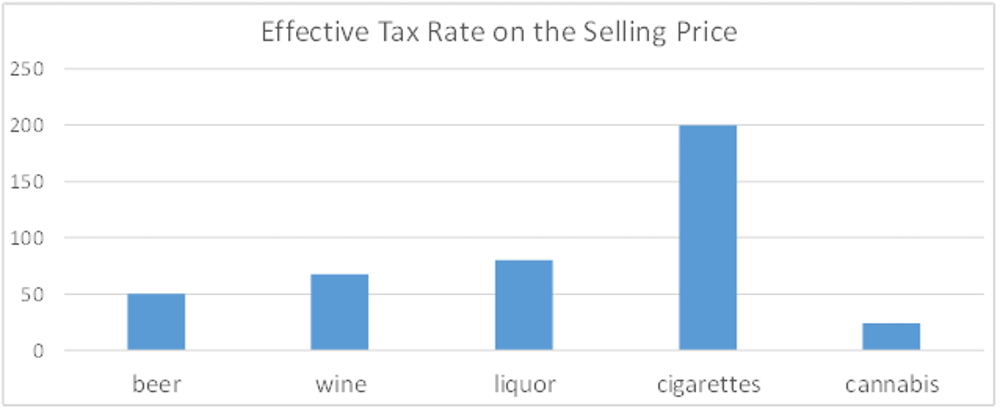
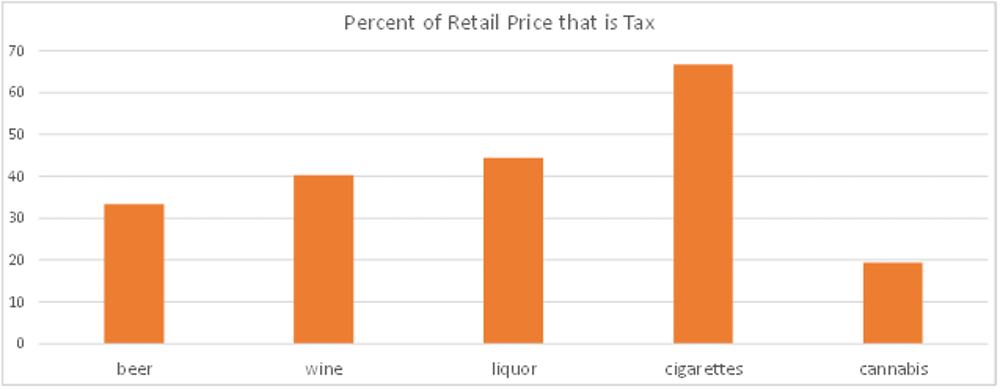
Historically, the government has taken clear positions through taxation on the impact of different products. Tobacco is seen as a social bad. That’s why cigarette taxes are so high and why the government has sponsored anti-smoking campaigns for decades.
Alcohol has a more muddled reputation. That’s because consuming large amounts of alcohol has terrible effects on health yet consuming small amounts from time to time does not appear to have a negative impact. So the level of taxation on alcohol, while high, is significantly lower than the level of tobacco.
One way we can infer the government’s position regarding recreational marijuana use is to compare the level of taxation across categories with the fraction of the expected retail price that is tax. The graphs below provide that information:
Author provided
Author provided
It’s apparent that the level of taxation on recreational cannabis is lower than other regulated products. Independent of how the tax is split between the province and the federal government (75/25 is the plan), the government is not discouraging consumption as it does with tobacco. In fact, these charts suggest that maybe the opposite is taking place.
Education
Recent news coverage has focused on the business and retail aspects of legalization and the issue of education almost seems like an afterthought. With a product like cannabis that has significant physical and psychological effects, the public needs to be better educated about its consumption.
There are lots of questions surrounding marijuana yet the reality for most Canadians is: It is difficult to obtain information on the pros and cons of a product that is not legal.
It seems that government-controlled stores may be better than the private sector at distributing educational materials and/or establishing programs to help Canadians understand the advantages and disadvantages of recreational marijuana use.


Quality control
With multiple suppliers already growing marijuana or set to enter the market, the supply is highly fragmented, and there could be significant quality differences across manufacturers.
As a result, quality control is an important issue. After all, marijuana is something people ingest. Pharmaceutical products, while distributed privately, are tightly controlled and subject to significant quality control.
The marijuana industry should be subject to similar quality checks, manufacturer validation and manufacturer monitoring, which would be more efficient and effective through a tightly controlled distribution system.
As we contemplate the future of recreational marijuana distribution in Canada, there are still many questions for both the public and government to consider before Oct. 17.

David Soberman is a Professor of Marketing and the CN Chair in Strategic Management at the Rotman School of Management at the University of Toronto. Professor Soberman joined the Rotman School in September 2008 after spending 12 years at INSEAD in Fontainebleau, France. He is a licensed Professional Engineer (Ontario), holds a Ph.D. (Management) from the University of Toronto and an MBA and a B.Sc. in Chemical Engineering from Queen’s University in Kingston. Follow him on Twitter at @dasoberman.

READ MORE ARTICLES BY THE CONVERSATION