Advertisement
Advertisement
Home Blog Page 129

New Retail Lineup Marks Paradies Lagardère’s Pearson Future

Muskoka Supply Co. - one of the newly awarded program that extends 42 locations at Pearson Airport. Photo: Paradies Lagardère

Paradies Lagardère Toronto Pearson operations will expand significantly over the next several years following a new seven-year contract extension at Canada’s largest and busiest airport. The renewal, awarded by the Greater Toronto Airports Authority, ensures that one of North America’s dominant travel retailers will remain deeply embedded in the commercial fabric of Toronto Pearson International Airport while introducing a wave of updated and reimagined stores designed to reflect the character of the city.

The Atlanta-based company, which serves millions of travelers across Canada and the United States, will continue running dozens of shops as part of the updated program. The extension reinforces an already long partnership between Paradies Lagardère and Toronto Pearson, which the company regards as one of the most important locations in its North American network.

“We value and appreciate our strong partnership with Toronto Pearson and are thrilled at the opportunity to continue that relationship through this extension,” said Gregg Paradies, chief executive officer of Paradies Lagardère. He noted that many of the forthcoming concepts were developed to deepen the company’s connection to Toronto’s communities through locally inspired design and products.

Deborah Flint, president and chief executive officer of Toronto Pearson, said retail remains central to how the airport shapes the traveler journey. “Experiences at airports are shaped by the vitality of the retail offerings,” she said. “We’re pleased to continue our partnership with Paradies Lagardère to provide travelers with shopping options that range from gourmet gifts, exclusive products and Canadian souvenirs, as well as the ‘got it’ relief for that important item in travel essentials.”

New Stores That Reflect a Growing City

Under the renewed agreement, the Paradies Lagardère Toronto Pearson portfolio will include 42 locations across the terminals. Twenty-one stores will be rebranded or significantly enhanced, and seven new retail concepts will be introduced. The changes amount to one of the most extensive refreshes of Pearson’s commercial landscape in recent years and are intended to align with the airport’s long-term investment plans, which include expanding terminals and accommodating rising passenger volumes.

A core feature of the new program is the emphasis on Canadian makers and Toronto culture. Shops @ The Six, Muskoka Supply Co. and Greetings from Toronto will spotlight gourmet foods, gifts and artisan products sourced from more than 30 makers, among them Totally Toronto Art, Mitchell’s Soup Co., Drip Candle Studio and The Doodle Diary. Airport officials believe the stores will help create a sense of place for travelers passing through an international gateway that often serves as their first point of contact with the country.

Retailer Shops@The Six will feature gourmet treats and gift items from more than 30 Canadian makers. Photo: Paradies Lagardère

Other concepts lean into Toronto’s identity as a design-driven and outdoor-oriented city. Hip & Humble, a women-owned boutique, will appear in a Canadian airport for the first time. Sky to Trail will carry brands such as Herschel Supply Co., KÜHL, Cotopaxi, Yeti and Tentree, catering to travelers preparing for excursions or seeking functional lifestyle products.

Longstanding favourites will remain, including The Scoreboard, a shop focused on merchandise from Toronto sports teams, and RELAY, a globally recognized travel-essentials label. iStore Express will continue offering technology accessories for passengers who may need last-minute devices or power solutions before boarding.

A Key Player in Global Travel Retail

The investment at Toronto Pearson aligns with Paradies Lagardère’s status as a major force in travel retail. The company operates more than 700 retail stores, restaurants and bars in over 90 airports across North America. It is the regional division of Lagardère Travel Retail, which manages more than 5,000 points of sale in over 50 countries worldwide and generated 7.6 billion euros in sales in 2024 on a managed basis.

Founded in 1960 by brothers Jim and Dan Paradies as The Paradies Shops, the company grew into one of the most decorated airport retailers in North America, routinely winning industry awards related to traveler satisfaction, merchandising and customer service. It became Paradies Lagardère in 2015 following its acquisition by Lagardère Travel Retail in a deal valued at about $530 million USD.

Today the company employs roughly 10,000 associates and continues to expand. Its presence in Canada includes operations in 12 airports, making the Paradies Lagardère Toronto Pearson partnership one of its most strategically significant contracts.

The Changing Landscape at Toronto Pearson

The renewed agreement arrives at a moment of growth and reinvestment for Toronto Pearson International Airport. The airport processed about 46.8 million passengers in 2024 and roughly 35.8 million in the first nine months of 2025, maintaining its position as the busiest airport in Canada and one of the most important hubs in North America. It supports a network of more than 50 airlines flying to over 180 destinations and serves as a main global hub for Air Canada while supporting operations for WestJet, Porter Airlines, Air Transat and numerous international carriers.

Pearson’s commercial transformation is part of the GTAA’s broader LIFT program, which focuses on long-term terminal improvements and increased capacity for security, U.S. preclearance and retail. Airport executives view retail as essential to both financial sustainability and the overall traveler experience. As passenger expectations increase and dwell times rise, airports across the world have sought to elevate their retail mix to resemble urban high streets rather than traditional travel corridors.

Paradies Lagardère Toronto Pearson updates are central to that shift. The forthcoming stores are designed to be visually distinct, flexible and relevant to a wide cross-section of travelers, whether they are purchasing essentials, looking for gifts or browsing specialty items before a departure.

More from Retail Insider:

Toronto Waterfront Adds Floating Saunas and Winter Fun

Toronto Waterfront BIA. Photo: Löyly Floating Saunas

The Toronto Waterfront BIA is closing out 2025 with a busy slate of openings, activations and evolving streetscapes that are pushing the district closer to its goal of becoming a true year-round destination. From floating saunas and virtual golf to new parks, community facilities and hospitality concepts, the waterfront is seeing a wave of experiential uses that build on its residential growth and strengthen its retail mix.

“We are trying our best to keep the area vibrant all year round,” said Dorsa Alizadeh–Shabani, Manager of Operations at the Toronto Waterfront BIA. “People still see us as a summer destination, and it is nice to finally have more reasons for them to come down even when it is cold.”

Dorsa Alizadeh-Shabani

For the Toronto Waterfront BIA, the narrative this fall and winter is about momentum, diversification and the long game of neighbourhood building in a district that is still filling in.

New East Bayfront Connections and Community Hub

On the east side of the district, the completion of the Aqualuna condominium has helped unlock another key piece of the public realm. The Water’s Edge Promenade has been extended further east, creating a continuous path from Sugar Beach all the way to the Parliament Slip, a distance of roughly 500 meters.

“Now you can walk out at Sugar Beach and go all the way east past the new Marché Leo’s, past that beautiful Aqualuna building and all the way around the Parliament Slip,” noted Executive Director Tim Kocur. “It is slowly filling in, and it hints at how much more connected the waterfront will be once the new bridge to the Port Lands is in place.”

Tim Kocur

The extended promenade also ties directly into the new East Bayfront Community Centre. The BIA recently used the facility as the anchor for a Halloween-themed movie night that attracted a strong crowd and demonstrated the potential for more community-oriented programming in the growing residential pocket.

“We had about three hundred people for a community event, which is a good sign,” said Kocur. “People are clearly willing to come to the neighborhood for activities, not just to walk along the water.”

Parks, Pickleball and Dogs at 50 Queens Quay East

Just steps away, the new temporary park at 50 Queens Quay East is already proving that green space can be a powerful draw in colder months. The site is technically “temporary,” but in waterfront terms that can mean anything from a couple of years to a full five-year run.

“The park has two pickleball courts and a huge dog run, and even though it opened later than planned in the fall we have already seen it perform well,” said Alizadeh–Shabani. “Every time we walk by there are people playing pickleball and the dog run is always filled with dogs.”

Picnic tables with custom artwork add to the sense of place, and the BIA sees the space as an important bridge between residential towers, the water’s edge and the commercial units at grade. While many people still associate waterfront parks with patio season, the early response suggests a deeper shift in how the district is being used.

“For the time of year we are in, which is pretty cold, that park is doing really well,” she added. “It gives residents and visitors a reason to linger rather than just pass through.”

Opening of 50 Queens Quay E Temporary Park. Photo: Oliver Hierlihy/Toronto Waterfront BIA

Grocery, Fashion and A New Kind of Daily Retail

One of the most closely watched openings in recent months has been Marche Leo’s, a next-generation grocery concept that has brought new life to the east side. The store has generated strong buzz not just for its prepared foods and local sourcing but for an unexpected fashion play.

“They have a Hugo Boss retail clothing section inside the store, which is really interesting,” said Alizadeh–Shabani. “We lack clothing stores in the neighborhood, so it is nice to see that here, even if it is in an unusual format.”

Further east, another experiential anchor is getting ready to welcome guests. World Swing, a virtual golf bar at the base of the T3 Bayside building, is in the final stages of fit-out and is expected to open soon.

Recently opened Marché Leos store on Toronto’s Waterfront. Photo: Toronto Waterfront BIA/Instagram

“It is super exciting to have another destination business in our neighborhood,” said Alizadeh–Shabani. “A place like this generates more foot traffic during the cold months, and it complements everything else that is happening in East Bayfront.”

T3 Bayside itself is one of the district’s notable new office buildings, with a contemporary tall-timber design that reflects a broader shift toward sustainable construction along the waterfront. While another timber building in the area is dedicated to institutional use for George Brown College, T3 Bayside is largely commercial and signals confidence in the waterfront as an office address.

For the Toronto Waterfront BIA, attracting tenants such as World Swing to these podium spaces is central to building an all-day, all-season economy that serves workers, residents and visitors.

Hugo Boss men’s clothing section in the recently opened Marché Leos store on Toronto’s Waterfront. Photo: Toronto Waterfront BIA/Instagram

Winter Programming Aims to Shift Perceptions

The waterfront’s winter season has traditionally been a challenge, with many Torontonians assuming the area is best enjoyed in summer. The BIA is using programming to counter that perception.

On the west side, Harbourfront Centre’s Winterfest continues to be a major draw, complete with a skating rink and free skate rentals on Saturdays. The BIA also supports another skating rink at Sherbourne Common South, which encourages cold-weather visits on the east side.

Photo: Harbourfront Centre

New Year’s Eve fireworks are returning to the waterfront as well, with the city expanding programming to run after the fireworks rather than ending precisely at midnight. “They are adding more programming after the fireworks so not everything bottlenecks at Union Station at the same time,” said Alizadeh–Shabani. “They are slowly improving the timing and the overall experience so it is enjoyable for everyone.”

Within the hospitality sector, waterfront operators are leaning into winter as an opportunity rather than an off-season. One major restaurant and bar with a retractable-roof patio has transformed its south-facing garden into a Winter Garden, complete with festive decor designed to entice repeat visits from summer regulars.

“They are very good at getting people to come back,” said Alizadeh–Shabani. “Now that it is winter they have a new interior, new decorations and a whole different mood, which gives people another reason to make a night of it on the waterfront.”

Photo: Loraine Luong

Experiential Retail: Climbing Gyms, Culture and More

The Toronto Waterfront BIA has spent the past several years advocating for more experiential businesses along Queens Quay, arguing that unique activities will help the district stand out in a crowded citywide landscape of entertainment districts. That push is now bearing fruit.

“We are seeing more experiential businesses, which is what our ideal retail mix looks like,” said Alizadeh–Shabani. “Experiences entice people to come down, even when it is cold.”

Ethos, the new climbing gym in the neighborhood, is one example. The facility adds another indoor anchor that brings regular foot traffic during evenings and weekends. The Museum of Toronto has also opened an exhibit at Harbourfront Centre focused on children’s television from the twentieth century, adding a family-friendly cultural layer to the district’s offer.

“These are all open through the winter,” noted Kocur. “A year ago, one of our biggest challenges was changing people’s perception about coming here when it is cold. As these things draw more people, we hope that perception will change.”

Photo: Ethos Climbing Gym

Retail Churn and Broker-Led Recruitment

Despite the positive momentum, the waterfront is not immune to the churn affecting urban retail across Canada. As some of the first new buildings reach the five-year mark, a handful of tenants have chosen not to renew.

“There have unfortunately been some closures,” acknowledged Kocur. “We have seen a cannabis shop close and a Popeyes location close, and we know those brands are closing stores elsewhere as well. It is important to be honest that this is still a neighborhood in progress.” (Editor’s note: Popeyes has closed several Toronto locations recently, not just in the waterfront).

At the same time, he noted that the Toronto Waterfront BIA’s retail review this past spring showed that replacement tenants and net-new arrivals continue to outpace closures. The BIA has responded by building a more proactive recruitment model, keeping detailed data on available spaces and maintaining regular contact with brokers and property managers.

“We are trying to promote the waterfront as an exciting space for new businesses,” said Alizadeh–Shabani. “We have had businesses reach out and tell us what they are looking for, and then we compare that with our database and connect them with the right broker or property manager.”

For prospective retailers, having a BIA act as a concierge is a differentiator. “I do not think other neighbourhoods are doing that,” said Kocur. “It shows that we are serious about curating a mix that works for residents and visitors, and for the businesses themselves.”

Photo: Löyly Floating Sauna

Löyly Floating Sauna Bring Nordic Wellness to Lake Ontario

The most eye-catching addition this winter sits directly on the water. Löyly Floating Sauna, a Canadian wellness company inspired by Finnish sauna traditions, is preparing to open at 275 Queens Quay West at Reese Street. The concept combines a moored floating sauna structure with an outdoor plunge pool that offers the same bracing chill as Lake Ontario, without actually sending guests into the lake itself.

“Their business model is not about a one-time bucket list experience,” said Alizadeh–Shabani. “They want people to fit it into their weekly routine so it becomes part of their lifestyle.”

Founded on Okanagan Lake, Löyly has built its reputation on minimalistic design, deep steady heat and the mental and physical benefits of hot-cold contrast. The Toronto location, the brand’s first on the Great Lakes, will offer seventy-five-minute public sessions priced at $45, along with private bookings starting at $465 for up to twelve guests. The sauna remains moored rather than cruising, which keeps the experience stable and accessible in all weather.

The structure is already turning heads along the waterfront. “People see it and they want to be part of it,” said Alizadeh–Shabani. “We have heard stories about joggers and people out for walks stopping to ask what it is and when it will open.”

Kocur believes it is exactly the type of operator the Toronto Waterfront BIA has been hoping to attract. “We would love to see more experiences that engage directly with the water,” he said. “Löyly really does that. You are sitting in a warm sauna, looking out at the lake and the islands, and then doing a cold plunge right on the slip. It is a powerful way to remind people that this is a waterfront, not just another part of downtown.”

A Long-Term Vision for Toronto Waterfront Retail

Formally established in 2004 and expanded in 2016, the Toronto Waterfront BIA covers the commercial corridor along Queens Quay from roughly Stadium Road in the west to Cherry Street in the east, including the Toronto Islands. The association is funded through a levy on commercial and industrial properties and governed by a board of local business and property owners.

Its mandate is broad, stretching from destination marketing and event programming to advocacy on public-realm design, wayfinding, transit connections and waterfront infrastructure. In recent years, the BIA has published a series of retail and visitor-experience studies, including a detailed retail review and broker package that outlines ideal tenant mixes and highlights under-performing spaces.

“We position ourselves as a unifying voice for businesses along the waterfront,” said Kocur. “That means supporting the existing merchants, but also helping shape future development so that we end up with a continuous, engaging retail experience from west to east.”

With multi-phase projects such as the Port Lands redevelopment and Queens Quay East transit extension still ahead, the Toronto Waterfront BIA is playing a long game. The new promenade segments, pop-up parks and experiential tenants arriving this month are early glimpses of what a more connected, animated waterfront can look like.

More from Retail Insider:

METRO signs the Canadian Grocery Industry Code of Conduct 

Photo: DoorDash
Photo: DoorDash

Grocery chain METRO has confirmed it has signed the Canadian Grocery Industry Code of Conduct.

Eric La Flèche, Metro’s president and CEO

“Since 2021, we have actively contributed with the Retail Council of Canada and industry stakeholders to the development of the Code of Conduct to promote principles of fairness and predictability”, said Eric La Flèche, President and Chief Executive Officer, METRO, in a statement. 

“In 2025, we continued our efforts with the Code Office to ensure its success and we look forward to its implementation in the years ahead.”

The grocer said the Code of Conduct sets clear standards for commercial relationships within the grocery sector and aims to create transparency and certainty in commercial transactions.

The Code applies to a wide range of businesses in the sector, not just major retailers and brand manufacturers, but also processors, suppliers, and distributors, including smaller and independent businesses. The Code is principle based and, by providing clear standards and an accessible framework for dispute resolution, the Code strengthens trust across the industry and supports long-term competitiveness, according to the Canada Grocery Code.

Karen Proud
Karen Proud

“The Canada Grocery Code is essential for fostering trust, ensuring fairness, and strengthening collaboration across the grocery supply chain. By promoting transparency and timely dispute resolution, the Code supports all businesses, from major national grocers and regional independents to primary processors and small-scale suppliers, in building a more predictable and equitable industry where everyone can thrive,” said Karen Proud, President and Adjudicator of the Canada Grocery Code.

With annual sales of more than $22 billion, METRO Inc. is a food and pharmacy leader in Québec and Ontario, providing employment to more than 97,000 people. Its purpose is to Nourish the health and well–being of our communities. As a retailer, franchisor, distributor, manufacturer, and provider of eCommerce services, the company operates or services a network of some 1 000 food stores under several banners including Metro, Metro Plus, Super C, Food Basics, Adonis and Première Moisson, and some 640 pharmacies primarily under the Jean Coutu, Brunet, Metro Pharmacy and Food Basics Pharmacy banners. 

More from Retail Insider:

CF Market Mall hosts “Winter Warm-Up” featuring massive snow show, indoor curling, and Olympic athletes (Photos/Videos)

CF Market Mall. Photo: Mario Toneguzzi

CF Market Mall has launched its Winter Warm-Up experiences, running to December 21. 

The celebration brought the thrill of the slopes directly to Calgary with a lineup of high-energy and interactive winter elements. Highlights include an exciting outdoor Snow Stunt Show featuring professional freestyle skiers and riders which took place on the weekend, an indoor curling rink with expert instruction, and special meet and greets with Canadian Olympic stars. The mall’s holiday décor will be enhanced with exciting, immersive winter displays for spectacular photo opportunities.

“This winter, we’re introducing a full slate of fun, high-energy and entertaining experiences designed to bring the community together,” said Paige O’Neill, General Manager, CF Market Mall. “From thrilling snow stunt shows featuring top notch freestyle skiers and riders to immersive indoor curling, our goal is to create memorable moments that truly capture and celebrate the vibrant Canadian winter spirit, both indoors and out.”

CF Market Mall. Photo: Mario Toneguzzi

To kick off the winter season, CF Market Mall partnered with Sunshine Village to host the thrilling Banff Sunshine Village Snow Stunt Show from December 6 and 7.

The two-day event brought the intense action of the slopes directly to Calgary, featuring professional skiers and snowboarders performing incredible freestyle tricks and aerial stunts on a custom-built terrain park. The high-energy show was located in the East Parking Lot, along Shaganappi Trail, offering a limited-time opportunity to witness world-class talent and high-impact action live and outdoors.

CF Market Mall. Photo: Mario Toneguzzi

The Canadian winter spirit continues inside with a variety of hands-on activities and exclusive experiences:

  • Indoor Curling with Curling Alberta: Bay Court will be transformed into a beautiful, photo-worthy winter playground featuring a miniature curling rink. Guests can learn the basics of curling with expert instruction and demos provided by Curling Alberta from Friday to Sunday and open rink play during the week, offering a fun, skill-building activity right inside the mall.
  • Immersive Photo Moments: Capture unforgettable memories at two stunning, immersive photo displays. The Mountain Escape displays, located in front of Alo Yoga and in Bay Court, feature a real-life Sunshine Village chairlift and gondola, snow-capped evergreen trees, and authentic ski equipment. These displays add excitement and entertainment to complement the mall’s traditional holiday décor. Visitors can snap a photo in Sunshine Village’s luxurious Super Angel chairlift and tag @cfmarketmall and @sunshinevillage on Instagram for a chance to win a Banff Sunshine Village Family Season pass worth over $3,800. Sunshine will choose a winner after activation ends on December 21st.
  • Olympic Athlete Meet & Greets: As the official Home of Team Canada, CF Market Mall is also proud to partner with the Canadian Olympic Committee and welcome former Olympians and Calgary-natives, Cheryl Bernard and Brad Spence. Cheryl, a silver medalist in curling, was available at the curling rink on November 25. Additionally, top Canadian alpine skier, Brad, is scheduled to appear at the Mountain Escape display on December 13 from 12:00 PM to 2:00 PM. This will give guests the incredible chance to meet these inspiring individuals and take photos against an exciting backdrop.
CF Market Mall. Photo: Mario Toneguzzi

The Winter Warm-Up experiences, including the thrilling snow stunt show and interactive curling, serve as the perfect complement to CF Market Mall’s full holiday lineup. This season, guests can also enjoy traditional Santa visits, stunning immersive decor throughout the property, live musical performances, and much more, said the shopping centre.

More from Retail Insider:

CF Market Mall. Photo: Mario Toneguzzi

EQB enters into agreement to acquire PC Financial from Loblaw

Image: Loblaw

EQB Inc. and Loblaw Companies Limited have entered into a definitive agreement where EQB will acquire President’s Choice Bank, PC® Financial Insurance Agency Inc., PC® Financial Insurance Brokers Inc. and certain other affiliated entities of PC Bank.

In connection with the closing of the acquisition, EQB will enter into a long-term strategic relationship with Loblaw pursuant to a commercial agreement to become the exclusive financial partner of the PC Optimum™ loyalty program. The transaction will unite two of Canada’s most innovative banking brands, redefining the sector by delivering extraordinary value, products and services to Canadians, according to a news release.

EQB will acquire PC Financial for 1.15x book value at closing, excluding excess capital above a 13% CET1 ratio, for consideration estimated at $800 million. The consideration will be satisfied by the issuance to one or more subsidiaries of Loblaw of 7.2 million common shares of EQB, representing approximately 16% of EQB’s issued and outstanding common shares as at the date hereof on a pro-forma basis, and the remainder in cash. In addition, prior to the closing of the transaction and subject to regulatory approval, Loblaw will release and receive approximately $500 million of excess capital and other value from PC Bank, for estimated total value of $1.3 billion to Loblaw. 

Loblaw will own a minimum of 17% of EQB’s issued and outstanding common shares on closing of the acquisition. Closing is expected to occur within 2026, subject to customary closing conditions and regulatory approvals.

EQB will acquire PC Financial’s products and services, including the PC Mastercard™ portfolio – one of the largest and most recognizable credit card portfolios in Canada with more than two million active accounts. The acquisition is expected to expand EQB’s total customer base to nearly 3.5 million Canadians and add $5.8 billion in assets with more than $800 million in direct retail deposits.

Chadwick Westlake
Chadwick Westlake

“(The) announcement marks a new era for banking in Canada. By combining EQ Bank’s exceptional digital platform and product shelf with PC Financial’s spending solutions, distribution and expertise in loyalty, we’re creating a better banking ecosystem for all Canadians that prioritizes innovation and value,” said Chadwick Westlake, President and CEO, EQB. “Fueled by our combined digital strengths and new ways to connect with customers, this transaction offers a unique opportunity for Canada’s Challenger Bank to redefine what Canadians should expect from their banks. We couldn’t be more excited to bring challenger banking to more Canadians and look forward to welcoming Loblaw as a shareholder and valued long-term partner.”   

Richard Dufresne
Richard Dufresne

“This new relationship between EQB and Loblaw will yield significant benefits to our customers, and those of EQ Bank. PC Financial’s products will be better positioned for long-term growth under EQB’s ownership, while maintaining the high level of quality and care our customers expect,” said Richard Dufresne, Chief Financial Officer of Loblaw. “Bringing together EQB’s digital platform with PC Optimum’s reach and personalization will bring more value and more rewards to Canadians.

More from Retail Insider:

Adyen processes record $43 billion as Black Friday/Cyber Monday weekend sets new benchmark for global payments 

Photo: Adyen
Photo: Adyen

This year’s Black Friday/Cyber Monday (BFCM) proved to be another record-breaking holiday shopping weekend, where consumer traffic and demand spiked, and the Adyen platform delivered, processing a total volume of $43 billion across the BFCM weekend (up 27% vs. last year), while maintaining an exceptional 99.9999% uptime. 

Transactions per minute on the Adyen platform reached a peak of 199,000 on Black Friday. Additional insights from this year’s BFCM are available on Adyen’s BFCM Unboxed Insights page.

How People Are Paying

Consumer habits have permanently changed, and flexibility at checkout is no longer a luxury. It’s essential: 54% of consumers globally will leave a store or abandon an online checkout if they cannot pay using their preferred method, said Adyen.

This BFCM, the data revealed some clear trends, it said:

  • Mobile Wallets Soar: Digital wallets are establishing themselves as a key payment method at the Point-Of-Sale (POS). During this year’s Black Friday, the share of POS revenue paid with digital wallets reached 33%, up from 21% last year, and this momentum is expected to accelerate.
  • Contactless Continuing as the Undisputed Norm: Contactless payments continue to gain ground worldwide. During last year’s Black Friday, 81% of in-store POS transactions were contactless, rising to 85% this year, further cementing contactless as the standard.
  • Local Payment Methods Remain Highly Relevant: Their share is stable at 14-15% year-on-year across channels, underscoring the necessity for merchants to implement fitting regional options like Carte Bancaire, iDeal, and PayPal.
  • Shoppers Continued to Embrace Flexible Payment Options During the Peak Period: The volume of online payments made via Buy Now Pay Later (BNPL) on Black Friday rose 43% compared to the previous month and matched last year’s Black Friday levels, underscoring consumers’ preference for flexible financing during major spending events.
Photo: Adyen
Photo: Adyen

The Value of In-Store Purchases

“Physical retail continues to hold a key advantage for high-value purchases during holiday sales. In 2025, the average basket size (ATV) from in-store Black Friday purchases was 28% higher than online. Overall, the ATV in Retail increased by 22% on Black Friday 2025 in comparison to a typical Friday,” said the company. 

From the US to Everywhere: The Global Embrace of Black Friday

While Black Friday originated in the US, it has grown in significance across other markets as well. This year, it tracked significant transaction volume uplifts compared to typical Fridays across key international markets:

  1. Denmark – 6.11x
  2. Spain – 4.47x
  3. Iceland – 3.75x
  4. Norway – 3.53x
  5. Finland – 3.51x
  6. Sweden – 3.36x
  7. Portugal – 3.33x
  8. US – 2.80x
  9. Canada – 2.77x
  10. Brazil – 2.75x

More from Retail Insider:

Photo: Adyen
Photo: Adyen

Dr. Phone Fix completes strategic expansion into Atlantic Canada

Image: Dr. Phone Fix

Dr. Phone Fix Canada Corporation says it has closed the previously announced acquisition of substantially all the business assets of Geebo Device Repair Inc., a leading mobile-device repair chain operating six retail service locations across Nova Scotia.

“This is a major milestone for Dr. Phone Fix and an important step forward in our national expansion strategy,” said Piyush Sawhney, founder and Chief Executive Officer of Dr. Phone Fix. “With this acquisition, we are officially entering Atlantic Canada with an established regional platform, a strong and loyal customer base, and a dedicated team that will help accelerate our growth coast-to-coast.”

Under the terms of the asset purchase agreement governing the acquisition, Dr. Phone Fix said it has acquired substantially all of Geebo’s business assets, which span six operating stores and one operating facility and include leases that provide optionality for future expansion. The total purchase price consists of a base consideration of $1.35-million, subject to customary adjustments, plus an amount equal to the value of saleable inventory at closing.

Piyush Sawhney
Piyush Sawhney

“Closing this transaction immediately strengthens our national footprint, expands our OEM-certified repair capabilities, enhances insurance-partner relationships and supports our commitment to sustainable device-care practices. With this foundation in place, Dr. Phone Fix is well positioned to scale meaningfully as we advance our goal of expanding from approximately 35 corporate locations to more than 70 stores nationwide within the next 12 to 18 months,” said Sawhney.

Following closing, said the company, Geebo’s team and management will remain with the business to ensure operational continuity and maintain the high standard of service customers have come to expect.

Dr. Phone Fix said it continues to focus on expanding its network of corporate-owned stores across major provinces while pursuing further acquisitions and partnerships to solidify its position as Canada’s leading coast-to-coast device-care and circular-economy brand.

Founded in 2019, the company now operates 41 corporately owned retail locations nationwide.

More from Retail Insider:

Birks Group reports net sales growth for mid-year Fiscal 2026 financial results

Birks in South End of Level 3 at CF Rideau Centre (August 2021). Photo: Dustin Fuhs.

Birks Group Inc. recently reported its financial results for the 26-week period ended September 27, 2025, indicating net sales of $93.1 million, an increase of $13.0 million or 16.2% from the comparable prior period ended September 28, 2024. 

Comparable store sales increased by 6.3% compared to the corresponding period of Fiscal 2025. The increase in net sales is attributable in part to the acquisition of the luxury timepieces and jewelry retail activities of European Boutique as well as an increase in sales of third-party branded timepieces across multiple brands, Birks branded jewelry and third-party branded jewelry, the retailer noted.

The company reported a gross profit of $36.5 million, an increase of $5.2 million, or 16.7%, compared to the corresponding period in Fiscal 2025, due to an increase in retail sales following the acquisition of European and strong third-party branded timepiece sales. Gross profit as a percentage of sales was 39.2%, consistent with the gross profit as a percentage of sales of 39.0% in the previous period, it explained.

 “Our net sales, gross profit and comparable store sales for the first half of Fiscal 2026 are higher than the corresponding period in Fiscal 2025 due in part to the acquisition of the European business but also due to our strong retail performance, which speaks to the strength of our product offerings, both in terms of our Birks branded products and our third-party branded watches and jewelry,” said Niccolò Rossi di Montelera, Executive Chairman of the Board and Interim CEO.

Niccolò Rossi di Montelera

“I would like to thank our teams for their dedication and hard work. The growth achieved in the first half of Fiscal 2026 is a testament of our commitment to our customers and I am grateful for the unwavering efforts of all our employees which contributed to these results and the successful integration of the European stores.”

Birks Group is a leading designer of fine jewelry and an operator of luxury jewelry, timepieces and gifts retail stores in Canada. The company operates 17 stores under the Maison Birks brand in most major metropolitan markets in Canada, one retail location in Montreal under the Birks brand, one retail location in Montreal under the TimeVallée brand, one retail location in Calgary under the Brinkhaus brand, one retail location in Vancouver under the Graff brand, one retail location in Vancouver under the Patek Philippe brand, four retail locations in Laval, Ottawa and Toronto under the Breitling brand, four retail locations in Toronto under the European Boutique brand, one retail location in Toronto under the Omega brand and one retail location in Toronto under the Montblanc brand. Birks was founded in 1879 and has become Canada’s premier designer and retailer of fine jewelry, timepieces and gifts. 

More from Retail Insider:

Canadian Retail News From Around The Web For December 8, 2025

Canadian Retail News From Around The Web

News at a Glance

Retail Insider is streamlining its Canadian retail news from around the web to include a handful of top news stories that can be viewed quickly during the day. Here are the top stories from the past 48 hours.

Classic Hudson’s Bay blankets sell out at some Canadian Tire stores within hours (CityNews)

M&M Food Market Isn’t Canadian Anymore (Money.ca)

Costco makes extended holiday hours on weekends permanent (Yahoo)

Coffee prices have nearly doubled since 2020. One expert says they’re unlikely to come down (BNN)

Canadian Consumers Feel the Squeeze—Sharon Kang Responds With a New Retail Approach (Press release)

Kinew suggests ‘real competition’ coming to Manitoba grocery sector as deadline passes (CBC)

Uniqlo coming to St. Vital Centre (CTV Winnipeg)

‘It’s embarrassing,’ says Indigenous man who believes he was racially profiled at Winnipeg Home Depot (CBC)

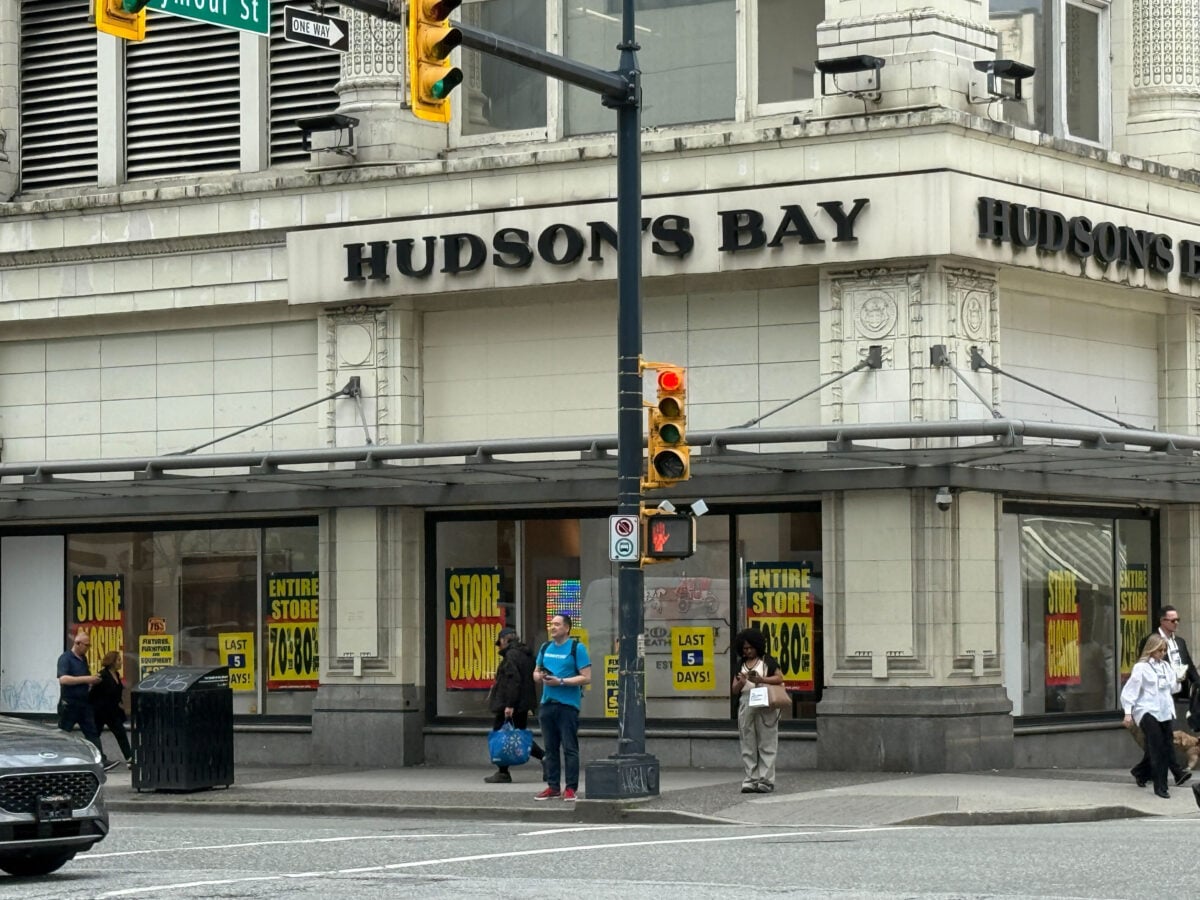
With Vancouver’s former Hudson’s Bay building now for sale, what’s next? (CBC)

John Lorinc: Pity the retail workers: The canned Christmas music loop isn’t making us jolly (Toronto Star)

Walmart to open new Quebec store in Sherbrooke in 2027 (Grocery Business)

Jewellery industry and law enforcement collaboration receives top awards (Jewellery Business)

From Eaton’s to the mall: The holly jolly evolution of the department store Santa Claus (CP24)

Scandinavian brand Peak Performance opens Vancouver flagship store (Daily Hive)

Edmonton Filipino community dances for holidays inside grocery store (CityNews)

No Frills opens new stores in Ontario, Alberta and British Columbia (Grocery Business)

Ottawa police warn of organized ‘crime tourism’ (CTV)

Spill the Tea: Gentrification of Vancouver Chinatown (Simon Fraser University)

Brampton Value Village store closing Dec. 6 (Brampton Guardian)

Food Inflation in Canada Has Become a Structural Crisis

Former McEwan Grocery Store at 1 Bloor Street - Image: Craig Patterson

Canada’s Food Price Report 2026 projects that food prices will rise by another 4% to 6% next year. For the average family of four, that means spending roughly $17,571 on groceries in 2026 — close to $1,000 more than this year. Food is now 27% more expensive than it was just five years ago. This latest forecast simply confirms what many Canadians already experience every time they walk into a grocery store: the squeeze is no longer cyclical. It is structural.

To understand where we are headed, we need to be clear about how we arrived here. A long-term review of seasonally adjusted Canadian CPI data, from 1993 to today, reveals a telling pattern. Food inflation did not begin to outpace general inflation during the pandemic, nor did it start with the global disruptions of the past four years. The divergence — this gradual decoupling of food inflation from overall inflation — began earlier, under the Harper government, around 2008 to 2010.

That timing matters not because it points to any single domestic policy choice, but because it underscores how global the shift truly was. The late 2000s marked the first major global food commodity crisis of the modern era. Energy prices spiked, extreme weather events disrupted harvests, and supply chains strained under growing complexity. Canada, deeply integrated into global agricultural markets and reliant on imported inputs for food manufacturing, was inevitably pulled into these forces. The decoupling that began then has persisted ever since, through governments of all political stripes — widening further over the last four years.

Today’s food price pressures reflect accumulated, long-standing structural weaknesses: chronic underinvestment in food processing capacity, high transportation and energy costs, labour scarcity across every segment of the agri-food sector, and a retail landscape in which a small number of players exert disproportionate influence. Add to that climate volatility, geopolitical uncertainty, and the fragility of global supply chains, and the outcome is sustained food inflation that no rebate, tax credit, or political announcement can easily correct.

A critical insight comes from Michael Graydon, CEO of Food, Health & Consumer Products of Canada. He argues that Canada does not suffer from a lack of productivity because its firms are unproductive; we suffer because our manufacturing ecosystem lacks depth.

He’s right.

Canada has world-class multinational plants operating at peak efficiency within their global networks. We also have thousands of small firms with talent, ingenuity, and ambition. What we lack is a strong, scaled “middle” — firms large enough to invest in automation, advanced processing, AI, and modernization. This missing middle is where productivity gains typically emerge. Without it, fewer companies can scale, innovate, or compete. And without it, multinational firms have less incentive to assign new global mandates to Canada. When both ends of the ecosystem — the large and the small — cannot grow together, competitiveness erodes. That erosion eventually shows up in consumer prices.

This same conclusion is reinforced in the latest Global Agri-Food Most Influential Nations Ranking prepared by Dalhousie University’s Agri-Food Analytics Lab and developed in partnership with MNP, which highlights Canada’s shrinking competitiveness in critical parts of the value chain.

The latest Food Price Report makes one thing clear: the affordability crisis is not an aberration. It is a defining characteristic of today’s food economy. Governments often respond with temporary rebates, targeted tax measures, or calls for grocers to stabilize prices, but these measures do not address the underlying issues. They are patches on a system that has been drifting for well over a decade.

If Canada is serious about improving food affordability, it must face these structural issues directly. That means reducing dependence on foreign processing, rebuilding the missing middle in manufacturing, investing in resilient regional supply chains, modernizing our transportation infrastructure, supporting innovation in food production, and strengthening competition within the retail sector. It also requires acknowledging the limits of domestic policy in a world where food is traded globally and increasingly influenced by climate disruptions and geopolitical tensions.

The 2026 forecast is a reminder that the trend lines are all pointing in the same direction. Food inflation separated from general inflation more than fifteen years ago and has not converged since. The pandemic exposed the vulnerability of our supply chains, but it did not create it. Rather, it revealed the cost of ignoring long-term warning signs.

Canada now faces a choice. We can continue to treat food inflation as a temporary irritant, hoping it will fade as global conditions stabilize. Or we can confront it as the structural challenge it has become. The data — spanning decades and multiple governments — is unequivocal: unless Canada commits to a deliberate national strategy that rebuilds depth and competitiveness in its food, health, and consumer products ecosystem, the gap between food prices and household incomes will only continue to widen.

More from Retail Insider: