ICSC@CANADA returned to the Metro Toronto Convention Centre’s North Building from October 5 to 7, drawing retail landlords, brokers, developers and retailers from across the country for three days of dealmaking, industry programming and networking. The event’s dealmaking floor was completely sold out, a milestone that organizers said had not been reached in close to a decade.
Dealmaking tables, Retailer Central and the Food Hall operated at capacity on Tuesday and Wednesday, with leasing representatives from major Canadian landlords holding meetings throughout both days. The busy floor reflected continued demand for retail space across the country, particularly as limited new construction and low vacancy rates create challenges for retailers looking to expand.
The activity was evident throughout the exhibition hall, where landlords and service providers presented their portfolios and projects through elaborate booths and displays. Seating was at a premium in several areas, and conversations sometimes competed with presentations underway at the Show Floor Theatre. For many attendees, the conference provided an opportunity to reconnect with industry colleagues, pursue leasing opportunities and discuss projects that will shape Canadian retail real estate over the coming years.
Tight Retail Conditions Set the Stage
The tone of this year’s conference was established even before the dealmaking floor opened. On Monday evening, JLL hosted its Retail Spotlight & Reception at the TIFF Lightbox, where JLL Canada CEO Alan MacKenzie discussed the country’s historically low retail vacancy rates and the changing relationship between landlords and tenants.
MacKenzie cautioned against viewing current market conditions purely through the lens of landlord leverage, encouraging a partnership approach between property owners and retailers. His comments came against a backdrop of strong leasing fundamentals, including RioCan REIT’s reported record committed retail occupancy of 98.8 per cent at the end of the second quarter and blended leasing spreads of 23.1 per cent.
The discussion reflected a broader challenge facing the Canadian retail industry. Retailers seeking additional locations are competing for a limited supply of desirable space, while landlords must balance opportunities to increase rents with the longer-term value of maintaining productive tenant relationships.
Retail Insider explored these themes in two recent articles, Entertainment Becomes a New Anchor for Canadian Shopping Centres and Scarce Retail Space Gives Canadian Landlords New Leverage, examining how property owners are responding to changing retail requirements and constrained availability.
Monday’s conference activities also included the Student Hard Hat Dealmaking Tour, the ICSC Next Generation program and the Opening Reception. Networking continued beyond the convention centre throughout the event, including a well-attended Marcus & Millichap reception at the Cactus Club on Adelaide Street on Tuesday evening. The gathering was among several off-site events that brought industry participants together during conference week.
Big Spaces, Grand Ideas: Reimagining Former Department Stores
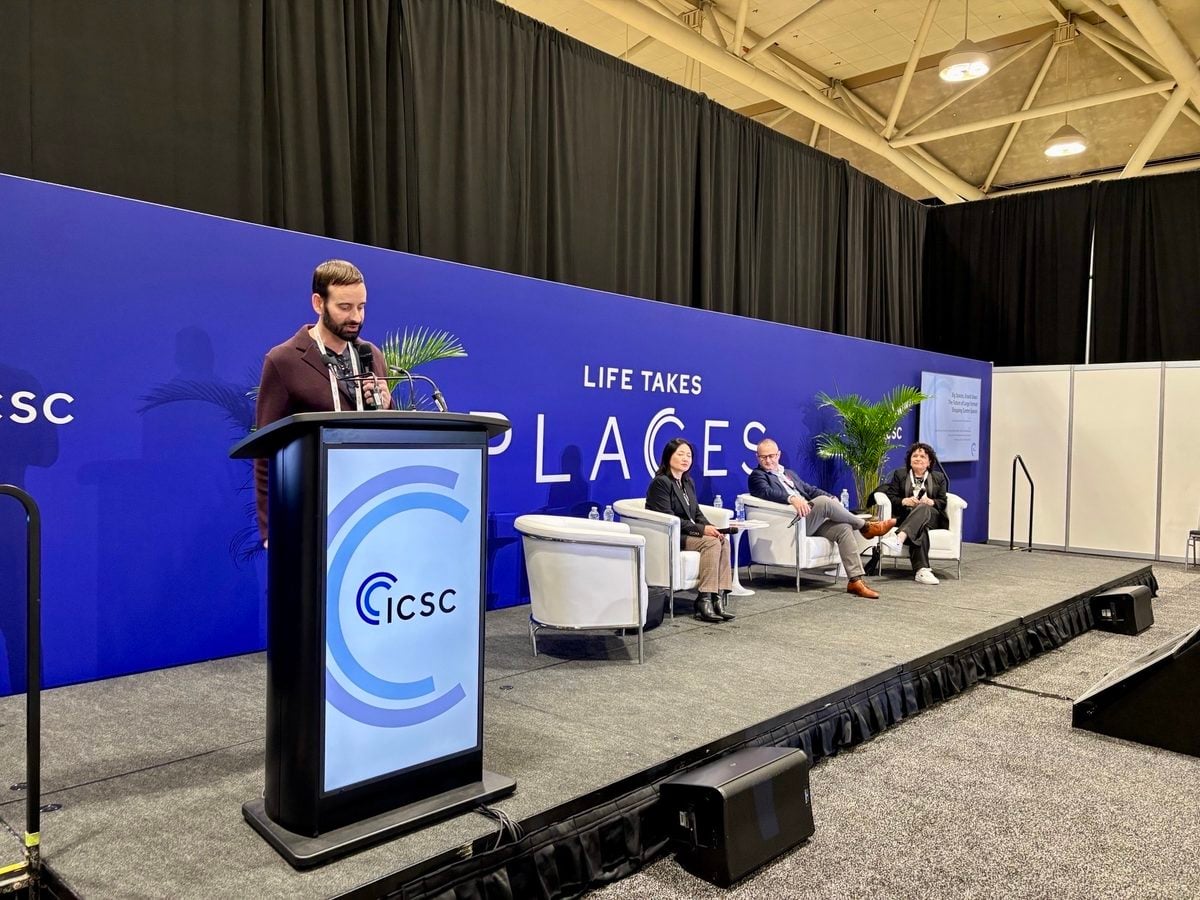
One of Tuesday afternoon’s featured sessions at the Show Floor Theatre examined a major challenge facing Canadian shopping centre owners: finding new uses for large-format retail spaces vacated by department stores and other major tenants.
The panel, titled “Big Spaces, Grand Ideas: The Future of Large Format Shopping Centre Spaces,” was moderated by Retail Insider Founder and Publisher Craig Patterson. It brought together Paola Marques of design firm Studio Ormonde Marques, Michael Peiser, Vice President of Development at Cadillac Fairview, and Mae Wang, CEO of Central Walk.
The discussion focused on how landlords are adapting former department-store spaces to accommodate new retailers, entertainment operators and other uses. The closures of Hudson’s Bay and the earlier departure of Nordstrom have created substantial redevelopment and leasing opportunities, although the size and configuration of these properties can make replacement strategies complicated.
Wang outlined Central Walk’s approach to repositioning former Hudson’s Bay locations at Woodgrove Centre in Nanaimo and Mayfair Shopping Centre in Victoria, both of which are owned by the company. Central Walk is planning approximately $30 million to $40 million in investment associated with the projects, with completion expected in 2028.
The plans involve introducing new retail and entertainment uses into spaces previously occupied by traditional department stores. They form part of Central Walk’s broader strategy to increase activity at its shopping centres through a combination of retail, food, entertainment and other attractions.
Wang also discussed developments at Tsawwassen Mills, where the approximately 25,000-square-foot TM Wander entertainment concept opened earlier this year. The property has recorded weekend traffic gains of roughly 10 per cent year-over-year, while a new H Mart supermarket spanning approximately 30,000 square feet is planned to open by Christmas 2027.
At Mayfair Shopping Centre, Chinese hot pot chain Haidilao is preparing to open its first Vancouver Island location, adding another food and beverage attraction to the property. The initiatives illustrate Central Walk’s efforts to diversify its tenant mix and encourage more frequent visits to its centres.
Retail Insider has reported extensively on these projects, including Central Walk’s redevelopment plans for the former Hudson’s Bay spaces at Woodgrove and Mayfair, Tsawwassen Mills’ 10th anniversary and ongoing investment program, and TM Wander’s plans for further Canadian expansion.
Peiser brought the perspective of one of Canada’s largest shopping centre landlords, discussing Cadillac Fairview’s experience re-leasing former department-store space across its national portfolio. That work has included transactions involving T&T Supermarket, demonstrating how former anchor locations can accommodate retailers with different operating requirements and customer bases.
Marques addressed the design considerations involved in adapting large-format retail properties, including how spaces originally built for department stores can be reconfigured to accommodate new tenants and uses. Together, the perspectives illustrated the financial, operational and architectural considerations involved in repositioning major retail spaces.
The discussion also connected with several developments Retail Insider has covered in recent months. Square One Shopping Centre in Mississauga is reshaping its retail mix through a series of new tenant announcements, while replacement tenants have now been identified at all former Nordstrom stores in Canada.
These projects demonstrate the range of approaches landlords are taking to large-format retail space, from attracting new anchor tenants to introducing combinations of smaller retailers and other uses. The investment required can be substantial, but the redevelopment of these properties also provides opportunities to reshape shopping centres around new customer demands.
Retail Investment and Expansion Remain Active
The conference took place during an especially active period for Canadian retail investment, leasing and store expansion, with several major developments receiving attention across the industry. Retail Insider has covered numerous transactions, openings and redevelopment projects that reflect the priorities of retailers and property owners heading into 2027.
Shopping Centre Investment and Leasing
Among the most significant recent developments was Primaris REIT’s $411-million acquisition of Upper Canada Mall in the Greater Toronto Area, adding another major regional shopping centre to the company’s portfolio.
In Calgary, CF Chinook Centre is adding three major retailers, while retail investment reached $522 million in the first half of 2026, led by the $154-million sale of Northland Village. The transactions and leasing activity reflect continued investor and retailer interest in established Canadian retail properties.
At Square One Shopping Centre in Mississauga, several notable changes are underway, including a planned standalone Tiffany & Co. boutique, an expanded Rolex presence and forthcoming stores for SUPER MINISO, POP MART and LEGO. The developments reflect continued investment in one of Canada’s leading regional shopping centres.
Retailers Pursue New Canadian Locations
Retailer expansion remained another important theme, with a range of domestic and international brands pursuing additional Canadian locations.
Recent Retail Insider reporting has examined Jollibee’s potential to expand to hundreds of restaurants across Canada and Canadian travel brand Monos’ plans for further retail expansion as tariffs reshape its U.S. strategy.
Other Canadian brands are also expanding their physical footprints. Craig’s Cookies has grown to 25 locations, while Quebec-based retailer Imaginaire is targeting two to three new stores annually. Quartz Co. is planning broader Canadian retail expansion following a new Montreal store, and KaleMart24 is preparing for a period of rapid growth.
International retailers are introducing new formats as well, including SUPER MINISO’s Canadian expansion under a multi-format store strategy. Meanwhile, a major new social and athletic club planned for Calgary illustrates the growing range of non-traditional uses being considered for commercial properties.
Retail development is also extending into emerging urban districts, including Toronto’s waterfront, where new residential communities and mixed-use development are creating opportunities for retailers.
Several other projects received attention during conference week. Vaughan Mills staged a 10,000-box Pasta Tumble as part of a mall-wide community activation, while Bayview Village Shopping Centre unveiled a major interior transformation as broader redevelopment plans advance.
Retail Insider also published its Q3 2026 Real Estate & Leasing report, examining the strength of Canadian retail leasing activity and the challenges associated with delivering new space.
The conference generated additional story leads for Retail Insider, including discussions with retailers pursuing Canadian expansion and property owners planning new developments. Several of those conversations are being developed into upcoming features, including a look at a growing Atlantic Canadian healthy-eating concept identified on the show floor.
Next Stop: Whistler in January 2027
With ICSC@CANADA concluded, attention is turning to the organization’s next major Canadian gathering, ICSC@WHISTLER, scheduled for January 24 to 26, 2027, at the Fairmont Chateau Whistler in British Columbia.
Registration is now open, with advance registration rates available until December 28, 2026. The advance rate is $735 for ICSC members and $1,475 for non-members, while ICSC retailer members can register free of charge. Student registration is available for $50, and attendees must register for the conference before booking accommodation through the event.
ICSC retailer members can also access a complimentary Retailer Central package, which includes a four-foot draped table and company signage. The program provides an opportunity for emerging retail brands and established operators to meet directly with leasing representatives and explore potential locations.
Whistler’s own retail market is undergoing changes that may be of interest to conference attendees. As Retail Insider recently reported, Brunello Cucinelli is preparing to open at the Fairmont Chateau Whistler as Oxford Properties expands the resort’s luxury retail offering, while MEC is planning a small-format Whistler store as part of its exploration of new retail concepts.
The January gathering will provide another opportunity for Canadian retail landlords, brokers and retailers to discuss leasing activity, development plans and expansion opportunities. Additional program details are expected in the coming months, with registration information available through ICSC.