Advertisement
Home Blog Page 24

11 Best Custom Electronics Packaging Companies and Manufacturers Compared

Picture this: You invest millions into a sleek new wearable, only for the first units to reach customers scuffed, dented, or wrapped in non-recyclable plastic. One bad unboxing can erase months of R&D as buyers broadcast every flaw.

That threat is growing fast. California’s SB 54 already demands that every single-use package sold in the state be recyclable or compostable by January 1, 2032—penalties included.

This guide decodes the new rules, spotlights eleven vetted suppliers, and serves up a quick-scan matrix so you can match the right partner to your timeline, sustainability goals, and budget.

Ready to protect your devices and your reputation? Let’s dive in.

How we built the shortlist

We cast a wide net. More than thirty packaging providers, from multinationals to two-person studios, went up on our research board.

Next, we asked a single litmus question: could this vendor serve an electronics operations manager who needs protective, brand-ready packaging in 2026? One “no” removed the name.

For every contender we ran a seven-factor scorecard, ten points each:

  • Scope of service,
  • Global manufacturing footprint,
  • Sustainability proof (certifications and public targets),
  • Flexible minimum order quantities and lead times,
  • Electronics-specific protection or testing know-how,
  • Innovation history (patents, APIs, smart sensors),
  • Proven client results or third-party reviews.

Any firm that failed two criteria left the board. The final eleven didn’t just look large or flashy; they delivered proof. One replaced foam with molded pulp to meet California’s 2032 recyclability mandate, while another rolled out an API reorder flow that keeps a DTC headphone brand from ever running out of boxes.

We then sorted the winners into four segments. The goal isn’t to crown a single champion; it’s to help you spot the partner that fits your goals and growth stage, weeks faster than a solo Google hunt.

1. Sustainability and compliance pressures

Regulation is no longer a distant murmur; it is at the door, clipboard in hand. California’s SB 54 requires every single-use package sold in the state to be recyclable or compostable by January 1, 2032. Similar extended-producer-responsibility programs are rolling across Washington, Colorado, and the European Union, each adding fees or outright bans on hard-to-recycle plastics.

For electronics brands, the stakes double. Batteries, rare-earth magnets, and anti-static foams already face hazmat scrutiny. Now the outer box must hit eco benchmarks too. Ignore them and you risk fines, shipping delays, and a chorus of eco-savvy customers ready to switch brands.

The good news: materials science has sprinted ahead. Molded-fiber inserts now match the shock absorption once handled by EPS foam. Paper-based bubble wraps protect tablets without a gram of plastic. Even anti-static layers are moving to graphene-infused cellulose, keeping circuits safe while meeting curbside recycling rules.

Sustainability also reshapes product dimensions. When Apple removed chargers from iPhone boxes, competitors followed. Smaller cartons translate to fewer pallets, lighter airfreight, and a lower carbon ledger—savings procurement teams can tie to real dollars.

The takeaway is clear. Any packaging partner you hire in the next two years should arrive with two proofs: current eco certifications and a roadmap to meet 2030-style mandates. Anything less could turn your next launch into a costly compliance fire drill.

End-to-end partners: when you want one team from sketch to doorstep

Zenpack

Zenpack custom electronics packaging website screenshot

Zenpack feels less like a supplier and more like an extension of your product crew. Founded by former industrial designers in San Jose, the firm set out to fix a pain they lived: brands juggling separate agencies for graphics, structure, and fulfillment. Now the loop—concept sketches, structural engineering, drop-test validation, mass production, and final kitting—runs under one roof.

Why it matters: electronics packaging lives at the intersection of aesthetics and physics. A stylish rigid box is useless if a lithium-ion battery punctures in transit. Zenpack’s engineers model shock, ESD, and humidity variables before a single dieline hits the press. The same team then manages production in California, Taiwan, or China, letting you toggle between speed and scale without retraining a new vendor mid-project.

Sustainability comes baked in, not bolted on. Every board grade is FSC certified, inks are soy based, and molded-pulp trays replace EPS foam whenever performance allows. For a recent wearable launch, switching to fiber inserts cut plastic to near zero and trimmed shipped volume by 12 percent, lowering landed cost.

Choose Zenpack if you rely on high-touch guidance and cannot risk a misstep between prototype and Black Friday shelf. Unit cost sits above a commodity printer, yet the insurance on design integrity and timeline often pays for itself in the first avoided reprint.

PakFactory

PakFactory sits at the intersection of online ease and hands-on service. You start with a web configurator that produces instant quotes and 3-D proofs. When specs grow tricky—say you need a rigid magnetic box with a die-cut foam cavity—an actual packaging engineer calls to sanity-check dimensions and suggest material tweaks. That blend saves time and keeps rookie errors off the press.

With headquarters near Toronto, North American brands gain a tariff-free shortcut. Production splits between vetted Canadian and U.S. plants for faster ground shipping, while overflow runs tap PakFactory’s Asia network to hold unit cost. Need 250 influencer kits next month and 25 000 retail boxes for holiday? The same dashboard tracks both jobs, so reorders feel as simple as adding items to a cart.

Quality shows up in the reviews. PakFactory lists more than three thousand brand clients and holds a 4.6-star rating on Google, where comments praise color accuracy and responsive support. Internally, the company audits partner factories against ISO 9001 and posts scores to your client portal, turning procurement approvals into a quick checkbox.

Pick PakFactory when you crave Amazon-style ordering speed yet still want a human to catch the mistakes algorithms miss. It is especially handy for Canadian electronics startups eager to avoid cross-border duties without losing design polish.

Tech-enabled low-volume platforms

Arka

Arka custom box configurator website screenshot

Arka grew out of a Silicon Valley accelerator, and it shows. You design boxes in a browser, watch live pricing update as materials change, then click “order” and receive a UPS tracking number a few days later. No phone tag, no PDFs. For time-strapped electronics founders, that speed is survival.

Low minimums headline the offer. Order ten branded mailers for a reviewer drop and Arka prints without complaint. Behind the scenes, its API connects to Shopify, ShipBob, or your ERP, so automatic reorders fire when inventory dips. The workflow feels closer to code deployment than corrugated.

Sustainability sits in the default settings. Boards contain recycled fiber, inks are water based, and checkout includes a carbon-neutral shipping toggle. Founders gain an instant ESG talking point without extra planning.

Arka excels at straightforward styles—mailers, folding cartons, simple corrugate. Complex trays for a drone controller belong with a specialist further down this list. For the many gadgets that ride safely in a sturdy mailer, Arka turns packaging into a task you finish over lunch.

Packlane

Packlane popularised drag-and-drop box design long before rivals caught on. The interface feels like Canva for corrugate: upload artwork, pick finishes, spin a live 3-D preview, and press print. Minimum order is twenty-five units, perfect for beta runs, Kickstarter perks, or limited gadget drops where photogenic branding matters.

Speed seals the deal. Domestic printing means most orders ship inside two weeks, faster with rush service. When hardware teams race toward embargo day, that gap decides who appears in the first review videos.

Packlane stays in its lane. It nails graphics on standard box shapes but outsources complex inserts, so brands often pair Packlane with a protective specialist such as UFP or Zenpack. Many startups accept the trade-off because the outer box tells the story, while an off-the-shelf kraft insert cushions the device just fine.

Iteration is where Packlane shines. Revise a dieline at 11 pm, place the update, and fresh samples arrive while the next firmware build compiles. For founders who tweak colour codes and copy until the last minute, that agility feels priceless.

PackMojo

PackMojo, based in Hong Kong, turns Asia’s manufacturing capacity into a low-MOQ playground. Its promise is simple: premium, retail-ready boxes in runs as small as one hundred units. The team pools orders across vetted converters and fills idle press time, so you pay for output, not machine downtime.

International hardware teams value the logistics edge. When assembly occurs in Shenzhen, PackMojo trucks finished packaging next door, cutting freight legs and still matching Western colour standards. For brands shipping back to the United States or Europe, PackMojo pre-clears duties and prepares customs codes, helping cartons glide through ports without surprise fees.

Cost control follows. Unit prices undercut most domestic quotes past two hundred pieces, while FSC paper, soy inks, and plastic-free tray options keep eco goals intact. Lead time averages four to six weeks door to door, so plan accordingly.

For a Kickstarter-ready unboxing on a tight budget, PackMojo slots neatly between desktop printers and enterprise giants.

Protective-engineering and smart-packaging specialists

UFP Technologies

UFP tackles packaging like a bridge designer: calculate every force, build to survive it, then verify each joint. The Massachusetts lab houses drop towers, vibration tables, and climate chambers that replay the worst freight nightmares. After testing, proprietary foam inserts cradle boards, batteries, and lenses with millimetre precision.
That rigour stems from the company’s medical-device roots. ISO 13485 audits allow near-zero variance, and the same controls now guard VR headsets, avionics modules, and premium audio gear. UFP recently added molded-pulp capability, giving electronics brands a path to remove plastic without losing G-force protection. Few suppliers can swap EPS for fibre and document the change with shock graphs instead of marketing claims.

Choose UFP when transit failure is off the table. Unit cost sits above commodity foam, yet brands recoup the premium through fewer warranty claims and stronger reviews.

Pregis

Pregis built its reputation on air pillows and foam; its latest headline feature is intelligence. Through the IQ innovation hub, engineers embed low-profile sensors inside cushioning that log shock, tilt, and temperature events. If a high-value drone kit takes a six-foot hit in transit, the data reveals the moment and supports a carrier claim.

Sensors arrive with greener materials. Recycled-content air pillows, paper-based padded mailers, and carbon-neutral film lines help brands meet sustainability targets without extra steps on the packing line. Pregis technicians also audit fulfilment centres, then adjust machine settings to trim void fill and cut seconds from each pack cycle. The result is less material, fewer damages, and faster throughput, outcomes your finance team can chart.

Pregis fits operations leaders who want measurable damage reduction and continuous-improvement metrics. Pricing stays mainstream, yet the insight once reserved for enterprise trackers now lands inside every carton.

Global heavyweights with scale and sustainability muscle

Sealed Air

Sealed Air Instapak protective packaging website screenshot

Sealed Air invented Bubble Wrap in 1957 and has studied protection science ever since. Its Instapak foam-in-place machines form custom cushions around everything from 65-inch televisions to rack-mounted servers. Press a foot pedal, inject liquid foam, and thirty seconds later a contoured cradle locks each gadget in place, cutting damage rates and keeping high-volume lines moving.

Scale completes the pitch. With plants in more than one hundred countries, Sealed Air mirrors your production footprint. Launch a headset in Mexico and a thermostat in Poland, and the same consumables, equipment settings, and test data follow you.

The 2025 pledge is clear: every material sold becomes recyclable or reusable. Progress appears in plant-based air pillows, paper mailers, and Prismiq digital watermarks that sort films at recycling centres. Choose Sealed Air for Fortune-level reliability and automation power without compromising tomorrow’s sustainability scorecard.

DS Smith

DS Smith earned its name in corrugated, yet the real edge is design thinking at industrial scale. Step into a PackRight Centre—there are more than forty worldwide—and co-create with engineers who breathe paper mechanics. Within hours, they prototype a box that locks a smartphone in place using folded flutes, no foam required.

That craft meets plastic bans head-on. DS Smith already supplies one hundred percent recyclable packaging to Samsung and Philips, replacing polystyrene with sculpted cardboard that passes ISTA drop tests. The DISCS simulator recreates parcel bumps so failures surface long before production.

Circularity runs deeper. Company-owned recycling mills across Europe and the United States turn yesterday’s cartons into tomorrow’s print runs. When ESG teams request hard numbers, DS Smith delivers lifecycle data, not slogans. Pick DS Smith for aggressive plastic-free goals and rapid, collaborative design sprints at a competitive unit price.

Sonoco

Sonoco is the Swiss Army knife of packaging. Order molded-pulp trays for earbuds, corner posts for refrigerators, or contract pack-out that slips manuals and chargers into every box—one supplier covers it. More than three hundred plants worldwide specialise in paper, plastic, composite, and retail-ready displays.

Electronics teams lean on Sonoco’s packaging-services division when assembly lines run hot. Devices roll off the belt, move next door for pack-out, and leave the gate retail-sealed, shaving days during peak season.

Sustainability shows in the EnviroSense line, where paper corner blocks match polystyrene compression strength and slide into curbside recycling. Sonoco fits brands with wide catalogues that want a single partner to standardise quality, certifications, and supply-chain visibility.

Mondi

Mondi is a materials innovator first and a converter second. That mindset matters when replacing films, bubble wrap, or anti-static bags. In a Mondi TechLab, chemists test paper that stretches like polyethylene and coatings that block moisture yet remain fully recyclable. Electronics teams tap this bench to meet 2025 recyclability targets without risking product safety.

Consider the paper bubble wrap: embossed kraft locks air pockets to cushion routers and smart speakers while eliminating mixed-material waste. Pair it with a lightweight corrugated board that keeps edge-crush strength while using eighteen percent less fibre, and freight emissions fall to numbers any ESG report welcomes.

Mondi’s footprint leans European yet reaches North America through recent acquisitions, keeping lead times predictable on both sides of the Atlantic. Minimums start in the thousands, suiting established brands ready to roll sustainable breakthroughs across full product lines. Mondi excels when material science blocks your roadmap; chances are a paper, laminate, or biopolymer in pilot already solves the hurdle.

Side-by-side comparison

You have met each player one-on-one; now see how they stack up at a glance.

CompanyEnd-to-end servicesGlobal footprintSustainability proofLowest practical MOQTypical lead timeNotable innovationElectronics clients
ZenpackDesign to fulfilmentUSA, Asia hubsFSC papers, soy inksPilot runs (≈50)3–5 wksDrop-test engineeringFitbit, NVIDIA
PakFactoryOnline portal plus engineersCanada, USA, AsiaOne hundred percent recyclable boards2502–3 wks (NA)Live 3-D quotingThree thousand-plus brands
ArkaAPI-driven orderingUS print centresRecycled boards, carbon-neutral shipping10<2 wksShopify reorder APIDTC gadget startups
PacklaneDigital print focusUS plantsFSC paper, water inks252 wksReal-time 3-D previewCrowdfunded tech
PackMojoVetted Asia convertersShips worldwideRecycled paper, soy inks1004–6 wksPooled low-volume runsKickstarter hardware
UFP TechnologiesIn-house design and test labsNorth America, EUMolded fibre, ESD foams1 000+6–8 wksISO 13485 foam scienceBose, Medtronic
PregisMaterials with IoT sensorsNA, EUCarbon-neutral films5001–4 wksShock-recording cushionsLenovo, bike OEMs
Sealed AirDesign, machinery, supplies100+ countries2025 recyclable pledge5 0002–4 wksInstapak, Prismiq QRDell, Amazon
DS SmithPackRight co-design34 countriesOne hundred percent recyclable range5003–5 wksDISCS drop simulationSamsung, Philips
SonocoDesign plus contract pack-out300+ sitesEnviroSense paper foams1 0003–6 wksMulti-material kitsHP, Sony
MondiMaterial R&D and convertingEU, NA, AfricaNet-zero 2050 target5 0004–8 wksPaper bubble wrapDyson, Apple (rumoured)

Use this chart as a filter, not a grade sheet. Shipping two hundred prototypes next month? Check the MOQ column first. Chasing a plastic-free directive by 2027? Scan the sustainability proof. Two minutes here can save two weeks of vendor calls.

How to choose your packaging partner in five clear steps

Step 1. Clarify the non-negotiables.

Create a one-page brief that lists protection level, eco targets, launch date, and budget range. If an ISTA 6 drop test or a one hundred percent recyclable bill of materials is required, state it plainly. Vendors quote faster and more accurately when your red lines are obvious.

Step 2. Match service depth to in-house skill.

If your team lacks structural designers, lean toward end-to-end shops like Zenpack or DS Smith that supply engineers and graphic artists. If you already own dielines and only require print capacity, a low-touch platform such as Packlane or PackMojo keeps overhead low.

Step 3. Pressure-test lead time and MOQ in writing.

Ask each finalist for two numbers: the quickest realistic schedule for a 500-unit pilot and the normal cadence for a 10 000-unit reorder. Discrepancies appear quickly. A vendor quoting six weeks for the pilot but four for reorders signals strong scale capacity; one that hesitates is a launch-date risk.

Step 4. Request a paid prototype pack.

Nothing beats holding the box. Pay for a final-form sample—graphics, inserts, and coatings included—and run a quick drop test yourself. This small spend often reveals print banding, weak corner crush, or insert mis-fits that glossy PDFs hide.

Step 5. Compare total landed cost, not unit price alone.

Add tooling fees, freight, duties, and potential damage claims to your spreadsheet. A PackMojo mailer may cost twenty cents less than a PakFactory equivalent, yet if it ships air from Asia and arrives five days later, expedited freight and buffer inventory erase the savings. Include every column before signing.

FAQ

Can I split my packaging between two suppliers?

Yes. Many electronics brands pair a graphic-box printer with a protective-insert specialist. Keep the bill of materials simple—two or three parts maximum—so tolerances align, and always test the full kit before scaling.

How long does a custom package take from idea to doorstep?

Plan for 8–12 weeks door to door. Design and quoting absorb the first two, prototyping another two, then production and freight the balance. Quick-print platforms like Packlane can compress the timeline to two weeks, but only for standard box styles.

Do I really require ISTA or MIL-STD testing?

If your product retails over USD 300 or contains fragile optics, electrostatic-sensitive boards, or lithium batteries, lab testing is inexpensive insurance. Vendors such as UFP and Sealed Air run these tests in-house, saving an extra lab fee.

What is the easiest eco win?

Swap foam or plastic trays for molded fibre. Most suppliers on our list offer a pulp option that meets the same drop specs, satisfies curbside recycling, and often trims freight weight.

Who handles Canadian bilingual labelling rules?

PakFactory and Sonoco operate facilities in Canada and print French/English layouts without extra turnaround. For United States-based suppliers, provide final bilingual artwork to avoid delays.

Conclusion

Follow these steps and the comparison table above shifts from helpful reading into a confident purchase order. Each supplier on this list solved a real electronics packaging challenge in the last twelve months, from SB 54 compliance to sub-fifty-unit prototype runs. Request samples, run your own drop tests, and let the data guide the final handshake.

Aritzia Unveils Expanded Flagship at CF Toronto Eaton Centre

Large-scale “Giant Bag” concept featuring work from photographer Gregory Crewdson, part of Aritzia’s CF Toronto Eaton Centre grand opening. Photo: Craig Patterson

Aritzia has unveiled a significantly expanded flagship at the CF Toronto Eaton Centre, marking a continued evolution in how the Vancouver-based retailer approaches physical retail. The new store, which opened on Monday, spans approximately 18,000 square feet and reflects the company’s growing emphasis on large-format “Super Boutique” environments that blend fashion, lifestyle, and experience.

The expansion consolidates several of Aritzia’s standalone concepts under one roof, bringing together brands such as Wilfred, Babaton, and TNA into a single, highly curated space. Previously, these labels operated in separate storefronts within CF Toronto Eaton Centre. The new configuration positions the location as a centralized hub for the brand’s full assortment, while also increasing operational efficiency and elevating the customer experience.

Aritzia flagship at CF Toronto Eaton Centre, April 26, 2026. Photo: Craig Patterson

Designing retail as an immersive destination

Inside, the store reflects Aritzia’s “Everyday Luxury” positioning through a residential-inspired design language that emphasizes materiality, scale, and atmosphere. The expansive façade stretches more than 200 feet along the mall corridor, creating a strong visual presence that reinforces the flagship’s importance within CF Toronto Eaton Centre.

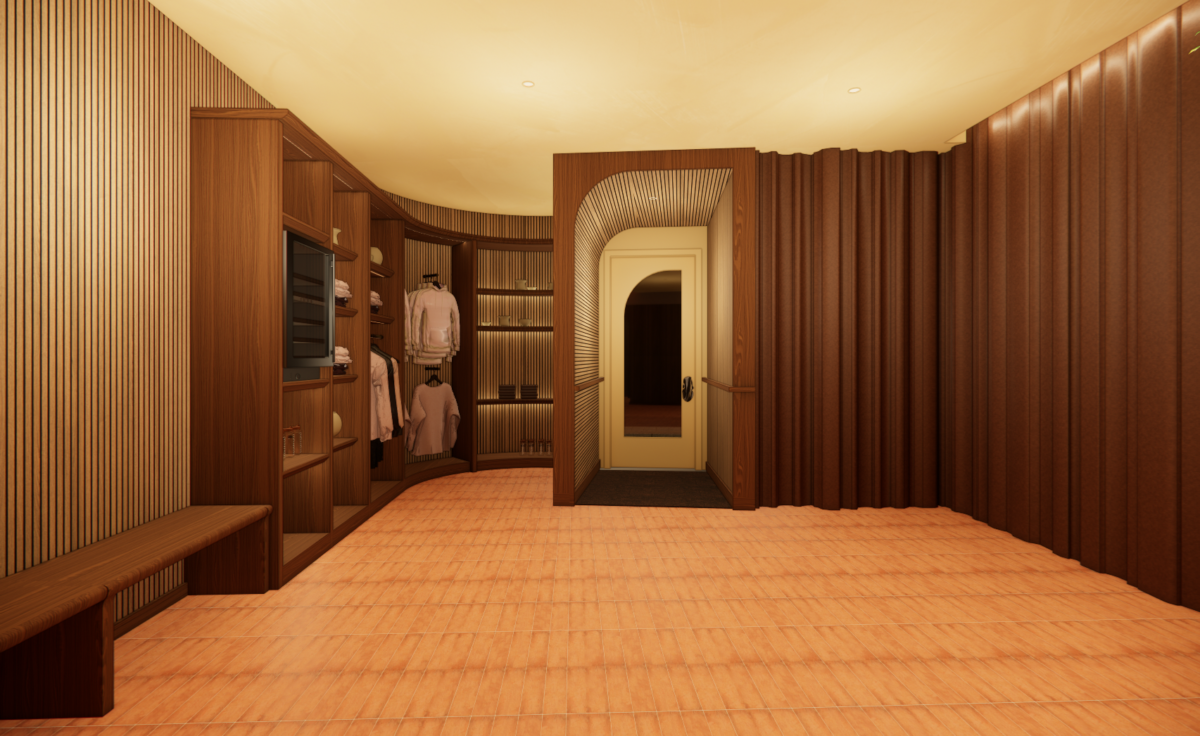
The interior features a split-level layout, connected by marble stairs that respond to the natural grade of the site. Two large dressing room areas anchor the customer journey, while multiple payment zones with branded finishes aim to streamline transactions without disrupting the overall flow of the space.

The space also includes an Atelier area with specialized lighting, alongside lounge-style seating and in-store Style Advisors offering personalized service. The design incorporates European-inspired furniture and curated playlists.

Art also plays a prominent role. The opening installation includes a large-scale “Giant Bag” concept featuring work from photographer Gregory Crewdson, part of Aritzia’s broader Artistic License Series. These types of installations are increasingly central to the retailer’s strategy, creating visual moments designed for social sharing while reinforcing brand identity.

A-OK entrance at the Aritzia flagship at CF Toronto Eaton Centre, April 26, 2026. Photo: Craig Patterson

Café integration and the shift toward dwell time

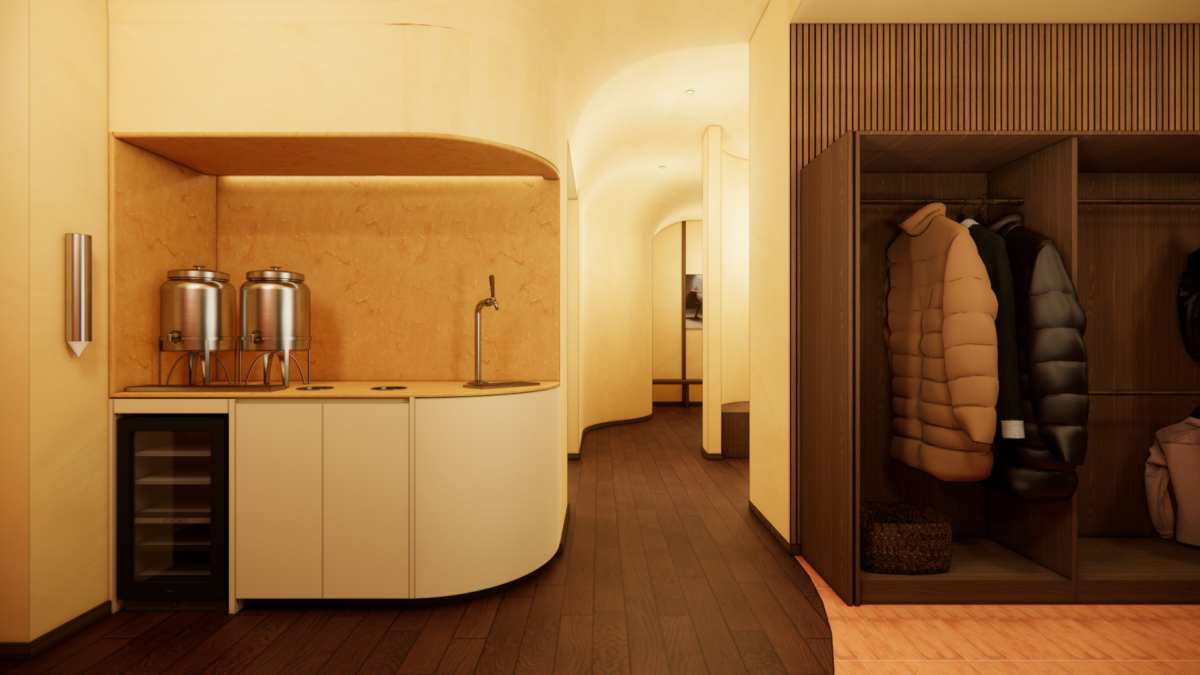
A defining feature of Aritzia’s flagship strategy is the integration of its in-store café concept, A-OK Café. At the CF Toronto Eaton Centre location, the café functions as a social and experiential anchor, encouraging customers to spend more time in-store and engage more deeply with the brand. The café is not licensed and does not serve alcohol, aligning with Aritzia’s broader positioning around daytime, accessible luxury experiences.

Notably, the CF Toronto Eaton Centre location is the first A-OK Café in Ontario to offer soft-serve ice cream, alongside a menu of beverages and baked goods sourced locally, including items from Toronto-based bakery Le Beau.

To mark the opening, Aritzia has partnered with Prime Seafood Palace, the restaurant concept associated with chef Matty Matheson. The collaboration includes a limited-time dessert offering as well as a capsule apparel collection featuring co-branded graphics.

A-OK Cafe at Aritzia at CF Toronto Eaton Centre in Toronto. Photo: Aritzia
Aritzia flagship at CF Toronto Eaton Centre, April 26, 2026 (A-OK cafe in the left of the photo). Photo: Craig Patterson

From boutique network to flagship-driven growth

The CF Toronto Eaton Centre expansion is part of a wider transformation underway at Aritzia. Historically known for its network of smaller boutiques, the company is now investing heavily in larger, multi-functional spaces that serve as both retail environments and brand billboards.

This “Super Boutique” model allows Aritzia to showcase the full depth of its product assortment, from core apparel lines to seasonal collections, in a way that smaller stores cannot. It also supports the company’s clienteling strategy, providing space for personal styling services and more relaxed, lounge-like environments. It could also support a future menswear expansion that is rumoured by some.

Importantly, these stores are designed to drive digital performance as well. Large-format flagships often create a halo effect, increasing online sales in surrounding markets as brand visibility and engagement rise.

Aritzia at CF Toronto Eaton Centre in Toronto. Photo: Aritzia
Aritzia flagship at CF Toronto Eaton Centre, April 26, 2026. Photo: Craig Patterson

CF Toronto Eaton Centre as a strategic showcase

The choice of CF Toronto Eaton Centre for this flagship underscores the continued importance of high-traffic urban shopping centres in Aritzia’s expansion strategy. As one of Canada’s most productive retail destinations as well as its busiest, the mall provides both visibility and volume, making it an ideal platform for a concept of this scale.

At the same time, the move reflects broader changes in the role of physical retail. Stores are no longer just points of sale. Instead, they function as immersive environments that combine shopping, dining, and cultural engagement into a single destination.

The CF Toronto Eaton Centre location joins a growing roster of large-format Aritzia stores across North America, including flagship expansions in Vancouver, Toronto, and key U.S. markets such as New York and Chicago. In many cases, these locations are significantly larger than traditional stores and incorporate cafés, curated art, and architectural elements that elevate the overall experience.

Aritzia flagship at CF Toronto Eaton Centre, April 26, 2026. Photo: Craig Patterson

More photos of Aritzia at CF Toronto Eaton Centre:

Aritzia flagship at CF Toronto Eaton Centre, April 26, 2026. Photo: Craig Patterson
A dressing room area at Aritzia at CF Toronto Eaton Centre in Toronto. Photo: Aritzia
Aritzia at CF Toronto Eaton Centre in Toronto. Photo: Aritzia
Aritzia flagship at CF Toronto Eaton Centre, April 26, 2026. Photo: Craig Patterson

More from Retail Insider:

Michaels debuts 10-minute custom framing in Canada

Michaels® Debuts 10-Minute Custom Framing in Canada, Launching New Suite of Instant In-Store Photo Services

 Michaels says it is fueling the joy of creativity and celebration in Canada with the launch of 10-Minute Custom Framing, an ultra-fast, personalized in-store service that transforms digital memories into gift-ready keepsakes  all for $29 CAD and in just 10 minutes or less.

Now available in all Canadian stores, the new service allows customers to upload a photo directly from their phone, choose a frame with the help of a Michaels framing expert, and leave with a printed, framed and gift-boxed memory at rapid speed and at an incredible value, said the company.

Derek Schweitzer
Derek Schweitzer

“We are thrilled to officially bring 10-Minute Custom Framing and instant photo printing to our Canadian customers,” said Derek Schweitzer, Senior Vice President, Stores (Canada) at Michaels. “With Mother’s Day, graduations, and wedding season just around the corner, this expansion is another way we are showing up for our customers with innovative, high-value services. We are continuing our transformation into the ultimate destination for all things creativity and celebration, and this launch makes it easier than ever to turn life’s milestones and everyday moments into lasting memories.”

With this launch, Michaels’ 10-Minute Custom Framing and in-store photo printing are now available at all stores across North America.

Michaels operates over 1,300 stores across 49 U.S. states and Canada, including 138 stores across all 10 Canadian provinces. The Michaels Companies, Inc. also owns Artistree, a manufacturer of custom and specialty framing merchandise. It was founded in 1973 and has headquarters in Irving, Texas.


More from Retail Insider:

Woodbine Mall CCAA Signals Shift to Redevelopment

Woodbine Centre in Toronto, 2025. Photo: Jasen Johnson via Google Maps

Woodbine Mall filed for CCAA last week, marking a pivotal turning point for the Etobicoke shopping centre and underscoring broader structural challenges facing secondary malls across Canada. The property, which has operated under receivership since 2023, formally entered creditor protection on April 17, 2026 under the Companies’ Creditors Arrangement Act.

The move reflects mounting financial pressure tied to declining retail performance, anchor tenant disruption, and a shifting valuation framework that increasingly prioritizes land redevelopment over traditional shopping centre operations.

The restructuring has been initiated by Romspen Investment Corporation, the mall’s primary secured lender, which is owed close to $500 million. Through a proposed credit bid using a reverse vesting structure, the lender is seeking to take control of the asset and reposition it for the future. A court hearing scheduled for April 27, 2026 is expected to determine the next phase of ownership.

Fantasy Fair at Woodbine Centre in Toronto. Photo: Google Maps

From Receivership to a Strategic Reset

The Woodbine Mall CCAA filing represents a shift from stabilization to strategy. Since May 2023, the property has been under receivership, with Ernst & Young overseeing operations and attempting to facilitate a sale. At the time of the initial filing, debt was estimated at approximately $333.3 million, alongside significant property tax arrears and declining operating performance.

Despite efforts to market the property, a traditional sale failed to materialize. The mall’s hybrid retail and entertainment format, anchored by Fantasy Fair, was increasingly viewed as niche, while rising vacancies and weakening tenant demand limited income stability.

The current approach reflects a change in strategy. Rather than waiting for an external buyer, the lender is effectively stepping in to assume ownership, restructure liabilities, and unlock long-term value tied to the land.

Woodbine Mall in Toronto, April 2026. Photo: Natalie Markiewicz via Google Maps

Hudson’s Bay Lease Constrained Sale and Redevelopment

A central factor in the mall’s prolonged insolvency process was the lease held by Hudson’s Bay, which functioned as both a financial and structural constraint on the asset.

The lease, which extended decades into the future, included provisions that significantly limited the landlord’s ability to redevelop or materially alter the property. These types of legacy department store agreements often contain restrictive covenants tied to site control, demolition rights, and co-tenancy protections. In the case of Woodbine Mall, the Hudson’s Bay lease effectively acted as a barrier to repositioning the site.

From a transaction standpoint, the lease introduced a level of uncertainty that deterred potential buyers. Any purchaser would have been required to navigate not only the long-term occupancy rights but also the operational and redevelopment restrictions embedded within the agreement. This reduced flexibility in pursuing mixed-use redevelopment, which is increasingly the primary value driver for large suburban sites.

That constraint was removed in July 2025, when Hudson’s Bay disclaimed its lease as part of its own restructuring proceedings. The removal of that “poison pill” fundamentally changed the asset’s profile, allowing stakeholders to consider redevelopment scenarios that were previously unworkable.

Fantasy Fair at Woodbine Mall in Toronto. Photo: jpdelicious via Google Maps

Retail Performance Undermined by Anchor Loss

Antony Karabus

The challenges at Woodbine Mall also reflect the broader collapse of the traditional anchor tenant model. Historically, the centre was anchored by Hudson’s Bay, Sears, and Zellers, all of which played a critical role in driving traffic and supporting smaller retailers.

Retail industry expert Antony Karabus has pointed to the systemic impact of anchor loss across Canadian malls. “When a major department store closes, it affects the entire ecosystem,” he said in a recent discussion. “Traffic declines, smaller tenants lose sales, and co-tenancy clauses can further erode rental income.”

At Woodbine, the loss of anchor stability contributed to a downward cycle. As vacancies increased and tenant quality shifted, the mall’s net operating income weakened, making it increasingly difficult to service debt and maintain the property.

Land Value Now Drives the Investment Thesis

While Woodbine Mall continues to operate with remaining tenants and attractions such as Fantasy Fair, its valuation is now primarily tied to its underlying land rather than retail productivity.

Karabus noted that many secondary malls are reaching a similar inflection point. “A number of these suburban malls have run their course as pure retail assets,” he said. “Their future will likely be as mixed-use developments that combine residential, retail, and entertainment.”

However, he cautioned that redevelopment is not immediate. “Residential projects can take years to approve and build, and current market conditions are slowing that transition,” he said, pointing to softer condo demand and tighter financing environments.

A Divided Retail Landscape

The Woodbine Mall CCAA process reflects a broader bifurcation in Canadian retail real estate. Top-tier shopping centres continue to report strong performance and attract leading tenants, while secondary properties face declining relevance.

Retailers are increasingly concentrating their footprints in high-performing locations, leaving mid-tier malls with elevated vacancy and limited leasing momentum. This shift has accelerated the financial pressure on properties like Woodbine, where the traditional retail model is no longer sustainable on its own.

Karabus described the dynamic as a structural reset. “There was an assumption that redevelopment would quickly solve these challenges,” he said. “In reality, there is a mismatch between how long redevelopment takes and how quickly retail performance can deteriorate.”

What Comes Next for Woodbine Mall

In the near term, operations at Woodbine Mall are expected to continue under court supervision as the restructuring process unfolds. Maintaining business continuity is essential to preserving asset value during the transition.

Over the longer term, the site’s future is likely to align with broader planning initiatives in the area. Located on more than 50 acres and positioned near major transit and the Woodbine Racetrack district, the property is a strong candidate for large-scale mixed-use redevelopment.

City planning efforts envision a more dense, transit-oriented community that integrates residential, retail, and public space. If realized, this would represent a complete transformation from the mall’s original 1985 format into a new urban node.

More from Retail Insider:

Canada losing businesses at an alarming rate: CFIB

Yan Krukau photo
Yan Krukau photo

Canada’s economic foundation is crumbling as business closures in Canada have been outpacing new business starts for six consecutive quarters. With Canada facing an entrepreneurial drought, governments must act to reverse this trend and fix Canada’s shrinking business landscape, says the Canadian Federation of Independent Business (CFIB).

As seen in CFIB’s Canada’s Entrepreneurial Drought, Part 1: The Shrinking Business Landscape report, business exits in Canada have outpaced new business entries since early 2024, and the problem seems to be getting worse. In the second quarter of 2025, exit rates reached 5.6%, while entry rates fell to 4.8% in Q4 2025, marking some of the highest closure rates and weakest startup activity outside the pandemic, explained the CFIB.

On Monday, CFIB released Part 2 of the report series, Canada’s Entrepreneurial Drought, Part 2: Fixing Canada’s Shrinking Business Landscape, which outlines practical reforms to reverse the drought and improve Canada’s business environment.

Michelle Auger
Michelle Auger

“Tomorrow’s federal spring economic statement is an opportunity for the federal government to address Canada’s entrepreneurial drought and restore small business confidence,” said Michelle Auger, CFIB director of trade and marketplace competitiveness. “Governments have spent years prioritizing big business needs, while small firms have been largely ignored. Canada cannot afford to keep losing more businesses than it gains, it’s time for all governments to put small businesses first and reverse the entrepreneurial drought.”

The CFIB is Canada’s largest association of small and medium-sized businesses with 103,000 members across every industry and region.

The CFIB said it identified three priority areas of action to fix Canada’s entrepreneurial drought: reducing the cost of doing business, cutting red tape, and responding to the ongoing transformation of Canada’s labour market.

Some key reforms for governments include:

Reducing the costs of doing business:
•    Reduce the federal small business corporate tax rate (SBCTR) from 9% to 6%; and
o    Provincial governments should permanently lower their SBCTRs to 0% by 2030.
o    Federal and provincial governments should raise SBCTR thresholds to at least $700,000 and index it to inflation.
•    Make financing more accessible and affordable.
•    Create a level playing field and ensure government programs and procurement processes are accessible to small firms.

Cutting red tape and reducing internal trade barriers:
•    Measure and publicly report the regulatory burden.
•    Eliminate two regulations for every new one introduced (a “2 for 1” rule) to cut red tape.
•    Streamline internal trade by expanding mutual recognition beyond its current scope to include food and alcohol and ensure the Canadian Mutual Recognition Agreement and provincial legislation are applied consistently and transparently, with minimal carve-outs.

Addressing labour market challenges and improving business succession:
•    Improve workforce quality through training incentives and stronger partnerships with educational institutions.
•    Keep, protect and defend the Temporary Foreign Worker Program and consult the business community in advance of future reform.
•    Increase awareness, particularly among young entrepreneurs, about the opportunities and advantages of purchasing an existing business. 
•    Allow small corporations to defer the tax on capital gains from the transfer of a business to the owner’s children.

Brianna Solberg
Brianna Solberg

“The entrepreneurial drought won’t fix itself. Canada needs to give businesses clear reasons to start, stay and invest, yet current government policies are failing to inspire confidence among entrepreneurs,” said Brianna Solberg, CFIB director for the Prairies and the North. “If governments are serious about Canada’s economic strength, competitiveness, and productivity growth, they need to start reflecting this in their policies.”

Visit cfib.ca/drought for more information. 

More from Retail Insider:

Growth planned for QuickBite Collective brands

Teriyaki Experience
Teriyaki Experience

QuickBite Collective, a relatively new player in the Canadian quick service restaurant space, is continuing to build its footprint across Canada with strong sales growth across its three brands – Teriyaki Experience, Burgers n’ Fries Forever (BFF) and Maverick’s Donut Company.

Although the company was founded in 2024, its legacy brand Teriyaki Experience is celebrating 40 years in business and has just posted double-digit sales growth this past quarter at a time when many legacy QSR brands are facing declines.

Hadi Chahin, President of QuickBite Collective  said overall in the industry there’s definitely a drop in sales across all the brands, especially the legacy brands or the big guys. 

“The major chains have seen quite a dip year over year from last year and into this year for sure. From what I hear from different colleagues and owners, January and February of this year were probably some of the lowest on record in terms of their sales,” he said.

“That’s why we were happy to see where Teriyaki landed in the first quarter because it actually outperformed the market. Now, part of it is the changes that we did to the brand, obviously, in terms of the rebranding, the marketing, the menu development, and on multiple levels.

“The other part is I do believe also that the Asian category is in growth. It was trending over the last few years in the U.S., and I think it’s trending right now in Canada. We had a period of time prior where chicken was trending as chicken sandwiches, and then shawarma was trending.

Hadi Chahin
Hadi Chahin

“I do believe that our brands today, between the smash burger and the Asian category, are definitely high on what people are looking for.”

There are currently 12 Burgers and Fries locations with another 10 under construction this year.

With Teriyaki Experience, there are 36 with another seven coming up this year, and more next year.

And with Mavericks, there are 19 locations, with five opening this year. 

“With Burgers and Fries, originally it was mostly here in Ontario. We just opened our first location in British Columbia at UBC. From there, we have another four locations opening this year between the mainland and Victoria,” explained Chahin.

“So we have two locations happening in Victoria and a couple of locations in Delta and Surrey. With the rest of it in Ontario, it’s really spread out in the sense that we have four locations in the core GTA. And then we have one in Sudbury, one in London, one in Cambridge.

“We’re opening Ajax. We’re opening in Burlington and Kitchener. So basically anywhere between Ajax to London, Ontario, that range is where most of the BFFs will be. We’re trying to stay focused that way to open clusters and maximize the presence and the focus on the marketing piece.”

Chahin said real estate is competitive in general for great locations.

“If you’re looking for a good spot that you believe would do well for a restaurant, especially QSR, you’re dealing with larger landlords because those spaces are usually built by bigger landlords,” he said.

“You’re looking at newer plazas or established plazas. It’s very competitive when it hits the market. There’s a lot of competition, the rents are extremely high, and the landlords have the upper hand today on retail units.

“On the flip side, there have been some closures in terms of restaurants, and there has been a lot of rebranding from older brands or from one brand to another. That’s where most brands are looking at opportunity, especially newer brands like us or growth-mode companies.

“We’re looking mostly at conversions because these are restaurants that were operating and still in good condition, and we’re able to take them and flip them to one of our brands versus trying to compete with landlords when they put units out for lease. So in most cases now, we’re actually buying assets from existing restaurants and rebranding.”

Teriyaki Experience
Teriyaki Experience

Chahin said the company focus on Teriyaki has been on existing locations. Most of Teriyaki prior to its acquisition was in Ontario, with a few in Quebec and in New Brunswick.

“Our focus this year and into next year is to continue to grow Ontario but make sure that BC is our next market. That’s where our next growth will be for our brands,” he said.

More from Retail Insider:

GS25 Rumor Highlights Demand for Asian Convenience Retail in Canada

Image of a GS25 store. Photo: GS25

A recent wave of speculation suggesting that South Korean convenience giant GS25 could be entering the Canadian market has been firmly debunked. However, the episode offers a revealing look at shifting consumer demand and the growing appeal of Asian convenience retail concepts in urban markets such as Toronto.

Reports circulated last week after signage resembling GS25 branding was spotted behind construction hoarding at 499 Church Street, the former home of the iconic Glad Day Bookshop in Toronto’s Church-Wellesley Village. The speculation gained traction online, including in a widely shared article in BlogTO, despite the lack of any official confirmation from GS25’s parent company, GS Retail.

A site visit conducted over the weekend confirms that the space is nearing completion as a location for Mapo Korean BBQ, a restaurant concept that already operates elsewhere in Toronto. The GS25 branding seen in earlier images appears to have been outdated, further undermining the credibility of the initial claims.

New Mapo Korean BBQ at 499 Church Street in Toronto (former site of Glad Day Bookstore), Sunday, April 26, 2026. Photo: Craig Patterson

Rumor Reflects Real Market Interest

While the GS25 Canada expansion narrative is unfounded, the speed at which it spread speaks to a broader truth. Canadian consumers are increasingly receptive to Asian retail formats that blend convenience, prepared food, and lifestyle merchandising.

The idea of a GS25 location in downtown Toronto did not seem far-fetched to many observers. The brand has aggressively expanded internationally in recent years, particularly in markets such as Vietnam and Mongolia, while also exporting its private label products globally. Its “food-first” model, which emphasizes fresh, ready-to-eat meals and in-store dining, stands in contrast to the traditional North American convenience store format.

In that context, Toronto appears to be a logical future market, even if no plans are currently in place.

Building permit in the window of the new Mapo Korean BBQ at 499 Church Street in Toronto (former site of Glad Day Bookstore). Photo: Craig Patterson

Rise of Asian Grocery and Convenience Concepts in Canada

The speculation also reflects the growing influence of Asian grocery and specialty retail in Canada. Chains such as T&T Supermarket, H Mart, and Galleria have expanded significantly, attracting a broad customer base that extends well beyond immigrant communities.

These retailers have introduced Canadian consumers to a more experiential approach to food retail, where freshly prepared meals, imported products, and curated assortments play a central role. In many ways, this model overlaps with what GS25 has perfected in South Korea.

As a result, the concept of a premium Asian convenience store entering the Canadian market aligns with existing consumer behaviour trends.

Former Glad Day Bookstore at 499 Church St. in Toronto. Photo: Craig Patterson

A High-Profile Site with Cultural Significance

The property at 499 Church Street carries additional weight due to its history. For nearly a decade, it was home to Glad Day Bookshop, widely recognized as the world’s oldest LGBTQ+ bookstore. Founded in 1970, the business evolved into a community hub that hosted hundreds of events annually before relocating in 2025 due to rising operating costs.

The departure left a highly visible vacancy in one of Toronto’s most prominent neighbourhoods, making it a natural focal point for speculation about potential tenants. In that sense, the GS25 Canada expansion rumor was amplified not only by retail trends but also by the significance of the location itself.

Debunked, But Not Implausible

Although GS25 is not entering Canada at this time, the underlying premise of the rumor remains noteworthy. The combination of dense urban populations, evolving food habits, and growing interest in international retail formats suggests that the Canadian market could eventually support concepts similar to GS25.

For now, the Church Street location will instead house a Korean restaurant, reflecting a different but still relevant aspect of Toronto’s increasingly diverse food and retail landscape.

At the same time, the episode underscores how quickly retail narratives can take hold in an environment where consumer expectations are evolving. The GS25 Canada expansion story may not be real today, but it points to a category that appears increasingly viable in the years ahead.

More from Retail Insider:

STRONG Pilates on aggressive expansion path

STRONG Pilates photo

STRONG Pilates has officially integrated its Canadian operations within its global structure – a strategic move to support the brand’s accelerated growth, strengthen franchisee support, and further investment in innovation and customer experience.   

In Canada, STRONG Pilates is set to expand from seven studios at the end of 2025, to 22 locations by the end of 2026, with plans to reach 40 by 2027. New studios have already opened in Toronto, Oakville, Kingston, St. Catherines, Ottawa, and Vancouver. 

The expansion reflects growing demand for boutique fitness concepts that deliver results without high-impact strain and highlights the strength of STRONG Pilates’ global integration and franchise-led model.

It has carved out a distinct position as the only nationwide workout blending Pilates, cardio, and strength into one high-intensity, low-impact session – an approach that continues to resonate with modern Canadian fitness consumers. 

Michael Ramsey
Michael Ramsey

STRONG Pilates Global CEO Michael Ramsey said the brand will have 11 locations in Canada by the start of May.

“The first studio launched in January 2024. That was Little Italy in Toronto. Ever since then, from the inception of the brand, we’ve really started to see that supercharged growth. It’s based on consumer demand, so we find the best thing we can do to expand our footprint is open studios and get people talking. I think it’s relatively strong growth for a 2024 business – exciting times ahead,” said Ramsey.

The brand has 115 locations in 14 countries and soon to be more countries. 

“We’re expanding through Europe a little bit more and into Saudi Arabia and those areas. In the pipeline, we’ve sold over 250 locations, so our goal is to get to 300 by the end of 2027,” said Ramsey.

Our goal by the end of 2027 is 40 locations in Canada, and I think that’s quite a conservative goal. Given the demand for boutique fitness, particularly Pilates, it’s booming right now. I think we can certainly get to 100 locations in Canada.

“For us, it’s more about slow, sustainable growth with good partners. We don’t want to come in and suddenly open 200 locations. It’s about working with the market and the operators. But I’d like to say we’ll get to 100 for sure.”

Ramsey described STRONG as a Pilates, strength, and cardio concept. 

STRONG Pilates photo

“We’re probably the first true hybrid Pilates concept in the world. We use a patented piece of equipment called a Rowformer. It’s effectively a rower attached to a reformer and a bike, and then we have heavy dumbbells, we go up to 30 kilograms, or about 70 pounds,” he explained.

“We fuse Pilates, strength, and cardio together in one. What we’re seeing is that Pilates is booming and having its day in the sun. Not only do we get people who train in Pilates and want a little bit more, we also get people doing functional training, people with regular gym memberships, and people who do spin classes. It’s a really broad mix of consumers.

“In the boutique space, Pilates is popular, but so are many other concepts. People only have so much to spend, and they might have two, three, or four memberships. What makes us different is we give them strength training so they’re building lean muscle, Pilates for mobility and core strength, and cardio for heart health and overall fitness. We’re delivering a full solution, which is why the brand has grown the way it has. It’s been consumer-led, and we have a strong following of people who love what we’re doing and can do it without spending a fortune.”

Ramsey said the typical client ranges anywhere from 16 years old through to 70-plus.

“It’s a very broad client base. For the most part, if I were to create a typical profile, it would be a 28- to 45-year-old female as our primary consumer,” he noted.

STRONG Pilates photo

“The really cool thing with us is we’re very gender-neutral in our branding and the way we communicate. Pilates has traditionally been very female-focused in the past, but we probably have the highest male participation of any Pilates brand as well. Some of our studios can get up to 25–30% male participation, which is huge. The average Pilates studio would generally be 90–95% female.

“It’s been really positive for us to get men into Pilates. As I mentioned before, they also get strength training and cardio as well, so it’s a perfect combination.”

More from Retail Insider:

Yorkdale Outpaces Canadian Malls by $700 Per Square Foot

Yorkdale Shopping Centre in Toronto, 2025. Photo: Craig Patterson

Yorkdale Shopping Centre is not simply Canada’s top-performing shopping centre, it is operating at a level far beyond its peers.

According to the latest data from the International Council of Shopping Centers, Yorkdale achieved $2,368 in sales per square foot in 2025, maintaining its position at the top of the national rankings. The scale of that performance becomes clearer when compared to the next closest competitor. CF Toronto Eaton Centre recorded $1,642 per square foot, leaving a gap of more than $700.

The ICSC rankings highlight a clear tier of high-performing malls across the country, including CF Pacific Centre, CF Chinook Centre, and Square One Shopping Centre. These centres continue to post strong productivity numbers, often exceeding $1,300 per square foot.

However, even within this top tier, Yorkdale stands apart. The gap between first and second place is unusually large for a mature retail market, suggesting that consumer spending is increasingly concentrating in a small number of dominant destinations.

This trend points to a broader industry reality. The best-performing malls are not just competing, they are separating themselves.

Strategy Behind the Performance

Robert Horst

The strength of Yorkdale’s shopping centre sales performance is not accidental. It reflects a deliberate strategy focused on securing category-defining brands and delivering elevated retail experiences.

Robert Horst, Vice President, National Retail at Oxford Properties Group, explained that Yorkdale has consistently prioritized “category defining luxury, first-to-market global brands and flagship formats” that reinforce its position as a leading destination.

Retailers entering Canada often look to Yorkdale first, using the centre as a platform to establish or elevate their presence. This approach has created a virtuous cycle, where high-profile brands attract high-spending customers, which in turn attracts more brands seeking visibility and performance.

Luxury and Experience Drive Results

Luxury retail continues to play a central role in Yorkdale’s dominance. Recent openings and expansions from global brands such as Dior, Saint Laurent, and the upcoming 12,000 square foot Gucci flagship are reinforcing the centre’s position as Canada’s leading luxury destination.

At the same time, Yorkdale’s tenant mix extends beyond traditional luxury. Experiential concepts such as Gentle Monster introduce immersive retail environments that draw visitors and increase dwell time. Dining has also become a strategic component, with premium casual and upscale restaurant offerings contributing to longer visits and higher spending.

Horst noted that these elements work together to create a cohesive ecosystem, where retail, food, and experience reinforce each other and ultimately drive productivity.

Dior Yorkdale store in Toronto. Photo: Daniel Bray, Here and Now Agency

A Destination Model for Canadian Retail

Yorkdale’s performance reflects a broader shift in consumer behaviour. Shoppers are increasingly gravitating toward destinations that offer depth, variety, and a high-quality overall experience.

As Horst observed, customers are “gravitating towards best-in-class destinations where they can get the highest depth and breadth of products.” This shift benefits centres that can deliver scale and differentiation, while placing pressure on those that cannot.

New 11,000 sq ft Saint Laurent flagship at Yorkdale. Photo: Dan via Google Maps

Context Within the Oxford Portfolio

Other properties within Oxford’s portfolio are also performing strongly, though at different scales. Square One Shopping Centre reached $1,396 per square foot, ranking among the top centres nationally, while Scarborough Town Centre surpassed $1,000 per square foot for the first time, reflecting significant growth in recent years.

These results highlight the strength of major regional centres in the Greater Toronto Area, particularly those benefiting from population growth, mixed-use development, and evolving tenant strategies.

The Implications for the Industry

Yorkdale’s widening lead is more than a headline figure. It signals a deeper transformation within Canadian retail, where performance is increasingly concentrated in a small number of dominant, experience-driven centres.

For landlords and retailers alike, the message is clear. Scale, brand curation, and customer experience are no longer optional. They are essential to competing in a market where the gap between the leaders and the rest continues to grow.

As the data shows, Yorkdale is not just leading the market. It is redefining what leadership looks like in Canadian retail.

Newly opened RIVIAN showroom at Yorkdale in Toronto. Photo: Yorkdale

More from Retail Insider:

Bath Depot Opens 50th Store, Expands Western Footprint

Photo: Bath Depot

Canadian home retailer Bath Depot has reached a milestone with the opening of its 50th store, as the company continues to expand its presence across Western Canada. The newest location opened on April 24 at 170 Mayfield Common NW in Edmonton, marking the retailer’s second store in the city and reinforcing its growing national footprint.

The milestone reflects a broader shift for the Quebec-based company, which has steadily evolved from a regional player into a national contender in the home renovation retail sector. With a growing store network and expanding e-commerce capabilities, Bath Depot is positioning itself to compete across multiple Canadian markets.

A Strategic Milestone in Edmonton

While the Edmonton opening represents the company’s 50th store overall, it is also part of a carefully sequenced expansion into Alberta. Bath Depot first entered the province in September 2024 with a large-format showroom in Calgary on Macleod Trail SE. This was followed by the opening of its first Edmonton location at the Mayfield Common retail node later that year.

The new store builds on that initial momentum, signalling confidence in the Edmonton market and the broader Prairie region. The showroom format, typically between 4,500 and 5,000 square feet, is designed to deliver a customer-focused experience that contrasts with the warehouse-style layouts of many big-box competitors.

“Our 50th store is an important milestone, not just in terms of growth, but in what it represents,” said Andrew St-Charles, Vice President, Strategy at Bath Depot. “We’ve always believed that a Canadian company can compete at a national level while staying true to its values.”

From Quebec Roots to National Expansion

Founded in 2008 in the Greater Montreal area by the Nadeau family, Bath Depot built its early success by focusing on a one-stop-shop model for bathroom, kitchen, and lighting products. The company established a strong base in Quebec before expanding into Ontario, where it now operates more than 20 locations.

Today, the retailer’s network spans 50 stores across Canada, including a growing presence in the Maritimes and Western Canada. The move west began in earnest with a Winnipeg opening in 2025, marking the company’s first entry into the Prairie provinces. Alberta quickly followed as a priority market, with multiple locations opening in rapid succession.

This progression highlights a deliberate strategy to move beyond its Quebec stronghold and establish a coast-to-coast presence.

Image: Bath Depot

Positioning in the Mid-Market Home Renovation Segment

Bath Depot has carved out a distinct position between high-end specialty boutiques and mass-market big-box retailers. Its model relies on direct relationships with manufacturers and a vertically integrated supply chain, including exclusive product lines, allowing it to offer well-designed products at accessible price points.

This “middle-ground” positioning has proven effective in a category where consumers often balance cost, design, and functionality. The showroom approach further supports this strategy by emphasizing curated displays and practical inspiration, rather than bulk inventory presentation.

Riding the Renovation Wave

The company’s expansion comes at a time when Canadian consumers are increasingly investing in their existing homes. Elevated interest rates and housing affordability challenges have contributed to a “renovate rather than relocate” trend, particularly in major urban and suburban markets.

Bathroom and kitchen renovations remain among the most resilient categories within home improvement retail, offering both functional upgrades and lifestyle enhancements. Bath Depot’s focus on these core areas aligns well with current consumer priorities, particularly as wellness and at-home comfort continue to influence spending decisions.

The company’s recent national campaign, “Create Your Escape,” reflects this shift by positioning the bathroom as a personal retreat rather than a purely functional space.

Infrastructure and Long-Term Growth Strategy

Behind the expansion is a significant investment in infrastructure. Between 2021 and 2024, Bath Depot modernized its digital and operational systems, implementing platforms such as LS Central and Microsoft Business Central to support national e-commerce and multi-store operations.

As the company surpasses 50 locations, further investment in logistics is expected, particularly to support Western Canadian growth and reduce shipping times outside of its primary distribution hub in Blainville, Quebec.

Bath Depot remains privately owned by the Nadeau family. This structure allows the company to pursue long-term growth strategies without the pressure of quarterly shareholder expectations, enabling measured expansion into new provinces and markets.

With Alberta now firmly established, Bath Depot is expected to continue expanding westward into British Columbia and Saskatchewan, while also exploring additional opportunities in Atlantic Canada. These moves would complete a truly national footprint and further solidify the company’s position in Canada’s competitive home renovation retail landscape.

More from Retail Insider: