Home Blog Page 50

65% of marketers say they have differentiation anxiety, new Cashew study finds

Gustavo Fring photo
Gustavo Fring photo

The biggest challenge facing marketers today isn’t creating more content. It’s creating content that doesn’t sound like everyone else’s. New research from Cashew found that 65% of marketers experience differentiation anxiety, the pressure to create content that feels fresh, original, and distinct in an increasingly crowded content landscape.

The study surveyed 206 senior mid-market and enterprise marketers across North America to understand how AI, content production, and originality are reshaping modern marketing.

While AI has made content creation faster than ever, marketers say standing out has become significantly harder, it said.

“We’ve reached a point where everyone has access to the same AI tools, the same prompts, and the same information,” said Addy Graves, CEO of Cashew Research. “The competitive advantage isn’t producing more content anymore. It’s having something original to say.”

The findings reveal a widening gap between content volume and content differentiation. Nearly three-quarters of marketers (71%) publish content at least weekly, while 66% have used original research in their marketing within the past 90 days, suggesting brands are increasingly searching for proprietary insights that competitors can’t easily replicate, said Cashew.

The Cashew research also explored which marketing messages resonate most with today’s marketers.

Benefits centered on helping brands better understand customers and stand out from AI-generated content ranked highest. By contrast, messaging focused on proving marketing ROI, and building credibility, ranked among the least compelling.

The results suggest marketers are shifting their priorities away from justifying marketing efforts and toward creating genuinely differentiated perspectives. As AI continues to lower the barrier to producing content, originality may be becoming one of the few remaining competitive advantages, added Cashew.

Cashew’s full report, Everyone Said That, is available now.

Addy Graves
Addy Graves

In an interview with Retail Insider, Graves spoke about the report.

Question: Your research found that 65 per cent of marketers experience “differentiation anxiety.” What’s driving that anxiety, and why is it becoming such a significant issue now that AI tools are widely available?

Answer: The biggest driver is the pressure to keep the content engine moving while still coming up with fresh ideas, angles, and campaigns.

Marketers have never been under more pressure to produce a high volume of content, across more channels, and more consistently. But at the same time, every piece of content still has to earn attention. That’s the hard part.

AI has made content production faster and easier but it has also raised the bar for originality. If everyone is drawing from the same sources, using the same data and insights, it becomes much easier for brands to start sounding the same. So the anxiety isn’t about creating more content, it’s about creating content that actually feels new, different, relevant, and worth sharing.

Q: The survey suggests original research is becoming a competitive advantage. For retailers and consumer brands, what kinds of original data or insights are proving most valuable in helping them stand out?

A: The most valuable insights tend to come from topics that are personally meaningful, culturally relevant, or a little provocative for the audience a brand is trying to reach. The strongest research-led content usually does more than talk about a brand or product. It reveals something interesting about culture and consumers’ lives, daily tensions, values and overall behaviours.

For example, Turo has used original research to explore how different generations think about car ownership, road trips, and even autonomous vehicles, including how open Gen Z is compared to older generations. Joni has used research to highlight the real-life affordability and access challenges many people face around period care.

Those kinds of insights work because they show the brand understands the world its consumers are living in. It gives brands something much more meaningful to say than “here’s our product.” Instead, the brands are saying “we understand you”.

Vitaly Gariev photo
Vitaly Gariev photo

Q: Many retailers are using AI to produce marketing content more efficiently. Where do you see AI adding value, and where does it risk making brands sound increasingly similar to one another?

A: AI is incredibly useful for operationalizing the content engine. It can help teams plan, edit, repurpose, summarize, and scale content more efficiently.

Where it becomes more risky is when brands rely on AI to generate the core idea or point of view in the first place.

AI is largely working from existing information, patterns, and language that many other teams can access too. So if every brand is using similar tools to come up with ideas, there is a real risk that the output starts to feel repetitive no matter how many ways we try to repackage it. Consumers will eventually just stop listening.

The best use of AI is not to replace original thinking. It is to make the process around original thinking faster. Brands still need a distinct point of view, fresh data, and a real understanding of their audience to create content that stands out.

Q: Your survey found that 71 per cent of marketers publish content at least weekly. Are companies starting to prioritize quality and unique insights over publishing volume, and what does that shift look like in practice?

A: The pressure to publish frequently is definitely still there. Our research shows that output is up, and many marketers are expected to create content on a weekly basis or more. But the smartest brands are realizing that quality and volume do not have to be in conflict. Original research can actually support both.

One strong study can uncover a compelling story that shapes your entire content strategy. It can reveal fresh insights that spark a new campaign or provide an early glimpse of an unexpected shift that catches your entire category off guard.

That gives marketers more substance to work with. Instead of using the same data points and insights that everyone else has access to, proprietary data gives you a story only you can own. That gives you the opportunity to run content ideas that no one else can copy, and allows you to bring a unique narrative to the market.

Addy Graves
Addy Graves

Q: Looking ahead, what do you think will separate the brands that successfully use AI from those that simply add to the growing volume of generic content online?

A: The brands that win will be the ones that use AI in a balanced way.

AI can make teams faster and more efficient, but it should not be the source of a brand’s entire point of view. The strongest brands will use AI to support the work, while staying close to real human experience, customer perception, and cultural tension.

I think that will become one of the biggest differentiators over the next five years. When content becomes easier for everyone to produce, the advantage shifts to brands that have something true to say.

The brands that succeed will not just be using AI to create more content but using it to amplify unique ideas.

More from Retail Insider:
Inside Aritzia’s Expanding Store and Infrastructure Strategy

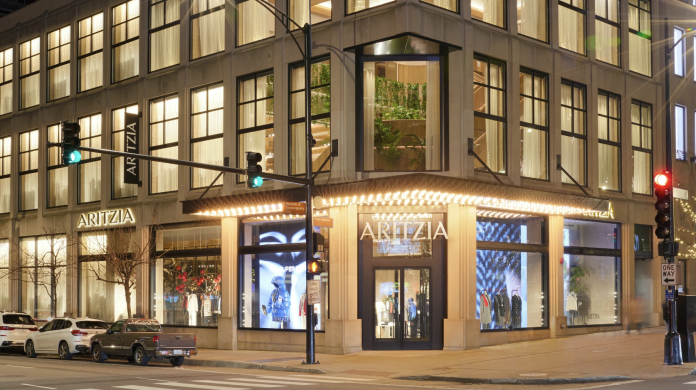
Aritzia Chicago flagship on Michigan Avenue. Photo: BLDUP.com

Buried in Aritzia’s latest quarterly financial statements is an unusual real estate disclosure.

During the first quarter, the Vancouver-founded retailer entered a 50/50 joint venture with an unnamed third party that owns a single property expected to become a future boutique location. Aritzia contributed US$1 million for its common interest and advanced another US$27 million through a loan carrying a 10% annual return and maturing in April 2029.

The filing does not identify the property or the partner. The transaction nevertheless provides a glimpse of a company whose physical expansion is becoming larger, more capital intensive and, in at least one case, more structurally complex.

A broader strategy emerges across Aritzia’s latest financial statements, investor presentation and earnings call. The retailer has articulated a repeatable new-store model of roughly 10,000 square feet with strong economics, while selectively committing to major urban flagships three or four times that size. Around the store network, it is increasing capital spending, adding distribution capacity and pursuing a U.S. opportunity that management believes extends far beyond its current footprint.

The buildout is occurring as Aritzia itself reaches a new scale. First-quarter net revenue increased 43.4% to $951.0 million, comparable sales rose 35.1%, and the company raised its fiscal 2027 revenue outlook to between $4.55 billion and $4.75 billion.

The quarterly growth is significant. The less obvious story is what Aritzia is building behind it.

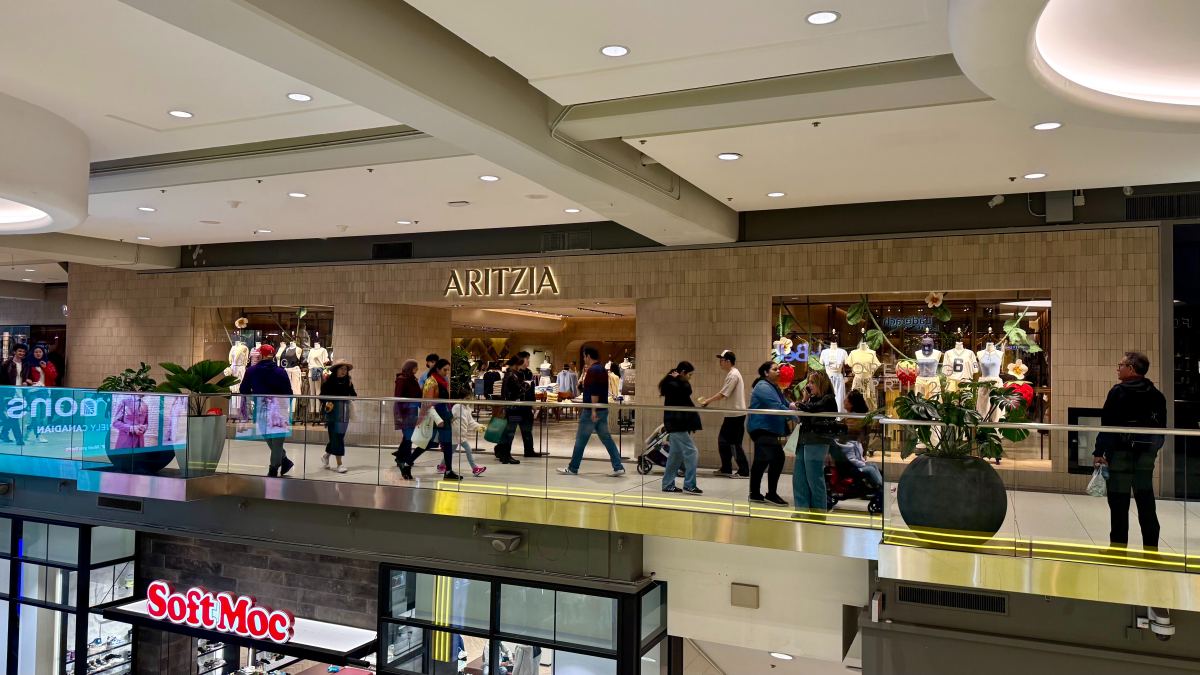
Aritzia flagship at CF Toronto Eaton Centre, April 26, 2026. Photo: Craig Patterson

The Economics of a 10,000-Square-Foot Aritzia

Aritzia’s Q1 investor presentation provides a rare public look at the economics behind a typical new boutique.

The model assumes approximately 10,000 square feet, sales productivity of about $1,000 per square foot and roughly $10 million in annual revenue. Aritzia estimates a net investment of about $4 million, with an expected payback period of 12 to 18 months.

Current performance is running ahead of that benchmark. Chief Executive Officer Jennifer Wong told analysts that new boutiques are paying back in less than one year on average. She also said locations above 10,000 square feet are producing sales per square foot in line with Aritzia’s highly productive smaller boutiques.

Jennifer Wong
Jennifer Wong

That combination goes a long way toward explaining why physical expansion remains central to the growth strategy.

Adding space can create a productivity problem for retailers. Total store sales may increase while the revenue generated by each additional square foot declines. According to Wong, Aritzia is not seeing that dilution in its larger boutiques.

The format has evolved considerably. Wong said the company was discussing average stores of roughly 6,000 square feet about a decade ago. That later moved toward 8,000 square feet. Aritzia now bases its new-store economics on a footprint of about 10,000 square feet, with selected flagships considerably larger.

The U.S. maturation curve has changed as well. Chief Financial Officer Todd Ingledew told analysts that Canadian boutiques historically opened closer to maturity while American locations tended to ramp over several years. Newer U.S. stores are now opening much closer to mature productivity, with the fiscal 2026 cohort starting from particularly strong levels.

Management did not attribute that improvement to a single factor. Greater brand awareness could be contributing, as could existing digital demand, stronger site selection and local execution. What is clear from the call is that the economics of opening in the U.S. have improved.

Aritzia therefore has a repeatable store model that has grown in size, is paying back faster than targeted and is reaching stronger productivity earlier in the United States.

It is also selectively building stores on an entirely different scale.

From 10,000 Square Feet to 40,000-Plus-Square-Foot Flagships

Aritzia’s largest urban flagships sit well outside the 10,000-square-foot model presented to investors.

On Chicago’s Michigan Avenue, the company operates from a roughly 46,000-square-foot space on the Magnificent Mile. The lease was announced as Aritzia’s largest location to date when the deal was arranged.

In New York City, its flagship at 608 Fifth Avenue spans approximately 33,600 square feet, following a major expansion of the retailer’s presence on the corridor.

In downtown Vancouver, Aritzia is developing another major flagship at CF Pacific Centre. Retail Insider understands the four-level location will approach 42,000 square feet in part of the former Nordstrom complex.

The gap between these stores and the standard model is substantial. Aritzia’s investor assumptions centre on about 10,000 square feet, yet selected gateway-city flagships are three or four times larger.

That suggests different locations are performing different jobs within the network.

Aritzia’s own investor materials say boutiques are intended to generate sales and profits, build awareness, propel client acquisition and fuel digital growth. A major flagship can potentially extend those functions across a wider audience while giving the company more room for assortment, multiple in-house brands and a fuller physical expression of its positioning.

Highly visible locations can also reach beyond their immediate residential trade areas. Michigan Avenue and Fifth Avenue draw tourists alongside local shoppers, while the forthcoming Vancouver flagship will occupy one of the city’s most prominent downtown retail locations. The strategic value of such stores may therefore extend beyond revenue generated within four walls.

That is an analytical interpretation, not a return Aritzia has publicly quantified. The company has not disclosed a specific financial value for the brand-building role of its largest flagships.

The difference in format is nevertheless becoming difficult to miss. A 10,000-square-foot boutique provides a repeatable model for expansion. A 40,000-plus-square-foot flagship can create a level of market presence that a conventional store cannot.

The evolution is particularly visible in Vancouver. Aritzia’s first standalone boutique opened at Oakridge in 1984 at approximately 1,500 square feet. Its reimagined Oakridge Park store is now about 10,000 square feet. The downtown flagship under construction will be more than four times larger again.

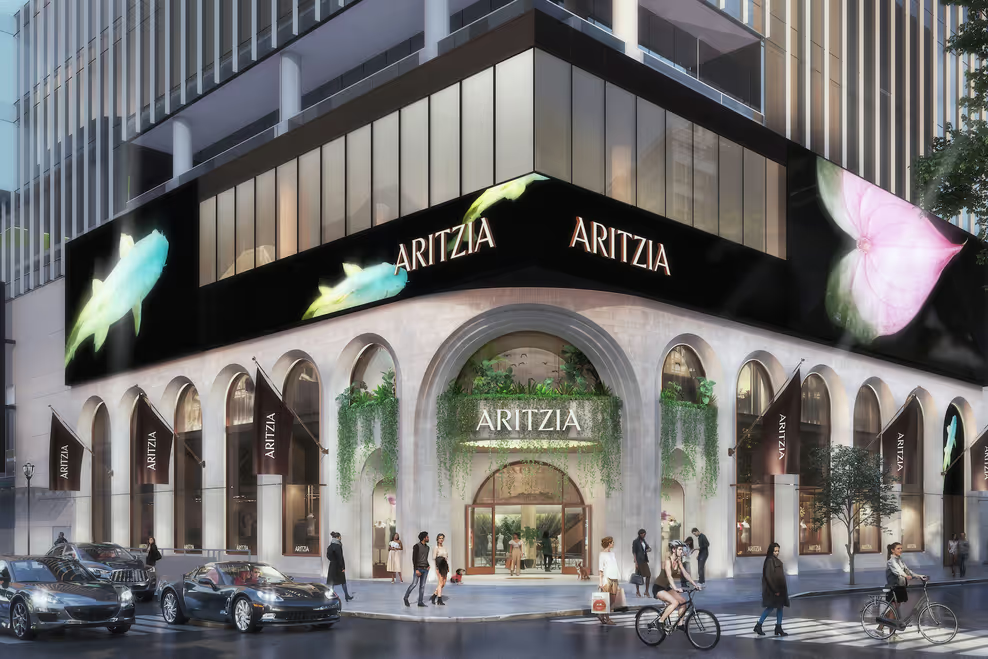
Rendering of the future four-level 41,800 sq ft Aritzia store at Robson and Howe in Vancouver. Rendering: Aritzia

A U.S. Network With Substantial Room to Grow

The repeatable boutique model becomes especially important when viewed against Aritzia’s stated opportunity in the United States.

At the end of Q1, the company had 143 Aritzia boutiques, excluding four Reigning Champ stores. Its investor presentation shows 76 boutiques in the United States and 67 in Canada.

Aritzia already has more boutiques south of the border than in its home country.

Management has also identified an opportunity for more than 180 U.S. locations that meet its criteria.

That figure is not a commitment to open 180 stores and should not be treated as a forecast. Real estate availability, market conditions and execution will determine how much of the opportunity is ultimately pursued, according to the company. Still, the gap between 76 existing U.S. boutiques and an identified opportunity above 180 shows the scale of the runway management believes may remain.

The current opening program is heavily weighted to the United States. Aritzia expects 12 to 13 new boutiques in fiscal 2027, with 11 to 12 south of the border. During the earnings call, management said Q2 openings would take the retailer into Birmingham, New Orleans and St. Louis, each a new market for the company.

Those cities also show the expansion broadening into a wider range of U.S. metropolitan markets.

The physical strategy is developing along two tracks: a scalable boutique model that can be deployed across a growing number of cities, and a selective flagship tier in high-profile urban locations. Both require increasing levels of capital and infrastructure.

The Expansion Is Becoming More Capital Intensive

Aritzia’s financial statements show how quickly the physical program is translating into investment.

During the 13 weeks ended May 31, the company recorded $69.8 million in property and equipment additions, up from $38.2 million a year earlier. The majority related to leasehold improvements at boutiques and distribution centres, along with furniture and equipment for those spaces.

For the full fiscal year, Aritzia expects approximately $250 million in capital cash expenditures, net of proceeds from lease incentives. About $210 million is related to investments in new and repositioned boutiques expected to open in fiscal 2027 and fiscal 2028.

Lease activity has increased as well. Aritzia recorded $74.5 million in additions to right-of-use assets during the quarter, compared with $29.7 million a year earlier. Total lease liabilities stood at approximately $1.08 billion as of May 31.

Those liabilities reflect accounting for contractual lease obligations and should not be equated simplistically with conventional bank debt. They do, however, illustrate the scale of the commitments attached to a growing physical network.

The importance of current store economics rises as those commitments increase. Management is reporting sub-one-year average payback on new boutiques, preserved sales productivity in larger stores and improved maturation among newer U.S. locations.

The challenge will be maintaining those outcomes as Aritzia opens more stores across a broader mix of markets and formats.

Distribution Capacity Behind the Store Growth

The retail expansion is being matched by investment behind the scenes.

In May, Aritzia brought a new 380,000-square-foot distribution centre in British Columbia online. Wong said the facility uses goods-to-person technology designed to reduce pick times and improve order accuracy, and that it ramped over a matter of weeks while maintaining service levels.

Further U.S. capacity lies ahead.

Management said the successful B.C. ramp increased confidence as the company turns toward expansion of its American distribution network. Aritzia’s investor presentation also references a second U.S. distribution centre among future infrastructure investments.

That back-end investment is directly connected to the growth strategy. A larger store network, bigger formats and expansion into new markets increase the complexity of moving and allocating inventory. Digital growth adds another layer of fulfilment demand.

The Challenge Is Shifting to Execution at Scale

For years, a central question around Aritzia was whether a Canadian fashion retailer could translate its success into the United States. The latest disclosures suggest the strategic question is changing.

U.S. revenue increased 54.5% in the first quarter to $638.1 million and represented 67.1% of total company revenue. Aritzia now has more boutiques in the U.S. than Canada, newer American stores are opening closer to maturity, and management has identified an opportunity for more than 180 U.S. locations meeting its criteria.

The challenge increasingly lies in supporting a much larger operation without weakening the execution behind the current economics.

Aritzia must continue securing productive real estate while entering a broader range of markets. It is supporting different physical formats, from 10,000-square-foot boutiques to major urban flagships. Distribution capacity and inventory allocation have to keep pace with both store and digital growth.

The company enters that phase from a strong financial position. At the end of Q1, Aritzia held $471.9 million in cash and had no amounts drawn on its $300 million revolving credit facility.

The latest filings reveal the scale of the task ahead. Aritzia is building a repeatable 10,000-square-foot boutique model while selectively committing to flagships approaching or exceeding 40,000 square feet. It is directing substantial capital toward future stores, adding distribution capacity and, in one newly disclosed case, participating in a property-owning venture tied to a future boutique.

For further insights into Aritzia’s financial performance and future expectations, the company held an earnings call on July 9, with both Wong and CFO Todd Ingledew discussing the results and outlook.

More from Retail Insider:
Knix Founder Joanna Griffiths Steps Down After 14 Years as Nicole Tapscott Takes Leadership

Knix Founder Joanna Griffiths at the Bloor Street Holt Renfrew Knix pop-up, March 2025. Image: Knix/Holt Renfrew

Knix is entering a pivotal moment in its history as founder Joanna Griffiths steps away from the company she launched in Toronto in 2013, handing leadership to veteran consumer brand executive Nicole Tapscott during a period of continued retail expansion in Canada and the United States.

The Globe and Mail first reported Griffiths’ departure. Griffiths later confirmed the news in a post on social media, saying the time felt right to step away after 14 years building Knix and four years leading the business following its acquisition by Swedish health and hygiene company Essity. She said she is looking forward to spending more time with her family while watching the company continue to grow.

Tapscott, Knix’s Chief Commercial Officer, will become President. The appointment suggests a carefully planned succession rather than a shift in strategy. Since joining Knix, Tapscott has taken on an increasingly visible role in the company’s commercial growth, helping lead retail expansion, wholesale partnerships and international development as the brand continues to evolve.

The leadership change closes an important chapter for one of Canada’s most recognizable consumer brands. Griffiths built Knix from a startup into an international business, while Tapscott now assumes responsibility for guiding a company that has grown into a sophisticated omnichannel retailer with global ambitions.

Knix on Queen Street West
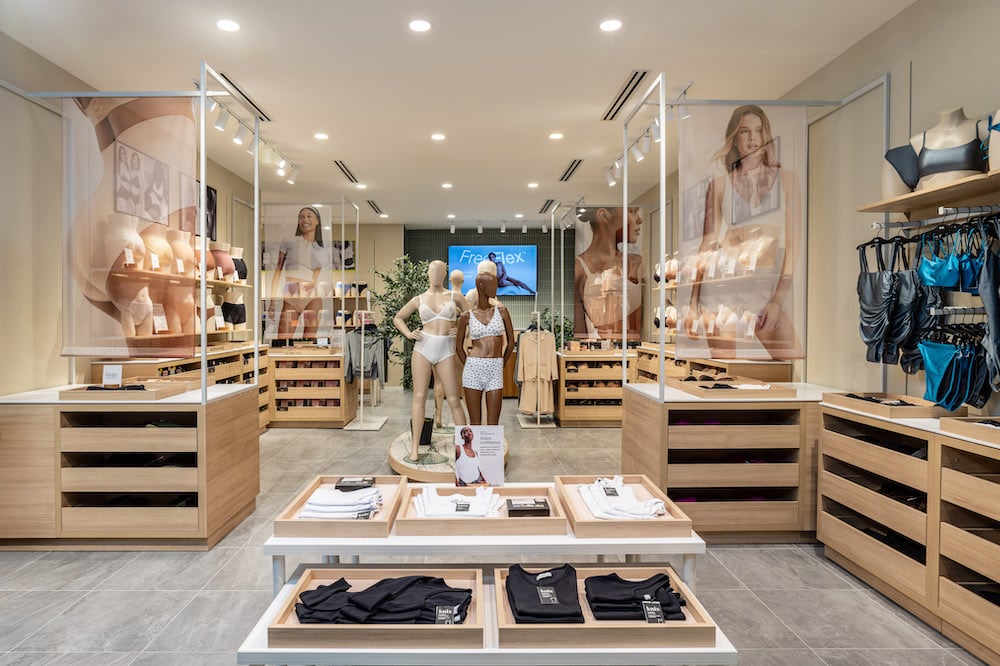
Knix on Queen Street West in Toronto – Photo by Dustin Fuhs

Building a Modern Canadian Retail Brand

When Griffiths founded Knix, she set out to address a gap in the women’s intimates market through products designed around comfort, function and innovation. The company became widely recognized for helping pioneer leakproof underwear while building a brand that encouraged more open conversations around women’s health and everyday needs.

Knix’s growth was driven by more than product innovation. Griffiths cultivated a highly engaged customer community through education, authentic storytelling and direct engagement with consumers, helping establish Knix as one of Canada’s most successful digitally native retail brands.

As the business matured, Knix successfully expanded beyond ecommerce into physical retail, demonstrating that online-first brands could build productive store networks without abandoning their digital strengths. Today, the company operates stores in major Canadian markets and continues to expand its brick-and-mortar presence while maintaining a strong ecommerce business.

That success attracted international attention. In 2022, Essity acquired an 80 per cent stake in Knix in a transaction valuing the company at approximately US$400 million. Griffiths remained as President following the acquisition, providing continuity as the business entered its next stage of growth under global ownership.

Her departure effectively completes that transition, marking the first time the company will operate without its founder leading the organization.

Nicole Tapscott
Nicole Tapscott

An Experienced Successor

Tapscott brings an unusually strong background for the role. Before joining Knix, she helped launch and grow Casper’s Canadian business before moving to Toronto-based jewellery retailer Mejuri, where she served as Chief Marketing Officer during a period of rapid international expansion. Earlier in her career, she worked with the World Economic Forum in Geneva on global engagement initiatives, building experience across digital strategy, brand development and organizational growth.

She joined Knix as Chief Marketing Officer before expanding into the role of Chief Commercial Officer, reflecting her growing responsibilities across marketing, ecommerce, retail operations and commercial strategy.

Retail Insider readers have seen that evolution firsthand. Earlier this year, Tapscott discussed Knix’s partnership with Holt Renfrew, the company’s growing store network and its broader retail strategy as it continued expanding beyond its direct-to-consumer roots.

Her work has also been recognized across the industry. The Association of Canadian Advertisers awarded Tapscott its 2025 Gold Medal for leadership in Canadian marketing, and she has since been recognized by Strategy magazine for her contributions to brand building.

Rather than recruiting an executive from outside the organization, Knix has elevated a leader who has already helped shape many of the initiatives now driving the company’s growth.

The Business She Inherits

Tapscott assumes leadership at a time when Knix continues to expand across multiple channels.

The company has announced plans to grow its Canadian store network to more than 30 locations, including its first Atlantic Canadian store, while continuing to invest in premium shopping destinations. It has also broadened its wholesale strategy through partnerships including Holt Renfrew in Canada while expanding its presence in the United States through company-operated stores and carefully selected retail partners.

The company’s approach illustrates how its strategy has evolved over time. During Knix’s earlier years, Griffiths emphasized direct-to-consumer distribution, allowing the brand to build close relationships with customers while maintaining control over the shopping experience.

Today, Knix continues to prioritize its own stores and ecommerce business, but it is selectively expanding wholesale partnerships from a position of strength. Years of brand building, customer loyalty and operational growth have given the company greater flexibility in deciding where and how consumers encounter the brand.

That measured approach reflects the evolution of a business that is no longer defined by a single sales channel but by an integrated retail ecosystem spanning ecommerce, company-operated stores and wholesale distribution.

Knix at CF Rideau Centre in Ottawa. Photo supplied

Looking Ahead

Leadership transitions are defining moments for founder-led businesses, particularly when the founder has become closely associated with the brand itself.

For Knix, however, the transition appears less about changing direction than ensuring continuity as the company enters a new stage of maturity. Tapscott inherits a business with a loyal customer base, an expanding store network and the backing of a global consumer products company. Her challenge will be to preserve the brand’s distinctive voice while continuing to scale its retail footprint and deepen its presence in international markets.

Griffiths leaves behind one of Canada’s most notable retail success stories of the past decade, having transformed a Toronto startup into a globally recognized brand that reshaped the intimates category. The next phase of Knix’s evolution will be led by an executive who has already helped guide many of the company’s recent strategic decisions, offering continuity as the business continues its expansion.

More from Retail Insider:

MTY Food Group to close 68 of its corporate locations in the coming months

MART PRODUCTION photo

MTY Food Group Inc., one of the largest franchisors and operators of multiple restaurant concepts worldwide, reported Friday its financial results for its 13 week period of 2026 ended May 31, 2026, indicating a decrease in revenue and same store sales as it announced it will be closing 68 of its corporate locations in the coming months.

Following a detailed review of its portfolio, the company said it has made the decision to close 68 of its corporate locations in the coming months, which had combined losses of over $10 million in the last 12 months.

The early termination of the related leases remains to be negotiated with the landlords and can fluctuate depending on the term left of each specific lease and the terms of those leases. The estimated total cost is expected to range between $10 million and $12 million. This will affect free cash flows in the short term, but will help teams focus on healthier, more profitable locations in the future. Estimated completion of all the closures and lease buyout negotiations will take between six and nine months, it explained.

“MTY continues to navigate a dynamic operating environment. The macro-economic conditions continue to create short term headwinds and the Company continues actively implementing a range of strategic initiatives to position the business for growth once the environment improves. These include, and are not limited to, driving menu innovation, leveraging data and AI to improve our understanding of customers and improve communications with existing, lapsed and potential guests, maintaining product quality and consistency, enhancing both online and in-store customer experiences, and reinforcing a strong value proposition across its banners,” it said.

“The pipeline of future locations remains strong as MTY continues to see strong demand for its brands. It anticipates an improvement in the pace of openings in the coming quarters and remains confident in its ability to achieve net location growth in the future.

“Management notes that certain macroeconomic and policy-related uncertainties could affect performance. To date MTY has only seen modest direct impacts from tariffs, and although the exact impact is difficult to measure, the increases in oil and gas prices has undoubtedly affected consumer confidence and spending in restaurants.

“In both Canada and the US, the Company primarily sources products domestically, which helps limit the potential exposure to tariffs. Oil and gas prices may have longer impacts should the war in the Middle East continue primarily impacting supply chain costs and margins for franchisees, corporate stores and the retail segment. Management remains confident in its ability to navigate potential impacts through its strong supply chain and procurement capabilities, strategic menu adjustments, and, when necessary, pricing actions.

“Management expects stability in normalized adjusted EBITDA margins across each of its segments, though the Company may experience some fluctuations in corporate store margins. Overall, management remains confident about its ability to drive margin improvement through positive unit growth, enhanced efficiencies, and an ongoing reduction in the number of less profitable corporate stores.”

Eric Lefebvre
Eric Lefebvre

“Our second quarter results reflected continued pressure on consumer spending and a challenging operating environment,” said Eric Lefebvre, Chief Executive Officer of MTY. “Despite these headwinds, our asset-light and diversified model continued to generate strong free cash flow from operations, and we remained focused on executing against our development pipeline, with positive store openings progressing in line with our plans and a strong slate of openings expected through the balance of the year.”

“We are also taking decisive action to improve the quality and profitability of our corporate store portfolio. Following a detailed store-by-store review, we have made the decision to close 68 underperforming corporate-owned locations over the next nine months. This is a decisive step to address underperforming assets and improve the overall quality of our corporate store portfolio. While this action will reduce our store count in the near term, we believe it will strengthen the business over the long term by reducing losses and allowing us to focus resources on our strongest opportunities. We remain committed to disciplined execution, strong cash generation and creating long-term value for shareholders.”

At the end of the 13 week period, MTY’s network had 7,040 locations in operation, of which 6,808 were franchised or under operator agreements and 232 were corporate-owned. The geographical split among MTY’s locations remained stable year-over-year at 57% in the US, 35% in Canada and 8% International.

During the 13 week period, MTY’s network opened 84 locations (2025 period – 76 locations) and closed 78 others (2025 period – 77 locations), resulting in net positive store growth of 6 locations (2025 period – net decrease of 1 location).

System sales were $1.4 billion in the 13 week period, a decrease of 3.5% compared to the same period in 2025. Excluding the impact of foreign exchange, which accounted for 49% of the decrease, organic system sales decreased 1.7%, with the US in line with the overall figure and Canada down 2.7%, it said.

Same-store sales decreased 2.1% year-over-year in the 13 week period. By region, Canada and the US were relatively similar with decreases of 1.8% and 2.2%, respectively while International experienced a 5.2% decrease.

Digital sales remained resilient in the 13 week period of 2026 at $284.2 million, including the impact of foreign exchange rates, representing 21% of total sales. As a % of total system sales, digital sales remained stable representing 20.7% of system sales compared to 20.8% in prior year.

MART PRODUCTION photo

Company revenue was $279.9 million in the second quarter, a decrease of 8.2% compared to the same period in 2025, primarily attributable to lower revenue from corporate stores, which was tightly correlated to a decrease in the number of corporate-owned locations, as well as lower revenue from turnkey projects and the impacts of foreign exchange, said MTY.

Net income attributable to owners totaled $15.4 million, or $0.67 per share, in the second quarter compared to $57.3 million, or $2.49 per share, for the same period in 2025. The change was primarily due to lower adjusted EBITDA and a stronger Canadian dollar relative to the US dollar which resulted in a loss of $7.6 million in the 13 week period compared to a gain of $35.0 million in the 2025 period. The 2026 period was also impacted by a $7.5 million impairment loss on right-of-use assets, resulting from managements decision to close 68 corporate locations compared to an impairment of $0.2 million in prior year.

Normalized adjusted EBITDA, which excludes acquisition-related expenses and SAP project implementation costs, was $60.2 million, a decrease of $9.8 million compared to 2025. The change was due to reduced profitability from corporate operations mostly in the U.S. and International segment together with lower contributions from franchising operations. These factors reflected continued pressure from commodity and other operating costs, as well as softer consumer spending in certain markets, added the company.

More from Retail Insider:

Montreal-based Richelieu Hardware sees 3.9% sales growth in Q2

Photo- Richelieu
Photo- Richelieu

Montreal-based Richelieu Hardware has reported its financial results for the second quarter ended May 31, with overall sales of $532.1 million, up 3.9% from a year ago.

“Our principal market segments continued to perform well during the second quarter, generating sales growth of 5.5% in Canada and 4.4% (US$) in the United States. Total sales increased by 3.9% to reach $532.1 million; on a constant-currency basis with 2025, this increase would have been 5.0%,” explained Richard Lord, President and Chief Executive Officer.

“In the manufacturers market, where sales totalled $473.7 million, the 3.8% increase was driven equally by internal growth and acquisitions. Sales to hardware retailers and renovation superstores market increased by 4.2% to $58.4 million. 

“We remained focused on our expansion strategy to seize new acquisition opportunities. On May 1, 2026, we acquired Fini U.V. International Inc. (Finium) in Quebec, followed by the acquisitions of Distributions Air-Cube Inc. (Solutions Acoustiques) in the Greater Montreal Area on June 26, 2026 and Winnec Inc. (Winnec) in the Greater Toronto Area on July 8, 2026. These three recent acquisitions represent $27 million in additional annual sales, while bringing valuable market expertise, new customers and future synergies through specialized products that complement our diversified offering. 

“At Richelieu, we continue to differentiate ourselves by offering design and space planning professional products that reflect the latest market trends. The addition of Finium and Solutions Acoustiques strengthens our leadership in decorative and acoustic solutions—two fast-growing market segments—while further expanding our presence among architects and designers across North America. This strategy builds on the recognition we received earlier this year with our Best of KBIS award in the Decorative Hardware category and reflects our commitment to remaining a leader in innovation and product differentiation.

Lord said the current economic environment is also creating attractive acquisition opportunities in its target markets. 

“We continue to evaluate several opportunities and remain well positioned to pursue those that meet our strategic criteria and contribute to our long-term growth,” added Lord. 

Following the acquisition of three McKillican American distribution centres in Oregon and Washington State during the first quarter, Richelieu acquired Finium on May 1, a distributor and manufacturer based in Frampton, Quebec, specializing in premium decorative and acoustic wall covering panels for residential and commercial applications. On June 26, it completed the acquisition of Solutions Acoustiques, which operates in the Greater Montreal Area as a specialized distributor of standard and premium acoustic products recognized for their performance and architectural design. This acquisition was followed by the acquisition of Winnec on July 8, a specialized hardware distributor operating three distribution centres in the Greater Toronto Area. 

Over the coming periods, Richelieu said it will integrate these new operations while continuing to execute its strategy of innovation and expansion across the North American market.

HIGHLIGHTS OF THE SECOND QUARTER ENDED MAY 31, 2026 

  • Sales of $532.1 million, up 3.9%, including $291.1 million in Canada and US$175.5 million in the United States, up 5.5% and 4.4% (US$), respectively; 
  • EBITDA of $56.1 million – EBITDA margin of 10.6%;
  • Net earnings attributable to shareholders of $23.2 million, or $0.42 per diluted share;
  • Adjusted cash flows from operating activities of $47.9 million, or $0.87 per diluted share;
  • Expansion: 1 acquisition (QC) on May 1, 2026, and 2 new acquisitions completed on June 26 and July 8, 2026 (QC and ON), adding $27 million in annual sales. 

FIRST-HALF

  •  Sales of $995.6 million, up 4.4%, including $540.9 million in Canada and US$331.1 million in the United States, up 4.5 % and 7.5 % (US$) respectively;
  • EBITDA of $99.4 million – EBITDA margin of 10.0%;
  • Net earnings attributable to shareholders of $37.6 million, or $0.68 per diluted share;
  • Adjusted cash flows from operating activities of $85.8 million, or $1.56 per diluted share;
  • Strong financial position as at May 31, 2026, with working capital of $629.5 million (ratio of 3.0:1)
  • Quarterly dividend of $0.1566 per share payable on August 7, 2026, to shareholders registered as of July 23, 2026. 

More from Retail Insider:
Costco Canada Sales Growth Moderates as Warehouse Expansion Continues

Image: Costco Canada

Costco’s Canadian sales continued to grow in June, although at a more moderate pace following several months of unusually strong gains for the warehouse retailer.

Comparable sales in Canada increased 3.7 per cent during the five-week period ending July 5, 2026. When the effects of gasoline prices and foreign exchange are removed, Canadian comparable sales rose 4.9 per cent, indicating that underlying demand remained healthy despite a noticeable deceleration from earlier in the fiscal year.

The latest results arrive as Costco undertakes a significant expansion of its Canadian warehouse network. Retail Insider recently reported on a series of new locations planned or under development across the country, including warehouses serving rapidly growing suburban communities and markets where existing stores are experiencing capacity pressures.

Together, the sales and real estate activity offer a broader picture of Costco’s Canadian strategy. Growth may be settling into a more sustainable range after an exceptionally strong period, but the company continues to generate enough momentum to support substantial long-term investment in the market.

Canadian Growth Returns to a More Moderate Pace

Costco’s June performance was considerably softer than the double-digit reported comparable sales increases recorded in Canada during several earlier periods.

Canadian comparable sales rose 10.7 per cent during Costco’s fiscal third quarter, or 6.2 per cent after adjusting for gasoline prices and foreign exchange. April comparable sales increased 11.5 per cent as reported and 7.6 per cent on an adjusted basis.

June’s 3.7 per cent reported increase therefore represents a clear moderation. However, the monthly result does not necessarily point to a significant deterioration in Costco’s Canadian business.

For the first 44 weeks of fiscal 2026, Canadian comparable sales remained 8.5 per cent above the previous year. Adjusted comparable sales were up 7.2 per cent over the same period, providing a more representative view of Costco’s performance than a single five-week reporting window.

The figures suggest Costco continues to attract additional spending from Canadian members, even as the extraordinary growth recorded earlier in the year begins to normalize.

Foreign exchange also weighed heavily on the reported result. Costco said currency movements reduced Canadian comparable sales by approximately three percentage points in June. Higher gasoline prices offset part of that pressure, which helps explain why the reported and adjusted figures were separated by 1.2 percentage points rather than the full currency impact.

The adjusted result of 4.9 per cent is therefore the more useful indication of activity within Costco’s Canadian warehouses.

Expansion Plans Signal Confidence in Canada

Costco currently operates 115 warehouses in Canada and has been advancing one of its most active development pipelines in years.

Retail Insider recently identified numerous traditional warehouse projects that are planned, under construction or preparing to open across several provinces. The activity includes stores in expanding metropolitan areas, secondary markets and communities where Costco appears to see room for additional capacity.

The development strategy is notable because new Costco warehouses require large sites, substantial capital investment and a sufficiently broad trade area to support the company’s high-volume operating model. The retailer must also be confident that a new location can attract enough members and sales without excessively weakening nearby warehouses.

Costco said cannibalization reduced company-wide comparable sales by approximately half a percentage point in June, illustrating one of the considerations involved as the chain adds locations. The company did not provide a separate cannibalization figure for Canada.

In some Canadian markets, a new warehouse can relieve pressure on an existing high-volume store while creating a more convenient option for members who previously travelled considerable distances. Costco can therefore expand its reach while improving the shopping experience within established markets.

The sustained Canadian sales gains recorded during fiscal 2026 provide a supportive backdrop for that investment. Even after June’s moderation, Costco is expanding from a position of strength.

Value Proposition Remains Central to Costco’s Performance

Costco’s resilience reflects a retail model that is particularly well suited to an environment in which households remain concerned about affordability.

The company’s membership structure creates recurring fee revenue while encouraging shoppers to consolidate purchases and visit regularly. Its limited product assortment allows Costco to buy large quantities from suppliers, maintain rapid inventory turnover and concentrate sales within a relatively small number of items compared with a conventional supermarket or mass merchant.

This operating model supports Costco’s reputation for value while helping the retailer maintain a distinctive mix of groceries, general merchandise and seasonal products.

Kirkland Signature is also an important competitive advantage. Costco’s private-label assortment spans food, household products, apparel, health products and other categories, giving the retailer greater control over product specifications and pricing.

For consumers, Kirkland Signature can provide an alternative to higher-priced national brands while carrying Costco’s implicit endorsement of the product. For the retailer, it strengthens differentiation because many of the items cannot be purchased from a competing supermarket, warehouse club or mass merchant.

That combination of value, quality and exclusivity can be especially effective when consumers are scrutinizing household expenses but remain reluctant to compromise on product quality.

Costco also attracts a broader customer base than retailers positioned strictly around discount pricing. Its warehouses serve value-conscious families, small businesses and relatively affluent households, allowing the company to participate in essential spending while also generating sales from discretionary categories.

Food and Essential Categories Support Traffic

Costco did not disclose Canadian sales by merchandise category in its June update, meaning company-wide category results should not be treated as a precise description of Canadian purchasing patterns.

Globally, however, food and sundries posted low- to mid-single-digit comparable sales growth, with food, candy and frozen products among the stronger departments. Fresh food sales increased in the mid-single digits, led by bakery and meat.

Non-food comparable sales were positive in the mid- to high-single-digit range, with jewelry, home furnishings and major appliances among the better-performing areas.

Ancillary businesses recorded growth in the high-20-per-cent range, supported by gasoline, pharmacy and hearing aids. Gasoline sales were influenced heavily by higher prices, with the average worldwide selling price per gallon up 22.4 per cent from the previous year.

Digitally enabled comparable sales rose 20.9 per cent globally, or 21.5 per cent after adjusting for currency. Although Costco remains overwhelmingly centred on physical warehouses, the digital result shows that online channels are becoming a larger complement to the in-store business.

Total company net sales reached US$29.24 billion for the five-week June period, an increase of 10.6 per cent from US$26.44 billion a year earlier.

Costco Adds Pressure to Canada’s Grocery Market

Costco’s continued growth has implications for Canada’s major grocery and mass-market retailers.

The company competes for a substantial share of household spending across food, pharmacy, household necessities, apparel, electronics, furniture and other categories. A member visiting Costco for groceries may also purchase products that would otherwise have been bought from a supermarket, drugstore, department store, home furnishings retailer or general merchandise chain.

Its expansion therefore adds capacity to several retail categories at once.

Costco’s scale also allows the company to sharpen consumers’ expectations around unit pricing and private-label quality. While package sizes and upfront basket costs may be higher, members frequently assess value based on the cost per unit and the perceived quality of the merchandise.

That dynamic can place pressure on conventional retailers whose customers increasingly compare prices across channels and divide spending among supermarkets, discount stores, warehouse clubs and online platforms.

Canada’s concentrated grocery market makes Costco’s position particularly significant. Although it operates fewer locations than the country’s largest supermarket groups, each warehouse can draw from an extensive geographic area and generate substantial sales volumes.

The retailer’s growing store network will make Costco more accessible to additional households while increasing competition for grocery spending in the communities it enters.

A Stronger Measure Is the Longer-Term Trend

June’s results show that Costco Canada is no longer growing at the extraordinary reported rates seen earlier in fiscal 2026. That moderation is worth noting, particularly if it continues through subsequent reporting periods.

It would be premature, however, to view one month of slower growth as evidence of a meaningful weakening in the business.

Adjusted Canadian comparable sales still increased 4.9 per cent in June, while the first 44 weeks of the fiscal year produced adjusted growth of 7.2 per cent. Those are substantial gains for a mature retailer operating an established network of more than 100 Canadian warehouses.

The company’s expansion plans provide another indication of its long-term outlook. Costco is committing capital to additional locations at a time when many retailers remain selective about physical growth and consumers continue to manage elevated household costs.

June may mark a return to more typical growth following an exceptional start to the year. Costco’s broader Canadian trajectory, however, remains firmly positive as the retailer builds additional capacity and seeks a larger share of consumer spending across the country.

More from Retail Insider:

Daily Synopsis: Jul 9, 2026

Welcome to the Daily Synopsis by Retail Insider. We hope you enjoy the articles we published today covering key developments in Canadian retail.

7-Eleven Canada expanded the Slurpee brand to celebrate its 60th anniversary with new packaged sodas, confections, and promotional events aimed at driving traffic. Vestis Fashion Group returned to Oakridge Park in Vancouver with Max Mara boutiques, reinforcing luxury retail growth. Joseph Tassoni returns to The Well in Toronto with his “Natural Authority” fashion experience, blending sustainability, art, and community. Winners/HomeSense announced its first Fort McMurray store near the new Walmart Supercentre at Parsons Creek Town Centre. Dollarama is shifting focus from store expansion toward convenience-driven locations and consumables growth, especially in Western Canada.

Retail Insider also published updates on Aritzia, which reported a 43.4% increase in Q1 fiscal 2027 net revenue fueled by strong U.S. and digital sales. Honestly Good Chicken Fingers appointed Naomi Kempkes as President to lead Canadian and U.S. expansion. KITS Eyecare achieved record revenue in Q2 2026 led by glasses sales. Additionally, D Spot Dessert Café opened its first U.S. location in Dallas and industry findings showed appliance customers prefer reliability over smart features.

🗞️ The Day’s Retail Insider Article List

🌐 Canadian Retail News From Around the Web will return on Monday. Have an excellent weekend.

Q2 2026 Consumer Behavior and Retail Economy: A Market Increasingly Divided

As part of Retail Insider Reports, this Q2 2026 Consumer Behavior and Retail Economy Report draws on Retail Insider reporting, public company disclosures, and broader economic research, this report identifies the developments and market dynamics most relevant to Canadian retail decision-makers. The full report series is available through the Report Hub.

This report examines Canada’s retail sectors of:

  • Consumer Behavior: includes shopping habits, spending priorities, demographics, loyalty, purchasing decisions, and evolving customer expectations; and
  • Retail Economy: includes retail sales, inflation, employment, consumer confidence, interest rates, tariffs, trade, and other economic indicators.

*****

Canadian retail in Q2 2026 continued to navigate an environment shaped by consumer caution, affordability pressures, and structural shifts in retail real estate and spending patterns.

The Canadian consumer has not stopped spending. Instead, spending has become more selective and more polarized.

Consumers continue to prioritize essentials, seek value, and carefully evaluate discretionary purchases. At the same time, premium consumers and prime retail locations continue to demonstrate resilience, creating a market that is increasingly divided between winners and losers.

This widening divide can be seen across multiple dimensions of Canadian retail. The gap between value and premium continues to expand, the gap between top-performing shopping centres and underperforming assets continues to widen, and spending patterns increasingly vary by income level and category.

The result is a Canadian retail landscape that increasingly resembles a K-shaped economy, where value and premium segments continue to perform relatively well while the middle of the market faces mounting pressure.

Market Context: Affordability Becomes the Defining Consumer Issue

Although inflation has moderated from its peak levels, affordability remains one of the defining issues facing Canadian consumers.

Higher housing costs, elevated food prices, and persistent economic uncertainty continue to shape purchasing decisions. Retail sales remain mixed, with headline growth masking weakness in several discretionary categories.

Consumers have become more deliberate in their spending behaviour. Many households are delaying larger purchases, seeking promotions, trading down in certain categories, and prioritizing essentials over discretionary items.

At the same time, higher-income consumers remain comparatively resilient and continue to spend on experiences, travel, premium products, and luxury goods. This divergence increasingly defines the Canadian retail economy.

Broad Overall Themes

Canadian retail in Q2 2026 reflected several interconnected themes:

  • Consumer spending remains cautious and increasingly value-driven.
  • Affordability pressures continue to reshape purchasing decisions.
  • The retail market is becoming more polarized between value and premium segments.
  • Retail real estate performance continues to diverge between dominant and secondary assets.
  • Experience-led and food-focused retail formats remain areas of relative strength.
  • International retail expansion continues to concentrate in Canada’s prime urban nodes.
  • Labour, trust, and policy challenges continue to create operational pressures.
Consumer Caution and Value Prioritization Continue

Canadian consumers remain cautious and selective.

Research released during the quarter showed weakening intentions to spend on discretionary categories such as apparel and furniture, while value-oriented categories remained comparatively resilient.

This cautious behaviour is not affecting all consumers equally. Lower-income households continue to face the greatest financial pressure, while middle-income consumers increasingly feel squeezed by higher living costs and elevated housing expenses.

At the same time, value retail continues to broaden its appeal. Dollar stores, discount grocery formats, off-price retailers such as TJX banners, and even the renewed ambitions of Zellers increasingly appeal to consumers across income groups, suggesting that value-seeking behaviour has become mainstream rather than a niche response to economic stress.

Large-scale loyalty programs and digital ecosystems are reinforcing this trend by helping consumers maximize value and optimize spending.

The resilience of discount and off-price retailers further suggests that value is becoming a structural consumer preference rather than merely a temporary response to inflation.

Canadian consumers are not necessarily spending less—they are increasingly spending differently.

Affordability Pressures and Food Inflation Continue to Shape Behaviour

Food affordability remains one of the most significant pressures facing Canadian households.

Although overall inflation has moderated, food prices continue to rise faster than many consumers would prefer, and affordability concerns remain deeply embedded in consumer sentiment.

This dynamic is contributing to increasing market segmentation. Many households continue to trade down in quality, reduce discretionary food purchases, and seek private-label alternatives, while higher-income consumers remain more willing to spend on premium and convenience-oriented products.

The result is a grocery market that increasingly reflects Canada’s widening economic divide.

Retailers continue to respond through discount expansion, loyalty initiatives, and efforts to improve operational efficiency. The Grocery Code of Conduct and broader discussions around competition policy and internal trade barriers also reflect growing interest in improving affordability and market function.

Retail Real Estate Polarization Continues to Intensify

One of the most pronounced developments in Canadian retail remains the growing divide between dominant and secondary retail assets.

Top-tier shopping centres such as Yorkdale Shopping Centre, CF Toronto Eaton Centre, and CF Pacific Centre continue to generate exceptionally strong sales productivity, maintain high occupancy levels, and attract premium tenants and international brands.

At the same time, many mid-tier malls continue to face redevelopment challenges, rising vacancies, and increasing competitive pressure. The gap between the strongest and weakest retail assets continues to widen.

Recent commentary from major landlords, including Primaris REIT and Choice Properties, further suggests that significant value remains embedded within Canada’s strongest urban retail portfolios despite near-term market challenges.

Meanwhile, former Hudson’s Bay locations, property-control issues, and redevelopment constraints continue to shape the long-term evolution of Canadian retail real estate by influencing where investment, redevelopment, and competitive opportunities can emerge.

The polarization of Canadian retail real estate increasingly appears to be structural rather than cyclical.

Experience-Led and Food-Focused Retail Continue to Gain Momentum

Despite consumer caution, certain categories continue to demonstrate resilience.

Food, fitness, entertainment, and experience-led concepts remain among the most active leasing categories in major urban markets.

Toronto’s retail leasing market increasingly reflects demand for food-led, convenience-oriented, and social concepts that encourage visitation and repeat engagement.

Emerging concepts such as book bars, romance-focused bookstores, interactive retail concepts, and social gathering places suggest that consumers continue to seek experiences that extend beyond traditional transactions.

Retailers increasingly recognize that physical spaces must offer consumers reasons to visit that go beyond merchandise alone.

Experience-led retail should not be overstated as a universal solution. However, carefully curated concepts that combine convenience, food, social interaction, and entertainment continue to demonstrate meaningful demand in dense urban environments.

International Retail Expansion Remains Highly Concentrated

International retailers continue to view Canada as an attractive market, but expansion remains highly concentrated in Toronto’s prime retail nodes.

The majority of recent international entrants have selected Toronto for their first Canadian locations, with Yorkdale Shopping Centre and the Bloor-Yorkville corridor continuing to attract outsized attention.

Luxury and experiential brands dominate many of these entries, reinforcing the strength of Canada’s leading urban retail markets while simultaneously widening the gap between prime and secondary locations.

The continued concentration of luxury investment in Toronto’s prime retail corridors suggests that premium demand remains healthy but increasingly focused on a limited number of high-performing markets.

Luxury demand remains sensitive to currency movements, tourism patterns, and broader geopolitical uncertainty. However, Canada’s top luxury corridors continue to attract investment and remain among the country’s strongest retail environments.

The Canadian retail landscape is increasingly characterized by concentration rather than broad-based expansion.

Labour, Trust, and Policy Challenges Persist

Operational challenges remain significant for many retailers.

Labour shortages continue to affect foodservice operators, particularly in rural markets and smaller communities where staffing challenges can limit operating hours and growth opportunities.

At the same time, consumer trust is emerging as an increasingly important issue. Concerns around fake online reviews, AI-generated content, food fraud, and transparency continue to raise questions about authenticity and confidence in the marketplace.

Retailers that invest in trust-building initiatives, verified reviews, and credible consumer engagement may be better positioned to strengthen customer relationships and protect brand equity.

Broader policy issues—including affordability measures, labour policy, competition enforcement, regulatory reform, and ongoing discussions around internal trade barriers—will continue to influence the operating environment for Canadian retailers.

Editor’s Take

Q2 2026 Canadian retail was increasingly defined by a widening divide.

Consumer caution remains widespread, yet spending has not collapsed. Instead, purchasing behaviour has become more selective and segmented.

Retailers focused on value, convenience, essentials, and loyalty ecosystems remain well positioned to capture resilient demand. At the same time, premium concepts and prime urban retail nodes continue to outperform, benefiting from affluent consumers, international investment, and strong market fundamentals.

The middle of the market appears increasingly challenged. Middle-income households face affordability pressures, many discretionary categories remain under pressure, and secondary retail assets continue to struggle with redevelopment challenges and changing consumer preferences.

Experience-led and food-focused retail concepts demonstrate that consumers remain willing to spend on experiences that offer convenience, community, and social engagement.

At the same time, affordability concerns, labour shortages, and growing questions around trust and transparency continue to create uncertainty and operational complexity.

The next phase of Canadian retail may be defined less by broad market growth and more by how effectively retailers position themselves within an increasingly divided marketplace.

The market is increasingly splitting between operators that can deliver value, convenience, trust, and experience at scale and those exposed to structural real estate challenges and weakening discretionary demand.

Representative Articles

Q2 2026 Convenience Retail: Food-Led Formats and Digital Loyalty Redefine the Channel

As part of Retail Insider Reports, this Q2 2026 Convenience Retail Report covers Q2 2026 developments in the Canadian convenience retail sector. Drawing on Retail Insider’s coverage, company disclosures, and broader market research, it identifies the key market dynamics, trends, and commercial implications shaping the sector. The full report series is available through the Report Hub.

This report examines Canadian convenience retail, including convenience stores, fuel retailers, grab-and-go foodservice, neighbourhood retail, tobacco alternatives, beverages, and related convenience formats.

*****

Canadian convenience retail entered Q2 2026 in a period of meaningful transformation. Long anchored by fuel and tobacco, the sector is becoming more food-led, digitally connected, and loyalty-driven as operators look for new growth engines and more resilient store economics.

The Canadian convenience store industry now represents an estimated $11.3 billion market, with more than 7,500 stores operating nationwide. Convenience stores are also expected to contribute more than $4 billion to Canada’s foodservice industry in 2026, underscoring the growing importance of prepared foods, beverages, and meal occasions to the channel.

The shift is not about abandoning fuel. Fuel remains a critical traffic and profitability driver. The bigger change is that leading operators are layering foodservice, beverages, loyalty, digital tools, and more modern store formats onto that core business.

Canadian convenience retail is beginning to look less like a traditional fuel-and-tobacco channel and more like a hybrid of convenience store, quick-service restaurant, small-format grocer, and digital loyalty platform.

Market Context: Convenience Remains Resilient

The Canadian convenience industry remains resilient, but its growth profile is changing.

Statistics Canada data showed gasoline stations and fuel vendors remained among the stronger contributors to retail growth in recent months, with gasoline station sales rising 12.4 per cent month over month in March, driven largely by higher prices. That reinforces the continued importance of fuel to the sector’s economics.

Foodservice is becoming a more important growth lever. Convenience stores’ contribution to Canada’s foodservice industry is expected to surpass $4 billion in 2026, with growth moving beyond snacks and packaged beverages into breakfast, lunch, dinner, coffee, and grab-and-go meal occasions.

The sector’s challenge is not declining relevance. Rather, it is evolving from a legacy model built around fuel, tobacco, and packaged goods into a broader daily-needs platform capable of serving consumers at multiple points throughout the day.

Broad Overall Themes

Canadian convenience retail in Q2 2026 was shaped by several interconnected trends. Food-forward formats continued to reshape store economics as operators invested in prepared meals, coffee programs, and grab-and-go offerings. Convenience stores also expanded their role as neighbourhood food destinations, capturing more meal occasions and grocery top-up trips.

Digital loyalty became more sophisticated, moving beyond simple rewards programs toward platforms built around personalization, payments, and customer engagement. Beverage innovation emerged as another key growth driver, while network optimization and store modernization gained importance as operators adapted to changing consumer habits and declining tobacco sales.

Fuel remained a foundational part of the business, but increasingly as the starting point for broader customer relationships rather than the sole driver of profitability.

Retail Insider Coverage

Food-Led Formats Are Reshaping Store Economics

Foodservice has become one of the most important growth drivers in convenience retail.

Retailers are investing in fresh food, prepared meals, grab-and-go products, coffee, and meal bundles to capture a larger share of daily consumer spending. These investments are pushing convenience stores closer to quick-service restaurants and small-format food retailers.

The shift was visible in 7-Eleven’s broader move toward food-forward formats. The company announced the closure of 645 stores as part of a strategy to move away from smaller, tobacco-dependent locations and toward larger, more food-led stores. That decision illustrates how difficult it can be to retrofit older convenience formats for a market where prepared food, fresh offerings, and stronger store economics matter more.

Circle K is also pushing further into foodservice. Couche-Tard has outlined plans to open 750 new stores by 2030, with foodservice and loyalty playing central roles in the strategy. In Canada, meal bundles already account for a meaningful share of Circle K’s food sales, pointing to the growing importance of value-oriented food offers in the convenience channel.

The broader story is clear: convenience stores are increasingly competing for meal occasions. Coffee, breakfast, lunch, dinner, snacks, and beverages are becoming part of a more complete daily-use proposition.

Convenience Stores Are Becoming Neighbourhood Food Destinations

The role of the convenience store is expanding.

A modern convenience store can still be a place to buy fuel, tobacco, lottery products, and packaged snacks. Increasingly, however, leading operators are designing stores around more frequent consumer needs: a morning coffee, lunch on the go, a quick dinner solution, a cold drink, or a grocery top-up trip.

This gives the channel a broader role in local communities. Convenience stores are not full grocery stores, and they are not traditional restaurants. They are becoming increasingly competitive in the space between the two.

That positioning matters because consumers continue to value speed, proximity, and convenience. Operators that can capture multiple visits across the day will have more resilient traffic and more diversified revenue streams.

Beverage Innovation Becomes a Growth Driver

Beverages remain one of the most important categories in convenience retail, and the channel is becoming increasingly attractive for emerging and differentiated brands.

Retail Insider’s coverage of Jones Soda’s expansion into approximately 700 additional Circle K stores in Eastern Canada demonstrates how convenience retail can become a platform for brand discovery. The expansion increased Jones Soda’s Canadian footprint by approximately 75 per cent year over year and included frozen and fountain beverage offerings.

That matters because it shows convenience retail is not simply a distribution channel. It can also be a testing ground for differentiated beverages, limited-time products, fountain innovation, and impulse-driven formats.

For retailers, stronger beverage assortments can create traffic, support margins, and encourage repeat visits. For brands, convenience stores offer broad reach and immediate-consumption occasions that are difficult to replicate elsewhere.

Digital Loyalty Programs Become Operating Systems

Loyalty programs are becoming more strategic in convenience retail.

Scene+’s expansion to Shell Canada locations nationwide is a clear example of fuel and convenience purchases being integrated into broader loyalty ecosystems. Customers can earn and redeem rewards through everyday fuel and in-store purchases, making convenience retail part of a larger household value proposition.

Cascadia Liquor’s The Den Rewards also points to a more experiential version of loyalty. The program combines points with app-enabled ordering, tastings, masterclasses, and customer engagement tools. While Cascadia is not a traditional convenience chain, the model illustrates where loyalty is heading: beyond discounts and toward a fuller relationship with the customer.

For convenience operators, loyalty now touches personalization, payment, targeted offers, customer data, digital ordering, and retention. The strongest programs are becoming operating systems that help retailers understand customers and encourage repeat visits.

Tobacco Decline Accelerates Transformation

Tobacco decline remains one of the most important forces reshaping convenience retail.

Industry data indicates tobacco sales have fallen approximately 26 per cent since 2019. That decline is pressuring older convenience formats that were built around tobacco, packaged goods, and quick fuel-adjacent transactions.

The shift toward foodservice, beverages, loyalty, and store modernization is partly a response to that decline. Retailers are pursuing new categories because they see growth opportunities, but also because they need to replace a traditional profit engine that has become structurally challenged.

This helps explain why operators are becoming more disciplined about their networks. Stores that cannot support foodservice, digital engagement, modern merchandising, or stronger customer missions are increasingly vulnerable to closure, conversion, or repositioning.

Network Optimization Separates Modern Formats from Legacy Stores

The convenience industry is not expanding in a simple straight line.

Operators are investing in modern stores while pruning older and less productive locations. That two-track strategy is becoming increasingly important as the sector shifts toward food-led formats and stronger digital engagement.

7-Eleven’s closure program reflects the challenge facing legacy stores that are too small, too tobacco-dependent, or poorly suited to fresh food and modern customer expectations.

Couche-Tard’s strategy points in the other direction: expansion, rebuilds, relocations, and modernized stores designed around foodservice, beverages, fuel, and loyalty. The company has also reported strong Canadian performance, supported by fuel execution and market share gains, even as tobacco remains a headwind.

The lesson is that convenience retail success is increasingly about the quality of the network rather than the size of the network alone.

Fuel Remains Critical

Fuel remains central to the economics of convenience retail.

Gasoline continues to drive traffic and profitability, and it will likely remain essential for many operators for years. The more important change is that fuel visits are becoming opportunities to sell more than fuel.

The strongest convenience operators are layering food, beverages, loyalty, and digital engagement onto fuel trips. A customer who stops for gas may also buy coffee, a meal bundle, a cold beverage, or a grocery top-up item while earning rewards through a loyalty program.

The next phase of the sector will not be defined by abandoning fuel. It will be defined by turning fuel visits into broader convenience occasions.

Broader Industry Coverage

Digital Payments and Mobile Engagement Continue to Gain Importance

Digital payments and mobile engagement are becoming increasingly important to the convenience channel.

For retailers, digital tools support faster transactions, loyalty participation, personalized offers, and customer retention. They also provide better insight into purchasing behaviour across fuel, food, beverages, and in-store categories.

As the channel becomes more food-led and loyalty-driven, digital infrastructure will become more central to execution. Convenience retail has always been about speed. The next phase will require speed combined with data, personalization, and seamless engagement across channels.

Competition Continues to Expand

Convenience retailers increasingly compete with a wider range of operators.

A modern convenience store can compete with quick-service restaurants for meal occasions, coffee chains for morning traffic, grocers for top-up trips, and beverage retailers for impulse and immediate-consumption purchases.

That broadening competitive set increases the importance of execution. Food quality, beverage assortment, pricing, loyalty, cleanliness, speed, and store location all matter.

Convenience retail is still about convenience, but the definition of convenience is expanding.

Editor’s Take

Q2 2026 shows Canadian convenience retail entering a new phase.

Fuel remains important, and the sector is not moving away from fuel as a core traffic driver. However, fuel and tobacco are no longer enough to define the future of the channel.

The most important shift is the rise of a more diversified convenience model built around foodservice, beverages, loyalty, digital engagement, and stronger store networks.

The 7-Eleven closure plan illustrates the pressure facing older, tobacco-dependent formats. Circle K’s expansion strategy shows the other side of the market: larger, more modern stores built around food, beverages, fuel, and loyalty. Jones Soda’s Circle K expansion demonstrates the growing importance of convenience as a beverage innovation channel, while Scene+ and Cascadia show how loyalty is becoming a more sophisticated engagement tool.

The strongest operators are increasingly monetizing multiple customer occasions throughout the day. A single store can serve a morning coffee trip, a lunch visit, an afternoon beverage stop, a fuel purchase, a quick dinner solution, and a grocery top-up mission.

That is the real transformation. Canadian convenience retail is becoming more than a place for fuel and packaged goods. It is evolving into a broader daily-use platform that serves consumers across multiple needs and occasions.

Looking ahead, the key questions will be how quickly foodservice can scale profitably, whether loyalty programs can meaningfully change customer behaviour, how operators replace declining tobacco revenue, and which store formats can support the next generation of convenience retail.

The winners will likely be those that use fuel traffic as a foundation while building stronger food, beverage, loyalty, and digital ecosystems around it.

Representative Articles

Q2 2026 Canadian Discount, Value and Off-Price Retail: Shape of the Next Phase of Canadian Retail

As part of Retail Insider Reports, this Q2 2026 Discount, Value and Off-Price Retail Trends Report covers Q2 2026 Canadian value retail trends. Drawing on Retail Insider coverage, company announcements, industry research, and broader market context, it identifies the key dynamics shaping discount retail, grocery, off-price expansion, and value-driven consumer behaviour in Canada. The full report series is available through the Report Hub.

This report examines Canada’s retail market segments of:

  • Discount retail: includes retailers built around explicit low-price positioning, simplified operations, limited-service formats, and aggressive value propositions;
  • Value retail: includes retailers competing through affordability, everyday value, efficient operations, and strong price-to-quality positioning for cost-conscious consumers; and
  • Off-Price retail: includes retailers selling branded merchandise below traditional retail pricing through closeouts, excess inventory, opportunistic buying, and treasure-hunt merchandising.

*****

Canadian value retail entered a new phase in Q2 2026.

Discount retail is no longer a niche segment serving financially constrained consumers. It has become a mainstream retail force influencing where Canadians shop, how retailers expand, and the types of tenants landlords increasingly seek to attract.

No retailer better illustrates this shift than Dollarama, which now reaches nearly every Canadian household and has become one of the country’s most influential retailers.

Although inflation has moderated from recent peaks, many Canadians remain highly selective with their spending. Seeking value has become increasingly normalized across income levels, with consumers often blending premium purchases and discount shopping within the same trip or broader shopping journey.

Importantly, many shopping behaviours that emerged during the inflationary period now appear to be becoming permanent.

The quarter saw major growth from Dollarama, continued momentum in discount grocery, expansion by off-price retailers, and increasing evidence that affordability-focused formats are helping reshape retail real estate strategies across the country.

These developments point to a broader shift: value is no longer simply a price point. It is increasingly becoming one of the defining forces shaping Canadian retail strategy.

Market Context: Value Shopping Becomes Mainstream

Canadian consumers remain cautious despite some improvement in inflation and interest rate expectations.

Statistics Canada data showed that retail spending remained uneven during the quarter, reinforcing the idea that consumers continue to prioritize affordability and carefully manage discretionary spending.

At the same time, value shopping has become normalized.

Discount retail now serves consumers across virtually all demographic groups. Higher-income households continue to seek deals and convenience, while middle-income consumers have become increasingly comfortable mixing premium purchases with lower-cost shopping.

Seeking value is increasingly viewed as a smart shopping behaviour rather than a financial necessity.

This represents an important shift in Canadian retail. Consumers are not only looking for the lowest price. They are looking for practical value, convenience, private label, discovery, recognizable brands at reduced prices, and affordable small indulgences.

Consumers increasingly expect low prices to be paired with convenience, design, discovery, and enjoyable shopping environments.

For many Canadians, dollar stores have evolved from occasional bargain destinations into regular shopping stops for everyday needs.

The result is a retail environment where value-oriented operators are increasingly influencing broader industry strategies.

Broad Overall Themes

Canadian value retail in Q2 2026 reflected several interconnected themes.

  • Value shopping has become increasingly mainstream across income levels.
  • Dollarama has become the clearest example of value retail’s move into the centre of Canadian consumer behaviour.
  • Discount grocery has become a core competitive battleground.
  • Off-price retail continues to win by combining affordability with branded merchandise and treasure-hunt discovery.
  • Affordable discovery concepts such as Flying Tiger and MINISO are adding novelty, design, and experience to the value retail landscape.
  • Value-oriented retailers are increasingly influencing real estate decisions and backfilling large-format vacancies.
  • Private label and trading-down behaviours remain important.
  • International retailers continue to see opportunity in Canada’s value segment.
  • Regional and community-based retailers continue to play a meaningful role in the retail landscape.
Dollarama Becomes the Face of Mainstream Value Retail

No retailer better illustrates the mainstreaming of value retail than Dollarama.

The Montreal-based chain surpassed 1,700 stores during the quarter and reported more than $1.8 billion in quarterly sales, reinforcing its position as one of Canada’s most important retailers.

Equally notable is the breadth of its customer base. Dollarama reaches approximately 96 per cent of Canadian households, demonstrating that value retail now appeals to consumers across virtually all income groups.

Dollarama’s continued growth reflects several broader trends.

Consumers increasingly appreciate convenience and everyday low prices. Suppliers increasingly recognize the chain’s scale and influence. Landlords value the traffic, frequency, and stability the company generates.

The company has evolved well beyond its origins as a traditional dollar store. It has become a household replenishment destination, a seasonal-shopping destination, an impulse destination, and a convenience stop for millions of Canadians.

As assortments expand, dollar stores increasingly function as neighbourhood convenience retailers for many consumers.

That matters because Dollarama’s success is changing how suppliers think about distribution. Major brands can no longer treat dollar stores as peripheral channels. In many categories, Dollarama has become too large and too widely used to ignore.

Dollarama’s performance illustrates a broader truth about Canadian retail: value shopping is no longer a temporary response to inflation. It has become a deeply embedded consumer behaviour.

Discount Grocery Becomes a Strategic Battleground

Value continues to shape Canada’s grocery industry.

Empire’s acquisition of wholesale food distributor Mayrand and FreshCo’s continued expansion into Atlantic Canada highlight the growing importance of discount formats and value propositions.

FreshCo’s expansion is particularly noteworthy because it demonstrates how discount grocery continues to penetrate new markets and repurpose existing retail space. The banner’s Atlantic expansion includes locations in former grocery and large-format retail spaces, including part of a former Hudson’s Bay location.

These moves show that discount grocery is not simply about price. It is also about real estate, regional positioning, loyalty programs, private label, local assortment, and market coverage.

Private label also continues to gain importance.

Consumers remain highly focused on value and are increasingly willing to experiment with store brands and lower-cost alternatives.

The grocery sector has become one of Canada’s most competitive value battlegrounds, with retailers investing heavily in price, assortment, loyalty programs, and owned brands.

Value has become a core competitive strategy in Canadian grocery retail.

Value Retail Reshapes Canadian Retail Real Estate

One of the quarter’s most interesting developments was the growing relationship between value retail and commercial real estate.

In an environment where some landlords continue to grapple with large-format vacancies and changing tenant mixes, discount chains and off-price operators are increasingly being viewed as dependable traffic drivers and practical backfill solutions.

In some cases, affordability-focused retailers are becoming among the few tenants capable of absorbing large-format vacancies while generating frequent customer visits.

FreshCo’s use of former retail space is one example of this trend.

Zellers has similarly demonstrated how value-oriented concepts can repurpose underutilized locations and generate significant consumer interest. The retailer’s new standalone Toronto store on Orfus Road and its continued use of experiential activations illustrate how value retail can help breathe new life into large-format space while attracting shoppers through affordability, nostalgia, and discovery.

Another example is Greek retailer JUMBO, which has secured a large-format location at Vaughan Mills in the Greater Toronto Area. The retailer’s entry into a former Toys “R” Us space demonstrates continued international interest in Canada’s value segment and further illustrates how value-oriented concepts are increasingly being considered for major retail vacancies.

Off-price retailers are also securing prominent space. Winners’ new location at Square One Shopping Centre in Mississauga is notable because Square One is one of Canada’s largest and most important shopping centres.

TJX Canada’s expansion into markets such as Fort McMurray, Alberta, also demonstrates the breadth of off-price demand across both major urban centres and regional markets.

For landlords, the appeal is clear. Affordability-focused retailers can generate frequent visits, broad demographic reach, and reliable traffic. That makes them attractive tenants at a time when many property owners are reassessing tenant mixes, anchor strategies, and large-format vacancy solutions.

Value retail is increasingly shaping leasing strategies and tenant mix decisions across Canadian real estate.

Off-Price Retail Continues to Win

Off-price remains one of the strongest-performing segments of Canadian retail.

TJX Canada continues to expand its Winners, Marshalls, and HomeSense banners while reporting strong sales performance. The company now operates more than 500 stores nationally, underscoring the scale and maturity of the off-price segment in Canada.

The category succeeds because it combines affordability with discovery.

Consumers can find recognizable brands at lower prices, while changing assortments create a treasure-hunt experience that encourages repeat visits.

This model appeals across income levels. Cost-conscious consumers value savings, while higher-income shoppers may visit for discovery, brands, home goods, fashion finds, and the satisfaction of getting a deal.

The success of off-price retail shows that value does not have to feel purely functional. It can also be engaging, enjoyable, and aspirational.

Affordable Discovery Continues to Resonate

Retailers such as Flying Tiger and MINISO demonstrate another side of the value market.

These concepts combine accessible prices with novelty, design, character licensing, giftability, and frequent assortment changes. The shopping experience is central to the appeal.

Consumers increasingly seek small indulgences, gifts, and impulse purchases that feel affordable but still provide enjoyment and discovery.

This is not traditional discount retail. It is affordable discovery retail.

Zellers also demonstrates that value retail increasingly extends beyond low prices and into experience, community engagement, and emotional connection.

The retailer has previously outlined ambitions to grow to as many as 100 stores over time. Whether that goal can ultimately be achieved remains uncertain, however, given intense competition in the discount sector and questions around product differentiation in an increasingly crowded value marketplace.

These concepts occupy a unique position within the value spectrum and continue to attract younger consumers, families, and shoppers looking for low-ticket items that feel fun, useful, or giftable.

For landlords, these stores can add visual interest, impulse traffic, and younger consumer appeal to malls and urban retail environments.

Private Label and Trading Down Persist

Private label remains an important part of the Canadian value story.

Consumers continue to demonstrate a willingness to purchase lower-cost alternatives, particularly in grocery, household products, and everyday essentials.

Trading down remains evident in several categories, even as inflationary pressures have eased.

Many consumers have permanently adjusted their shopping habits and continue to prioritize value and affordability.

No Name’s experiential marketing and continued private-label relevance illustrate how value brands are evolving beyond basic price messaging. Private label can now carry its own identity, humour, cultural relevance, and shopper loyalty.

The success of private label demonstrates that value perceptions can change over time. Consumers are increasingly comfortable balancing premium purchases with lower-cost alternatives.

Regional Retailers Continue to Serve Important Niches

While national chains dominate much of the discussion around value retail, regional and community-based retailers continue to play an important role.

Retailers such as Giant Tiger and Peavey Mart maintain strong customer relationships and serve markets that may be underserved by larger national chains.

Their success illustrates that value retail is not one-size-fits-all. Different regions require different assortments, price strategies, store formats, and community connections.

For some customers, value is not only about price. It is also about convenience, familiarity, local relevance, and trust.

Editor’s Take

Q2 2026 showed that value retail has moved firmly into the centre of the Canadian market.

Discount formats are no longer viewed primarily as defensive retailers serving financially stressed consumers. They have become mainstream shopping destinations that influence consumer expectations, competitive strategy, supplier relationships, and real estate decisions.

Dollarama’s continued growth demonstrates the broad appeal of value retail across income groups. Its scale, store count, household penetration, and supplier influence make it one of the most important retailers in Canada.

Discount grocery remains a major competitive battleground as retailers seek to strengthen their value credentials through new banners, regional expansion, private label, loyalty programs, and real estate repositioning.

Off-price retailers continue to expand into both major urban centres and regional markets, while affordable discovery concepts such as Flying Tiger and MINISO illustrate the enduring appeal of novelty and accessible price points.

The continued evolution of Zellers also suggests that value retail can be experiential, nostalgic, and community-oriented while still maintaining a strong affordability proposition.

At the same time, landlords increasingly view value-oriented retailers as traffic drivers and solutions for large-format vacancies. Interest from international retailers such as JUMBO also suggests that Canada’s value segment continues to offer attractive long-term opportunities despite increasing competition.

The next phase of Canadian retail may be defined less by who can offer the lowest price and more by who can deliver compelling value, convenience, and discovery to increasingly selective consumers.

Value in Canada is no longer simply a response to economic uncertainty. It has become a permanent and increasingly sophisticated force shaping how Canadians shop, how retailers compete, and how landlords think about the future of their properties.

Representative Articles