Home Blog Page 16

Inside Leon’s $1.17 Billion Canadian Real Estate Portfolio

Leons' Weston Location. Image: www.leons.ca

Leon’s Furniture Limited has put a $1.17-billion appraised value on its Canadian real estate portfolio, bringing new attention to a collection of properties accumulated over more than a century and to the retailer’s longstanding plan to establish a publicly traded real estate investment trust.

The valuation provides a clearer picture of the property holdings sitting beneath one of Canada’s largest home furnishings retailers. Leon’s has identified approximately 50 owned properties encompassing about 5.5 million square feet and 430 acres of land, including retail locations, distribution facilities and sites with redevelopment potential.

Many of those assets have been owned for years or decades and remain recorded on the company’s balance sheet at historical cost. In investor materials earlier this year, Leon’s highlighted a carrying value of more than $284 million for the portfolio, well below the newly disclosed appraisal.

Leon’s CFO Victor Diab

Management says the valuation was commissioned to establish a market-based reference for assets whose current value is not reflected in their historical accounting figures.

“I think analysts have taken a shot at what the value of our real estate is or was, and we thought it was time and important for us to establish a market-based reference point for our portfolio,” CFO Victor Diab told analysts during Leon’s second-quarter earnings call.

Diab said the appraisal validates what the company has been saying about the value of its holdings for several years. The disclosure comes as Leon’s continues to pursue a strategy that could eventually place a portion of those properties into a publicly traded REIT, with the retailer maintaining a majority interest in the new vehicle.

A National Real Estate Portfolio Built Over Generations

Leon’s property holdings stretch across Canada, with the largest concentrations in Ontario and Alberta.

Company investor materials indicate Ontario accounts for approximately 40 per cent of the portfolio, followed by Alberta at 27 per cent. British Columbia represents about 10 per cent, Quebec nine per cent, Saskatchewan and Nova Scotia five per cent each, and Manitoba approximately four per cent.

Leon’s describes the portfolio as the product of more than 100 years of property accumulation. Founded in 1909, the company has historically owned many of the properties supporting its retail and distribution operations, leaving it with a sizeable asset base as land values increased and Canadian cities expanded around some longstanding locations.

The holdings include large-format stores, warehouses and distribution properties, some accompanied by substantial parcels of land. Leon’s has identified opportunities to intensify or redevelop portions of the portfolio as its retail and distribution requirements evolve.

The company’s overall physical footprint, including leased locations, is considerably larger than the owned portfolio. The land and buildings held directly by Leon’s, however, have increasingly become a strategic part of the business.

Decades of Ownership Create a Wide Valuation Gap

The $1.17-billion appraisal puts the value accumulated within those properties into perspective.

Real estate acquired decades ago can remain recorded at amounts far below current market values. Leon’s March 2026 investor materials put the portfolio’s carrying value at more than $284 million, meaning the new appraisal is more than four times that figure.

The difference does not represent an immediate gain or cash available to the company. It does show how little the historical balance-sheet value says about what the portfolio could be worth in today’s market.

Stifel Managing Director and analyst Martin Landry calculated that substituting the newly disclosed market value for the historical carrying value of Leon’s real estate would increase book value per share by approximately 66 per cent, from roughly $18 to about $30.

That gap has been one of the considerations behind Leon’s efforts to surface more of the value associated with its property holdings.

REIT Strategy Dates Back to 2023

Leon’s first announced its intention to create a REIT in May 2023 as part of a broader strategy for its real estate portfolio.

At the time, the company was evaluating structures that included an initial public offering or a spinout. By November 2023, Leon’s board had approved plans to create the REIT through an IPO.

Under the model subsequently outlined by the company, Leon’s would contribute a portfolio of income-producing properties to the REIT and retain an ownership interest of more than 50 per cent at launch. The REIT is also expected to have an independent management team.

Not every Leon’s property is expected to move into the vehicle at once. Company materials describe a longer-term strategy under which LFL can continue owning and developing properties, with additional completed income-producing assets potentially transferred into the REIT over time.

That would create a pipeline of future properties while leaving development opportunities within LFL. The REIT could eventually acquire assets beyond those occupied by Leon’s businesses, giving it scope to develop a more diversified real estate portfolio.

Leon’s continues to describe the REIT as a strategic priority, although management has not established a launch date and says timing remains dependent on market conditions and regulatory approvals.

Photo: Leon’s Furniture

Toronto Site Shows the Development Opportunity

One of the clearest examples of the potential embedded in Leon’s land holdings sits near the intersection of Highways 401 and 400 in Toronto.

The company controls more than 40 acres in the area, including properties on Gordon Mackay Road and Suntract Road that have long housed Leon’s corporate operations. Leon’s has occupied the site since the company went public in 1969.

The land is now being positioned for a substantially more intensive use.

In 2024, Leon’s announced plans for a major mixed-use redevelopment after a change in the property’s land-use designation opened the site to a broader range of uses. The long-term concept includes approximately 4,000 residential units along with retail, commercial and community space.

Leon’s has said the first phase is expected to include a new flagship store and corporate headquarters, with residential development to follow. Plans contemplate townhouses as well as mid- and high-rise buildings, and the company expects to work with development partners as the project moves forward.

The Toronto site illustrates how the economics of a longstanding retail property can change as the surrounding city develops. Land acquired to accommodate a store, offices and related operations decades ago can eventually support considerably greater density while allowing Leon’s to maintain a presence on the property.

Burlington Offers Another Example

A sizeable Leon’s property in Burlington, Ont., provides another example of the redevelopment opportunities management sees within the portfolio.

The approximately 32-acre site includes a roughly 73,000-square-foot retail store and a warehouse of approximately the same size. Leon’s has identified development potential associated with the property’s zoning and existing configuration.

The Burlington site also shows that the real estate strategy extends beyond the large Toronto redevelopment.

Leon’s has discussed optimizing some stores toward smaller, higher-traffic footprints where comparable profitability can be maintained. On large owned sites, changing the amount of space required for retail operations could create opportunities to use portions of the land differently over time.

The company’s retail and property strategies are therefore increasingly connected. Changes to the store network can influence how much land is required for existing operations, while redevelopment can create additional value from properties already owned by LFL.

Leon’s Location in Burlington, Ontario. Image: www.leons.ca

Edmonton Distribution Centre Adds Another Piece

Leon’s is also consolidating ownership of a major distribution property in Western Canada.

The company has agreed to acquire the remaining 50-per-cent interest in its Edmonton distribution centre for $45.75 million in cash, giving LFL full ownership once the transaction closes. The facility is an important part of the company’s Western Canadian distribution network and also houses The Brick’s corporate headquarters.

Management has presented the transaction in operational terms. CEO Mike Walsh has described the property as a high-quality asset that is already central to LFL’s business, with full ownership representing a disciplined investment in a facility the company knows well.

Stifel sees a possible additional significance.

Landry highlighted the Edmonton acquisition alongside the newly disclosed $1.17-billion appraisal and said the developments may represent steps toward positioning Leon’s to eventually proceed with the REIT process.

Leon’s has not said the Edmonton acquisition was undertaken to facilitate the REIT, and management has given no indication that an IPO is imminent. Full ownership gives the company greater control over a strategically important distribution property regardless of how the asset fits into its longer-term real estate plans.

Is a Leon’s REIT Getting Closer?

The recent developments add another chapter to a real estate strategy that has been taking shape for more than three years.

Leon’s now has a defined plan to create the REIT through an IPO, an identified national portfolio, a pipeline of development opportunities and an independent appraisal placing the property holdings at $1.17 billion. The company is also continuing to invest directly in its real estate while advancing large-scale redevelopment planning on selected sites.

Asked about the REIT during the second-quarter earnings call, Diab reiterated the company’s interest but stopped short of providing a timetable.

“It does remain a strategic priority for us,” he said, adding that market conditions and regulatory approvals continue to factor into the timing.

The appraisal and Edmonton transaction do not establish that an IPO is approaching. They do provide considerably more visibility into the assets behind the proposed REIT and the value Leon’s believes has accumulated within its property portfolio.

Stifel Sees Substantial Real Estate Value

Stifel’s analysis illustrates why the eventual structure has attracted investor attention.

The firm estimates that Leon’s real estate could represent approximately $13 to $15 per share. In a more optimistic sum-of-the-parts scenario, Stifel estimates the retail operating business at approximately $25 per share, producing a theoretical combined value of about $38 to $40 per share when the real estate component is included.

Landry also identifies considerable uncertainty around any eventual transaction. The outcome would depend on which assets Leon’s transfers into the REIT, how investors value the remaining retail operation, the timing of the transaction and how LFL uses any proceeds.

A REIT would also change the relationship between parts of the retail operation and the underlying properties. Depending on the final structure, stores or facilities currently owned directly by LFL could become leased locations occupied by the retailer, while Leon’s retains a significant ownership position in the real estate vehicle.

Development could add another dimension. Properties completed or repositioned by LFL could provide future assets for the REIT, creating a potential connection between the company’s land-development pipeline and the growth of the real estate vehicle.

A Billion-Dollar Property Business Beneath the Retailer

For much of Leon’s history, its real estate served the practical needs of a growing furniture and appliance business. Decades of property ownership have left the company with something considerably larger.

Large parcels can support intensification, while existing retail footprints can be reconsidered as store formats evolve. Development projects can create new income-producing properties, and selected assets could eventually become part of a publicly traded real estate platform.

The strategy remains closely tied to the retail company. Leon’s plans to retain majority ownership of the REIT at launch, and many of the properties under consideration support the operations of Leon’s, The Brick and other LFL businesses.

There is still no timetable for an IPO, and management continues to point to market conditions and regulatory approvals when discussing when the REIT might proceed. The new appraisal nevertheless puts a much clearer number on what Leon’s has accumulated: approximately 50 properties, 5.5 million square feet and 430 acres of land now carrying an appraised value of $1.17 billion.

For a company best known for selling furniture and appliances, real estate has become an increasingly significant part of the Leon’s story.


More from Retail Insider:

43% of Canadians Less Likely to Trust AI-Generated Ads, Vistar Media Finds

Vistar Media image
Vistar Media image

AI is quickly becoming a staple of the advertising industry, transforming everything from creative development to campaign optimization. But while marketers are embracing the technology, Canadian consumers aren’t necessarily buying in.

According to Vistar Media’s State of Consumer Attention Report, 43% of Canadians say they’re less likely to trust an ad if they know it was created using AI, while one-third say AI-driven personalization feels invasive. At the same time, consumers continue to value the qualities AI often struggles to replicate: 69% say humour, emotion and entertainment make ads memorable, and more than half say relevance is what captures their attention.

As brands, agencies and retailers continue investing in AI-powered creative and media strategies, the findings highlight a growing challenge: how can marketers harness AI without sacrificing the authenticity and trust that drive consumer engagement?

In  this interview with Retail Insider, Scott Mitchell, Managing Director, Canada at Vistar Media, discusses what the latest consumer data means for the advertising industry.

Question: Why should AI support, rather than replace, human creativity in advertising?

Answer: Our research reinforces something marketers have always known: the advertising that resonates most is rooted in human connection. Consumers remember work that makes them laugh, surprises them or reflects something meaningful about their lives. Technology can help make those experiences more relevant and effective, but it can’t replace the human insight behind them.

AI has an important role to play in helping marketers analyze data, uncover insights, test creative and work more efficiently. The opportunity is to use those capabilities to strengthen human creativity, not substitute for it. When AI takes on some of the complexity behind the scenes, creative teams can focus more of their energy on the ideas, cultural understanding and emotional connections that ultimately build consumer trust and make advertising memorable.

Q: What does the latest Canadian consumer data reveal about trust, personalization and AI generated content?

A: The research shows that consumer trust in AI is conditional. People see the potential for technology to make advertising more relevant, but they also have clear expectations around how it should be used.

When 43 per cent of consumers say they’re less likely to trust an ad they know was created using AI, and one third say AI-driven personalization feels invasive, it signals that relevance alone isn’t enough. How brands achieve that relevance matters. Consumers want advertising that feels useful and authentic, without crossing the line into an experience that feels overly automated or intrusive.

For marketers, the takeaway is to be intentional about where AI adds value. The technology should work behind the scenes to help deliver smarter, more relevant experiences while maintaining the authenticity, privacy and human connection that build trust. Ultimately, the best use of AI isn’t about making the technology more visible; it’s about making the advertising experience better.

Q: How can brands use AI effectively while maintaining authenticity?

A: The most effective uses of AI are those where the technology enables a better experience without becoming the focus of it.

AI can help marketers better understand audiences, optimize campaigns, improve measurement and automate repetitive tasks. That creates more space for teams to focus on strategy, creative thinking and the ideas that make a brand distinctive. Used well, AI can make marketing smarter and more responsive without changing what consumers recognize and value about the brand.

The key is keeping people in control of the decisions that define the brand. AI can provide insights, accelerate execution and help tailor experiences, but a brand’s voice, values and creative direction need to remain grounded in human judgment. Authenticity comes from knowing what your brand stands for and using technology to express that more effectively, not allowing the technology to define it.

Vistar Media image
Vistar Media image

Q: What do these findings mean for advertisers, agencies, retailers and media owners navigating an increasingly AI driven landscape?

A: We’re moving beyond the question of whether organizations should adopt AI. The more important question is where it can add meaningful value.

For advertisers, agencies, retailers and media owners, that means looking beyond efficiency alone. AI can help make media planning smarter, optimize campaigns, uncover insights and improve performance, but those capabilities need to translate into better advertising experiences for consumers, not simply more content, more personalization or more automation.

The research is a reminder that technology and trust have to advance together. As AI becomes a bigger part of how advertising is created, bought and delivered, marketers should stay focused on the fundamentals: strong ideas, relevant experiences, trusted media environments and a clear understanding of the audiences they’re trying to reach. AI can make each of those things more effective, but it should serve the strategy rather than become the strategy itself.

More from Retail Insider:

AI Isn’t Expected to Cut Canadian Retail Jobs by 2031, but the Skills Needed Are Changing: ServiceNow

Ron Lach photo
Ron Lach photo

The prevailing narrative is that AI will eliminate retail jobs. But a report by ServiceNow suggests a different story for Canada: retail employment is expected to remain essentially flat through 2031 (+10,000 jobs, +0.4%).

The AI Workforce Skills Forecast Report said the skills employers value are undergoing a significant shift. Demand is projected to grow for skills like Python, SQL, data analysis and leadership, while declining for routine transactional skills such as customer service, cashiering and cash handling. Rather than replacing retail workers, AI and automation appear to be replacing routine tasks—placing a premium on employees who can work alongside digital tools and leverage data.

The implication for retailers is clear: competitive advantage is likely to come less from expanding headcount and more from reskilling existing employees for an AI-enabled future.

In an interview with Retail Insider, Josh Newman, Vice President, Workforce Skills & Talent Readiness at ServiceNow, discusses the report.

Question: Your report suggests AI won’t significantly reduce retail employment in Canada by 2031. What data or trends led you to that conclusion, and why does it differ from the common perception that AI will eliminate retail jobs?

Answer: I think there’s an important distinction we need to make here, and it’s one that gets lost in a lot of the conversation right now. The data tells a much more nuanced story than “AI will eliminate retail jobs”.

Here’s what we’re seeing: In Canada, retail employment is projected to remain essentially flat through 2031, we’re talking an increase of about only 10,000 jobs, or 0.4%. AI is likely to change tasks before it changes entire jobs. That’s a critical difference. What’s actually shifting is the skills those employees will need as the sector becomes more digital and AI-enabled.

The Canadian retail findings point to growing demand for skills such as Python, SQL, data analysis, and leadership. At the same time, demand for certain frontline skills such as customer service and transactional skills like cashiering and cash handling is expected to decline as automated payment systems and self-checkout technologies handle routine point-of-sale transactions, particularly as more commerce shifts online.

This is why we see the retail story as one of workforce transformation, not workforce replacement. The report shows that as digital processes take on more routine work, the value of human capability becomes even more important: can your team lead? Collaborate? Make good judgment calls? Adapt when issues arise?

Demand is quickly shifting toward these kinds of qualitative capabilities which shape how effectively new tools are adopted, governed, and applied. Organizations that invest in both technical and human capabilities will be better positioned to translate AI adoption into real business impact.

Q: Which retail roles are likely to see the biggest transformation as demand shifts from traditional customer service and cashier skills toward data, technology, and leadership capabilities?

A: As mentioned, demand for skills such as customer service is projected to decline, while demand for skills such as Python, SQL, data analysis, leadership, collaboration and project management is expected to grow.

This suggests the greatest change will be in retail roles centred on routine transactional activities, as employers increasingly value digital, analytical and leadership capabilities in place of traditional customer-facing experience—with new roles emerging around online customer experiences and chatbot-managed interactions.

But I want to be really clear about this: frontline employees are being augmented, not replaced. AI takes on the routine tasks, the stuff that doesn’t require judgment. That frees people up to focus on the work that actually matters. Think about a cashier today. Right now, the’re spending most of their day processing transactions, handling cash, managing point-of-sale systems. With AI and automated checkout, that transactional work largely goes away. But that same person is now helping a customer solve a problem, recommending products based on what they know about that customer, managing a difficult interaction, mentoring newer staff. The routine work shifts to machines. 

The human work becomes the priority. And that human work—the work that requires collaboration, problem-solving, judgment—that’s where retail creates value.

Q: How prepared are Canadian retailers to reskill their existing workforce, and what are the biggest barriers they face in making that transition?

A: I’ve seen this pattern across organizations and the honest truth is that the biggest barrier for retailers is mindset. Organizations that are making the greatest progress recognize something critical: AI adoption and workforce development must happen together. They can’t be separate initiatives. When they are, things fall apart.

The biggest barrier I see is treating AI as a technology initiative instead of a workforce transformation initiative. That’s the wrong frame entirely.

Building real AI capabilities requires organizations to invest in both technical and human skills, create clear development pathways, and—this is crucial—make learning part of everyday work rather than relying on one-time training programs. One-time training won’t cut it in this environment. The pace of change is too fast.

Andrea Piacquadio photo

Q: What practical steps should retailers be taking today to help frontline employees develop AI-related skills without disrupting day-to-day operations?

A: What I’ve learned from working with organizations at scale is that the goal is to embed learning into the work itself, not pull people away from it.

As AI becomes more embedded in the workplace, organizations have an opportunity to move beyond the old training model. You know the one—you send someone to a class for two days, they take a test, and then they go back to their job unchanged. That doesn’t work anymore, and frankly, it never did work that well.

What works is making learning part of everyday work. Help employees build future-facing skills through their actual work. Create clear development pathways so people know where they’re heading. Support continuous learning over time, not one-and-done training events.

Take a store associate working on the floor. To learn new data analytics skills, instead of sending them to a two-day data analytics workshop, they can learn by analyzing the store traffic patterns they see every day. They start asking questions like: which products move fastest during which hours? What patterns do we see in customer behaviour and how can we adapt to meet customer needs? That’s real learning happening in the context of their actual work. Or a customer service rep learning to manage an AI chatbot by actually working with the technology to help streamline daily customer conversations, getting real-time coaching on how to handle the handoffs and the nuances that machines can’t figure out yet.

The good news: many of the high-growth roles build on capabilities employees already have. That makes targeted development both practical and achievable. You’re not asking people to become completely different people. You’re helping them evolve.

The goal isn’t simply to teach people how to use new technologies. It’s to help them build the confidence and capabilities needed to adapt as work continues to evolve. Organizations that embed learning into everyday work are better equipped to respond to changing skill requirements and unlock the full value of AI.

Gustavo Fring photo
Gustavo Fring photo

Q: For retail workers concerned about AI, what skills or capabilities should they prioritize over the next five years to remain competitive and create new career opportunities?

A: If I were talking to a Canadian retail worker right now who’;s worried about AI, here’s what I’d say: the most important skill is adaptability.

Our research shows growing demand for both technical and human capabilities, reinforcing the idea that success in an AI-powered economy comes from combining digital fluency with uniquely human strengths.

Technical skills are growing rapidly, absolutely. But so are skills like leadership, collaboration, mentorship, and project management which help people navigate change and work effectively alongside new technologies. 

AI can accelerate work, but people create value through judgment, collaboration, creativity, and responsible decision-making.

Rather than trying to predict every new tool that might emerge—and there will be many—focus on developing a mindset of continuous learning. Build skills that can evolve alongside technology. The individuals who are most successful will be those who are comfortable learning, adapting, and applying new capabilities as work changes.

In Canada retail specifically, we’re seeing growing demand for Python, SQL, data analysis, leadership, collaboration, and project management. 

That’s an opportunity for retail employees to build digital and analytical capabilities while continuing to strengthen the customer, teamwork, and leadership skills that remain critical in a people-centered industry.

The competitive edge isn’t what you know today. It’s being willing to keep learning tomorrow.

More from Retail Insider:

CBRE seeks grocery store for Saskatoon’s downtown redevelopment

CBRE image
CBRE image

CBRE is seeking a grocery retailer for a major redevelopment of the former Star Phoenix newspaper headquarters, with the planned store expected to serve new residents and workers in Saskatoon’s downtown core.

The redevelopment, led by Duchuck Holdings, involves adding three floors to the existing 96,134-square-foot building, along with two residential towers. CBRE Saskatchewan managing director Michael Bratvold is working with the developer to find a grocery operator for the project.

“Saskatoon hasn’t seen a downtown grocery store in decades,” said Bratvold. “It’s an extremely important part of this development and something residents have been talking about for a long time.”

Demand and development

The downtown area has several convenience stores and small markets, but residents generally have to travel to suburban locations for larger grocery purchases, said CBRE.

“It’s a bit of a food desert downtown,” says Bratvold. “So it’s high time we got a grocery store here. It’ll drive the rest of the development and help revitalize our city, as well.”

The search for a grocery tenant has been complicated by the economics of the business, according to Bratvold. Developers have considered a downtown grocery store for years, but finding an operator that fits the location has proved difficult.

“But there are so many challenges with finding a suitable partner,” Bratvold said. “Grocery stores operate on thin margins. The business is driven primarily by volume.”

The project faces what Bratvold describes as a “chicken and egg” problem: retailers want a large nearby customer base, while residents are attracted to areas where grocery stores are already available.

CBRE says the proposed location has several potential sources of customer traffic. About 30,000 people work downtown, while another approximately 30,000 live within two kilometres of the Star Phoenix site, according to CBRE local research.

The University of Saskatchewan is also identified as a potential source of customers, with the university described as being about an 18-minute walk from downtown and having 28,000 students living on campus grounds, it said.

CBRE image
CBRE image

Residential growth

CBRE said the redevelopment’s residential component is expected to add another source of demand for a grocery operator. The two planned residential towers will add 600 units and 540 parking spaces to the area. The development is described by CBRE as the largest and tallest residential complex in Saskatchewan history.

“The residential component of this project is substantial,” said Bratvold. “It’s going to be a huge source of demand for the grocer onsite.”

Bratvold said the grocery store would also be positioned along a route between downtown and the university.

“Our prospective grocer would be in an ideal location, benefitting from traffic along the route from downtown to the university,” said Bratvold.

The search is continuing for a national-scale grocery retailer to occupy the planned space.

“It’s not hard to see that the demand will be there,” he said. “The closest grocery store is probably three or four kilometres away from the city centre right now.”

CBRE image
CBRE image

Retail role

CBRE is also positioning the grocery component as an important part of the broader redevelopment, saying grocery-anchored retail can support neighbouring businesses by generating regular customer traffic.

“We’re confident in the success of this project,” Bratvold said. “A future grocer at this site will thrive off of the natural traffic in the area, and in return help generate much needed foot-traffic and complementary commerce for downtown Saskatoon.”

The former Star Phoenix property, owner by Postmedia, was sold last year by Bratvold and his CBRE Saskatchewan team to Duchuck Holdings, one of the province’s largest private real estate developers.

More from Retail Insider:

Canada’s Supply Management System Must Evolve: 10 Myths That Need Rethinking

Dairy Aisle at a Loblaw grocery store. Image: StuCor Construction Ltd.

Suddenly, everyone—and their grandmother—seems to be an expert on supply management.

That newfound interest is healthy. Canadians are finally examining the benefits, costs and contradictions of a complicated system affecting roughly one-quarter of the country’s agricultural economy.

A generation ago, few economists openly criticized supply management. Those who did faced fierce attacks, while the dairy lobby deployed a nationwide marketing budget approaching $200 million annually. Remember the Doug Gilmour milk advertisements? Today, the “Milk” logo appears on Toronto Maple Leafs jerseys through a multimillion-dollar sponsorship.

For years, criticizing supply management was almost politically taboo. Social media has changed that. Consumers can now see milk being dumped, compare Canadian prices with those abroad and question why Ottawa repeatedly compensates a protected industry.

Dairy farmers are not the problem. They operate rationally within rules created by governments and administered by marketing boards. But those rules should not be immune from scrutiny.

Here are 10 myths Canadians should stop believing.

1. Dairy farmers are poor

Dairy farmers can be cash-constrained, but they are generally asset-rich. Once land, buildings, livestock, machinery and quota are included, many operations are worth more than $6 million. The real problem is that these inflated asset values make entering the industry almost impossible without significant family wealth or financing.

2. Supply management is saving the family farm

Canada had more than 90,000 dairy farms when supply management began. Fewer than 10,000 remain, and that number could approach 5,000 by 2030. The system has stabilized revenues for surviving producers, but it has not stopped consolidation. It protects farm income more effectively than it protects family farms.

3. Canadian dairy farmers receive no subsidies

Ottawa has provided billions of dollars in compensation following trade agreements with Europe, Pacific nations and the United States and Mexico. Canadians support dairy through administered prices, tariff protection, import restrictions and public payments. Calling these payments “compensation” does not make them any less of a subsidy. Dairy farmers also receive millions for “research”.

4. Trade agreements make every dairy farmer lose money

Opening part of the Canadian market does not produce an equivalent loss for every farm. Marketing boards can adjust quota as producers retire or leave the industry. Compensation has often been distributed without demonstrating actual farm-level losses. Public money should support genuine adjustment and competitiveness—not simply purchase political peace.

5. Ending supply management would automatically lower prices

There is no guarantee. Processing, packaging, transportation, labour and retail margins also determine grocery prices. Canadian processors nevertheless pay comparatively high prices for industrial milk. Reform could attract investment, improve competition and increase product variety, but anyone promising immediate savings at the dairy aisle is overselling the case.

6. Farmers alone pay for dumped milk

That is true in the U.S., not in Canada. Farmers initially absorb some losses through pooled revenues, but quota, prices and future production are subsequently adjusted. When boards instruct producers to discard milk, it is a system-level failure—not simply one farmer producing too much. If marketing boards control production, they must accept responsibility when their forecasts are wrong.

7. Milk dumping is unavoidable

Temporary surpluses are inevitable; dumping usable milk is not. Canada could create transparent reserves of milk powder and other storable ingredients, redirect suitable surpluses or expand processing capacity. Global demand for dairy protein is growing. Canada should be discussing how to process excess milk, not how to pour it away.

8. Canada has fully respected CUSMA

Before CUSMA, discounted milk Classes 6 and 7 helped Canadian processors displace American protein imports and export surplus ingredients. CUSMA was supposed to end the practice, yet similar pricing continued through Class 4(a). Canada also allocated much of its dairy import access to Canadian processors competing against foreign suppliers. Washington can be unreasonable, but Canada is not blameless.

9. Supply management guarantees food security

Domestic production contributes to food security, but protectionism is not the same as resilience. Dairy farms still depend on imported machinery, feed ingredients, animal-health products and packaging. Canada also lacks processing capacity for some dairy ingredients. A secure industry must be productive, innovative and able to adapt—not merely protected from competition.

10. Reform means abolishing the system overnight

Canada does not have to choose between preserving supply management unchanged and eliminating it tomorrow. A 15-year transition could lower industrial milk costs, help new farmers enter, strengthen processing and address quota values gradually. Farmers invested under government-created rules and deserve predictability, but fairness does not require permanent paralysis.

Supply management has delivered stable farm revenues, predictable production and relatively steady retail prices. Those are genuine advantages.

But it has also produced inflated asset values, high barriers to entry, expensive industrial milk, limited processing investment and recurring trade disputes. Its defenders cannot demand public compensation while claiming the system costs taxpayers nothing. Nor can they claim to be saving family farms while farm numbers collapse.

The greatest threat to supply management is not Donald Trump or American dairy farmers. It is the refusal of Canada’s dairy establishment to acknowledge that the system must evolve.

Canada should not let Washington dictate the future of its dairy sector. But neither should American pressure become an excuse to avoid reforms we should already be pursuing ourselves.

More from Retail Insider:

Canadian consumer insolvencies hit highest quarterly level since 2009: CAIRP

cottonbro studio photo

Consumer insolvencies in Canada reached their highest quarterly volume since 2009 in the second quarter of 2026, as cost pressures continued to weigh on highly indebted households, according to data from the Office of the Superintendent of Bankruptcy.

There were 37,523 consumer insolvencies filed during the quarter, up 6.9 per cent from the same period a year earlier and 1.1 per cent from the first quarter. The Canadian Association of Insolvency and Restructuring Professionals (CAIRP) said the volume works out to an average of roughly 17 consumer insolvencies filed every hour during the quarter.

Household debt pressures

The figures suggest some households continue to have limited room in their budgets to reduce debt, said Wesley Cowan, a licensed insolvency trustee and vice-chair of CAIRP.

“The latest insolvency data suggests that many highly indebted Canadians have not yet regained enough room in their budgets to reduce what they owe,” said Cowan. “For those households, the problem is no longer a temporary period of financial pressure, but a more entrenched gap between income, expenses and debt obligations. Greater stability in interest rates does not immediately reduce accumulated debt or the cost of other essentials.”

For the 12-month period ended June 30, consumer insolvencies increased 5.9 per cent from the previous 12-month period.

CAIRP said the population-adjusted annual consumer insolvency rate was 4.1 insolvencies per 1,000 Canadian adults aged 18 and older in 2025, down from 4.2 in 2024. The rate remained above levels recorded from 2020 through 2023.

The association said indebted Canadians continue to face the cumulative effect of higher costs, while changes in employment, income or essential expenses can leave limited time to rebuild savings or reduce debt.

“For households already stretched, the challenge is often the absence of recovery time between one higher bill and the next,” explained Cowan. “When each paycheque is already allocated, even relatively small changes in essential costs may have to be financed rather than absorbed. That is how a temporary reliance on credit can become a permanent feature of the household budget.”

Some consumers may respond by transferring balances, making minimum payments, delaying bills, refinancing or using one form of credit to pay another. Cowan said those measures can defer payment problems without reducing the underlying debt.

“When someone is repeatedly reorganizing debt without materially reducing it, the problem has moved beyond day-to-day budgeting,” said Cowan. “Transferring balances or using one credit product to service another may postpone a missed payment, but it does not change the amount owed or create additional income to repay it.”

Cowan said seeking advice before arrears deepen, collection activity intensifies or legal action begins can help people assess their financial position and available options.

“Debt problems become more difficult to resolve when every decision is being made under immediate pressure,” said Cowan. “A Licensed Insolvency Trustee can examine the complete picture—including debts, income, assets and creditor action—and explain how each available option would affect the individual. Getting that clarity earlier can help prevent a series of short-term decisions from further narrowing the path forward.”

Provincial trends

Prince Edward Island recorded the largest year-over-year increase in consumer insolvencies in the second quarter, with filings rising 14.7 per cent to 156. Saskatchewan followed with an 11.1 per cent increase to 984 filings, while British Columbia recorded a 10.9 per cent increase to 4,207.

For 2025, Newfoundland and Labrador had the highest annual consumer insolvency rate at 5.1 insolvencies per 1,000 adults, followed by New Brunswick at 4.9 and Nova Scotia at 4.8.

Yan Krukau photo
Yan Krukau photo

Business insolvencies edge higher

Business insolvencies were comparatively stable from a year earlier, with 1,281 filings in the second quarter, up 0.2 per cent. Filings nevertheless increased 4.0 per cent from the first quarter.

CAIRP said businesses continued to face uneven demand, higher operating costs and limited ability to pass those costs on to customers. Second-quarter business insolvencies were 33.7 per cent above the second-quarter pre-pandemic average.

Over the 12 months ended June 30, business insolvencies were 9.7 per cent lower than in the previous 12-month period. The annual business insolvency rate also declined to 1.0 insolvencies per 1,000 businesses in 2025 from 1.1 in 2024, although it remained above the 0.9 recorded in 2019.

Accommodation and Food Services had the highest annual insolvency rate among economic sectors in 2025, at 5.0 insolvencies per 1,000 businesses, followed by Manufacturing at 4.1.

“For many businesses, demand remains too soft to support the price increases needed to fully offset higher costs,” said Craig Munro, Licensed Insolvency Trustee and Chair of CAIRP. “When expenses rise faster than a company can adjust its pricing, those costs are absorbed through margins and working capital. The quarter-over-quarter increase in insolvencies is a reminder that, even as the longer-term trend has eased, some businesses remain under significant financial pressure.”

The sectors with the largest increases in the number of insolvencies in the second quarter compared with a year earlier were Transportation and Warehousing, with 136 filings, up 36; Accommodation and Food Services, with 191 filings, up 30; and Manufacturing, with 112 filings, up 18.

Construction accounted for the largest share of business insolvencies at 16.9 per cent, followed by Accommodation and Food Services at 15.1 per cent.

Adventure Studio photo

Pressure on business operations

CAIRP said higher fuel, transportation, supply and tariff-related costs can affect companies quickly, while pricing changes, contract renegotiations and alternative sourcing arrangements can take months to implement.

“When ordinary operations begin to depend on personal borrowing, overdue remittances or continual extensions from suppliers, the business is losing control of the timing of its obligations,” said Munro.

The association said businesses with a workable operational core can use Canada’s insolvency and restructuring system to address debt, co-ordinate creditor claims and preserve value before financial pressure results in an abrupt closure.

Licensed Insolvency Trustees are federally regulated debt professionals authorized to administer options including consumer proposals and bankruptcies. Initial consultations are generally free, according to CAIRP.

More from Retail Insider:

From The Desk: Strategic Expansions and Resilience Shape Canadian Retail Landscape

This week in Canadian retail, expansion remained a major theme as brands opened new stores, added locations and adjusted their strategies for a changing market. At the same time, earnings reports and real estate activity offered some signs of resilience, even as retailers continue to contend with economic uncertainty, shifting consumer spending and a softer labour market.

Back-to-school activity is also picking up, with retailers looking for new ways to drive traffic both in stores and online. Across the industry, companies are balancing growth opportunities with continued pressure from inflation, trade uncertainty and changing consumer behaviour.

Retailer News

Retail real estate continues to be a major area of transformation, with several key redevelopment and expansion projects signaling confidence in urban mixed-use environments. Morguard’s ongoing mall redevelopments replace traditional department store anchors with diversified tenants such as Uniqlo and entertainment options like Splitsville, illustrating an evolution toward multi-purpose destinations that offer more than conventional shopping experiences. Similarly, Westrich Pacific’s approved acquisition of Edmonton City Centre sets the stage for a landmark redevelopment blending 1,500 residential units with renewed retail and wellness offerings. These projects exemplify how retail real estate is intensifying its residential and experiential components to respond to urban demographic shifts.

On the retailer front, expansion efforts are notably deliberate and regionally targeted. Kit and Ace’s selective growth focuses on markets underpinned by strong real estate fundamentals, while Leon’s and The Brick are tailoring their footprint to capitalize on regional opportunities, such as Leon’s push westward and The Brick’s franchise growth in Atlantic Canada. The furniture sector, with Leon’s efforts documented amid changing consumer spending patterns, highlights polarization between value-seekers and premium shoppers, dictating multi-tiered merchandising and store strategies.

Retailers in specialty categories are also advancing. Pet Valu’s revenue growth and its plan to expand beyond 1,200 stores demonstrates the continued vitality of specialty pet retail, especially in underserved rural and regional markets. Meanwhile, Luminaire Authentik’s larger flagship showroom signals ongoing demand for Canadian-made, customizable design products. In urban luxury retail, Chanel’s new beauty boutique at Pearson Airport enhances premium experiential offerings in travel-centric locations, supporting a growing affinity for branded environments that engage travellers.

Meanwhile, the acquisition of the historic Centre Rockland mall by Jadco Corporation through a strategic $1 share deal highlights complexities in mall ownership and local redevelopment potential amid heightened competition from new retail destinations like Royalmount. The dynamics underscore the ongoing transformation of regional shopping centres from purely retail nodes toward mixed-use hubs driven by residential and commercial integration.

Q2 and Q3 financial updates provide a snapshot into Canadian retail’s operational realities and consumer demand nuances. Canadian Tire Corporation’s Q2 2026 performance, buoyed by SportChek’s World Cup-linked momentum, reflects the power of aligning inventory and pricing strategy with major event-driven demand peaks, exemplifying the tactical use of data and AI within retail operations.

In grocery, Metro’s nearly $7 billion Q3 sales growth is dampened by labor disruptions impacting margins, signaling challenges that supply chains and labour relations pose to retail continuity. Such operational headwinds are critical for stakeholders assessing risk and resiliency in essential retail segments. Complementing this, Pet Valu’s financial results demonstrate durable underlying growth driven by new stores and effective digital integration, reinforcing the specialty retail sector’s strength within the Canadian ecosystem.

From a real estate investment perspective, Plaza Retail REIT’s 31.2% profit increase is fuelled by rent escalations and persistent high occupancy in essential retail assets, attesting to strong investor appetite amid tightening retail supply. These financial trends highlight the attractiveness of well-curated, necessity-based retail portfolios and provide a barometer for capital flows and redevelopment prioritization across secondary Canadian markets.

Labour market signals, as detailed in the latest Canadian retail hiring report, reveal a recovering but fragmented employment landscape with particular shortages in frontline roles within luxury and beauty segments. This uneven rebound challenges retailers’ operational and experiential strategies, affecting store-level delivery of service and necessitating more sophisticated talent management amid wage pressures and competitive recruitment.

Retailer People News

The broader retail sector’s leadership stability was notably underlined by The Home Depot’s recent management adjustments, appointing Ann-Marie Campbell and Richard McPhail to oversee operations during CEO Ted Decker’s temporary medical absence. This interim management ensures continuity for a sprawling North American retail network, a move that emphasizes the importance of resilient leadership frameworks in large-scale retail operations during periods of executive transition.

Editor’s Take

Canadian retail continues to show a mix of growth and caution. Retailers are opening stores, expanding into new markets and testing different formats, while landlords are finding new ways to make their properties more relevant. At the same time, economic uncertainty, changing consumer spending and labour market pressures continue to influence where and how companies invest.

One of the clearest themes is that there is no single Canadian consumer right now. Value remains important for many households, while demand for premium products and experiences continues in other parts of the market. Retailers are responding accordingly, whether through discount formats, franchise expansion, new store concepts or greater investment in customer experience and digital channels.

Real estate strategies are changing as well. The continued redevelopment of shopping centres and urban properties into mixed-use destinations reflects a broader shift in how landlords think about retail space, with stores increasingly part of a larger mix of residential, entertainment, food and other uses.

The overall picture is one of an industry that is still investing, but doing so selectively. Canadian retailers and landlords are looking for growth while paying close attention to costs, consumer behaviour and the wider economy. The companies that understand where demand is changing will be in the strongest position as the market evolves.

This Week’s Articles

Retailer News

Retailer People News

Retailer Op-Eds

News From Around the Web

Daily Synopsis: August 14, 2026

Welcome to the Daily Synopsis by Retail Insider. We hope you enjoy the 12 articles we published covering key developments in Canadian retail.

Goodfood Market Corp. secured court approval to begin a sale and investment solicitation process during its financial restructuring while maintaining business operations. Plaza Retail REIT is drawing takeover interest amid tight retail space availability and high occupancy in secondary markets.

Absolutely Fabrics is expanding with a flagship store in Toronto adding menswear to its offering. Luminaire Authentik opened a large flagship to support Canadian growth beyond Quebec. Leon’s Furniture is expanding in Western Canada while The Brick targets Atlantic regions through franchising. Retail Insider also published updates on Squishmallows fragrances launching in Canada through Sephora and Montréal’s tourism season on track for a record year, supporting retail demand.

🗞️ The Day’s Retail Insider Article List

🌐 Canadian Retail News From Around the Web

Squishmallows fragrances expand into Canada through Sephora

Squishmallows Fragrances Wonder Whirl, Moonlit Mist, Pink Possibilities, and Whisked Away

Blue Meadow Brands is expanding its Squishmallows fragrance line into Canada through Sephora Canada, with five scents and several product formats now available as the company builds on a U.S. launch last year.

The collection includes Pink Possibilities, Whisked Away, Moonlit Mist, Whisked Away Tropical Sunset and Wonder Whirl. The products are available now through Sephora Canada, with distribution to all Sephora Canada stores scheduled to expand on Sept. 15.

Expansion follows U.S. launch

Blue Meadow introduced Squishmallows fragrances in the U.S. last year with three scents: Pink Possibilities, Whisked Away and Moonlit Mist. The line has since expanded to include Eau de Parfum travel sprays, the limited-edition Whisked Away Tropical Sunset Eau de Parfum and Wonder Whirl Eau de Parfum.

The company said the fragrance line has recently become the No. 1 fragrance on Ulta Beauty’s TikTok Shop, which it cited as evidence of demand among beauty consumers.

“The response to Squishmallows Fragrances has been incredible, and we’re thrilled to bring the collection to Canadian consumers through Sephora Canada. Squishmallows has always been about creating moments of comfort and joy, and we’re proud to continue expanding that playful experience through fragrance. This launch marks an exciting milestone as we introduce our mood-boosting scents to even more fans around the world,” said Joel Ronkin, founder and CEO of Blue Meadow Brands.

The collection was developed in partnership with DSM-Firmenich and designer Lance McGregor. The fragrances use what the company calls the Squishmallows Accord, a combination of marshmallow notes and EmotiWaves scent technology.

The 3.4-ounce fragrances also come with three caps: a travel cap, a regular spray atomizer and a collectible bulb atomizer.

Squishmallows business

Squishmallows launched in 2017 and has sold more than 600 million plush units worldwide, according to the release. The brand is owned by Jazwares, which continues to expand the Squishmallows product line through collaborations, new consumer product categories and fan experiences.

Blue Meadow Brands was founded by Ronkin and develops, crafts and manufactures fragrances. The company says it focuses on fragrance development, innovation and sustainability.

More from Retail Insider:

Tre Stelle targets grocery-shopping habits with cream cheese campaign

Tre Stelle image
Tre Stelle image

Tre Stelle is urging Canadian consumers to reconsider their routine cream cheese purchases through a marketing campaign that includes public activations in Toronto, Montreal and Vancouver.

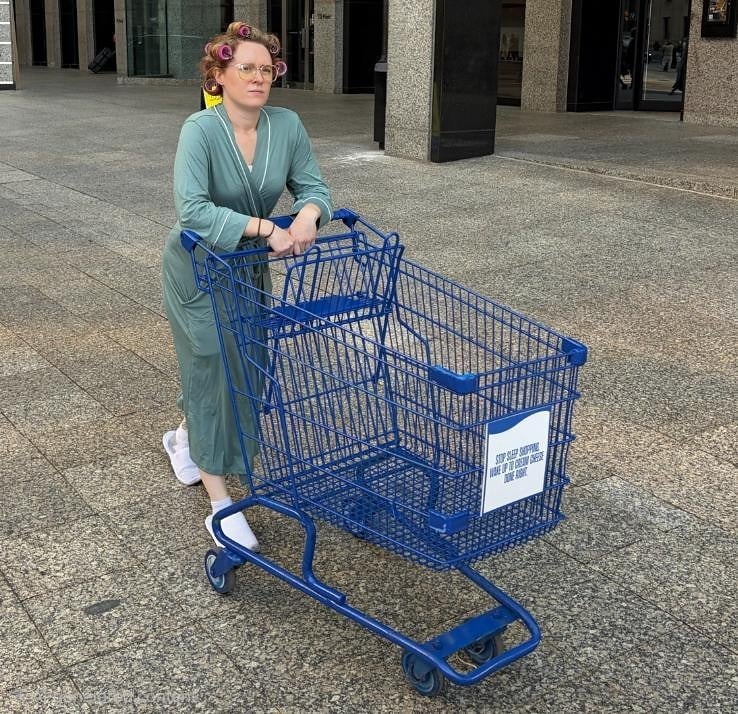
The Sleep Shopper campaign, launched this week by the dairy brand, features people dressed in bathrobes and sleeping masks pushing grocery carts through morning commuter stations. The company says the campaign is intended to encourage shoppers to break from habitual grocery-buying decisions and consider Tre Stelle cream cheese.

Campaign targets shopping habits

The activations took place at Toronto’s Union Station, Vancouver’s Commercial–Broadway Station and Montreal’s Gare Centrale, where commuters encountered the Sleep Shopper stunt on Thursday.

The campaign centres on Tre Stelle Original Cream Cheese and the company’s Lactose-Free Garlic & Chives product, which Tre Stelle describes as Canada’s first flavoured lactose-free cream cheese.

Logan McCarles
Logan McCarles

“We know that many grocery decisions are made out of habit, and that’s especially true for products people buy week after week,” said Logan McCarles, Head of Brand at Arla Foods. “With this campaign, we’re encouraging Canadians to break out of that routine and discover a cream cheese made with high-quality, simple and natural ingredients that delivers the quality, freshness and flavour they can count on, whether it’s for breakfast, an afternoon snack or recipes.”

Tre Stelle says the Lactose-Free Garlic & Chives product is made with premium ingredients and is intended to provide a lactose-free option for consumers seeking a flavoured cream cheese.

Tre Stelle Sleep Shopper stunt in Toronto, encouraging Canadians to wake up from grocery shopping on autopilot and discover a cream cheese that's worth making the switch for
Tre Stelle Sleep Shopper stunt in Toronto, encouraging Canadians to wake up from grocery shopping on autopilot and discover a cream cheese that’s worth making the switch for

Product lineup

The company says its cream cheese range also includes Organic, Light, Herbs & Spices and Lactose-Free Original varieties.

Tre Stelle is positioning the range for different consumer preferences and uses, including as a spread and as an ingredient in recipes.

The campaign’s focus on changing routine purchasing decisions comes as the company seeks to draw attention to its cream cheese offerings through the three-city activation.

Tre Stelle says it has been producing cheese for Canadian consumers for more than 65 years and that its cream cheese products are widely available in grocery stores across Canada.

The company’s broader cream cheese lineup includes Original, Organic, Light, Herbs & Spices, Lactose-Free and the newly launched Lactose-Free Garlic & Chives varieties.

Brand strategy

The campaign is built around encouraging consumers to reconsider an everyday grocery choice rather than automatically purchasing the same product.

Tre Stelle says its products are made with simple, natural ingredients and describes the brand as Canadian. The company is part of Arla Foods, with McCarles identified in the release as the organization’s Head of Brand.

The Sleep Shopper campaign is being used to highlight the company’s existing cream cheese range alongside its newest lactose-free flavoured product.

More from Retail Insider: