Americans filed about 1.72 million business applications in the 12 months to June that the U.S. Census Bureau identifies as most likely to become employer businesses, roughly 31% above the 2019 level and still edging higher.
The figure comes from an analysis of Census Bureau Business Formation Statistics by Mandoe Media, a digital signage supplier that works with restaurants, retailers and gyms. It points to a pipeline of genuine new premises that has stayed full well after the pandemic-era spike, and one that matters to anyone selling into retail and hospitality.
The headline number is what the Census Bureau calls high-propensity applications, the filings its model treats as the closest read on businesses likely to hire and open premises. That measure is anchored in consumer-facing sectors: accommodation and food services and retail are among the industries that qualify an application as high-propensity. In the latest single month of industry detail, retail trade drew about 77,200 applications and accommodation and food services about 26,800, two of the larger categories.
There is a second story underneath the first. Applications of every kind ran at about 6.02 million over the same 12 months, up almost 15% year over year and about 72% above 2019. But the share of that total classed as high-propensity has fallen, from 37.6% in 2019 to 28.6% now. The raw count has climbed faster than the part of it likely to become a staffed storefront, which is why the 1.72 million figure carries more signal for suppliers than the headline six million does.
“The number that matters to anyone selling to retailers is the share of applications likely to actually open premises and hire, and that has held up even as the raw filing count has run ahead of it,” said Paul Madden at Mandoe Media. “A storefront that opens this year is competing for attention from its first day, and how it presents prices and offers at the door is part of that.”
Growth in the likely-employer pipeline has not stalled. High-propensity applications rose 2.3% on the prior 12 months, and the run rate now averages roughly 143,700 likely-employer filings a month.
Mandoe Media compiled the finding from public Census Bureau Business Formation Statistics retrieved through the Federal Reserve Bank of St. Louis. No private data was used. The Census Bureau publishes industry detail at national level and geographic detail as a total across all industries, so a clean state-by-sector ranking of restaurants or shops is not available from the series.
Inventory is a large investment for most retailers – Managing spending is necessary for profitability and growth. While businesses often focus on sales, controlling inventory expenses is also important for financial performance. Purchasing decisions, supplier payments, storage costs and transportation expenses affect the cost of maintaining stock. When these expenses are not visible, retailers may spend too much, hold unnecessary stock or have limited cash flow.
Better expense tracking provides retailers with accurate financial information for inventory decisions. Businesses can see where money is spent plus how those expenses influence inventory performance – this visibility allows companies to lower waste, create better purchasing agreements and invest in products that provide high returns.
Understanding Inventory Related Expenses
Many retailers focus on the purchase price of products but may overlook other costs. Freight charges, storage fees, insurance, packaging materials, handling costs, returns processing and seasonal promotions are part of the total investment. Tracking these expenses individually helps businesses understand the actual cost of every product.
Accurate expense tracking also reveals spending patterns – Retailers can identify recurring charges that increase operating costs or suppliers whose pricing is high. By recognizing the trends early, businesses can make informed decisions before expenses lower profitability.
Improving Purchasing Decisions
Retailers with detailed expense records are able to make informed purchasing decisions. They can evaluate the financial impact of each purchase instead of relying only on historical sales or supplier suggestions – this evaluation includes shipping costs, warehouse capacity, turnover but also seasonal demand.
Expense management software also assists in negotiations with suppliers – Financial data is useful when discussing pricing, delivery schedules or discounts. Retailers that understand how supplier expenses affect operations are in a position to negotiate agreements that lower costs and maintain product availability.
Reducing Overstock & Understock Problems
Financial issues often come from purchasing incorrect amounts of inventory. Overstocking uses capital, increases storage expenses and creates a risk of unsold goods. Understocking leads to missed sales, unhappy customers as well as expensive emergency purchases.
Expense tracking helps retailers identify the financial results of both situations. By reviewing spending and inventory performance, businesses can determine which purchasing patterns are most effective – this approach encourages inventory levels that meet customer demand without creating financial pressure.
Strengthening Cash Flow Management
Cash flow is critical for retail operations – Businesses can experience difficulties if inventory purchases use available cash before sales occur. Tracking inventory expenses allows retailers to forecast financial obligations and prepare for purchasing cycles.
With financial visibility, retailers can schedule purchases strategically instead of making large orders that strain resources – this approach supports cash reserves or ensures products are available for customers. Better cash flow management also creates flexibility for market changes or new opportunities.
Using Technology To Improve Accuracy
Technology improves the accuracy and efficiency of expense tracking. Digital accounting systems, inventory management platforms and reporting tools record transactions next to lower manual errors – these systems provide real time financial information for fast decision making.
Many retailers integrate expense management software with accounting and inventory systems – this integration simplifies reporting and reduces administrative tasks. Managers can review reports that connect inventory purchases with operational expenses for effective financial analysis.
Improving Inventory Forecasting Accuracy
Retailers can forecast inventory levels more precisely when they track expenses – this practice provides clear information about how customers purchase items and how the business spends money. When a company knows the costs for products, storage and shipping, it can predict future demand with greater accuracy. The business is less likely to hold excess stock or have insufficient supplies during busy periods.
Correct forecasts are also helpful when a company decides how to distribute its budget. Businesses can determine which products are successful – comparing previous costs with sales data – this analysis shows which items are profitable plus which items require less financial support. Such a method is beneficial because it keeps inventory at balanced levels and ensures the business uses its money and tools efficiently.
Monitoring Supplier Performance
Expense tracking provides insight into supplier performance – Retailers can evaluate delivery reliability, shipping consistency, product quality, return rates plus service costs. A vendor with low prices is expensive if delays or quality problems increase operating costs.
Regular financial reviews encourage supplier accountability – Retailers with detailed records can identify suppliers who meet expectations – these insights help businesses work with dependable partners and lower inventory expenses.
Supporting Better Financial Planning
Long-term planning depends on accurate expense information – Retailers need historical data to estimate inventory investments, seasonal requirements and operating expenses. Better expense tracking provides the information necessary for realistic financial forecasts.
Accurate data also allows retailers to evaluate expansion opportunities. When opening locations, introducing products or increasing warehouse capacity, businesses can estimate the financial impact using actual spending patterns – this improves budgeting but also reduces uncertainty during growth.
Establishing Consistent Spending Practices
Consistent procedures help retailers control inventory spending. Employees responsible for purchasing or managing suppliers should follow standard processes so that expenses are accurate and reviewed regularly. Documentation reduces confusion and supports financial accountability.
A business expense policy establishes expectations for approvals, documentation as well as oversight. When employees understand how to manage inventory expenses, businesses lower the risk of unauthorized spending and improve financial records.
Measuring Inventory Performance
Expense tracking is valuable when combined with inventory performance measurements. Retailers can compare carrying costs, turnover rates, profit margins and sales performance to see if purchasing decisions are successful – these measurements show which products contribute to profitability.
Ongoing reviews encourage improvement – As retailers monitor data, they can identify successful strategies, stop inefficient practices or adjust investments based on customer demand. Small improvements generate savings and support long term financial performance.
Conclusion
Improving inventory spending involves more than reducing purchase costs. Retailers have better financial results when they understand the expenses for acquiring, storing and selling inventory. Better expense tracking provides visibility for purchasing decisions, cash flow management, supplier relationships next to financial planning.
As markets change, businesses that prioritize expense tracking are prepared for customer demand and economic conditions. By using financial oversight and inventory management, retailers can lower spending, improve efficiency plus build a foundation for profitability.
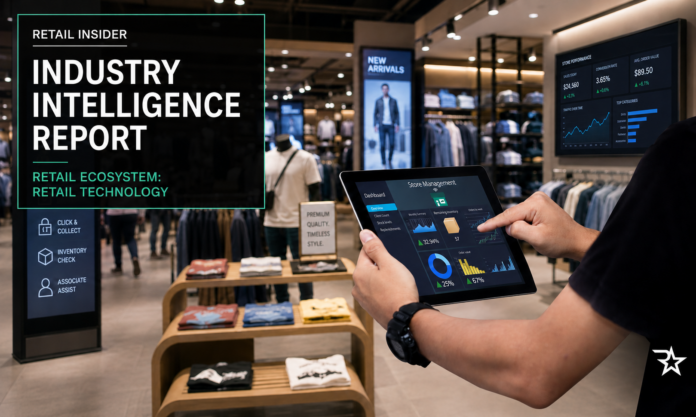
Canadian retail technology is entering a new phase as artificial intelligence, payments, loyalty programs and commerce platforms become increasingly interconnected rather than operating as standalone solutions.
The report examines two closely connected segments of the retail industry. Retail Technology covers technologies enabling Canadian retail, including POS systems, artificial intelligence, ecommerce platforms, retail software, customer engagement, loyalty technology, cybersecurity, automation and digital innovation. Payments & POS focuses on payment technologies, point-of-sale systems, fintech, digital wallets, payment processing, checkout innovation, fraud prevention and retail financial technology.
General Themes
AI becomes core infrastructure — Artificial intelligence is moving beyond experimentation into merchandising, inventory planning, customer engagement and operational decision-making.
Integrated commerce ecosystems — Retailers increasingly want connected platforms that unify payments, loyalty, customer data, marketing and operations.
Loyalty grows in strategic importance — Loyalty programs and first-party customer data are becoming foundational business assets rather than simple rewards programs.
Convenience becomes expected — Delivery, click-and-collect and fulfillment capabilities are increasingly viewed as baseline customer expectations.
Agentic commerce emerges — AI-powered shopping agents are beginning to influence how retailers may eventually sell products and engage consumers.
People remain critical — Technology investments continue to outpace workforce readiness, making implementation and organizational capability key competitive factors.
Cross-border commerce improves — Technology continues to reduce friction for international retail, even as tariffs, regulation and geopolitical issues remain challenges.
Retail Insider Coverage
The report draws extensively on Retail Insider’s coverage of technology investments, payment innovation and evolving commerce platforms across Canada’s retail industry. Among the developments examined are Loblaw’s ChatGPT grocery integration, Rogers’ launch of POS and payment solutions for small businesses, Skip’s expanded grocery partnership with Loblaw, DoorDash’s grocery expansion with Empire, and SumUp’s entry into the Canadian market.
Retail Insider’s reporting also captures broader technology trends affecting retailers, including AWS’s AI shopping assistant for retailers, Canadian Tire’s continued use of AI and data-driven merchandising, loyalty initiatives such as Cascadia Liquor’s new program, and research examining workforce readiness, cross-border commerce and consumer attitudes toward AI-powered shopping. Together, these developments illustrate how technology is increasingly supporting every stage of the retail value chain rather than isolated business functions.
Broader Industry Coverage
The report suggests Canadian retail is entering an era in which competitive advantage depends less on adopting individual technologies than on connecting them into cohesive operating platforms. Artificial intelligence, payments, customer data, loyalty, fulfillment and marketing are increasingly converging into integrated commerce infrastructure that supports both customer experience and operational efficiency.
The findings also point toward a future where many of the most important retail technology investments are largely invisible to consumers. As payment experiences become more seamless, loyalty ecosystems expand, fulfillment networks mature and AI becomes embedded across retail operations, the technology itself becomes less visible while its influence on retail performance continues to grow. Emerging concepts such as agentic commerce suggest retailers may also need to prepare for AI participating directly in purchasing decisions alongside human shoppers.
Editor’s Take
The report argues that Canadian retail has moved beyond viewing technology as a collection of tools. Artificial intelligence, payments, loyalty, commerce platforms and operational systems are increasingly becoming interconnected infrastructure that supports nearly every aspect of retail. Retailers that can successfully integrate these capabilities alongside investments in people and organizational readiness are likely to be better positioned than those pursuing isolated technology initiatives.
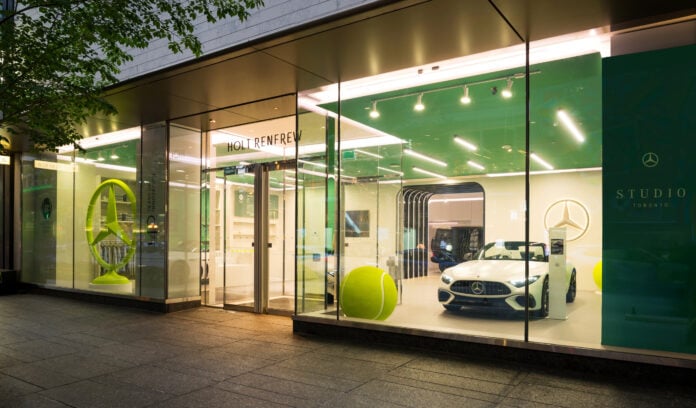
Mercedes-Benz showroom on the street level of Holt Renfrew at 50 Bloor Street West in Toronto. Photo: Mercedes-Benz Canada
Mercedes-Benz has opened an evolving automotive and lifestyle destination inside Holt Renfrew’s Toronto flagship, bringing vehicles together with fashion, product customization, hospitality and cultural programming.
Mercedes-Benz Studio Toronto occupies approximately 3,000 square feet on the main floor of the department store at 50 Bloor Street West. Opened June 26, the Studio will be redesigned twice more during 2026, with each version introducing a new creative concept, automotive presentation, fashion residency and merchandise assortment.
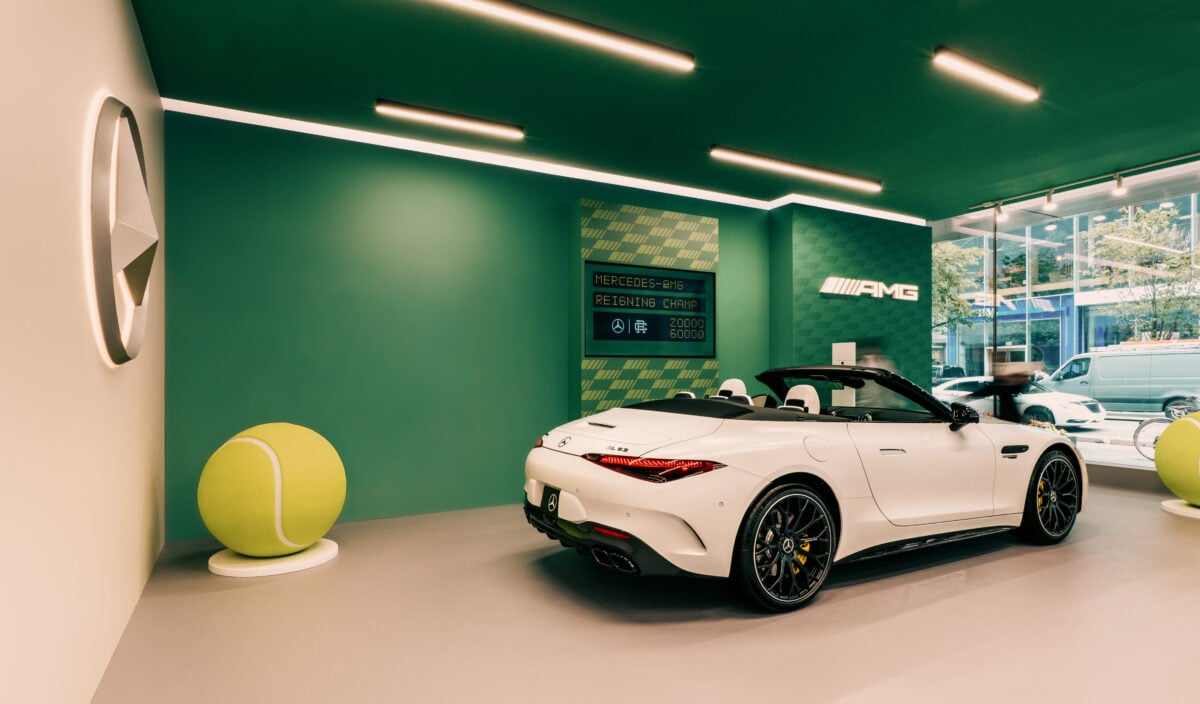
The inaugural summer installation is centred on Mercedes-AMG, performance and tennis culture. It features the Mercedes-AMG SL 63 4MATIC+ Roadster, a residency by Vancouver-founded Reigning Champ, tennis-related collectibles, an embroidery station and a café program inspired by major international tournaments.
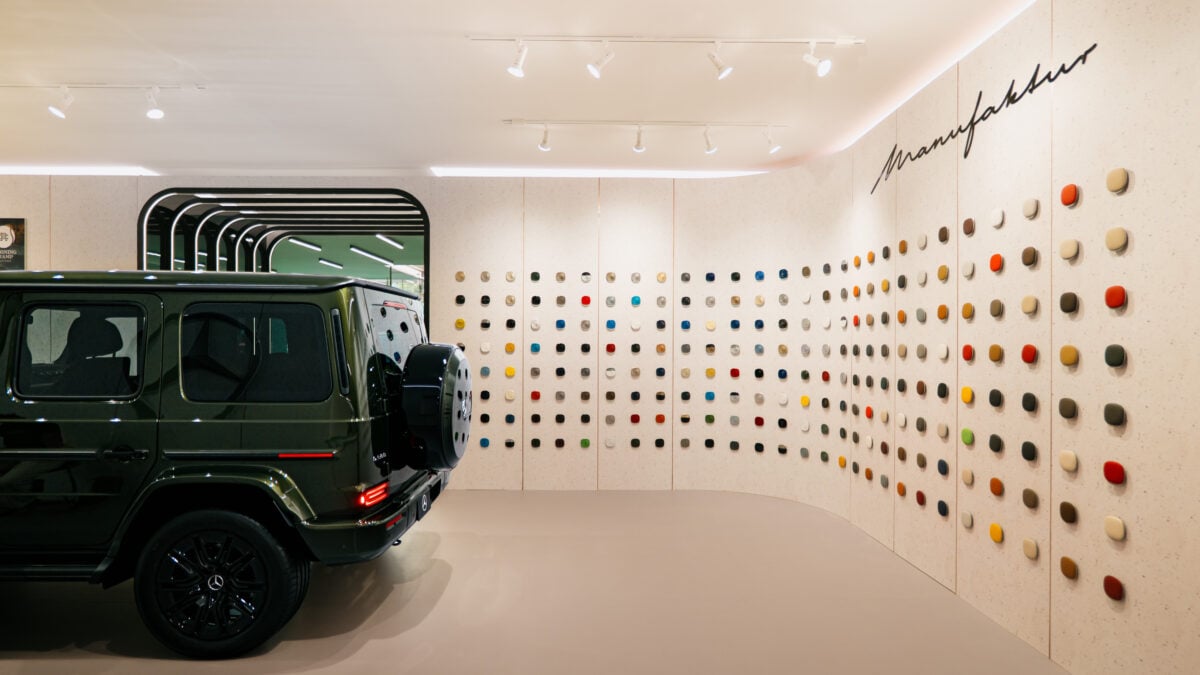
At the rear of the Studio, the MANUFAKTUR Atelier presents a more permanent exploration of Mercedes-Benz craftsmanship and personalization. Visitors can examine exterior colours, upholstery, interior materials and trim selections in a workshop-inspired setting that demonstrates how a vehicle can be configured around individual preferences.
The Studio gives Mercedes-Benz a presence beyond the traditional dealership and places the automotive brand directly within Toronto’s principal luxury shopping district. For Holt Renfrew, it creates a changing main-floor attraction intended to encourage discovery, interaction and repeat visits throughout the year.
“Through our partnership with Holt Renfrew, we’ve created an inviting, design-led space where customers can experience Mercedes-Benz beyond the vehicle,” said Alex Matthews, Vice President, Digital, PR and Marketing at Mercedes-Benz Canada.
Matthews said the Studio reflects the breadth of the Mercedes-Benz portfolio, ranging from AMG performance and the S-Class to electric vehicles and the craftsmanship offered through MANUFAKTUR.
Mercedes-Benz showroom on the street level of Holt Renfrew at 50 Bloor Street West in Toronto. Photo: Mercedes-Benz Canada
Inside Holt Renfrew’s Canadian Flagship
Holt Renfrew’s Bloor Street flagship spans more than 150,000 square feet of retail space across multiple levels, with expansive frontage along Bloor Street. Its Yorkville location places the Mercedes-Benz Studio within Canada’s most concentrated luxury retail district and directly in front of customers already engaging with premium fashion, beauty, accessories and personal service.
The prominent main-floor location allows Mercedes-Benz to meet customers in a setting that is less formal than a dealership. Visitors can move between Holt Renfrew’s fashion departments, the Studio’s merchandise, the vehicles and the MANUFAKTUR material displays without beginning with an automotive sales appointment.
Mercedes-Benz Studio Toronto functions as a vehicle showcase, fashion shop, customization space and cultural installation. Merchandise is available for purchase, while test drives offered on selected dates create a pathway from the in-store presentation to direct engagement with Mercedes-AMG vehicles.
The space is divided into two principal portions. The front section will change with each creative refresh, while the MANUFAKTUR Atelier will remain in place throughout the activation. The summer concept will be replaced by a new presentation in September, followed by another transformation in November. The three phases will explore sport, timeless creativity and the holiday season.
The rotating model gives the Studio a cadence associated with fashion retail, where new collections, collaborations and visual presentations provide customers with reasons to return.
During a walkthrough, Retail Insider observed a space built around participation as much as presentation. Visitors can shop, examine the vehicles, explore materials, customize apparel and engage with programming tied to the summer tennis concept.
Mercedes-Benz showroom on the street level of Holt Renfrew at 50 Bloor Street West in Toronto. Photo: Mercedes-Benz Canada
Reigning Champ Leads the First Fashion Residency
The Studio’s first residency features Reigning Champ, with a curated assortment of premium athletic apparel and products developed in collaboration with Holt Renfrew.
The presentation includes clothing bearing custom Holt Renfrew and Reigning Champ graphics, with certain products created specifically for the Toronto installation. The limited availability gives the residency an element of exclusivity that extends beyond the vehicles on display.
The apparel is joined by tennis-related objects curated through Pro Shop, a concept created by artist and photographer Vicente Muñoz. Vintage magazines, rackets, tennis balls, prints and ceramic works are displayed throughout the space, with several one-of-one pieces available for purchase.
Muñoz’s work draws from the culture, imagery and material history of tennis, providing a bridge between performance, fashion, design and collecting.
The summer program has also included racket-stringing sessions, allowing visitors to observe the technical process and have equipment restrung according to their preferred tension. An embroidery station offers further customization for selected merchandise, including Mercedes-Benz and Reigning Champ branding and personal initials.
These elements make participation part of the retail proposition. Customers can purchase a product, take part in its customization and leave with something individualized, an approach increasingly visible across luxury fashion, footwear, jewellery and accessories.
A café component adds another layer, with refreshments inspired by the traditions surrounding major tennis tournaments. Together, the retail, food, vehicles and programming create a destination designed to be explored over time.
The tennis theme also gives the global Mercedes-Benz Studios concept a local connection. Mercedes-Benz has relationships involving the WTA, Tennis Canada and the National Bank Open, which is held annually in Toronto and Montreal.
Mercedes-Benz showroom on the street level of Holt Renfrew at 50 Bloor Street West in Toronto. Photo: Mercedes-Benz Canada
Customizing a Vehicle Like a Luxury Product
The MANUFAKTUR Atelier provides the clearest connection between automotive design and the shopping experience elsewhere inside Holt Renfrew.
Exterior paint samples, interior colours, upholstery, fabrics and trim options are displayed in an environment where customers can see and touch the materials used to personalize a Mercedes-Benz vehicle. The process is presented in a manner similar to selecting a made-to-order garment, accessory or piece of furniture.
That comparison becomes especially visible inside a luxury department store. Customers accustomed to making decisions around colour, fabrication, craftsmanship and personal style can apply a similar mindset to configuring a vehicle.
The Atelier remains in place while the front of the Studio changes, creating continuity across the three creative concepts. The merchandise customization station reinforces the same broader idea: giving customers a role in shaping the final product.
The Studio also has a commercial function beyond brand awareness. Visitors can explore vehicles, materials and design choices in a lower-pressure setting before arranging a test drive or continuing the conversation through the Mercedes-Benz dealer network.
Mercedes-Benz showroom on the street level of Holt Renfrew at 50 Bloor Street West in Toronto. Photo: Mercedes-Benz Canada
A New Use for a Former Luxury Concession
The Mercedes-Benz Studio has introduced a new use for one of Holt Renfrew’s most visible former luxury concessions.
The approximately 3,000-square-foot space previously housed Saint Laurent, which operated a comprehensive concession with its own entrance along Bloor Street. It closed after the French fashion house opened a substantially larger standalone flagship a short distance west at 110 Bloor Street West.
The newer Saint Laurent store spans approximately 10,400 square feet and formed part of a broader wave of expanded international luxury flagships along Bloor Street.
The transition illustrates how the relationship between department stores and global luxury brands is evolving. Some major fashion houses are establishing larger standalone locations where they can control the full assortment, environment and customer journey. Department stores, meanwhile, are introducing rotating partnerships, cultural programming and categories beyond conventional fashion concessions to animate prominent space.
In this case, a relatively static branded boutique has been replaced by an installation expected to transform three times within approximately six months. The vehicles, merchandise, fashion partners and creative treatment will change, while the Mercedes-Benz presence and MANUFAKTUR Atelier provide continuity.
For Holt Renfrew, the model introduces a new category to the main floor and creates an attraction that can be repeatedly remerchandised. Mercedes-Benz gains access to the department store’s customer base, luxury positioning and central Yorkville location.
Mercedes-Benz showroom on the street level of Holt Renfrew at 50 Bloor Street West in Toronto. Photo: Mercedes-Benz Canada
Automotive Retail Moves Into Yorkville
Mercedes-Benz Studio Toronto forms part of an international initiative spanning more than 10 cities across four continents. Although the Studios share a broad framework, each is adapted through local design, partnerships and cultural programming.
Toronto’s version draws from Yorkville’s concentration of luxury retailers, the seasonal importance of the National Bank Open and the presence of a Canadian performance-wear company through Reigning Champ.
“Mercedes-Benz Studio Toronto brings our brand directly into Yorkville, the city’s most prestigious neighbourhood,” Matthews said.
Mercedes-Benz Canada operates through 57 authorized dealerships and sold 37,382 vehicles in Canada in 2025. The Studio does not replace those dealerships. It creates another point of entry into the brand, reaching people who may be shopping or spending time in Yorkville without actively seeking an automotive showroom.
Automotive brands have long displayed vehicles in shopping centres and other high-traffic environments, but the Toronto Studio is structured as a longer-term retail and cultural residency. Its product releases, fashion partnerships, food service and rotating concepts position it closer to a branded flagship or gallery than a temporary vehicle display.
“At Holts, we curate the best of the world’s brands and experiences in our stores for our customers,” said Jerry Wu, Senior Vice President of Marketing at Holt Renfrew.
Wu said the Studio will continue to transform throughout its time at the flagship, introducing further innovation and partnerships.
Expanding the Role of the Luxury Department Store
The Studio arrives as department stores continue to reconsider the role of their largest physical locations.
Holt Renfrew remains an important Canadian distribution platform for international fashion and beauty brands, while its stores also bring together products, services, collaborations and programming that are difficult to reproduce through online shopping.
That role is particularly relevant on Bloor Street, where global luxury brands have invested in larger and increasingly elaborate standalone flagships. Holt Renfrew operates alongside those boutiques while seeking distinct reasons for customers to enter and move through its store.
Mercedes-Benz Studio Toronto broadens the definition of what can occupy prime department-store space. Vehicles, performance apparel, collectible objects, customization services and food and beverage have been assembled within one changing environment, connected through a narrative built around performance and design.
For Mercedes-Benz, the Studio presents its vehicles and materials through the language of luxury retail. For Holt Renfrew, it replaces a departed fashion concession with a concept capable of generating newness several times during the year.
Mercedes-Benz Studio Toronto is expected to remain at Holt Renfrew through the end of 2026 and into the period immediately following the holiday season. The current Mercedes-AMG and tennis installation will be followed by two additional versions, extending the concept across automotive design, fashion and experiential retail.
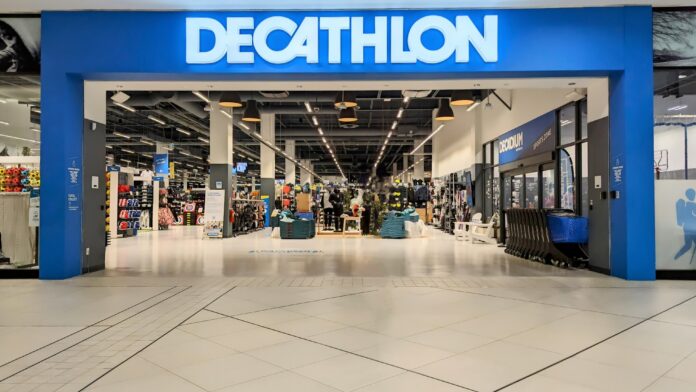
Vusion, a global leader in digitalization solutions for physical retail, says that Decathlon reached the milestone of 700 stores equipped with its digital solutions during the second quarter 2026. The deployment now spans 54 countries across three continents (Europe, South America, and Asia-Pacific), making the sporting goods retailer Vusion’s most internationally deployed customer to date, it noted.
“Voted France’s Most Attractive Retailer in 2026 and widely recognized for its outstanding customer experience, Decathlon relies on Vusion’s platform to automate price management. With instant, synchronized price updates on the electronic shelf labels (ESL), store teams are freed from the time-consuming task of manually replacing paper price tags. As a result, associates can dedicate more time to what lies at the essence of their job: welcoming customers, delivering personalized advice and service to sports enthusiast customers,” according to a news release.
“Beyond the productivity gains for store teams, digital shelf management ensures an excellent level of pricing accuracy. Discrepancies between the shelf price and the price charged at checkout are nearly eliminated. This perfect transparency reinforces customer trust and directly contributes to higher customer satisfaction across the Decathlon network.”
“Thanks to ESLs, we have further enhanced the in-store experience while improving our operational efficiency. Deploying connected shelf labels at scale enables us to focus on our core mission: advising and supporting our sports customers. This project delivers immediate, tangible benefits for both our store teams and consumers,”said Xavier Dété, VP Innovation, Decathlon.
“We are particularly proud to support Decathlon, a global retail leader highly valued by its customers and recognized for both the strength of its brand and its commitment to sustainability. This large-scale partnership demonstrates our ability to support leading global retailers and industrialize our cutting-edge solutions in the demanding sporting goods sector–a high-potential market where Vusion continues to strengthen its leadership position,” added Sébastien Fourcy, SEVP EMEA, Vusion.
From a technical perspective, Decathlon leverages Vusion’s cloud platform. The electronic shelf labels connect natively and securely to the retailer’s existing Cisco Meraki network infrastructure, enabling a seamless deployment without requiring any additional networking hardware, said the news release.
METRO Inc. and FGF Brands (FGF), a Canadian company and a North American leader in bakery products, have announced a strategic partnership for the commercial bakery manufacturing operations of Première Moisson Group Inc., a subsidiary of METRO. As part of the transaction, FGF will acquire Première Moisson Group’s production facility located in Baie-D’Urfé for $90 million.
This transaction reflects METRO’s ongoing commitment to focus its investments and resources on its core food and pharmaceutical retail and distribution operations, while simplifying its operating model through the support of a specialized partner, said METRO.
Upon closing of the transaction, FGF will manufacture and distribute Première Moisson products sold in food stores. This agreement will allow METRO to continue offering Première Moisson products to customers throughout its Québec and Ontario food store network while leveraging FGF’s manufacturing expertise, innovation capabilities and operational scale, it said.
Première Moisson Group will remain a subsidiary of METRO and will retain ownership of the Première Moisson brand, its network of 25 retail bakeries across Québec, its artisanal in-store production operations, and its French pastry production facility in Vaudreuil-Dorion, which exclusively supplies its bakery network, it explained.
The agreement with FGF provides for the continued production and manufacturing of all Première Moisson products. All impacted employees will be transferred to FGF upon closing of the transaction; METRO and FGF will work with the union representing unionized employees as part of the transition, according to the companies.
“This transaction is consistent with our focus on our core food and pharmaceutical retail and distribution activities, while preserving the strength of the Première Moisson brand. By partnering with a company recognized for its manufacturing expertise, we will continue to offer customers the Première Moisson products they enjoy while benefiting from enhanced innovation, product development capabilities and a more efficient operating structure.” said Marc Giroux, Chief Operating Officer, METRO.
Marc Giroux
“We are pleased to bring our baking expertise to METRO and in particular to Première Moisson, a brand renowned for the quality of its products and craftsmanship. This partnership allows us to leverage our manufacturing and innovation capabilities to support the growth of Première Moisson’s grocery offering while continuing to provide consumers with high-quality products,” said Ojus Ajmera and Tejus Ajmera, Co-Chief Executive Officers and Co-Founders of FGF.
The transaction is subject to customary closing conditions for transactions of this nature. It is expected to close during METRO Inc.’s fourth quarter of fiscal 2026, which ends on September 26.
With annual sales of more than $22 billion, METRO Inc. is a food and pharmacy leader in Québec and Ontario, providing employment to more than 97,000 people. As a retailer, franchisor, distributor, manufacturer, and provider of eCommerce services, the company operates or services a network of some 1,000 food stores under several banners including Metro, Metro Plus, Super C, Food Basics, Adonis and Première Moisson, and some 640 pharmacies primarily under the Jean Coutu, Brunet, Metro Pharmacy and Food Basics Pharmacy banners.
FGF Brands is a Canadian, family-owned private bakery company founded in 2004. The FGF Group of Companies is Canada’s largest industrial baker and one of the world’s fastest-growing producers of bakery and snack foods. Headquartered in Toronto, FGF supplies a broad range of branded and private-label products to leading retailers and foodservice partners across the globe.
Red Apple Stores will host four grand openings on Friday, August 14 across the country: Esterhazy, SK, where the former Bargain! Shop has both converted to Red Apple and undergone a full renovation, and Revelstoke, BC, Blind River, ON, and Fort Nelson, BC, where newly renovated stores are ready to welcome shoppers back.
“Four grand openings on one day is a great way to show how much momentum we’ve got going right now,” said Jim Hreljac, President, Red Apple Stores. “Esterhazy customers are getting a double transformation – a new name and a completely refreshed store. In Revelstoke, Blind River and Fort Nelson, shoppers are walking back into stores they already love, now with a brand-new look. Either way, August 14 is a great day to shop.”
Grand Opening Day Highlights, August 14
A FREE $10 shopping card and laundry basket for the first 100 customers
A FREE shopping bag, while quantities last
Entry to win a $1,000 shopping spree
Two-day flyer deals available August 14
A 25% off coupon for every customer, valid on a future purchase
“A renovation is a great opportunity to take a fresh look at what’s on the shelves, and that’s exactly what we did for these four stores,” said Barry Fisler, Senior Vice President of Merchandising, Red Apple Stores. “Customers are going to find a strong mix of fashion, home and everyday essentials waiting for them.”
In Esterhazy, the transformation is twofold: the store has officially converted from The Bargain! Shop to Red Apple and has come out of a full renovation at the same time. Customers will find a familiar location now carrying the Red Apple name, with a brighter, more open layout to match, said Red Apple.
All four stores, Esterhazy, Revelstoke, Blind River and Fort Nelson have undergone the same kind of renovation: a brighter, more open layout, refreshed signage, and displays designed to make deals easier to find, including the new CandyWorks™ section, a colourful candy destination for treat lovers of all ages, it said.
“There’s a lot that goes on behind the scenes to pull off four store transformations at the same time,” said David Johnson, Vice President of Store Operations, Red Apple Stores. “Our store teams made sure customers never lost access to the products and service they rely on, even while the work was happening around them. Seeing all four stores open together on August 14 makes it all worth it.”
There is a particular shade of blue that seems to return with every Mediterranean summer. It appears in the sea beneath a clear afternoon sky, across hand-painted ceramics, against whitewashed façades, and in weathered shutters overlooking quiet harbours. It is a colour shaped by sunlight, water, and architecture, one that has become inseparable from the enduring beauty of the Mediterranean coastline.
Known as Blu Mediterraneo, Dolce & Gabbana‘s signature decorative motif draws inspiration from the landscapes, architecture, craftsmanship, and lifestyle of the Mediterranean. Defined by its distinctive blue-and-white palette, the collection evokes places such as the Amalfi Coast, Capri, Saint-Tropez, and the Greek islands through imagery and craftsmanship that celebrate coastal living.
At Royalmount, Maison Territo embraces this timeless aesthetic through curated furniture and interior collections that celebrate craftsmanship, texture, and refined living. The 11,000-square-foot showroom presents internationally recognized brands including Fendi Casa, Versace Home, Dolce & Gabbana Casa, and Bentley Home, creating immersive environments where global design influences come to life.
Dolce & Gabbana Blu Mediterraneo
A Design Language That Endures
Blu Mediterraneo is expressed through azure ceramics, limestone, linen textiles, woven natural fibres, light woods, and handcrafted details that reflect generations of Mediterranean artisans. Together, these materials create interiors that feel calm, welcoming, and deeply connected to their surroundings.
Its enduring appeal lies in its ability to balance sophistication with simplicity. While design trends evolve from season to season, Blu Mediterraneo continues to influence luxury interiors through an aesthetic that feels both timeless and unmistakably Mediterranean.
Craftsmanship at the Centre
Authentic materials and skilled craftsmanship remain central to the Blu Mediterraneo philosophy. Hand-finished ceramics, natural stone, carefully woven textiles, and thoughtfully crafted furnishings create spaces with warmth, texture, and character.
This appreciation for craftsmanship aligns closely with Maison Territo’s approach to interior design. Throughout the showroom, carefully curated collections demonstrate how exceptional materials and thoughtful design can create interiors that are elegant, personal, and enduring.
Madonna’s 2026 short film Confessions II – The Film, produced in partnership with Dolce & Gabbana, luminous fabrics, expressive shades of blue, and the interplay of light and reflection.
Beyond the World of Interiors
The influence of Blu Mediterraneo extends beyond architecture and interior design into fashion and contemporary culture. In Madonna’s 2026 short film Confessions II – The Film, produced in partnership with Dolce & Gabbana, luminous fabrics, expressive shades of blue, and the interplay of light and reflection evoke many of the same sensory qualities associated with Mediterranean summers.
While distinct from the Blu Mediterraneo concept itself, these visual elements demonstrate how this timeless palette continues to inspire creative expression across multiple disciplines.
Experience Blu Mediterraneo at Maison Territo
For architects, interior designers, and private clients alike, Blu Mediterraneo offers an enduring source of inspiration where colour, craftsmanship, and natural materials come together in harmonious interiors.
Maison Territo invites visitors to experience this Mediterranean design language firsthand through its curated collections and immersive showroom environments, where timeless design traditions continue to inspire contemporary living.
Destination Canada, a Crown corporation wholly owned by the Government of Canada, and the Economic Developers Association of Canada (EDAC) have signed a Memorandum of Understanding to strengthen collaboration between tourism and economic development leaders across Canada, helping communities advance tourism investment, attract visitors and unlock long-term economic growth.
Tourism is a major economic engine for Canada, and Destination Canada’s latest Outlook Report shows growth that will far outpace the general economy. The sector generated $140.5 billion in direct visitor spending in 2025. Tourism GDP grew at 2.5%, outpacing the national economy, which grew at 1.7%. Destination Canada’s forecast shows that annual tourism revenue is projected to grow by 6% in 2026. It supports 280,010 businesses in 5,000 communities; 1 in 10 jobs in Canada relies on tourism. Tourism is one of Canada’s largest service exports, contributing $34.9 billion in export revenues last year, said the corporation.
Stronger collaboration between tourism and economic development leaders advances Destination Canada’s strategy Tourism 2030: A World of Opportunity by positioning tourism as a high growth economic driver offering fast returns, while strongly supporting the government’s goals of doubling non-US exports by $300 Billion by 2035 and unlocking $1 trillion in investment over five years, it added.
Meaghan Ferrigno
“Tourism supports communities across Canada by diversifying economic activity, creating immediate jobs, improving local amenities, and attracting investment,” said Meaghan Ferrigno, Interim President and CEO of Destination Canada. “By partnering with the Economic Developers Association of Canada, we are strengthening connections between professionals in tourism and economic development to help communities position tourism as a catalyst for investment and long-term growth.”
“Economic developers play a critical role in shaping vibrant, resilient communities,” said John Perrott, Executive Director of EDAC. “This collaboration with Destination Canada will help equip our members with new insights, tools and partnerships to integrate tourism into economic development strategies and unlock opportunities for communities across Canada.”
John Perrott
Destination Canada said the collaboration will focus on knowledge sharing and strengthening investment readiness between the tourism and economic development sectors, including:
Promoting the economic value of tourism to economic development professionals and municipal leaders
Sharing research, data and best practices related to tourism development and investment attraction
Delivering workshops and webinars that build tourism investment literacy among economic development professionals
Integrating tourism-focused content into EDAC’s Certified Economic Developer (Ec.D) curriculum
Participating in conferences and joint communications initiatives that strengthen collaboration between tourism and economic development organizations
The agreement establishes a framework for collaboration over the next three years, enabling both organizations to advance initiatives that support tourism growth, strengthen investment attraction and create new economic opportunities for communities across Canada, it said.
To learn more about how Canada’s tourism sector is positioned for growth, including market fundamentals, demand drivers, priority growth corridors, and opportunities to align capital with destination development, visit www.investintourism.ca.
In 2025, tourism generated $133 billion in visitor spending, supporting over 280,000 businesses in 5,000 communities. With revenues projected to grow to $177B by 2030, tourism is a key economic driver and Canada’s second-largest service export, with the potential to contribute up to 10% to Canada’s $300B trade diversification goal, said Destination Canada.
A bilingual pharmacist with more than 25 years of leadership experience in healthcare, she has dedicated her career to advancing pharmacy practice and improving patient care in Canada. She has held senior leadership roles across specialty pharmacy, hospital and community pharmacy, regulatory consulting, and pharmacy operations. She holds an MBA from the University of Ottawa and is a strong advocate for integrated, patient-centreed care, believing the best health outcomes are achieved through collaboration across health system partners, said the Association.
“Serving as Chair of Neighbourhood Pharmacies over the past two years has been a privilege. Together, our Board established a bold strategic direction for the Association throughPrescription for Success – a roadmap that recognizes strong, sustainable pharmacy businesses as the foundation for expanding access to care and strengthening Canada’s health system. I’m proud of the progress we’ve made to strengthen the Association, elevate pharmacy’s voice with governments and partners, and position the sector for long-term success. On behalf of our Board, I want to congratulate Renée on her appointment as Chair. Renée brings tremendous experience, strategic insight, and a collaborative leadership style, and I know she will lead the Association with confidence as it enters its next chapter,” said Vezina.
Neighbourhood Pharmacies said it is now focused on executing the next phase of its strategy – strengthening its national advocacy, expanding the value it delivers to members and partners, and helping shape the future of community pharmacy in Canada.
“I am excited to welcome Renée as Chair and look forward to working alongside her as we continue advancing our vision for a thriving, sustainable pharmacy sector that delivers exceptional care while strengthening communities and Canada’s economy. Under Marie-Claude’s leadership, our Board established a strong strategic foundation and positioned the Association for its next phase of growth and impact. Today, Neighbourhood Pharmacies is exceptionally well positioned to build on that momentum by strengthening our advocacy, expanding the value we deliver to Members and Partners, and helping shape the future of pharmacy in Canada. I also want to thank Marie-Claude for her outstanding leadership, partnership, and lasting contributions to the Association over the past two years,” said Sandra Hanna, Chief Executive Officer of Neighbourhood Pharmacies.
Sandra Hanna
Looking ahead to her term as Chair, St-Jean said: “I am honoured to assume the role of Chair of Neighbourhood Pharmacies at a pivotal time for pharmacy and the broader healthcare system. Across Canada, pharmacy teams are playing an increasingly important role in improving access to care and supporting better health outcomes. I look forward to working alongside our Board, Members, Partners, and the Neighbourhood Pharmacies team to advance policies and initiatives that strengthen pharmacy businesses, expand access to care, and demonstrate the value our sector delivers to patients, the healthcare system, and Canada’s economy.”
Neighbourhood Pharmacies represents Canada’s leading pharmacy organizations, including chain, banner, long-term care, specialty pharmacies, grocery chains, and mass merchandisers with pharmacies. It advocates for pharmacies’ role in caring for Canadians, both behind and in front of the counter. We aim to advance sustainable healthcare for all stakeholders by leveraging over 12,000 pharmacies located in virtually every community throughout the country.