Leon’s Furniture Ltd. reported Thursday higher second-quarter net income despite lower revenue and system-wide sales, as the retailer pointed to cost management, cash generation and continued investment in store expansion during a consumer environment marked by cautious discretionary spending.
The Toronto-based company said net income for the quarter ended June 30 rose to $35.0 million, or 51 cents per diluted share, from $31.8 million, or 46 cents per diluted share, a year earlier. Revenue fell two per cent to $631.2 million from $644.1 million, while system-wide sales declined two per cent to $756.2 million. The company also opened four new franchise locations during the quarter.
The results reflected lower average selling prices as consumers continued to prioritize value, although the company said the number of retail units delivered increased compared with the same period last year. Same-store sales declined 2.2 per cent.
Revenue declined by $12.9 million from a year earlier, with furniture delivered sales down 4.2 per cent against what the company described as a strong prior-year comparison. Appliance sales also declined as builder activity slowed in the commercial channel and retail competition remained highly promotional. Those declines were partly offset by growth in the mattress category, which the company attributed to changes in its product assortment.
Margins pressured by foreign exchange
Gross profit totalled $281.7 million, down from $288.7 million a year earlier, while the gross profit margin slipped 19 basis points to 44.63 per cent from 44.82 per cent. The company said the margin was affected by foreign exchange revaluations tied to U.S.-dollar payables, partially offset by improved margins in its mattress business and higher revenue from insurance and delivery services.
Selling, general and administrative expenses fell to $232.6 million from $234.3 million, but increased as a percentage of revenue to 36.85 per cent from 36.38 per cent. Leon’s said the higher ratio reflected lower revenue, increased marketing costs related to promotions and new product partnerships, higher fuel and occupancy costs, and was partly offset by lower retail financing fees resulting from lower Bank of Canada interest rates.
Adjusted earnings fall despite higher reported profit
Adjusted net income, a non-IFRS measure used by the company, declined to $34.8 million from $39.4 million a year earlier. Adjusted diluted earnings per share fell to 51 cents from 57 cents. Leon’s said the year-over-year decline reflected lower sales, changes in the valuation of U.S.-dollar payables and the absence of a $1.4-million one-time benefit recorded in the second quarter of 2025 related to CURO Holdings Corp.
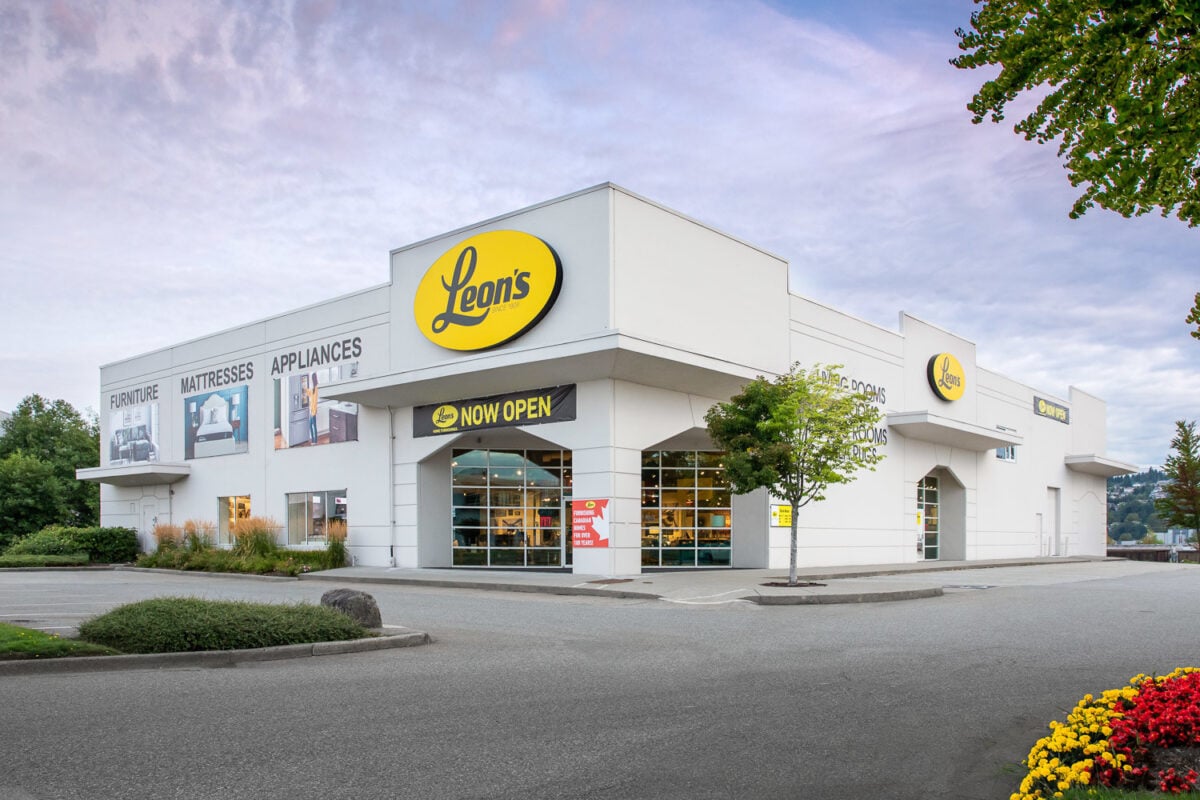
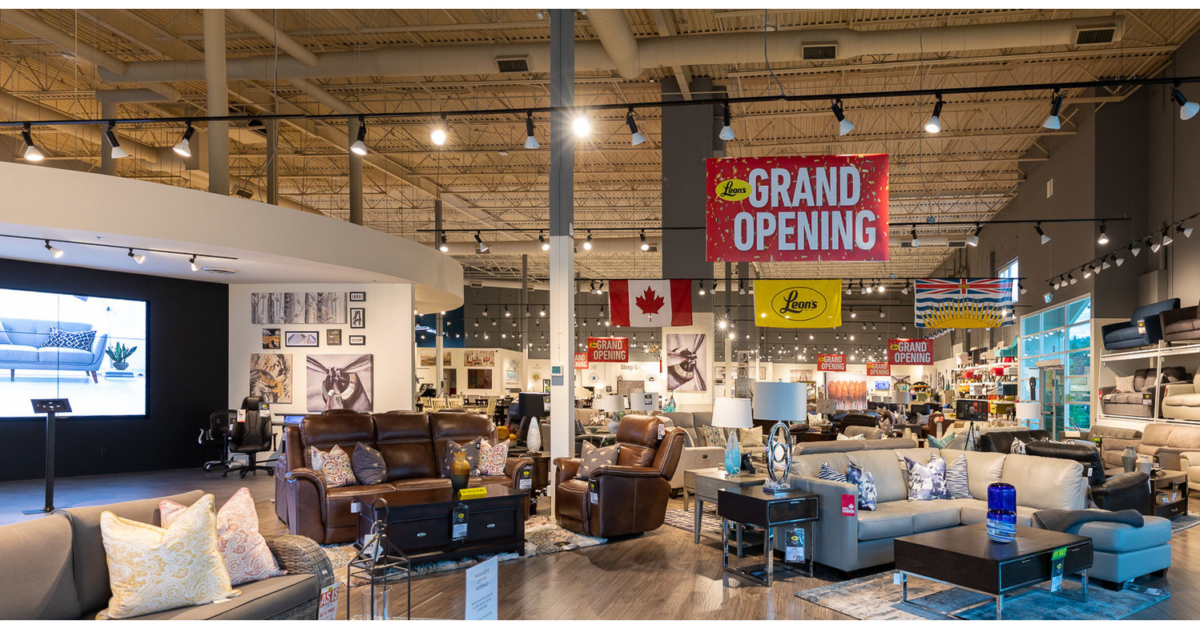
Photo: Leon’s Furniture
CEO says company remained disciplined during quarter
“During the second quarter, our team executed with discipline in an environment that unfolded largely as we anticipated, with consumers remaining selective on larger discretionary purchases. Against that backdrop, the mattress category was once again a standout, as our focused-assortment playbook continued to deliver. Gross margin came in at 44.6%, higher than the prior year when excluding a prior year accounting-related foreign exchange gain. This performance reflects our consistent focus on thoughtful merchandising and an optimized promotional strategy. Combined with ongoing cost management across the business, these efforts contributed to adjusted diluted earnings per share of $0.51.”
Liquidity strengthens as company expands store network
The company ended the quarter with unrestricted liquidity of $560.1 million, up from $454.5 million a year earlier. The balance included cash, cash equivalents, debt and equity instruments, and available capacity under its revolving credit facility. During the quarter, Leon’s repurchased about $3.0 million worth of shares.
Dividend maintained
The board declared a quarterly dividend of 24 cents per common share, payable Oct. 7, 2026, to shareholders of record as of Sept. 9, 2026. The company had previously paid a quarterly dividend of 24 cents per share on July 8.
Company focused on market share and growth
Leon’s said its principal objective remains increasing market share and profitability through cost management and continued investment in growth initiatives, including its e-commerce operations and retail network, which now includes 301 stores across Canada.
Outlook remains cautious
Walsh said the company is preparing cautiously for the remainder of the year while continuing to invest in expansion.
“Looking ahead, although we have seen encouraging signs, the operating environment remains challenging and we are planning the balance of the year prudently. Comparisons ease through the back half, and our focus remains on gaining share through this cycle and coming out of it in an even stronger leadership position as conditions normalize. We generated solid cash flow, repurchased approximately $3.0 million of shares and ended the quarter with $560.1 million of unrestricted liquidity. At the same time, we kept investing in growth, and the four new stores we opened during the quarter are off to a strong start. Our scale, national distribution network and rock-solid balance sheet position us to continue delivering value to Canadians, outperforming in our core categories, and delivering long-term returns for our shareholders.”
Part of Retail Insider Reports, the report analyzes Q2 2026 developments in Canadian retail marketing, advertising, branding, customer acquisition, loyalty, digital media, social commerce, public relations and consumer engagement. It draws on Retail Insider coverage and Canadian operator transcripts to assess event-driven advertising, sustainable media and packaging practices, and experiential retail activations.
Retail Insider Reports are designed to deliver executive-level insights across major retail sectors and can be accessed through the Retail Insider Report Hub.
General Themes
Live events increase the value of location: Major events such as the FIFA World Cup concentrate audiences around fan zones, transit hubs, entertainment venues and retail destinations, creating opportunities for contextually relevant advertising.
Motion strengthens DOOH performance: Research cited in the report found that motion-based digital billboards can deliver up to 67% higher brand awareness than static advertisements in event-driven settings.
Physical retail is an activation platform: Strong occupancy and investment in urban retail properties give landlords and brands opportunities to connect shopping destinations with sports culture and community events.
Loyalty has become core infrastructure: Large programs such as PC Optimum and Scene+ provide owned audiences that can complement paid media and support more targeted engagement.
Sustainability requires evidence: Environmental considerations are influencing media and packaging decisions, but measurable outcomes carry more weight than broad branding claims.
Retail Insider Coverage
Retail Insider’s reporting documented how advertisers are approaching the FIFA World Cup and other major events through dynamic OOH and DOOH campaigns. Coverage featuring Vistar Media Canada examined the performance of motion-based creative, the use of programmatic buying around high-traffic locations and the environmental advantages of digital formats that reduce physical production materials.
The report also draws on Retail Insider stories about experiential and community-oriented marketing. CF Market Mall’s partnership with Calgary Wild FC brought soccer-themed events and athlete appearances into the shopping centre, showing how landlords can connect retail properties with local sports culture. Coverage of sustainable small-business packaging added another perspective on how product presentation can communicate brand values, while also revealing where stronger Canadian evidence is still needed.
Broader Industry Coverage
Canadian operator transcripts reinforce the commercial importance of physical venues and owned audiences. Cineplex management linked the FIFA World Cup with increased demand at Canadian locations, while advertising-spend trends affecting Cineplex Media supported the case for event-driven inventory. The company’s new entertainment location at Vaughan Mills further connects entertainment anchors with major retail hubs.
George Weston Limited reported more than 18 million active Canadian PC Optimum members, demonstrating the scale loyalty programs can bring to customer engagement. It also disclosed that 98% of its controlled-brand plastic packaging in Canada is recyclable or reusable. Choice Properties, meanwhile, reported 98.2% occupancy alongside strong tenant demand and continued urban retail acquisitions, providing a healthy real estate base for media placements and experiential activations.
The report cautions that commercial impact data for many experiential initiatives remains limited. The next challenge is to connect foot traffic and fan engagement with measurable sales, loyalty and customer-acquisition outcomes.
Editor’s Take
Canadian retail marketing is not simply returning to traditional outdoor advertising. It is turning physical space into a more responsive media channel. The emerging advantage belongs to organizations that can combine live context, localized motion creative, loyalty data and relevant on-site experiences. Brands relying on static campaigns or digital-only strategies face growing pressure when audiences gather around major events. At the same time, sustainability claims are moving toward a higher standard in which disclosed metrics matter more than sentiment.
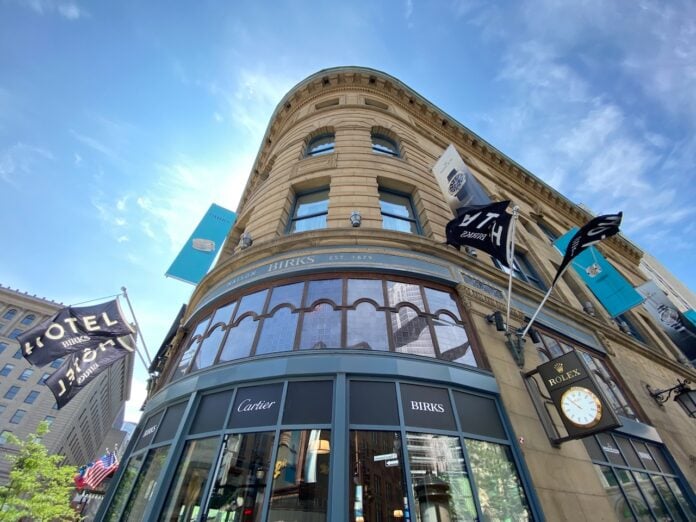
Maison Birks (620 Saint-Catherine St W, Montreal) Image: Dustin Fuhs
Birks Group has secured financing through 2031, reported a substantial improvement in its operating performance and announced plans to leave the NYSE American, placing the historic Canadian jeweller at another important point in its financial restructuring.
The Montreal-based company said it intends to voluntarily delist its Class A voting shares from the NYSE American and transition trading to the OTCQB market. Birks expects to file Form 25 with the U.S. Securities and Exchange Commission on August 17, 2026, with its final day of trading on the NYSE American anticipated around August 27.
The announcement comes shortly before the end of a compliance period granted by the exchange and only weeks after Birks reported higher sales, stronger margins and a return to operating profitability for fiscal 2026. The sequence highlights the distinction between an improving retail operation and a balance sheet that remains under considerable pressure.
Birks is performing better than it was a year ago, its principal financing arrangements have been extended, and the company continues to invest selectively in its Canadian store network. It nevertheless remains burdened by debt, high financing costs and negative shareholders’ equity, conditions that stronger sales alone have been unable to resolve.
Birks Plans Move to OTCQB
Birks said its Class A shares have been approved to trade on the OTCQB, an over-the-counter market operated by OTC Markets Group. The company plans to continue filing information through the SEC’s EDGAR system and providing semiannual financial information and annual audited financial statements.
The transition does not mean Birks is going private or that its shares will cease trading. It does represent a meaningful change for investors, since OTCQB-listed companies generally receive less market visibility and may experience lower trading liquidity than those listed on a national securities exchange.
For customers, however, the change may be largely invisible. Birks has not indicated that the move will affect its stores, employees, merchandise, customer orders or day-to-day retail operations.
The company said it considered several alternatives before determining that voluntary delisting was in its best interests. Birks did not quantify any anticipated savings or state that reducing listing expenses was the principal reason for the decision.
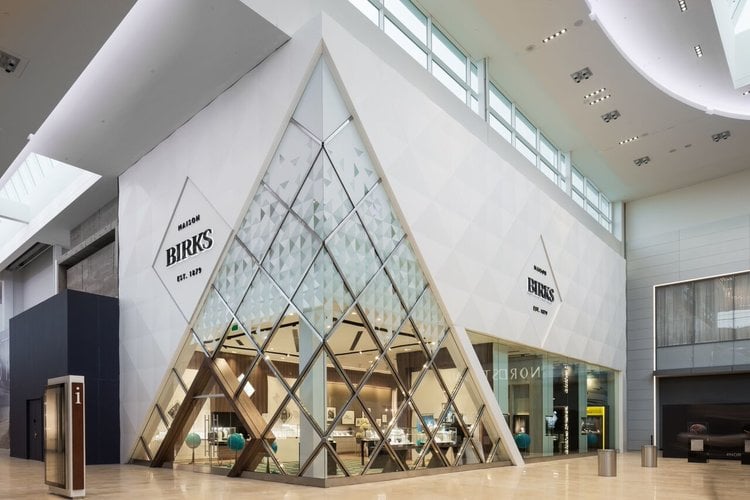
Birks at Yorkdale Shopping Centre (PHOTO: BEN RAHN/A-FRAME)
NYSE Compliance Deadline Approached
The timing is closely connected to Birks’ existing compliance issues with the NYSE American. Birks was notified in February 2025 that it did not comply with certain continued-listing requirements related to shareholders’ equity and sustained losses. The exchange later accepted a compliance plan submitted by the company and gave Birks until August 25, 2026 to regain compliance.
The voluntary delisting was announced less than three weeks before that period was scheduled to end. The NYSE American had not announced that Birks’ shares would be involuntarily removed, but the company’s decision provides an orderly resolution to an exchange-compliance process that remained outstanding despite a considerably stronger fiscal year.
That context is important because the delisting follows a period of improving retail sales. Birks has made meaningful operational progress, although its financial position continues to reflect accumulated losses, substantial borrowing and the cost of adapting to changes across the luxury jewellery and watch sector.
Fiscal 2026 Results Showed Improvement
For the year ended March 28, 2026, Birks generated net sales of $205.4 million, an increase of $27.6 million, or 15.5 per cent, from fiscal 2025. Comparable-store sales increased 2.6 per cent.
Gross profit rose to $79.2 million from $66.3 million, while gross margin improved to 38.5 per cent from 37.3 per cent. Adjusted earnings before interest, taxes, depreciation and amortization increased to $12.9 million from $9.2 million.
The company also returned to operating profitability, reporting operating income of $3.1 million following an operating loss of $5.5 million one year earlier. Its net loss narrowed to $3.4 million from $12.8 million.
A significant portion of the revenue increase came from Birks’ acquisition of European Boutique, a Greater Toronto Area luxury jewellery and watch retailer. Birks completed the acquisition of European Boutique’s retail operations in July 2025, adding four stores and strengthening its position in the Toronto-area luxury watch market.
The company also reported stronger sales of Birks-branded jewellery, higher average transaction values and growth in third-party branded jewellery. Comparable-store growth of 2.6 per cent shows that the improvement was not entirely acquisition-driven, although the underlying increase was considerably more modest than the headline revenue gain.
Foreign-exchange movements also helped the results. Birks benefited from a weaker U.S. dollar and recorded a foreign-exchange gain on its U.S.-dollar debt, compared with a loss during the previous year.
Taken together, the figures marked a considerable improvement for a retailer that has experienced several years of store changes, international brand departures, management transitions and financial pressure. They did not establish that Birks had achieved sustainable profitability.
Maison Birks store in downtown Vancouver. Photo: C. Hagemoen
Financing Costs Remain a Burden
Birks remained in a net-loss position even after generating operating income during fiscal 2026. Interest and other financing costs reached approximately $8.8 million, substantially exceeding the company’s $3.1 million in operating income.
That gap helps explain why improved store performance has not yet translated into bottom-line profitability. Birks may be selling more merchandise at stronger margins, but a significant portion of the benefit continues to be absorbed by the cost of its financing.
The company ended the fiscal year with approximately $1.5 million in cash and cash equivalents. Inventory stood at more than $126 million and represented the large majority of current assets, while current liabilities exceeded current assets.
Birks also continued to report a shareholders’ deficiency, reflecting the accumulated effect of previous losses. Those balance-sheet conditions were central to the NYSE American compliance issue and could not be corrected through one year of improved sales and margins.
Luxury jewellery retailers typically carry substantial inventory, and that inventory supports Birks’ asset-based borrowing arrangements. Birks nevertheless remains dependent on continued access to secured credit and lender support.
Gordon Brothers Deal Extended Financial Runway
In June, Birks completed a financing package intended to provide additional liquidity and extend its principal debt maturities. The company entered into a five-year, $32.5-million senior secured term loan with an affiliate of Gordon Brothers. The facility replaced a previous $26-million secured term loan and matures in June 2031.
Birks also extended its revolving credit facility with Wells Fargo Canada to June 2031 and increased total commitments to $93 million from $90 million. A separate $3.75-million loan from controlling shareholder Mangrove Holding was extended to the same year.
Birks said the financing could support working capital, store renovations, omnichannel capabilities, digital commerce and other strategic initiatives. The arrangements removed a significant near-term refinancing concern and gave management more time to improve the performance of the business.
That additional runway comes at a considerable cost. The Gordon Brothers loan bears interest based on Term CORRA plus between 6.75 and 7.75 percentage points, depending on Birks’ fixed-charge coverage ratio. The Mangrove shareholder loan carries an interest rate of 12.2 per cent beginning August 1, 2026.
The refinancing addressed maturity and liquidity pressure more directly than profitability. Birks now has greater certainty around its principal lending arrangements through 2031, while interest expense remains one of the largest obstacles separating operating improvement from a net profit.
With its longer-term financing in place, the move to OTCQB resolves another area of uncertainty as management works to improve the underlying business.
First standalone Chaumet store in North America at Oakridge Park in Vancouver. Photo: Craig Patterson
Canadian Store Operations Continue
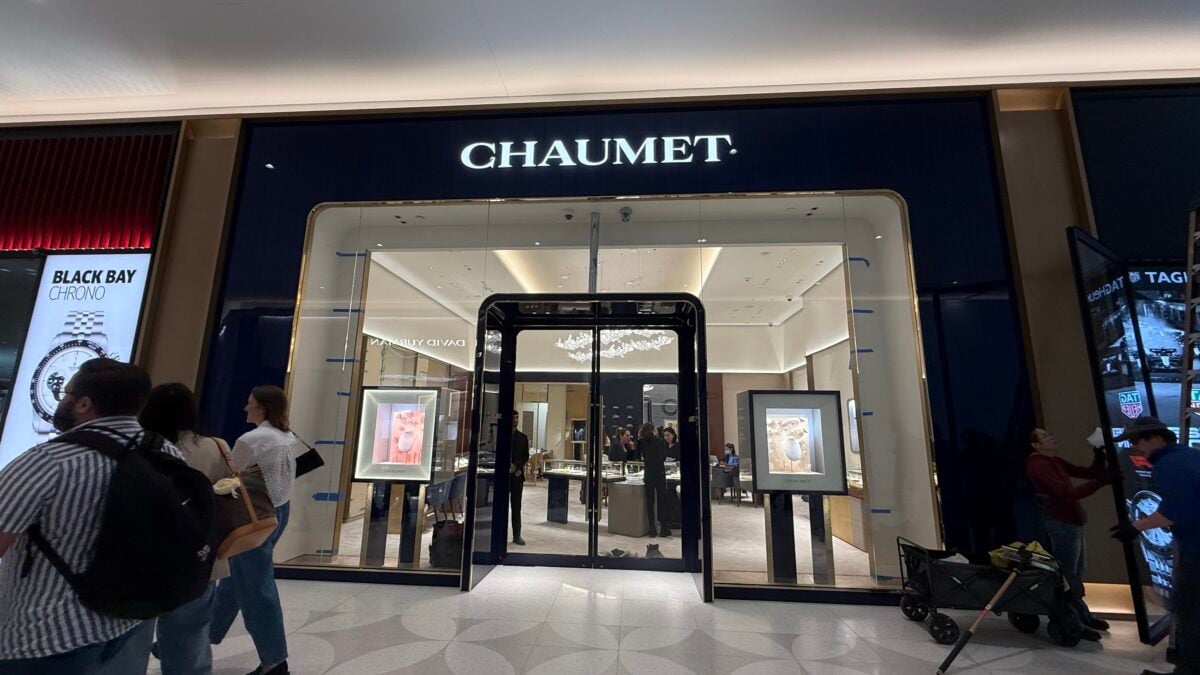
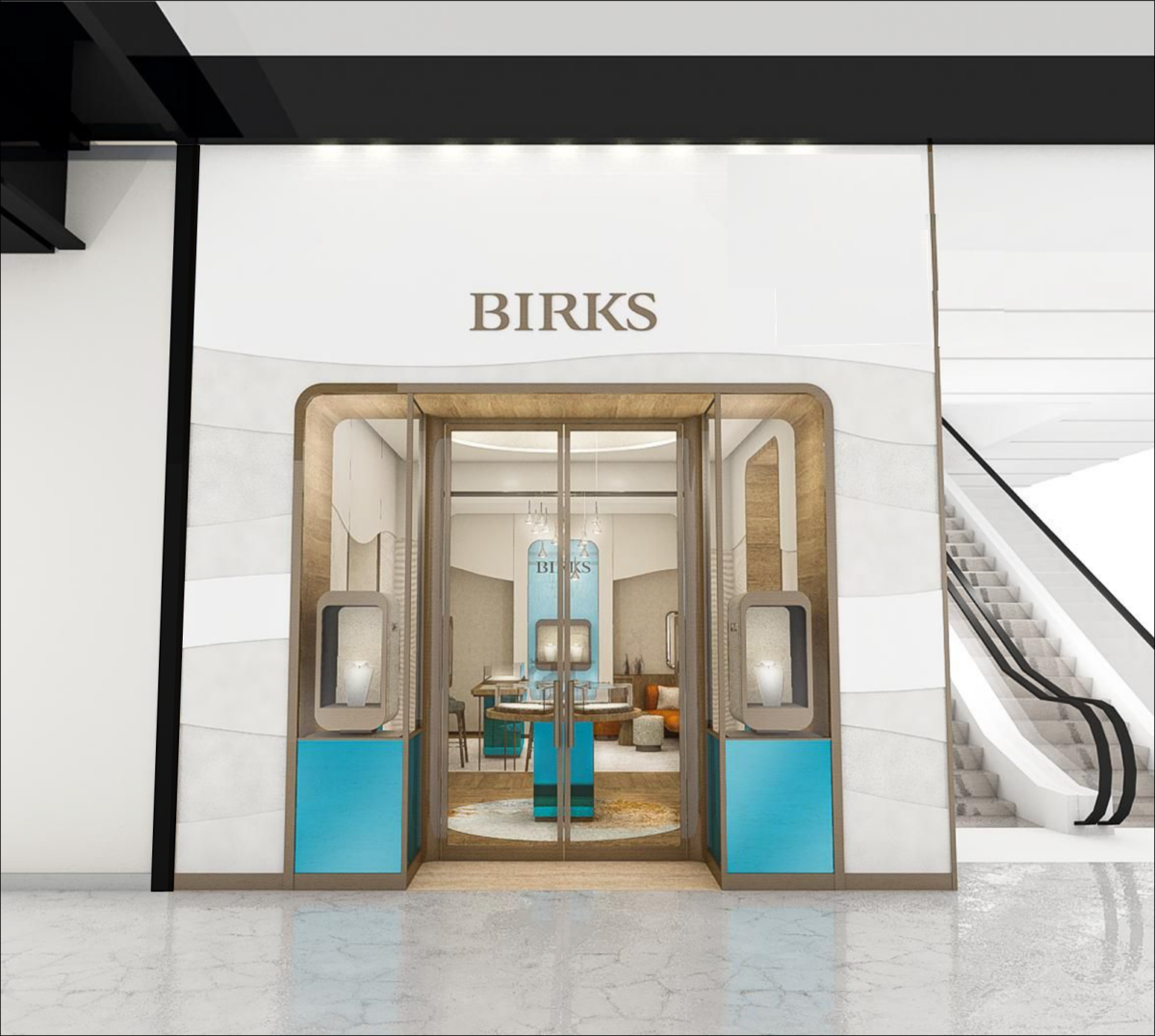
There is no public indication that the delisting will result in an immediate reduction of Birks’ Canadian retail network. The company plans to open a Birks-branded store at Oakridge Park in Vancouver in fall 2026. Birks already operates the newly opened Chaumet boutique at the development, the French jewellery house’s first standalone location in North America.
European Boutique has expanded the company’s Greater Toronto Area presence, while Birks continues to invest in its proprietary jewellery collections and selected relationships with international luxury brands. The recently completed financing package also identified store renovations, omnichannel capabilities and digital commerce among the areas that could receive investment.
In Toronto, questions have persisted around the long-term future of the Manulife Centre Birks store at 55 Bloor Street West. Former president and chief executive officer Jean-Christophe Bédos previously told Retail Insider that the store was expected to close, although he later said there was no immediate closure plan following further discussions with the landlord.
The location remains open, and a vendor Retail Insider spoke with recently said the Bloor Street store is expected to continue operating for now. Its assortment has changed considerably following the departures of Van Cleef & Arpels, Cartier and Panerai, all of which have established or expanded standalone locations nearby.
The continued operation of Bloor Street, the planned Oakridge Park store and the integration of European Boutique indicate that Birks continues to invest in its Canadian retail business. The company appears to be allocating capital selectively while adjusting its store network and brand portfolio to changes in the luxury market.
Birks Brand Takes on Greater Importance
Birks-branded jewellery was one of the stronger components of the company’s fiscal 2026 performance, and its proprietary collections are likely to become increasingly important to its future.
International luxury jewellery and watch houses have been seeking greater control over distribution, store design, presentation and customer relationships. Several brands that were once prominently represented inside Birks stores now operate their own Canadian boutiques or work through a smaller number of specialized retail partners.
Birks’ proprietary jewellery gives the company more control over product development, pricing, margins, inventory and presentation. It also gives the retailer a distinct identity at a time when access to some of the industry’s largest international brands is becoming more selective.
European Boutique provides additional scale in luxury watches, while operated boutiques such as Chaumet offer another growth model. Birks can continue participating in the expansion of international brands where suitable partnerships remain available while placing greater emphasis on the Birks name within its own stores.
The company’s ability to generate stronger sales and margins from proprietary jewellery will be important as it manages borrowing costs and invests in its network. Revenue growth will have to translate into sustained earnings if Birks is to move beyond the financial pressures that have characterized recent years.
Rendering of the new Birks store, set to open September 5, 2024, next to TimeVallée. Image provided by Birks
The Next Test Is Sustainable Profitability
Birks’ departure from the NYSE American represents a significant corporate change, but the trading venue itself will not determine the future of the retailer.
The company enters fiscal 2027 with stronger revenue, improved margins, positive operating income and lending arrangements extended through 2031. It also continues to carry substantial debt, limited cash, negative shareholders’ equity and financing costs that exceeded the operating income generated during its latest fiscal year.
The OTCQB transition gives Birks an orderly path forward after a prolonged exchange-compliance process. It separates the immediate question of where the company’s shares trade from the larger challenge facing the business.
Birks has gained time, liquidity and greater certainty around its financing and public-market status. The more consequential test now is whether stronger retail performance, growth in proprietary jewellery and selective store investment can generate consistent profitability after financing costs.
Canada’s floral retail sector is following much of the same transformation as we see in retail at large.
Shoppers value seeing less friction in how they buy online, and they are looking for convenient purchase and delivery windows in addition to better labour incentives in the warehouse and with the delivery team. Meanwhile, a flower consumer in Canada has more choices than ever when buying flowers. It’s no longer purely the flower shop down the street, but the leading flower delivery brand across the country, competing with grocery, warehouse clubs, and digital marketplaces.
Since the online customer’s flower shopping decision is increasingly driven by convenience, visibility of choice for the occasion and overall bouquet differences, ergo skewing towards large marketing budgets influencing demand, florists must craft their story in a way that differentiates them from the company with deep pockets or from the competitor that “does it all”.
Understanding the National Delivery Model
National flower delivery companies have built very strong brand recognition simply by making the process of ordering online convenient and by spending vast sums on digital advertising. Their size also leads customers to imagine a single, national, literal powerhouse capable of delivering to any Canadian city.
In most cases, they are essentially brokers of orders rather than fulfilment companies. Once you have placed an order via their website, a portion of the sale price is immediately paid to the company, and they then forward the order to a local florist. The florist has a limited selection of the ordered product on hand to execute the rest of the sale.
For many customers, this remains a mystery. What they receive from a national order gatherer is a gift typically designed and delivered by a local florist in the recipient’s home city. This is an umbrella rule, and although this broad approach can be beneficial for anyone looking to send a gift to a distant city, the extra layer means the recipient receives less value, and the original purchaser may be left in the dark when substitutions or delivery issues arise.
It’s a system that works, so long as all parties are fulfilling hundreds and thousands of orders a month. It also speaks to an ongoing truth about the floral industry in Canada. Hyperlocal knowledge is one of the keys to successful fulfillment, even when there are a few national brands in between you and the florist.
Independent Florists Compete on Experience, Not Scale
Independent florists rarely compete with the big guys. Instead, they need to try to out-execute on the things that impact the customer experience.
Freshness is the easy example. Local florists can buy stock based on local demand, seasonality, and upcoming events, rather than being limited to the stock keeping units in a catalogue. They also have more flexibility in letting you know what they’d recommend if they don’t have the perfect flower in stock. Bouquets are often more personalized because they don’t have to be assembly-line perfect.
Delivery is another operational strength. Because preparation and delivery are done within a local market, florists have much better timing, quality and customer experience, making sure it is a great experience. And rather than having to manage the different parts of fulfillment across a network of contracted third-party companies, they control the flow of their work from workshop to recipients.
This leads to better customer relationships. Repeat customers, customer referrals, and the overall reputation in the local community remain large customer acquisition strategies for many independent florists. Especially in large metropolitan markets, customers are increasingly valuing brand relationships with trusted local businesses as alternatives to big-box retailers and major marketplaces. Florists tend to have a much more personal relationship with their customers than a manufacturer or distributor.
Retail Innovation Is Creating New Growth Opportunities
Possibly one of the more interesting recent developments concerning Canadian flower retail is the way independent companies are combining physical and digital with more creative approaches.
Automated, full-size floral vending machines in malls allow consumers to buy a professionally arranged bunch any time of the day when in the mall, rather than during traditional, stricter store hours. Staffed stands in malls can also make a florist’s services much more accessible to the typical consumer.
The principles are part of an omnichannel playbook that today is common in virtually every consumer products category. A consumer can find a florist online, place an order on a website, pick that order up at a mall store, or simply buy from a nearby, unattended retail unit, based on the occasion and the consumer’s own schedule.
An independent florist in Edmonton and Calgary, Florans, is a classic example that, in addition to an online shop, they have several flower vending machines found in Edmonton area shopping centers. They demonstrate that local, independent florists, while making choices on where to buy, are looking to increase that access rather than throw over the side their craft and their unique local value proposition in favour of the ability to reach consumers through yet another online storefront.
Why Local Fulfilment Remains a Competitive Advantage
Unlike many categories of products that can be efficiently centralized through warehouse distribution, the business of flowers on the retail side is inherently a local one.
Flowers are highly perishable, arrangements are made by hand, and consumers want their flowers to be fresh and to look nice. Every order needs to be designed by someone with creative training, stored appropriately, inventoried, and put onto delivery routes in a timely manner. For all of these reasons, flowers are structurally different from products that can be picked, packed, and shipped.
This is why local, vertical approaches to business continue to outperform. Local florists that handle procurement, design, flow, and delivery in-house are keeping quality tighter and reducing unnecessary handoffs that can affect customer satisfaction.
Local flow is not becoming some sort of operational constraint. It is becoming a competitive moat. Smaller operators can use it to keep quality tight and to better flex to customer needs, seasonality, and last-minute needs, which are more difficult for larger national platforms to accommodate effectively.
The Outlook for Canada’s Independent Floral Retailers
Canada’s floral retail will remain a field of fierce competition with online players, grocers and national delivery brands extending their reach. But the future of the industry will not necessarily be decided by ad budget.
Independent florists investing in omnichannel retail, differentiated customer experiences and innovative physical footprints are building the foundations for long-term success. The capacity to combine local fulfilment with a two-tap app has a much bigger meaning, and the highly informed localism comes amid significant changes in Canada’s retail landscape, where shoppers no longer have to trade away quality for convenience.
As the category modernizes, the healthiest independents will continue to prove that local expertise, execution and new store pipelines are not retail scale trade-offs. They are competitive advantages in their own right.
Canada’s toy market is expanding, although the growth is concentrated in particular categories. Games, building sets, action figures and vehicles are drawing increased spending, while dolls continue to face a more difficult environment.
Mattel’s latest quarterly results place the company near the centre of those shifts. Hot Wheels continues to gain momentum, Mattel is building a larger presence in construction toys, UNO is expanding across physical and digital play, and entertainment properties are driving demand for action figures. Barbie, meanwhile, is preparing for a wider content, product and merchandising reset.
Tracked Canadian toy sales reached approximately $2.68 billion in 2025, up 14 per cent from the previous year, according to Circana data published by the Canadian Toy Association. Games and puzzles increased 56 per cent, building sets rose 25 per cent, action figures grew 13 per cent and vehicles advanced seven per cent. Doll sales declined one per cent.
Mattel reported a 10 per cent year-over-year increase in second-quarter net sales, or nine per cent in constant currency, supported by double-digit growth in North America. The company said consumer demand remained positive into the third quarter and reiterated its full-year guidance. Mattel did not disclose separate Canadian financial results.
The results provide a useful indication of how one of the world’s largest toy companies is responding to changing consumer demand, including the growing importance of collectors, licensed entertainment, digital engagement and products that reach across multiple price points.
Hot Wheels Continues to Build Momentum
Hot Wheels provides Mattel’s strongest connection to the Canadian market.
The Hot Wheels Singles 1:64 Assortment was Canada’s top-selling toy product of 2025, according to Circana. It also led the country’s vehicles category, while the same assortment ranked as the top-selling toy globally.
Mattel said Hot Wheels grew 12 per cent during the second quarter, supported by continued demand from children and adult collectors. The company described Hot Wheels as its largest brand since 2024 and said the business is approaching $2 billion globally.
The brand now reaches consumers across a wide range of products and price levels. Entry-level die-cast vehicles encourage frequent purchases, while premium models, larger playsets and licensed collaborations provide higher-value options. Collector-focused releases also allow Hot Wheels to reach adults who may engage with the brand through automotive culture, nostalgia and product display.
Mattel sees further room to extend Hot Wheels through building sets, consumer products, experiences, digital gaming and content. Executives said the brand has developed into a broader car-culture and lifestyle property, giving the company additional ways to engage shoppers beyond the traditional vehicle aisle.
For Canadian retailers, that breadth creates opportunities to merchandise Hot Wheels across impulse products, children’s toys, premium collectibles and larger construction sets. It also supports repeat purchases, since collectors and younger consumers often return for new models, licences and limited releases.
Building Sets Create Another Avenue for Growth
Mattel is expanding its relationship with Hot Wheels through Mattel Brick Shop, a building-set line introduced in 2025.
The strategy gives the company entry into one of Canada’s strongest toy categories. Canadian building-set sales rose 25 per cent in 2025 to approximately $516 million, making the category considerably larger than vehicles, dolls or action figures.
Mattel described building sets as one of the toy industry’s fastest-growing areas and said the initial Hot Wheels Brick Shop products had performed well. The company plans to expand the assortment through 2027.
Brick Shop products are reported outside the Hot Wheels brand results, giving Mattel another source of revenue around a property that already holds a leading position in Canada.
The line also allows the company to use its relationships with automakers and its reputation for vehicle authenticity in a new product category. A shopper who knows Hot Wheels through inexpensive die-cast cars can now encounter the brand through detailed construction sets positioned at higher price points.
Mattel is entering a category with deeply established competitors, and the company has not disclosed Canadian Brick Shop sales. Even so, the size and recent growth of Canada’s building-set market point to a meaningful opportunity.
A display of Barbie Fashionistas is shown at the Mattel showroom at the North American International Toy Fair in 2015 in New York. (AP Photo/Mark Lennihan)
Barbie Prepares a Retail and Content Reset
Barbie presents a different challenge for Mattel. The brand declined during the second quarter, partly due to lower streaming-content revenue and softer product performance. Mattel expects Barbie’s trends to improve during the second half of 2026 and has maintained its expectation that the brand will return to growth in 2027.
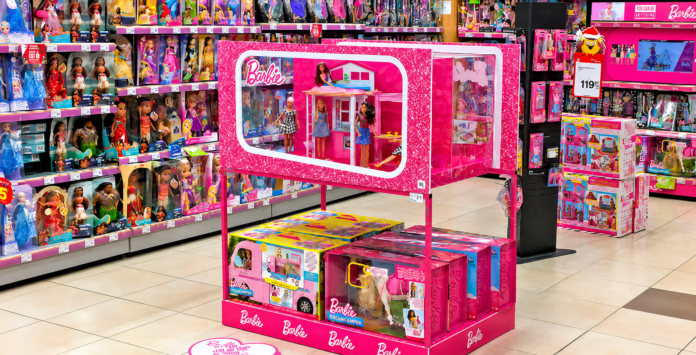
The planned recovery includes a substantial increase in digital content, the rerelease of several classic animated titles, a new Barbie in the Nutcracker special and a redesigned Barbie Dreamhouse.
Mattel is also introducing updated packaging intended to make the assortment easier to navigate in stores. The company plans to support the Dreamhouse through a wider campaign called Barbie Is Moving, which will include brand partnerships, consumer products and retail executions.
The Canadian market illustrates both Barbie’s continued strength and the pressure facing the wider category. Canadian doll sales declined in 2025, following larger decreases during the previous two years. The Barbie Dreamhouse still ranked as Canada’s top-selling doll product, according to Circana.
That gives Mattel a recognized flagship product around which to organize its next campaign. The new Dreamhouse, revised packaging and increased content may help retailers create a clearer presentation around the brand during the holiday season.
Mattel also plans to increase Barbie’s appeal among adult consumers through fashion, detailed accessories, partnerships and collector collections. Executives pointed to the success of Hot Wheels, UNO and Monster High among adult fans as a model that could be applied more extensively to Barbie.
UNO Expands Across Physical and Digital Play
Games and puzzles delivered the largest increase among the major Canadian toy categories in 2025, rising 56 per cent to approximately $464 million.
Mattel’s games business grew during the second quarter, led by UNO and the contribution of Mattel163, the mobile-game developer that Mattel fully acquired earlier this year. The acquisition contributed nearly $49 million in quarterly revenue and approximately $14 million in adjusted operating income.
Mattel is preparing the global commercial launch of UNO Wild, a self-published mobile game currently in soft launch. The company said the title had met its production milestones and is expected to launch more broadly in early 2027.
UNO demonstrates how Mattel is extending familiar physical products into digital experiences. The traditional card game remains widely distributed, while mobile gaming gives the company another way to engage consumers and build direct relationships around the brand.
Entertainment and Collectibles Drive Demand
Action figures were another area of strength, supported by Toy Story 5, Masters of the Universe, WWE and early shipments tied to Mattel’s DC partnership.
Canadian action-figure sales rose 13 per cent in 2025. Mattel said it became the leading U.S. action-figure manufacturer during June, according to Circana, although the company did not provide a comparable Canadian ranking.
The Masters of the Universe film had a weaker theatrical performance than initially hoped, but Mattel said the franchise’s gross billings had more than tripled year to date. Management attributed the increase to the wider attention generated by the film, its streaming release and the surrounding product assortment.
The results reflect the increasing influence of entertainment calendars on toy merchandising. Film releases, streaming programs, gaming franchises and nostalgic properties can support coordinated product launches across action figures, apparel, collectibles and other licensed merchandise.
Adult consumers are also becoming more important to the industry. Collector products can command higher prices and bring toy merchandise into specialty stores, hobby retailers, bookstores, gaming shops and other channels serving pop-culture audiences.
Little People Stands Out Within Fisher-Price
Mattel’s infant, toddler and preschool business declined during the quarter, largely due to weakness at Fisher-Price. Little People was a notable exception.
The brand generated strong double-digit point-of-sale growth, supported by partnerships involving Nintendo, Toy Story, Disney Princess, Frozen and Mickey Mouse, along with its core product range. Mattel believes Little People can become a more meaningful growth driver.
Its familiar design and cross-generational appeal give Mattel another platform for connecting preschool products with major entertainment properties. The company is also preparing another relaunch of Thomas & Friends, supported by new animated content and die-cast products.
Holiday Merchandising Comes Into Focus
Mattel enters the second half of the year with lower retailer inventories and a more stable ordering environment in the United States. The company said fall retail resets were returning to a more traditional August schedule after delays in 2025. Those comments were specific to the U.S. market and should not be interpreted as confirmation of Canadian ordering activity.
The broader brand strategy still provides clues about what Canadian shoppers are likely to encounter as the holiday season approaches: deeper Hot Wheels assortments, a larger building-set presence, more collector-focused products, entertainment-linked displays and a refreshed Barbie presentation.
Mattel’s strongest brands are positioned in several categories already capturing increased Canadian spending. Hot Wheels provides the clearest foundation, supported by vehicles, adult collectors and the expansion into building sets. UNO connects the company to rapid growth in games, while action figures benefit from a busy entertainment and licensing pipeline.
Barbie’s reset will be an important test. Its continued leadership within the Canadian doll category gives Mattel a solid starting point, but reversing broader softness will require products and merchandising that connect with children, parents and adult fans.
The 2026 holiday season should offer an early indication of how effectively Mattel can translate its portfolio strategy into stronger shelf presence and consumer demand across Canada.
With two locations in Kelowna and now Calgary, Realm Fitness is drawing 700 to 800 visits a day as owner Michael Zvonik expands its recovery, retail and event-driven model.
Realm Fitness has grown to approximately 2,500 members since opening its 44,000-square-foot Calgary facility in spring 2025, giving owner Michael Zvonik early evidence that a large, independently operated gym can compete on community, experience and frequency of use.
The gym is registering between 700 and 800 visits on an average day, according to Zvonik. That is equivalent to roughly 28 to 32 percent of Realm’s total membership base passing through the facility daily.
Michael Zvonik, Founder of The Realm Fitness
Realm is also signing up approximately 100 to 120 new members each month. Zvonik said the larger membership base is contributing to increased merchandise sales, adding another source of revenue beyond monthly dues.
The figures are notable in an industry where many operators rely on large membership rolls but expect only a small portion of customers to use their facilities regularly.
For Zvonik, the objective is different.
“I genuinely want this to be the best part of your day,” he said.
Realm positions the gym as a social gathering place
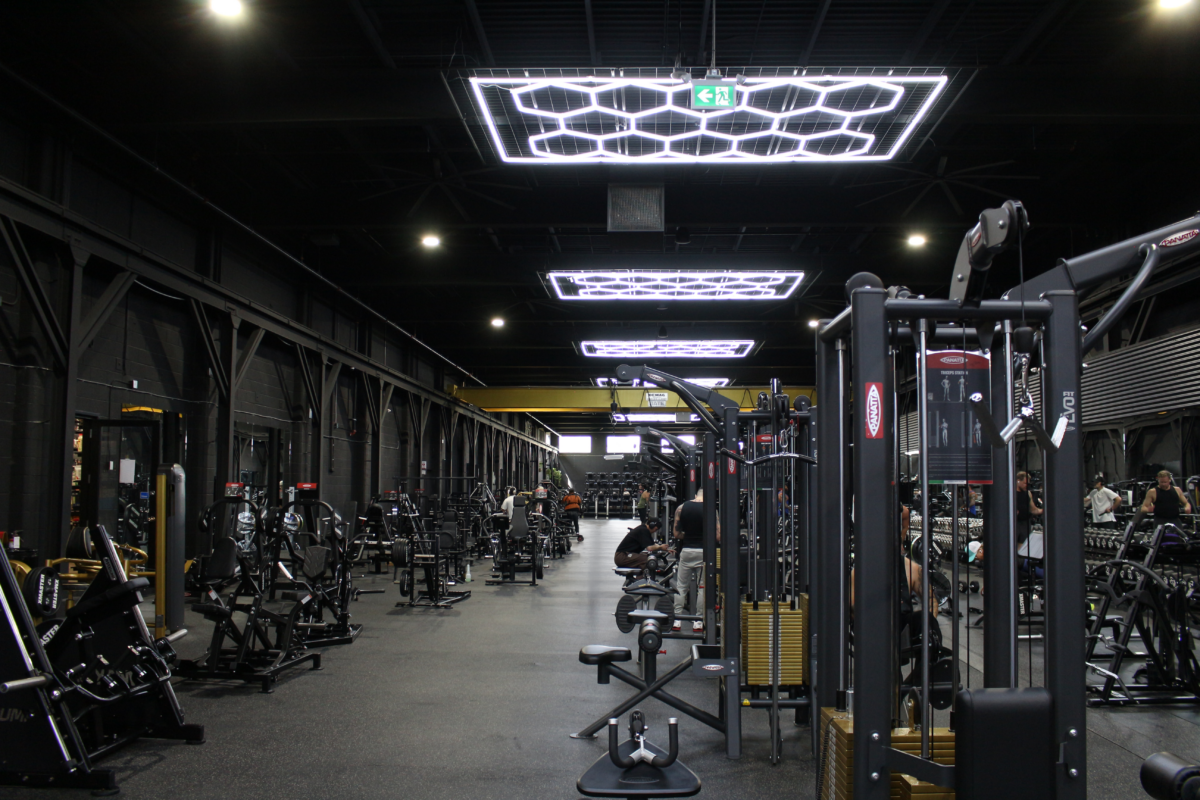
Realm operates from a roughly 44,000-square-foot former industrial building with its second location at 1390 17 Avenue SE, near Calgary’s Inglewood neighbourhood.
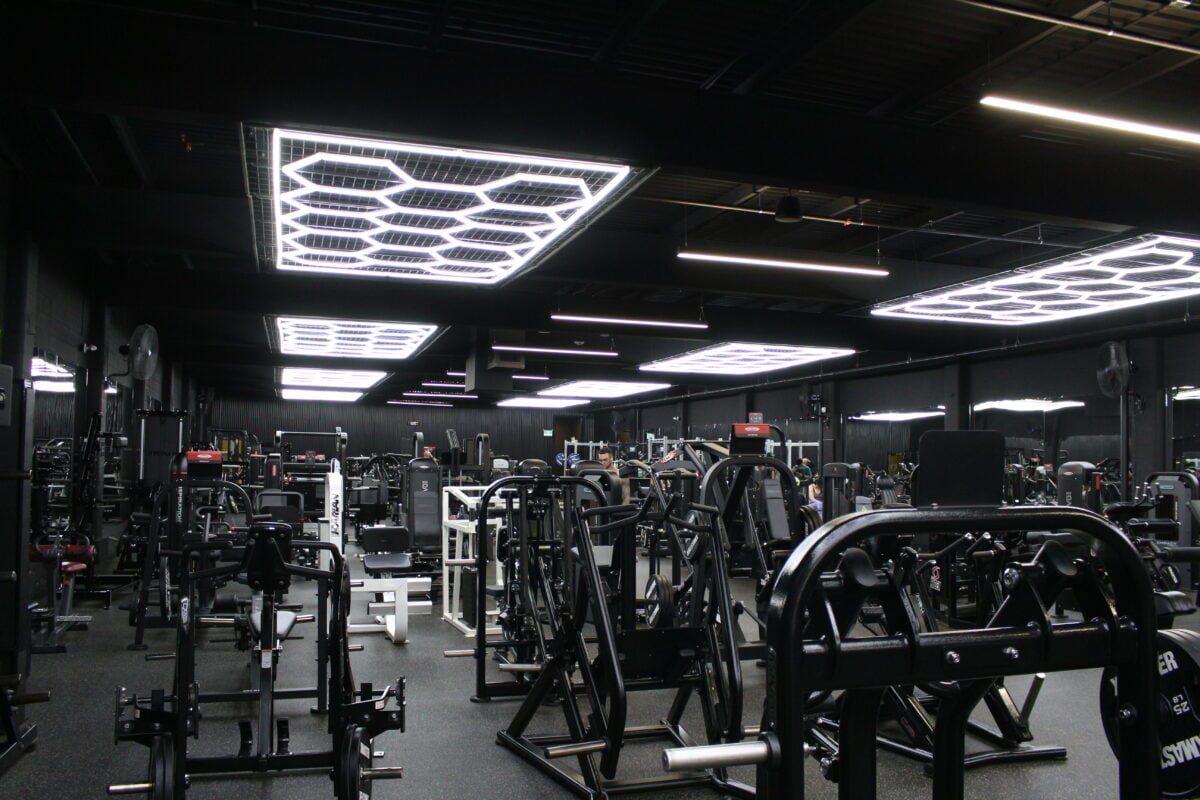
The scale allows Zvonik to combine a large training floor with retail, supplements, recovery services, independent trainers, and social events and spaces designed for fitness content.
His vision was to recreate the community atmosphere of smaller independent gyms inside a much larger facility.
Zvonik believes gyms are becoming a social “third space” for consumers who spend much of their time between home and work. For some younger customers, he said, training with friends has taken on part of the social role once filled by bars and nightclubs.
Canadian consumer data offers some support for the shift in social habits. Statistics Canada has reported four consecutive annual declines in alcohol volumes through the 2024-2025 fiscal year.
That does not mean gyms are directly replacing nightlife. It does suggest that some consumers are changing how they spend their leisure time, with fitness, wellness and group activities taking a larger role.
Realm has leaned into that behaviour.
Groups of members gather before and after workouts. Fitness creators film content throughout the building. Athletes, trainers and visiting personalities bring their own audiences into the facility.
The gym’s size helps those groups coexist, according to Zvonik. A person filming with a tripod can usually find space without interfering with another member’s workout.
There is still a clear rule.
“The lifting comes first” Zvonik said.
Realm permits filming, but members are expected to respect the people using the facility primarily to train. Zvonik said content creation is welcome as long as it remains secondary to the gym’s main purpose.
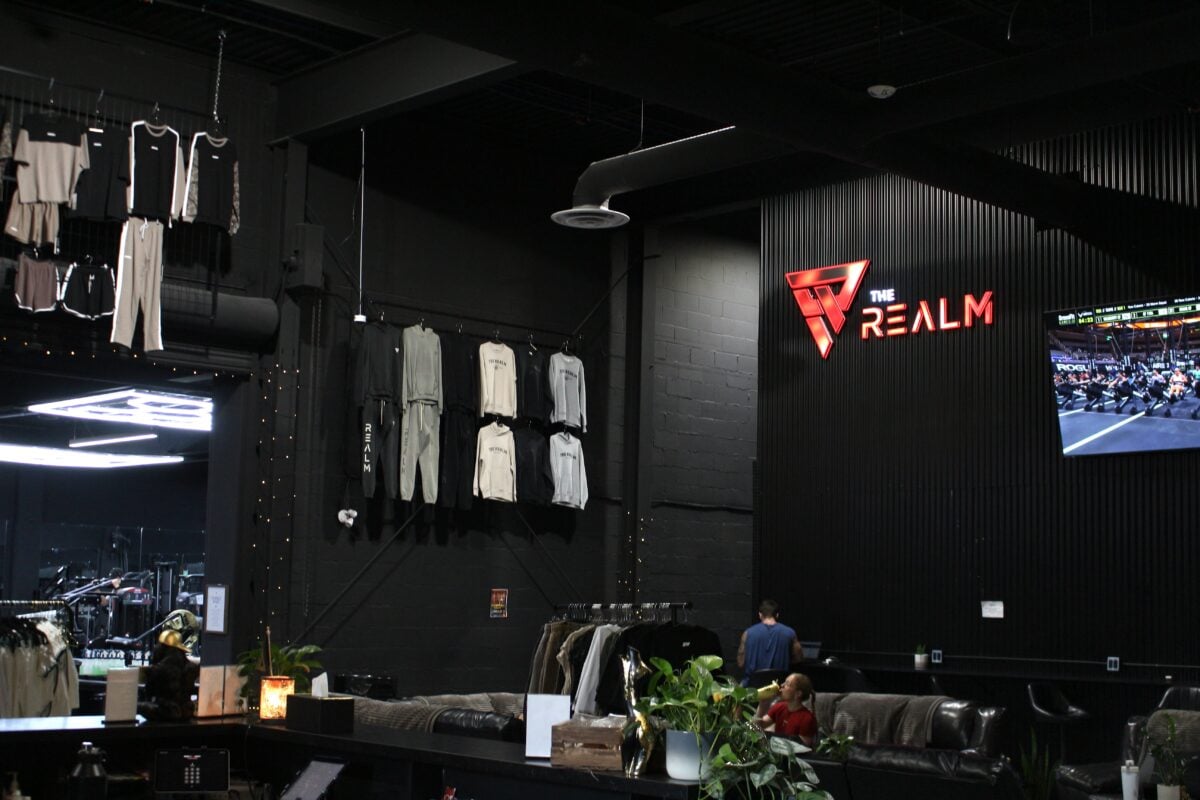
The Realm Fitness Main Lobby. Photos: Evan Nagy
Membership model avoids contracts and promotional pricing
Realm charges $119.99 per month for a standard membership, positioning the facility above many low-cost and conventional gyms in the Calgary market.
Zvonik said the higher price reflects the building, equipment, amenities and operating model.
The company does not use long-term membership contracts, enrolment fees, cancellation fees or recurring promotional discounts. Zvonik said he does not want a new customer receiving a lower price than a member who supported the business from the beginning.
Early members remain locked into their original rate.
The straightforward pricing strategy is also intended to reduce one of the most common sources of frustration in the fitness industry: complicated membership agreements and unexpected charges.
Zvonik said customers should be able to pay for the service, use it and leave if it no longer meets their needs.
“If you don’t want to be here, don’t be here,” he said. “I don’t want to keep you stuck here.”
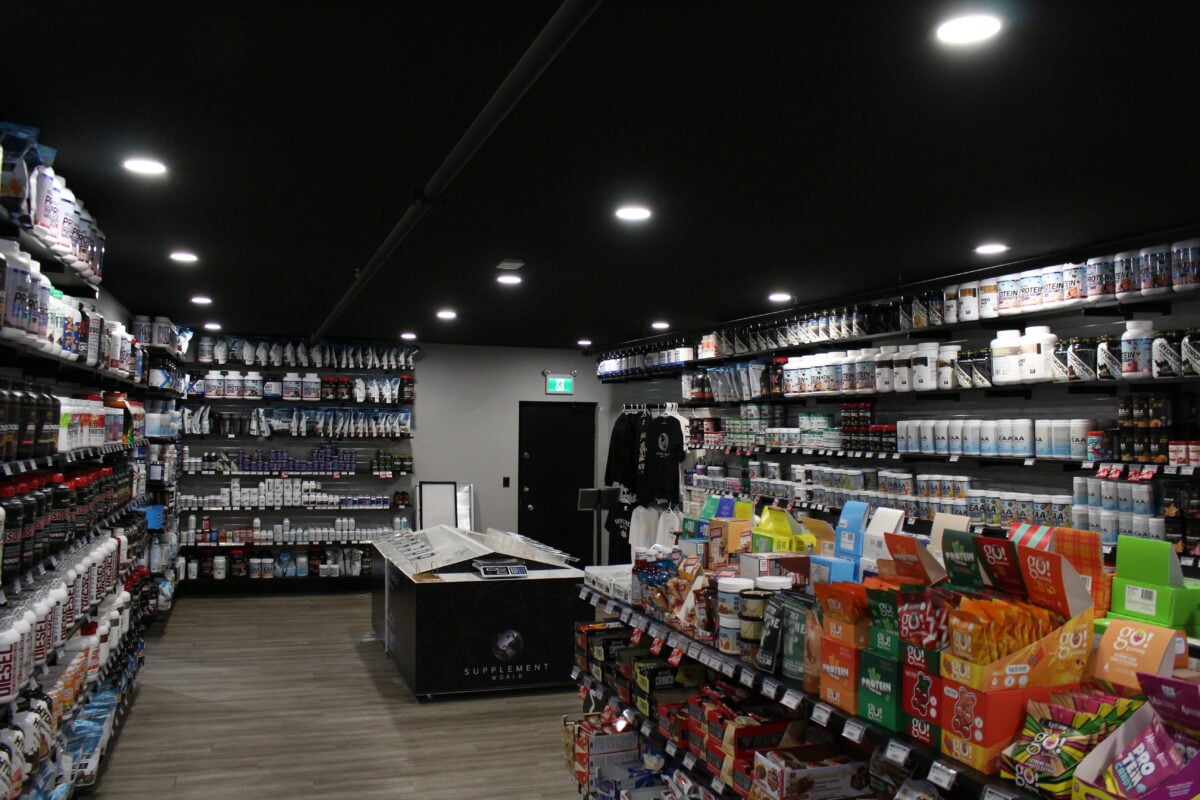
Realm supplements the core membership with services such as towel access, shower products and areas where members can prepare food or coffee. The facility also includes a supplement store and sells Realm-branded merchandise.
Zvonik said membership growth is now translating into stronger merchandise activity, although he did not provide sales figures.
Industrial conversion created room to differentiate
Realm’s Calgary location was previously used as a steel plant and industrial warehouse.
The building’s size gave Zvonik the opportunity to create a facility that would have been difficult to fit into a conventional retail unit. It also came with substantial conversion work.
The property needed new building systems to support its change of use. Zvonik said the work included a new fire hydrant, an eight-inch water line, sprinklers, HVAC equipment, drainage lines, electrical transformers and interior construction.
Work began around September, with occupancy secured near the end of the following May.
Zvonik, who has a background in construction and development, was directly involved in the project. He said he and his network of tradespeople completed much of the work, allowing him to control costs and make design changes during construction.
He also installed lights, fans and other building components himself.
The conversion offers a useful example for the commercial real estate industry. Large fitness operators can absorb older industrial properties that may not suit conventional retail, office or warehouse tenants. Those conversions can also require major investments in water, ventilation, life-safety systems, parking and interior infrastructure.
Realm currently leases the building.
Zvonik has said he would eventually like to purchase the property and the industrial building across the street. The additional property could support more parking, equipment storage, merchandise operations and future expansion.
Parking is already becoming a constraint despite the size of the existing lot, he said.
The Realm Fitness Gym Floor. Photos: Evan Nagy
Recovery and wellness facilities remain under construction
Realm is developing a 3,600-square-foot Nordic spa inside the Calgary property.
The spa is under construction and is not yet open.
Current plans include a steam room, sauna, hot tub, cold plunge and hydrotherapy equipment. Zvonik expects the space to accommodate approximately 20 people at a time through a booking system, with visits likely limited to two-hour sessions.
The relatively low capacity is intentional. Zvonik wants the spa to feel spacious even though individual features, including the sauna and steam room, will be built to hold larger groups.
Nurses’ offices and a tanning salon are also under development. Medical, testing and tanning services are not currently available.
Zvonik has discussed eventually offering services such as blood testing and DEXA body-composition scans through qualified providers. Those remain future plans and will depend on the completion of the spaces and the involvement of licensed operators.
The additions could broaden Realm’s revenue base by allowing members to combine training, recovery, retail purchases and other appointments within one property.
They would also move the business closer to a hybrid fitness and wellness model, where the gym floor serves as one part of a larger customer relationship.
Realm Fitness Built-In Supplement World Location. Photos: Evan Nagy
Realm also functions as an equipment showroom
Zvonik is involved in gym-equipment sales, and the Calgary facility serves as a working showroom.
Gym owners can visit Realm, try different machines and evaluate equipment before purchasing it for their own facilities.
That arrangement gives Realm another commercial function. The equipment is used by members while also helping Zvonik generate business-to-business sales.
It also helps explain why he is cautious about expanding Realm into every available market.
Zvonik said he would prefer to sell equipment to independent gym owners and help them grow than open competing Realm locations in their cities. He cited Edmonton as an example of a market where he knows several operators and does not want to compete directly with them.
The approach is unusual in a sector where successful operators are often encouraged to franchise quickly.
Zvonik said he does not want Realm to become a conventional commercial chain. Rapid expansion could reduce the time and attention available for the Calgary facility and weaken the culture that has helped attract members.
Realm also has a location in Kelowna. Zvonik said that operation developed through a partnership with a local gym owner after the facility transitioned away from its previous brand.
He has also teased a separate gym project in Ottawa involving other partners. The Ottawa project is not a Realm Fitness location, and Zvonik said he could not disclose further details.
The Realm Fitness Gym Floor. Photos: Evan Nagy
Events extend the brand beyond memberships
Realm uses events and entertainment to reach people outside the traditional fitness audience.
Before construction was completed, Zvonik invited drivers to bring drift cars into the empty industrial building. The resulting content demonstrated the size of the property and generated attention before members began using the space.
Realm has since hosted car shows, anniversary events and live music.
Zvonik said the events are partly about community and partly about marketing. His approach is influenced by brands that build an audience through experiences and culture, with the product appearing as part of that larger identity.
The facility’s industrial setting gives Realm room to host activities that would be difficult inside a conventional shopping centre gym.
For retail and real estate operators, that event strategy matters because it can generate visits beyond normal workout patterns. It also gives sponsors, apparel brands, food operators and fitness personalities reasons to participate in the business.
Zvonik said future events may be organized with relatively little lead time, based on opportunities and partnerships.
Realm grows as Canadian fitness spending recovers
Realm’s early growth comes as Canada’s fitness industry continues to recover from the disruption of the pandemic.
Statistics Canada reported that operating revenue for Canadian fitness and recreational sports centres increased 14.9 per cent in 2024 to $5.8 billion. Industry expenses rose 11.9 per cent, while the operating profit margin increased to 8.3 per cent.
The figures indicate that Canadians are again spending heavily on gyms, recreation and in-person fitness.
Realm is positioned at the premium end of that market, although it does not follow the traditional luxury-club model. Its proposition centres on scale, specialized equipment, social culture, recovery facilities and high member usage.
Zvonik said the Calgary facility was profitable during its first month of operation. He expects the project to recover its initial investment within three years of opening.
He did not disclose the total capital investment, revenue or operating profit.
The 2,500-member base and 700 to 800 daily visits provide a clearer measure of the facility’s traction. The next test will be whether Realm can maintain that level of participation as membership continues to grow.
Looking ahead
Zvonik’s immediate focus remains the Calgary facility.
The Nordic spa, nursing spaces and tanning salon are still being built. Equipment sales, merchandise and events are continuing to develop alongside membership revenue.
The potential acquisition of the existing building and neighbouring property could give Realm more control over its long-term expansion, but Zvonik has not announced a purchase agreement.
His larger ambition is to make Realm one of the most recognized gyms in the world without turning it into a standardized chain.
That creates a difficult balance.
The gym’s appeal is closely tied to its scale, local relationships, industrial building and Zvonik’s direct involvement. Those qualities have helped Realm grow to 2,500 members, but they may also make the concept difficult to reproduce.
For now, the Calgary location shows that a fitness facility can function as a daily-use business, social gathering place, equipment showroom, retail platform and event venue within the same space.
The model gives members several reasons to visit and several reasons to spend once they arrive.
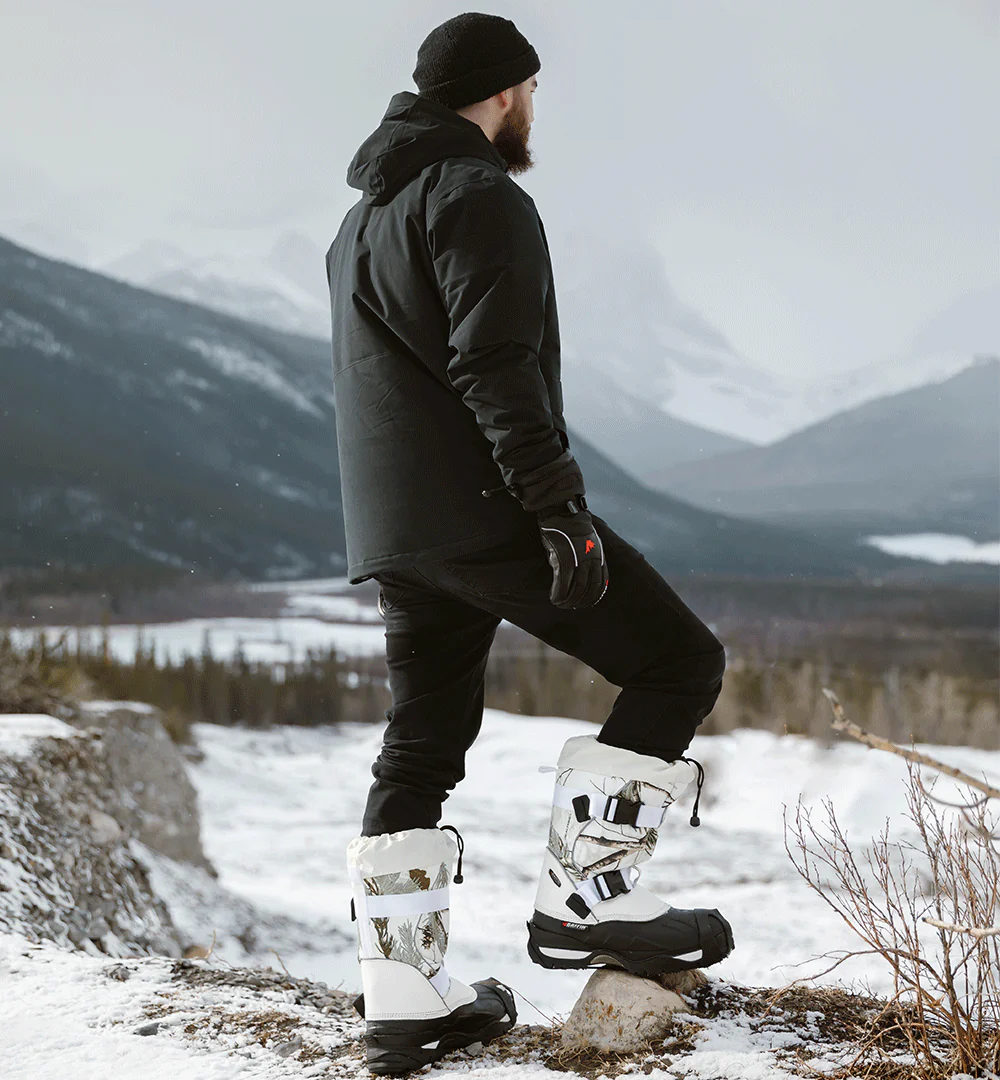
Under Royer’s ownership, Baffin will operate as Baffin Footwear Inc., preserving the Baffin brand, its leadership team, employees, customer relationships and day-to-day operations while benefiting from Royer’s long-term investment and manufacturing expertise, according to a news release.
“A Canadian factory was founded by the Hubner family in 1979 and since that time Baffin has earned an international reputation for engineering technically advanced footwear trusted everywhere from polar expeditions to industrial worksites. Together, Royer and Baffin share a commitment to Canadian craftsmanship, innovation and technical expertise, creating a strong foundation for the brand’s continued growth,” it said.
Mark HubnerBaffin photo
As part of the transition, founder Paul Hubner, who led Baffin for decades and helped transform it into one of Canada’s most respected footwear brands, is moving on following the completion of the transaction after more than 45 years with the company, said the release.
Mark Hubner has been appointed Managing Director of Baffin Footwear Inc. and will continue to lead the company into its next chapter alongside the existing leadership team.
“Baffin is one of Canada’s most respected footwear brands, with an incredible legacy, exceptional team and tremendous potential,” said Simon La Rochelle, President of Royer. “We believe strongly in the Baffin team and are committed to investing in the brand, preserving everything that has made it successful while supporting its continued growth for years to come.”
“Today marks the beginning of an exciting new chapter for Baffin,” said Mark Hubner. “For more than 45 years, Baffin has been built by incredible people who are passionate about designing the world’s best footwear. That doesn’t change. Our people, our values and our commitment to our customers have always been at the heart of everything we do.
“Royer shares those values and brings a long-term commitment to investing in our future while preserving everything that makes Baffin unique. Together, we’re building on a strong foundation and creating new opportunities for our employees, customers, partners and the brand.”
Simon La RochelleBaffin photo
Baffin will continue operating as its own brand within the Royer Group of Companies, with its existing leadership team, employees and operations remaining in Stoney Creek, Ontario. The transaction includes the entire Baffin organization. Customers, retail partners, suppliers and employees can expect business to continue as usual, with no interruption to products, service or day-to-day operations.
“This is an investment in Baffin’s future,” added Hubner. “We’re proud of what we’ve built over the past 45 years, through Real-World Testing, and I am excited for the opportunity to be a steward of this great brand alongside a Canadian owner that shares our values, believes in our people and is committed to growing the next chapter of the Baffin story.”
Baffin was founded in 1979 by the Hubner family in Stoney Creek, Ontario, Baffin has spent more than four decades engineering technically advanced boots for the coldest and most demanding environments on earth.
Royer was founded in 1934 and headquartered in Sherbrooke, Quebec, Royer is a Canadian manufacturer of technical footwear recognized for its performance, comfort, and durability, serving workers across the most diverse industrial sectors – mining, oil and gas, metallurgy, construction, and heavy industrial manufacturing.
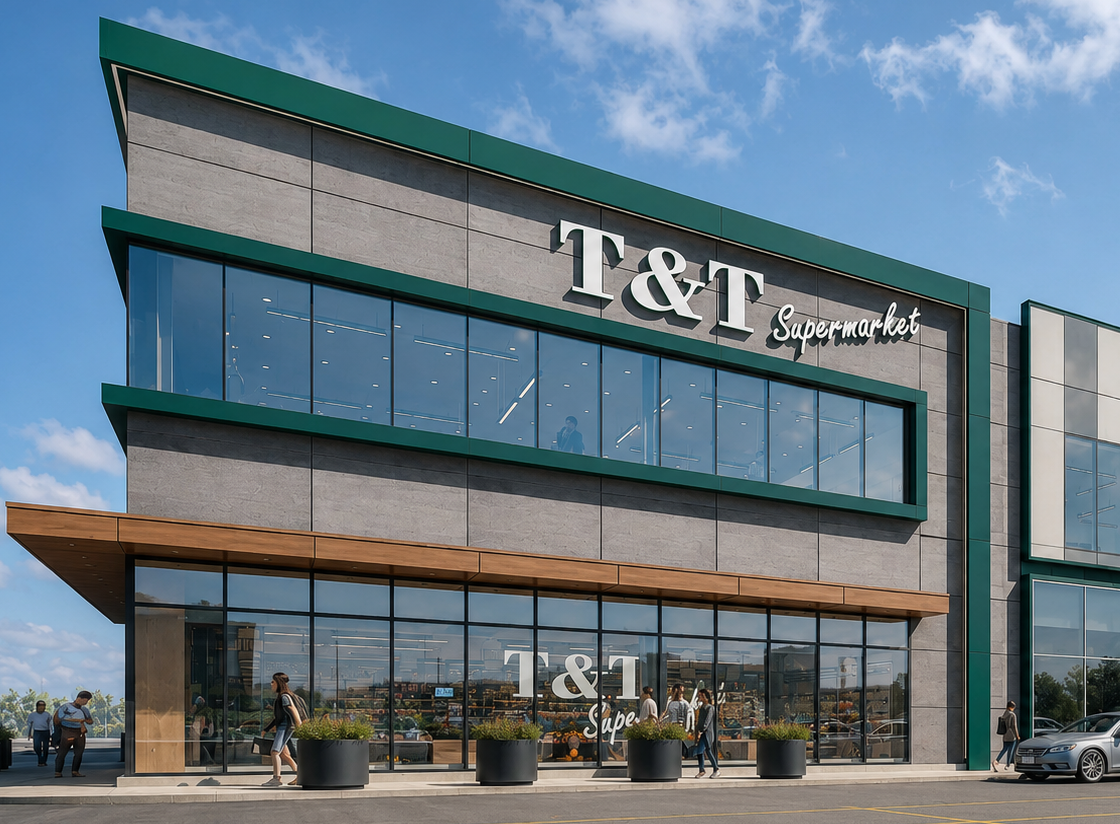
The new 48,000-square-foot store will be located on the lower level of the mall at 1485 Portage Avenue and is expected to open in Spring 2028.
CF Polo Park marks T&T’s third project together with Cadillac Fairview, following the successful opening at CF Fairview Mall and the recently announced store at CF Sherway Gardens in Ontario, the company said.
Tina LeeSal Iacono
“We’ve finally figured it out,” said Tina Lee, CEO of T&T Supermarkets. “Winnipeg is more than a thousand kilometres away from the nearest T&T, but we’ve found a way to bring T&T’s immersive Asian food experience to the community. We’re proud to have found the perfect home at CF Polo Park, where customers can discover fresh produce, exotic fruits, trendy Asian snacks, beauty products, and beloved T&T kitchen and bakery favourites. We’re excited to once again partner with Cadillac Fairview and can’t wait to become part of the city’s vibrant food scene.”
“We are thrilled to build on our successful and growing partnership with T&T Supermarket to bring their unique retail experience to Winnipeg at CF Polo Park,” said Sal Iacono, President & CEO, Cadillac Fairview. “This opening represents a significant milestone in our commitment to evolving our properties into vibrant, multifaceted destinations, and we look forward to the energy and excitement this new store will undoubtedly bring to our guests in Manitoba.”
T&T Supermarket is Canada’s largest Asian grocery retailer, operating more than 40 stores across British Columbia, Alberta, Ontario, Quebec, Washington, and California. Founded in Vancouver in 1993, T&T is led by second-generation successor and CEO Lee. The company is headquartered in Richmond, British Columbia.
T&T Supermarket is owned by Loblaw Companies Limited, Canada’s largest food retailer. Loblaw acquired T&T in 2009, and T&T has operated as a subsidiary ever since.
CF Polo Park Rendering
Following the successful openings of its Erin Mills store in Ontario and its first California location in San Jose earlier this year, T&T has been praised by shoppers and media alike as a “cult-favourite” Canadian supermarket known for its loyal fan following, said the grocery store chain.
Recently Retail Insider reported that T&T Supermarket‘s first California store generated the highest first-week sales of any location in Loblaw Companies Limited’s history, giving the Canadian-founded Asian grocer a strong start as it expands its presence in the United States.
The approximately 55,000-square-foot supermarket opened June 18 at Westgate Center in San Jose, occupying a former Walmart space at 1600 Saratoga Avenue. It is T&T’s third U.S. store and its first outside Washington State.
During Loblaw’s second-quarter earnings call, President and Chief Executive Officer Per Bank said the San Jose supermarket set a company record during its opening week. Management also pointed to strong customer traffic and lengthy lineups as evidence of demand for the banner in California.
In a LinkedIn post, Bank said: “What has been most rewarding is seeing how enthusiastically the local community has embraced the store. Customers have welcomed T&T with open arms, and their excitement continues to inspire us every day. We’re just getting started. We can’t wait to open two more T&T stores in the U.S. this year, with Los Angeles coming soon.”
Also coming up this year in Canada is a North York store in Ontario, and Gilmore Place store in Burnaby.
Corby Spirit and Wine Ltd. says it has agreed to sell the Lamb’s rum brand and certain related assets for $39.2 million in a move the company says will sharpen its focus on higher-growth areas of its business.
The Toronto-based spirits, wine and ready-to-drink beverage company said it has signed a definitive agreement to sell the brand and related intellectual property, along with brand inventories at closing, to Maison des Futailles, L.P., a subsidiary of Phildan Inc., and Glen Turner Company Limited, a subsidiary of COFEPP SAS.
Under the agreement, Phildan will acquire the North American rights to the Lamb’s brand, while COFEPP will acquire rights to the brand outside North America.
Corby said the transaction is intended to concentrate its resources on priority growth platforms, including ready-to-drink beverages and premium spirits, while freeing capital for higher-return opportunities. The company also said the sale will simplify its portfolio and support its long-term growth, profitability and shareholder value objectives.
Florence Tresarrieu
“The sale of Lamb’s is a disciplined portfolio management decision that supports Corby’s long-term strategy,” said Florence Tresarrieu, president and chief executive officer of Corby. “It allows us to further focus our resources on higher-priority categories, strengthen our financial position, and continue investing behind the brands and innovations that will drive Corby’s next chapter of growth.”
Corby said it and its affiliated companies will continue to provide transition support related to production and distribution of the brand for a period following the closing of the transaction.
The company’s board of directors has approved the sale.
For the buyers, the acquisition expands their ownership of the Lamb’s brand across different geographic markets.
Corby Spirit and Wine Ltd. photo
“Lamb’s is one of Canada’s most recognized rum brands, and we’re proud to welcome it into the Dandurand Group family. This acquisition strengthens our brand portfolio, expands our presence in the spirits category and reflects our long-term commitment to investing in brands with strong consumer recognition and significant growth potential,” said Hugues Gauthier, president of Phildan.
COFEPP, through its subsidiary Glen Turner Company Limited, will assume ownership of the brand outside North America.
“Lamb’s is a well-established brand in the United Kingdom that complements our existing portfolio and strategic objectives. We are excited about the opportunities ahead and committed to supporting the brand’s continued success, and building the next chapter of its long history,” said Christophe Pichambert, international director, La Martiniquaise-Bardinet.
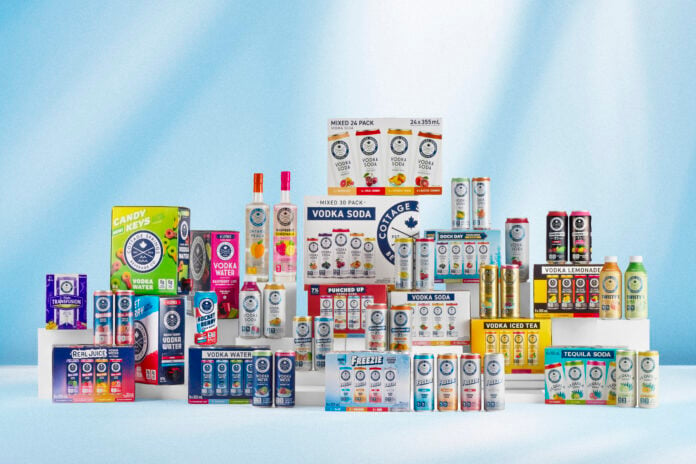
Corby is a Toronto-based manufacturer, marketer and distributor of spirits, wines and ready-to-drink beverages. Its portfolio includes owned brands such as J.P. Wiser’s, Lot 40, Pike Creek, Polar Ice, McGuinness, Cottage Springs, Nude and Foreign Affair, while it also represents a range of international spirits, wines and ready-to-drink products in Canada through commercial affiliations.
Children’s audio platform Yoto has made its largest Canadian retail expansion to date through a new partnership with Indigo, bringing its screen-free audio players, cards and accessories to 90 stores across the country.
Karen Zakeri, Country Manager for Yoto Canada
The products launched August 5 in Indigo’s Kids departments and on Indigo.ca. Dedicated branded displays have been introduced in stores to help families explore Yoto’s card-based audio system, which gives children control over the stories, music and other content they hear.
The rollout marks Yoto’s first major national retail partnership in Canada after approximately four and a half years of building its direct-to-consumer business in the market.
Karen Zakeri, Country Manager for Yoto Canada, said the company waited until its Canadian operations, content library and fulfilment capabilities were ready to support expansion on a national scale.
“Canada has always been a key market for us. Yoto fans here have been some of our most loyal from day one,” she said. “But we wanted to earn this moment rather than rush it.”
Canadian Growth Drives National Retail Expansion
The Indigo partnership follows a period of considerable Canadian growth for Yoto. According to the company, Canada was its largest growth market globally last year, recording a 50 per cent year-over-year increase.
Much of that growth occurred without a major national bricks-and-mortar presence. Yoto had concentrated on its direct-to-consumer channel, supported by Amazon, paid media, word of mouth and a smaller network of independent retailers.
Zakeri said the strength of demand, despite limited physical availability, showed that the Canadian market was ready for a broader rollout.
“When organic demand outpaces your physical availability at that rate, it’s a clear signal the market is ready for you to show up in a bigger way,” she said. “Indigo allows us to meet that demand where families already are.”
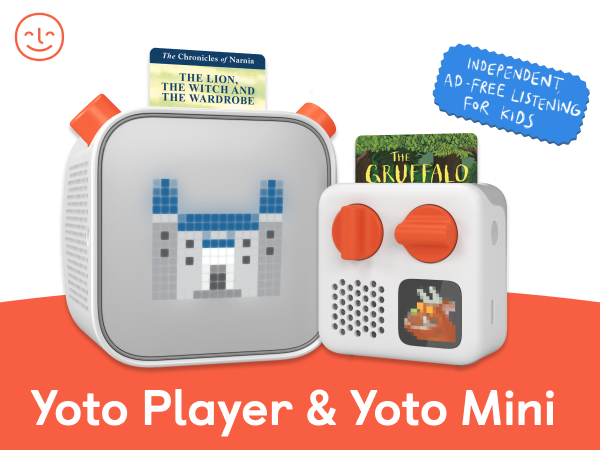
Founded by Ben Drury and Filip Denker in 2017, Yoto offers two principal devices: the Yoto Player and the portable Yoto Mini. Children choose what to hear by inserting physical audio cards into the players, without navigating a conventional phone or tablet interface.
Yoto’s catalogue includes more than 1,200 stories, songs, activities and other audio experiences. The platform carries original programming and licensed or co-created content from publishers, music companies and entertainment brands. Its players have no cameras, microphones or advertising.
Building the Canadian Business Before Scaling
Yoto developed its Canadian business gradually, focusing first on the operational foundation needed to serve customers reliably.
Before entering a national retail partnership, the company wanted to ensure its distribution, fulfilment and content offering were properly established for Canada. Zakeri said Yoto did not want to copy the approach used in its more mature markets without considering the needs of Canadian families.
“This launch with Indigo represents the moment all of that came together,” she said. “It’s not the start of our Canadian strategy, but it’s proof that now, the foundation is right, and we can build on it with confidence.”
Physical retail adds another route to market for a company that will continue to place considerable importance on direct sales.
Yoto’s own platform allows the company to maintain relationships with customers, observe purchasing patterns and respond quickly to feedback. Indigo gives the brand exposure to families who may be unfamiliar with the system or who want to handle a player and understand how its cards work before purchasing.
“DTC and retail aren’t competing channels for us. They’re complementary,” Zakeri said. “DTC lets us build direct relationships and respond quickly to what families want; retail like Indigo lets us put the product in front of new families who may not have discovered us yet, in a setting where they can see, touch and experience it in person.”
That physical interaction is particularly relevant for a product built around an ecosystem of players, audio cards and accessories. The Indigo partnership puts Yoto in front of parents who are already browsing children’s books, educational products and gifts.
Photo: Yoto
Why Indigo Was Selected
Yoto selected Indigo because of the retailer’s national reach and longstanding association with books, storytelling and discovery.
“Indigo isn’t just a retailer to Canadian families; it’s a cultural institution,” Zakeri said. “It’s where parents already go to build a love of reading and discovery in their kids, from picture books to gifts to experiences.”
Yoto extends that connection with storytelling into audio. Its card-based format allows children to select and control their own stories, music and learning content independently.
Nicole Savo, Kids Senior Category Manager at Indigo, said the product aligned with the retailer’s focus on encouraging a lasting interest in reading and learning.
“At Indigo, everything we do is rooted in inspiring a lifelong love of reading and learning,” she said. “We’re thrilled to bring Yoto to our customers because they share that same belief—that stories have the power to spark imagination, creativity and connection.”
Savo said Yoto also gives families a way to keep children engaged with stories without relying on a conventional screen, whether they are at home, travelling or spending time outdoors.
The products are available through Indigo’s Kids departments in 90 stores nationwide and through the retailer’s website.
Dedicated Displays and a Larger Holiday Presence
Yoto has been introduced through dedicated branded displays within Indigo’s existing Kids sections.
The approach places the products alongside categories associated with children’s reading, learning and imaginative play, while giving Yoto a clear visual identity within the department. The displays are intended to help shoppers understand the players and browse the card library.
Zakeri said Yoto would appear more prominently within the Indigo ecosystem during the holiday season, although the companies have not yet disclosed details of the planned activity.
The holiday period is likely to be an important test of how the brand performs in a national retail setting, particularly among shoppers encountering Yoto for the first time while looking for children’s gifts.
The Yoto Mini and travel-oriented content have already generated strong interest among Canadian customers, according to Zakeri. She said families are using the portable player during cottage weekends, road trips and flights.
Yoto is also seeing demand for recognizable entertainment properties and music tied to current cultural interests, including Disney and K-pop. Other areas of interest include original stories, music discovery and audio developed for bedtime or focus routines.
Make Your Own cards have consistently ranked among the company’s bestselling products, Zakeri added. Families can use the cards to add their own recordings or audio, including stories, music and personal messages.
Demand for Tactile, Screen-Free Experiences
Yoto’s retail expansion comes as some parents reconsider the role of phones and tablets in children’s entertainment.
Zakeri said the company is seeing several consumer trends converge, including concern about unstructured screen time, interest in child-led play and renewed enthusiasm for tactile products that children can hold and collect.
Yoto’s physical cards allow children to browse and choose content without opening an app or navigating an illuminated screen. Once audio has been downloaded, Wi-Fi is not required for regular listening, according to the company.
Zakeri compared the interest in tangible children’s products with the resurgence of vinyl records and board games. In each case, the physical format becomes part of how consumers discover, organize and interact with the content.
For Yoto, the combination of physical cards and digital audio also creates opportunities for repeat purchases. Families can expand their libraries over time through individual titles, collections and user-created cards.
The system therefore sits across several retail categories, including children’s books, toys, consumer electronics, licensed entertainment and gifts. Indigo’s Kids departments give the company a setting where those categories already overlap.
Canadian Authors and French-Language Content
As its distribution expands, Yoto is also working to make its content and marketing more specific to the Canadian market.
The company ran a dedicated Canada Day campaign for the first time in 2026, highlighting Canadian content and interests. It has partnered with Canadian parent communities and is exploring collaborations with domestic brands.
Content localization will be another priority. Yoto is pursuing work involving Canadian authors and examining opportunities to expand its Quebec French-language library.
“We want Yoto to feel like it was made for Canadian families,” Zakeri said.
The company is also preparing to launch a partnership with a major Canadian author during the holiday season. Yoto has not yet identified the author or disclosed details of the project.
The French-language opportunity could help the brand reach more families in Quebec and other bilingual markets. It also supports Yoto’s goal of building a Canadian offering informed by local customer demand.
Further Retail Partnerships Planned
Indigo is Yoto’s first major Canadian retail partner, though the company plans to continue broadening its physical distribution.
Zakeri said Yoto would pursue retailers whose values and customer base align with the brand. She did not identify prospective partners or provide a timeline for additional announcements.
Over the next 12 to 24 months, Yoto’s Canadian strategy will centre on expanding its business-to-business retail network, developing partnerships with Canadian brands and communities, and using customer feedback to guide product and content decisions.
Those priorities could lead to a deeper French-language catalogue, further Canadian author collaborations and content connected to emerging cultural interests.
“Canadian families grew this business on trust,” Zakeri said. “Our responsibility now is to honour that as we scale into what comes next.”
The Indigo rollout gives Yoto a national physical platform after Canadian consumers had already demonstrated demand through online purchases and recommendations within parent communities. It also provides a foundation for the company’s next stage of growth, connecting wider retail availability with a more localized Canadian content strategy.